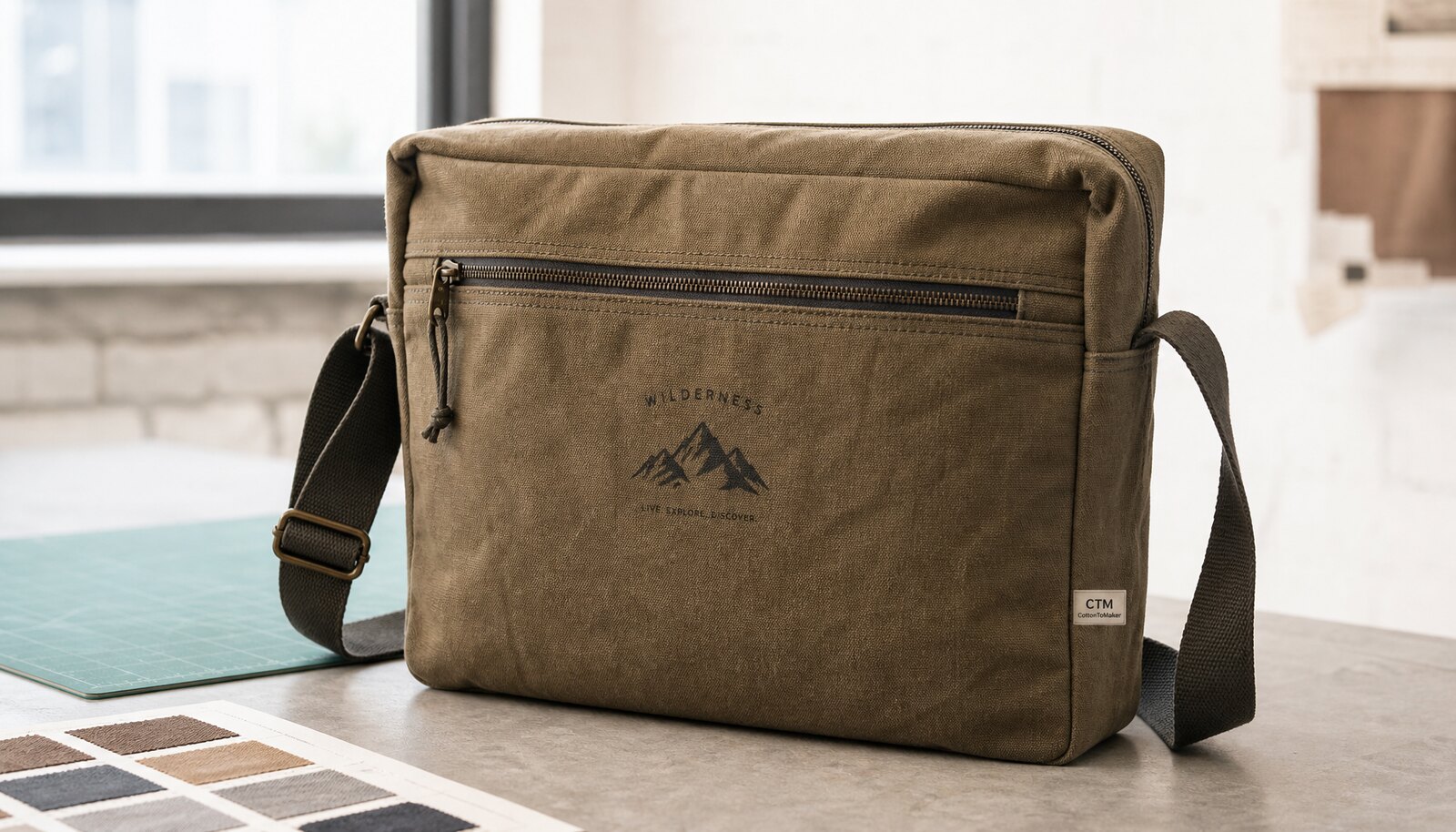
Why gift-shop buying is different from general tote sourcing
Gift shops do not buy canvas messenger bags the same way a corporate promo buyer does. The product has to do more than carry items. It has to look like something a visitor would pick up on purpose, display neatly near the till, and feel substantial enough that the buyer does not second-guess the price tag. That is why procurement should treat the bag as a retail SKU, not a throwaway handout. Shelf appeal, handling feel, seam finish, and logo quality matter as much as the factory’s unit price.
The biggest commercial risk is spec drift. A supplier may offer a technically correct bag that is still wrong for retail: the fabric is too limp, the print is slightly off-center, the color reads dull under store lighting, or the handle feels thin in the hand. Those small details affect sell-through and returns more than many buyers expect. If the bag sits in a gift shop next to journals, postcards, travel pouches, and souvenir apparel, it needs to compete visually with products that are already designed for retail presentation.
That means the RFQ should begin with the use case. Is this a tourist souvenir, a museum shop item, a bookstore add-on, or a small travel accessory? Each channel calls for a different balance of cost, structure, and finish. A souvenir line may need broad appeal and modest pricing. A museum shop may accept a slightly higher cost if the bag looks premium and supports the institution’s graphic identity. A bookstore may care more about carrying notebooks and paperbacks without distortion. When the use case is clear, the supplier can quote the correct construction rather than making assumptions that later become change orders.
For procurement teams, the right buying discipline is to compare products as retail assets. Ask how the bag will hang on a display hook, how it will look folded in a carton, whether the front panel stays flat enough for the print to read cleanly, and whether the hand feel matches the retail price. If the answer to those questions is weak, the lowest quote is usually not the best buy.
One practical test is to imagine the bag sitting in three places at once: on a shelf, in a shopper’s hand, and in a warehouse carton. If it looks good in only one of those settings, the spec is incomplete. Gift-shop procurement works best when the supplier understands that the bag must survive handling, support margin, and still look attractive enough to be selected without a long explanation from the store staff.
- Gift-shop buyers need stronger visual consistency than event or giveaway buyers.
- Shelf appeal, touch feel, and print quality influence sell-through directly.
- Write the RFQ around the channel and end use, not only the material name.
Start with the right bag spec, not the lowest quote
The first procurement mistake is treating canvas messenger bags as if all versions are interchangeable. They are not. A 10 oz canvas bag, a 12 oz standard retail bag, and a 16 oz premium bag may all be called the same product, but they behave differently in production and on shelf. Lower weights can reduce cost, but they often look softer, wrinkle more easily, and show print distortions sooner. Heavier weights create a more confident retail impression, but they can also increase sewing difficulty and freight cost. For most gift-shop programs, 12 oz is a practical baseline because it offers a credible hand feel without becoming bulky.
Bag geometry matters almost as much as fabric. A messenger bag with a flat front panel is usually easier to brand cleanly than a bag with complex seams across the artwork area. Gusset depth changes both usability and carton efficiency: a deeper gusset can hold books or gift bundles, but it also creates more volume in storage and transport. Flap shape also affects retail appeal. A neat, squared flap can feel more structured and premium; a soft or rounded flap may work better for casual souvenir lines. Before asking for price, define the exact finished dimensions, the intended load, and how the bag should open and close.
Do not rely on nominal size names like small, medium, or standard. Require the supplier to quote finished length, height, gusset depth, handle length, and any flap overlap. Ask for the measurement tolerance as well. A small deviation can change how the logo sits, how the bag packs in a carton, and how it looks when hung on a display rack. For gift shops, consistent presentation is part of the product itself. If the bag is meant to sit next to premium printed stationery or travel accessories, even a one-centimeter drift can make the line look less controlled.
A useful procurement habit is to tie spec choices to the retail price band. If the target shelf price is modest, the bag should stay simple and use the fewest necessary components. If the bag is sold as a higher-value souvenir or a branded destination item, then the buyer can justify stronger canvas, better finishing, and more precise print control. The spec should follow the merchandising strategy rather than the other way around.
The same logic applies to assortment planning. A gift shop often does better with one sharply defined bag than with three loosely different versions that look similar on paper. If the store staff cannot explain the difference between them in a sentence, the buyer is probably carrying too much SKU risk. Clear specs make quoting easier, reduce rework, and help the replenishment team know exactly what to reorder.
- Use 12 oz canvas as a common retail starting point, then move up or down only with a clear reason.
- Lock finished dimensions and tolerance, not just nominal size names.
- Choose the bag geometry around the intended retail price and contents.
Fabric, lining, and hardware choices that change the quote
Canvas is only one cost driver. Lining, zipper tape, sliders, magnetic snaps, webbing, label stock, and pocket construction all change both the unit price and the production method. An unlined open-top bag can often be sewn quickly and packed efficiently. Add a zipper and the factory must source a compatible closure, align it cleanly, and inspect the full opening path. Add lining, and the sewing sequence becomes more complex because the inner and outer bodies must be joined properly. That means the buyer should decide early which features are essential and which are only nice to have.
For gift shops, the right feature set depends on the merchandising plan. A tourist destination may want a simple open-top bag with a single front print because the item must stay affordable and move quickly at checkout. A museum shop or premium bookstore may be able to support a zipper top, inner pocket, and woven side label because the retail margin is higher and the product can carry a stronger perceived value. The procurement team should not assume that more features automatically improve sales. Every added component should earn its place through the retail price and target customer.
When evaluating fabric, ask what kind of canvas treatment is being used. Natural canvas, bleached canvas, dyed canvas, and washed canvas each create a different visual effect. Natural canvas is usually the easiest and safest choice for large production runs because it gives a clean, neutral retail look and often works well with simple screen print. Bleached fabric may look brighter but can carry more variation. Dyed fabric can be visually attractive, but you should watch shade consistency and color migration. If the line will be reordered, ask whether the supplier can maintain the same shade over multiple production runs, and request a physical reference swatch for future repeat orders.
Hardware should be specified rather than left to supplier discretion. If the bag uses a zipper, request the exact zipper size, coil or metal type, puller style, and stop-end method. If the bag uses snaps or magnetic closures, request the finish and how the hardware is backed internally. For handles, state whether you want self-fabric handles or cotton webbing, the finished width of the tape, and the reinforcement method at the stress points. The buyer should not accept a vague promise of strong handle without a construction detail that can be checked at inspection.
Lining and pockets deserve the same treatment. If they are added only to make the bag sound better in the quote, they can create cost without improving the shelf result. If they help the bag carry a journal, ticket wallet, map, or small souvenir safely, they may be worth the spend. In retail programs, the feature set should match the checkout decision a shopper makes in the first five seconds.
- Open-top construction usually lowers cost and lead time.
- Zippers, lining, and pockets should be justified by the retail price point.
- Ask for exact hardware types and finishes instead of accepting vague descriptions.
Print method choice: where suppliers hide the real cost
For custom canvas messenger bags wholesale, the print method is often the biggest source of quote variation after fabric weight. Screen print is still the default choice for many gift-shop programs because it is cost-efficient for one to three solid colors, holds up well on textured canvas, and usually gives a bold retail look. If the artwork is simple and the order is not tiny, screen print often provides the best balance of durability and price. For most gift-shop graphics, that is enough.
Transfer and digital methods can be useful, but they are not automatically better. They are often chosen because the artwork contains multiple colors, fine detail, or a short-run requirement that makes screen setup less attractive. The buyer still has to verify how the artwork sits on rough canvas. Very small text, gradients, and thin linework can degrade when transferred to a textured surface. Ask the factory to show a sample on the actual canvas weight you plan to order, not on a smooth substitute fabric. If the design depends on subtle color shading, make sure the final appearance is acceptable under normal store lighting, not just on a screen proof.
The most common print-related mistake is approving artwork in a way that does not match production reality. A logo may look perfect in a digital mockup and still fail on the bag because it crosses a seam, sits too close to the edge, or uses line weights too thin for the canvas surface. To avoid that, specify the art file format, exact print window, the distance from seams or edges, and the acceptable registration tolerance. If color match matters, require a Pantone reference or a controlled lab dip process before bulk production. Do not assume that same as sample means the same ink density or same finish across reorder lots.
Durability also matters when the bag is sold in a gift shop where customers will touch it, compare it, and perhaps carry it home with books or souvenirs. Ask about rub resistance, especially for dark prints on lighter canvas or lighter prints on rough, absorbent fabric. If the product is likely to be handled frequently on open retail hooks, a print that smudges or starts to abrade will quickly hurt the line’s appearance. Where possible, request a print test or strike-off that reflects the final production method, not just a digital proof. This small step often prevents the biggest complaints later.
If the artwork is more decorative than logo-led, ask the supplier to explain which method preserves the image without making the bag look overprocessed. Many gift-shop buyers want the print to look intentional, not promotional. That distinction matters because a souvenir bag should feel collectible, not like a trade-show handout that happened to be sold at retail.
- Screen print is usually best for simple logos and repeat orders.
- Transfer or digital methods need rub and durability validation on the actual canvas.
- Define print placement, seam clearance, and color reference before sample approval.
How to compare supplier quotes without being misled by unit price
Two quotations can look close on paper and still represent very different buying outcomes. One supplier may quote only the bag shell, while another includes print setup, woven labels, polybags, barcodes, and carton strengthening. One quote may be EXW, another FOB, and a third may quietly bundle local delivery but exclude export documents. If procurement compares the numbers directly without normalization, the result is often a bad sourcing decision. The first rule is to make every supplier quote the same spec, same packaging, same trade term, and same production assumptions.
The second rule is to compare control level, not only cost. A direct factory can be a better fit when the buyer needs repeatability, artwork control, and the ability to approve samples against real production settings. A trading company may be useful for smaller orders, multi-item consolidation, or fast communication, but the buyer needs to know where the bag is actually being made and who owns the production QC. If the supplier cannot explain the production source, or keeps changing details between sample and mass order, that is a commercial risk regardless of the unit price.
Procurement buyers should also watch for hidden cost categories that are easy to miss during sourcing. Setup charges may be one-time, but they can make a first order look expensive if they are not separated clearly. Packaging costs can change if the supplier adds individual polybags, care labels, or custom hangtags. Carton dimensions matter because they influence freight and warehouse receiving. A very low factory price can be erased by inefficient packing or by the need to repack goods at destination. That is why the quote comparison should include a standardized cost sheet with line items for product cost, decoration, packaging, documentation, and logistics.
The best buying practice is to score each supplier on both commercial and operational criteria. Commercially, ask whether the price is stable for repeat orders and whether setup charges are transparent. Operationally, ask whether the factory can hold size, color, print position, and packing consistency. A supplier that is cheap but vague is rarely a good long-term partner for a retail gift-shop program.
Before you short-list, make sure every supplier has quoted the same retail reality: same bag size, same artwork, same packaging, same carton spec, same Incoterm, and same sample policy. If any of those differ, the comparison is not yet valid. It also helps to ask for the quote in a repeat-order format so you can see what the bag costs after tooling is amortized. That is often where the true supplier difference becomes visible.
- Normalize every quote to the same product, packaging, and Incoterm.
- Separate one-time setup charges from repeat-order pricing.
- Treat supplier transparency and production control as part of the price comparison.
Decision table: sourcing routes and spec choices for gift shops
This side-by-side table helps procurement compare actual sourcing paths, not just fabric choices. For gift shops, the right route depends on whether you need speed, repeatability, merchandising polish, or lower overall risk. A cheap quote can still be expensive if it creates extra work in packing, relabeling, or reorder management.
Use the table to narrow the field before sending the final RFQ. If two options both support your retail margin, choose the one with better QC traceability, cleaner packing, and fewer hidden cost changes. If the buyer plans a test run, favor the path that makes sample approval easiest and inventory risk smallest.
- Use the table to compare decision paths, not just materials.
- Let use case and retail margin guide the final spec choice.
Sample approval: what to lock before production starts
A sample should be treated as a binding reference, not as a casual preview. In canvas messenger bag sourcing, too many disputes start because the buyer approved a loose prototype and assumed the factory would make it like the sample. That only works when the sample itself is complete and the approval notes are specific. The approved sample should define fabric shade, print position, print size, seam style, handle construction, closure type, label placement, and any internal or external pocket detail. If those items are missing, the sample is not really approved.
Inspect the sample under normal indoor light and, if possible, under the same type of lighting used in the gift shop or warehouse. Retail lighting can change how the canvas shade reads, how dark the print appears, and whether surface imperfections stand out. Check the front, back, side seams, bottom corners, and folded condition. A gift-shop bag often gets handled from multiple angles, so a clean front alone is not enough. The back should not show loose thread clusters or uneven seam lines that make the product feel unfinished.
The buyer should also verify practical handling. Does the bag stand neatly when displayed? Does it collapse too easily? Is the handle length comfortable for the intended customer? Does the flap sit flat, or does it curl? Small usability questions become commercial questions once the bag is on a shelf. If the line is intended as a premium souvenir, the sample should not only look good in a photo; it should also feel deliberate and robust in hand.
When the supplier submits a pre-production sample, record it with photos and written comments. If changes are required, state them precisely: for example, move print 1.5 cm down from top edge, reduce loose thread ends, or change handle length to X cm. Avoid vague remarks like make it better or improve quality. Those comments are hard to enforce later. Once the sample is approved, keep one master reference sample in your records so final inspection can be compared against the same standard.
For reorder programs, document what must remain fixed and what may vary. Some gift-shop buyers are comfortable allowing a small shade range in natural canvas. Others need tighter repeatability because the bag sits beside a branded product wall. Spell this out now, because reorder disputes are usually about assumptions, not sewing.
- Approve only a finished sample with the final materials and construction.
- Check retail appearance from front, back, side, and folded condition.
- Record sample changes in measurable terms, not vague quality language.
Buyer checklist for QC, packing, and carton controls
Quality control for custom canvas messenger bags wholesale should focus on the points customers touch first: print finish, handle strength, seam quality, and cleanliness. For gift shops, cosmetic defects matter more than in some industrial categories because the product is displayed openly and handled by shoppers. A small stain, a loose thread on the front panel, or a crooked logo can be enough for a store buyer to reject the batch or pull units off display. That is why QC has to be operational, not generic.
Start with the inspection standard. Many retail programs use AQL as the final gate, and a practical starting point is AQL 2.5 for major defects and 4.0 for minor defects unless your company standard is stricter. Define what counts as major and minor before production begins. A torn seam, wrong artwork, incorrect bag size, missing handle reinforcement, or visible stain on the front face should usually be major. A loose thread, slight carton scuff, or small label misplacement may be minor if it does not affect function or shelf presentation. Once those definitions are written down, the factory and the buyer can inspect against the same rule set.
Measurement control should also be more specific than within tolerance. Write down the tolerance for finished length, height, and gusset depth. For example, if your product needs to fit a display tray or ship in a fixed carton, size drift can create a packing problem even if the bag still functions. Measure samples across several cartons rather than one or two pieces from the top layer. This helps catch batch drift before the shipment is released. Also check that print position is consistent from bag to bag; if the logo appears to creep higher or lower within the run, the batch may need sorting.
Handle testing deserves special attention because it is one of the most common failure points. Ask the supplier to show the reinforcement method and perform a practical pull check that reflects real retail use. If the bag is meant to carry books, journals, or souvenir bundles, the handle attachments must not open, crack, or distort during normal load. The same applies to zippers and closures. Check that the zipper glides smoothly, the puller is attached properly, and the end stops are secure. A zipper that jams during one hundred open-close cycles may not be acceptable for a retail product even if it looks fine at first glance.
Packing controls matter because the bags often move through a warehouse before they reach a gift shop shelf. Confirm whether the bags are flat-folded, loosely stuffed, or individually polybagged, and ask why the supplier chose that method. Flat-folding saves space, but if the bag is prone to dust or wrinkling, a light protective bag may be justified. Ask for carton count, outer carton dimensions, net and gross weight, SKU labels, and any barcodes or ship marks. If those details are absent from the quote, the receiving team may face avoidable repacking or relabeling work when the shipment arrives.
Finally, agree on reject and repair handling before mass production. If the factory finds a defect that can be repaired, who approves the repair? If the final inspection finds a problem, who pays for rework, replacement, or freight for returned goods? The answer should be written into the purchase order or quality agreement. That prevents a common dispute where the supplier calls a defect acceptable and the buyer calls it a rejection. Clear rules protect both sides.
Gift-shop buyers should also define what a sellable unit looks like on arrival. If the bag is displayed folded, the fold should be clean and repeatable. If it ships stuffed to reduce creasing, the packing should not leave lint or compression marks. These details are small on paper but visible to the end customer.
- Use an AQL-based final inspection rather than a casual visual check.
- Define major and minor defects before production starts.
- Specify measurement tolerance, handle test expectations, and reject/repair rules in writing.
Lead time, MOQ logic, and schedule risk
MOQ is not just a factory number; it is a production logic question. A supplier may offer a surprisingly low minimum if the bag uses stock canvas, standard thread colors, and basic packing. The moment the buyer adds custom dyeing, special hardware, a branded woven label, or retail packaging, the MOQ often rises. That is why MOQ should be reviewed together with construction complexity. In gift-shop programs, the better tactic is usually to start with one design, one colorway, and one print position, then expand once sell-through is verified. This keeps inventory risk under control while still giving the buyer enough volume to test the market.
Lead time should be broken into separate blocks: sample development, sample revision, production, inspection, and transport. A supplier that says 30 days may only mean sewing time. If artwork revision, packaging approval, or raw material procurement is still pending, the practical schedule can be much longer. For straightforward canvas messenger bags, sampling often takes about 7 to 15 days depending on accessory sourcing and artwork complexity, while production commonly falls in the 25 to 40 day range for standard orders. Those are planning ranges, not promises, and they can stretch during peak season or if the buyer changes the spec late.
The best way to protect the calendar is to freeze the most change-sensitive details first: artwork, bag dimensions, print method, hardware, labels, and carton markings. The more late changes the buyer makes, the greater the chance that the factory will miss the shipping window. Gift-shop buyers often have seasonal launches tied to tourism peaks, holidays, or exhibition dates, so schedule discipline matters as much as cost control. If a bag is meant for a gift shop event or destination opening, the delay cost can be bigger than the unit price difference between two suppliers.
A simple procurement rule helps here: do not use low MOQ as the only filter. A slightly higher MOQ from a more stable supplier may be cheaper overall if it reduces rework, aligns with carton efficiency, and improves repeat-order consistency. The best order size is usually the one that supports both first-run testing and a clean replenishment path.
When the product is new to the shop, it is often smarter to buy enough to create a visible display, but not so much that the line ages before it proves itself. That balance is especially important for seasonally themed or destination-specific artwork, where sell-through risk is tied to visitor traffic and calendar timing.
- Review MOQ together with fabric, hardware, and packaging complexity.
- Break lead time into sampling, production, inspection, and freight.
- Freeze artwork and carton details early to avoid calendar slippage.
Landed-cost comparison: what to include before you place the PO
The final buying decision should be based on landed cost, not factory price alone. That means adding sampling charges, print setup, packaging materials, carton upgrades, inland freight to port or warehouse, export documents, ocean or air freight, customs clearance, duties, and receiving costs. A quotation that looks slightly higher at the factory gate can become cheaper overall if the cartons are efficient, the packing is cleaner, or the supplier has fewer corrections during production. Procurement teams should build a standard landed-cost sheet so every quote is translated into the same total number.
For gift-shop programs, landed cost should also be viewed against retail margin and sell-through speed. A bag that costs a little more but looks stronger on shelf may outperform a cheaper one that appears flat, flimsy, or badly printed. The buyer should ask whether the line is supposed to be a fast-turn souvenir or a higher-margin branded item. If the product sells faster because it presents better, the slightly higher procurement cost can still improve the business result. That is a retail decision, not just a sourcing decision.
It helps to ask the supplier for a quote format that splits product cost, packaging cost, and logistics assumptions into separate lines. If a supplier refuses to show the carton spec or hides the packing method, that is a warning sign. Those details affect transport cost and warehouse handling. They also matter when reorders are placed later, because a good quote should let the buyer reproduce the same landed cost logic with less guesswork. If the first order succeeds, the reorder quote should not become a fresh negotiation over basic packing facts.
In practical terms, the procurement team should compare the following before signing the PO: unit cost, sample charge, setup charge, packaging cost, carton efficiency, freight assumption, duties, and a margin check against expected shelf price. Once that sheet is complete, the sourcing decision becomes much clearer. The cheapest-looking offer is not always the best one, and the most polished quote is not always the safest one. The right answer is the supplier who can deliver the approved product at the right total cost, on time, with repeatable quality.
A good landed-cost review also shows where small spec upgrades are worth paying for. If a reinforced handle adds a modest amount but reduces defect risk and improves shopper confidence, that can be a sensible trade. If a decorative lining adds cost without increasing conversion at shelf, it may not be. The point is not to minimize every cost line; it is to spend where the shopper sees value and save where they do not.
- Build a landed-cost sheet that includes packaging, freight, and duty assumptions.
- Compare cost against shelf price and expected sell-through, not only against EXW.
- Ask for a quote format that separates product, packaging, and logistics lines.
Specification comparison for buyers
| Sourcing option | Best fit for gift shops | What you get | Commercial downside to check | Best use case |
|---|---|---|---|---|
| Direct factory, stock canvas, one-color screen print | Fastest path to a clean retail SKU when the spec is simple | Lower unit cost after setup, clearer production control, easier repeat orders | Requires tighter spec writing and stronger follow-up on sample approval | Tourist shops, souvenir counters, bookstore impulse lines |
| Direct factory, custom fabric weight and zipper closure | Premium retail feel when the bag must justify a higher shelf price | More control over structure, hardware, and finish consistency | More moving parts can increase lead time and QC touchpoints | Museum stores, premium gift shops, destination branding programs |
| Trading company, mixed-accessory package | Useful when the buyer wants small runs or several related items in one shipment | Convenient communication, broader product sourcing, simpler bundle buying | Factory source may be less transparent, and quote normalization is harder | Smaller chains, test buys, seasonal assortment trials |
| Domestic decorator plus imported blank bag | Good when speed matters more than a fully custom build | Shorter turnaround on artwork and localized support | Blank-bag supply can limit fabric and construction control; landed cost may rise | Quick reorders, event-driven gift-shop programs |
| High-MOQ custom program with custom label, lining, and packaging | Best when the bag is a core retail SKU with predictable sell-through | Strong brand consistency and repeatability once the line is established | Inventory risk rises if the design misses price expectations or seasonal timing | Established gift-shop programs with stable demand |
| Material | 10-16 oz canvas, washed canvas, rPET canvas, lining fabric, interfacing, and hardware finish | Before price comparison | Different cloth weights, backing, or certification claims make quotes hard to compare | |
| Construction | flap shape, strap webbing, buckle, D-ring, inner pocket, zipper pocket, seam allowance, and load path | Before sampling | Weak stress points create returns and failed inspections | |
| Decoration | embroidery, woven patch, leather patch, metal label, or print placed away from flap folds and hardware pressure | Before artwork approval | The wrong method can crack, bleed, pucker, or fail on the chosen fabric |
Buyer checklist before sampling
- Confirm finished dimensions, gusset depth, and acceptable measurement tolerance in writing before requesting quotes.
- Specify canvas weight in oz or GSM, and state whether the fabric is natural, bleached, dyed, washed, or post-treated.
- Define the front artwork size, print position, number of colors, and whether the supplier must match a Pantone reference.
- Choose screen print, transfer, digital, embroidery, woven label, or patch based on the artwork and the selling price, not only the cheapest method.
- State handle material, tape width, finished drop length, and reinforcement method at the attachment point.
- Decide whether the bag will be open-top, zipper-top, or flap-closure before quoting, because hardware changes price and lead time.
- Request a finished pre-production sample, not just a blank body or artwork proof.
- Ask the supplier to quote the same Incoterm, the same packaging spec, and the same sample-charge logic across all offers.
- Request carton count, carton dimensions, net weight, gross weight, and whether the bags are flat-folded, stuffed, or individually polybagged.
- Set acceptance criteria for print alignment, thread trimming, stain rejection, seam quality, and odor before production starts.
Factory quote questions to send
- What exact canvas weight are you quoting, and is that finished fabric weight or greige fabric weight?
- Can you confirm the finished bag dimensions, gusset depth, handle length, and measurement tolerance you will hold during production?
- Is the quotation based on EXW, FOB, CFR, CIF, or DDP, and what exactly is included in the unit price?
- How many print colors are included, what are the setup charges, and what is the repeat-order pricing after tooling is paid?
- Which print method are you proposing for this artwork, and why is it the best fit for this canvas surface?
- What is the MOQ per design, per color, and per print position, and does the MOQ change if we add packaging or a woven label?
- Can you share the handle construction detail, stitch pattern, and reinforcement method at the stress points?
- What closure options are available, and what is the price and lead-time difference between open top, zipper, and snap closure?
- What carton pack count, carton dimensions, and gross weight per carton are you quoting?
- Will the bags be flat-folded, lightly stuffed, or individually polybagged, and is that included in the price?
Quality-control points to confirm
- Set a measurable fabric-weight requirement and verify it with supplier mill documents, a test report, or agreed spot checks, not just by hand feel.
- Use the approved sample to lock finished size, logo placement, handle length, closure type, label position, and internal pocket detail before mass production.
- Inspect print alignment against the approved artwork window, and define how much shift is acceptable from seam edge to logo edge.
- Check for visible print flaws such as patchiness, bleeding, ghosting, cracking, pinholes, or incorrect color density under normal retail lighting.
- Confirm that handle attachments use box-X, bar-tack, or equivalent reinforcement, and look for skipped stitches, back-tacking gaps, or loose thread tails.
- Use an AQL plan for final inspection rather than relying on a casual visual check; for many retail programs, AQL 2.5 major and 4.0 minor is a practical starting point unless your internal standard is stricter.
- Define major versus minor defects in advance: for example, a torn seam, wrong print position, wrong shade, or stained front panel is major; a loose thread or slight carton scuff may be minor.
- Measure finished bags from multiple cartons to confirm that size variation stays within the agreed tolerance across the lot.
- Test handle strength with a practical pull or load check that reflects retail use; if the bag is meant to carry books, samples, or souvenirs, the handles must not shift or open under normal handling.
- Verify zipper smoothness, puller alignment, and stop-end security if a closure is included, and reject any zipper that jams or catches on fabric.