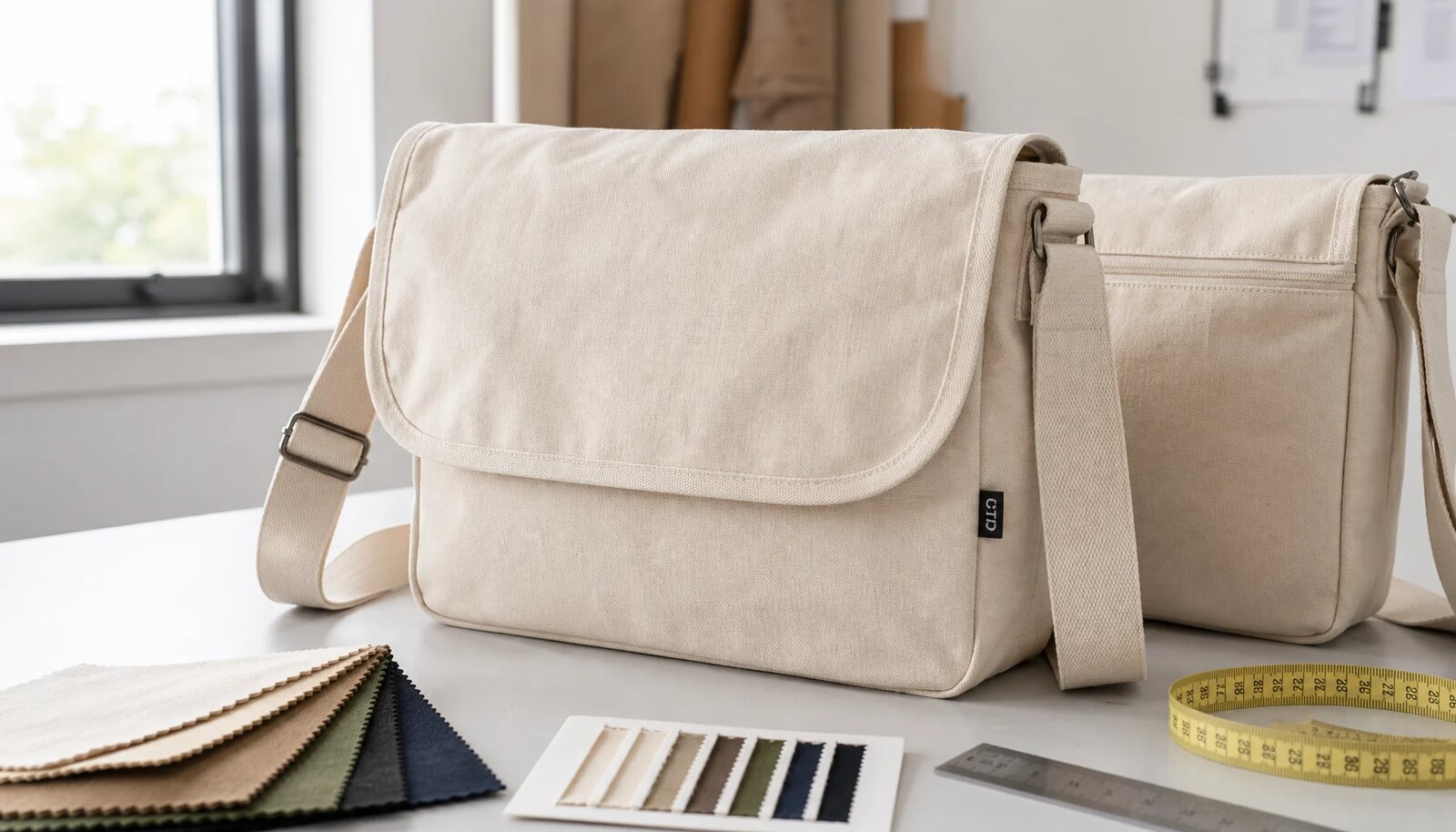
Start With The Retail Job
A canvas messenger bag for hotel retail is a sellable unit, not just a decorated giveaway. It has to look right on a shelf, carry the intended load, scan correctly at receiving, meet labeling expectations, and arrive packed in a way the hotel or distributor can process without extra sorting.
The same bag shape can serve very different jobs. A resort boutique may need a cleaner flap, heavier hand feel, discreet branding, and retail-ready hangtags. A welcome amenity may prioritize cost, speed, and predictable replenishment. A conference store may care most about logo visibility and delivery date. A staff accessory may need darker canvas, stronger strap anchors, and less visible branding.
Define compliance as the supplier's ability to repeat the approved sample, document materials, follow applicable labeling and restricted-substance requirements, allow inspection, and ship goods in the receiving format required by the buyer. Factory certification is useful, but it does not replace product-level control.
- Channel: resort boutique, hotel gift shop, conference store, loyalty item, staff issue, or amenity.
- Commercial position: budget souvenir, mid-tier branded accessory, premium retail item, or utility bag.
- Use expectation: documents only, tablet and books, guest purchases, employee daily carry, or event material.
- Display method: hanging fixture, folded shelf stack, basket display, backroom replenishment, or pre-packed amenity kit.
- Receiving requirement: barcode label, SKU separation, carton marks, destination allocation, carton weight limit, and inspection access.
Turn The Bag Into A Build Sheet
A product photo is not enough for comparable quotes. Messenger bags hide cost in the flap, gusset, lining, webbing, reinforcement, pocket layout, seam allowance, closure, and pressing standard. If those details are not written, suppliers can quote different products while appearing competitive.
Use a build sheet with measurements and tolerances. Include finished body width, finished height, bottom gusset, flap width, flap drop, strap width, strap length range, pocket depth, logo position, label position, and barcode position. Use fixed reference points, such as top seam, side seam, flap edge, or center line.
Separate visible materials from hidden construction materials. A supplier can keep the outer canvas acceptable while reducing webbing thickness, removing reinforcement patches, changing zipper tape, or using weaker thread. These changes may not show clearly in early photos, but they affect retail value and durability.
- Visible controls: canvas color, texture, flap shape, logo, label, hardware finish, stitching, and pressing.
- Hidden controls: lining, interlining, reinforcement patches, seam allowance, zipper tape, binding, thread, and pocket fabric.
- Functional controls: strap adjustability, buckle grip, closure strength, pocket access, zipper smoothness, and load path.
- Appearance controls: centered flap, even corners, trimmed threads, no stains, no panel shade mismatch, and clean hangtag placement.
- Tolerance examples to validate: plus or minus 10 mm for body dimensions and plus or minus 5 mm for logo or label placement, adjusted for design complexity.
Specify Canvas And Trims
Canvas weight affects structure, perceived value, sewing difficulty, carton weight, and freight cost. Treat common weights as buying ranges rather than fixed rules. An 8-10 oz canvas can work for lightweight souvenirs or simple amenity bags. A 10-12 oz canvas is often a practical starting range for hotel retail because it balances structure and sewability. A 12-16 oz canvas can support a more premium feel, but it needs the right needles, seam construction, and carton-weight planning.
Ask suppliers to quote fabric by composition, GSM or ounce weight, weave, finish, color method, shrinkage expectation, and approval reference. Natural canvas may reduce dye-lot risk but still needs approved shade range, slub tolerance, and fabric-character limits. Custom dyed or washed canvas requires lab dip approval, shade control, shrinkage review, and extra lead-time buffer.
Trims need the same discipline. Webbing width and thickness affect comfort and adjuster slippage. Hardware finish affects perceived value and corrosion risk, especially in humid destinations. Magnetic snaps, zippers, buckles, adjusters, D-rings, rivets, labels, patches, and hangtags should be reviewed on a trim card before bulk production.
- Quote fabric by composition, GSM or ounces, weave, color, finish, shrinkage expectation, and swatch reference.
- Approve a trim card with canvas, lining, webbing, thread, zipper, hardware, label, patch, hangtag, barcode label, and packing material.
- Confirm whether antique brass, matte black, nickel, branded hardware, or special zipper pulls are stock or custom.
- For recycled or blended canvas, request the claim basis, composition statement, and any available material declaration.
- For washed or garment-dyed canvas, validate dimensions and shade on the sample because finishing can change both.
Check Retail And Legal Documents
Compliance documents should be named, current, and relevant to the market. A generic supplier certificate is not enough if the buyer needs product-level support for retail sale. The required file depends on destination, sales channel, buyer policy, age positioning, and material claims.
For the United States, buyers often review country-of-origin marking, fiber content labeling, care labeling where applicable, and Prop 65 exposure where relevant. CPSIA may matter if the product is designed, marketed, or sized for children; it may not apply to a standard adult hotel retail bag, but the applicability decision should be documented. For the EU or UK, restricted-substance review may include REACH or buyer-specific chemical requirements.
The supplier should identify the legal company name on each document, the production site, the material covered, the date, and whether the report can be tied to the actual lot used for the order. If a test report covers a different fabric, different dye, or old trim lot, treat it as supporting evidence only, not proof for the current production.
- Product identity: item name, SKU, composition, supplier, production site, and purchase order.
- Labeling: fiber content, country of origin, care instructions if required, importer or brand label rules, and retail barcode format.
- Chemical review: restricted substances, azo dyes where relevant, lead and phthalate checks where applicable, Prop 65 review for California exposure, and REACH review for EU sale.
- Children's product review: CPSIA applicability if the bag is marketed to children or designed primarily for children.
- Traceability: material lot, dye lot, trim lot, report date, issuing lab, tested item, and legal entity named on the report.
Choose Branding For Handling
The flap is usually the main branding area, but it is also the surface most likely to be touched, folded, stacked, and compressed in cartons. A large logo can look strong in a mockup but fail if ink cracks near a fold, transfers to packing, or prints unevenly on textured canvas.
Screen print is practical for bold one-color or two-color marks on flat panels. Embroidery gives a premium look for smaller logos but needs backing and stitch-density control. Woven labels and sewn patches can be stable for hotel retail because they reduce large-surface print risk. Heat transfers and metal badges need extra review for adhesion, cracking, scratches, sharp edges, and attachment strength.
Approve branding on the actual canvas, not only on a digital mockup. Confirm whether decoration is in-house or outsourced, because print, embroidery, patch, label, and badge production can affect MOQ, sample timing, defect ownership, and rework speed.
- Screen print: ink type, artwork size, color reference, position, edge sharpness, coverage, and dry-rub result.
- Embroidery: thread colors, backing, stitch density, minimum letter height, puckering limit, and placement tolerance.
- Woven label: size, fold type, seam location, stitch method, color tolerance, and fray resistance.
- Sewn patch: material, thickness, edge finish, stitch color, corner shape, and attachment sequence.
- Metal badge: plating, backing safety, scratch tolerance, corrosion expectation, attachment strength, and packing protection.
Make MOQ And Price Comparable
MOQ is rarely one number for one reason. It may be driven by fabric rolls, dye lots, hardware finish, logo setup, woven label MOQ, patch production, barcode labels, carton printing, or sewing-line efficiency. Ask for the driver behind the MOQ before negotiating.
For a hotel retail pilot, stock canvas, standard hardware, and a woven label may be safer than forcing a small order with custom dyed fabric and special trims. Once sell-through is proven, custom color, custom hardware, or more complex packing can be introduced with better volume leverage.
Compare quotes only after the specification is equal. One supplier quoting 10 oz unlined canvas is not comparable to another quoting 12 oz canvas with lining, reinforcement, retail hangtag, barcode labeling, and carton marks. Unit price should be reviewed with sample cost, setup cost, testing, inspection, packing, Incoterm, carton CBM, and landed-cost assumptions.
- MOQ by fabric color, logo version, hardware finish, packing version, and destination allocation.
- Included costs: sample, logo setup, trim card, retail packing, barcode application, hangtag, carton marks, and inspection cooperation.
- Excluded costs: lab testing, sample revisions, rush freight, carton upgrades, reinspection, palletization, customs, duty, and local delivery.
- Commercial terms: EXW, FOB, CIF, DDP, or delivered warehouse, with cost and risk clearly separated.
- Inventory risk: lower MOQ may protect cash flow; higher MOQ may improve unit cost but create slow-moving hotel retail stock.
Qualify The Production Site
A compliant supplier should show how the order will be made, not only send catalog photos. Useful evidence includes recent messenger bag production, similar canvas weights, strap-anchor close-ups, lining details, trim sourcing, retail packing examples, and inspection cooperation.
Confirm who controls production. A direct factory may give faster technical answers and better sample-to-bulk control. A trading company can help coordinate mixed orders or extra services, but the actual sewing site must be disclosed when compliance matters. Audit records, invoices, export documents, and inspection bookings should not point to unrelated entities without explanation.
Outsourcing is common for embroidery, woven labels, patches, metal badges, washing, and specialty printing. The key question is not whether outsourcing exists; it is who owns timing, quality decisions, rejected work, and rework cost.
- Verify legal identity: factory name, address, invoice entity, export entity, audit document name, and inspection contact.
- Request order-specific evidence: similar bag photos, flap details, strap anchors, lining photos, packing-line photos, and first-piece approval examples.
- Map production steps: cutting, sewing, printing, embroidery, patch production, hardware sourcing, pressing, packing, and carton marking.
- Confirm rework rules: who decides, who pays, how long rework takes, and whether reinspections are allowed before shipment release.
- Check production capacity by month, not only annual capacity, especially for seasonal hotel openings or event-driven launches.
Control Samples Before Bulk
Sampling should move from style exploration to production control. A sales sample may use available fabric, substitute hardware, and approximate decoration. That can help confirm direction, but it should not become the production standard. The pre-production sample should represent the bulk order as closely as possible.
Keep approval in one file: measurements, photos, rejected points, approved deviations, trim card, label artwork, barcode placement, packing instruction, carton mark, and approver name. Scattered email comments are easy to miss during production.
Review the sample like a retail unit. Hang it, fold it, pack it, scan it, open and close the flap, adjust the strap, and load it with likely contents. A bag that looks acceptable flat may collapse poorly on a fixture or arrive too wrinkled for a boutique display.
- Measure body width, height, gusset, flap width, flap drop, pocket depth, strap width, strap range, and logo placement.
- Compare canvas, lining, webbing, hardware, thread, label, patch, hangtag, barcode label, and packing material against the trim card.
- Check handling with expected contents such as tablet, brochures, travel documents, small purchases, or staff items.
- Rub print or transfer decoration with a dry white cloth and a slightly damp cloth if agreed in the test plan.
- Keep one signed approved sample with the buyer and one with the supplier; use detailed photos where physical samples cannot be shared.
Write Inspection Criteria
Inspection language needs measurable points. Terms such as good stitching, strong strap, and nice printing are too vague for a third-party inspector. Define defect categories, tolerances, sample references, and functional checks before production.
Many buyers use AQL sampling for final inspection. A typical starting point is General Inspection Level II for workmanship, with separate major and minor AQL limits agreed in the purchase order. Critical issues such as unsafe sharp hardware, wrong logo, wrong product, or strap failure should have zero tolerance or a clearly stricter rule. The right plan depends on order size, buyer policy, and product risk.
Inspection should cover incoming materials, first-piece approval, inline construction, and final packed goods. Waiting until cartons are sealed can make repair expensive and delay seasonal launches. Barcode labels, carton marks, and SKU counts must be inspected as seriously as stitching because they affect receiving and sale.
- Critical defects: strap anchor failure, sharp hardware, unsafe edges, broken closure, wrong logo, wrong product, severe contamination, or unusable construction.
- Major defects: logo beyond tolerance, crooked flap, wrong shade, weak seam, scratched hardware, unreadable barcode, incorrect hangtag, or wrong packing.
- Minor defects: trimable loose threads, slight internal marking, small carton scuffing, or non-visible workmanship issues that do not affect saleability.
- Functional checks: strap pull or static load test, buckle slippage, snap closure, zipper smoothness, pocket access, flap alignment, and basic load simulation.
- Barcode acceptance: correct SKU, correct number, scannable label, consistent placement, no duplicate labels, and no mismatch between unit, carton, and packing list.
Pack For Hotel Receiving
Packing is part of compliance. Hotel retail goods may move through central warehouses, distributors, property storerooms, or third-party logistics providers. If cartons are heavy, mixed, poorly marked, or missing barcode logic, receiving teams may have to open every carton manually.
Unit packing should protect the bag without damaging presentation. Polybags protect light canvas from dust and moisture, while paper wrap, tissue, belly bands, or carton liners may fit buyers trying to reduce plastic. Whatever method is chosen should be approved on the pre-production sample.
Carton details should be known before booking: dimensions, gross weight, net weight, quantity per carton, CBM, carton strength, sealing method, carton number, destination, and SKU. Many retail operations prefer manageable carton weights, often around 15-18 kg gross, but the buyer's warehouse rule should control the final limit.
- Unit packing: polybag or paper wrap, hangtag, barcode label, price-ticket area, silica gel if needed, and folding method.
- Carton marks: PO number, SKU, color, quantity, destination, carton number, country of origin where required, gross weight, and carton dimensions.
- Mixed-SKU control: inner cartons, dividers, carton map, destination allocation, and packing list by carton number.
- Moisture control: route-appropriate desiccant or liner when needed, especially for natural cotton canvas and metal hardware.
- Shipment release: packed-carton photos, carton mark photos, barcode scan proof, final packing list, and inspection pass report.
Specification comparison for buyers
| Supplier option | What to verify | Commercial advantage | Buyer risk to control |
|---|---|---|---|
| Direct sewing factory | hardware trim card, strap-load photo, lining close-up, approved flap sample, and first-piece production photos | Better sample-to-bulk control and faster production feedback | May be weaker on export paperwork or branded packing unless checked early |
| Trading company | Factory name, production photos, trim-source proof, and who owns QC decisions | Can coordinate small mixed orders and extra services | Markup can hide real factory capability and slow defect decisions |
| Specialized bag workshop | flap shape, strap webbing, buckle, D-ring, inner pocket, zipper pocket, seam allowance, and load path | More practical for detailed construction, trims, and repeat programs | Capacity may be limited during peak seasons |
| Low-price general supplier | 10-16 oz canvas, washed canvas, rPET canvas, lining fabric, interfacing, and hardware finish | Useful for simple promotional runs with loose specs | Material downgrades, weak packing, and vague inspection scope can erase savings |
| Retail-ready supplier | shape support, strap folding, hardware protection, individual bag, carton drop expectation, and retailer hangtag placement | Can handle labels, SKU separation, carton marks, and receiving rules | Higher unit cost must be compared against reduced warehouse work |
| Compliance-focused supplier | Fabric records, labeling review, test plan, and production traceability | Safer for retail programs and repeat brand orders | Documentation claims need evidence, not only sales language |
| Local sample room plus bulk factory | Signed sample, bulk factory handoff, first-piece photos, and deviation owner | Good for complex branding before large production | Sample room quality may not match bulk line unless handoff is controlled |
Buyer checklist before sampling
- Define the selling use before quoting: resort boutique, hotel gift shop, welcome amenity, loyalty redemption item, conference merchandise, staff accessory, or destination souvenir.
- Issue a measurement table with body width, height, gusset, flap drop, pocket depth, strap width, strap length range, logo position, hangtag location, barcode position, and finished-size tolerances.
- Specify outer fabric by composition, GSM or ounce weight, weave, color reference, finish, shrinkage expectation, and approved swatch or lab dip. Treat 8-10 oz, 10-12 oz, and 12-16 oz as buying ranges to validate by sample and testing, not universal rules.
- List hidden construction materials separately: lining, interlining, reinforcement patches, zipper tape, webbing, binding, thread, padding, pocket fabric, hardware, labels, and packing material.
- Confirm likely regulatory documents by market: fiber content labeling, country-of-origin marking, care labeling if required, restricted substance declarations, REACH or Prop 65 review where relevant, and CPSIA applicability if the item could be marketed to children.
- Choose branding by handling conditions. Define artwork size, color reference, placement tolerance, application sequence, dry-rub acceptance, attachment method, and inspection method for print, embroidery, woven label, patch, transfer, or badge.
- Identify the real MOQ driver: fabric roll, dye lot, hardware finish, logo setup, patch or label MOQ, retail packing material, barcode labels, carton printing, or sewing-line efficiency.
- Require a pre-production sample made with bulk fabric, bulk trims, final logo method, correct label, hangtag, barcode placement, unit packing, and proposed carton layout.
- Freeze an approval file before deposit or bulk material purchase: signed sample photos, trim card, measurement table, logo proof, label artwork, packing instruction, carton mark, AQL level, defect classification, and approver name.
- Set inspection criteria for canvas weight, shade, dimensions, seam strength, strap pull, stitch density, logo placement, rub resistance, hardware finish, closure function, barcode scan, carton count, and carton condition.
Factory quote questions to send
- Are you the actual sewing factory for this order, or will production be subcontracted? Provide the production-site legal name, address, contact, and inspection access policy.
- Which canvas options can you supply for this construction in GSM or ounces, and are they stock, stock-dyed, custom-dyed, washed, recycled blend, or special order?
- What is the MOQ driver for this quote: fabric, dye lot, hardware, logo setup, patch or label MOQ, packing material, barcode batch, carton printing, or line efficiency?
- Which steps are in-house and which are outsourced: cutting, sewing, printing, embroidery, woven labels, patches, badges, washing, pressing, barcode labeling, packing, and carton marking?
- Can the pre-production sample use the same canvas, lining, webbing, hardware, thread, logo process, hangtag, barcode label, unit packing, and master-carton plan as bulk production?
- What finished-size tolerances do you accept for body dimensions, flap alignment, logo placement, strap length, pocket depth, carton count, carton dimensions, and carton gross weight?
- Which compliance documents can be provided for this order, and can they be tied to the material lot or supplier lot used in production?
- Does the price include retail packing, hangtag stringing, barcode application, SKU separation, carton marks, carton upgrades, moisture protection, export carton sealing, and packing-list preparation?
- What AQL level, inspection level, and defect classification do you accept, and can a buyer-appointed inspector open cartons, scan barcodes, perform pull checks, and inspect packed goods?
- How many calendar days are needed for artwork proof, swatch or lab dip, sample making, sample revision, bulk material purchase, cutting, sewing, decoration, packing, inspection, rework, and shipment booking?
Quality-control points to confirm
- Canvas GSM or ounce weight checked against the approved swatch and order tolerance, with shade reviewed under consistent lighting before cutting.
- Finished dimensions measured after sewing and pressing, including body width, height, gusset, flap drop, flap alignment, pocket depth, logo placement, strap width, and strap length range.
- Common tolerance examples agreed before production: plus or minus 10 mm for main body dimensions, plus or minus 5 mm for logo placement, and tighter limits for visibly centered flap or patch details when the design requires it.
- Strap attachment checked by construction method and function. For many retail messenger bags, buyers may request a static hanging-load check or pull test validated during sampling; the target should reflect intended load, material, and seam design.
- Stitching inspected for skipped stitches, broken seams, loose threads, seam puckering, exposed seam allowance, inconsistent stitch density, crooked binding, and needle damage.
- Logo application checked against the approved proof for position, scale, color, edge sharpness, ink coverage, embroidery puckering, patch alignment, badge attachment, and dry-rub transfer.
- Rub testing defined in practical terms, such as a dry white cotton cloth rubbed across the print or dyed area for an agreed number of cycles, with no visible transfer that affects saleability.
- Hardware inspected for rust, sharp edges, plating scratches, weak magnetic snaps, loose buckles, slipping adjusters, zipper roughness, rivet security, and inconsistent finish.
- Final inspection plan tied to AQL, such as General Inspection Level II for workmanship with agreed major and minor AQLs, plus 100% checks for critical safety or wrong-logo issues when required.
- Barcode acceptance checked by scanning a sample from each SKU and carton grouping with no unreadable, duplicated, missing, misplaced, or mismatched retail labels.