What tech startups should actually control when sourcing custom canvas messenger bags
The buying challenge is bigger than the product name suggests. Tech startups are not simply ordering custom canvas messenger bags; they are buying a branded carry item that may need to work for onboarding kits, conference giveaways, enterprise gifting, or hybrid office distribution. That means the supplier has to deliver the right bag, in the right pack-out, with the right evidence and receiving details. If any of those pieces are vague, the order can look fine on paper and still fail in production or fulfillment.
A procurement checklist helps because it turns a visual concept into a controlled file: fabric, construction, decoration, device fit, labels, packing, test evidence, inspection rules, and change approval. Without that structure, two quotes can look similar while hiding very different builds. One supplier may include padded construction, stronger webbing, and branded packing. Another may price a thinner shell, simpler stitching, and generic cartons. The unit price is not comparable unless the scope is locked.
For startup buyers, ambiguity is usually more expensive than the bag itself. A weak sample round can delay a launch. A missing barcode can slow warehouse intake. A bag that misses the actual laptop size can damage employee adoption. A supplier that cannot support compliance review can create downstream friction with retail, marketplace, or enterprise procurement checks. The goal is straightforward: remove uncertainty before the purchase order is released.
Use the checklist to compare suppliers on evidence, not claims. Ask what is included in the quote, what is optional, what is sampled, and what will be inspected at bulk. If the supplier cannot answer those questions cleanly, the sourcing risk is already visible.
Practical rule: treat the bag as three products at once — a carry item, a branding surface, and a fulfillment unit. The best supplier is the one that understands all three.
- Treat the bag as a carry item, branding surface, and fulfillment unit.
- Compare suppliers on evidence, not sales language.
- Build approvals around use case, paperwork, and receiving reality.
Define the use case before you ask for prices
Messenger bags for startups are often specified too broadly. A team may say it needs a logo bag, then later discover that engineering staff carry 16-inch laptops, sales teams need charger and notebook storage, and event teams need a lower-cost bag that can ship in volume. Those are different requirements. If the RFQ starts with only a front-view design reference, the factory will fill in the missing details based on cost, not on your actual use case.
Start by mapping the carry kit by audience. For onboarding, list the device size, charger dimensions, notebook format, accessories, and any printed insert card. For event gifting, decide whether a padded sleeve is needed or whether a lighter build is acceptable. For executive or founder gifting, you may care more about hardware finish, lining quality, and shape retention. For DTC merch or resale, barcode placement, carton count, and fold method matter more than they do for office distribution.
Role-specific fit matters more than many buyers expect. A bag that fits a 13-inch laptop in a bare sleeve may fail once the device stays inside a protective case. A slim messenger bag may look clean in a sample room but become awkward when a charger brick and mouse are added. Ask the supplier to comment on usable internal dimensions, opening width, and gusset function, not just the outer measurements.
Write the user scenario into the RFQ. That single step helps the supplier choose a proper construction and gives you a better basis for comparing quotes. It also makes later quality checks easier because the approved sample can be tied to a real use case, not to a generic concept sketch.
If you expect more than one audience, split the project into variants. One spec should not try to serve every team if the carry needs differ materially.
- List actual carry contents by role or program.
- Specify internal sleeve fit for real devices, with case allowance if relevant.
- Separate office, event, and DTC fulfillment needs early.
Material specification: what to lock before comparing suppliers
Canvas is easy to describe badly. Terms like heavy canvas, premium cotton, or eco canvas are not enough for a procurement file. Ask for shell fabric in ounces and GSM, plus composition, weave, and finish. For many business-use messenger bags, 12 oz to 14 oz canvas is a practical starting point because it balances structure, printability, and freight weight. But the final choice depends on the bag’s size, pocket load, and whether you want a softer or more structured look.
Weight alone does not define performance. A tighter weave can feel more substantial than a nominally heavier loose weave. A washed finish may soften hand feel while changing print behavior and dimensional stability. If the supplier offers coated, wax-look, or heavily washed canvas, ask how that finish affects logo application, color consistency, and fold recovery. Those details matter when you expect reorders.
Composition matters too. Cotton canvas gives a familiar natural look and usually prints well. Blends can change cost, hand feel, and durability. If recycled content is part of your brand promise, ask the supplier to separate marketing language from the material reality: what is recycled, at what percentage, and in which layer or component. A recycled claim is only useful if it can be repeated consistently on the next order.
Color control is another common source of confusion. Piece-dyed, yarn-dyed, washed, and coated fabrics behave differently in shade consistency and aging. If your startup wants repeatable corporate merch, lock the base fabric and finish early. Otherwise a second order can arrive with a different hand feel or a slightly different shade even when the supplier says the color is close. For reorder programs, consistency usually matters more than broad aesthetic language.
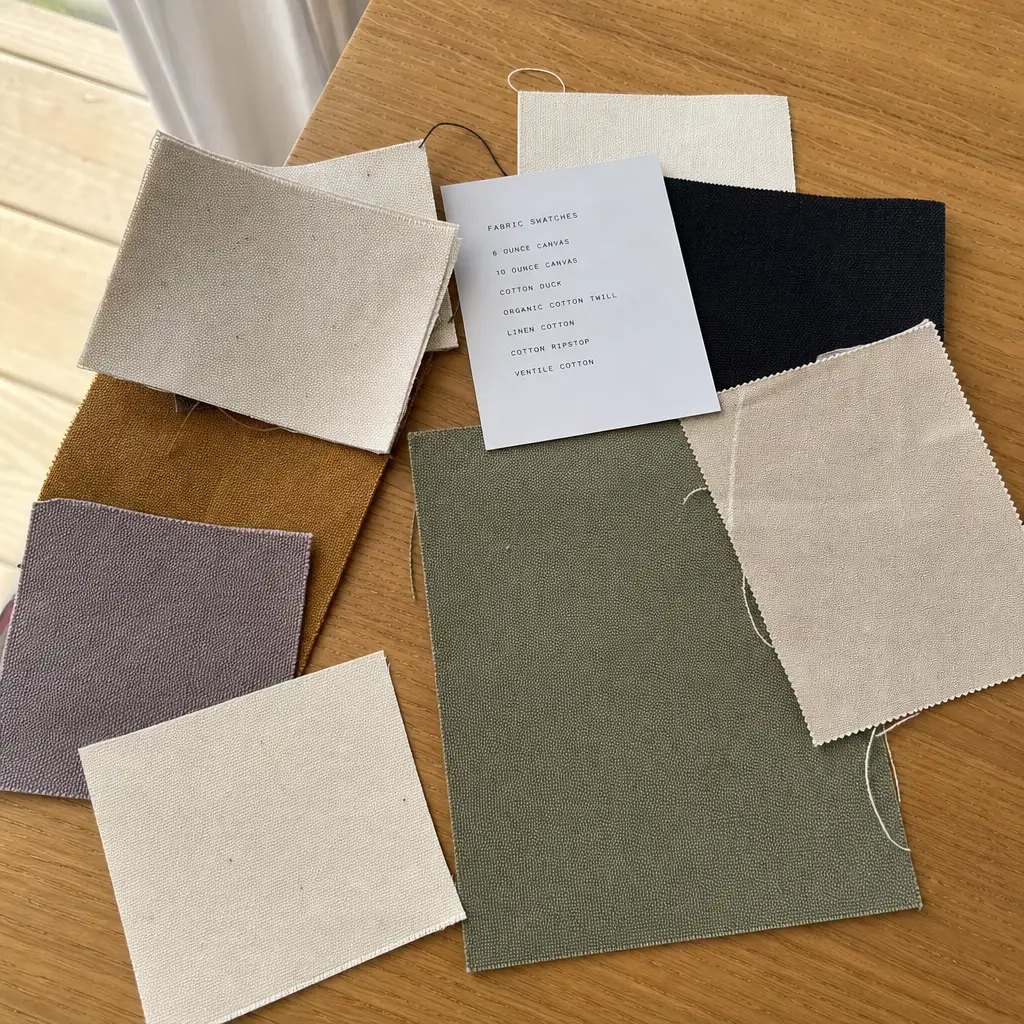
Ask for fabric cards or cut swatches as part of sample approval. They are useful only if they match the actual bulk source and not a similar-looking substitute.
- Request oz, GSM, composition, weave, and finish on every quote.
- Use fabric cards or cut swatches as part of sample approval.
- Lock the base fabric early if you expect repeat orders.
Construction choices that affect function, not just appearance
The shell is only one part of the messenger bag. Functional quality comes from the construction beneath it: lining, sleeve padding, seam allowance, reinforcement patches, webbing grade, zipper quality, and load path from the body to the strap anchors. For tech buyers, these details matter because the bag needs to carry devices and accessories reliably, not just look good in a product photo.
Start with the laptop sleeve and main compartment. If the bag is meant to protect devices in ordinary commuting use, ask whether the sleeve is padded, how the top edge is finished, and what dimensions are actually usable once the seams and lining are installed. Then check the opening and gusset. A bag can meet the target outer size and still feel cramped because the opening is too narrow or the gusset collapses when loaded. Pocket depth and closure style matter too. A front organizer pocket that looks neat in a flat sample may be hard to use once the main body is filled.
The strap system deserves its own review. Ask about webbing width, thickness, adjuster style, anchor reinforcement, and whether the strap is detachable. For a messenger bag carrying a laptop, weak strap anchors are a common failure point. Reinforcement should be part of the design, not an afterthought. If the supplier cannot explain where bartacks, box stitches, or reinforcement layers are used, they may not be controlling durability consistently.
If you plan to include a trolley sleeve, magnetic flap, water bottle pocket, or hidden pocket, ask the supplier to show how each feature affects sewing complexity and cost. Extra pockets can be useful, but they also add points of failure and can reduce clean packing efficiency. More features are not automatically better; the right balance is the one that supports the actual use case.
Do not approve construction from a flat sketch alone. Ask to see the bag loaded, zipped, opened, and carried if possible through photos or video. That is where real usability problems usually appear.
- Ask for sleeve dimensions, padding detail, and opening width.
- Review gusset function with the bag loaded, not empty.
- Treat strap anchors, webbing, and reinforcement as key approval points.
Decoration, labels, and branding: compare like for like
Logo decoration is one of the easiest places for quote comparisons to go wrong. A supplier pricing screen print on a flat panel is not pricing the same thing as a supplier pricing embroidery over a seam-adjacent area or a sewn patch with extra labor. For custom canvas messenger bags, the buyer should define the decoration method before comparing commercial terms. Screen printing is often a practical default for simple startup logos because cost is stable and repeatability is good. Embroidery can look premium on a small mark but can distort fabric if stitch density is too high. Heat transfer or digital methods may suit complex artwork, but they need durability review if the bag will be folded tightly or handled heavily.
Branding scope also includes labels and secondary marks. Many startups forget to price an inside care label, woven side label, or barcode label at the quote stage and add them later. That creates avoidable changes to MOQ, setup, and timing. If you need a retail-facing or enterprise-approved presentation, state all labeling requirements in the first RFQ. Include logo position, dimensions, Pantone references where relevant, and tolerance expectations.
Ask suppliers practical production questions, not just design questions. What is the smallest legible text on this canvas? How close can artwork sit to a seam? What is the typical placement tolerance on a front panel this size? If a supplier answers with concrete limits, they are easier to compare. If they answer only with yes, no problem, expect revisions later.
It also helps to separate primary branding from compliance or identification labels. A sewn label, woven label, or care label may affect inside panel layout and stitch path. If those items are added after sample approval, the bag can change in subtle but important ways. Include them in the first approval round so the sample reflects the real production spec.
If your organization uses a master brand guide, send the relevant pages with the RFQ. That avoids repeated back-and-forth over logo size, background contrast, and preferred label style.
- Fix decoration method before comparing unit pricing.
- Include all labels and secondary branding in the first RFQ.
- Ask for minimum text size and placement tolerance in writing.
Compliance evidence to request, and when CPSIA actually matters
Compliance discussions are often too broad in bag sourcing. Buyers mention REACH, CA Prop 65, or CPSIA without specifying what evidence they expect. That creates confusion because these frameworks apply differently depending on the product, the market, and the channel. A useful supplier compliance checklist should focus on documents the buyer can actually review.
For REACH-related sourcing into Europe, ask the supplier for current material declarations or third-party test reports tied to the finished bag or its key materials. At minimum, the buyer should know whether the supplier can identify shell fabric, lining, prints, coatings, inks, labels, and hardware by source and lot. If testing is required, ask for the report date, lab name, product description, and whether the tested materials match the current construction. A generic older report for a different style is weak evidence.
For CA Prop 65, ask what evaluation the supplier can support for relevant materials and whether they can provide test reports or declarations for inks, coatings, metal hardware, and other components that may trigger review. If warning-label decisions are part of your program, that should be handled with your legal or compliance team. The supplier’s job is to provide accurate material information, not to make legal decisions on your behalf.
CPSIA is often discussed when products are sold into channels involving children’s product review, but it does not automatically apply to every adult corporate messenger bag. For typical tech-startup onboarding or corporate merch, you usually only need CPSIA-specific support if your sales channel, customer requirements, or product positioning makes it relevant. In those cases, ask for the exact documentation you need, such as traceability support, testing where applicable, and tracking label support. If the bag is clearly an adult promotional item, say so in the file to avoid unnecessary confusion. The key is to match the compliance request to the product and channel rather than to a generic checklist.
Across all of these frameworks, the main rule is simple: request current, product-relevant evidence, not broad promises. Also ask who owns the documentation and whether updates can be provided for repeat orders if materials change.
- Request dated, product-relevant documents tied to current materials.
- Check whether reports match your exact construction, not a similar bag.
- Clarify document ownership: factory, trader, mill, or third-party lab.
Sampling discipline: prototype, pre-production sample, and first-piece approval
Many startup teams approve samples too early. A polished prototype may be enough for stakeholder review, but not enough for bulk release. Messenger bags benefit from clear checkpoints depending on project complexity: a prototype to confirm shape and branding, a pre-production sample to confirm final materials and construction, and a first-piece approval when the bag has functional details that could drift during production.
The prototype stage should answer basic design questions: Does the silhouette look right? Does the laptop fit? Does the logo scale work? The pre-production sample should answer manufacturing questions: Are the approved fabric, lining, zipper, hardware, labels, and reinforcement actually in use? Does the final packing method protect the product? If the project includes a padded sleeve, flap magnets, multiple internal pockets, or retail labeling, a pre-production sample is strongly recommended. It reduces surprises when the line starts.
First-piece approval is especially useful when a startup is working with a supplier for the first time. Ask for photos or video of one actual production unit with measurement points visible. This step helps catch avoidable issues such as shifted label placement, wrong zipper pull, reduced pocket depth, or simplified reinforcement. It is usually cheaper to stop and correct a first piece than to sort through packed cartons later.
A clean approval process also reduces internal confusion. The product team can comment on appearance, operations can verify packing, and procurement can confirm the commercial scope. When those decisions are separated, the final approval is easier to defend if questions come up later.
If the bag will be reused in multiple programs, keep the approved sample, fabric card, and packing reference together in one file. That makes reorders and supplier transitions much easier.
- Use prototype approval for design, not full production release.
- Use a PP sample to verify final materials and construction.
- Add first-piece approval for new factories or function-heavy designs.
QC standards buyers can put into the purchase order
Quality control becomes more useful when it is measurable. For custom canvas messenger bags, buyers should define the inspection framework before production starts. That includes the AQL level, points of measure, defect categories, and any functional tests. If your team uses a third-party inspection company, give the same standard to the supplier so there is no argument later about what pass or fail means.
Measurement protocol is one of the simplest upgrades a buyer can make. State that bags are measured laid flat on a hard table, with width across the body at the specified point, height from top edge to bottom seam, gusset at its widest natural point, and strap length from hardware reference to hardware reference. Example tolerances can be set by project, but many buyers use about ±0.5 cm for body dimensions and a slightly wider tolerance for gusset or soft components. Placement tolerances should also be named. A logo that drifts 1 cm low can make a premium bag look off even if the sewing is otherwise acceptable.
Functional test detail matters too. If the messenger bag is sold or distributed as a laptop-carry product, strap-load performance should be checked. A practical static hold test can be specified using the intended bag weight plus a safety margin for a defined period, with no seam burst, anchor tearing, or hardware deformation allowed. Zipper cycling, hardware function, and visual checks for stains, skipped stitches, and seam puckering should be listed in the workmanship criteria.
A clear defect list also helps. For example, a misplaced logo may be a major defect if the brand is sensitive to presentation. A loose thread may be minor unless it affects seam integrity. Hardware that scratches badly, pockets that are too shallow for the approved use case, or a strap anchor that shows stress marks should be treated more seriously than a simple cosmetic issue. The buyer should decide that logic before inspection begins.
Once QC rules are written into the PO or quality annex, they become easier to enforce. That is especially important when the bag is part of a startup launch, where timing pressure can otherwise push teams to accept vague quality claims.
- Name the AQL plan in the PO or quality annex.
- Define measurement points and tolerances clearly.
- Include at least one functional test for load-bearing components.
Packing, hybrid fulfillment, and landed-cost thinking for startups
Tech startups often have mixed fulfillment realities. Some units go to a head office for onboarding days. Some go to a 3PL for individual shipment. Some are held for conferences or investor events. The same messenger bag may therefore need different pack-out logic depending on the channel. A supplier that is strong on sewing but weak on packing control can still create downstream cost through relabeling, repacking, or receiving delays.
Start with unit pack decisions. Does each bag need a polybag, tissue, insert card, desiccant, or protective wrap on hardware? Should the strap be folded inside or laid flat to avoid hard creases? Where should the barcode sit so a warehouse can scan without opening the unit? Then define carton rules: units per carton, gross weight cap, outer dimensions, master carton marks, and any SKU separation. If your 3PL has receiving rules, send them to the supplier before the quote is finalized.
Landed cost should include more than ex-factory price. A bulkier fold method, lower carton efficiency, or missing barcode can quietly increase total program cost. For startups, that hidden cost can show up as warehouse labor, launch delays, or split inventory handling. A slightly higher unit quote from a supplier that packs correctly and documents clearly may be commercially better than a cheaper quote that pushes work downstream.
For multi-channel programs, ask the factory for a simple packing mockup. That one visual check can prevent a surprising amount of rework. It also gives operations a better sense of how the product will arrive, how much shelf or bin space it needs, and whether the bag keeps its shape under transit stress.
If you expect future reorders, keep the packing spec separate from the product art file. That makes it easier to revise fulfillment details without reopening the entire bag design.
- Match pack-out to office, event, or DTC channel needs.
- Specify barcode location and carton rules before bulk pricing.
- Compare landed operational cost, not only factory unit price.
How to review quotes without getting lost in vendor language
A good RFQ process for custom canvas messenger bags should feel simple, not bureaucratic. Send the same core spec to every supplier. Ask each one to quote the same construction, decoration, packing, and compliance scope. Then compare not only price, but also what each supplier had to clarify, what they left vague, and how well they translated your use case into a production plan.
The most revealing questions are usually about change control and evidence. What happens if the approved zipper is unavailable? Who must approve a substitute? Can the supplier show dated test records that actually correspond to the materials in this bag? Can they define lead time start conditions precisely? Can they explain their first-piece approval workflow? These questions expose whether the supplier runs an organized production system or simply sells attractively during quotation.
A useful quote review scorecard is short: scope clarity, sample plan, documentation quality, packing fit, and change-control discipline. Price still matters, but it should sit beside the operational questions that determine whether the bag arrives usable. A supplier that asks smart clarifying questions is often safer than a supplier that says yes to everything.
To keep the process efficient, ask each supplier to quote on the same assumptions: same fabric weight, same logo method, same pocket structure, same packing, same compliance asks, and same lead-time trigger. If one supplier adds hidden extras and another does not, the lowest quote may only be the least complete quote.
The practical workflow is: define use case, issue RFQ, review quote parity, approve sample stages, lock QC and packing, confirm compliance documents, then release the PO. That sequence is usually enough for startup programs without making procurement feel heavy.
- Use one RFQ format so quotes are genuinely comparable.
- Score suppliers on clarity, controls, and evidence as well as cost.
- Prefer vendors who define substitution and approval rules upfront.
Specification comparison for buyers
| Supplier option | What to verify | Commercial advantage | Buyer risk to control |
|---|---|---|---|
| Direct sewing factory | hardware trim card, strap-load photo, lining close-up, approved flap sample, and first-piece production photos | Better sample-to-bulk control and faster production feedback | May be weaker on export paperwork or branded packing unless checked early |
| Trading company | Factory name, production photos, trim-source proof, and who owns QC decisions | Can coordinate small mixed orders and extra services | Markup can hide real factory capability and slow defect decisions |
| Specialized bag workshop | flap shape, strap webbing, buckle, D-ring, inner pocket, zipper pocket, seam allowance, and load path | More practical for detailed construction, trims, and repeat programs | Capacity may be limited during peak seasons |
| Low-price general supplier | 10-16 oz canvas, washed canvas, rPET canvas, lining fabric, interfacing, and hardware finish | Useful for simple promotional runs with loose specs | Material downgrades, weak packing, and vague inspection scope can erase savings |
| Retail-ready supplier | shape support, strap folding, hardware protection, individual bag, carton drop expectation, and retailer hangtag placement | Can handle labels, SKU separation, carton marks, and receiving rules | Higher unit cost must be compared against reduced warehouse work |
| Compliance-focused supplier | Fabric records, labeling review, test plan, and production traceability | Safer for retail programs and repeat brand orders | Documentation claims need evidence, not only sales language |
| Local sample room plus bulk factory | Signed sample, bulk factory handoff, first-piece photos, and deviation owner | Good for complex branding before large production | Sample room quality may not match bulk line unless handoff is controlled |
Buyer checklist before sampling
- Confirm the actual carry kit by team role: 13-inch or 16-inch laptop, charger, mouse, notebook, badge, cables, bottle, and any insert card.
- State shell fabric in ounces and GSM, plus composition, weave, finish, and whether recycled content is required.
- Define device-fit dimensions for the internal sleeve, not only the outer bag size, and note whether the laptop will already be in a case.
- Lock decoration method, artwork size, Pantone target, placement point, and acceptable color and position tolerance before sample sign-off.
- Ask for MOQ by shell color, artwork, lining, custom label, hardware finish, and packing requirement.
- Require a prototype, then a pre-production sample if the bag includes padding, magnetic closures, or multiple pockets.
- Specify packing format, barcode location, carton quantity, gross weight limit, and whether units ship to offices, events, 3PLs, or end customers.
- Request supplier evidence for REACH, CA Prop 65, CPSIA only if relevant to your channel, or other applicable rules, with document dates and material scope shown clearly.
- Set QC standards in writing: AQL level, measurement method, load test requirement, workmanship criteria, and defect classification.
- Confirm exactly when lead time starts: after artwork approval, sample sign-off, deposit, material booking, or all of the above.
Factory quote questions to send
- What is the exact shell fabric specification in oz and GSM, composition, weave, finish, and color source, and can you put it on the quote and sample card?
- What laptop size and actual device dimensions does this construction fit comfortably once charger and accessories are inside? Please state sleeve opening and usable internal width and height.
- Which decoration method is included, what print area and color count are priced, and what setup or surcharge applies if we add a second logo position or inside label?
- What is your MOQ by color, by artwork, by lining option, by hardware finish, and by packing requirement?
- What are your sample stages: prototype, revised sample, pre-production sample, and first-piece approval, and which stage best predicts bulk quality?
- For REACH, CA Prop 65, or CPSIA only if applicable to our market and channel, what exact evidence can you provide: supplier declarations, third-party test reports, bill of materials, tracking label support, or warning-label review?
- What are your workmanship and measurement tolerances for bag width, height, gusset, strap length, logo placement, stitch density, and zipper alignment?
- What load test do you use for straps and anchor points, how long is the hold time, and is the test performed on the approved construction or only on a similar style?
- What packing is included in the quote at unit and carton level, and can you show a packing mockup for DTC, office bulk delivery, or warehouse receiving?
- If any material or trim is unavailable, what is your substitution approval process, who must sign off, and how will the change be documented before production continues?
Quality-control points to confirm
- Shell canvas weight should stay within the agreed tolerance, such as ±5% of approved GSM, with no unapproved change in composition, finish, or visible weave density.
- Finished bag measurements should be taken laid flat on a hard table using the approved points of measure; a practical tolerance example is ±0.5 cm on width and height and ±0.7 cm on gusset unless the buyer approves otherwise.
- Logo placement should be measured from fixed reference points such as top edge and side seam; a common commercial tolerance is ±3 mm for woven labels and ±5 mm for screen print placement on larger panels.
- Stitch density should be consistent and appropriate to the construction, with reinforcement at strap ends, flap anchors, D-ring tabs, handle roots, and zipper ends; skipped stitches, loose ends, and seam grin at load points are major defects.
- Strap load test should be defined before bulk. A practical static hold test uses the intended bag weight plus a safety margin for 24 hours, with no seam burst, hardware deformation, or visible strap-anchor failure.
- Zippers should run smoothly through full travel for repeated cycles, with no tape puckering, tooth damage, offset installation, or weak back-tack at end stops.
- Padded laptop sleeve dimensions, opening width, retention method, and seam cleanliness should be checked against the specified device size including any protective case allowance.
- Hardware finish and color should match the approved sample, with no sharp edges, plating peel, major scratches, or inconsistent buckle function.
- Workmanship inspection should follow a named AQL standard such as AQL 2.5 for major defects and 4.0 for minor defects unless the buyer sets a stricter plan.
- Carton audit should confirm unit count, barcode readability, carton marks, gross weight, dimensions, and whether the fold method protects the bag shape and hardware during transit.