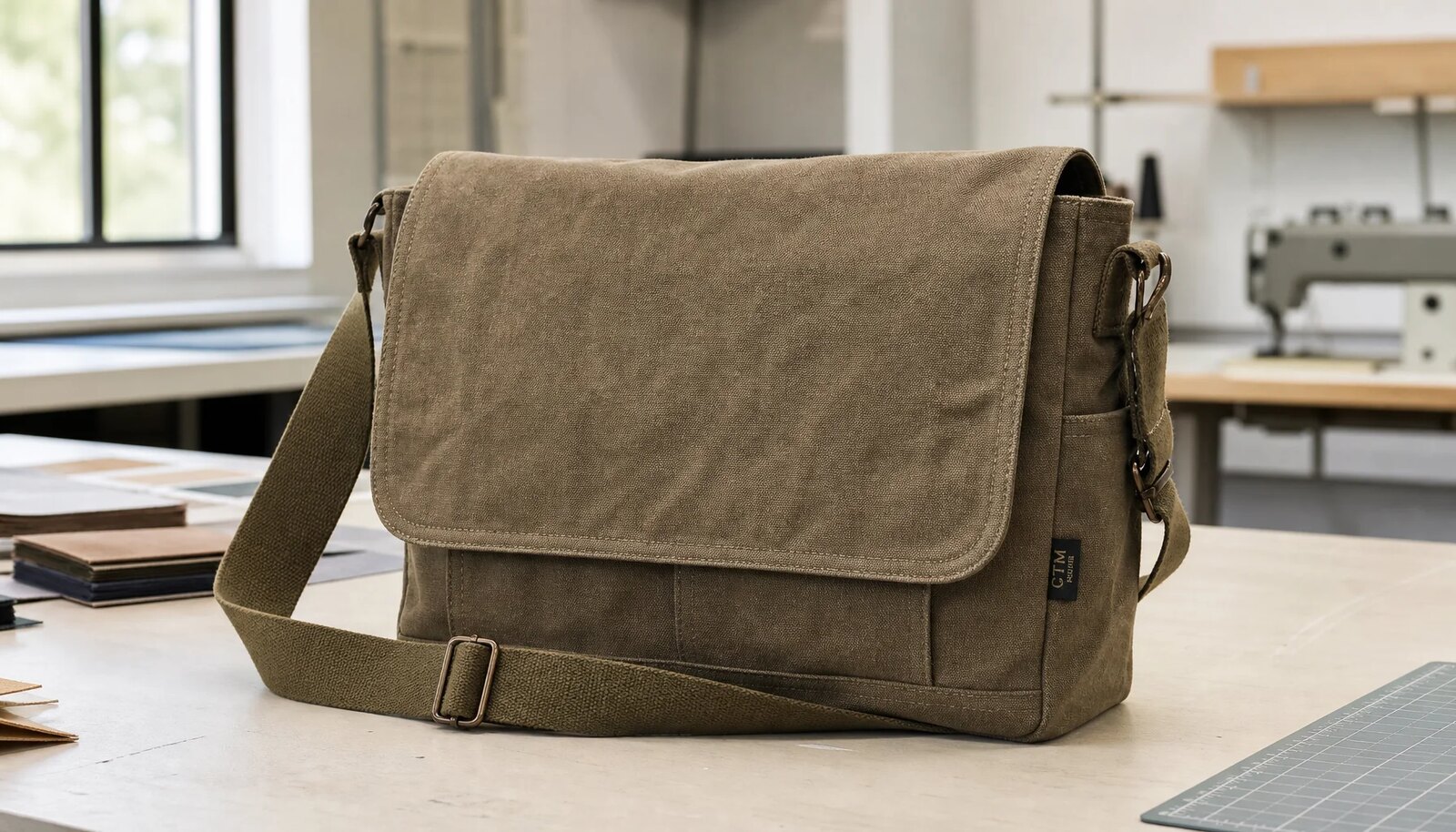
Start with the event brief, not the bag photo
Most problems in a custom canvas messenger bag order begin before the first quotation is issued. Procurement asks for pricing on a reference image, marketing comments on logo appearance, and operations assumes the supplier will somehow infer the right packing plan. That is not a sourcing process. It is a set of unstated assumptions that later becomes a rush of sample revisions, cost disputes, and preventable delivery risk.
For B2B buyers, the event brief is the control document behind the product brief. It should explain where the bag will be used, what it must carry, how it will be distributed, and what failure would be most expensive. A bag handed out empty at registration has a different risk profile from a bag pre-filled with catalogs, drinkware, and printed collateral at an off-site venue. If the order must arrive sorted by sponsor tier, by show date, or by registration desk, that requirement belongs in the first RFQ pack, not in a last-minute packing email.
This matters because a custom canvas messenger bags supplier compliance checklist for event planners is not just about product quality. It is also about whether the supplier can translate event requirements into repeatable production and delivery controls. A low unit price is usually a poor result if the bags arrive short-counted, with mixed label versions, or in cartons that force the onsite team to open and sort everything under deadline pressure.
- Write the event use case before requesting quotes.
- Define what the bag carries, how it is handed out, and who receives it.
- Treat distribution format and labeling as part of sourcing scope.
- Use the brief to align procurement, branding, and logistics before sampling starts.
Define the messenger bag specification so suppliers quote the same product
A supplier cannot give a comparable quote if each factory is free to imagine a different bag. In practice, one quotation may assume 10 oz fabric, no lining, and a 3 cm webbing strap, while another assumes 14 oz fabric, a full lining, a 3.8 cm strap, inner zipper pocket, and magnetic flap closure. Both are still described as canvas messenger bags, but they are not commercially equivalent.
A workable RFQ should state finished dimensions in centimeters, not only a flat sketch or inspiration photo. List width, height, gusset depth, flap drop, pocket count, strap width, strap adjustment range, handle detail if any, and whether the base includes interfacing or board. If the bag must fit A4 brochures, a 13-inch tablet, exhibitor materials, or a boxed gift set, say so directly. Event buyers often overlook target load, yet target load is what drives practical reinforcement decisions at strap joins, base corners, and flap closure points.
Fabric specification also needs discipline. State the canvas weight in both ounces per square yard and gsm, plus fiber composition and finish. For example, 12 oz cotton canvas is approximately 407 gsm, while 16 oz is approximately 542 gsm. For many event programs, the commercially useful range is 12 oz to 16 oz because it balances print appearance, structure, and cost. If you want washed canvas, coated canvas, or recycled content, put that in the RFQ. If the bag should feel soft and casual, say that. If it needs to sit upright and look clean on a registration table, say that too.
- Specify finished size, not pattern size.
- State canvas in both oz and gsm to reduce ambiguity.
- Define closure type: open top, zipper, magnet, snap, or buckle.
- Note lining type, pocket layout, and reinforcement requirements.
- Include intended contents or target load if bag performance matters.
Know the commercial spec ranges that affect cost and performance
Procurement buyers do not need to overengineer a promotional bag, but they do need to understand which specifications change the quote materially. Fabric weight is one of the clearest drivers. A plain unlined 10 oz bag can be priced very differently from a 14 oz or 16 oz bag with full lining and reinforced strap tabs. The same is true for webbing width, hardware finish, and whether the bag includes a zipper pocket or shaped flap.
As a planning shortcut, many event bags sit within a few common commercial ranges. A body size around 34 to 38 cm wide, 26 to 30 cm high, and 8 to 12 cm gusset is typical for conference materials. Strap widths of 3.0 cm to 4.0 cm are common; 3.8 cm often feels more stable when the bag carries catalogs or a tablet. Lining choices range from unlined, to half lining under the flap, to full lining with internal pocketing. These are not mandatory standards, but they are useful RFQ anchors because they reduce the chance that each supplier prices a different interpretation.
Tolerances should also be considered early, not after the sample is approved. On a sewn cotton bag, zero tolerance is not realistic. A practical commercial starting point is often +/- 1.0 cm on finished width and height, +/- 0.7 cm on gusset depth, and +/- 5 mm on logo placement from defined reference points. These values should be adjusted for the product, but if no numbers appear in the RFQ or PO, suppliers will assume their own standard. That is where disputes start.
- Use practical commercial ranges to frame your RFQ.
- Expect structure, lining, and hardware choices to move the price.
- Define measurable tolerances before the supplier samples.
- Treat zero-tolerance language as a red flag unless the product and process can support it.
Verify supplier identity, production route, and compliance evidence early
A good-looking sample is not proof of a reliable production chain. Before sampling goes too far, confirm who your contractual counterparty is, where production will happen, and which operations are outsourced. On custom canvas messenger bag programs, the most common outsourced steps are printing, embroidery, patch application, washing, and sometimes final packing. If the supplier cannot state these handoffs clearly, it will be difficult to assign accountability when defects or delays appear.
Ask for the legal company name, registered address, and production site address. If you are dealing with a trading company, ask for the named factory producing your order. Request business registration and any factory audit reports or quality certifications your organization requires. If the program has retailer-style requirements, ask whether the supplier can manage origin labels, care labels, barcode application, and destination carton marks. If those tasks are outsourced, ask who checks them before shipment.
Documentation alone is not enough. Operational evidence matters. Request recent production photos, a trim card showing canvas, webbing, lining, labels, and hardware, and examples of first-piece approvals or inline inspection reports. A supplier that can show you how it controls a bag order is usually more credible than one that only repeats generic compliance language. The goal is not paperwork for its own sake. The goal is traceability and clear ownership across the steps most likely to fail.
- Match the quote, sample, and factory information to the same entity whenever possible.
- Ask which steps are outsourced and who makes the final QC call.
- Check whether the supplier can support your labeling and packing requirements.
- Use practical evidence such as trim cards and line photos, not sales claims alone.
Use a quote sheet that exposes hidden scope, not just unit price
Suppliers often answer an inquiry with three headline points: price, MOQ, and lead time. That is not enough for a procurement decision. A serious quote sheet should force each bidder to declare the same cost and scope blocks so you can compare like with like. At minimum, capture finished dimensions, fabric specification, lining, webbing, hardware, branding method, number of print positions, sample fee, setup fee, MOQ, lead time by stage, packing details, incoterm, payment terms, and validity period.
This is where many hidden costs surface. A supplier may appear cheaper until you discover that polybags, barcode labels, export cartons, inspection support, or artwork setup were excluded. Another supplier may quote a faster lead time that actually begins after all artwork and sample approvals, while a different supplier counted fabric booking in its stated lead time. Those are not small differences. They change landed cost and schedule risk materially.
It is also important to ask about overrun and underrun policy. Event programs often require exact counts for venue distribution, sponsor allocations, or desk-by-desk packing. A factory standard that allows a short shipment with later credit may be commercially acceptable in some industries but still operationally damaging for an event. The quote should therefore state whether exact quantity is expected, what tolerance is allowed if any, and who absorbs replacement or expedited freight costs if the final shipment does not meet the approved standard.
- Standardize all bidders onto one quote template.
- Separate repeat-order pricing from one-time setup charges.
- Force suppliers to declare what is included in packing and labeling.
- Clarify exact-count expectations and shortage remedies before PO stage.
Sample approval should lock the production standard, not just the look
Many buyers approve a sample because it photographs well or because the logo appears centered on an empty bag. That is not a strong enough control for event procurement. The sample process should move through clear stages: concept sample if needed, revised sample after comments, and pre-production sample made from the intended bulk materials and trims. Once that pre-production sample is approved, it should become the production control reference for the factory, the buyer, and any third-party inspector.
The distinction between sample types matters. A sales sample can confirm silhouette and basic construction, but it may use substitute fabric, temporary hardware, or a hand-finished print. A pre-production sample should not. It should reflect the actual BOM, decoration method, labels, and packing method intended for bulk. If any element is still open, write that exception explicitly and state that cutting cannot begin until the exception is approved. Unwritten assumptions at this stage often lead to lighter fabric, different webbing, smaller pockets, or looser packing in bulk.
Functional testing during sample review is essential. Put the real event contents into the bag or the closest practical substitute. Check whether the flap still closes, whether the print distorts when loaded, whether the strap adjuster slips, and whether the bag shape recovers after being folded for packing. These are normal procurement checks, not luxury product tests. They are especially relevant for event planners because the bag often has to look presentable immediately after cartons are opened onsite.
- Label sample status clearly: concept, revised, or pre-production.
- Approve the sample against the actual BOM and packing plan.
- Test with realistic contents, not only an empty display sample.
- Circulate one approved reference set to the supplier and inspector.
Control branding on canvas with print-method and placement rules
Decoration issues are among the most visible failures on custom canvas messenger bags. Canvas is textured and absorbent, so the artwork method needs to suit the surface. For simple one-color or two-color graphics, screen printing is often the most commercial option because it performs well at volume and usually gives a cleaner look on medium-to-heavy canvas than a rushed transfer process. For complex multi-color art, photo-like graphics, or multiple small named versions, a transfer-based method may be considered, but the buyer should review edge adhesion, hand feel, and resistance to cracking on folded panels. Embroidery and stitched patches can create a premium look, but they add cost, sample time, and a risk of panel distortion if backing and placement are not managed correctly.
Placement must be defined from physical reference points, not from an abstract centered mockup. On a messenger bag, flap shape, seam allowance, topstitching, and filling can change the apparent balance of the logo. A better instruction is to measure from the finished flap edge or side seam and state the print area and acceptable deviation. For most event bags, a placement tolerance of +/- 5 mm is a workable starting point if the artwork size and bag structure allow it.
Color control should also be written with care. If the buyer expects a close Pantone match, say which Pantone reference applies and whether approval is by printed strike-off, fabric swatch, or sample review. If the order uses a simpler visual match standard, say that instead. What matters is that both sides understand the approval basis. Vague language such as 'match logo color' is not an inspection standard.
- Choose the print method based on artwork, volume, and fabric texture.
- Approve print placement from seam-based reference points.
- Write color approval method into the sample and PO workflow.
- List every branding element separately, including labels and patches.
Build measurable QC and inspection rules into the PO
Quality control is only useful when the acceptance rules are measurable. 'Good quality' or 'same as sample' is too vague unless the sample is fully documented and the PO names the critical checkpoints. Start with dimensions, fabric, logo placement, seam quality, hardware finish, label accuracy, and packing count. Then list the stress points that must be reinforced and checked, including strap joins, D-ring tabs, base corners, flap corners, and zipper ends where applicable.
If your organization uses AQL, include that method in the inspection brief before production starts. A common commercial approach for general merchandise is AQL 2.5 for major defects and 4.0 for minor defects, but the correct standard depends on your internal policy and risk tolerance. If you do not use AQL, define your own pass-fail rules clearly. For example, missing bartacks, broken hardware, incorrect carton marks, or logo misplacement beyond tolerance should be treated as major defects, while minor thread ends that can be trimmed may be classified differently. The important point is consistency and written agreement.
A simple load test is often worth adding for messenger bags intended to carry catalogs, sample kits, or electronics. The exact method should suit the product, but the buyer should at least define a fill weight and failure criteria. For example, the bag may be loaded to the intended event-use weight for a short hang or carry check, with no seam opening, hardware deformation, or webbing slippage permitted. This is not a substitute for lab testing when required, but it is a practical control for commercial bag orders.
- Define dimensional, visual, and functional checkpoints in writing.
- State your inspection method before production starts.
- Classify obvious failures such as missed reinforcement or bad carton marks as major defects.
- Add a practical load test when the bag will carry meaningful weight.
Packing and labeling should match the event-distribution workflow
Packing is not an afterthought on event orders. It directly affects labor at the warehouse, at the venue, and sometimes at customs or receiving. Decide early whether bags should be individually polybagged, tissue stuffed, desiccant packed, or bulk packed. Premium sponsor bags may justify cleaner individual presentation, while fast-fill attendee bags may not. The right choice depends on who opens the cartons, how quickly the bags must be deployed, and whether the bags need to look crisp immediately after unpacking.
Carton planning matters just as much as inner packing. State exact units per carton, carton dimensions if limited by pallet or venue access, and maximum gross weight if your warehouse or event team has handling limits. For many buyers, keeping carton gross weight under about 15 kg to 18 kg is operationally easier, but the correct figure depends on your receiving environment. If cartons must be split by venue, date, region, or sponsor tier, write the format into the PO and require carton-mark approval before packing begins.
Barcode labels, origin labels, and carton marks should be treated as controlled artwork, not side notes. Ask for label samples or photos, confirm placement, and check that the supplier understands whether labels apply to the individual bag, the polybag, the inner bundle, or the outer carton. Many event teams lose time because the product itself is fine but the outer logistics format was never properly specified.
- Choose inner packing to support the real distribution method.
- Set units per carton and any gross-weight limits early.
- Approve carton marks and barcode placement before bulk packing.
- Use packing photos as part of shipment release evidence.
Work backward from the in-hand date and compare landed cost, not headline price
Event schedules are fixed more often than merchandise schedules are. That means the sourcing timeline must be built backward from the required in-hand date, not forward from the supplier's best-case production estimate. Break the project into approval gates: RFQ issue, quote comparison, sample round, revised sample if needed, pre-production approval, material booking, decoration setup, sewing, inline check, final inspection, packing, dispatch, and inbound delivery. Each gate should have an owner and a buffer. When orders slip, the delay is often caused by artwork, sample comments, or label changes rather than sewing time itself.
This backward-planned timeline should then be evaluated together with landed cost. Add sample fees, artwork setup, woven labels, barcode application, inspection, special packing, inland transfer, freight assumptions, duties or import charges where relevant, and downstream handling caused by the chosen packing format. A supplier that appears cheaper on an ex-works basis may become more expensive after repacking labor, split-shipment risk, or expedited freight exposure is considered.
The strongest commercial decision is usually the one with the fewest unpriced assumptions. If two suppliers are close on unit cost, the better choice is often the supplier with the clearer BOM, tighter sample discipline, more credible timeline, and better packing control. That is the real procurement value of a supplier compliance checklist: it converts a loosely defined promotional product purchase into a controlled B2B sourcing decision.
- Plan backward from in-hand date with named approval gates.
- Add buffer for sample revisions, labeling changes, and freight cutoff.
- Compare landed cost with all handling and packing effects included.
- Prefer the quote with fewer open assumptions, not just the lower unit price.
Specification comparison for buyers
| Supplier option | What to verify | Commercial advantage | Buyer risk to control |
|---|---|---|---|
| Direct sewing factory | hardware trim card, strap-load photo, lining close-up, approved flap sample, and first-piece production photos | Better sample-to-bulk control and faster production feedback | May be weaker on export paperwork or branded packing unless checked early |
| Trading company | Factory name, production photos, trim-source proof, and who owns QC decisions | Can coordinate small mixed orders and extra services | Markup can hide real factory capability and slow defect decisions |
| Specialized bag workshop | flap shape, strap webbing, buckle, D-ring, inner pocket, zipper pocket, seam allowance, and load path | More practical for detailed construction, trims, and repeat programs | Capacity may be limited during peak seasons |
| Low-price general supplier | 10-16 oz canvas, washed canvas, rPET canvas, lining fabric, interfacing, and hardware finish | Useful for simple promotional runs with loose specs | Material downgrades, weak packing, and vague inspection scope can erase savings |
| Retail-ready supplier | shape support, strap folding, hardware protection, individual bag, carton drop expectation, and retailer hangtag placement | Can handle labels, SKU separation, carton marks, and receiving rules | Higher unit cost must be compared against reduced warehouse work |
| Compliance-focused supplier | Fabric records, labeling review, test plan, and production traceability | Safer for retail programs and repeat brand orders | Documentation claims need evidence, not only sales language |
| Local sample room plus bulk factory | Signed sample, bulk factory handoff, first-piece photos, and deviation owner | Good for complex branding before large production | Sample room quality may not match bulk line unless handoff is controlled |
Buyer checklist before sampling
- Define the event use case in writing: attendee giveaway, sponsor kit, staff issue, press pack, VIP gift, or resale-support item.
- Issue one RFQ specification sheet to all suppliers with finished dimensions, gusset depth, flap style, closure type, pocket layout, strap width, and target load.
- State fabric as both oz and gsm, plus fiber composition, weave, color, wash or coating, and whether recycled content is required.
- Specify whether the bag is unlined, half-lined, or fully lined, and note any foam, base board, binding, or interfacing.
- List all branding elements separately: front print, back print, inside label, woven side tag, patch, hangtag, barcode, and carton marks.
- Confirm the legal supplier name, production address, and which processes are outsourced, including printing, washing, label sewing, and final packing.
- Require a pre-production sample made from bulk-intended materials and state that it becomes the production control sample once approved.
- Write measurable tolerances into the PO, including finished size, logo placement, print color reference, stitch quality, hardware finish, and packing count.
- Set inspection expectations before bulk starts, including AQL level if used, load-test requirement, and photo evidence needed before shipment release.
- Compare landed cost only after setup fees, sample charges, inspection, packing, freight assumptions, and shortage or replacement terms are aligned.
Factory quote questions to send
- What exact canvas are you quoting, including fiber content, weave, finish, and nominal weight in both oz and gsm? Please attach the fabric specification if available.
- What finished measurements are included in your price for width, height, gusset, flap drop, strap width, and adjustable strap range in centimeters?
- Is the bag produced in your own factory? If not, list each outsourced step such as printing, washing, embroidery, patch sewing, or packing and identify who controls QC at that step.
- What seam construction is included at strap joins, side seams, base corners, and zipper ends? Please state whether bartacks, box-x reinforcement, or backtacks are used.
- What decoration method are you quoting for this artwork on canvas, what Pantone or color standard will you work to, and what print placement tolerance can you hold in millimeters?
- What is the MOQ by colorway, by artwork version, and by any change to fabric, lining, hardware finish, or label type?
- Can you provide a pre-production sample using bulk-intended fabric and trims? State sample lead time, sample fee, revision fee if applicable, and whether the fee is credited against a bulk PO.
- What production lead time do you quote after sample approval, broken out by material booking, printing, sewing, inspection, and packing?
- What packaging is included in the unit price: individual polybag, tissue, insert, desiccant, units per carton, export carton grade, carton dimensions, and gross weight?
- What quality standard do you work to for bulk inspection? If you use AQL, state the level and defect classification method; if not, describe your internal pass-fail standard.
Quality-control points to confirm
- Finished size must match the approved sample and PO within +/- 1.0 cm on width and height, +/- 0.7 cm on gusset depth, and +/- 1.5 cm on total strap length range unless otherwise agreed.
- Canvas weight must stay within the agreed commercial tolerance to the quoted standard, typically within +/- 5 percent of the nominal gsm, with no unauthorized fabric substitution.
- Logo placement must be within +/- 5 mm from approved seam-based reference points, and print alignment must show no obvious skew, ghosting, voids, or color contamination.
- Spot-color print should visually match the approved standard under normal daylight; any critical Pantone match requirement must be written into the PO before production starts.
- Main seams should be even and secure, with no skipped stitches, loose thread chains, seam grin, or raw-edge exposure beyond the approved construction method.
- Stress points at strap joins, D-ring tabs, flap corners, and zipper ends must follow the approved reinforcement pattern, such as bartack or box-x stitch, with no seam opening under agreed load test.
- Webbing width, hand feel, color, and edge finish must match the approved trim; no twisting, fraying, or excessive slippage through adjusters is acceptable.
- Metal hardware or coated hardware must be consistent in finish, free from sharp edges, burrs, plating peel, rust marks, and deformation, and must move smoothly during normal use.
- Zippers, snaps, magnets, and buckles must function cleanly from end to end without snagging, tooth misalignment, weak closure, or puller detachment.
- Lining, pockets, labels, and country-of-origin or care labeling must match the approved sample and PO, including exact placement where compliance labeling is required.