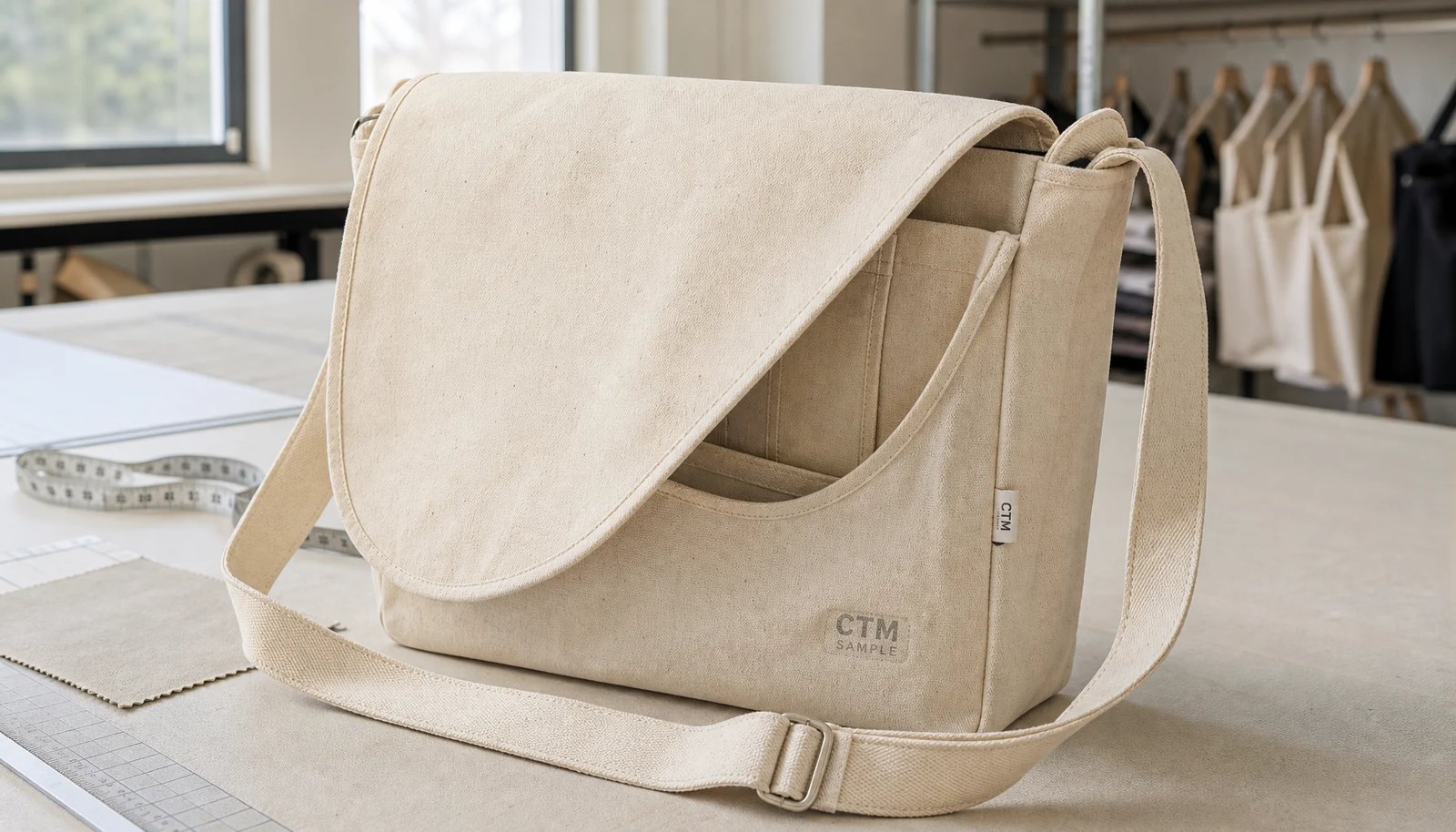
Define the Bookstore Use Case First
A university bookstore canvas messenger bag can be a low-cost orientation giveaway, a paid campus retail SKU, a laptop-friendly student bag, a department program item, or a premium alumni gift. These uses look similar in a catalog photo, but they require different construction, decoration, packing, and inspection controls. The buyer should define the selling purpose before asking suppliers for price.
For giveaways, the priority is usually stable cost, simple artwork, fast carton handling, and reliable delivery. For retail, the product must look consistent on shelf, scan correctly at checkout, carry approved labeling, and survive repeated handling by students and visitors. For laptop or textbook use, the supplier needs clearer load expectations, wider straps, reinforced seams, and stronger closure points.
This step prevents both overbuying and under-specifying. A 16 oz canvas bag with metal hardware may be unnecessary for a one-day event, while a lightweight promotional bag can cause complaints if sold as an everyday book bag. A strong RFQ links the intended use to material, reinforcement, logo method, packing, and QC level.
- Orientation programs: prioritize cost stability, simple packing, carton count accuracy, and delivery date control.
- Retail programs: require clean stitching, consistent logo placement, barcode accuracy, approved hangtags, and shelf-ready appearance.
- Laptop or textbook programs: specify strap width, bottom reinforcement, closure strength, and realistic load checks.
- Alumni or gift programs: use better canvas hand-feel, cleaner internal finishing, premium decoration, and stronger presentation packaging.
- Online bookstore orders: require SKU accuracy, carton labeling, and packing that protects the flap and logo during parcel handling.
Control Licensed University Marks
University bookstore orders often involve protected school names, mascots, seals, slogans, department marks, or athletic logos. These are not ordinary decoration files. Before sampling, confirm who has approval authority: the university licensing office, bookstore, licensee, distributor, athletics department, or brand manager. The supplier should not cut bulk fabric, print panels, embroider logos, make woven labels, or produce hangtags until written approval is received.
The purchase order should state that the factory may use the artwork only for the approved order. It should prohibit unauthorized overruns, resale, sample catalog use, and substitution of similar marks. If screens, embroidery files, woven labels, heat transfers, hangtags, or packaging carry the mark, those materials need the same control as the main flap logo.
Excess branded materials also need a plan. Depending on the license agreement, rejected panels, leftover labels, printed inserts, and defective bags may need to be returned, destroyed, or documented. Treat trademark approval as a production gate, not a final artwork formality.
- Confirm approved logo file, mascot version, wordmark, seal use, slogan use, product category, and placement limits.
- Approve ink colors, thread colors, and Pantone direction on actual canvas, not only on a digital mockup.
- Require written approval before bulk cutting, decoration, label production, hangtag production, or carton printing with licensed marks.
- Control overruns, rejected goods, leftover branded trims, screens, digitized embroidery files, and printed packaging.
- Keep approval records with the PO, signed sample, inspection report, production lot, and shipment documents.
Specify Canvas and Construction
Canvas weight is one of the most common quote-comparison problems. A buyer asking for heavy canvas may receive prices based on 10 oz, 12 oz, 14 oz, or 16 oz material. The RFQ should state both oz and GSM, plus whether the weight refers to greige fabric, finished fabric, washed fabric, or coated fabric. Dyeing, washing, brushing, and coating can change hand-feel, shrinkage, shade, and measurable weight.
For many bookstore retail programs, 12 oz canvas with proper reinforcement is a practical starting point. Lighter 10 oz canvas may suit giveaways with limited load expectations. A 14 oz canvas can provide a stronger retail hand-feel without excessive bulk. A 16 oz canvas may feel premium, but it can increase freight weight, seam thickness, needle stress, and print difficulty.
Construction deserves the same precision as fabric. Messenger bags usually fail at stress points, not in the center of the panel. Specify strap joints, side seams, bottom seam, flap corners, pocket openings, magnetic snap backing, buckle attachment, and rivet reinforcement. Ask the supplier to quote the stitch type, seam allowance, hardware material, strap webbing, and reinforcement method.
- 10 oz canvas: cost-conscious choice for light giveaways and short-term promotional programs.
- 12 oz canvas: balanced retail option when strap and seam reinforcement are included.
- 14 oz canvas: stronger hand-feel for campus merchandise without excessive structure or freight weight.
- 16 oz canvas: premium option that requires tighter sewing control and decoration approval.
- Washed or coated canvas: approve hand-feel, shrinkage, odor, moisture behavior, print result, and packing impact before bulk.
Match Decoration to the Material
Decoration should be chosen by artwork, canvas texture, order quantity, and licensing rules. Screen printing is efficient for bold school logos on a flap or front panel, especially when spot colors are controlled. On coarse canvas, however, small letters can fill in, thin lines can lose sharpness, and ink coverage can vary across slubs.
Embroidery gives a premium look for smaller marks, but dense stitching on a soft flap can pucker or stiffen the panel. Woven labels work well for bookstore private-label programs, side branding, and repeat SKUs. Heat transfers can reproduce detailed artwork, but adhesion, edge lift, cracking, fold marks, and hand-feel should be tested on the selected canvas.
The quote should separate setup charges, screen charges, digitizing fees, label tooling, color-change costs, and repeat-order costs. For licensed programs, confirm who checks first-output artwork and what happens if the logo is wrong. A low unit price loses value quickly if panels must be reprinted or relabeled.
- Use screen print for bold logos, mascot graphics, and cost-controlled repeat orders.
- Use embroidery for smaller premium marks where texture matters more than large color coverage.
- Use woven labels for side branding, private-label identity, and repeat SKU consistency.
- Test heat transfers for adhesion, edge lift, cracking, hand-feel, and appearance after folding.
- Approve placement tolerance, rub resistance, registration, thread trimming, and packing marks on the decorated area.
Break Down MOQ and Price Variables
MOQ should be read by variation, not only by total order quantity. A supplier may quote 1,000 pieces, but that may mean 1,000 pieces per fabric color, logo, strap color, label, hangtag, or hardware set. University bookstore assortments often include multiple campuses, departments, alumni designs, event marks, colorways, and online-exclusive SKUs.
A practical RFQ groups the order into spec families. If the same base bag is used across several logo designs, the factory may be able to split decoration at a lower incremental cost. If each SKU changes fabric color, lining, strap, label, barcode, hangtag, or carton routing, the supplier must manage separate material lots and packing controls.
Quote comparison should also include lead-time triggers. Ask whether the schedule starts from PO date, deposit receipt, artwork approval, lab dip approval, pre-production sample approval, or material arrival. A supplier with a slightly higher unit price but clear sample gates may be safer than a low-price quote with vague timing.
- Base bag MOQ: one fabric color, construction, strap, hardware, closure, and lining combination.
- Logo MOQ: each screen print, embroidery design, woven label, heat transfer, or licensed artwork version.
- Color MOQ: dyed canvas, contrast strap, lining color, binding tape, or custom webbing color.
- Packing MOQ: hangtag, barcode, price sticker, insert card, carton label, destination split, or e-commerce pack.
- Reorder MOQ: replenishment quantity after patterns, screens, labels, trims, and approvals already exist.
Verify Retail Labeling and Receiving
Bookstore merchandise often enters a retail system with specific receiving rules. A custom canvas messenger bag may need a UPC or EAN barcode, internal SKU, price sticker, hangtag, color code, country-of-origin marking, fiber content statement, care language, importer information, and carton label. If these details are handled after import, the buyer may face relabeling labor, launch delays, or receiving errors.
The supplier should confirm whether barcode labels are printed, stickered, or attached by hangtag, and whether each carton is separated by SKU. Barcode scanability should be checked during inspection using an agreed method. Hangtag content should match approved licensed-mark language and any material claims used by the bookstore.
Receiving requirements should be written in operational terms. Cartons may need maximum weight limits, SKU-only packing, destination codes, purchase order numbers, style numbers, color names, case packs, and scannable carton labels. For multi-campus systems, a carton mix error can be as disruptive as a sewing defect because the product cannot be received cleanly.
- Confirm UPC, EAN, SKU, style number, color name, price sticker, case pack, and carton mark format.
- Check country-of-origin marking, fiber content, care instructions, importer information, and applicable warning language.
- Treat hangtags, woven labels, stickers, and packaging with university marks as licensed artwork requiring approval.
- Request evidence before using recycled, organic, rPET, low-impact, fair-labor, or other claim-sensitive language.
- Require barcode scan checks, SKU separation, carton count verification, and destination labeling in the final inspection report.
Name Compliance Documents by Market
Compliance should be framed by destination market, buyer rules, sales channel, and product applicability. Do not ask suppliers to promise every global standard by default. Instead, state which documents may be required for the actual order: fabric composition, dyes, inks, coatings, adhesives, hardware, trims, labels, and packing.
For example, California sales may require Prop 65 review for relevant materials and exposure risks. EU or UK-related programs may ask for REACH SVHC support. CPSIA support is relevant when the product is children’s merchandise, not automatically for every university retail bag. Some buyers use their own restricted-substance list, an AFIRM-style RSL, or brand-specific testing protocol. If the supplier cannot support the named requirement, find out before sample approval.
Social compliance should be handled with the same specificity. University-affiliated merchandise may require a supplier code of conduct, factory profile, audit summary, labor questionnaire, subcontractor disclosure, or no-unauthorized-subcontracting commitment. Avoid vague claims such as ethical, green, or compliant unless the supplier can provide current documents tied to the order.
- Request fabric composition records, trim records, mill declarations, and test support before approving material claims.
- Ask whether inks, dyes, coatings, adhesives, hardware, and trims can meet the buyer’s named RSL or destination-market requirement.
- Identify subcontracted printing, embroidery, washing, cutting, packing, label production, or inspection before PO release.
- Collect factory profiles, audit summaries, code-of-conduct acknowledgments, or labor questionnaires when required.
- Link compliance documents to the PO, artwork approval, production lot, inspection report, and shipment.
Use Samples as Contract Evidence
A pre-production sample should freeze the production standard. It is not only a sales sample or photo reference. The approved sample should confirm fabric hand-feel, shade, pattern, dimensions, gusset depth, flap shape, strap comfort, hardware, logo execution, labels, hangtags, barcode, and packing method.
Sample comments should be written as measurable instructions. Instead of saying the flap should look better, state that the flap length must increase by 1.5 cm, the logo must move 2 cm lower, the strap must widen to 3.8 cm, or the magnetic snap needs a larger backing patch. If a sample is approved with comments, the supplier should issue a correction sheet or revised sample before bulk cutting.
Keep sample control simple but disciplined. One signed sample should stay with the buyer, and one should stay with the factory. Photos help communication, but they do not replace physical comparison for canvas shade, hand-feel, seam bulk, strap comfort, and logo texture.
- Measure width, height, gusset, flap length, strap length, strap width, pocket size, and closure placement.
- Load the sample with realistic contents such as books, a hoodie, tablet, water bottle, or retail bundle.
- Open closures repeatedly and check snap backing, buckle movement, zipper function, strap adjustment, and flap alignment.
- Inspect inner seams, trimming, loose threads, seam allowance, lining, pocket openings, and bottom reinforcement.
- Keep one signed approval sample with the buyer and one with the factory for bulk comparison.
Set QC, AQL, and Shipment Gates
QC standards should be set before production, not negotiated after defects appear. For many retail bag programs, buyers use an AQL plan such as AQL 2.5 for major defects and AQL 4.0 for minor defects, with critical defects not accepted. The buyer and supplier should agree on sample size, defect classes, measurement method, barcode check method, photo requirements, and failure handling.
Inspection timing matters. A first-piece or early-production check can catch wrong logos, weak strap construction, missing labels, incorrect hangtags, or poor flap alignment before the full lot is sewn. Final inspection should happen when goods are finished and packed so barcode accuracy, carton marks, SKU mix, hangtag placement, and packing condition can be verified.
Packing should protect the bag and support bookstore receiving. Canvas can crease, absorb moisture, collect dust, or arrive with distorted flaps if packed poorly. If reduced plastic is required, use carton liners, tissue, paper bands, paper sleeves, or controlled bundle packing, and confirm the moisture-control plan for ocean freight or humid seasons.
- Inspection gates: approved sample, first production output, final packed goods, and reinspection after corrective action.
- AQL standard: define critical, major, and minor defects before PO release, including licensed-mark and barcode defects.
- Measurement controls: use the same method for body width, height, gusset, flap length, strap length, pocket size, and closure position.
- Packing controls: unit pack, hangtag, barcode, carton size, carton weight, SKU separation, carton marks, and moisture protection.
- Shipment release: allow only after inspection pass, successful reinspection, or written buyer acceptance of remaining issues.
Compare Suppliers on Total Program Risk
The strongest supplier decision is rarely based on unit price alone. For university bookstore canvas messenger bags, compare the total landed and operational cost: sampling, artwork setup, licensed-mark control, material testing, barcode work, hangtags, carton separation, inspection, rework risk, freight weight, and warehouse labor.
Place all suppliers on the same spec sheet. Each quote should name canvas weight, dimensions, reinforcement, decoration method, hardware, labels, hangtags, barcode rules, packing, AQL scope, lead time, Incoterms, payment terms, testing exclusions, sample charges, and setup fees. If a supplier cannot confirm a point, mark it as an open risk instead of assuming it is included.
For repeat programs, ask how the supplier preserves the approved standard. Pattern files, fabric references, trim cards, screens, embroidery files, label records, carton-label formats, and inspection criteria should be retained for reorder consistency. That discipline turns a one-time campus bag order into a manageable retail program.
- Compare suppliers using the same finished spec, not similar product photos or broad catalog descriptions.
- Separate unit price from setup fees, sample charges, testing costs, packing costs, inspection costs, and freight impact.
- Score risk by MOQ flexibility, lead-time control, compliance documents, licensed-mark discipline, and retail packing capability.
- Require open issues to be answered before deposit, not after sample approval or bulk material purchase.
- Keep approved specs, samples, artwork approvals, and QC reports organized for repeat orders and reorder negotiation.
Specification comparison for buyers
| Supplier option | What to verify | Commercial advantage | Buyer risk to control |
|---|---|---|---|
| Direct sewing factory | hardware trim card, strap-load photo, lining close-up, approved flap sample, and first-piece production photos | Better sample-to-bulk control and faster production feedback | May be weaker on export paperwork or branded packing unless checked early |
| Trading company | Factory name, production photos, trim-source proof, and who owns QC decisions | Can coordinate small mixed orders and extra services | Markup can hide real factory capability and slow defect decisions |
| Specialized bag workshop | flap shape, strap webbing, buckle, D-ring, inner pocket, zipper pocket, seam allowance, and load path | More practical for detailed construction, trims, and repeat programs | Capacity may be limited during peak seasons |
| Low-price general supplier | 10-16 oz canvas, washed canvas, rPET canvas, lining fabric, interfacing, and hardware finish | Useful for simple promotional runs with loose specs | Material downgrades, weak packing, and vague inspection scope can erase savings |
| Retail-ready supplier | shape support, strap folding, hardware protection, individual bag, carton drop expectation, and retailer hangtag placement | Can handle labels, SKU separation, carton marks, and receiving rules | Higher unit cost must be compared against reduced warehouse work |
| Compliance-focused supplier | Fabric records, labeling review, test plan, and production traceability | Safer for retail programs and repeat brand orders | Documentation claims need evidence, not only sales language |
| Local sample room plus bulk factory | Signed sample, bulk factory handoff, first-piece photos, and deviation owner | Good for complex branding before large production | Sample room quality may not match bulk line unless handoff is controlled |
Buyer checklist before sampling
- Define the selling purpose: orientation giveaway, campus retail SKU, laptop carry, alumni gift, department merchandise, event item, or online bookstore product.
- Confirm finished dimensions, gusset depth, flap length, strap width, strap adjustability, pocket layout, closure type, hardware finish, and measurement tolerances.
- Specify canvas weight in oz and GSM, fiber composition, color standard, finish, shrinkage expectation, and whether the weight is greige, finished, washed, or coated.
- Confirm licensed university mark rules before sampling: approved artwork file, trademark owner approval, mascot limits, logo colors, product category approval, and placement restrictions.
- List decoration details: method, print size, Pantone direction, embroidery area, thread colors, woven label artwork, placement tolerance, setup charges, and repeat-order charges.
- Require reinforcement at strap joints, flap corners, bottom seams, closure points, pocket openings, rivet locations, buckle points, and magnetic snap backing.
- Clarify MOQ by base bag, canvas color, strap color, lining, logo version, label, barcode, hangtag, hardware variation, packing variation, and reorder quantity.
- Approve a physical pre-production sample covering fabric, construction, logo execution, hardware, labels, barcode, hangtag, carton packing, and any reduced-plastic packing method.
- Set compliance expectations by destination market and product use, including restricted substances, fiber labeling, country-of-origin marking, factory disclosure, subcontractor control, and document retention.
- Define QC before production: inspection timing, AQL level, defect classes, measurement method, sample size, barcode scan method, pass/fail report format, and shipment-hold rules.
Factory quote questions to send
- What canvas weight in oz and GSM are you quoting, and is that greige, finished, washed, or coated fabric weight?
- What is the exact fiber composition, and can you provide mill records, supplier declarations, or third-party test support if requested?
- Which licensed university artwork files do you need, and what is your process to prevent printing, embroidery, or label production before trademark approval?
- Which destination-market or buyer-specific restricted-substance requirements can you support for the materials used, such as Prop 65 screening for California sales, REACH SVHC review for relevant markets, CPSIA support only if the product is children’s merchandise, or brand RSL or AFIRM-style checks when requested?
- Which reinforcements are included at strap joints, bottom seams, flap corners, closure points, pocket openings, and hardware attachment areas?
- What is the MOQ per base bag, per canvas color, per strap or lining color, per logo design, per label, per barcode or hangtag version, and per reorder?
- Which decoration method do you recommend for this artwork on this canvas, and what print, embroidery, label, or transfer limitations should be approved before sampling?
- Can the pre-production sample use the same canvas, hardware, labels, decoration process, hangtag, barcode, and packing planned for bulk production?
- What AQL level, inspection timing, measurement tolerance, defect classification, and reinspection process will be used before shipment release?
- What packing is included in the unit price: hangtag, UPC or EAN barcode, price sticker, inner protection, master carton, carton label, carton weight limit, and pallet or destination split rules?
Quality-control points to confirm
- Use an agreed inspection plan before shipment, commonly AQL 2.5 for major defects and AQL 4.0 for minor defects, with critical defects not accepted unless the buyer provides written acceptance.
- Inspect at pre-production sample approval, first production output, and final packed-goods stage for programs with licensed marks, retail barcodes, or fixed campus launch dates.
- Classify critical defects as unsafe hardware, wrong university logo, unapproved mark use, mold, severe contamination, broken strap, unusable closure, or mixed licensed artwork.
- Classify major defects as open seams, missing labels, incorrect barcode, visible print error, wrong color, dimensions outside tolerance, weak reinforcement, or heavy stains.
- Classify minor defects as small thread ends, slight canvas slub, minor shade variation within the approved range, or small packing wrinkles that do not affect saleability.
- Check measurements using a signed method for body width, height, gusset, flap length, strap length, strap width, pocket size, and closure position.
- Verify decoration against approved artwork, Pantone direction, placement tolerance, rub resistance, registration, embroidery puckering, thread trimming, and label alignment.
- Review retail compliance items: hangtag content, barcode scanability, price sticker accuracy, country-of-origin marking, carton SKU, fiber content, and licensed mark approval evidence.
- Record pass/fail results in an inspection report with photos, defect counts, carton numbers, measurement table, barcode check, packing review, and corrective action notes.
- Hold shipment release until failed critical or major issues are reworked, reinspected, or formally accepted in writing by the buyer.