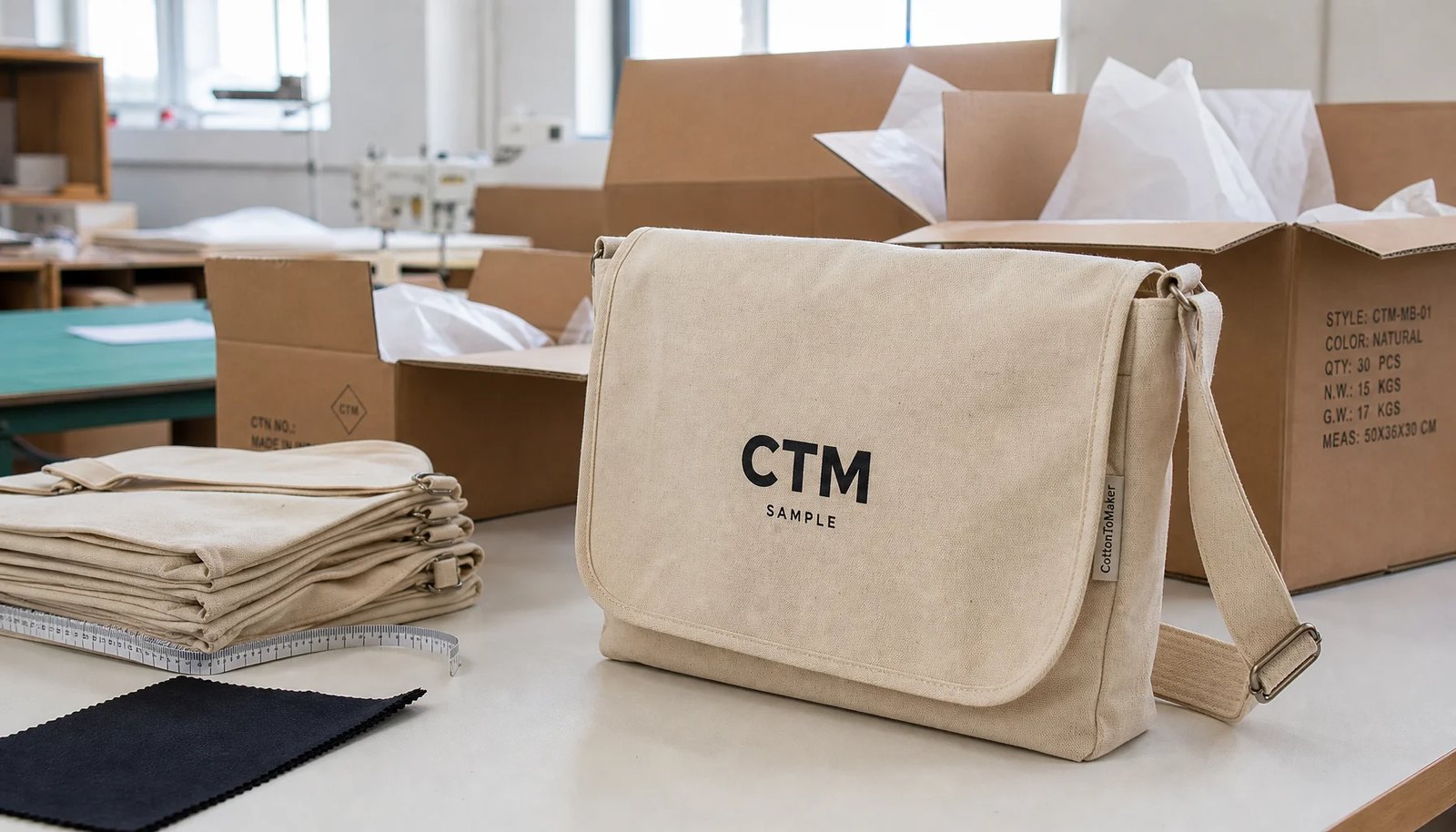
Why Carton Planning Comes Before the Final Bag Quote
For trade show exhibitors, custom canvas messenger bags are not only a branded product. They are part of a timed logistics job. The bags may need to arrive at a venue receiving dock, a hotel storage room, a distributor warehouse, or a fulfillment partner that builds delegate kits. If the carton plan is weak, the buyer may receive the right bag but still lose time opening cartons, repacking quantities, relabeling boxes, or paying for avoidable freight volume.
Carton planning should start while the bag specification is still flexible. Body size, gusset depth, canvas weight, flap construction, strap hardware, and individual packing all change the carton count and carton CBM. A messenger bag that looks only slightly larger on the sample table can use much more space in export cartons because the flap, gusset, and strap create irregular bulk. A good RFQ gives the factory enough data to calculate packing early, not after mass production is finished.
- Treat the shipping carton as part of the product specification, not a warehouse detail.
- Request carton dimensions and CBM at quotation stage, then update after sample approval.
- Set a maximum carton gross weight if your event team or 3PL has handling limits.
- Confirm whether cartons ship directly to the show venue or first to a consolidation warehouse.
Build the Bag Size Around the Inserts, Not Guesswork
Most trade show messenger bags are used to carry printed material, notebooks, badge holders, chargers, water bottles, tablets, or sponsor kits. The buyer should identify the largest real insert before choosing the finished bag size. A common A4-friendly canvas messenger bag may sit around 36 x 28 x 8 cm, but the correct size depends on whether the bag needs to hold a thick catalog, a presentation folder, a small laptop, or only lightweight handouts.
Oversizing feels safe during design, but it hurts packing. A larger body panel consumes more fabric, a deeper gusset creates empty air inside cartons, and a wider flap can fold poorly. Undersizing creates a different problem: the venue team may force catalogs into the bag and damage seams or distort the flap before the visitor even receives it. The best production spec gives both finished dimensions and intended loading information.
- Measure the largest insert width, height, and thickness, then add realistic clearance.
- For A4 documents, allow room for corners and folders rather than matching paper size exactly.
- Use an 8-10 cm gusset only when the bag must hold bulky kits; shallow gussets pack better.
- Write finished size tolerance into the PO, for example plus or minus 1 cm depending on construction.
Canvas Weight Changes Structure, Freight, and Carton Count
Canvas messenger bags are often quoted in ounces, such as 10 oz, 12 oz, 14 oz, or 16 oz, while some factories also provide GSM. The exact GSM can vary by mill and finishing, so the RFQ should ask for both the stated ounce weight and the fabric weight reference used by the supplier. For trade show bags, 12 oz and 14 oz cotton canvas are common because they offer a firm hand feel without becoming too bulky in cartons.
A heavier canvas may improve perceived value, especially for retail merchandise or VIP delegate bags, but it also increases carton weight and can make folding less compact. A 16 oz messenger bag with a thick flap, wide strap, and metal hardware may require fewer pieces per carton to prevent deformation. On the other side, 8 oz or 10 oz canvas can save cost and shipping space, but it may look limp when loaded with catalogs unless the design includes reinforcement or lining.
- Use 10 oz canvas for lightweight giveaways where freight efficiency matters most.
- Use 12 oz or 14 oz canvas for general trade show exhibitor bags with better structure.
- Use 16 oz canvas only when the bag is positioned as durable merchandise or premium staff gear.
- Ask whether the canvas is washed, dyed, bleached, natural, or laminated because finishing changes shrinkage and packing behavior.
Print Method and Logo Placement Affect Packing Damage
For custom canvas messenger bags, the logo is usually placed on the flap, front body, strap, or a woven side label. Screen printing is often the most practical method for solid logos and event graphics because it is durable, economical at volume, and works well on canvas texture. Heat transfer may be suitable for gradients, small runs, or detailed artwork, but it needs careful testing on textured cotton canvas. Embroidery gives a premium feel but adds thickness, cost, and possible backing marks.
The carton plan should consider where the logo sits when the bag is folded or stacked. If a thick ink print lands exactly on a fold line, the print may crease during long transit. If metal adjusters rub against the printed flap, cartons opened at the show may reveal scuffed logos. The supplier should show the packed fold method before bulk packing so the buyer can see how the printed face is protected.
- Define logo placement from seam edges, flap bottom, or panel center, not by a vague visual mockup.
- For screen print, specify number of colors, Pantone references, artwork size, and print position tolerance.
- For heat transfer, test adhesion and flexibility on the approved canvas weight before bulk production.
- Use tissue, paper interleaving, or a different fold direction if hardware touches the printed area.
MOQ Logic for Event Orders and Reserve Stock
The MOQ for custom canvas messenger bags is shaped by several small minimums, not only the sewing line. Fabric purchase, dye lot, screen setup, hardware color, woven labels, carton marks, and barcode labels can each create a threshold. A buyer asking for 480 pieces may receive a quote that is much less efficient than 500 or 600 pieces because the supplier still has to set up the same print screens and buy similar fabric quantities.
Trade show buyers should also think beyond the exact visitor forecast. Cartons can be damaged, VIP packs may be added late, booth staff may need samples, and distributors may request extras for follow-up meetings. A practical reserve is often cheaper at the original production stage than placing a small reorder after the event. The RFQ should show the base quantity and optional quantity breaks, then compare unit price, carton count, CBM, and lead time together.
- Request price breaks at realistic levels, such as 500, 1,000, 2,500, and 5,000 pieces if relevant.
- Ask which MOQ is driven by fabric, printing, hardware, woven label, or packing label.
- Include a reserve quantity plan instead of ordering exactly to the attendee forecast.
- Compare total landed cost by quantity break, not only factory unit price.
Packing Method: Inner Pack, Master Carton, and Handling Weight
Messenger bags can be bulk packed, individually polybagged, paper-banded, or packed with a hangtag and barcode. For a trade show giveaway, individual packing keeps the bag clean and easy to distribute, but it increases labor, material use, carton volume, and unpacking waste. For internal kit assembly, a simple paper band or no inner bag may be enough if the warehouse environment is clean and the bags will be filled soon after arrival.
The master carton quantity should be chosen by both volume and weight. A carton holding 50 lightweight bags may be fine, while 50 heavy 14 oz canvas messenger bags with metal adjusters could be too heavy or may crush the lower layers. Many buyers focus on maximizing pieces per carton, but event logistics often favor cartons that can be lifted, counted, opened, and allocated quickly.
- Use 25 pieces per carton for heavier messenger bags or bags with structured flaps and hardware.
- Use 40-50 pieces per carton only after confirming carton strength, gross weight, and bag deformation.
- Set a maximum gross weight per carton based on warehouse and venue handling rules.
- Require a packing photo showing fold direction, layer count, inner packing, and final carton closure.
Carton Construction and Marking for Venue Delivery
Trade show freight is handled differently from a controlled retail replenishment shipment. Cartons may pass through forwarders, advance warehouses, loading docks, union labor, temporary storage, and booth delivery teams. A weak carton can arrive crushed even when the bag itself is well made. For messenger bags, a 5-ply export carton is usually a safer baseline than a thin domestic carton, especially when bags are shipped by sea or moved through multiple warehouses.
Carton marks are just as important as carton strength. When several exhibitors, product lines, or booth destinations share one shipment, unclear marks create real receiving delays. The carton should carry item code, PO number, event name, carton number, quantity per carton, gross weight, net weight, country of origin if required, and destination code. If the venue or 3PL requires labels, those files should be supplied before mass packing, not after cartons are sealed.
- Use sequential carton numbering such as 1 of 80, 2 of 80, and so on.
- Separate cartons by destination or booth allocation if the bags will be split on arrival.
- Provide barcode, pallet, or venue labels before production packing begins.
- Confirm whether carton printing, stickers, or plain marks are included in the quoted packing cost.
Sample Approval Should Include the Packed Carton Logic
Approving only one loose messenger bag is not enough for a trade show order. The buyer should approve the finished bag sample, logo execution, strap function, and at least a documented packing method. For high-value or deadline-sensitive orders, a packed carton sample or detailed packing photo set is worth the extra time. It shows whether the bag folds correctly, whether the print is protected, whether the straps tangle, and whether the carton bulges.
Sample checks should be practical and measurable. The buyer can measure finished body size, flap position, strap length range, print placement, and seam strength at strap anchors. The packed sample review then confirms carton piece count, inner packing, carton dimensions, gross weight, and carton marks. This step reduces arguments later because the factory and buyer have a shared reference for both product and packing.
- Approve fabric hand feel and color using a physical swatch or approved sample, not only photos.
- Measure print location from fixed references such as flap edge, side seam, or panel center line.
- Test the strap adjuster and stress points with realistic catalog weight inside the bag.
- Approve the packed fold direction before bulk packing if the logo is on the flap.
Lead Time Risks When Carton Data Is Late
A typical production schedule may include artwork confirmation, material purchasing, fabric cutting, printing, sewing, trimming, inspection, packing, and export booking. Carton planning touches the last steps, but delays there can still affect the whole shipment. If the buyer sends carton labels late, changes destination splits, or revises inner packing after production, the factory may need to reopen cartons, relabel boxes, or recalculate the packing list.
For trade shows, the delivery date is fixed by the event, not by the supplier's convenience. Buyers should work backward from the venue receiving deadline, then include time for inland trucking, customs clearance, sea or air transit, inspection, and possible sample revision. Air freight can rescue schedule problems, but canvas messenger bags are bulky. A carton plan that reduces CBM can be more valuable than a small unit price discount.
- Freeze artwork and bag construction before fabric cutting where possible.
- Send carton mark and label requirements before mass packing starts.
- Keep a buffer for sample revision if the first print strike-off is not acceptable.
- Compare sea, rail, truck, and air options using actual packed carton CBM, not estimated loose bag size.
Quote Data Buyers Need for Landed-Cost Comparison
A useful quotation for custom canvas messenger bags should include more than unit price. It should show fabric specification, finished size, print method, included packing, carton quantity, carton size, gross weight, net weight, total cartons, total CBM, sample cost, mold or screen charges if any, and lead time. Without this data, the buyer cannot compare two suppliers fairly. A lower unit price may become more expensive after freight if the carton plan is inefficient.
Buyers should also separate optional costs. Individual polybags, hangtags, barcode labels, woven labels, reinforced cartons, palletization, carton stickers, and inspection support may not be included in the base price. When these details are shown line by line, procurement can decide what is needed for the event and what is unnecessary. The goal is not to buy the cheapest possible bag; it is to receive the right quantity, in usable cartons, before the trade show deadline.
- Request EXW, FOB, or FCA terms clearly so logistics teams know what is included.
- Compare quotes using total order cost plus estimated freight based on supplier carton data.
- Ask for separate pricing on individual packing, woven labels, hangtags, and carton labeling.
- Require final packing list data before balance payment or shipment release.
Specification comparison for buyers
| Spec decision | Recommended option | When it fits | Buyer risk to check |
|---|---|---|---|
| Canvas weight | 12 oz or 14 oz cotton canvas for most trade show messenger bags | Good balance of structure, print surface, and carton efficiency for giveaways or delegate kits | Very heavy canvas increases carton CBM and freight cost; very light canvas may collapse when packed with brochures |
| Bag size | A4/laptop-friendly body around 36 x 28 x 8 cm, adjusted to insert size | Fits catalogs, badges, notebooks, tablets, and sponsor inserts without oversizing the carton | Oversized gussets create empty shipping volume and may cause bags to crease during stacking |
| Print method | Screen print for solid logos; heat transfer only for detailed gradients or small runs | Best for clear branding on flap or front panel before sewing or after panel cutting | Thick ink on heavy canvas can crack if folded sharply; artwork position must match packed fold line |
| Packing unit | Individual polybag or paper band, then 25-50 pcs per master carton depending on size | Keeps trade show distribution clean and makes booth allocation easier | Too many pieces per carton can crush flap shape, damage buckles, or exceed manual handling weight limits |
| Carton strength | 5-ply export carton for sea freight or mixed handling; reinforced tape on all seams | Suitable for container loading, warehouse relabeling, and venue delivery docks | Thin cartons may burst when messenger bags are packed tightly with straps and hardware |
| Carton marking | Item code, event name, carton number, quantity, gross/net weight, destination, and PO number | Useful when cartons are split across booth, hotel, warehouse, or distributor addresses | Missing carton sequence numbers make partial shipment receiving slow and error-prone |
| MOQ planning | Base MOQ on fabric dyeing/printing setup and carton allocation, not only unit price | Works when exhibitors need fixed booth quantities plus reserve stock | A low MOQ quote may hide higher print setup, poor carton utilization, or mixed shade lots |
| Sample approval | Approve one packed sample carton or packing photo set, not only one loose bag | Best for trade show deadlines where cartons go directly to venue or fulfillment partner | Loose sample approval misses fold marks, strap tangling, carton bulging, and label mistakes |
Buyer checklist before sampling
- Define the actual trade show use: giveaway, paid merchandise, delegate kit, sponsor bag, or internal staff bag.
- Confirm the largest insert size before freezing the messenger bag body and gusset dimensions.
- Choose canvas weight by required structure and freight impact, not only perceived quality.
- Specify whether the flap, body, gusset, strap, or side label carries the logo.
- Set artwork size, Pantone references, print tolerance, and placement tolerance in the RFQ.
- Decide whether each bag needs an individual polybag, paper wrap, barcode, size sticker, or no inner packing.
- Set a target carton quantity and maximum gross weight per carton before asking for a final quote.
- Require a carton packing photo or packed sample approval before mass packing starts.
- Include carton marks, shipping marks, destination codes, and carton numbering format in the PO.
- Ask for packed carton dimensions, gross weight, net weight, total cartons, and total CBM in the quotation.
Factory quote questions to send
- What canvas weight in oz and GSM are you quoting, and is it natural, dyed, washed, or laminated canvas?
- What is the finished bag size, gusset depth, strap length range, and flap size after sewing tolerance?
- Which print method is included, how many colors, and what is the maximum printable area on the flap or front body?
- Is the logo printed before sewing on cut panels or after sewing on the finished bag?
- What MOQ applies to the fabric, print setup, hardware, woven label, and carton printing separately?
- How many pieces are packed per inner pack and per master carton?
- What are the estimated carton dimensions, gross weight, net weight, total cartons, and total CBM for the order quantity?
- Can you provide photos of one fully packed carton before bulk packing?
- What carton grade, ply, edge crush strength, or export carton specification is included?
- Are carton marks, barcodes, FBA labels, distributor labels, or venue delivery labels included in the quote?
Quality-control points to confirm
- Canvas weight tolerance should be agreed before production, commonly within a practical fabric mill tolerance rather than a vague 'heavy canvas' description.
- Finished bag dimensions should be measured flat at body width, body height, gusset depth, flap drop, and strap length range.
- Print position tolerance should be written in millimeters from seam or flap edge reference points.
- Logo color should be approved against Pantone or a physical print swatch, especially on natural canvas where ink appearance can shift.
- Stitching should be checked at strap anchors, flap corners, gusset joints, and stress points that carry catalog weight.
- Metal hardware or plastic adjusters should be tested for smooth movement and checked for sharp edges that can cut straps or packaging.
- Each carton should be checked for piece count, inner packing method, carton mark accuracy, and carton condition before sealing.
- Packed carton weight should stay within the buyer's warehouse or event handling limit, often more important than maximizing pieces per carton.
- Random cartons should be opened after packing to confirm straps are not tangled, logos are not rubbed, and bags are not deformed.
- Final shipment data should match invoice, packing list, carton labels, and freight booking data.