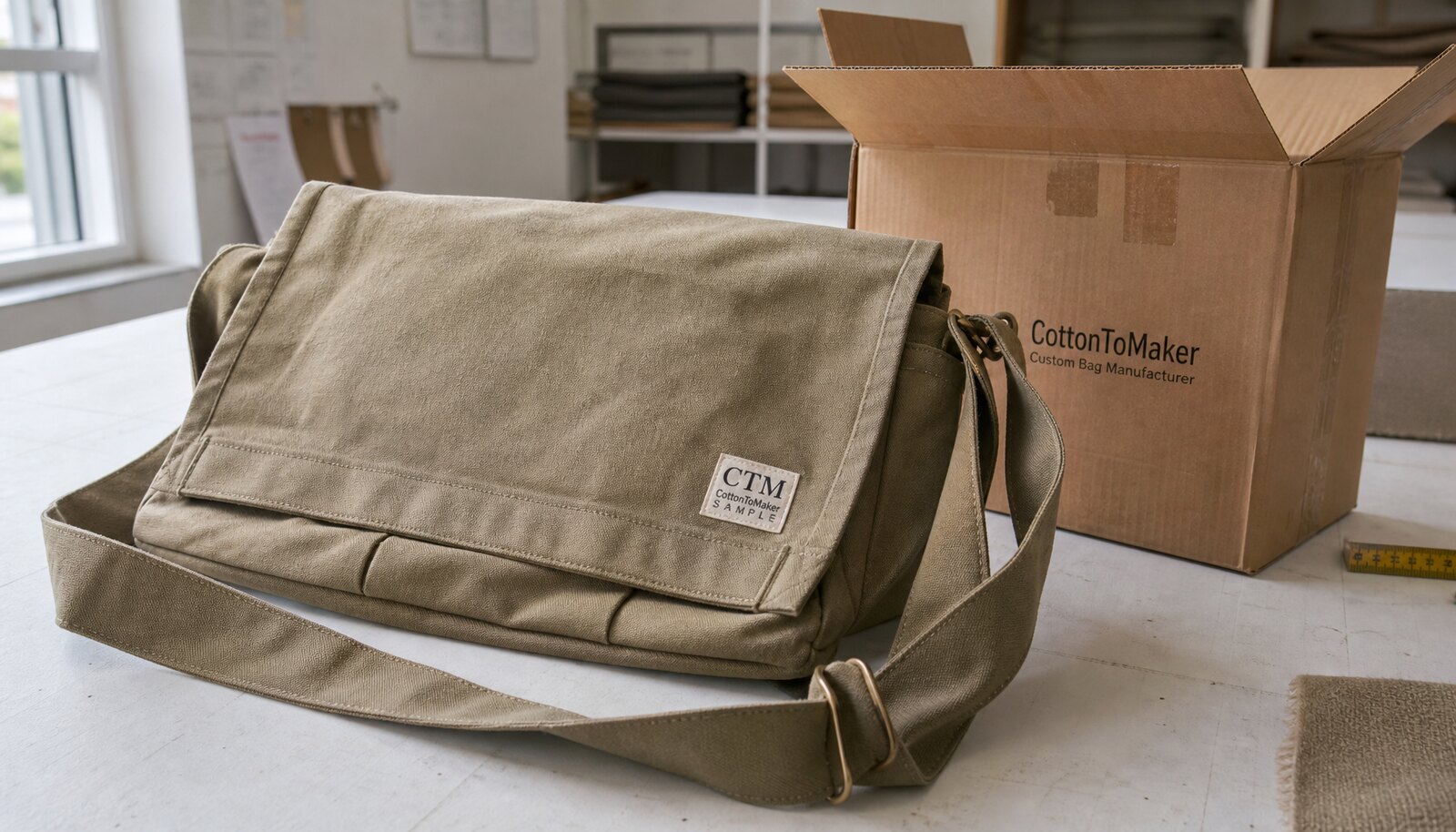
Why carton planning changes the quote
For custom canvas messenger bags shipping to gift shops, the carton is part of the product economics, not a warehouse afterthought. It affects freight cube, carton count, receiving time, damage rate, and whether the bags arrive ready to sell or need repacking. Buyers often compare canvas weight, decoration, and unit price first, then discover that the packing spec is what turns a good source price into a weak landed cost. The same bag can be a clean margin item or a margin leak depending on whether the carton was designed around the real folded bag or around a guess.
The main sourcing error is approving the style sample and treating carton planning as a later packing note. In this category, the bag build changes the carton. Canvas weight, lining, strap construction, pocket depth, patches, zippers, and coatings all affect folded thickness and stack behavior. A carton that is too loose wastes space and lets the contents shift. A carton that is too tight bows at the flaps, crushes at the corners, and looks acceptable only until the receiving dock opens it. Procurement teams need the carton spec to be part of the PO, not a side comment in the shipping instructions.
- Treat carton size, pack count, and gross weight as a product spec, not a warehouse preference.
- Compare landed cost, not bag price alone.
- Ask how the carton will perform at receiving, not only on a pallet.
Start with bag geometry, not carton math
Before asking for a carton quote, lock the bag in production terms. State the canvas weight in oz or GSM, the lining status, the gusset depth, the pocket count, the strap width, and whether the bag is soft or lightly structured. An 8 oz soft bag and a 12 oz lined bag with reinforcement do not behave the same way when folded. The thicker version usually needs more stack height, a different fold sequence, and a stricter carton closure allowance.
The RFQ also needs the folded form, not just the finished size. Write down the fold direction, where the flap sits, whether the strap is laid flat or tucked, and whether the print lands on the front face or near a seam. If the bag uses an insert board, magnetic closure, zipper pocket, heavy webbing, or dense patchwork, the folded thickness can move enough to force a second carton size. That is the point where carton planning becomes a design decision. If the pack-out is not defined at the sample stage, the supplier can quote a neat unit price that later fails when the real bag is packed.
- Include both finished size and folded size in the RFQ.
- Identify every feature that adds thickness or stiffness.
- Approve the fold sequence before the carton is finalized.
Set pack counts from the real folded sample
Pack count should come from a packed sample, not a volume estimate. Ask the factory to fold the bag exactly as it will ship, stack a full layer, and measure the height after compression. Then check the carton closure with enough room for the flaps to seal without bulging. That is the simplest way to avoid cartons that look efficient on paper but fail in the warehouse. It also keeps the quote honest, because the factory cannot hide a different fold method behind a dimension estimate.
For gift shop programs, the best pack count is the one that keeps cartons easy to lift, easy to label, and easy to reopen. Procurement should set a maximum gross weight per carton in the RFQ and reject any quote that exceeds it unless the route risk truly requires a stronger carton. A useful working rule is to keep hand-carry cartons under about 15 kg / 33 lb when the carton may be handled by store staff, and to stay below the buyer’s internal receiving limit if the cartons will move through a retail back room. Heavier cartons are acceptable only when the warehouse, freight mode, and staffing can support them. If a carton exceeds the limit, reduce the pack count before you upgrade the board grade. Board strength is not the first fix for weight control.
Typical pack counts should be treated as examples, not defaults: a small soft messenger bag may fit 16 to 20 pieces per carton; a medium lined bag may sit around 10 to 16; a larger structured version may need 6 to 10. The only count that matters is the one that stays within gross weight, lets the flaps close flat, and keeps compression within the test limit.
- Validate pack count with a packed sample before releasing bulk.
- Set a maximum gross weight per carton in the RFQ.
- If the pack count changes, recheck carton height and closure strength.
Choose board grade by load, route, and failure mode
Start with a regular slotted carton in single-wall board unless the pack-out proves otherwise. For lighter domestic shipments, 32 ECT or 200# is usually a reasonable starting point. For heavier packs, taller stacks, or more handling, 44 ECT or 275# is the more defensible baseline. Double-wall belongs in the discussion only when the actual load, stacking, or transport risk shows single-wall will fail. It is not a substitute for a bad pack count.
The useful procurement question is not whether a board grade is strong in general. It is which failure mode you are trying to avoid. Lower-grade single-wall cases typically fail at the corners, at the center seam, or by flap spring-back when they are overfilled. Stronger single-wall board delays those failures but does not fix a carton that was packed too high. Double-wall reduces compression risk and can help on export lanes or mixed-handling routes, but it also increases carton cost, carton weight, and cube. If the carton travels by parcel or over long transit chains, that extra material may be justified. If the bags are moving in a short, controlled domestic lane, the cost increase is usually wasted.
Ask the supplier to name the board grade, flute type, closure method, and tape assumption in writing. Then test the packed carton. A strong board spec does not rescue an overstuffed case or a weak seal.
- Use 32 ECT / 200# as a lighter-load starting point and 44 ECT / 275# for heavier or riskier routes.
- Escalate to double-wall only when compression, stacking, or route handling justifies it.
- Require the closure method and tape spec, not only the board grade.
Compare supplier routes on packaging control
Direct factory sourcing usually gives the buyer the clearest control over carton dimensions, packed weight, and label format because the bag and the carton are managed in one place. That matters when you need repeatable reorders, carton print control, or a specific test standard. A trading company can work better when the order spans several SKUs, several factories, or a consolidation lane that needs one point of contact. The tradeoff is accountability. If no one owns the carton spec, the quote can look competitive while the packed case remains vague.
The right comparison method is to break the quote into separate line items. Ask for bag price, decoration cost, packing labor, carton cost, inner packing, carton print, labels, and any insert or retail ticket. Then ask who owns the packed sample and who signs off on carton dimensions. This makes it much easier to compare offers on a landed basis. A lower bag price can disappear if the carton is oversized, the inner pack is expensive, or the supplier has to rework labels after approval. For procurement, the cleanest quote is the one that exposes every packaging assumption instead of burying them inside the unit price.
- Separate bag cost from packing and carton cost.
- Ask who owns the approved packed sample.
- Do not compare quotes that hide packaging assumptions inside the unit price.
Use carton print and labels as receiving tools
Gift shops and their distributors care about fast receiving. They want cartons that open cleanly, show the correct item code, and make the count obvious without opening every case. That is why carton marks should be designed for warehouse use first and branding second. If the outer case only needs to identify the SKU, color, and quantity, a simple one-color flexo print or even a plain case with a clear label is usually the better tradeoff. Heavy graphics add proofing time, version control risk, and reorder mistakes without improving freight performance.
Inner packing should be intentional, not decorative. Polybags can protect light-colored canvas from dust and scuffing, but they can also add labor and trap moisture if the goods sit in humid storage. Tissue or a breathable sleeve may be enough for a soft bag; a coated or decorated bag may need a different protection method. For gift shop programs, clarify whether the buyer wants warehouse-ready cartons or shelf-ready presentation. If retail tickets, barcode labels, hang tags, or polybag warnings are required, they should be quoted and sampled before bulk production. Every one of those details changes labor and can change carton height.
The carton mark format should match the packing list exactly: style code, color code, carton number, and quantity per carton. If the shipment will be split to multiple stores or DCs, use a consistent case numbering scheme so the receiving team can sort quickly.
- Keep carton marks aligned to the packing list.
- Use inner packing only for a specific reason: dust, scuffing, moisture, or retail presentation.
- Confirm whether the buyer wants warehouse-ready or shelf-ready cartons.
Write QC around the packed case, not only the bag
QC for custom canvas messenger bags should cover construction and shipping behavior. The bag needs stitching, print, and dimension checks. The carton needs board grade, closure strength, and handling checks. If the inspection plan only covers appearance, the shipment can still fail when the warehouse opens the carton. This is why buyers should set the quality method before production starts and not after the first case is already on the truck.
A workable inspection plan starts with AQL and then adds pack-out checks. A common baseline is critical 0, major 2.5, and minor 4.0, with tighter first-run control if the factory is new or the decoration is complex. On the product side, verify fabric weight, stitch density at load points, seam finish, and print placement on the folded bag. On the shipping side, ask for a packed-sample compression check and a drop test covering faces, edges, and corners. If the route is export-heavy, pallet-stacked, or handled multiple times, ask the supplier to show the test basis, such as ASTM D642 for compression and ASTM D5276 for drop testing, or an internal equivalent that matches the route risk.
The practical QC rule is simple: if the folded thickness, packed weight, or closure method changes, the carton must be rechecked before bulk packing continues. That is the control point that keeps a small production drift from becoming a freight claim.
- Use an AQL plan that covers both the bag and the carton.
- Inspect packed samples, not only loose bags.
- Require carton test evidence for the first run.
Approve style, decoration, and packed samples separately
A style sample proves pattern and construction. A print sample proves decoration. A packed sample proves the carton. Those approvals are not interchangeable. For gift shop programs, the buyer should ask for a preproduction sample in the correct fabric, a print or label strike-off on the real material, and a packed sample in the actual carton with the real pack count. If the factory ships only a flat sample, you still do not know whether the bag will sit cleanly in the carton or whether the logo shifts into a crease line once the bag is folded.
The best approval file is a signed master sample kept at the factory and tied to the PO. It should show the fold direction, final print position, inner packing method, carton marking format, and the approved board grade. If the supplier later wants to substitute fabric, change the fold, or reduce carton strength, the approval point is clear. This matters on reorder programs because small changes can happen quietly when the original merchandiser is no longer managing the account. A disciplined sample file is the fastest way to keep the second order identical to the first.
If you need a single rule for procurement, use this: no bulk release until the packed sample matches the requested carton count, gross weight, and closure condition. That one gate prevents most of the avoidable carton problems in this category.
- Approve style, decoration, and packed-out samples as separate steps.
- Keep one signed master sample tied to the order.
- Do not allow a bulk change without a new carton check.
Control lead time and landed cost together
Lead time is more than sewing time. It includes fabric booking, decoration, sample approval, carton procurement, packing, inspection, and freight booking. If the carton is custom printed, add proofing time. If the artwork changes after sampling, the schedule can slip more than the supplier first admits. Buyers should ask for a step-by-step schedule that starts at sample sign-off and ends at cargo handoff. A single delivery promise is not useful when the carton itself is on the critical path.
Landed cost is where carton planning either pays off or leaks margin. A bag that is slightly cheaper at source can become more expensive if the carton is too large, too heavy, or too weak for the route. Ask for gross weight, carton cube, packing labor, carton cost, and any label or insert cost in the same quote. Then compare suppliers on total shipped cost, not unit price alone. For gift shop programs, the better supplier is usually the one that minimizes surprises at receiving and keeps repeat orders consistent, even if the bag-only price is not the lowest number. Packaging is part of the commercial model, so it should be priced and reviewed like one.
A practical rule: if a quote omits carton weight, pack count, or closure method, treat the lead time and landed cost as incomplete until those details are filled in.
- Ask for a production schedule by step, not a single delivery promise.
- Compare gross weight and carton cube across quotes.
- Treat carton changes as landed-cost changes, not just packing changes.
Build a reorder file that survives staff changes
The best way to protect margin on a repeat program is to document the approved pack standard as part of the product file. That file should hold the finished dimensions, fold method, print method, carton size, pack count, label format, inspection criteria, and the signed packed sample reference. When the next reorder comes in, the factory should not infer the original intent from memory. It should be able to build the same result from the file.
That discipline matters especially for custom canvas messenger bags sold into gift shops because the category often reorders in seasonal waves. If the first run used one fold direction, one carton size, and one board grade, that combination should be locked unless the buyer explicitly re-approves a change. Reorder control is where money disappears quietly. Once the pack-out drifts, freight, damage exposure, and receiving time all move in the wrong direction even if the unit price stays flat. The buyer who owns the file owns the margin.
A strong reorder file also shortens supplier comparisons on future bids. If the carton spec is already locked, the factory can quote the same assumption instead of restarting the discussion from a flat sample and a vague target weight.
- Store the approved carton and pack-out spec with the product file.
- Tie reorder changes to a formal approval step.
- Keep the packed master sample available for comparison on later runs.
Specification comparison for buyers
| Spec decision | Recommended option | When it fits | Buyer risk to check | Cost / lead-time impact |
|---|---|---|---|---|
| Supplier route | Direct factory with carton control | You need repeat orders, carton print control, and one owner for bag build, pack-out, and packing QC | The factory may quote the bag correctly and still guess carton dimensions or gross weight | Usually lowest friction on reorders; sample loop is faster when the same team owns bag and carton |
| Supplier route | Trading company with packaging coordination | You are consolidating multiple SKUs or need one contact across several factories | Margin stacking can hide the real carton and labor cost | Can reduce coordination time on multi-supplier programs, but approvals may take longer |
| Board grade | 32 ECT / 200# single-wall | Packed cartons stay at or below a moderate gross weight and the route is controlled | Board strength does not fix overfill or weak closure | Lowest material cost and fast availability; usually simplest to source |
| Board grade | 44 ECT / 275# single-wall | Heavier packs, longer routes, more stack load, or higher damage exposure | A stronger board still needs a realistic pack count and clean closure | Slightly higher material cost and sometimes a small sourcing delay |
| Board grade | Double-wall | Large cartons, export stacking, mixed-handling lanes, or cartons that fail compression in trials | Do not use double-wall just to paper over bad pack geometry | Higher carton cost, more cube, and more material lead time |
| Carton style | Regular slotted carton with clean tape closure | You want a standard case that packs quickly and opens cleanly at receiving | Assume tape performance and flap overlap only after a packed test | Fastest to produce and easiest to reorder |
| Pack-count strategy | One pack count per variant | You have stable SKUs and can keep the carton spec fixed across colors | Every size or fabric change can alter thickness enough to break the formula | Simplest on receiving and fastest for repeat orders |
| Pack-count strategy | Two pack counts within one carton family | You need one footprint but vary quantity by bag size or fabric weight | The heavier count may require a stronger board or a lower fill height | Can preserve carton tooling while optimizing cube by SKU |
| Test standard | ASTM D642 compression and ASTM D5276 drop on packed samples | You need a documented packed-case test for parcel, pallet, or export risk | Internal hand tests are not enough for procurement decisions | Adds sample time but avoids expensive freight claims later |
Buyer checklist before sampling
- Confirm finished dimensions, folded dimensions, strap lay direction, and the maximum folded thickness that must fit in the carton.
- Lock the fabric weight in oz or GSM, plus lining, coating, interlining, patchwork, or hardware that changes stack height.
- State the print method, print placement, number of colors, and whether the mark must survive rubbing during transit.
- Define the target carton dimensions, pack count, and maximum gross weight before asking for a quote.
- Ask for the board grade, carton construction, closure method, and the exact test standard used for compression and drop performance.
- Require a packed preproduction sample, not just a flat style sample, before approving bulk production.
- Specify inner packing, carton marks, barcode format, and whether the gift shop wants shelf-ready or warehouse-ready presentation.
- Ask for MOQ by fabric color, decoration method, carton print version, and any separate insert or label MOQ.
- Set inspection criteria for stitching, size tolerance, print alignment, carton integrity, and pack-out accuracy.
- Write down the reorder standard so the next PO matches the approved sample without a fresh round of assumptions.
Factory quote questions to send
- What finished size, folded size, and pack-out assumption are you using in this quote?
- Which canvas weight, lining, coating, and reinforcement details are included, and what tolerance do you allow?
- Which print method is quoted, how many colors are included, and what setup or screen fees are separate?
- What carton dimensions, board grade, closure method, and test standard are you using for shipping cartons?
- How many pieces per carton, what is the gross weight, and what carton cube are you targeting?
- Will you quote inner polybags, tissue, desiccant, inserts, and carton labels as separate line items?
- Can you provide a packed preproduction sample and keep one signed reference sample at the factory?
- What inspection report will you provide for the first bulk run, and what AQL will you use?
- What changes trigger a re-approval: fabric lot, print color, folded thickness, carton size, label format, or closure method?
- What is the production lead time after sample approval, and which steps typically delay the shipment?
Quality-control points to confirm
- Set the inspection plan before bulk starts. A common starting point is AQL 0 for critical defects, 2.5 for major defects, and 4.0 for minor defects, then tighten the first run if the program is new.
- Check fabric weight against the approved spec, usually within plus or minus 5 percent unless the construction or finish intentionally shifts the weight.
- Measure finished dimensions on a representative sample and keep body dimensions within a practical tolerance such as plus or minus 1 cm, with strap length and placement checked separately.
- Inspect stitching at load points, gussets, pockets, and strap anchors for skipped stitches, loose ends, seam drift, and weak bartacks.
- Verify print placement on the folded bag, not just on the open panel. The logo should remain readable after folding, packing, and light carton rub.
- Confirm folded thickness with a real packed sample. If the stack height changes, the carton count and closure strength must be rechecked before bulk packing continues.
- Check carton board grade by specification or supplier certificate. For export or heavier cases, ask for 44 ECT / 275# or an equivalent specification if the pack-out demands it.
- Request a packed-sample compression check and a drop test on all faces, edges, and corners. A practical target is an ASTM D642-style compression setup and an ASTM D5276-style drop test at 1.0 m to 1.2 m, adjusted to the route risk.
- Inspect labels, SKU codes, quantity marks, and carton numbering against the packing list so the receiving team does not need to open every case.
- Review the first carton off the line, the middle cartons, and the last cartons in the run so you catch packing drift before the shipment closes.