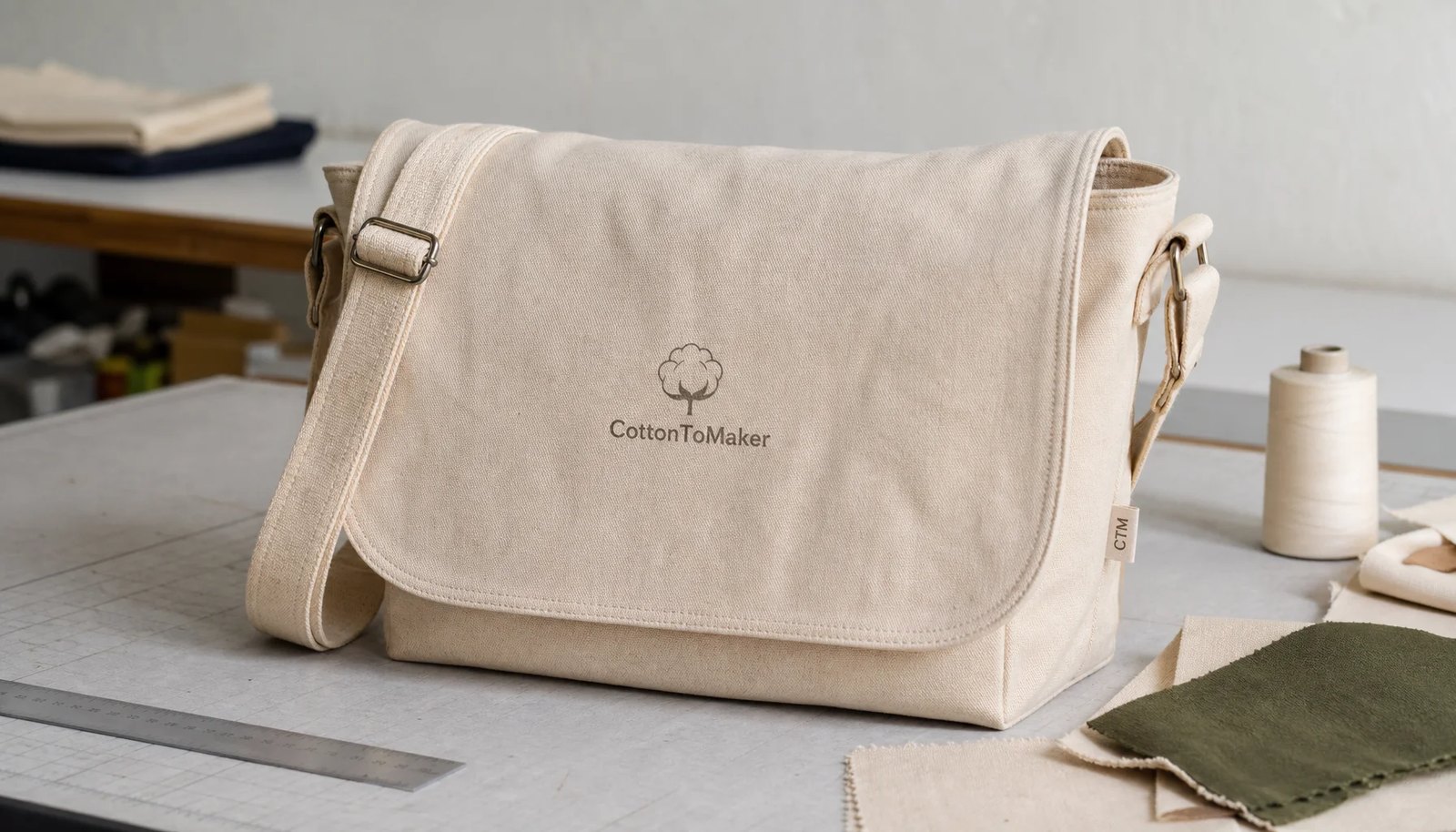
Start the RFQ with the buying use, not only the bag name
A factory can quote a canvas messenger bag in many ways: a thin promotional shoulder bag, a structured bookstore retail item, a laptop-style campus bag, or a premium alumni gift. The phrase "custom canvas messenger bag" is not enough for a comparable quote. Your RFQ should first state the selling channel, target retail positioning, expected carry weight, and whether the bag is for daily student use, orientation resale, graduation merchandise, or department events.
For university bookstores, the biggest RFQ problem is usually SKU splitting. One buyer may need the same body style with the main bookstore logo, athletics logo, alumni logo, and several department marks. If this is not explained early, suppliers may quote one easy MOQ and later increase the cost when the order is divided into smaller logo runs. A stronger RFQ tells the factory how many colors, logos, and delivery windows are expected before they calculate fabric, print setup, and packing labor.
- State the target user: student, alumni, parent, faculty, event attendee, or retail gift buyer.
- State the expected load: books only, laptop and books, light daily items, or gift packaging.
- List planned SKUs by body color, print color, logo version, and packing style.
- Clarify whether the bag must fit a laptop size, bookstore shelf width, or specific retail display fixture.
Specify canvas weight in terms the factory can buy
Canvas weight drives the first real cost decision. Many buyers request "heavy canvas" but suppliers need a measurable fabric standard. For messenger bags, common practical options are around 10 oz, 12 oz, 14 oz, and 16 oz cotton canvas. In GSM terms this can vary by construction and finishing, so it is safer to give both oz and GSM when possible. A 12 oz canvas often works well for bookstore retail because it has enough body for a flap bag but still keeps shipping weight under control.
Natural canvas, bleached canvas, and dyed canvas are not the same sourcing problem. Natural canvas is usually faster and more stable for small to mid-size orders. Dyed canvas can help match school colors but may require higher MOQ, longer lead time, and tighter shade control. Black, navy, maroon, forest green, and royal blue are common bookstore colors, but each mill lot can shift. If a campus color must be close, include Pantone guidance and accept that fabric shade and print shade have different tolerances.
- Value retail option: 10-12 oz cotton canvas for lower weight and easier pricing.
- Balanced bookstore option: 12 oz cotton canvas with reinforced strap points.
- Premium option: 14-16 oz canvas, especially when unlined but requiring better structure.
- Risk control: request a fabric swatch or cutting before approving a dyed production lot.
Define the construction before comparing unit prices
Messenger bag construction changes labor cost quickly. A flat flap shoulder bag with one main compartment is not comparable to a lined messenger bag with zipper pocket, inner divider, adjustable strap, metal slider, and reinforced magnetic snap. If the RFQ does not define the construction, the cheapest quote may simply be a different product. A useful RFQ includes a simple line drawing or reference photo, but the written specification must still describe each functional part.
For campus retail, the strap and flap deserve more attention than small decorative details. Students and visitors will test the bag by loading books, bottles, laptops, and apparel. A narrow strap may look fine in a photo but feel weak in use. A snap without reinforcement may tear out. A flap that is too short may expose the contents. These are avoidable if the RFQ includes strap width, strap length range, reinforcement method, and closure placement.
- Body: finished size, gusset depth, flap coverage, and whether corners are squared or rounded.
- Strap: fixed or adjustable, webbing width, slider material, and reinforcement stitch type.
- Pockets: front slip pocket, inner zipper pocket, pen pocket, or laptop sleeve if required.
- Closure: magnetic snap, metal snap, hook-and-loop, zipper under flap, or buckle detail.
- Finishing: bound inner seams, overlocked seams, lined interior, or raw-edge avoidance.
Choose a logo method that matches the artwork and reorder plan
Most university bookstore messenger bags use screen printing because it is cost-effective for flat school logos, mascots, bookstore marks, and department names. Screen print is also practical when the same bag body is repeated with different one-color prints. The buyer should specify print size, print location, Pantone colors, number of colors, and whether the print sits on the flap, body, strap, or pocket. A large print across a flap seam or folded edge can create registration and ink deposit problems.
Embroidery, woven patches, and sewn labels can raise the perceived value, but they change MOQ logic. A woven patch may require a separate patch MOQ before bag assembly. Embroidery on heavy canvas is possible, but dense stitches can pucker the flap unless backing and stitch density are handled correctly. For a bookstore program with many small logo versions, a sewn woven label may be more repeatable than full embroidery. The RFQ should ask suppliers to recommend the decoration method based on artwork, not only quote the buyer's first idea.
- Screen print: best for one- to three-color flat graphics and repeat bookstore SKUs.
- Heat transfer: useful for detailed artwork but requires adhesion and wash or rub testing.
- Embroidery: premium look, better for smaller marks, but may distort thin or soft canvas.
- Woven patch: good for heritage campus style, but patch MOQ and sewing labor must be included.
- Side label: efficient for small CTM-style branding or secondary brand identification.
Build MOQ logic around fabric, color, logo, and trim
MOQ is not a single number in a real factory quote. A supplier may accept 300 pieces for a natural canvas messenger bag with one screen print, but the same supplier may need 800 or 1000 pieces for custom dyed fabric, custom lining, special hardware, or woven patches. Buyers get into trouble when they negotiate only the total MOQ and forget MOQ per color, per logo, and per trim set. A 1000-piece total order split into five logos may behave like five 200-piece jobs.
The cleanest way to request pricing is to present quantity tiers and SKU splits together. For example, request 300, 500, 1000, and 2000 pieces, then show whether those quantities are one logo or multiple logos. Suppliers can then separate fixed setup costs from scalable material and labor costs. This also prevents a quote that looks attractive at 1000 pieces but becomes expensive after the bookstore approves several smaller campus designs.
- Base MOQ driver: canvas availability and cutting efficiency.
- Color MOQ driver: dyed fabric lot size and shade approval process.
- Logo MOQ driver: screen setup, embroidery programming, patch weaving, or label production.
- Trim MOQ driver: custom zipper pull, metal hardware, lining color, strap color, and hangtag.
- Packing MOQ driver: barcode labels, retail sleeves, hangcards, and SKU-separated cartons.
Request quote data that supports landed-cost comparison
A unit price alone is not enough for importers, distributors, or retail buyers. Canvas messenger bags can be bulky, and a heavier construction may increase freight cost even when the factory unit price is only slightly higher. Your RFQ should request carton quantity, carton dimensions, gross weight, net weight, estimated cubic meters, and packing method. This data lets the buyer compare a 12 oz unlined bag against a 14 oz lined bag on landed cost, not just ex-factory cost.
Quote format also affects decision speed. Ask the supplier to separate base unit price, sample charge, mold or setup fees if any, print setup, label or patch cost, hangtag cost, packing upgrade, inspection support, and shipping term. If one supplier includes retail hangtags and another does not, their prices are not comparable. The RFQ should make hidden cost items visible before the purchase order is issued.
- Quote tiers: 300, 500, 1000, and 2000 pieces with the same specification.
- Commercial terms: EXW, FOB, FCA, or DDP only if the supplier can support it transparently.
- Freight data: units per carton, carton size, gross weight, and estimated CBM.
- Cost adders: print setup, woven label, hangtag, barcode label, individual bag, and carton marking.
- Validity: quote expiration date, currency, payment terms, and lead time assumptions.
Use sampling to approve production, not to admire a prototype
A sample is useful only if it represents the bulk order. Many buyers approve a showroom sample made from available fabric, then expect the same result from a different production lot. For custom canvas messenger bags, request the correct fabric weight, correct strap webbing, correct hardware, correct print method, and correct packing concept in the pre-production sample whenever possible. If a substitute is used, the supplier should clearly mark what is temporary and what will change in bulk.
Sample approval should include measured criteria. Do not approve only by photo if the bag size, strap length, print placement, and closure position are important. The buyer or importer should measure the sample, load it with realistic items, open and close the flap several times, adjust the strap, and inspect the print. If the sample fails because the flap is too short, the strap feels narrow, or the print cracks at the fold, it is cheaper to revise before fabric cutting.
- Measure finished body size, gusset, flap length, strap length range, and print placement.
- Load test with the expected contents, such as books, hoodie, tablet, or laptop sleeve.
- Review print sharpness, ink coverage, Pantone closeness, and rub resistance.
- Check snap reinforcement, slider movement, seam finishing, and loose threads.
- Record sample approval with photos, measurements, and written change notes.
Set quality thresholds before bulk production starts
Quality control for canvas messenger bags needs both appearance and function. A bookstore customer may notice crooked print first, but the more serious failures are strap detachment, snap tearing, weak seams, and inconsistent sizing. The RFQ should include inspection criteria that the supplier can understand before production. This does not need to be complicated, but it must be specific enough to prevent arguments after the order is finished.
For bulk inspection, use AQL or a practical sampling plan agreed with the supplier and inspection team. Major defects should include broken stitches, failed strap reinforcement, non-functioning closure, wrong logo, wrong color, severe stains, and incorrect packing. Minor defects may include small loose threads or slight shade variation within approved tolerance. For campus colors and licensed logos, wrong artwork or poor placement should be treated as a major issue because it affects retail acceptance.
- Size tolerance: commonly around plus or minus 1 cm unless the buyer specifies tighter limits.
- Print placement: define tolerance from flap edge, seam, or pocket edge rather than visual center only.
- Strap strength: require reinforced stitching and no tearing under reasonable pull testing.
- Hardware: check snap, slider, D-ring, buckle, zipper, or hook-and-loop function on sampled units.
- Appearance: reject obvious stains, holes, heavy slubs on front logo area, and severe shade mismatch.
Plan packing for bookstore receiving and shelf handling
Packing is often treated as an afterthought, but university bookstore receiving teams care about carton labels, SKU separation, barcode accuracy, and shelf-ready handling. If bags arrive mixed by logo or color without clear carton marks, the receiving team loses time and the importer may face chargebacks or relabeling costs. A good RFQ states how each bag is packed and how cartons are marked.
Individual polybags protect the bag during export and warehouse handling, but some campus buyers prefer reduced-plastic packing. Paper bands, recyclable bags, or bulk packing can work if the product and distribution route allow it. The tradeoff is protection. Natural and light-colored canvas can pick up dust or carton rub marks. If the bag is sold at retail, include hangtag, barcode sticker, care label, country-of-origin marking, and any required licensing label in the packing instruction.
- Retail-ready option: individual bag, hangtag, barcode, and SKU carton labels.
- Lower-plastic option: paper band or recyclable sleeve with carton liner if needed.
- Warehouse control: one SKU per carton unless mixed carton rules are clearly approved.
- Carton marks: PO number, style number, color, logo version, quantity, carton number, and destination.
- Pre-shipment evidence: request packing photos, carton label photos, and carton dimension confirmation.
Protect the lead time with approval gates
Production lead time should not be counted from the first email. It usually starts after deposit, final artwork, fabric approval, trim approval, and pre-production sample approval. For bookstore programs tied to back-to-school, orientation, homecoming, or holiday retail, missed approvals can be more damaging than a slightly higher unit price. The RFQ should ask the supplier to show a schedule with approval gates, not only a single delivery date.
The highest schedule risks are custom dyed fabric, late artwork changes, patch or label production, and packing material approval. If the bookstore needs delivery before a campus event, buyers should avoid unnecessary custom trim unless the quantity and margin justify it. For repeat programs, keeping the same body fabric and changing only the logo can shorten future lead times because the construction, cutting pattern, and packing method are already proven.
- RFQ stage: supplier confirms feasibility, MOQ, and quote data.
- Sample stage: buyer approves fabric, construction, logo, and packing direction.
- Pre-production stage: final sample or strike-off is approved before bulk cutting.
- Production stage: supplier provides inline photos or inspection timing if required.
- Shipment stage: carton data, packing photos, and inspection report are reviewed before release.
Specification comparison for buyers
| Spec decision | Recommended option | When it fits | Buyer risk to check |
|---|---|---|---|
| Canvas body fabric | 12 oz cotton canvas, pre-shrunk or controlled shrinkage within supplier tolerance | Best balance for university bookstore retail bags that need structure without feeling too heavy | Quotes using only GSM may hide fabric handfeel; request oz and GSM plus shrinkage data after washing or steaming |
| Lining construction | Unlined for value orders; 210D polyester lining for premium bookstore programs | Unlined fits campus event resale; lining fits laptop, tablet, and alumni gift positioning | Lining adds labor and inspection points; confirm inner seam finishing and whether loose threads are visible inside |
| Logo decoration | Screen print for one- to three-color flat artwork; woven patch or embroidery for premium identity | Screen print fits bookstore price points and repeat colorways; woven patch suits heritage campus branding | Thick canvas absorbs ink differently; require strike-off showing edge sharpness, color match, and rub resistance |
| Shoulder strap | Adjustable cotton webbing or polyester-cotton webbing, 3.2-3.8 cm width | Fits mixed student and adult users; gives better retail usability than a fixed strap | Low-cost quotes may use thin webbing or weak slider hardware; request pull test and hardware material |
| Closure method | Flap with magnetic snap or metal snap; avoid complex buckles unless needed for style | Works for bookstore retail because shoppers can open and close easily | Magnetic snaps require reinforcement patches; without backing fabric the canvas can tear around the snap |
| MOQ structure | 300-500 pcs for basic screen print; 800-1000 pcs when dyed fabric, custom lining, or custom hardware is required | Good for bookstore seasonal buying where multiple school marks or department logos may split quantities | Suppliers may quote low MOQ but charge high setup or fabric surcharge; compare total cost per usable SKU |
| Packing method | Individual polybag or paper band, then export carton with carton marks and carton dimensions supplied before shipment | Individual packing fits retail shelf handling; paper band supports lower-plastic bookstore policies | Retail buyers often miss barcode, hangtag, and carton label requirements until final packing |
| Inspection standard | AQL-based final inspection with functional checks for print, strap, seams, snaps, and carton counts | Useful when importer cannot inspect every unit before campus delivery | Appearance-only inspection misses load performance; include seam strength and strap attachment acceptance criteria |
Buyer checklist before sampling
- Define finished bag size, flap size, gusset, pocket layout, strap length range, and whether dimensions are measured empty or lightly filled.
- State canvas weight in oz and GSM where possible, plus acceptable color tolerance and shrinkage expectations.
- Attach logo artwork with Pantone references, print location, maximum print area, and decoration method preference.
- Separate must-have features from optional features so suppliers can quote base cost and upgrade cost clearly.
- Request sample cost, sample lead time, sample revision policy, and whether sample charge is refundable against bulk order.
- Require carton dimensions, gross weight, units per carton, packing method, and barcode or hangtag handling in the quote.
- Ask for MOQ by color, by logo, and by fabric type instead of only one headline MOQ.
- Include QC acceptance criteria for print placement, seam strength, strap attachment, hardware function, and carton count.
- Confirm production lead time starts after deposit, artwork approval, fabric approval, and pre-production sample approval.
- Request quote validity, payment terms, Incoterm, port of loading, and any surcharge for split shipments or mixed SKUs.
Factory quote questions to send
- What canvas weight are you quoting in both oz and GSM, and is it stock greige, stock dyed, or custom dyed fabric?
- What is the MOQ per color and per logo for this messenger bag, and what changes if we split the order across multiple campus marks?
- Which print method do you recommend for our artwork, and what are the setup charges, color limits, and artwork file requirements?
- Can you quote base construction and upgrade options separately, including lining, zipper pocket, woven label, embroidery patch, metal hardware, and retail hangtag?
- What tests or internal checks do you run for strap attachment, seam strength, snap function, print adhesion, and fabric color consistency?
- What is the sample lead time for a printed pre-production sample using the correct canvas, trim, strap, and hardware?
- How many units fit per export carton, and what are the estimated carton size, gross weight, and cubic meters for landed-cost calculation?
- Do you provide product photos, packing photos, carton marks, and inspection support before shipment release?
- Which Incoterms can you quote, and what port or warehouse is used for shipment handover?
- What are the most common production risks for this design, and what specification changes would reduce cost or lead time?
Quality-control points to confirm
- Finished size tolerance should normally be controlled around plus or minus 1 cm for body dimensions unless the design has a tight retail display requirement.
- Print placement should be measured from fixed seams or flap edges, not estimated visually from the bag center.
- Screen print should pass reasonable dry rub checks without obvious ink transfer after normal handling.
- Strap attachment must be reinforced with box stitch, bar tack, or equivalent reinforcement suitable for the target carry weight.
- Magnetic snaps, metal snaps, sliders, and D-rings should open, close, and adjust smoothly without sharp edges or weak plating.
- Seams should be free from skipped stitches, broken threads, untrimmed long threads, and visible needle damage on the front flap.
- Fabric shade should be checked by production lot, especially for natural canvas, black, navy, forest green, maroon, and other campus colors.
- Carton counts, SKU separation, barcode labels, and hangtags should match the purchase order before shipment release.