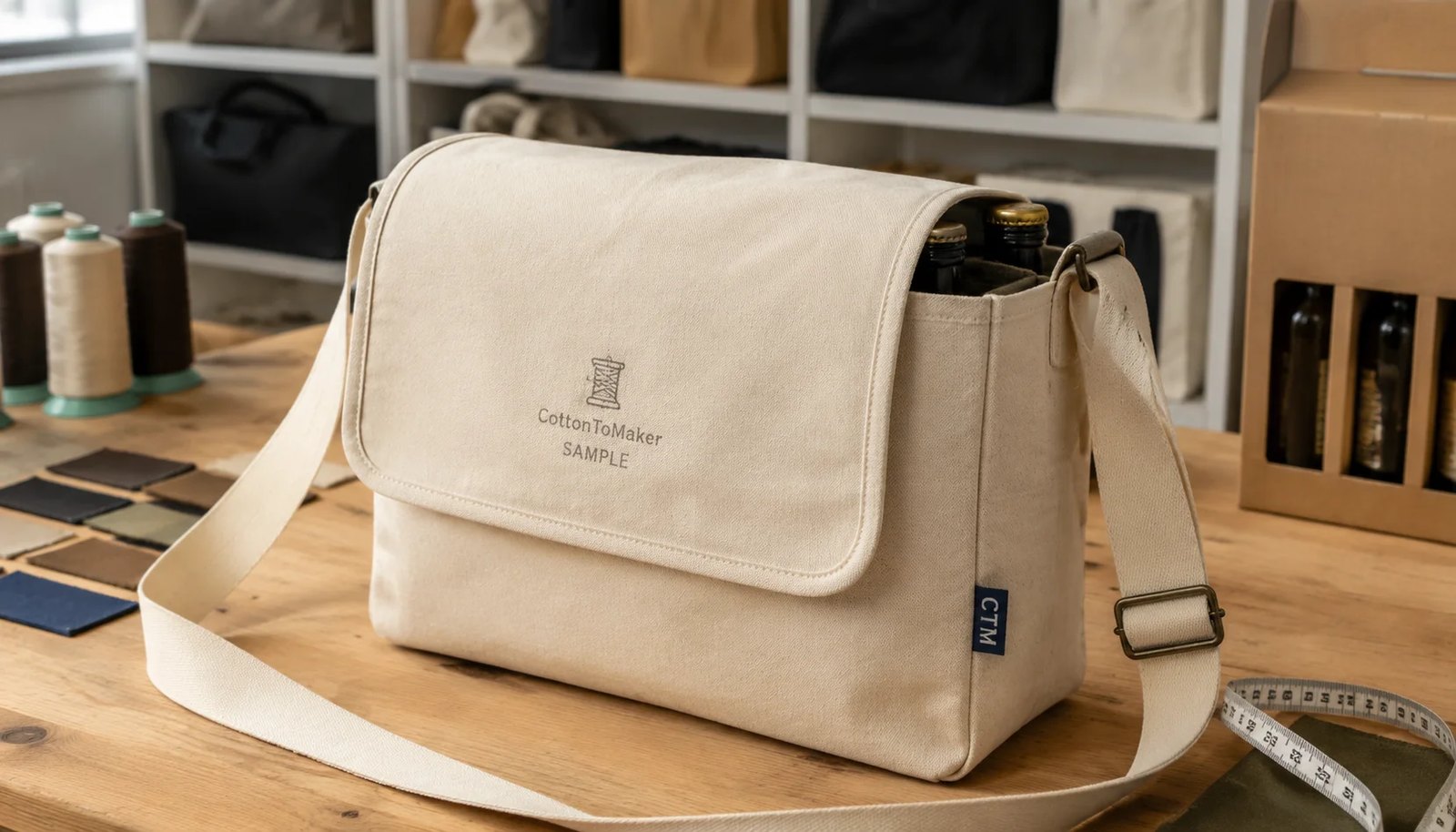
Why liquor retailers need a tighter RFQ than a standard promo bag brief
A custom canvas messenger bag for liquor retail usually carries glass, not lightweight brochures or apparel. That changes the engineering priorities. The bag must manage concentrated bottom load, protect bottle presentation, and stay usable through store handling, gifting, and customer carry-out. If a buyer sends only a short brief such as 'canvas messenger bag with logo,' each supplier will fill in the missing details differently. One may quote a soft 10 oz body with no base support, while another includes a heavier shell, divider, and insert. The price gap then looks dramatic even though the products are not comparable.
A stronger RFQ solves that problem by fixing the product architecture before quote comparison begins. For this category, the critical variables are bottle fit, safe carrying load, base reinforcement, strap specification, closure, print method, and packing logic. When those details are defined up front, procurement can compare offers on equal footing and challenge real cost drivers instead of guessing which supplier interpreted the bag more generously.
This is especially important for seasonal liquor promotions. A bag that arrives on time but fails bottle fit or strap durability can still derail the campaign. A procurement-ready RFQ should therefore serve three functions at once: it should describe the product, standardize the quote basis, and create the first layer of quality control before sampling even starts.
- Do not let suppliers decide bottle fit assumptions on your behalf.
- Treat load-bearing construction as a commercial spec, not a factory detail.
- Ask for quote assumptions in writing so low prices cannot hide omitted components.
- Use the RFQ to align procurement, merchandising, QC, and logistics before supplier selection.
Define the use case first: gift-with-purchase, resale, boxed set, or staff carry
The best starting point is not bag dimensions. It is the business use case. A gift-with-purchase bag for one bottle may prioritize visual impact and moderate cost. A reusable retail merchandise bag may justify heavier canvas, cleaner internal finishing, and stronger strap construction because the end customer is expected to reuse it. A two-bottle carrier or boxed-set bag creates a different engineering problem again, because width, gusset depth, and bottom support all change.
Buyers should write the intended carrying scenario into the RFQ. For example, is the bag expected to carry one 750 ml bottle, two 750 ml bottles, one bottle plus gift carton, or a rectangular presentation box? Is upright positioning required? Should the bottle remain hidden under the flap? Is the bag meant for a short walk from store to car, or for regular consumer reuse? These questions shape material and construction choices far more than logo size does.
Without this use-case definition, factories tend to quote around what they already make. That may produce a familiar-looking messenger bag but not the right one for your retail program. A supplier can only optimize the pattern if the intended bottle count, orientation, and service life are written clearly.
- Name the bottle format: wine, spirits, boxed gift set, or mixed retail pack.
- State whether the bag is a free promotional item or a resale SKU.
- Set expected carrying load in kilograms, not only bottle count.
- Clarify expected reuse level: one-trip, seasonal, or repeated consumer use.
How to specify dimensions from actual bottle data
In this category, finished bag dimensions should be built from the actual product inserted into the bag. A wine bottle, champagne bottle, and square spirit bottle all occupy space differently. Diameter, shoulder shape, and neck height influence divider spacing, gusset width, and flap coverage. If the bottle profile is not supplied, the factory may size the divider from a generic bottle reference, which is one of the most common causes of sample revision.
The RFQ should therefore include bottle measurements in millimeters: total height, maximum body diameter, and, if the bottle is boxed, the box width, depth, and height. If your product line includes multiple bottle shapes, specify whether the bag must fit the largest SKU or only one designated SKU. For two-bottle bags, define whether the bottles should sit tightly side by side, be separated by a stitched divider, or fit with a removable divider.
A practical RFQ also separates external bag size from critical internal fit points. For example, body width might allow a tolerance of plus or minus 5 mm, but divider cell width may need a tighter tolerance of plus or minus 3 mm because a small error there can block insertion. Writing the fit-critical dimensions separately gives the supplier a clearer pattern target and gives your QC team a more useful inspection checklist.
- Provide bottle or box dimensions in millimeters, not only photos.
- State whether dimensions are internal target, external finished size, or both.
- List critical fit points separately: opening width, divider cell width, and flap drop.
- If fit is tight, send a physical bottle or approved dummy during sampling.
Fabric, GSM, composition, and structure: what actually changes performance
Canvas weight is often discussed in ounces, but procurement should convert it into a more controlled material description. A typical entry commercial level for this category is 12 oz canvas, approximately 407 GSM. A heavier option is 16 oz, approximately 542 GSM. Those numbers are useful, but they are not enough on their own. Buyers should also ask for composition, weave type if available, and any finish that may affect hand feel or printing. A nominal 12 oz fabric can still feel weak if the weave is loose or if actual delivered weight falls below the quoted level.
For liquor retail, 12 oz cotton canvas is commonly workable for one-bottle or moderate two-bottle programs when the base and strap joints are reinforced. For premium reuse or higher load expectations, either move to 16 oz or keep the 12 oz body and upgrade the structure with a double-layer bottom, internal webbing reinforcement, or a removable board. This can be more efficient than simply specifying heavy fabric everywhere.
Composition matters too. Some buyers want 100% cotton for positioning or labeling reasons. Others accept a declared recycled blend. The key is that the composition must be stated in the quote and matched by the sample. For procurement, a vague phrase like 'canvas fabric' is not a specification. A tighter line would read: '100% cotton canvas, nominal 407 GSM, tolerance plus or minus 5%, natural color, no coating unless approved.' That sentence gives the supplier a measurable sourcing target and gives the buyer a standard for incoming review.
- Nominal 12 oz equals about 407 GSM; nominal 16 oz equals about 542 GSM.
- Ask whether the supplier controls GSM by roll testing or only buys to trader declaration.
- State if natural slub and slight weave variation are acceptable on undyed canvas.
- Confirm whether any wash, coating, or backing is applied, because it affects print and hand feel.
Construction details buyers should put into the RFQ instead of leaving to the factory
Many quote problems come from missing construction detail. Two bags may use the same canvas but perform very differently depending on seam type, reinforcement, strap material, and base build. A liquor retailer should not assume the factory will automatically upgrade these points for glass loads. If they are not in the RFQ, they may not be in the quote.
Start with the base. If the bag must carry bottles upright, specify whether you want a removable PE board, a sewn-in board sleeve, a double-layer bottom panel, or some combination. A removable board in the 1.5-2.5 mm range is common for shape retention, but the buyer should also ask how the board edges are finished and whether it is inserted before packing or packed separately. Then specify the divider: permanent or removable, number of cells, and edge finish. Raw-cut divider edges may fray and abrade bottle labels over time.
Next, define the strap. For many projects, a 38 mm cotton webbing strap with box-X reinforcement at anchor points is more reliable than a simple self-fabric strap. If adjustability is required, ask for the length range in millimeters and the hardware finish. Hidden webbing reinforcement inside a canvas strap can improve performance but should be quoted clearly so it does not appear later as a cost add-on. Finally, write the closure into the RFQ. A flap with hidden magnetic snap gives cleaner presentation, while a zipper top adds security but also sewing complexity and potential waviness if poorly executed.
- Specify base structure, not just 'reinforced bottom.'
- Call out divider permanence, material, and edge finish.
- Use measurable strap details: width, total length range, and reinforcement type.
- State closure type and component finish if appearance consistency matters.
Branding methods and artwork controls for canvas liquor bags
For most bulk programs, one- or two-color screen printing remains the most practical branding method for custom canvas messenger bags. It is cost-efficient, scalable, and relatively easy to compare across suppliers. But print comparability still depends on the RFQ being precise. Buyers should state the print location, print size, color count, and reference point for measurement. For example, 'front flap, centered, logo width 160 mm, print top edge 45 mm below flap edge' is far more useful than 'logo centered on flap.'
Canvas texture can affect ink appearance. Natural canvas tends to absorb differently from dyed canvas, and heavier fabrics may need stronger opacity planning for light-on-dark or dark-on-light graphics. That is why a strike-off on production fabric is valuable. A digital mockup shows layout but not how ink sits on the actual weave. Procurement should request the strike-off before bulk printing is approved, especially when brand color consistency is important.
For more permanent retail programs, woven labels are often a cleaner and lower-risk secondary branding element than large decorative patches. A small side seam label gives brand identity without adding stiffness to the flap. Patches can still work, but they should not sit directly on fold lines or thick seam junctions, and their placement should be approved from seam-based reference points. In the RFQ, include whether woven labels, care labels, or origin labels are required so the quote reflects the full trim package.
- Measure print placement from flap edge, seam, or centerline, not by eye.
- Request a strike-off on bulk fabric for color and opacity review.
- Use woven labels when logo detail is too fine for clean screen print.
- Include all labels in the quote scope, not only the decorative logo element.
MOQ, split orders, and the quote comparison traps that affect real cost
MOQ for this product is rarely one clean number. In practice, there may be a fabric MOQ by color, a print MOQ by artwork, and a hardware MOQ by finish. A supplier might accept 500 units total, but if that quantity is split into two colors and two logos, the true efficiency changes. Buyers should therefore ask for MOQ and pricing by design, by colorway, and by hardware variant rather than relying on one blended minimum.
For liquor retailers with multiple store banners, shared-material planning often gives better value than trying to customize every component. A stock natural or black canvas body with different prints or woven labels can keep order quantities commercially sensible while still creating channel differentiation. By contrast, a custom dyed body color in a low volume may add both cost and lead-time risk because fabric booking and shade approval become separate stages.
The main quote trap is that low MOQ offers may hide weaker process control. A supplier may use leftover material, mix near shades, or minimize sampling steps to make a small project look attractive on paper. That does not mean low-volume sourcing is impossible, only that the buyer should ask what is being standardized and what is being sacrificed. Procurement should compare not just unit price but also setup charges, sample charges, package density, and likely rework risk.
- Ask MOQ separately for body color, logo version, and hardware finish.
- Use shared stock canvas where brand requirements allow it.
- Check whether low MOQ pricing relies on stock leftovers or limited color choice.
- Compare total landed cost, not only quoted unit price.
A practical RFQ template structure buyers can send to suppliers
A good RFQ for custom canvas messenger bags should let a supplier quote without guessing. The structure can be simple, but each field should be measurable. Start with project basics: program name, target order quantity, target ship date, and Incoterm requested. Then list the product application, bottle type, bottle dimensions, and target load. After that, define finished bag dimensions, strap details, divider and insert details, closure, branding, labels, and packaging instructions.
Next, include commercial and operational fields that many buyers forget. Request sample stages and sample fees, tooling or screen charges, MOQ by color and logo, carton quantity, carton dimensions, gross weight, production lead time, and quote validity period. Require the supplier to state any assumptions or exclusions. This prevents a low quote from slipping through because the factory silently omitted a board insert, barcode label, or interleaf packing.
Finally, attach visual support. A simple line sketch with key dimensions, flap shape, and print location can save several rounds of clarification. If you have an existing reference bag, note which features should be copied and which should be changed. The goal is not to overwhelm the supplier with paperwork. It is to remove the high-cost ambiguities that create mismatched quotations and delayed sample cycles.
- Project basics: quantity, ship window, destination, and Incoterm.
- Product basics: bottle dimensions, use case, load requirement, and reuse expectation.
- Technical basics: fabric, size, strap, divider, base, closure, logo, labels, and packing.
- Commercial basics: sample charges, MOQ splits, carton data, lead time, and exclusions.
Sampling and approval flow: fit sample first, branded sample second
A two-stage sample process is usually more efficient than jumping directly to a fully branded pre-production sample. The first stage should be a fit sample made to verify pattern, bottle insertion, opening width, divider spacing, flap coverage, and balance under load. This sample does not need full branding if the shape itself is still under review. It is the cheapest point in the process to catch wrong assumptions about bottle geometry or strap drop.
Once fit is approved, move to a branded pre-production sample in production-intent fabric using the actual print method, reinforcement method, and hardware. This sample should confirm print color and position, seam appearance, closure operation, insert fit, and the approved packing fold. If the item will be packed with inserted board or special interleaf, that should be tested now rather than left for bulk.
Approval should be documented, not verbal. Buyers should keep annotated photos, a signed spec sheet, and, where practical, a retained approved sample for inspection reference. This becomes especially important when different internal teams sign off at different times. Procurement may approve cost, merchandising may approve appearance, and QC may approve tolerances. One retained reference keeps those decisions aligned when production starts.
- Use a plain fit sample to validate bottle geometry and balance before final branding.
- Use a branded pre-production sample to lock print, stitching, hardware, and packing.
- Approve with notes on dimensions, logo placement, closure function, and insert type.
- Retain one sealed approval sample as inspection reference for bulk.
QC tolerances, inspection priorities, and packing details that protect the order
Inspection should focus first on function failure, then on appearance. For a liquor retailer, the biggest risks are strap failure, bottom sag, bad divider fit, and closure misalignment. A bag that looks neat but cannot safely carry the intended bottle load is not commercially acceptable. That is why the RFQ and PO should include a short list of critical-to-function points with measurable tolerances.
Typical tolerances depend on the pattern, but many buyers use body width and height within plus or minus 5 mm, gusset depth within plus or minus 3 mm, and divider cell width within plus or minus 3 mm when bottle fit is important. Print position can be controlled from a defined reference point, often within plus or minus 5 mm. These figures are not universal rules, but they are concrete starting points. What matters is that the tolerance is written before bulk, not argued after inspection.
For inspections, ask the supplier how key points are checked. Even if the final audit follows an AQL method, it is reasonable to request 100% visual confirmation for print orientation, strap attachment presence, and barcode correctness because those defects are easy to screen before packing. Packing itself deserves the same attention. If printed flaps are stacked too early or without interleaf, offset and rub marks can appear in transit. If straps are folded carelessly, they can imprint creases onto the body panel. These are preventable losses when fold method and carton count are approved early.
- Prioritize critical checks: strap anchors, base support, divider fit, and closure function.
- Write dimensional tolerances into the PO and approval sheet.
- Use seam- or edge-based references for print position measurement.
- Approve folding method, interleaf use, and carton count before production packing.
Specification comparison for buyers
| Spec decision | Recommended option | When it fits | Buyer risk to check |
|---|---|---|---|
| Base fabric weight | 12 oz cotton canvas, nominal 407 GSM, with acceptable lot tolerance of plus or minus 5% if no wash is applied | Suitable for one-bottle and two-bottle promotional or gift-with-purchase programs where cost, printability, and reasonable structure must balance | Some suppliers quote by ounce but deliver open-weave fabric with lower actual mass or mixed fiber content; request composition, weave description, and roll test result |
| Heavy-duty fabric route | 16 oz cotton canvas, nominal 542 GSM, or 12 oz body with reinforced double-layer bottom panel | Better for premium resale bags, heavier glass loads, and programs expecting repeated consumer reuse | Heavier fabric can change print opacity, fold bulk, carton density, and seam turning; verify whether the quoted machine capability supports clean sewing on thick assemblies |
| Fabric composition | 100% cotton canvas or declared recycled cotton blend with composition stated on quote and sample | Use when retailer needs natural fiber positioning or sustainability disclosure at item level | Undeclared polyester content, recycled blend inconsistency, and shade variation are common sourcing issues; require written composition and sample retention swatch |
| Inner structure | Removable PE board bottom, typically 1.5-2.5 mm, in a sewn sleeve plus stitched divider sized to actual bottle diameter | Useful when bottles must stand upright and bag base cannot sag during gifting or store handling | Divider spacing often misses real bottle shoulder width; require fit test with actual bottle or a dimensioned dummy and confirm board edge finish does not cut fabric |
| Strap construction | 38 mm cotton webbing or canvas-covered webbing with box-X reinforcement at both upper joints | Recommended for shoulder carry loads around 2.5-5.0 kg depending on bottle count and board | Quoted strap may be self-fabric only, which can twist or stretch; ask for strap material, width, total cut length, and reinforcement stitch count |
| Closure choice | Flap with hidden magnetic snap plus optional top zipper if transit security matters | Fits urban carry use and premium presentation where bottle tops should be covered | Magnet alignment failures and zipper waviness are common; specify component finish, pull style, and acceptable operation standard on sample |
| Printing method | 1-2 color screen print with strike-off approved on production fabric before bulk | Best value for clean logos and medium to large order quantities | Ink coverage on natural canvas can vary by absorbency and pretreatment; require print position tolerance and cure quality standard |
| Premium branding route | Small woven label in side seam or flap seam, optionally combined with one-color print | Fits private-label liquor programs that want a less promotional and more permanent retail appearance | Large patches can interfere with flap folds and create needle marks; approve exact placement from seam reference points |
| MOQ structure | 500-1000 pcs per design using shared stock natural or black canvas where possible | Good balance for regional chains, importers testing one campaign, and seasonal retail promotions | Low MOQ quotes may exclude stable dye lots, consistent printing, or full QC discipline; ask what MOQ applies by color, logo, and hardware |
Buyer checklist before sampling
- State the exact commercial use: one-bottle gift bag, two-bottle carrier, boxed-set bag, reusable retail merchandise, or staff-use shoulder bag.
- Provide bottle data in millimeters: total height, maximum body diameter or box dimensions, neck position if relevant, and target number of units per bag.
- Specify target safe carry load in kilograms, including bottles, divider, insert, and any promotional collateral.
- Define finished bag size in millimeters as width x depth x height, plus flap drop length and opening width if bottle insertion is tight.
- State canvas requirement by fiber composition and nominal weight, for example 100% cotton 12 oz nominal 407 GSM, acceptable tolerance plus or minus 5%.
- Clarify whether natural canvas, stock dyed color, or custom Pantone body color is required, and whether slight natural slub is acceptable.
- Set strap details: material, width, adjustable or fixed, strap length range, reinforcement type at anchor points, and any shoulder pad requirement.
- Confirm internal engineering: divider quantity, divider permanence, board thickness, sleeve construction, and whether bottles must remain upright.
- Define logo method and placement from measurable reference points, such as centerline or distance from flap edge, not only visual mockup notes.
- Include packaging rules: barcode label content and position, polybag requirement, suffocation warning rules, carton size limit, and pallet rules if your warehouse requires them.
Factory quote questions to send
- What exact fabric are you quoting by composition, nominal GSM, weave, and finish, and what lot-to-lot weight tolerance do you control in production?
- What is the finished cut-and-sew construction at the base and side seams: seam type, seam allowance, reinforcement layer, and whether the bottom is single or double panel?
- What strap material is included in the quote, what is the finished width, what is the adjustable length range, and how are the strap joints reinforced?
- What load assumption are you using for this bag, and can you describe any internal factory carry test or seam check used before packing?
- Is the divider permanent or removable, what material is used for body and edging, and what internal cell width will you make based on our bottle dimensions?
- What board material and thickness are included for the base insert, and is the insert packed inside the bag or separately in the carton?
- What print method, color count, print area, and artwork setup are included, and will you provide a strike-off on production fabric for approval before bulk printing?
- What MOQ applies separately by bag color, logo version, and hardware finish if we split one PO across multiple store programs?
- Which operations are completed in-house and which are outsourced, specifically fabric sourcing, dyeing, screen printing, sewing, woven labels, and export packing?
- What are your sample stages and sample lead times for a fit sample, pre-production sample, and shipping sample from bulk lot?
Quality-control points to confirm
- Fabric should match approved composition, hand feel, and nominal weight, with the production lot remaining within the agreed GSM tolerance, commonly plus or minus 5% unless another standard is specified in the PO.
- Body panels, flap, gusset, and strap components should show no obvious shade mismatch under standard inspection lighting; slight natural variation on undyed canvas should be pre-approved if acceptable.
- Finished size should stay within the approved tolerance, for example body width and height within plus or minus 5 mm, gusset depth within plus or minus 3 mm, and divider cell width within plus or minus 3 mm because bottle fit is critical.
- Strap length and adjustability must match approved range, and left-right anchor placement should be symmetrical to prevent twisted carry behavior.
- Strap attachments and other stress points should show the approved reinforcement method, such as box-X or bartack, with no skipped stitches, broken threads, loose back-tacks, seam grin, or open needle holes.
- Base panel and insert sleeve must sit flat without severe distortion; if a PE board is included, edges should be smooth, corners rounded, and insertion or removal possible without tearing the sleeve.
- Bottle divider should fit the approved bottle dimensions and hold bottles upright without excessive collapse; divider edges should be bound or folded so raw fraying does not contact labels.
- Flap drop and closure position must align cleanly so the flap covers the bottle neck area as approved; magnets, snaps, or zippers should function smoothly without puckering or misalignment.
- Screen print should match approved artwork, color, opacity, and location, with no obvious ghosting, pinholes, smudging, registration shift, or under-cured ink transfer.
- Visible stitching should be reasonably straight and consistent; thread ends should be trimmed, and visible oil marks, dark contamination, mildew smell, or metal dust inside the bag are not acceptable.