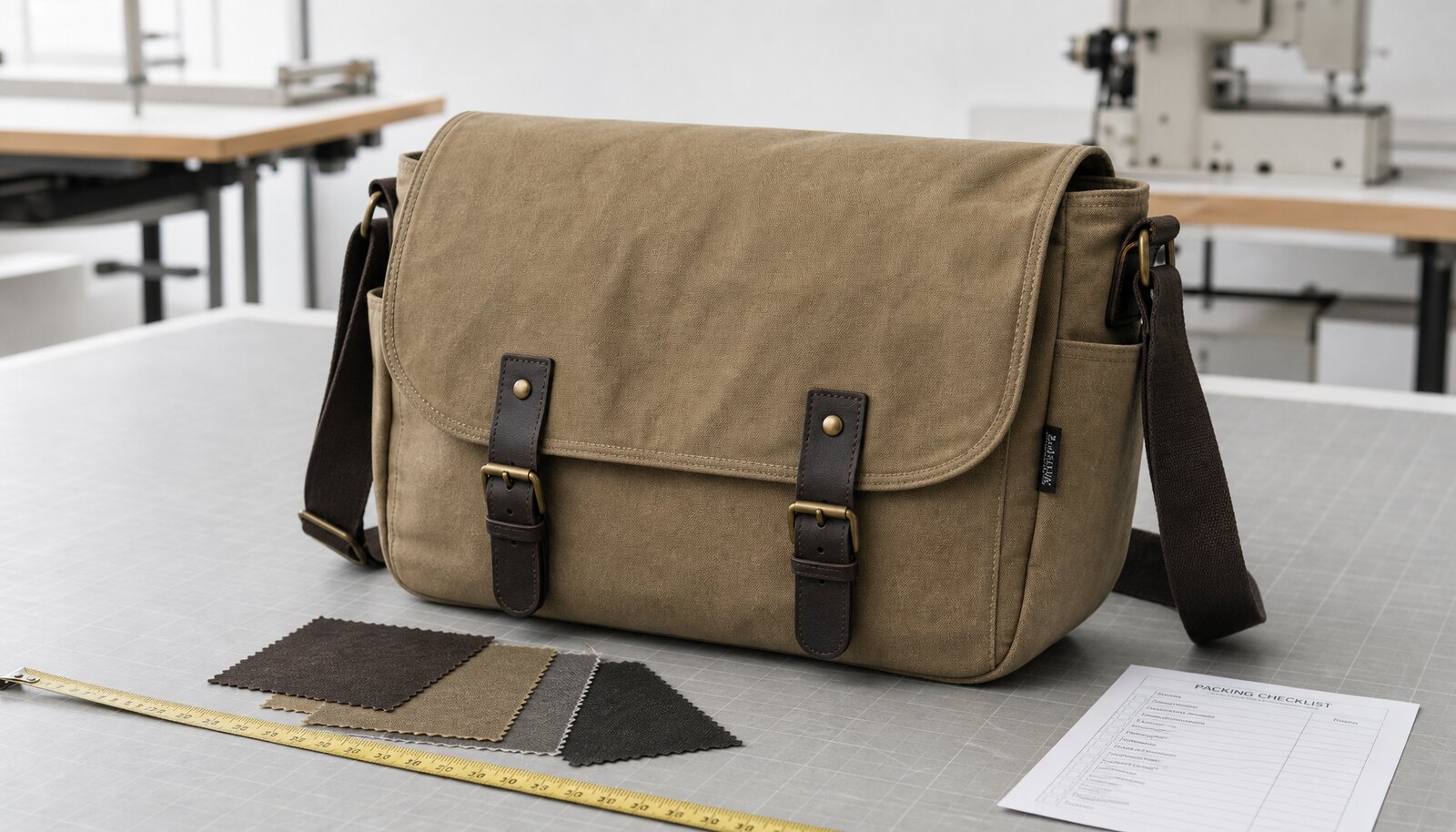
Why boutique wineries need a different inspection lens
Custom canvas messenger bags sit in a very visible part of the winery experience. They are often handed over at tasting rooms, used in seasonal gift sets, or sold as branded merchandise, so the buyer is not only managing a utility item. The bag becomes part of the customer’s first physical impression of the brand, which means small defects can matter more than they would in a generic promotional program.
A bag that is slightly off-center, too soft, or inconsistently packed can still be usable, but it does not feel premium. That matters for boutique wineries because the product is usually tied to a higher-touch brand story. The bag may carry a bottle, a tasting booklet, or a small purchase from the shop floor, so the design needs to balance presentation, carry comfort, and repeatable production quality.
The right quality plan is less about chasing a perfect spec and more about making the important details measurable. If the bag will be used in public-facing service, the buyer should care about shape retention, print placement, strap comfort, and packing presentation as much as they care about unit price. That framing keeps the procurement process focused on what the customer will actually see and feel.
Start with the use case, not the quote request
Different winery programs need different messenger bag constructions. A bag meant for a bottle purchase needs enough depth and base support to carry weight without collapsing. A bag for retail resale needs a cleaner front panel, a more disciplined logo placement zone, and packaging that looks shelf-ready. A seasonal gift kit needs a wider opening and a fold that does not create a deep crease in the logo area.
If the buyer does not define the use case early, the supplier will usually quote a generic bag that looks reasonable in a render but does not match the actual retail function. The fastest way to avoid that is to state the contents first, then the dimensions, then the presentation standard. For example: one 750 ml bottle plus brochure insert, or one bottle sleeve plus a tasting notes card, or an event handout bag that must stack cleanly in cartons.
Use-case clarity also helps compare suppliers on equal terms. Two quotes can appear close in price while hiding very different assumptions about body size, pocket count, strap length, lining, or decoration method. Once the intended use is written down, those differences become obvious instead of showing up later as change orders.
- Bottle carry: prioritize base support, gusset depth, and strap reinforcement.
- Retail resale: prioritize front-panel presentation, logo consistency, and packing quality.
- Gift kit: prioritize opening width, fold behavior, and insert compatibility.
Build a spec sheet the factory can actually make
The best spec sheets are short, literal, and easy to inspect. Include finished width, height, gusset depth, strap drop, strap width, pocket size, and logo placement. If the bag has lining, an internal divider, a closure, or a base insert, list those as separate lines rather than describing them in prose. That makes it easier for the supplier to price the bag accurately and for your team to compare the sample against the approved drawing.
Canvas terms deserve extra care. State the fabric weight, but also state whether that number refers to finished fabric or base cloth before dyeing, washing, or coating. Add the finish condition as well: raw, dyed, washed, or coated. These details affect hand feel, shrink behavior, print performance, and repeat-order consistency. If the factory uses a slightly different base fabric for a recycled or specialty line, that needs to be visible before the order starts.
Avoid vague instructions like ‘premium quality’ or ‘strong enough for bottles.’ Those phrases do not help a sewing line or a QC inspector. Instead, attach a simple drawing or measurement sheet and ask the supplier to restate the same details in the quote. If the factory can repeat your spec accurately, it usually understands the job well enough to produce it consistently.
Choose fabric and finish for the actual merchandising job
For boutique winery use, 12 oz to 14 oz cotton canvas is often a practical starting point because it gives the bag enough body without making it heavy or awkward. That said, weight alone is not a quality guarantee. Two fabrics with the same stated weight can feel very different depending on weave density, finishing, and whether the cloth has been washed or coated. The sample swatch matters more than the catalog description.
If the bag is meant to feel rustic and natural, raw or lightly washed canvas may fit the brand story. If the bag must hold a cleaner retail shape, a firmer finish or light reinforcement may be more appropriate. Coated canvas can help with wipeability, but it can also change how the bag folds and how decoration adheres. None of these options is automatically better; the right choice depends on whether the bag is being sold, handed out, or used as a package carrier.
Straps deserve the same attention as the body fabric. A soft bag with a strong strap can still carry well, while a heavy bag with an underbuilt strap feels cheap quickly. Keep the strap material, width, and attachment method tied to the loaded use case rather than treating them as secondary details.
- Use the approved swatch, not only the quote description, to confirm fabric hand feel.
- Check whether dyeing or washing changes the final shade enough to matter for repeat orders.
- Match strap width and attachment style to the expected load and the way staff will hand the bag out.
Decoration is part of quality, not just branding
On a winery messenger bag, the logo is often the first thing people notice, so decoration quality has to be treated as a production control point. Screen print works well for simple marks and keeps recurring cost predictable. Woven labels or embroidery can give a more retail-ready look, but they also introduce more ways for the bag to fail visually if placement, backing, or stitch density is off.
The most common mistake is approving the artwork in isolation. A logo can look fine on a white proof and still feel cramped on natural canvas, too close to a seam, or too low on the front panel once the bag is sewn. The safer approach is to approve the artwork on the actual bag color and ask the supplier to show the final placement on a pre-production sample. That gives the buyer a real view of scale, contrast, and panel balance.
Decoration durability should also be tested in a simple, practical way. After curing or finishing, rub the print lightly with a clean cloth and inspect for smearing, lifting, or edge break-up. For embroidery, look for puckering, loose thread ends, and distortion around the design. If the decoration cannot survive a basic handling check, it will not hold up well in retail service.
Structural QC: seams, reinforcement, and carry performance
A canvas messenger bag can look clean in a photo and still fail at the load-bearing points. The risk areas are usually strap anchors, gusset corners, pocket seams, and any fold line that carries tension. For that reason, the inspection plan should start with construction, not only appearance. The buyer should review the approved sample and confirm where reinforcement is expected, how it is built, and how it is repeated across the order.
Do not treat seam allowance or stitch density as universal defaults. Those values depend on the bag pattern, the fabric weight, and the factory’s construction method. What matters is consistency with the approved sample and with the way the bag is intended to be used. If the supplier proposes a different seam allowance or stitch pattern for production, it should be explained and matched to the tested sample before bulk sewing starts.
A practical load check is enough for most buyer programs. Use the intended bottle load or an equivalent weight, place it in the bag, and confirm that the seams, strap anchors, and body shape remain stable. If the bag sags badly, opens at the top, or shows stress at the gusset, the construction needs revision. That is better caught in sample review than in a warehouse complaint.
Compare suppliers on control, not just headline price
Supplier selection for boutique wineries should be based on how well the vendor controls the product, not only on the lowest unit price. A direct factory can often give the clearest picture of sewing, decoration, and packing, but only if it actually owns the line or can show the production flow in a credible way. Trading companies can be useful when they manage coordination well, but the buyer needs to know who is responsible for defects if the order goes wrong. Local distributors may be suitable for quick replenishment, though they usually offer less flexibility on custom sizing and branding.
A useful comparison framework is to look at four things: production visibility, sample discipline, quote clarity, and reorder stability. Production visibility means the supplier can show where the bags are made and how they are checked. Sample discipline means the vendor can produce a decorated pre-production sample that matches final materials, not just a rough mockup. Quote clarity means the supplier breaks out unit price, setup, packing, and any optional extras. Reorder stability means the bag can be made again without drifting in shade, strap length, or logo placement.
If two quotes are close, choose the supplier that answers the hard questions directly. A lower price is not useful if it hides a different fabric weight, a thinner strap, or a packing format that damages the bag in transit.
Sample approval and pre-production control
Sample approval is where many problems become visible, but only if the buyer treats the sample as a working document rather than a display object. Start by checking the sample against the spec sheet line by line. Confirm dimensions, logo placement, strap length, pocket size, and any closure or lining details. Then move to touch points: how the canvas feels, how the bag folds, whether the strap sits comfortably, and whether the bag looks balanced when full.
The pre-production sample should match the final materials and packing format as closely as possible. If the supplier shows a sample made with different thread, different canvas, or a different label, the buyer is not approving the real product. That creates avoidable ambiguity later. The signed sample should include the exact fabric, thread, trim, decoration method, and pack format that will be used in the order.
Treat the sample as the last place to make changes without cost. Once the sample is approved, freeze the drawing, the artwork map, and the material list. Small changes after that point often create ripple effects in production and inspection, especially when the order is seasonal and the window to ship is narrow.
- Approve the sample under normal light, not only in a studio or on a screen.
- Keep one sealed golden sample and one signed spec sheet for reorder control.
- Do not approve a sample that uses substitute fabric, trim, or packing unless that substitution is intentional and documented.
Inspection at the factory and at receipt
A useful inspection plan looks at the bag in the same order a buyer would notice it: first the visual appearance, then the construction, then the packing. Start with color, logo placement, and panel symmetry. Move next to seams, bartacks, and strap attachment points. Finish with folding, carton count, barcode placement, and whether the bags arrive ready for shelf or handout use. This order saves time and catches the issues that matter most to the end customer.
Set the defect rules before production, not after. Most procurement teams distinguish between critical defects, major defects, and minor cosmetic issues, but the exact sampling plan should be written into the PO or quality agreement. For this product, critical defects are the ones that affect use or brand trust directly: wrong artwork, wrong size, broken seams, severe stains, odor contamination, or missing reinforcement. Major defects are those that make the bag look or function poorly in retail use, such as obvious print misalignment or weak stitch lines. Minor defects are small cosmetic issues that do not interfere with use, but may still matter if the bag is sold at a premium price.
If the order is going to a tasting room or retail shelf, do not stop at technical acceptability. Look at the bag from display distance and ask whether it looks worth handing to a customer. That question catches a lot of otherwise passable defects that procurement language alone tends to miss.
Packing, transit, and reorder discipline
Packing can protect quality or ruin it. A clean messenger bag can still arrive looking weak if it is folded badly, over-compressed, or stacked without protection. For retail use, ask for a folding method that keeps the front panel presentable and the logo area from creasing. If the bag ships with inserts, tags, or barcodes, confirm that those elements do not shift or leave adhesive marks on the canvas. If the order is bulk packed, verify that carton density does not crush the bag shape before it reaches the store.
For bottle-related programs, packing matters even more because the buyer may be using the bag as part of a gift or carry experience. A carton that is packed too tightly can deform the bag and make the first customer handoff look poor. A carton that is packed too loosely can cause wrinkling, corner wear, or contamination. The pack method should be part of the approved sample, not a last-minute warehouse choice.
Reorder discipline is the last piece most buyers forget. Keep a record of the approved swatch, the signed sample, the artwork file, the packing spec, and any material substitution that was allowed. If the bag sells well and gets reordered next season, those documents prevent small differences from creeping in and making the new batch look like a different product.
Specification comparison for buyers
| Procurement decision | Recommended option | Why boutique wineries usually choose it | Inspection / quote point to verify |
|---|---|---|---|
| Fabric body | 12 oz to 14 oz cotton canvas as a starting point | Usually strong enough for tasting-room use, retail gifting, and light bottle carry without feeling bulky | Confirm whether the weight is finished fabric or base cloth, and whether the swatch reflects the same dye, wash, or coating process |
| Bag format | Gusseted messenger body with reinforced base and strap anchors | Holds brochure packs, bottle sleeves, or small gift kits better than a flat tote-style bag | Check finished dimensions, gusset depth, and how the bag stands or folds when loaded |
| Decoration method | Screen print for simple logos; woven label or embroidery when the brand call is more premium | Screen print is efficient for clean marks; labels and embroidery can look richer if the construction supports them | Approve artwork on the actual canvas color and tie placement tolerances to the artwork size, not a generic number |
| Internal structure | Light lining or panel reinforcement only when the bag must hold shape | Adds presentation value when the bag is sold retail or used for gift sets | Ask what material is used for reinforcement and whether it changes weight, fold behavior, or print adhesion |
| Supplier route | Direct factory with bag specialization and written QC flow | Gives clearer accountability for sewing, decoration, and packing defects | Verify who owns production, who owns QC, and whether the quote comes from the actual maker or an intermediary |
| Sampling path | Material swatch, decorated strike-off, then pre-production sample | Reduces risk of wrong canvas shade, logo drift, or trim substitution | Keep the approved sample sealed and signed, with the exact fabric, thread, and packing format noted |
| Packing format | Bulk packed for distributor use; individual polybag or tissue wrap for retail | Boutique wineries often need shelf-ready presentation or clean event handouts | Confirm carton count, fold method, barcode location, and whether dust protection is included |
| Inspection standard | Factory-defined sampling plan written into the PO, with defect classes named in advance | Prevents the supplier from changing the bar after production starts | Do not accept a quote that leaves inspection method, defect definitions, or acceptance limits unstated |
Buyer checklist before sampling
- Define the actual use case first: bottle presentation, tasting-room retail, seasonal gift kit, or event handout.
- Write one dimension sheet with finished width, height, gusset depth, strap drop, pocket size, and logo placement.
- State the canvas weight, finish, and color basis, and approve a physical swatch before sampling.
- Lock the decoration method, artwork file, print area, and acceptable placement movement before bulk order.
- Request a pre-production sample built with final fabric, trim, thread, and packing method.
- Have the supplier state its inspection method and defect classes in writing before production starts.
- Set functional checks for seam integrity, strap strength, print durability, carton count, and retail presentation.
- Confirm whether the bags will be bulk packed, individually wrapped, or shipped with inserts and barcode labels.
- Keep one sealed golden sample and one signed spec sheet for reorder control and claims handling.
- Break the quote into unit price, setup, sampling, packing, and any extra charge for trim, lining, or alternate colors.
Factory quote questions to send
- What exact use case is this quote based on: one bottle, a brochure set, a gift kit, or a general retail bag?
- Is the quoted canvas weight based on finished fabric after washing or dyeing, or on the base cloth before finishing?
- Can you separate the price for the bag, decoration, packing, sample development, and any setup or tool charge?
- What construction method are you using at the strap anchors, corners, and gusset, and how is reinforcement handled?
- How will the logo be positioned on the actual bag, and what placement variation do you hold during production?
- What is included in the decorated pre-production sample, and will it match the final fabric, thread, and packing format?
- What inspection plan do you normally use for this product, and how do you define critical, major, and minor defects?
- How do you test load performance for the final bag, and what weight or bottle equivalent do you use?
- Can you keep lot traceability for canvas, thread, webbing, labels, and hardware if we need a reorder or claim review?
- What is the production lead time, what starts the clock, and what items are on the critical path if the order is seasonal?
Quality-control points to confirm
- Compare finished dimensions against the signed sample and spec sheet; set the tolerance to fit the artwork and load profile rather than relying on a universal default.
- Check the fabric against the approved swatch under normal light, including shade consistency across panels, straps, and pocket pieces.
- Inspect seam behavior at stress points such as strap anchors, gusset corners, and pocket edges; look for skipped stitches, puckering, or thread breakage.
- Review reinforcement against the approved construction sample, especially bartacks or box stitching where the strap carries weight.
- Verify that the bag keeps its intended shape when loaded with the expected contents, not only when empty on a table.
- Measure logo placement against the approved artwork map and inspect whether the decoration sits cleanly away from seams, folds, and pocket edges.
- Test print or label durability after cure with a basic rub check; look for cracking, bleeding, lifting, or edge fray.
- Check hardware, if any, for finish consistency, secure attachment, and compatibility with the canvas weight and fold method.
- Inspect packing quality: fold consistency, protection of front panels, carton count, barcode location, and resistance to corner crush.
- Confirm reorder consistency by noting any approved alternate fabric lot, dye range, or trim substitution before the first production run ships.