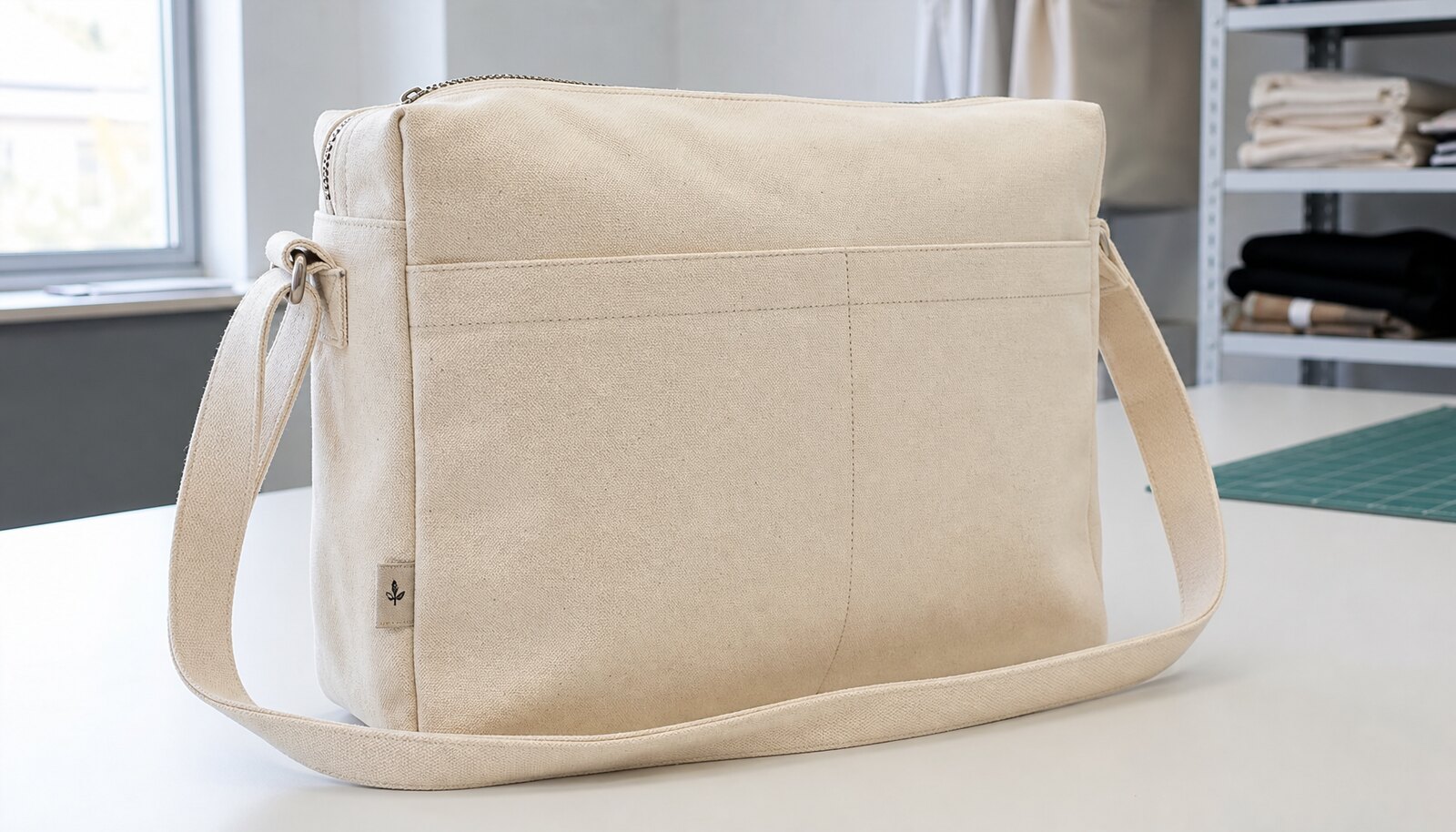
Start With the Gift Risk, Not the Product Photo
A custom canvas messenger bag for corporate gifting is judged twice. First, it has to work as a bag. Then it has to behave like a branded gift in front of employees, clients, event guests, sales prospects, or channel partners. A weak strap is an obvious functional defect. A crooked logo, dusty surface, chemical odor, crushed fold, rough interior, or cheap zipper is also a problem because the recipient connects those details with the company that gave the bag.
Many bulk problems are created before fabric is cut. A buyer sends a reference image, logo file, target quantity, and deadline. Suppliers return prices that look comparable, but each one fills in missing details differently. One supplier prices 12 oz canvas. Another assumes 14 oz. One includes individual polybags and carton marks. Another quotes bulk packing only. One uses a basic nylon coil zipper, while another includes heavier hardware and bound seams. The difference is not always margin. Often, it is a different bag.
Use this custom canvas messenger bags quality inspection checklist for corporate gifting as an RFQ guide, sample approval guide, and final QC checklist. The point is not to add paperwork for its own sake. The point is to make the supplier price the same product you expect to receive, produce against a physical standard, and give inspectors measurable criteria instead of opinions.
- Identify whether the bag is a utility giveaway, employee welcome gift, conference kit, retail-style premium, or client presentation item.
- Define what would create a complaint: strap failure, wrong color, poor logo alignment, rough interior, fabric odor, carton sorting error, or poor gift presentation.
- Separate critical functional points from cosmetic points so the supplier understands priority during production and rework.
- Use one sealed approved sample as the reference for fabric, construction, branding, packing, and overall hand feel.
- Write inspection criteria before bulk production so defects are not debated after goods are finished.
Turn the Use Case Into Measurable Specs
A good messenger bag specification starts with the recipient, not the silhouette. A flat document carrier for event papers can be much simpler than a messenger bag expected to hold a notebook, catalog, charger, tablet, and bottle. If the bag will be handed out quickly at a trade show, packing speed and carton sorting may matter as much as interior finish. If it is part of an executive gift set, the same general shape may need cleaner seams, tighter logo alignment, better hardware, and individual presentation packing.
When procurement asks for one price without defining load, handling, or presentation, the factory has to guess. A price-focused supplier may reduce canvas weight, narrow the strap, remove reinforcement, simplify the closure, loosen the stitch standard, or pack bags tightly to reduce carton volume. Those choices might be fine for a low-cost promotional item. They are risky for a corporate gift that should feel useful beyond the day it is received.
The RFQ should describe expected contents, distribution method, brand standard, and delivery route. That context helps the supplier recommend the right construction level. It also helps the buyer compare value instead of only unit price. A bag used for onboarding kits, for example, may need reliable carton sorting by department or location. A bag used for client meetings may need cleaner packed presentation and stricter logo placement.
- For document use, define paper size, folder thickness, and whether the bag needs a gusset or only a flat body.
- For tablet or notebook use, define target device size, estimated carry weight, and whether padding, divider panels, or a secured pocket are required.
- For event handouts, confirm whether bags must be packed by color, SKU, department, event date, recipient group, or destination.
- For premium gifts, add cleaner interior finishing, tighter logo alignment, better hardware finish, and presentation packing requirements.
- For international distribution, define carton labels, barcode needs, mixed-carton rules, destination marks, and any customer compliance documentation.
Write a Specification the Factory Can Repeat
A factory cannot consistently produce a specification that only exists in the buyer's head. The RFQ should state finished dimensions, material, trims, branding, construction, packing, and tolerances. For a canvas messenger bag, the minimum useful spec includes width, height, gusset depth, flap depth if applicable, strap width, strap length or adjustable range, closure type, pocket layout, fabric color, canvas weight, logo method, logo size, logo position, and packing method.
Canvas weight should be written in both ounces and GSM where possible because buyers and suppliers may use different conventions. As a practical sourcing range, 10 oz to 12 oz canvas can suit light promotional bags. 14 oz, or about 475 GSM, is a common starting point for a more substantial corporate gift. 16 oz or heavier may work for premium or heavier-use programs, but only after a physical sample is reviewed. Heavier fabric can improve structure, yet it may also increase stiffness, sewing difficulty, folding marks, carton volume, and freight cost.
Tolerances need to be realistic for sewn cotton goods. Many programs start with plus or minus 10 mm for main finished dimensions, plus or minus 5 mm to 10 mm for logo and pocket placement, and plus or minus 20 mm for long straps, depending on construction. Tighter control is possible, but it should be priced and planned. It may require better cutting control, placement jigs, slower sewing, and more inspection time.
- List finished dimensions with tolerances: width, height, gusset depth, flap depth, strap length, strap drop, and pocket size.
- Specify fabric weight, composition, color, finish, and whether it is natural, dyed, washed, pre-shrunk, coated, or laminated.
- Define sewing details including stitch density, seam allowance, binding, lining, topstitching, and reinforcement method.
- State closure and hardware details including zipper type, slider style, snap size, buckle material, D-ring size, adjuster type, and finish color.
- Provide logo placement measurements from fixed reference points such as top edge, side seam, flap edge, zipper line, or patch edge.
- Include packing requirements in the same specification so the sample is approved as a finished gift item, not just as an unpacked bag.
Choose Materials With Inspection in Mind
Material choices look simple on a quote sheet, but they create most of the inspection questions later. Natural canvas can show seed specks, fiber variation, and shade differences. These details may be acceptable if they are visible in the approved sample and written into the standard. They become disputes when the buyer expected a cleaner, more uniform surface. Dyed canvas brings additional shade and colorfastness risk, especially when dark fabric touches light inserts, pale linings, or light clothing. Washed canvas may feel softer, but shrinkage can make size tolerance harder to hold.
Fabric composition should be written plainly. Cotton, recycled cotton, organic cotton, cotton-poly blend, and post-consumer recycled content are not interchangeable for costing, feel, customs paperwork, or sustainability claims. If the corporate program will use environmental language, ask what documentation is available before the claim is used in HR, sales, or event materials. A supplier's casual phrase such as eco canvas is not enough for buyer-facing claims.
Straps, closures, and reinforcement deserve the same attention as body fabric. A 50 mm strap can still fail if the anchor stitching is weak or the backing is missing. Inspectors should check webbing width, thickness, weave density, twist, attachment angle, stitch pattern, and reinforcement behind the anchor. Zippers should be judged by smooth operation, tape alignment, end stops, slider finish, and whether surrounding fabric catches after sewing.
- Ask the supplier to identify fiber content and whether recycled, organic, virgin, or blended yarn is being used.
- Review lab dips or fabric swatches under consistent light before approving dyed fabric.
- Check shade consistency across body panels, straps, binding, lining, patches, and labels.
- Require reinforcement at strap anchors, side tabs, flap stress points, D-ring loops, and pockets expected to hold weight.
- Confirm zipper grade, length, tape color, slider finish, end stops, and whether zipper function is checked after sewing.
- Treat odor, moisture, mildew marks, oil stains, dust, and color transfer as shipment risks, not minor cosmetic details.
Match Branding Method to Artwork Risk
Branding should follow the artwork, fabric surface, order size, and brand standard. Single-color screen printing is often practical for bold corporate logos on canvas because it can be economical and repeatable. Still, canvas texture matters. Small text, thin lines, gradients, and tight registration can lose clarity when printed over a heavy cotton weave. A logo that looks sharp in a PDF may look broken at actual size on fabric.
Woven labels and woven patches create a more controlled branding surface because the logo is made separately and sewn onto the bag. They are useful when the canvas texture makes printing difficult or when the buyer wants a more retail-style detail. The tradeoff is another production step and another inspection point. Patch skew, edge fray, stitch placement, border color, thread color, and orientation all need acceptance criteria. Embroidery can look durable, but it can also pucker canvas or make small lettering illegible if the design is not digitized and tested carefully.
Artwork approval is not the same as production approval. Approving a logo file only confirms the artwork. It does not prove the logo works at actual size, on the selected canvas, in the final position, after folding and packing. Procurement should approve a physical sample showing the final logo method, actual scale, final placement, and final packing. At final inspection, logo placement should be measured from fixed bag features rather than judged by eye.
- For screen print, check ink opacity, edge sharpness, registration, pinholes, bleeding, cracking, rub resistance, and hand feel.
- For heat transfer, check adhesion, flexibility, edge lifting, gloss level, and whether folding marks the transfer.
- For embroidery, inspect thread color, density, backing, puckering, loose loops, and small text legibility.
- For woven patches, check border finish, corner shape, stitch-down alignment, edge fray, color match, and skew.
- Set logo placement tolerance from fixed features, such as top edge, side seam, flap edge, pocket edge, or zipper line.
- Approve the logo after the bag is folded and packed, because creasing or hardware pressure can damage the most visible brand area.
Make Supplier Quotes Comparable
A quote is useful only when it describes the same finished product procurement intends to buy. For custom canvas messenger bags, the quote should state fabric weight, composition, finished dimensions, trims, branding method, number of logo positions, setup fees, sample fees, packing method, carton configuration, production lead time, payment term, and incoterm. Without those details, the buyer is comparing assumptions.
The common quote gaps are small on paper and expensive in production. One supplier may quote lighter canvas, exclude individual packing, omit screen setup, use a cheaper zipper, remove interior binding, or leave carton marks out of the price. Another supplier may include these details and look more expensive. Procurement should ask suppliers to break out cost drivers enough to show what is included, what is optional, and what changes if the approved sample is upgraded.
Landed cost matters more than factory unit price. A gift sleeve may improve presentation and increase carton volume. Heavier canvas may improve perceived value and increase freight. Individual polybags may protect against moisture while adding labor, material, and waste considerations. These are valid tradeoffs when they are visible. They become problems when discovered after sampling or after cartons are packed.
- Request volume breaks at realistic quantities, such as 300, 500, 1000, 2500, and 5000 units if relevant.
- Separate tooling, screen, digitizing, patch, label, insert, packing, sample, and mass production charges.
- Ask whether prices are EXW, FOB, CIF, DAP, DDP, or another term, and compare suppliers on the same basis.
- Require carton dimensions, carton weight, and pieces per carton before estimating freight or landed cost.
- Ask whether overrun or underrun is allowed and how extra units or shortages will be charged, reported, or shipped.
- Score suppliers on quote completeness, sample accuracy, communication clarity, production control, documentation, and inspection cooperation.
Approve Samples as the Production Standard
The approved preproduction sample is the bridge between buyer expectation and factory production. It should not be treated as a quick photo confirmation. For corporate gifting, the sample should use final canvas, final trims, final branding method, final labels, and the intended fold or packing method. If anything is substituted, the supplier should state the substitution in writing and explain what will change in bulk.
Sample review should be physical and structured. Measure the bag. Load it with intended contents. Open and close the zipper. Adjust the strap. Inspect the interior. Check logo placement. Review packed presentation. If the sample is rejected, comments should be measurable: move logo 15 mm upward, change zipper tape to black, improve ink opacity, add bar tack at strap anchor, reduce thread tails, increase seam allowance, or change fold direction so the logo is not creased.
Once approved, the sample should be sealed, dated, photographed, and referenced in the purchase order or production approval. Ideally, both buyer and supplier keep a sealed sample. This prevents the familiar problem where bulk goods are compared to a mockup, an earlier sample, a sales photo, or someone's memory of how the bag looked.
- Record actual sample measurements for width, height, gusset, flap, strap, pocket, logo position, and packed size.
- Load the sample with expected contents to check strap comfort, balance, flap behavior, closure function, and body distortion.
- Inspect logo detail at normal viewing distance and close range, especially small text, fine lines, and patch borders.
- Check whether the bag can be folded without crushing the logo, bending hardware, denting fabric, or distorting the zipper.
- Require written confirmation of every sample deviation that will be corrected before bulk production.
- Keep approval comments, photos, measurements, artwork, packing instruction, and the physical sample together as the production standard.
Use Inline QC Before Defects Are Packed
Final inspection matters, but it happens late. If the factory has already produced and packed the full order, defects are harder and more expensive to sort. Inline QC lowers that risk by checking early production while there is still time to correct cutting, stitching, logo placement, trim installation, or packing setup. For custom canvas messenger bags, a useful inline check often happens after the first production units are sewn and branded, before most cartons are closed.
Inline QC is about repeatability. The inspector compares early units to the sealed sample and looks for process drift: shade variation between fabric lots, strap anchors moving off position, logo placement creeping toward a seam, zipper waviness, inconsistent stitch density, patch skew, or cartons being packed with the wrong fold. If problems appear early, the factory can adjust guides, retrain operators, replace a screen, reset embroidery placement, or segregate affected units.
Production photos can help, especially when the buyer is remote, but they do not replace inspection. Photos may confirm layout, color direction, or packing flow. They cannot fully verify hand feel, odor, stitch tension, zipper operation, reinforcement strength, or carton count. Any production change should be documented, and major changes should go back through sample approval before bulk continues.
- Check first-off production units against the sealed sample before full-speed sewing and branding continue.
- Verify that cutting templates, print jigs, embroidery placement, patch guides, and packing instructions match approval.
- Review strap anchors, bar tacks, zipper installation, pocket placement, label orientation, and logo position early.
- Segregate units made before a correction so they are not mixed into approved bulk goods.
- Ask the factory to report defect type, quantity affected, correction method, responsible process, and whether reinspection is needed.
- Pause packing when defects affect branding, structural strength, odor, moisture, carton accuracy, or customer-facing presentation.
Set Final AQL Rules Before Shipment
Final inspection should be planned before goods are ready, not negotiated while cartons are waiting to ship. The buyer and supplier should agree on inspection timing, sample size, defect classification, AQL level if used, and documents required for release. For many B2B orders, inspection is performed when production is 100 percent complete and at least 80 percent packed, so inspectors can check both product quality and packing accuracy.
Defect classification matters because not every issue carries the same risk. A critical defect may create safety, legal, or severe brand risk, such as sharp hardware, mold, strong chemical odor, severe color transfer, or strap attachment failure. A major defect affects function, durability, or obvious appearance: broken zipper, missing logo, wrong fabric, wrong color, crooked patch, weak seam, or incorrect packing. A minor defect is less noticeable and does not materially affect use, such as a short loose thread or slight shade variation within the approved limit.
The inspector should have the sealed sample, purchase order, artwork file, packing instruction, carton mark file, and checklist. Without those references, final QC becomes subjective. A useful report shows pass or fail results, defect photos, measured dimensions, carton count, packing verification, and recommended rework. Shipment should not be released until the buyer understands whether defects are isolated, systematic, or related to correctable packing work.
- Use the sealed sample as the top reference for material hand feel, shade, construction, branding, and packed presentation.
- Measure representative bags for width, height, gusset, flap depth, strap length, logo position, pocket placement, and label position.
- Function-test zippers, snaps, buckles, adjusters, D-rings, hook-and-loop, and strap anchors across the inspection sample.
- Classify defects as critical, major, or minor before deciding whether goods pass, fail, require sorting, or require rework.
- Check carton count, carton marks, inner packing, color assortment, barcode labels, destination labels, gross weight, and net weight against the packing list.
- Require reinspection after major rework if defects were systematic or cartons had to be opened and repacked.
Control Packing and Distribution Details
Packing is part of product quality for corporate gifting. A well-made bag can still create a receiving problem if it arrives creased across the logo, dusty, compressed, mislabeled, damp, or mixed incorrectly by color. The packing plan should be approved before bulk production because it affects labor, carton size, freight cost, warehouse handling, and the condition of the bag when unpacked.
The fold method is especially important for canvas messenger bags. Heavy canvas can hold creases, and printed logos can crack or show pressure marks if folded sharply. Zippers, buckles, D-rings, and metal sliders can dent or scratch adjacent fabric when bags are packed too tightly. If a gift sleeve, hang tag, insert card, barcode label, or individual polybag is used, the buyer should review a packed sample before authorizing bulk packing.
Carton quality should not be treated as an afterthought. Export cartons need enough strength for the planned weight, stacking, and transport route. Overfilled cartons can crush bags. Underfilled cartons can collapse. Carton marks should match purchase order, SKU, color, quantity, gross weight, net weight, carton number, and destination requirements. A carton mark error can create expensive warehouse sorting even when the bags themselves are acceptable.
- Approve the exact fold direction and confirm that the logo, patch, zipper, buckle, and hardware are not sharply creased.
- Decide whether bags ship bulk-packed, individually polybagged, sleeved, tagged, barcode labeled, or inserted into gift-ready packaging.
- Set carton quantity, carton dimensions, gross weight limit, carton ply or strength requirement, and carton mark format before packing starts.
- Use moisture protection when shipment route, season, container loading, or warehouse conditions create humidity risk.
- Confirm color assortment and carton labeling rules for each destination, department, event, SKU, or recipient group.
- Inspect packed cartons for crush damage, odor, moisture, carton mark accuracy, missing inserts, incorrect count, mixed colors, and wrong destination labels.
Specification comparison for buyers
| Spec decision | Recommended option | When it fits | Buyer risk to check |
|---|---|---|---|
| Sourcing route | Factory or supplier that controls sewing, branding coordination, final QC, and packing documentation | Best for corporate gift orders where approved samples must be repeated across multiple cartons, colors, or destinations | Ask which processes are in-house and which are subcontracted. Confirm who pays for rework if outside printing, embroidery, washing, dyeing, or packing fails. |
| Canvas weight | 12 oz for light promotional use, 14 oz or about 475 GSM for most corporate gifting, 16 oz for heavier premium builds after sample testing | Use 14 oz when the bag should feel substantial without becoming too stiff, bulky, or expensive to ship | Confirm whether weight is greige, dyed, finished, washed, or coated. The same nominal ounce weight can feel different after finishing. |
| Fabric composition | Written cotton, recycled cotton, cotton-poly blend, or organic cotton composition with shade standard | Needed for sustainability claims, customs paperwork, customer requirements, and consistent hand feel | Do not rely on marketing words such as eco canvas or premium cotton. Ask for fiber content and whether certification or test documentation is available if claims will be used. |
| Finished size | Written width, height, gusset, flap depth, pocket size, and strap length with tolerances | Needed when the bag must fit A4 or letter folders, notebooks, catalogs, tablets, chargers, or onboarding kits | A photo reference is not a specification. Measure the approved preproduction sample and record actual finished dimensions. |
| Typical dimension tolerance | Plus or minus 5 mm for small placements, plus or minus 10 mm for main bag dimensions, plus or minus 20 mm for long adjustable straps unless the design needs tighter control | Works for most sewn cotton canvas bags where natural fabric and manual sewing create normal variation | Tolerance must be agreed before production. Very tight tolerances may require extra cutting control, sewing jigs, slower output, and more inspection time. |
| Branding method | Screen print for bold one- or two-color artwork; woven label or patch for premium controlled branding; embroidery only after puckering and legibility are tested | Choose based on logo detail, canvas texture, order quantity, and brand standard | Check logo size, ink coverage, registration, patch edge finish, thread color, placement from seams, and whether folding crosses the logo. |
| Strap build | 38 to 50 mm cotton or poly-cotton webbing with reinforced anchors, bar tacks, or box stitching | Best for messenger bags expected to carry notebooks, catalogs, tablets, chargers, or mixed event materials | Inspect webbing width, twist, anchor position, stitch density, reinforcement backing, and strap length variation across cartons. |
| Closure type | Nylon coil zipper for smooth daily use; flap with snap, magnetic snap, buckle, or hook-and-loop for classic messenger styling | Top zipper fits travel and privacy needs; flap closure fits a casual corporate gift look | Cheap zippers may snag, split, bow, or scratch fabric. Magnetic snaps and metal hardware need burr, pull-strength, and rust checks. |
| Interior finish | Bound seams for durable visible construction; lining for premium presentation; overlocked seams only when budget and use case allow | Bound seams are often enough for corporate gifting; lining improves finish but adds cost and defect points | Inspect seam allowance, skipped stitches, loose threads, lining puckering, trapped fabric, color transfer, odor, and raw edge exposure. |
Buyer checklist before sampling
- Define the exact use case: document carrier, event handout, onboarding kit bag, client gift, tablet bag, light daily carry, or retail-style premium gift.
- Freeze finished width, height, gusset depth, flap depth, strap width, strap length range, closure type, pocket layout, and interior finish before requesting price.
- Specify canvas in oz and GSM where possible, and ask whether the quoted weight is before dyeing, after dyeing, after washing, after coating, or after final finishing.
- State fabric composition in writing, including whether the bag uses virgin cotton, recycled cotton, cotton-poly blend, organic cotton, or another material.
- Provide artwork at actual production size with Pantone, thread, ink, patch, or label color references where applicable, plus measurements from fixed bag edges.
- Set placement tolerance for the logo, patch, pocket, zipper, flap, and labels before sample approval. For many sewn bags, plus or minus 5 mm to 10 mm is a practical starting range depending on the feature.
- Define acceptable variation for main body size, gusset depth, strap length, shade, stitch defects, carton quantity, and packed presentation.
- Request a physical preproduction sample made with final fabric, final trims, final logo method, final label, closure, fold, and inner packing.
- Confirm whether the quoted unit price includes cutting, sewing, branding, setup, labels, inserts, inner packing, export cartons, carton marks, and inspection support.
- Compare quotes on the same incoterm, currency, payment term, packing method, carton configuration, and lead time so freight and local charges are not hidden.
Factory quote questions to send
- What finished bag width, height, gusset depth, flap depth, strap length, and strap width are included in this quote, and what tolerance will you hold in bulk?
- What canvas weight in GSM and oz is quoted, and is that weight greige, dyed, finished, washed, coated, or measured after production finishing?
- What is the exact fabric composition, including cotton, recycled cotton, organic cotton, polyester, or blended yarn percentage where available?
- Can you provide fabric shade reference, lab dip, strike-off, or approved swatch before bulk fabric cutting?
- Which trims are included: zipper type and size, slider finish, zipper tape color, buckle, D-ring, adjuster, snap, magnetic snap, hook-and-loop, lining, binding, label, or patch?
- What strap webbing material, width, thickness, length range, and reinforcement method are included?
- What branding method is included in the unit price, and what extra cost applies for additional colors, larger print area, second logo position, woven patch, rubber patch, leather patch, or embroidery?
- What setup, screen, embroidery digitizing, mold, patch, label, sample, and artwork charges are separate from the unit price?
- What is included in the quoted unit price: cutting, sewing, branding, labels, hang tags, insert cards, individual packing, export cartons, carton marks, and pre-shipment preparation?
- Which production steps are done in-house, and which are outsourced to another printer, embroidery workshop, washing facility, dye house, or packing team?
Quality-control points to confirm
- Finished width, height, gusset depth, flap depth, strap length, pocket placement, and logo placement are within the written tolerance and match the sealed sample.
- Canvas weight, hand feel, fabric composition, surface texture, and shade are consistent with the approved sample, with no obvious thin panels, streaks, oil marks, mildew, water stains, or unapproved slubs.
- Cutting is straight and symmetrical, with aligned panels, square corners where required, and no distorted flap, bowed zipper line, twisted body shape, or uneven gusset.
- Main seams have even stitch density, stable tension, clean backstitching, no skipped stitches, no broken thread, no seam slippage, and no visible loose thread tails at normal viewing distance.
- Seam allowance, binding, and lining are consistent, with no raw edge exposure unless raw edges were approved as part of the design.
- Strap anchors, side tabs, buckle loops, and load points include the agreed reinforcement, such as bar tacks, box stitching, cross stitching, or backing panels.
- Bar tacks and reinforcement stitches are centered, complete, secure, and consistent from unit to unit, especially at strap attachments and pocket stress points.
- Zippers open and close smoothly through repeated cycles, with no snagging, split teeth, sharp slider edges, fabric catching, missing end stops, or wavy installation.
- Snaps, magnetic snaps, buckles, adjusters, D-rings, hook-and-loop, and other hardware are correctly positioned, firmly attached, clean, and free from rust, scratches, plating defects, or sharp burrs.
- Logo placement is measured from approved reference points and shows no misregistration, blurry edges, ink bleeding, pinholes, cracking, uneven coverage, embroidery puckering, thread loops, or patch skew.