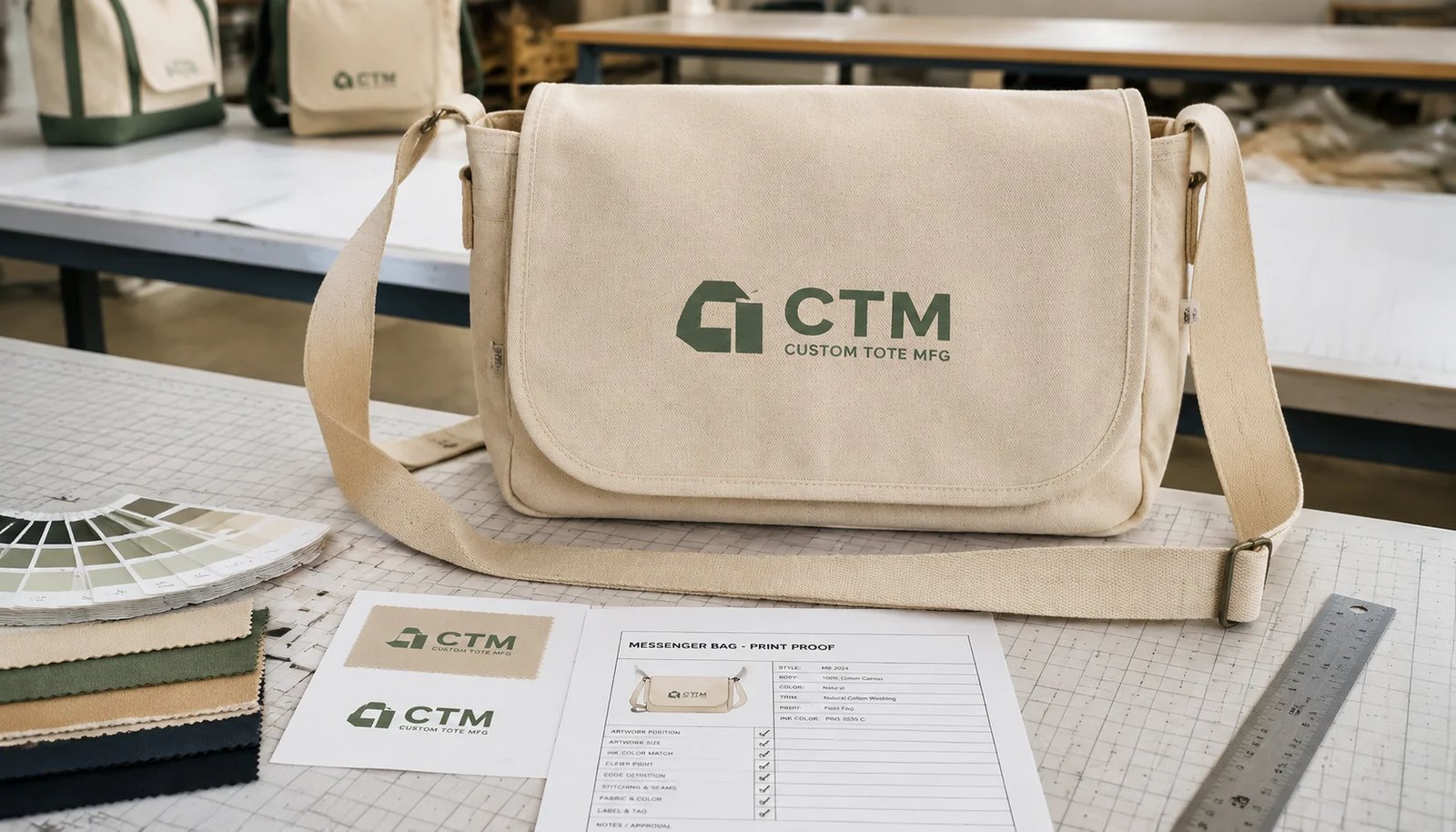
Why print proofing is the real risk point on canvas messenger bags for natural grocers
Messenger bags look simple on a line sheet, but print approval is where many natural grocer orders go wrong. The issue is not only logo color. Canvas texture, natural fabric shade, flap fold lines, and webbing or closure placement can all change how a front logo reads once the bag is sewn. A proof that looks fine on a flat PDF often fails on the actual flap panel because the art sits too close to a stitch line, the ink sinks into a coarse weave, or the natural base tone dulls the brand green.
Natural grocers also tend to use quiet, earthy brand palettes with dark green, black, muted brown, or low-contrast botanical artwork. Those colors can look clean on coated paper but weak on unbleached canvas. If procurement teams treat the order like a standard promotional tote, they usually get a quote quickly but a weaker result in bulk. The buying problem is not finding a factory that can print a bag. It is making the print proof specific enough that three suppliers quote the same bag, the same print route, and the same quality threshold.
- Main failure modes: wrong fabric base tone, poor opacity, logo too close to flap seam, print cracking on heavy ink blocks, and placement drift after sewing
- Most preventable cost driver: approving digital artwork only, without a strike-off on actual production canvas
- Most common quote mismatch: one supplier prices 280 GSM body fabric while another prices 380 GSM, but both describe it as canvas messenger bag
Set the base specification first: size, GSM, construction, and end use
Before discussing print, lock the bag construction. For natural grocer programs, messenger bags usually fall into three uses: store operations, staff issue, and branded resale or membership merchandise. Store operations bags used for documents, clipboards, and tablets can work in 12 oz canvas around 340 GSM if the shape is not too large. Resale bags or premium promo bags often need 14 oz canvas around 400 GSM for a more substantial hand feel. If the bag is oversized with a wide gusset, lighter cloth tends to collapse, making the flap print look distorted in photos and at retail.
Size detail matters because print area depends on the flap shape and edge turn-in. A buyer who writes 'custom messenger bag 38 x 30 cm' still leaves open several cost variables: gusset, flap depth, strap length, inside pockets, and closure system. Those details affect cut panel size, labor minutes, and where the artwork can safely sit. A stronger RFQ gives finished dimensions plus usable print panel dimensions after seam allowance, fold, and hardware are considered.
- Typical body fabric range: 340-400 GSM for standard wholesale canvas messenger bags
- Heavier than 450 GSM is possible, but expect higher freight, more difficult sewing, and stiffer flap behavior
- Useful RFQ note: 'Front flap printable area after seam/fold deductions: 240 x 160 mm'
- If adding lining, state material such as 210D polyester or cotton lining and whether inner seams must be bound
Choose the print method based on artwork shape, ink coverage, and quantity
For most natural grocer messenger bag programs, screen printing is still the most stable option. It is cost-effective at volume, handles one-color and two-color logos well, and holds up better than many budget transfer routes when used on canvas. It also gives the factory more control over opacity on natural cloth. If the artwork is mostly solid copy or a symbol with clean edges, screen print should usually be the default quote basis.
Heat transfer or digital transfer can make sense for short runs, photo-style artwork, or very fine detail, but those methods need tighter testing on fabric hand feel and peel resistance. Large transfer areas on flap panels can look too plastic for a natural grocer brand aesthetic. Pigment wash effects or eco-looking graphics may also shift in color more than expected when transferred to warm-toned natural canvas. Buyers should compare methods not only by unit price but by visual fit, durability, and failure risk.
- Screen print suits: simple logos, store names, event branding, broad quantity ranges
- Transfer suits: multi-color art, small runs, fine image detail, variable regional artwork
- Important quote detail: ask whether printing is done on flat cut panels before sewing or after assembly stage
- If white underbase is used under dark colors, specify whether slight hand feel increase is acceptable
Natural canvas changes color perception, so proofing must happen on production fabric
Natural grocer buyers often choose unbleached or lightly bleached canvas because it aligns with the category image. That choice affects print proofing more than many teams expect. A Pantone green on white paper is not the same green on warm natural canvas. The cloth tone can mute brightness, shift hue warmer, and expose uneven opacity in lighter ink deposits. Even black can read charcoal if the screen mesh, ink deposit, or base shade is inconsistent.
This is why a physical strike-off on the actual canvas matters. Not a lab dip on another fabric, and not a photo on a phone. A strike-off shows whether the weave texture breaks fine lines, whether the ink fills correctly on the chosen GSM, and whether the approved logo remains legible after topstitching and flap folding. For repeat programs, keep a retained approved fabric swatch and approved print swatch from the prior order. That becomes more useful than relying on memory or old website images.
- If using natural canvas, define whether slight flecks and seed marks are acceptable or if a cleaner bleached base is required
- Request print viewing under consistent light such as D65 or agreed daylight conditions
- Set a visual standard for logo readability at normal viewing distance, especially for thin text under 3 mm cap height
- For repeat orders, ask if the mill source and finishing route are unchanged from prior bulk
Build a proof approval workflow that catches errors before PPS
A workable proof path for messenger bags usually has three stages: digital artwork proof, physical strike-off, and pre-production sample. The digital proof is only for layout, size, and spelling. It should never serve as final color approval on its own. The physical strike-off tests color, opacity, and edge quality on the real canvas. The pre-production sample then proves the final relationship between print and construction: flap fold, closure hardware, stitching, pocket seams, and overall bag shape.
The main goal is to stop preventable corrections before bulk cutting. Once panels are cut and printed, moving artwork 8 mm away from a seam or switching from transfer to screen print can reset production. That causes delay and can leave the buyer paying for wasted printed panels. Your approval sheet should name who approves each stage and what each stage covers so there is no hidden assumption between merchandising, design, and procurement.
- Artwork proof covers: spelling, size, placement map, color callouts, orientation
- Strike-off covers: print color, opacity, edge sharpness, texture show-through, bleed risk
- PPS covers: sewn appearance, flap alignment, closure interference, print visibility on finished bag
- Useful acceptance note: 'No bulk printing before written PPS approval on production fabric and hardware'
Use clear acceptance criteria instead of subjective comments on samples
Comments like 'logo looks slightly off' or 'print not crisp enough' create expensive back-and-forth because the factory cannot convert them into process changes. Natural grocer procurement teams get better results when they define measurable acceptance criteria. For example, print placement on the flap can be held to plus or minus 3 mm from centerline; small text should remain fully legible at normal viewing distance; no pinholes larger than 1 mm in the main logo fill; and no visible clipping by topstitching or edge turn-in.
These criteria matter even more when working through a trader, importer, or distributor rather than directly with the factory. Each relay point adds interpretation risk. A practical QC note sheet should include tolerances for bag size, print placement, strap length, and hardware position, plus visual examples of unacceptable defects. That gives procurement something enforceable during inline inspection and final random inspection.
- Sample size tolerance example: finished width and height within plus or minus 5 mm; gusset within plus or minus 5 mm
- Print placement tolerance example: plus or minus 3 mm on flap logo location
- Registration tolerance example: no visible color overlap shift beyond agreed standard at 50 cm viewing distance
- Defect examples to reject: drag lines across logo, patchy opacity, closure covering text, skewed flap making logo appear off-center
MOQ logic and quote comparison: why low-volume art changes can distort unit cost
Messenger bag quotes become hard to compare when buyers mix construction variables and print variables in one request. MOQ is not just a factory policy; it reflects setup time, screen cost, fabric purchasing efficiency, and line planning. A standard construction with one logo and one natural canvas body may be feasible at a lower MOQ than the same bag split across four store regions, each with different art, barcode labels, and carton assortments. The bag body may be common, but the print and packing complexity increase handling cost.
For natural grocers, a smart MOQ plan is often to standardize the bag build and split only what creates visible customer value, such as one or two logo variants. If procurement wants several departments or private-label programs to share one order, have the supplier quote a common body with separate print setup and packing adders. That exposes where the cost is coming from instead of hiding it in a blended unit price.
- Ask for quantity tiers such as 500, 1,000, 3,000, and 5,000 units on the same specification
- Separate these quote elements: base bag cost, print setup, sample cost, custom label cost, and packing adder
- Mixed-SKU orders often raise labor cost through sorting, carton marking, and barcode handling even if fabric stays common
- If one supplier offers very low MOQ, confirm whether they are using stock fabric, simplified print, or subcontracted sewing
Packing, transit, and landed cost can undo a good print result
A messenger bag can pass sample approval and still arrive in poor retail condition if packing is too tight. Flap bags are especially vulnerable because the print sits on a foldable panel that can rub against straps, buckles, or neighboring bags in transit. If the logo has a heavy ink laydown or transfer surface, abrasion and pressure marks become visible quickly. Procurement should decide early whether the order is for wholesale distribution, direct retail display, or event use, because the packing standard should follow that purpose.
For bulk wholesale orders, flat packing without individual polybags may be acceptable if the print is stable and the carton fill is controlled. For resale or cleaner presentation, an individual protective bag or tissue interleave may be worth the added cost. Packing also affects freight. A lined messenger bag with hardware and thick flap structure packs less efficiently than a simple unlined version. Unit price savings can disappear if carton utilization is poor.
- Define whether flap should lie flat, be tucked in, or be lightly stuffed to protect shape
- If no individual polybag, consider interleaving or bundling by count to reduce print face abrasion
- Request estimated carton size and gross weight per quantity tier to compare freight impact between constructions
- If bags include magnetic snaps or metal buckles, confirm they will not press into the printed panel during transit
Lead time planning: where messenger bag programs actually slip
Lead time is rarely lost only in sewing. Most delays happen earlier, during artwork clarification, strike-off revision, substitute material approval, or packing detail changes. Natural grocer teams often involve marketing, merchandising, and operations, so approval can stall unless ownership is clear. The supplier should break the schedule into milestones rather than quoting one generic lead time. A useful schedule starts from artwork receipt, then shows digital proof, strike-off, development sample if needed, PPS, bulk production, final inspection, and shipment booking.
The most expensive delay is a correction after bulk printing. If the logo sits too close to the flap stitch or the approved natural canvas shade is unavailable, the factory may need new fabric or reprinted panels. Procurement should ask what items are on the critical path: custom-dyed webbing, custom hardware finish, woven labels, or fabric mill lead time. If one part is unstable, the bag is not really a short-lead item even if sewing capacity exists.
- Typical timing example only: 3-7 days for artwork proofing, 5-10 days for strike-off and sample, 25-40 days for bulk after approvals
- Separate holiday risk, fabric procurement risk, and hardware procurement risk in the schedule review
- Require a date-linked production plan, not only a promise such as 30 days lead time
- If delivery is for a campaign or store opening, set a last acceptable ship date in the PO
How to compare supplier quotes without rewarding under-spec pricing
When three suppliers quote the same art file but deliver very different prices, the cheapest option often excludes quality protections rather than genuine efficiency. One supplier may quote lighter canvas, no physical strike-off, basic carton packing, and stock black webbing instead of matched trim. Another may include production fabric PPS, stronger GSM, tighter print placement control, and cleaner packing. If procurement compares only the unit rate, the under-spec offer wins on paper and loses in execution.
A more commercial quote review converts the specification into a comparison sheet. Put fabric GSM, construction details, print method, sample route, QC tolerances, included packaging, and lead time assumptions side by side. Also note what is not included. This avoids the common problem where a supplier prices a bag to win the RFQ and later reopens cost on labels, strike-offs, closure hardware, or export cartons. The buyer should reward quotes that make hidden assumptions visible.
- Flag any quote that describes fabric only as canvas without GSM or oz reference
- Flag any quote that approves color from digital artwork only, with no strike-off route
- Flag any quote with no stated packing assumption or no carton information
- Request a revised normalized quote if one supplier uses transfer print and another uses screen print on the same artwork
Specification comparison for buyers
| Spec decision | Recommended option | When it fits | Buyer risk to check |
|---|---|---|---|
| Canvas weight | 12 oz to 14 oz canvas, about 340-400 GSM | Best balance for grocery-related messenger bags carrying catalogs, tablets, samples, or store documents | Below 280 GSM can feel too soft for structured flap bags; above 450 GSM raises freight and may distort large prints on seams |
| Fabric color base | Pre-bleached natural canvas with agreed shade band | Useful when brand art uses greens, black, or fine line copy that needs cleaner contrast | Natural canvas varies lot to lot; if no shade tolerance is defined, the same Pantone can look different across production |
| Print method | Screen print for solid logos; heat transfer only for photo detail or short-run graphics | Screen printing suits most natural grocer branding and holds cost at scale | Large flood areas can crack or feel heavy if ink deposit is too thick; transfer prints may peel if wash or rub resistance is not tested |
| Proof approval route | Digital artwork proof plus physical strike-off on production fabric | Best for logos printed on flap panels where fold lines and stitching affect readability | Artwork-only approval misses ink opacity, texture show-through, and seam interference |
| Logo placement | Centered on flap with 20-25 mm clearance from stitch lines and edge turn-ins | Works for store branding and event distribution where the flap is the hero panel | If artwork sits too near topstitch or Velcro area, text can skew or be partly hidden after sewing |
| MOQ strategy | Split colorways on one construction if print screens and fabric stay common | Good for regional natural grocer chains testing multiple departments or promotions | Very low color split by SKU can trigger higher setup cost, excess packaging complexity, and slower approvals |
| Inner construction | Add 210D lining only if carrying electronics, paperwork, or premium retail use | Suitable for store teams, field reps, and branded resale programs | Lining changes bag drape, raises sewing time, and can affect print registration if panels are pre-assembled incorrectly |
| Packing format | Individual polybag only when resale presentation or dust control matters; otherwise bulk carton with size separator | Helps control landed cost for wholesale promotion or staff issue programs | Overpacking adds cost and plastic; underpacking can cause flap creasing and print rub during transit |
| Sample approval stage | Approve pre-production sample made with production canvas, production print, and production strap hardware | Essential when messenger bags include buckles, magnetic snaps, or dyed webbing | A development sample made from substitute materials is not reliable for final color, fit, or print tolerance |
Buyer checklist before sampling
- State the exact end use: resale item, staff bag, event giveaway, or store operations bag, because this changes GSM, lining, and packing decisions.
- List finished bag size, flap depth, gusset width, strap width, and required load use such as documents, tablet, or grocery samples.
- Specify canvas weight in GSM or oz and whether the bag body and flap must use the same fabric lot.
- Define fabric color as natural, bleached natural, dyed, or recycled blend, and set an acceptable shade tolerance if natural canvas is used.
- Attach vector artwork and identify all print locations with dimensions in millimeters from seam lines, not just from panel edges.
- Name the print method preference and acceptable alternatives, such as screen print only or screen print with transfer allowed for fine detail.
- Require a physical strike-off on actual canvas before PPS approval for any dark ink on natural fabric or any artwork with small text.
- Set print acceptance criteria for color match, edge sharpness, opacity, and maximum allowed misregistration.
- Clarify whether hardware, webbing, snaps, magnets, or zippers must match a Pantone or can follow stock colors.
- Define carton pack, whether bags ship flat or with flap inserted, and whether individual polybags, hangtags, barcodes, or carton marks are needed.
Factory quote questions to send
- What canvas GSM are you quoting, and what is the finished fabric weight tolerance after washing or finishing?
- Is the quote based on stock natural canvas or custom-woven canvas, and what is the standard shade variation between lots?
- Which print method are you using for this logo size and ink coverage, and why is it better than the alternative for this construction?
- Can you provide a physical strike-off on production fabric before PPS, and is that charge included or separate?
- What is the maximum artwork size you can print on the flap without distortion from seams, fold-over allowance, or hardware placement?
- Is your unit price based on panel printing before sewing or printing on cut panels after partial assembly?
- What is the MOQ by colorway, and can mixed print designs share one bulk order if bag construction stays identical?
- Which parts are stock components versus custom components: webbing, buckles, snaps, magnets, lining, labels, and packaging?
- What packing assumption is included in the quote: inner polybag, carton quantity, carton size, and estimated carton gross weight?
- What are your normal tolerances for bag size, print placement, strap length, and print color registration?
Quality-control points to confirm
- Fabric GSM within agreed tolerance, typically plus or minus 5 percent unless a tighter spec is contracted.
- Natural canvas shade band approved against submitted swatch or retained standard before cutting bulk fabric.
- Print color match reviewed under consistent lighting with agreed Pantone target or approved visual standard on natural canvas.
- Print placement within agreed tolerance, commonly plus or minus 3 mm for logos on flap panels and plus or minus 5 mm on side panels.
- No major ink bleed, pinholes, ghosting, screen drag marks, or visible misregistration at normal viewing distance.
- Top flap edge turn-in must not clip artwork; maintain approved clear space from stitch lines and closures.
- Seam strength and strap box-stitch reinforcement must meet the intended load use and sample approval standard.
- Hardware function tested for snaps, buckles, magnetic closures, or zipper movement before packing.
- Cartons packed to prevent flap crush and print rub; no overfilled cartons that permanently crease bag fronts.
- Shipping marks, barcode labels, and assortment counts must match PO and carton pack plan exactly.