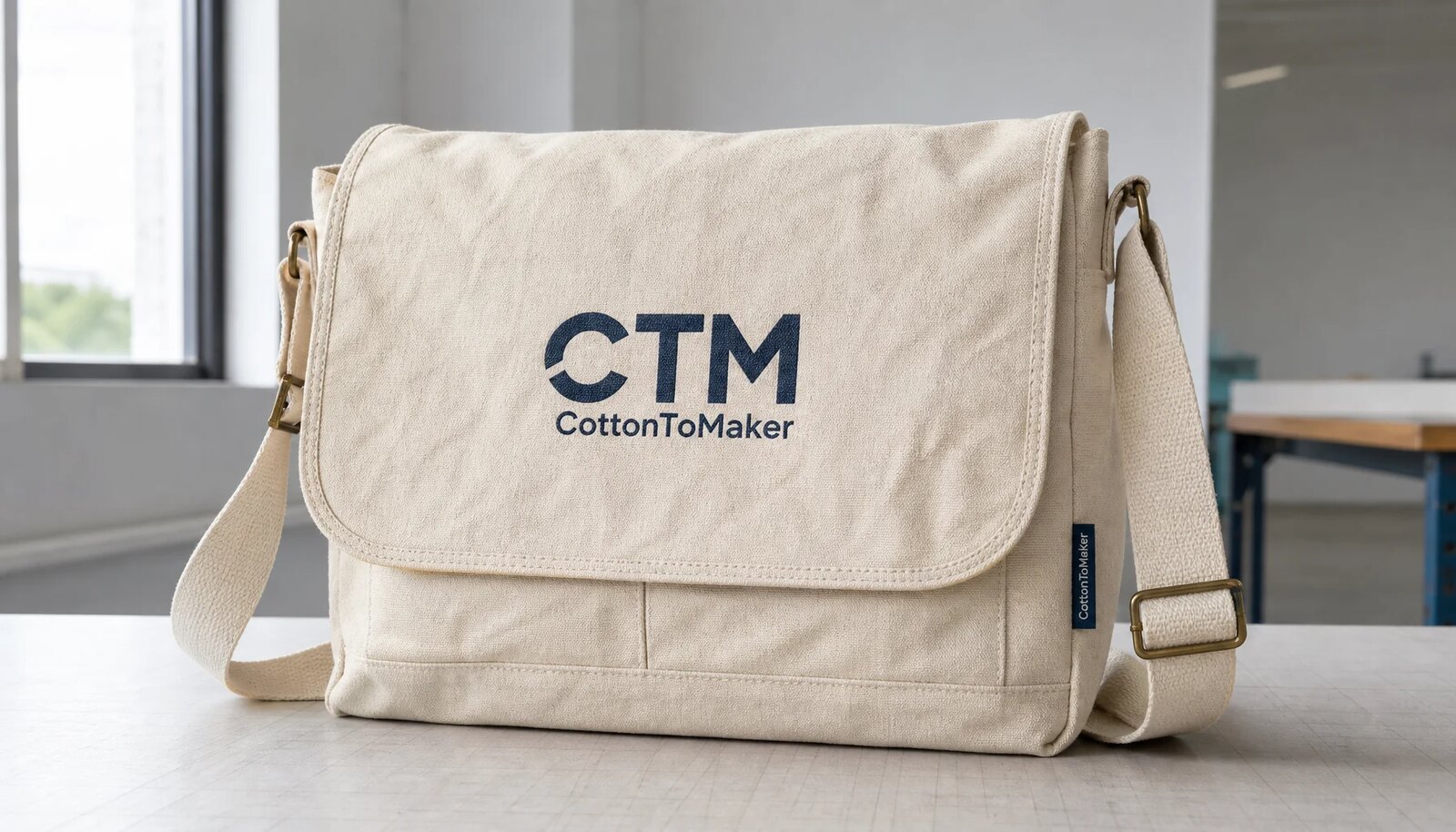
Why print proofing fails on canvas messenger bags
Proofing goes wrong when buyers review a logo as if it were a flat flyer instead of a sewn product. A canvas messenger bag has seams, gussets, a flap, pockets, and strap anchors, so the same artwork can look centered on a screen and still land too low, too close to a fold, or too wide for the front panel once it is sewn. For event planners, that failure usually shows up only when the cartons arrive and the bags are already allocated to a fixed date.
The print proof should therefore answer a production question, not a design question: will this logo survive sewing, folding, curing, packing, and casual use without moving or distorting? A useful proof is tied to a real bag size, a real fabric weight, and a real decoration method. If the supplier gives only a logo file over a white background, you still do not know how the finished bag will look in hand.
- Treat the proof as a production document, not a presentation slide.
- Review the logo against the sewn bag, including flap fold lines and seam interference.
- Define who approves the proof and who can change it after sign-off.
Lock the bag spec before the artwork is approved
The base bag spec should be frozen before anyone talks about print color. On canvas messenger bags, the fabric weight changes the hand feel, the print coverage, and the way the bag folds. A 12 oz canvas around 340 gsm suits lighter event kits and lower budgets, while 14 oz to 16 oz, roughly 475 to 550 gsm, is a better fit for retail gifting or repeated carrying. If you plan to load notebooks, catalogs, tablets, or hard goods, a lighter fabric can feel acceptable in sample stage and weak in use.
Construction details matter just as much as fabric. Strap width, stitch count, gusset depth, lining, zipper type, flap closure, and pocket layout all affect the print area and the bag's final shape. A logo that looks safe on an unlined natural canvas tote may be too close to a pocket seam on a messenger bag. Before proofing artwork, write down the exact finished dimensions, the seam allowance, and which side will carry the logo.
- Specify fabric weight in both oz and gsm so the factory cannot substitute a lighter cloth.
- Lock finished size, gusset depth, closure style, and strap construction before artwork placement.
- Ask for a sewn sample or sample photo that uses the exact bag structure, not a generic blank.
Choose the print method by artwork complexity and run size
For most custom canvas messenger bags, one or two spot colors screen printed on the front panel is the cleanest commercial option. It is usually the lowest-risk route for flat logos, bold lettering, and higher quantities because the print sits well on canvas and holds up better than a rushed digital transfer. When the art is simple, screen print keeps the hand feel manageable and the quote easy to compare. The risk rises when the artwork has thin strokes, tight knockout spaces, or a large solid area that can crack if the ink is applied too heavy.
Transfers and DTF-style decoration can solve multicolor artwork, gradients, or small type, but they should not be treated as a free upgrade. On thicker canvas, the edge of the transfer must still be checked for lift, wrinkle, and rub resistance. Embroidery or a woven patch can work well on the flap or side label when the brand wants a premium finish, but fine detail may be lost. The right proofing checklist depends on the decoration method the factory will actually use, not on the method that makes the mockup look nicest.
- Use screen print for flat logos and repeat orders with controlled color count.
- Use transfer-based methods only after testing edge durability and hand feel on the actual canvas.
- Move very small text to a woven label or patch if the art is too detailed for print.
Build the proof like a production document
A good proof tells the factory exactly where the logo sits, how large it is, and what surface it is printed on. Do not leave placement to phrases like center front or upper flap. Measure from the top seam, the side seam, and the fold line, then state the finished logo width and height. If the bag has a flap, decide whether the art appears on the closed flap, the body panel, or both, because a design that looks centered when the flap is open may disappear when it is closed in use.
Color control also needs structure. A digital file can guide layout, but it is not enough for final approval if you care about shade or edge sharpness. Ask the supplier to provide a sample with the correct canvas color, print ink, and curing method. If the logo uses a Pantone reference, note whether the factory is matching to coated or uncoated standards. For light natural canvas, the ink edge should be sharp and the background cloth should not show through in an uneven way.
- State logo dimensions, placement measurements, and safe margins from seams and folds.
- Require the proof to show the real bag color, not only a white background mockup.
- Use one named approver internally so artwork changes do not creep in late.
Compare supplier routes and MOQ logic before you request quotes
MOQ on canvas messenger bags is rarely driven by one factor. It usually comes from a mix of fabric minimums, screen setup, sewing efficiency, trim sourcing, and packing labor. A factory with stock natural canvas and standard webbing can often quote a smaller first run than a program that needs custom-dyed cloth, branded zipper pulls, or a woven label. If you ask for a low MOQ without stating the fabric weight and decoration method, you will get quotes that are hard to compare and easy to misspecify.
The sourcing route matters as much as the spec. A direct factory with in-house printing gives you fewer handoffs and clearer proof ownership. A bag factory plus an external printer can work when decoration capability is limited, but then the buyer needs a clear owner for print defects after sewing. Trading companies simplify communication but can obscure the real cost split between the blank bag and the print work. For a buyer who cares about repeatability, the lowest quoted MOQ is not always the best production path.
- Separate blank bag MOQ, print MOQ, and packed MOQ in the quote request.
- Ask whether setup costs are spread across the run or charged as a fixed line item.
- Avoid mixing custom fabric, custom trim, and complex print on the first order unless the timeline is flexible.
Use sample approval to catch placement, color, and build issues
The pre-production sample should reflect the final bag, not a simplified placeholder. If the factory sends a lighter canvas, a different zipper, or a different print process, you are approving a sample that does not predict the bulk order well enough. For messenger bags, the sample needs to show how the front panel lays when loaded, how the flap closes over the logo, and whether the strap hardware changes the way the bag hangs. A clean photo is useful, but a physical sample is better because the buyer can see print texture and stitching in the same object.
Set measurable acceptance thresholds before you sign. The logo should sit within the agreed placement tolerance, the print should be even across the bag grain, and the strap and bar-tacks should survive a realistic handling test. If you need retail-grade consistency, inspect multiple samples or ask for batch photos from the same production lot. If the first sample is close but the color is off, do not approve it on the assumption that bulk production will magically improve. Bulk usually copies the approved sample very faithfully, including its mistakes.
- Inspect one sample under neutral light and compare it to the approved artwork file and fabric reference.
- Test the flap closure, strap adjustment, and load-bearing points before approving the run.
- Reject samples that look right in a photo but fail when folded, opened, or carried.
Packing and retail readiness can change the quote
Packing is not a minor detail on custom canvas messenger bags. A bag that ships loose in a carton may arrive with sharper creases, visible rub marks, or a pressed logo line if the print crosses the fold. If the channel is retail or e-commerce, ask for a folding method that protects the front art and keeps the flap shape stable. Individual polybags, tissue separators, and master carton counts all affect labor and freight, so the quote should show those items clearly instead of hiding them inside a single unit price.
Labeling also matters for the commercial buyer. If you need barcodes, hangtags, carton marks, or assortment labels for a distributor warehouse, those details should be included in the proofing stage. The factory should know whether the bag is going direct to stores, to a fulfillment center, or to an event kit packer. A clean pack-out spec reduces damage, but it also prevents delays when the goods hit receiving and have to be relabeled or repacked.
- Specify whether each bag ships loose, polybagged, tissue-wrapped, or retail-ready.
- Write carton pack count, carton dimensions, and label format into the RFQ.
- Protect printed surfaces from hard folds, scuffing, and carton compression.
Control lead time by freezing art and trim early
Lead time slips when buyers treat proofing as a flexible stage instead of a decision gate. The clock usually starts over when artwork changes after the proof, when a trim color is revised, or when the buyer asks for a different placement after sample approval. For time-sensitive programs, especially event planning, the safest approach is to freeze the art first, then confirm the sample, then release the bulk order. If the supplier is quoting from stock canvas, the timeline can be fairly short; if they need custom weaving, special lining, or imported trim, the schedule stretches quickly.
Ask the factory to break the schedule into steps: proof, sample, bulk sewing, decoration, packing, and inspection. That makes it easier to see where the real risk sits. A factory that promises one total lead time without showing the critical path may still be able to deliver, but you have less control if a screen has to be remade or if the print cure needs extra drying time. Buyers who manage multiple events or sales windows should add buffer for sample revision, freight booking, and warehouse receiving.
- Freeze artwork before sample approval so the proof stays tied to one version.
- Request a step-by-step timeline instead of a single blanket lead-time number.
- Add buffer for peak season, custom trims, and any rework after the first sample.
Compare landed cost, not just the unit price
A low unit price on canvas messenger bags can hide expensive extras. Print setup, extra color charges, woven labels, hand-tagging, individual polybags, carton reinforcement, and sample courier fees all change the true landed cost. Freight can also move the number more than buyers expect because a messenger bag with a gusset and added packaging may occupy more volume than a flat tote. If you only compare the bag price, you may choose the quote that looks cheapest but ends up costing more once packing and shipping are added.
The better method is to ask every supplier for the same line-item structure. Separate the blank bag, decoration, packing, inspection, inland handling, and shipping basis. Then compare the quote against the exact spec, not against a generic bag. That is especially important when one factory includes a simple polybag and another quotes retail-ready packing. For procurement teams, the cleanest quote is the one that can be audited line by line and tied back to the sample you approved.
- Request a quote matrix that breaks out blank bag, decoration, packing, and freight basis.
- Compare volume weight and carton count, not only per-piece bag price.
- Treat sample fee, setup charge, and rework risk as real buying costs.
Send a clean RFQ packet the factory can actually price
The fastest way to get a useful quote is to send a complete RFQ packet. Include the bag sketch or reference photo, finished dimensions, fabric weight, closure type, logo file, print placement, quantity by size or color, packing needs, destination, and target ship window. If the supplier has to guess the flap position or the canvas weight, the first quote will not be the final quote. A complete packet also helps your own team compare offers because each supplier is pricing the same product instead of a different interpretation of the same idea.
For this category, the best buyer workflow is simple: define the bag, define the print, approve the proof, then release production. Do not let an off-spec sample become the basis for the bulk order. If the supplier cannot quote from a clean document set, the problem is usually not the price but the missing spec discipline. A disciplined RFQ protects your event date, your brand presentation, and your landed cost at the same time.
- Attach vector artwork, dimensioned drawings, and a finished-use note for the bag.
- State the required proof format, sample deadline, and approval owner.
- Include destination, incoterm, packing rules, and inspection expectation in one packet.
Specification comparison for buyers
| Spec decision | Recommended option | When it fits | Buyer risk to check |
|---|---|---|---|
| Supplier route | Direct canvas bag factory with in-house printing | Repeat programs, custom sizes, and tighter control over proofing | Confirm that the same plant approves the sample and runs the bulk order |
| Supplier route | Bag factory plus external print partner | Useful when the bag plant does not offer your required decoration method | Define who owns print defects after sewing and who pays for rework |
| Supplier route | Trading company managing bag and print | Good for mixed-category buying or when you need one purchase order | Request itemized costs and the actual factory name before approval |
| Print method | 1 to 2 spot-color screen print | Flat logos, strong contrast, and larger runs | Check fine text, small reverse type, and ink bleed on absorbent canvas |
| Print method | Transfer or DTF for complex art | Gradients, small text, or multiple colors | Test edge lift, rub resistance, and the feel on thicker canvas |
| Fabric weight | 12 oz / about 340 gsm natural canvas | Light promotional use and lower-budget events | Confirm the bag still holds shape after print and folding |
| Fabric weight | 14 to 16 oz / about 475 to 550 gsm canvas | Retail, premium gifts, or heavier carry loads | Ask whether print curing or sewing changes the lead time |
| Packing route | Individual polybag plus master carton with tissue separators | Retail, e-commerce, or long transit lanes | Check rub marks, carton compression, and barcode placement before shipment |
Buyer checklist before sampling
- Final bag size, gusset depth, strap length, and closure type are locked before artwork is placed.
- Artwork is supplied as vector files with spot-color references and a single named approver.
- Print placement is measured from seams, edges, and flap fold lines, not described only as centered.
- Fabric weight is specified in oz and gsm, and the supplier confirms whether the canvas is natural, bleached, or dyed.
- The proof shows the actual decoration method, not only a flat mockup of the logo.
- Sample approval includes color, hand feel, stitch quality, and strap load behavior.
- Packing method, carton count, barcode needs, and retail labels are written into the RFQ.
- Lead time is split into proof, sample, production, packing, and transit milestones.
- The quote separates blank bag cost, decoration cost, setup charges, packing, and freight basis.
- Inspection criteria and the reject/rework process are agreed before the order is placed.
Factory quote questions to send
- Is the print done in-house, or will it move to a third party after the bags are sewn?
- What is the MOQ for this bag size, this fabric weight, and this print method?
- How many setup charges apply for artwork, screens, transfer films, or embroidery files?
- Can you show the proof with exact logo dimensions and placement measured from the seam?
- What is the tolerance for logo position, color shift, and stitch alignment on the finished bag?
- Which canvas weight do you recommend for this load target, and what changes if we go heavier?
- What packaging is included by default, and what is extra for individual polybags, tissue, or hangtags?
- What is the sample lead time, and does the bulk timeline start from sample approval or deposit receipt?
- What carton size and pack count do you use, and how does that affect volumetric freight?
- Which items are firm in the quote, and which ones can change after proofing or final artwork review?
Quality-control points to confirm
- Logo placement stays within the agreed tolerance from the top seam, side seam, and flap fold.
- Print color matches the approved sample under neutral light, not only on a bright office screen.
- No obvious ink bleed, pinholes, smudging, or patchy coverage on the canvas grain.
- Stitch density, bar-tacks, and strap attachment points hold when the bag is loaded and carried.
- All trims match the approved spec: zipper pull, buckle, hook-and-loop, lining, and label.
- Canvas weight and hand feel match the approved sample lot, with no thinner substitute fabric.
- Folding and packing do not crease the logo into a visible permanent line.
- Cartons are closed, labeled, and packed to prevent scuffing during transit and cross-dock handling.