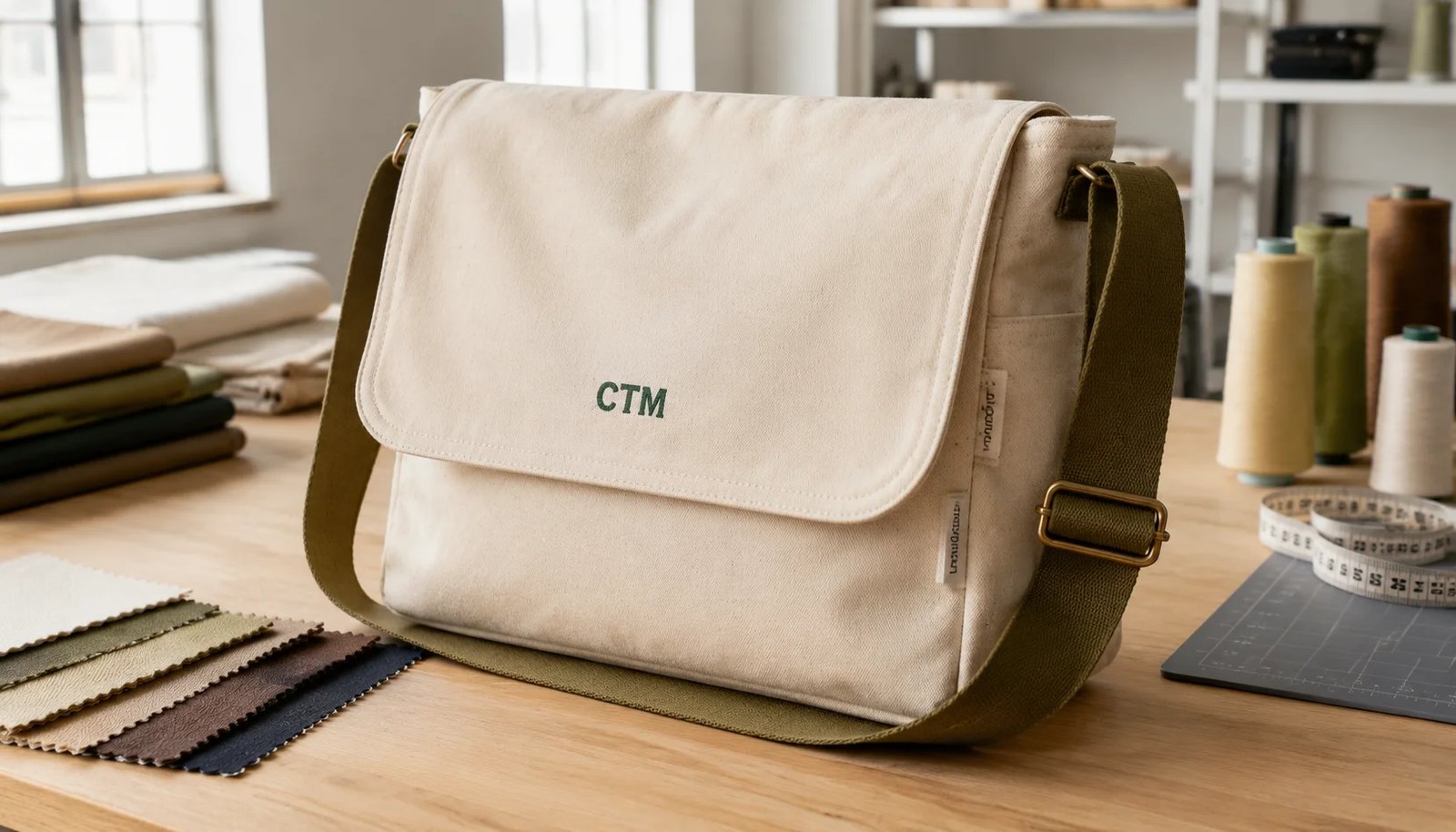
Why MOQ gets tricky on canvas messenger bags for natural grocers
Natural grocers often buy canvas messenger bags for a narrower use case than standard promo totes. The bag may support staff handouts, membership programs, vendor events, wellness kits, or paid retail merchandise. That matters because messenger bags add more components than basic totes: flap construction, longer webbing strap, reinforcement, and often closure hardware. MOQ is therefore not just a volume issue. It is a mix of cutting efficiency, trim sourcing, print setup, sewing time, and how many artwork versions the grocer wants across store locations.
Many buyers push MOQ down too early without narrowing the build. That usually gets a polite low price on paper followed by hidden compromises later: lighter canvas, shorter strap, fewer reinforcements, cheaper webbing, or oversized carton packs. A better negotiation starts by identifying which parts of the messenger bag can stay standard across all stores and which parts truly need customization. Once the factory sees stable core construction, MOQ becomes easier to flex.
- Most MOQ pressure comes from trim and print variation, not only bag sewing.
- Natural canvas stock fabric usually allows lower MOQ than custom dyed body fabric.
- A single construction with multiple logo versions is easier to negotiate than multiple bag sizes.
- Messenger bags with zipper top, lining, foam padding, or metal hardware usually need firmer MOQ than simple flap styles.
Set the right spec before you negotiate quantity
Procurement teams get stronger leverage when they quote a realistic specification instead of a broad idea like 'eco messenger bag.' For grocery-related use, 12 oz canvas, roughly 340 GSM finished, is often the best starting point. It holds shape better than 10 oz under moderate weight but avoids the jump in sewing time and trim stress that comes with very heavy 14-16 oz canvas. If the bag will only carry flyers, a notebook, or light store merchandise, 10 oz can work. If the bag is intended as premium retail merchandise or repeated heavy use, move to 14 oz and negotiate around fewer color or print options instead of forcing the fabric down.
Construction details also affect MOQ flexibility. A plain body with flap, one front pocket, adjustable cotton webbing strap, and magnetic snap is easier to place into a lower-volume run than a fully lined bag with zipper top and organizer pockets. Every added operation creates another minimum somewhere in the chain. Brand owners often save more by standardizing pocket construction and webbing color than by arguing over a 100-piece MOQ reduction.
- Typical practical range: 10 oz / 280-300 GSM for cost-sensitive programs; 12 oz / about 340 GSM for balanced use; 14-16 oz / 400-450 GSM for premium structure.
- 38 mm cotton webbing is a common strap width for comfort and easier hardware sourcing.
- Magnetic snap closure generally costs less in labor than zipper-top messenger construction.
- Natural body color with dark ink often reduces MOQ and lead time compared with dyed body colors.
Understand the factory's MOQ logic instead of treating MOQ as a single number
Factories rarely calculate MOQ from one cost line. For canvas messenger bags, the real minimum can come from fabric roll usage, cutting efficiency, print setup, woven label quantity, hardware packing lot, or simply line time needed to run the style without frequent interruptions. A supplier quoting 300 pieces may be using stock natural canvas and stock black webbing, while a supplier quoting 1,000 pieces may be factoring custom-dyed webbing, a woven side label, and two print positions. Buyers who compare only the MOQ number miss the actual cause.
This is where natural grocers can negotiate smartly. If your chain needs several branch names, keep body fabric, webbing, flap shape, and closure identical. Only vary artwork. Then ask the supplier to treat the order as one master production run with split print versions. If the label MOQ is blocking the deal, consider printed care labels or one generic brand label for all stores. If dyed fabric is the issue, switch to stock natural canvas and use print color to create brand distinction.
- Clarify MOQ by style, by color, by print, by label, and by shipment split.
- Stock fabric and stock webbing are the fastest way to reduce MOQ pressure.
- Artwork variation is cheaper to negotiate than construction variation.
- Custom metal logo hardware often creates higher minimums than buyers expect.
Cost drivers that matter more than the quoted unit price
A messenger bag quote can look competitive while hiding cost in setup, packing, and freight inefficiency. Heavier canvas, wider webbing, metal adjusters, lining, zipper tape, reinforced base panels, and woven labels all add cost, but not at the same rate. Some are linear by unit, such as heavier canvas. Others create threshold costs, such as custom labels or special hardware, where the first few hundred units carry the biggest burden. That is why a 500-piece order can sometimes price almost the same as 300 pieces if setup and trim costs are spread over more units.
Freight and warehouse handling also change the real economics. Messenger bags are bulkier than flat tote bags because of strap length, flap shape, and any internal structure. If the factory packs each bag with thick inserts or oversized polybags, carton cube rises quickly. Natural grocers distributing to regional stores should compare not only FOB unit price but also units per carton, cartons per pallet, and handling time at the DC. A cheaper bag can lose its advantage if carton volume is 15-20% larger.
- High-impact cost drivers: fabric GSM, lining, zipper closure, hardware type, strap width, print colors, woven labels, and retail packing.
- Threshold costs: label setup, print screen setup, custom dyeing, and metal logo molds.
- Landed cost can shift on carton cube even when FOB unit difference is small.
- Messenger bags often benefit from folded packing plans that keep flap shape without adding excess filler.
How to negotiate lower MOQ without forcing the wrong bag build
The most effective MOQ negotiation is not demanding a number. It is offering the supplier a lower-risk production plan. For example, propose one body size, one natural canvas fabric, one webbing color, one common care label, and one packing method across the entire order. Then split only the flap print by region or store. This reduces cutting waste and trim complexity, making the supplier more willing to bend on quantity. If you need a low first order for testing, ask for a pilot run on existing stock material and accept a simpler decoration set.
Another practical tool is tiered commitment. Instead of pushing for the 300-piece price at 150 pieces, ask for a trial MOQ with written price breaks for repeat order quantities once the style is approved. Factories are more open to flexible first runs when they see a likely replenishment path. Procurement teams should also separate non-recurring charges from unit price. If screen setup and label setup are shown clearly, it becomes easier to negotiate what can be amortized over future POs.
- Lower MOQ by standardizing fabric, webbing, closure, and packing.
- Use one print position where possible; second print positions add setup and handling.
- Ask for pilot quantity on stock materials with simplified branding.
- Negotiate repeat-order price tiers in writing, not only the first PO price.
- Separate one-time setup charges from recurring unit cost.
Sample approval points that prevent MOQ disputes later
A weak sample process causes many MOQ arguments because the factory builds in risk premium. If the buyer has not approved exact material and print expectations, the supplier protects itself with higher minimums or wider tolerances. Start with a fit sample if needed, but do not treat that as final approval. For messenger bags, the pre-production sample should use actual bulk-intended canvas, actual strap webbing, actual closure hardware, actual print process, and intended packing method. A digital artwork approval alone is not enough.
Natural grocers often care about utility more than luxury presentation, so the sample should be tested under load. Put 3-5 kg into the bag depending on the intended use. Check flap alignment, strap comfort, print cracking, seam opening at webbing attachment points, and whether the bag still looks acceptable after carrying. If the bag is for retail sale, review fold marks after unpacking. A bag can pass sewing review and still fail at shelf presentation if packed too tightly.
- Approve print size and location from seam reference points, not just centered visually.
- Measure actual finished size and strap adjustment range on the sample.
- Load-test the sample with realistic weight for 10-15 minutes of carry.
- Review closure alignment when empty and loaded.
- Photograph approved sample details for PO attachment: stitching, labels, print color, and fold method.
Quality thresholds to write into the PO for messenger bag production
Canvas messenger bags fail in a few predictable areas: print cure, skewed flap, weak strap reinforcement, inconsistent webbing shade, and rough interior finishing. Buyers should turn those risks into acceptance criteria. For example, state that print placement must be within an agreed tolerance from the flap edge or side seam; do not leave placement to visual judgment. Define that major skipped stitches, open seams, and visible oil marks on outer panels are unacceptable. If multiple store-logo versions are packed together, carton assortment accuracy should be treated as a key QC point, not an afterthought.
Stitch density and reinforcement matter because messenger bags carry off-center loads through the strap. A generic tote seam spec does not always hold up. Where the strap joins the body, box-X reinforcement or bartack should be specified if the design allows. If the bottom panel is single-layer 10 oz canvas, state whether a hidden reinforcement patch or seam tape is needed. These details protect the buyer from receiving a bag that technically matches dimensions but fails in use.
- Print placement tolerance example: within ±5 mm from approved location on flap front.
- Critical appearance points: flap symmetry, front panel cleanliness, webbing centering, and label alignment.
- Critical performance points: closure function, strap reinforcement, seam security, and print adhesion.
- Carton-level QC: correct logo version count, barcodes, carton marks, and master carton weight consistency.
Packing and carton planning for wholesale grocery distribution
Packing decisions affect both cost and store execution. If the bags are for bulk program use, individual polybags may only be needed for moisture and dust protection. If they are retail items, you may need hangtags, barcode labels, and cleaner presentation after unpacking. The mistake is letting the factory choose a generic packing method. Messenger bags fold differently from totes; a poor fold can permanently crease the flap or distort print. Buyers should specify whether the strap is tucked inside, whether the flap is folded flat or left shaped, and whether any tissue or insert is actually necessary.
Carton planning should be reviewed before order approval, especially if the grocer ships from a central DC to stores. Oversized cartons increase handling difficulty and may trigger courier or pallet inefficiency. Ask for carton dimensions and estimated gross weight at quote stage. For many messenger bags, a moderate pack count with consistent folding is better than trying to maximize pieces per carton if it crushes the flap and creates heavy cartons.
- Typical decision points: individual polybag yes/no, hangtag attached or packed loose, desiccant required or not, fold direction, and strap containment method.
- Target carton design should balance cube efficiency and product recovery after unpacking.
- Request export carton marks by style, colorway, store logo, and PO line if orders are split.
- If shipping to a 3PL or retail DC, match outer carton labeling to receiving process.
Lead time planning: where delays usually happen
Messenger bags often miss schedule not because sewing is slow, but because upstream decisions are late. Artwork approval, woven label confirmation, custom webbing shade matching, and closure hardware sourcing can all add days before bulk cutting starts. A natural grocer with seasonal campaigns should work backward from in-store date and separate fixed steps from flexible ones. If timing is tight, remove custom-dyed components first. Stock natural canvas and stock black or natural webbing typically save more time than pushing the factory for rush sewing.
Another common delay is sample rework caused by incomplete usage information. If the buyer says the bag is 'for retail' but later adds laptop carry expectations or bottle load requirements, the factory may need stronger webbing, wider seam allowance, or heavier canvas. Those changes reset both cost and lead time. Clear performance intent at RFQ stage is one of the easiest ways to keep MOQ negotiation and production schedule aligned.
- Typical lead-time drivers: fabric availability, label setup, print screen preparation, hardware sourcing, and pre-production sample approval.
- Fastest route is usually natural stock canvas + standard webbing + 1-color screen print.
- Custom dyeing and multi-component decoration often add more time than sewing itself.
- Do not approve a bulk date until artwork, sample, and packing are all frozen.
How to compare supplier quotes without being misled
When comparing factories, convert every offer into the same structure: fabric specification, construction details, print method, setup charges, sample cost, packing, MOQ basis, lead time basis, and carton data. If one quote says 12 oz and another says 340 GSM, reconcile them to finished material expectations. If one supplier includes woven labels and another excludes them, the cheaper offer is not truly cheaper. Procurement teams should also flag whether the supplier quoted to approved sample quality or only to artwork concept. Quotes made before sample clarification often drift upward later.
A useful quote comparison also separates supplier capability from supplier willingness. One factory may have a higher MOQ but stronger control over strap stitching and print registration. Another may accept a small run but outsource printing or webbing, creating schedule risk. For natural grocers planning repeat programs, the best supplier is not always the one offering the smallest first MOQ. It is the one whose quote structure remains stable as the program scales across stores or seasons.
- Normalize quotes to one Incoterm and one spec sheet before comparing.
- Map every extra charge: screens, labels, samples, barcodes, polybags, and carton marks.
- Check whether printed artwork variations are billed as separate setup lines.
- Review sample-to-bulk consistency evidence, not only bulk price.
Specification comparison for buyers
| Spec decision | Recommended option | When it fits | Buyer risk to check |
|---|---|---|---|
| Base fabric weight | 12 oz canvas, about 340 GSM | Daily retail staff use, farmers market promos, bottle-and-book loads without excessive cost | Some suppliers quote 12 oz before washing or before dyeing; confirm finished GSM tolerance and whether weight is for body only or includes flap lining |
| Lighter cost-down fabric | 10 oz canvas, about 280-300 GSM | Short campaign runs, lower fill weight, price-sensitive store promotions | Bottom corners can deform under glass jars or heavy catalogs; ask for loaded sample photos with 4-5 kg test load |
| Premium structured option | 14-16 oz canvas, about 400-450 GSM | Higher-end private label, laptop carry, better shelf presence | MOQ often rises because heavier fabric may require dedicated sourcing and slower sewing; verify machine capability and seam puckering risk |
| Printing method for grocery branding | 1-2 color screen print on flap or front panel | Store logos, natural food messaging, simple artwork with solid ink coverage | Large flood areas crack or offset if curing is weak; request rub test result and photo of print on actual canvas, not paper proof only |
| Retail look decoration | Woven label plus small screen print | Brands wanting reusable, understated merchandising rather than giveaway look | Woven labels have their own MOQ and setup; clarify whether label MOQ is separate from bag MOQ |
| Closure construction | Magnetic snap under flap or open-top under flap | Fast cashier or floor use, lower sewing complexity than zipper-top messenger | Magnet placement must align after washing and loading; ask for closure function video with bag filled |
| Strap construction | 38 mm cotton webbing adjustable strap with box-X reinforcement | Comfortable carry for grocery staff, event teams, and repeat users | Some factories splice webbing on long straps; require no strap joins on finished goods unless pre-approved |
| MOQ route for artwork variations | One body construction, split colorways or store names within master order | Regional chains with multiple branch logos sharing same size and trim | Plate and print setup costs can erase savings; request quote showing MOQ by style versus MOQ by artwork |
| Packing route | Individual polybag only if required, then export carton by fixed count | Wholesale replenishment where moisture protection matters but retail unpacking speed is important | Overpacking increases carton size and freight; verify carton dimensions, gross weight, and whether hangtags are packed inside or attached |
Buyer checklist before sampling
- Define the real MOQ unit before negotiating: per style, per color, per print, per label, or per total order.
- State target fabric in finished GSM, not only ounces, and specify whether body, flap, and pockets use the same canvas.
- List load expectation such as 3 kg brochures, 5 kg groceries, or tablet-and-notebook carry so the factory can match seam reinforcement.
- Decide early whether the bag is a promotion item, staff utility bag, or retail merchandise; this changes fabric, trim, and packing economics.
- Request quote lines separated by sample charge, print plate/setup, woven label setup, and bulk unit price.
- If splitting one order across multiple store logos, specify artwork count, print size, and quantity per version.
- Set acceptance standard for print placement tolerance, strap length tolerance, finished size tolerance, and carton count variance.
- Confirm whether quoted MOQ assumes greige stock fabric, dyed fabric, or custom color fabric; each has different flexibility.
- Approve a pre-production sample made in actual canvas, actual webbing, and actual print method rather than digital render only.
- Review carton dimensions and gross weight before order confirmation to avoid pallet and courier surcharge surprises.
Factory quote questions to send
- Is your MOQ based on one messenger bag construction, one fabric color, one print artwork, or one combined order quantity?
- What is the finished fabric GSM of the body, flap, pocket, and strap webbing, and what tolerance do you allow in production?
- Do you hold stock natural canvas in 10 oz, 12 oz, or 14 oz, and how does stock fabric reduce MOQ or lead time?
- Which print method are you quoting: screen print, heat transfer, digital print, or embroidery, and what setup cost applies to each artwork?
- Can one bulk order combine several store names or colorways under one master style, and how does that affect MOQ and unit price?
- What reinforcement is included at strap ends, side seams, and bottom corners: bartack, box-X stitch, binding, or internal tape?
- Are magnets, zippers, buckles, or labels sourced in-house or externally, and which of these items drives the longest lead time?
- Please provide carton pack quantity, carton dimensions, estimated gross weight, and whether inner polybags are included or optional.
- What sample stages do you offer: blank fit sample, print strike-off, pre-production sample, and top-of-production approval sample?
- What AQL level or in-house inspection standard do you normally use for stitching, print placement, shade variation, and carton assortment?
Quality-control points to confirm
- Finished size tolerance should be defined, for example within ±1 cm on width and height and within ±1.5 cm on strap length after adjustment range is measured.
- Fabric weight should be spot-checked against approved sample or supplier test record; large GSM drop usually shows up in weak body structure and flap collapse.
- Print placement should be measured from fixed seams or flap edge, not estimated visually; set tolerance before production.
- Ink adhesion should pass a dry rub test and light damp cloth rub test on actual canvas, especially on dark or enzyme-washed fabric.
- Webbing must be centered, free from visible splices, and reinforced with consistent stitch density at stress points.
- Magnetic snaps or other closures should align and close properly when the bag is both empty and loaded.
- Internal seam binding or overlock finish should be consistent with no major raw-edge fraying at corners or pocket openings.
- Carton assortment must match PO by logo version, colorway, and barcode or hangtag if used for retail distribution.