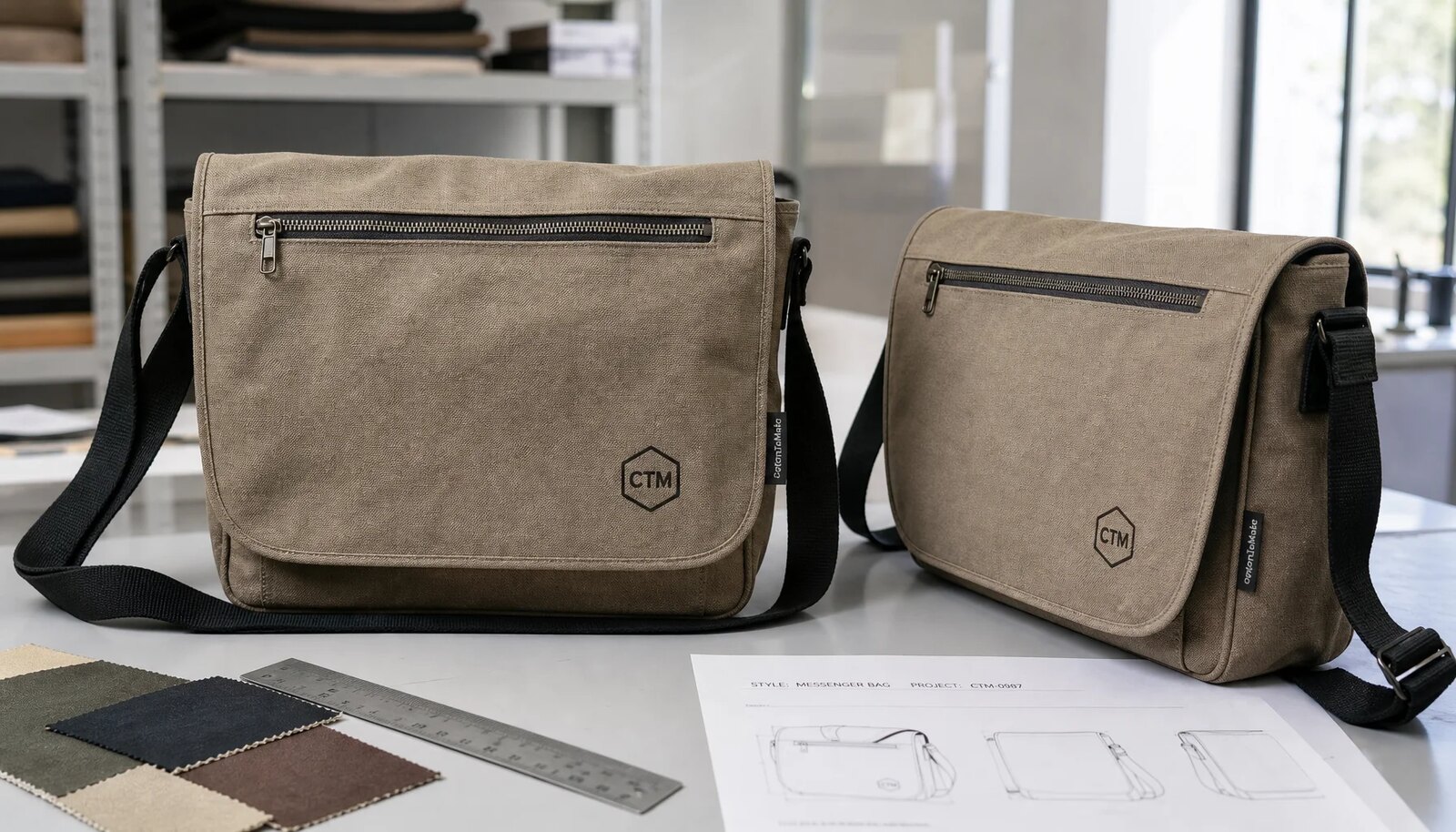
Start With the Event Requirement, Not the Smallest MOQ
For custom canvas messenger bags, the best MOQ is not the lowest number a factory will agree to. It is the smallest production quantity that still gives the event a bag that works for the contents, schedule, branding, and receiving plan. A basic conference bag may only need to hold a badge wallet, notebook, pen, brochure, and lightweight sponsor inserts. A sponsor gift may need cleaner structure, better trim, and a logo method that looks credible after the event. A staff operations bag may need stronger strap anchors, secure closures, and enough capacity for repeated daily use.
Procurement buyers should separate attendee count from manufacturing count. A program with 1,200 attendees may look simple until it becomes 300 natural canvas bags, 300 black bags, 300 navy bags, and 300 green bags, each with different sponsor marks and destination labels. From the factory's view, that is not one efficient run. It is a group of smaller runs with separate material allocation, decoration checks, packing lists, and carton marks. MOQ pressure usually appears when variation is added faster than volume.
A better negotiation starts by deciding what must be custom and what can remain standard. The sewn body, canvas color, lining, strap, and hardware usually affect MOQ more than a hangtag or insert card. If attendee tiers, sponsor versions, or city versions are needed, keep the bag body consistent and move versioning to printed inserts, hangtags, belly bands, barcode labels, or carton marks. That gives the event team control without forcing the factory into many small production runs.
Tell suppliers how the bag will be used before asking them to lower MOQ. Share the contents, target load, event date, delivery locations, pack-out method, and whether reorders are likely. A factory can suggest practical lower-MOQ routes only when it understands which requirements are functional and which are cosmetic.
- Define the bag as a giveaway, sponsor gift, staff tool, or resale item before selecting canvas weight.
- Treat each body color, logo version, lining color, packing format, and destination split as a possible MOQ driver.
- Standardize the bag construction first; customize printed or removable elements when versioning is needed.
- Include a realistic overage, often 2-5 percent for event distribution, replacements, and last-minute attendee changes.
- Avoid negotiating construction quality downward when a simpler color or packing plan would solve the MOQ issue.
Specifications That Drive MOQ Fastest
MOQ is shaped by the parts of the order that require material buying, setup, or slow production handling. Canvas weight is one of the first levers. A 10 oz canvas can be acceptable for lightweight promotional use, but it may feel thin for a messenger bag carrying tablets, catalogs, or water bottles. A 12 oz cotton canvas is often a practical event baseline because it has more structure while still being familiar to many bag factories. A 14-16 oz canvas can feel more substantial, but it may raise material cost, carton weight, needle requirements, and sewing time at thick seams.
Ask for both ounce weight and GSM because canvas terminology varies by supplier and market. As a rough conversion, 10 oz canvas is about 339 GSM, 12 oz is about 407 GSM, and 16 oz is about 542 GSM when using ounces per square yard. The actual handfeel still depends on weave, finishing, washing, and shrinkage, so a swatch or pre-production sample matters more than the number alone.
Fabric sourcing is the next major MOQ factor. Stock canvas gives the best chance of a lower minimum because the supplier can use available fabric and standard colors. Custom dyed canvas changes the schedule and cost structure. It may require lab dips, bulk dye approval, minimum fabric yardage, colorfastness checks, and replacement time if shade or finish fails. For event planners, custom dyeing should be reserved for programs where brand color is central and the order volume can absorb the fabric minimum.
Construction complexity also moves MOQ. A simple flap messenger with one open pocket and adjustable webbing strap is a relatively efficient sewing job. Add lining, padded laptop compartments, organizer pockets, zipper dividers, magnetic snaps, leather trim, contrast binding, and custom zipper tape, and the factory must slow down production and inspect more points. Decoration choices matter too. One-color screen printing on a flat flap panel is usually easier than large multi-color art, embroidery across a seam, or a woven patch with its own label MOQ.
- Use stock 12 oz canvas when the priority is balanced cost, lead time, and event-ready durability.
- Specify ounce weight, GSM, weave, finish, fiber content, and approved color reference instead of saying only heavy canvas.
- Move to 14-16 oz canvas only when structure, load, or premium handfeel justifies the higher cost and slower sewing.
- Freeze closure type early because zipper, magnetic snap, buckle strap, and open flap constructions use different materials and labor.
- Keep decoration on a flat panel where possible; printing across seams, curves, or thick folds increases risk.
How Factories Build MOQ and Unit Price
Most custom canvas messenger bag quotes are built from materials, labor, decoration, packing, setup, overhead, and margin. Materials include canvas, lining, interlining, webbing, thread, zipper tape, zipper sliders, snaps, buckles, adjusters, labels, patches, hangtags, polybags or paper bands, cartons, and moisture protection. Labor includes cutting, panel decoration, sewing, trimming, pressing, inspection, folding, packing, and carton sealing. Setup can include pattern work, sample making, screens, embroidery digitizing, woven label production, cutting dies, color matching, line preparation, and packing trials.
MOQ is often the point where those setup activities make sense for the factory. If a supplier quotes 1,000 pcs but the buyer needs 600, the issue may not be unwillingness. It may be that the fabric roll, label order, print setup, or sewing line preparation is inefficient below that point. A useful negotiation asks which part of the spec is creating the minimum. If the MOQ is fabric-driven, changing from embroidery to print will not help much. If the MOQ is decoration-driven, simplifying the logo method can help immediately.
A low unit price is not meaningful unless the quote scope is clear. One supplier may include individual polybags, barcode labels, carton marks, export cartons, and print setup. Another may quote only the sewn bag. Procurement buyers should request line items for base bag, decoration, setup, sample, packing, carton, and freight term assumptions. The supplier can still provide a final unit price, but the buyer needs the breakdown to compare fairly.
Price breaks reveal where the factory gains efficiency. Ask for 300, 500, 1,000, 2,000, and 3,000 pcs when practical. If the price drops sharply from 500 to 1,000 pcs, the lower quantity is carrying real setup burden. If the price is almost flat after 1,000 pcs, buying extra inventory may not make sense unless the event has a realistic reuse plan. MOQ negotiation should be tied to the price curve, not only to the headline minimum.
- Request base bag, decoration, packing, sample, carton, and setup costs as separate line items.
- Ask whether MOQ is driven by fabric, webbing, hardware, labels, printing, sewing setup, or packing labor.
- Compare price breaks at 300, 500, 1,000, 2,000, and 3,000 pcs before choosing a quantity.
- Confirm which screens, embroidery files, labels, patterns, or dies are reusable for repeat orders.
- Ask whether paid setup, stock fabric, one colorway, or simpler packing can reduce the minimum.
Choose the Sourcing Route Before Pushing MOQ
The sourcing route determines which MOQ levers are realistic. A direct factory is usually the strongest option when the bag spec is clear, the order is large enough for production management, and repeat orders matter. Direct factory sourcing gives better visibility into fabric, construction, sampling, and reorder economics. It also requires the buyer to manage specifications carefully, including artwork, approvals, inspection standards, packing details, and shipping terms.
A trading company can be practical when an event planner is sourcing several categories together, such as bags, apparel, lanyards, notebooks, badges, or gift packaging. The value is coordination and vendor management, not always the lowest unit cost. If using a trading company, ask who controls sample comments, which factory makes the bags, who performs inspection, and who pays for corrective action if production does not match the approved sample.
Domestic decorators using imported blanks are a different solution. They can be right for rush events, small quantities, or simple logo work where local delivery is more important than custom construction. They are less suitable when the buyer needs custom dimensions, lining, interior pockets, trim, hardware, or a long-term repeat program. Blank continuity is also a risk because the same style and shade may not be available for the next event.
Hybrid sourcing can work well for event kits. The overseas factory produces and ships the bags flat, while a domestic warehouse handles late-arriving inserts, badges, sponsor cards, or city-specific packing. This approach can protect the production schedule when event materials are not finalized, but it adds receiving checks, repacking labor, and version-control requirements.
- Use direct factory sourcing when construction control, repeat pricing, and clear specs matter most.
- Use a trading company when multi-category coordination is more valuable than full factory-level visibility.
- Use domestic decoration for small, urgent orders that fit available blank constructions.
- Use hybrid packing when bags can be finished early but inserts or venue kits are still changing.
- Ask every sourcing route who owns QC, sample approval, and corrective action before placing the order.
Write an RFQ That Makes Quotes Comparable
A strong RFQ should read like a production brief, not a mood board. Start with finished dimensions, target canvas weight in ounces and GSM, body color, lining requirement, pocket layout, closure type, strap style, hardware finish, reinforcement points, logo method, logo size, and logo placement. Reference photos can help communicate style, but they should not replace measurements and material requirements.
State quantities by version. Do not write 1,000 pcs if the true need is 400 natural, 300 black, and 300 navy. If every version uses the same construction and only the carton label changes, say so. If each color also has a different lining, strap, zipper tape, or logo, the supplier needs to know because those changes can trigger separate material minimums and setup charges.
Artwork details should be specific. Send vector artwork, Pantone references where color matters, maximum logo dimensions, and placement measurements from bag edges or seam lines. For screen printing, ask whether panels are printed before sewing or finished bags are decorated after sewing. For embroidery or patches, ask for stitch count, backing, patch size, and attachment method. For woven side labels, confirm label MOQ and whether labels are sewn into a seam or attached externally.
Packing should be part of the RFQ, not an afterthought. State whether bags ship flat, folded, tissue-stuffed, individually polybagged, paper-banded, or pre-packed with event materials. List hangtags, barcode labels, sponsor cards, attendee-track labels, carton labels, and destination splits. Include Incoterm, requested delivery window, and whether partial shipments are acceptable. Freight and warehouse labor cannot be compared accurately without this information.
- Use one RFQ sheet for every supplier so all quotes answer the same scope.
- Separate fixed requirements from flexible substitutions such as thread color, zipper pull style, or inner label format.
- Ask suppliers to show exceptions in writing instead of silently quoting a different spec.
- Include carton data requirements in the RFQ: dimensions, gross weight, net weight, pieces per carton, and carton marks.
- Require the quote to state sample type, production lead time after approval, and payment terms.
MOQ Negotiation Levers That Do Not Weaken the Bag
The most effective MOQ negotiation gives the supplier a trade-off, not just pressure. If the normal MOQ is 1,000 pcs and the event needs 600, ask what would make 600 workable. The answer may be stock canvas, one body color, standard webbing, no custom lining, one print location, paid setup, simpler packing, or a longer production window. These changes reduce operational complexity while preserving the core bag.
Cut variation before cutting durability. A thinner strap, weak zipper, or under-built canvas can create attendee complaints and make the sponsor or host brand look careless. A standard body color or simpler pocket layout is usually a better concession. For many events, a clean useful bag with a well-placed logo matters more than custom zipper tape, contrast lining, or multiple small brand marks.
Separate setup charges can be useful when the event quantity is fixed. Some factories resist small runs because setup cost cannot be recovered through unit price alone. A transparent setup line lets the buyer order the needed quantity while showing the supplier how setup is covered. It also clarifies reorder economics: the same screen, embroidery file, pattern, or die should not be charged again unless the artwork or construction changes.
A repeat program can also support MOQ negotiation, but procurement should avoid promising unapproved future volume. Instead, explain the likely buying pattern and ask for first-run and reorder pricing. If the product uses standard materials and the reorder path is documented, the supplier may be more flexible on the first minimum. Put fabric continuity, setup reuse, and repeat lead time in writing.
- Ask what specification changes would make the target quantity workable.
- Protect durability features such as canvas weight, strap anchors, zipper quality, and closure function.
- Simplify colorways, lining, hardware finish, decoration locations, and packing before reducing construction quality.
- Use a separate setup fee when the quantity is fixed below the factory's normal efficient run.
- Negotiate reorder pricing and reusable setup during the first order, not after the event is over.
Sample Approval and Measurable Tolerances
Sample approval should prove materials, construction, decoration, and packing assumptions. A clean logo is not enough if the flap sits crooked, the strap anchors are weak, or the canvas is lighter than quoted. For messenger bags, inspect stress points first: strap attachment, handle joins, side seams, bottom corners, flap edges, pocket openings, zipper ends, buckles, sliders, and adjuster points. These are the areas most likely to fail when attendees load the bag.
Define sample stages clearly. A prototype may show size and construction but use substitute fabric or trim. A material swatch confirms canvas, lining, webbing, or hardware. A print strike-off or embroidery sew-out confirms decoration before full sampling. A pre-production sample should use approved materials, actual decoration, final measurements, and intended packing. A production sample should be pulled from the line. These sample types are not interchangeable.
Set tolerances before bulk cutting. For many sewn canvas bags, a finished dimension tolerance around +/- 1 cm is workable, but critical placements may need tighter control. Logo placement might be limited to +/- 3-5 mm if the design is visually sensitive. Strap length should be measured at minimum and maximum adjustment. Stitch density can be specified by stitches per inch or centimeter, and bartack positions should be shown on a marked sample or technical drawing.
Color control should be practical. For stock canvas, approve the physical fabric lot or accept a documented stock shade range. For custom dyed canvas, request lab dips and define the shade tolerance before bulk fabric. Also check crocking, especially on dark colors, because color transfer can affect clothing and event materials. The approved physical sample should be retained by both buyer and supplier as the production standard.
- Approve a pre-production sample before mass production when the schedule allows.
- Keep one approved sample with procurement and one with the supplier as the reference standard.
- Document tolerances for dimensions, strap length, logo placement, stitch density, closure function, and color.
- Test a loaded sample with realistic event contents, not only an empty bag on a table.
- Require written approval for substitutions in fabric, lining, webbing, hardware, thread, or packing.
Quality Control for Bulk Production
Quality control for custom canvas messenger bags should focus on both appearance and function. Cosmetic issues such as stains, oil marks, loose threads, shade variation, print smudges, and crooked labels are easy to notice at registration tables. Functional issues such as weak strap anchors, poor zippers, skipped stitches, failing snaps, or short straps can cause actual use problems. The inspection checklist should cover both categories.
Use random sampling from multiple cartons, not supplier-prepared samples. For larger orders, many buyers use an AQL-based inspection plan, but the exact standard should be agreed before production. Critical defects can include unsafe hardware, broken closures, major seam failure, wrong logo, wrong color, or wrong packing version. Major defects can include visible stains, severe print misplacement, open seams, missing bartacks, or incorrect dimensions outside tolerance. Minor defects can include small thread ends or slight creasing if they do not affect presentation or use.
Decoration needs its own checks. For screen print, inspect opacity, registration, edge sharpness, curing, rub resistance, and placement. For heat transfer, check lifting, cracking, edge adhesion, and heat marks. For embroidery, check puckering, thread breaks, backing, stitch coverage, and loose thread trimming. For woven labels and patches, check attachment alignment and fraying. Decoration failures are especially costly because they are visible on every event photo and attendee touchpoint.
Packing QC matters as much as sewing QC for event orders. Incorrect carton marks, mixed versions, missing inserts, wrong barcode labels, or bad destination labels can create serious receiving problems even when the bags themselves are acceptable. Inspect carton sequence, pieces per carton, gross weight, packing list, moisture protection, and version labels before shipment release.
- Pull inspection samples from different cartons, colorways, and packing versions.
- Classify defects as critical, major, or minor before inspection starts.
- Check stress points under light load, especially strap anchors, flap corners, bottom corners, and zipper ends.
- Verify decoration placement against measured artwork maps, not only visual judgment.
- Treat incorrect carton marks or mixed destination cartons as QC failures for event logistics.
Packing, Carton Math, and Landed Cost
Packing decisions can change landed cost and event labor. Flat-packed canvas messenger bags usually reduce carton volume and freight cost, especially when the bag has no rigid insert or padded structure. Stuffed bags take more space but can present better for premium handout programs. Individual polybags protect against dust and handling but add cost, labor, and waste considerations. Paper bands, belly wraps, or bulk packing may be acceptable when bags are handled in a clean warehouse and distributed quickly.
If the factory inserts brochures, notebooks, cards, or sponsor items, packing becomes a production operation. The RFQ should show insert dimensions, insert count, pack sequence, version labels, and whether inserts are supplied to the factory or sourced separately. If inserts are still changing, local kit packing may be safer even if it adds labor cost. Late insert changes can affect carton count, freight cube, and production release.
Carton data should be collected before final quote comparison. Ask for carton dimensions, gross weight, net weight, pieces per carton, carton material, and carton marks. Freight teams cannot estimate accurately from unit price alone. Overpacked cartons may crush flap edges, distort bags, stress zippers, or create moisture risk. Underpacked cartons waste freight space and increase cost per unit.
Landed cost includes factory price, setup, packing, inland freight, international freight, duty, brokerage, customs exam risk, drayage, warehouse receiving, repacking, local delivery, and rush handling if the schedule slips. A slightly higher unit price with efficient cartons and clean labels can be better than a cheaper quote that creates sorting labor or late delivery risk.
- Request carton dimensions, pack count, gross weight, net weight, and carton marks before approving the quote.
- Choose flat packing when freight efficiency and local kit assembly matter more than shelf-ready presentation.
- Use stuffed or shaped packing only when presentation value justifies extra cube and labor.
- Separate factory packing labor from bag production cost when inserts or kits are involved.
- Use version-specific carton labels for venue, city, sponsor, attendee tier, or distribution channel splits.
Lead Time, Approval Gates, and Schedule Risk
A realistic schedule includes more than sewing time. Artwork preparation, sample making, sample review, revisions, material reservation, bulk cutting, decoration, sewing, finishing, inspection, packing, export handoff, transit, customs, warehouse receiving, and local delivery all need time. A standard stock-canvas order may move quickly, but missing artwork files or late sample comments can still cost days.
Ask suppliers to quote sample lead time, production lead time after sample approval, packing time, and transit separately. A simple sample using available materials may take about 5-10 business days, while custom dyed fabric, woven labels, embroidered patches, or complicated packing can add additional approval loops. Production timing varies by order size and factory load, so the supplier's current schedule is more important than a generic estimate.
The highest-risk moments are usually the beginning and the end. At the beginning, unclear measurements, undecided colorways, missing Pantone references, and incomplete artwork delay sampling. At the end, failed inspection, carton label changes, late insert arrivals, split-shipment decisions, and freight congestion threaten the fixed event date. Procurement should define which changes are locked after sample approval and which substitutions are acceptable if materials become unavailable.
Partial shipment can protect an event deadline, but it should be deliberate. If 400 bags are needed for early registration and the balance can arrive later, a partial air shipment may reduce risk. It can also raise freight cost and create version-control issues. Ask whether the factory can pack the first lot cleanly without mixing colors, logos, or destinations. Partial shipment is a risk-control tool, not a substitute for late specifications.
- Work backward from the event date and include approvals, production, inspection, freight, customs, receiving, and local delivery.
- Freeze artwork, measurements, colorways, decoration method, and packing format before bulk cutting.
- Use stock canvas, one decoration method, and simple packing when the deadline is tight.
- Document allowed substitutions for thread, zipper tape, inner labels, cartons, or packing materials.
- Consider partial shipment only when the first lot can be packed and labeled cleanly.
Specification comparison for buyers
| Sourcing or spec decision | Best procurement position | Typical use case | MOQ, cost, and QC points to verify |
|---|---|---|---|
| Stock 12 oz cotton canvas, standard messenger pattern | Use as the baseline for most event RFQs because the material and sewing flow are familiar | 500-3,000 pcs, one body color, one flap logo, flat or individual packing | Confirm actual GSM, shrinkage allowance, fabric lot availability, color continuity for reorders, and whether the quoted MOQ is per color |
| 10 oz promotional canvas | Consider only for light contents and short-duration giveaway use | Budget registration bags carrying agendas, badges, pens, and light inserts | Check handfeel, opacity, seam strength, and whether the bag collapses too much after packing; do not assume it is suitable for laptops |
| 14-16 oz heavier canvas | Use when the bag must feel more substantial or carry heavier contents | Executive kits, sponsor gifts, staff bags, retail-adjacent merchandise | Higher fabric cost, slower sewing, thicker seam allowances, heavier cartons, and tighter needle/stitch control are required |
| Custom dyed canvas | Use only when brand color accuracy is more important than MOQ and speed | Premium brand events, annual conferences, sponsor merchandise programs | Verify fabric dye MOQ, lab dip rounds, bulk shade tolerance, crocking risk, replacement lead time, and whether dyeing is per fabric lot |
| One-color screen print on flat flap panel | Best low-complexity decoration route for event logos | Conference giveaways, staff bags, sponsor programs with simple artwork | Confirm print area, ink type, curing, rub test, placement tolerance, screen charge, and whether panels are printed before sewing |
| Embroidery, woven patch, or woven side label | Use for smaller premium marks where texture matters more than print area | VIP gifts, executive attendee bags, reusable delegate bags | Check stitch count, backing, puckering, patch or label MOQ, attachment tolerance, and whether the logo works at reduced scale |
| Full cut-and-sew with lining and interior organization | Use when the bag needs real utility beyond a giveaway | Laptop/document carry, field staff kits, resale or premium merchandise | More operations create more defect points; confirm lining fabric, pocket dimensions, seam allowance, bartacks, and inspection time |
| Trading company coordination | Use when one buyer needs multiple event merchandise categories managed together | Bags plus apparel, lanyards, notebooks, packaging, or venue kits | Ask who owns sampling, who performs QC, which factory makes the bags, and how corrective action is handled |
| Domestic decorator using imported blanks | Use for small rush orders where speed matters more than custom construction | Under 300-500 pcs, local events, simple logo decoration, short lead time | Higher unit cost, limited blank inventory, fewer construction controls, and uncertain reorder continuity |
Buyer checklist before sampling
- Confirm event quantity by colorway, logo version, destination, delivery date, and overage requirement before requesting prices.
- Define finished dimensions, target canvas weight in ounces and GSM, lining, closure, strap length range, hardware finish, pocket layout, and reinforcement points in one RFQ sheet.
- Specify whether the quantity is total MOQ or per body color, per lining color, per logo, per packing version, or per shipping destination.
- Choose logo method, artwork size, Pantone targets, placement measurements, and whether decoration happens before or after sewing.
- Ask for price breaks at 300, 500, 1,000, 2,000, and 3,000 pcs with base bag, decoration, packing, sample, and setup charges separated.
- Require the supplier to state what drives MOQ: fabric yardage, custom dyeing, webbing, zipper tape, hardware, labels, printing, sewing setup, or packing labor.
- Set measurable tolerances for finished size, strap length, logo placement, color, stitch density, seam strength, and closure function before approving the pre-production sample.
- Request carton dimensions, gross weight, net weight, pieces per carton, carton marks, pallet assumptions, and moisture protection details before comparing freight.
- Confirm sample type, sample cost, sample lead time, sample materials, and whether sample charges are credited after bulk order placement.
- Document reorder pricing, reusable setup, file ownership, fabric availability, and repeat lead time so the first order does not become a one-time quote trap.
Factory quote questions to send
- Is the quoted MOQ total order quantity or per bag color, lining color, logo version, label type, packing version, and destination split?
- Is the canvas stock or custom sourced? Please state ounce weight, GSM, fiber composition, weave, finish, shrinkage expectation, available colors, and whether fabric can be reserved after deposit.
- If custom dyeing is required, what are the fabric MOQ, lab dip lead time, number of included lab dip rounds, bulk fabric lead time, shade tolerance, and colorfastness test method?
- Which charges are one-time setup and which are recurring: screens, embroidery digitizing, woven labels, patches, cutting dies, pattern work, color matching, sample making, or special packing?
- Can you quote 300, 500, 1,000, 2,000, and 3,000 pcs with base bag cost, decoration cost, packing cost, export carton cost, sample cost, and setup fees shown separately?
- Does the quote include inner packing, polybags or paper bands, hangtags, barcode labels, carton marks, export cartons, desiccants if needed, and packing list preparation?
- What sample will you provide: prototype, material swatch, print strike-off, embroidery sew-out, pre-production sample, or production sample pulled from the line?
- What tolerances do you hold for finished dimensions, strap length, flap alignment, logo placement, logo color, stitch density, seam allowance, and bartack position?
- What inspection standard do you recommend for this order size, and can you support third-party pre-shipment inspection using AQL or a buyer-defined checklist?
- For an identical reorder within six or twelve months, which setup fees disappear, what minimum quantity applies, and what lead time should we expect if the same fabric is still in stock?
Quality-control points to confirm
- Canvas weight, GSM, weave density, surface finish, handfeel, and color match the approved pre-production sample or signed swatch.
- Body color, lining color, webbing color, zipper tape, thread, hardware finish, labels, and patches follow the approved spec or documented substitution list.
- Finished bag dimensions, gusset width, flap shape, pocket placement, and strap length stay within agreed tolerance, commonly around +/- 1 cm for sewn dimensions unless a tighter limit is specified.
- Strap anchors, handle joins, flap corners, bottom corners, pocket mouths, and zipper ends have secure stitching, reinforced bartacks where specified, and no skipped or broken stitches.
- Logo size, color, registration, opacity, edge sharpness, orientation, and placement match the approved artwork map and physical sample.
- Screen print, heat transfer, embroidery, patch, or woven label is checked for rub resistance, lifting, puckering, loose threads, cracked ink, and visible misalignment.
- Zippers, snaps, magnetic closures, buckles, sliders, adjusters, and hook-and-loop closures operate smoothly across randomly selected units.
- Loose threads, stains, odor, oil marks, fabric slubs, needle holes, creasing, shade variation, and carton-pressure marks are checked before final packing.
- Individual packing, insert placement, barcode labels, carton marks, carton count, gross weight, net weight, and packing list match the approved packing plan.
- Pre-shipment inspection pulls units from multiple cartons, colorways, and packing versions instead of relying on supplier-prepared top samples.