1. Start With The Coffee-Roaster Channel, Not The Bag
A custom canvas messenger bag can look like a simple merchandise item, but for a coffee roaster it may sit in very different parts of the business. It can be sold on a cafe retail wall, bundled with seasonal coffees, used by wholesale reps to carry sample kits, handed out at cuppings, packed for trade shows, or issued to staff. Each channel changes the acceptable MOQ, build quality, decoration method, and landed-cost target.
Cafe retail bags need shelf appeal and consistent finishing because customers compare them visually against mugs, brewing gear, apparel, and premium coffee bags. A wholesale sample-kit bag has a different job: it needs to carry sample pouches, information cards, cupping notes, and maybe a small brewer accessory without looking disposable. An event bag may be less expensive, but it still has to survive being filled, carried, and photographed by customers. Procurement should define the use case before asking suppliers to chase a lower MOQ.
A useful internal brief starts with the business model. If the bag will retail for a set price, estimate the margin after landed cost, payment fees, and fulfillment. If it is a giveaway, define the maximum allowable cost per acquisition or per event attendee. If it supports wholesale sales, decide whether the bag’s role is presentation, durability, or brand recall. These decisions prevent the common mistake of overbuilding a giveaway or underbuilding a retail SKU.
- Cafe retail merch: prioritize hand feel, logo alignment, hangtag/barcode placement, and display consistency.
- Wholesale sample kits: prioritize reinforcement, closure reliability, and dimensions that fit roasted-coffee samples and sell sheets.
- Cuppings and events: prioritize budget, fast reorderability, and easy pack-out for staff.
- Staff bags: prioritize durability, washable appearance, and neutral branding that employees will actually use.
- Gift bundles or subscriptions: prioritize carton efficiency, unboxing presentation, and predictable delivery dates.
2. Build A Spec That Maps To Roasted-Coffee Operations
The best MOQ negotiation starts with a bag spec that reflects how the roaster will use the product. A messenger bag for two 12 oz coffee bags and a postcard can be lighter and simpler than a bag used by wholesale reps carrying samples, a cupping spoon set, notebooks, and cafe account materials. If you do not state the expected contents, a factory may quote a generic messenger bag that looks fine in a photo but collapses when used in the field.
Dimensions matter more than many buyers expect. A shallow gusset may look sleek on a retail shelf but may not fit boxed coffee, mugs, or bundles. A wide messenger bag may carry catalogs well but look oversized for cafe shoppers. Strap drop matters too: a short strap can feel awkward over coats at winter events, while an overly long strap may make the bag hang poorly when displayed on hooks. For cafe retail display, ask whether the bag will hang flat, stand folded, or sit on a shelf with a belly band or hangtag.
Coffee packaging also creates abrasion and staining considerations. Kraft coffee bags, valve edges, tin ties, sample pouches, and retail cards can rub against the inside of an unlined canvas bag. If the bag is premium merch, consider a bound inside seam or partial lining. If it is a low-cost kit carrier, an unlined bag can work, but the canvas weight and seam finish need to be strong enough that the bag does not feel like a disposable tote with a flap.
- For cafe retail: confirm hang orientation, folded dimensions, hangtag location, barcode placement, and whether the logo remains visible on display.
- For wholesale kits: test with the exact sample pouch count, sell sheets, cupping forms, and small tools your reps use.
- For events: confirm staff can pack bags quickly and that printed surfaces will not scuff when stacked in cartons.
- For gift bundles: test how the bag fits inside your shipper or whether it ships separately.
- For staff use: test strap comfort and closure access, not just logo appearance.
3. Understand What Actually Drives MOQ
MOQ is rarely one number. It is usually a bundle of minimums created by fabric purchasing, dyeing, cutting efficiency, decoration setup, trim sourcing, sewing-line scheduling, and packing labor. A supplier may say the MOQ is 500 pieces, but the real constraint may be 500 pieces per body color, 300 pieces per print design, or 1,000 pieces for a custom woven label. Procurement buyers should always break the MOQ apart before negotiating it down.
For canvas messenger bags, the easiest MOQ path is usually a stock canvas color, one finished size, one decoration position, stock strap webbing, stock zipper or snap, and standard carton packing. MOQ rises when the buyer adds custom dyed canvas, contrast lining, multi-color artwork, branded zipper pulls, leather or PU patches, multiple pockets, several strap colors, or split shipments by region. None of these features are wrong; they simply need enough volume to justify the setup and material commitment.
Coffee roasters often want small runs because merch demand is uncertain. That is reasonable, but a very small run can push unit cost high enough that the bag cannot be resold profitably. A good negotiation frames the first order as a controlled pilot, not a permanent low-volume exception. Ask the supplier what spec changes would move the order from a premium custom run into a stock-material run. Then decide whether those changes hurt the brand or simply remove unnecessary complexity.
- Lowest-MOQ path: stock natural canvas, one-color screen print, unlined body, standard strap, no custom hardware.
- Moderate-MOQ path: 12-16 oz canvas, one body color, woven label or screen print, one internal pocket, standard zipper or flap.
- Higher-MOQ path: custom dyed canvas, full lining, branded metal trims, embroidery plus print, multiple colorways, retail insert card program.
- Question to ask: “Which component creates the MOQ: fabric, trim, decoration, sewing setup, or packing?”
4. Use Negotiation Bands Instead Of Asking For “Your Best MOQ”
The phrase “best MOQ” often produces a weak answer because it gives the supplier no commercial structure. A better method is to ask for three volume bands with the same spec: a pilot band, a standard production band, and a reorder band. For many custom canvas messenger bag projects, the pilot band may be in the 100-300 piece range when stock materials are used, the standard first production band may be around 300-800 pieces, and a more efficient reorder band may be 1,000 pieces or more. These are negotiation bands, not universal promises, because supplier capabilities and material minimums vary.
The point of volume bands is to reveal tradeoffs. A supplier may accept 200 pieces if the roaster pays a screen charge, uses stock canvas, and accepts a higher unit price. The same supplier may offer a better price at 500 pieces because cutting, printing, and sewing become more efficient. At 1,000 pieces, the unit price may improve again, but the roaster now carries more inventory risk. The right decision depends on sell-through, event deadlines, and cash flow, not just the lowest unit cost.
A practical scenario: a roaster wants two body colors at 250 pieces each. The supplier may counter with 500 pieces in one body color because fabric cutting and trim purchasing are easier. If the roaster’s goal is to test demand, one body color with two removable hangtag designs may be a smarter first run. Another scenario: a roaster wants custom zipper pulls on 300 bags. The supplier may require 1,000 zipper pulls. Procurement can either buy and hold the surplus pulls for reorder, switch to a stock zipper, or move the custom pull to the second run.
- Pilot order: accept higher unit cost only if the purpose is market validation, event timing, or sample-kit testing.
- Standard run: use when the bag will be sold in cafes or sent to wholesale accounts repeatedly.
- Reorder run: negotiate better unit cost after screens, labels, cartons, and PP sample are already approved.
- Useful trade: “We can use stock natural canvas and one print color if you can support a lower pilot MOQ.”
- Risky trade: “We want two colors, three logos, custom hardware, and the same low MOQ.”
5. Compare Supplier Types Before Comparing Prices
A quote from a direct factory, trading company, local decorator, or promotional-products reseller may look similar on the surface, but each route has different economics. A local decorator may be ideal for a 50-piece emergency event run using blank bags, but the blank bag dimensions and canvas quality may change on reorder. A trading company may communicate well and consolidate options, but you need to know who controls sewing, printing, and inspection. A direct factory usually offers better control over repeat production, but may require clearer specs and more disciplined approvals.
For coffee roasters building a long-term merch program, repeatability matters. If a customer buys a bag in March and another in November, the canvas shade, logo size, strap length, and finish should not feel like different products. This is harder to control when blanks are sourced from changing inventories. If the bag supports wholesale account presentation, consistency also matters because sales reps may reorder kits every quarter.
Supplier choice should also reflect reorder economics. Domestic decoration can be faster and useful for small batches, but the base bag cost may be higher and customization limited. Overseas production can improve unit economics at higher volume, but freight, duties, lead time, and inventory planning become more important. A blended strategy can work: use domestic blanks for a small event test, then move the proven spec to a factory run once the retail or wholesale program is validated.
- Direct factory: best for repeatable custom construction, tighter QC, and better control of packing details.
- Trading company: useful when communication, sourcing multiple components, or lower access friction matters, but verify production control.
- Domestic decorator: useful for tiny or urgent runs, but check blank-bag consistency and decoration durability.
- Promotional reseller: convenient for simple giveaways, less suitable for controlled retail-quality custom messenger bags.
- Decision rule: if the bag will become a recurring SKU, prioritize production control over the lowest first invoice.
6. Turn The RFQ Into A Real Quote Comparison Matrix
A usable quote should let procurement compare suppliers on identical assumptions. If one supplier quotes 12 oz canvas with no lining and another quotes 16 oz canvas with lining and a zipper, the lower price does not mean better value. Your RFQ should define the baseline spec and ask each supplier to price the same version, then optionally quote upgrades as separate add-ons. This prevents the quote process from becoming a guessing game.
Separate recurring unit cost from one-time charges. Screen charges, embroidery digitizing, woven-label tooling, sample fees, custom carton setup, artwork conversion, and courier charges should not be hidden inside the unit price. If they are blended, the first order may appear expensive or the reorder may stay artificially high. Ask suppliers to show which charges disappear or reduce on repeat orders using the same artwork and components.
The comparison matrix should also include commercial risk, not only price. Lead time, payment terms, Incoterms, sample policy, QC plan, carton cube, and reorder MOQ can matter more than a small unit-price difference. For example, a supplier with a slightly higher unit price but lower carton volume and clearer FOB terms may have a better landed cost than a cheaper ex-factory quote with bulky cartons and unclear export charges.
- Quote matrix columns to include: supplier, MOQ by component, unit price by band, one-time charges, sample cost, lead time, Incoterms, carton data, QC standard, and reorder terms.
- Ask for two spec levels: value build and retail build, with each change priced separately.
- Require a dated quote version tied to the artwork file, material swatch, and sample reference.
- Reject vague lines such as “heavy canvas” or “standard packing” unless the supplier defines the weight and carton method.
- Compare total commercial reliability, not just the lowest ex-factory unit price.
7. Sample Approval Is Where MOQ Risk Gets Reduced
Sample approval is not only a design checkpoint; it is a commercial control point. Once bulk fabric, trims, screens, and labels are purchased, every change becomes expensive. For a coffee roaster, the sample should be tested with real contents and real handling: coffee bags, sample packs, cupping paperwork, wholesale catalogs, notebooks, or POS cards. A sample that looks good empty may sag, twist, or fail when loaded.
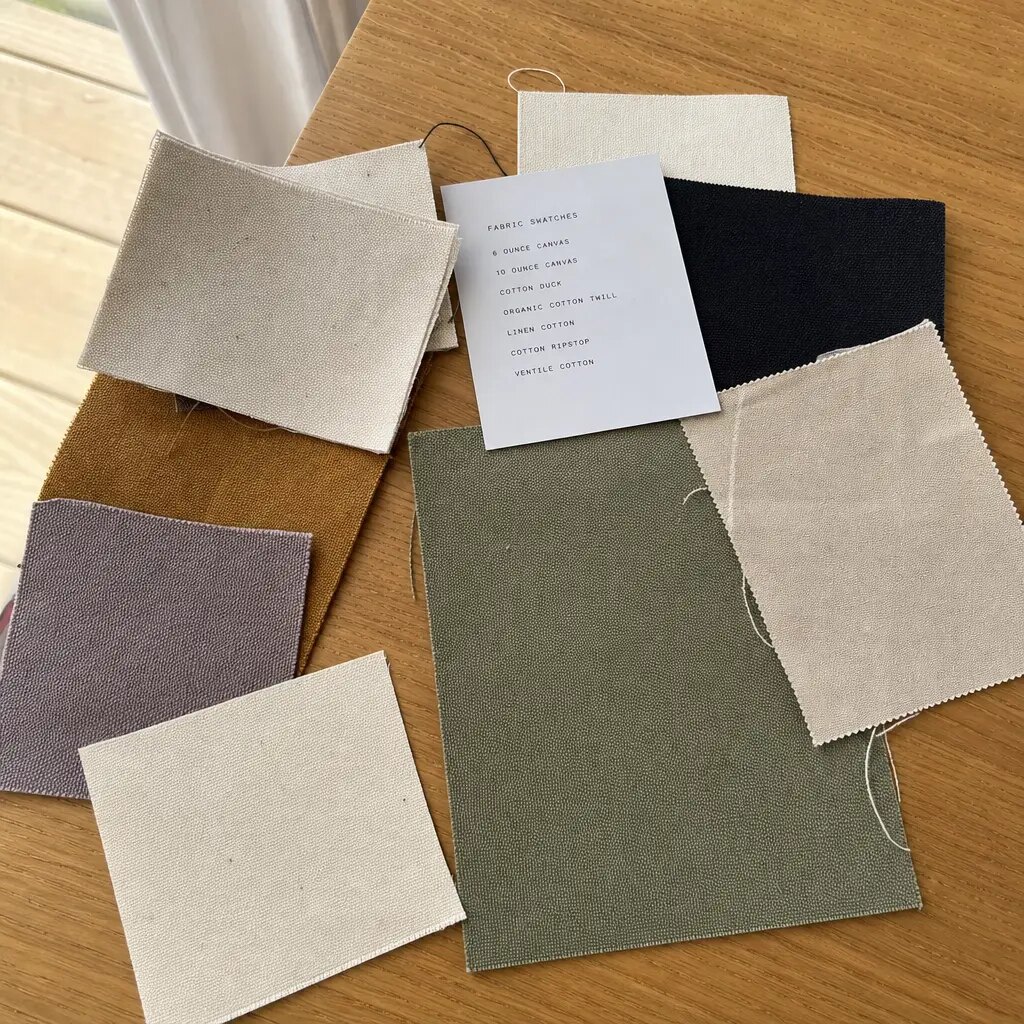
Ask for the right sample type. A material swatch confirms fabric color and hand feel. A print strike-off confirms ink coverage and logo readability on textured canvas. A fit sample confirms dimensions and construction. A pre-production sample confirms the final combination before bulk. For small orders, the supplier may resist multiple sample rounds, but procurement should still insist on at least one physical reference for any retail or wholesale-facing bag.
Approval notes should be specific. Instead of writing “approved except logo slightly higher,” state the exact correction: “Move logo center 10 mm lower; final tolerance plus or minus 5 mm from approved measurement.” Photograph the sample next to a ruler. Mark strap width, strap drop, zipper length, pocket location, and label position. If the inside seam finish is acceptable only because the bag is unlined, state that it must match the approved sample and cannot be downgraded in bulk.
- Test-load the sample with the exact coffee products or sales materials it must carry.
- Approve a print strike-off if the logo has fine lines, small type, or large ink coverage.
- Create a deviation list with measurements, not general comments.
- Seal or sign the PP sample when possible so inspection has a physical reference.
- Do not approve bulk production from a showroom sample that uses different fabric, trim, or decoration.
8. Set Measurable QC Standards Before Bulk Starts
Canvas bags are often judged by feel, but QC needs numbers. Without measurable standards, disputes become subjective: the supplier says the print is acceptable, while the buyer says it looks off. A written QC plan should define fabric tolerance, finished dimensions, logo placement, stitch density, reinforcement, hardware performance, print durability, packing, and acceptable defect levels. These points belong in the purchase order or approved specification sheet, not only in a chat thread.
For general consumer textile accessories, many buyers use an AQL inspection framework such as AQL 2.5 for major defects and AQL 4.0 for minor defects, with critical defects not accepted. The exact level should match the order value and risk. A bag sold as premium cafe merch deserves tighter cosmetic control than a low-cost event giveaway. However, even giveaways should reject critical defects such as broken straps, sharp hardware, severe print transfer, mold, incorrect logos, or unsafe components.
Define defects by severity. Critical defects make the product unsafe, unusable, legally risky, or brand-damaging. Major defects affect function or obvious appearance: broken stitches at strap ends, zipper failure, wrong print position, incorrect fabric color, or significant stains. Minor defects are small issues that do not affect use and are not obvious at normal viewing distance, such as a short loose thread that can be trimmed. This structure helps the factory inspect the order the same way you will.
- Fabric: specify oz/GSM and tolerance, commonly plus or minus 5% unless agreed otherwise.
- Dimensions: set finished-size tolerances, for example plus or minus 1.0 cm on main body and plus or minus 0.5 cm on small pockets or labels.
- Logo placement: set reference points and tolerance, such as plus or minus 5 mm for screen print and plus or minus 3 mm for sewn labels.
- Stitching: specify approximate stitches per inch, seam type, bar-tack locations, and no skipped/broken stitches at stress points.
- Hardware: cycle-test zippers, snaps, buckles, and magnets during inspection; reject jamming, sharp edges, rust, or finish peeling.
- Print: require dry rub and light wet rub checks suitable for the ink and canvas surface; reject heavy transfer, cracking, peeling, or obvious misregistration.
- Packing: verify units per carton, SKU separation, carton marks, gross weight, and protection against print abrasion.
- Inspection: use the signed PP sample, spec sheet, and AQL plan as the final reference.
9. Calculate Landed Cost: Incoterms, Freight, Duty, And Carton Cube
MOQ negotiation is incomplete until landed cost is calculated. A 200-piece pilot may be easy to approve, but if it ships by courier in bulky cartons, the freight per bag can destroy the economics. A 1,000-piece run may have a lower unit price, but it ties up cash and warehouse space. Coffee roasters should compare cost per sellable bag after product cost, setup, samples, duty, freight, customs brokerage, domestic trucking, warehousing, and expected rejects.
Incoterms matter. EXW may look cheap because export handling, inland transport, and port charges are not included. FOB gives a cleaner comparison for overseas freight because the supplier is responsible up to the named port. CIF may include ocean freight and insurance to the destination port, but local destination charges still need review. DAP and DDP can simplify delivery, but the buyer should understand what is included and whether duty, tax, and customs clearance are covered. Never compare an EXW quote directly against a DDP quote without normalizing the cost.
Carton cube can be as important as carton weight. Canvas messenger bags are soft but bulky, especially if they are packed with inserts, hangtags, or individual polybags. Freight may be charged by dimensional weight rather than actual weight for air and courier shipments. Ocean freight is sensitive to cubic meters, while domestic warehousing may care about carton count and pallet efficiency. Ask for carton dimensions, units per carton, gross weight, and packing photos before confirming the final order.
Domestic versus overseas reorder economics should be reviewed honestly. Domestic decoration may win for emergency restocks, small cafe drops, or local event runs. Overseas production may win for planned retail programs and wholesale kits once the SKU is stable. Some roasters use a two-tier approach: keep a domestic backup for urgent small batches, while placing larger factory runs on a seasonal reorder calendar.
- Normalize all quotes to the same Incoterm before comparing price.
- Ask for carton dimensions and units per carton early; do not wait until shipping week.
- Calculate air, courier, and ocean/consolidated freight scenarios for pilot and reorder quantities.
- Include duty, brokerage, destination charges, domestic trucking, and warehouse receiving labor.
- Check whether individual polybags increase carton volume enough to affect freight materially.
- For cafe retail, calculate landed cost against expected retail price and markdown risk.
- For wholesale sample kits, calculate cost per kit delivered, not just cost per empty bag.
10. Reorder Strategy: Negotiate The Second Order During The First
The best time to negotiate reorder economics is before the first purchase order is placed. Suppliers are more willing to discuss future pricing, saved screens, label inventory, and lower reorder friction when they see a clean first-run plan. Ask what happens if the same bag is reordered within three, six, or twelve months. Will the screen charge be waived? Can leftover labels or trims be held? Is the reorder MOQ lower if the fabric and components remain stock?
For coffee roasters, reorder timing often follows seasonal launches, subscription campaigns, holiday gifting, and trade-show calendars. If the bag becomes a cafe retail staple, avoid waiting until inventory is nearly gone. Canvas goods take time for material booking, sewing, decoration, packing, freight, and receiving. A simple reorder trigger can prevent expensive air freight: reorder when inventory falls to a defined number of weeks of sales, not when the last carton is opened.
Use first-run data to improve the second order. If cafe customers like the bag but ask for a zipper, price that upgrade against proven demand. If wholesale reps overload the bag, add reinforcement or a deeper gusset. If the hangtag blocks the logo on display, change the retail pack-out. MOQ negotiation becomes easier when changes are based on sell-through and operational feedback rather than personal preference.
- Ask for reorder MOQ and reorder price at the same time as the first quote.
- Confirm whether screens, label tooling, and approved patterns are retained for future orders.
- Set an inventory trigger based on sales velocity, event calendar, or wholesale-kit usage.
- Keep the first run simple enough that the second run can improve the spec without scrapping the entire program.
- Document customer, staff, and wholesale-rep feedback so changes are commercially justified.
Specification comparison for buyers
| Quote item to compare | Supplier A: low-MOQ pilot | Supplier B: standard factory run | Supplier C: premium retail build | Procurement decision rule |
|---|---|---|---|---|
| MOQ structure | 100-300 pcs if using stock canvas, one print color, simple unlined body | 300-800 pcs per color or style, depending on fabric booking and sewing schedule | 800-1,500+ pcs if custom dyed canvas, lining, branded hardware, or multiple decoration positions | Do not compare MOQ alone. Compare MOQ by body color, print color, closure type, and label program. |
| Indicative unit-cost behavior | Highest unit cost because setup, sampling, and freight are spread over fewer bags | Usually best balance for first repeatable SKU if the design is stable | Lower unit cost possible, but higher cash commitment and inventory risk | Use pilot only to validate sell-through or event need; move to standard run once demand is proven. |
| Fabric and body spec | Stock natural or black canvas, usually 12-14 oz, limited trim choices | 12-16 oz canvas, more control over pockets, strap width, and closure | 16 oz+ canvas, lining, structured base, custom trims, premium finish | For coffee retail, avoid going too light. A flimsy bag weakens perceived brand value next to premium roasted coffee. |
| Decoration route | One-color screen print or stock woven label | Screen print, woven label, small embroidery, or two-position branding | Multi-color print, embroidery, leather/PU patch, custom zipper pull, retail hangtag | If margin is uncertain, start with one decoration method. Add premium branding on reorder after sell-through data. |
| Best coffee-roaster use case | Event giveaway, staff onboarding, first merch test, local cafe launch | Cafe retail merch, wholesale partner kits, subscription gift, regional campaign | Flagship merch, holiday bundle, trade-show retail pack, high-value wholesale presentation | Match the bag to the channel: giveaway, resale, wholesale kit, or reusable sample carrier. |
| Main negotiation lever | Accept stock materials and limited artwork placement in exchange for lower minimum | Offer forecast, repeat-order window, and faster sample approval for better price/MOQ balance | Commit to larger volume or staged delivery in exchange for lower unit price and stricter QC | Trade certainty for flexibility. Factories respond better to clean specs and reorder visibility than vague promises. |
| QC risk | Inconsistent finishing if the supplier squeezes production into a small batch | Manageable if PP sample, inspection level, and tolerances are written clearly | Higher because more components create more failure points | More customization requires more measurable QC points, not just a nicer sample. |
| Landed-cost risk | Air freight or courier can make unit economics look poor | Ocean freight or consolidated freight often works if carton cube is controlled | Inventory carrying cost and duty/freight exposure can outweigh lower unit price | Compare landed cost per sellable bag, including carton volume, dimensional weight, setup, and receiving labor. |
Buyer checklist before sampling
- Define the commercial role before sourcing: cafe retail merch, wholesale sample kit, staff bag, cupping/event carrier, subscription gift, or customer giveaway.
- Set a target retail price or internal cost ceiling before negotiating MOQ. A resale bag and a free-with-purchase bag should not use the same spec.
- Freeze the first-run SKU count: ideally one body color, one size, one closure, and one decoration method until sell-through is proven.
- State the bag’s expected contents: 12 oz or 250 g coffee bags, sample pouches, cupping spoons, notebooks, catalogs, mugs, POS cards, or small brewing accessories.
- Specify finished dimensions, gusset depth, strap width, strap drop, pocket layout, closure type, fabric weight, lining, reinforcement, and packing method in the RFQ.
- Ask MOQ separately by style, fabric color, print color, lining, closure, woven label, and custom hardware. Do not accept a single unexplained MOQ number.
- Request a quote at two or three volume bands, such as pilot, standard run, and reorder quantity, with setup charges separated from unit price.
- Require a physical pre-production sample or sealed reference sample before bulk production, especially if the bag is for retail sale.
- Set measurable QC tolerances for GSM, dimensions, logo placement, stitch density, zipper/snap function, abrasion/rub resistance, and carton packing.
- Confirm Incoterms, port, carton dimensions, gross weight, units per carton, pallet plan, and whether freight will be charged by actual weight or dimensional weight.
Factory quote questions to send
- What is the MOQ by finished bag style, fabric color, print color, lining choice, closure type, woven label, and custom trim?
- Can you quote three bands, for example 200-300 pcs, 500-800 pcs, and 1,000-1,500 pcs, with setup fees shown separately?
- Which canvas weight is included in the quote, in oz and GSM, and what GSM tolerance do you guarantee against the approved swatch?
- Is the fabric stock greige, stock dyed, custom dyed, or purchased only after order confirmation? What is the minimum fabric purchase behind the MOQ?
- What are the finished bag dimensions, gusset depth, strap width, strap drop, and dimensional tolerances after sewing?
- Is decoration completed in-house or outsourced? If outsourced, how many extra days are needed and who controls print QC?
- For screen print, what is the maximum print area, ink type, number of colors, expected rub resistance, and setup charge per screen?
- For woven label or embroidery, what is the tooling charge, MOQ, placement tolerance, and lead time for label approval?
- What reinforcement is included at strap ends, side seams, flap corners, pocket openings, zipper ends, and base corners?
- What stitch density do you use on main seams and strap attachments, and where will bar-tacks or box-X stitches be applied?
Quality-control points to confirm
- Fabric weight should match the approved swatch within a written tolerance, commonly plus or minus 5% GSM unless a tighter standard is agreed.
- Finished dimensions should be measured on a flat relaxed bag, with practical tolerances such as plus or minus 0.5 cm for small features and plus or minus 1.0 cm for main body dimensions.
- Logo placement should be controlled from fixed reference points, with a written tolerance such as plus or minus 3 mm for woven labels and plus or minus 5 mm for larger screen prints.
- Screen print should pass a dry rub and light wet rub check appropriate to the ink and canvas surface, with no obvious cracking, peeling, heavy smudging, or color transfer beyond the agreed standard.
- Stitch density should be specified, commonly around 7-9 stitches per inch for main seams unless the construction requires otherwise, with no skipped stitches, broken threads, or loose tension at stress points.
- Strap ends should use bar-tacks, box-X stitching, or equivalent reinforcement, and inspectors should tug-test attachments consistently against the approved construction.
- Zippers, snaps, buckles, and magnetic closures should be cycled during inspection. Zipper pullers should move smoothly without tooth separation, jamming, or broken sliders.
- Hardware color and finish should match the approved sample, with no sharp burrs, rust, plating peel, or obvious shade mismatch across the same order.
- Inside seams should be bound, overlocked, or otherwise finished as specified, with no exposed raw edges that differ from the approved sample.
- Lining, if used, should be checked for twisting, puckering, loose fabric, misaligned pockets, and color transfer risk against light canvas.