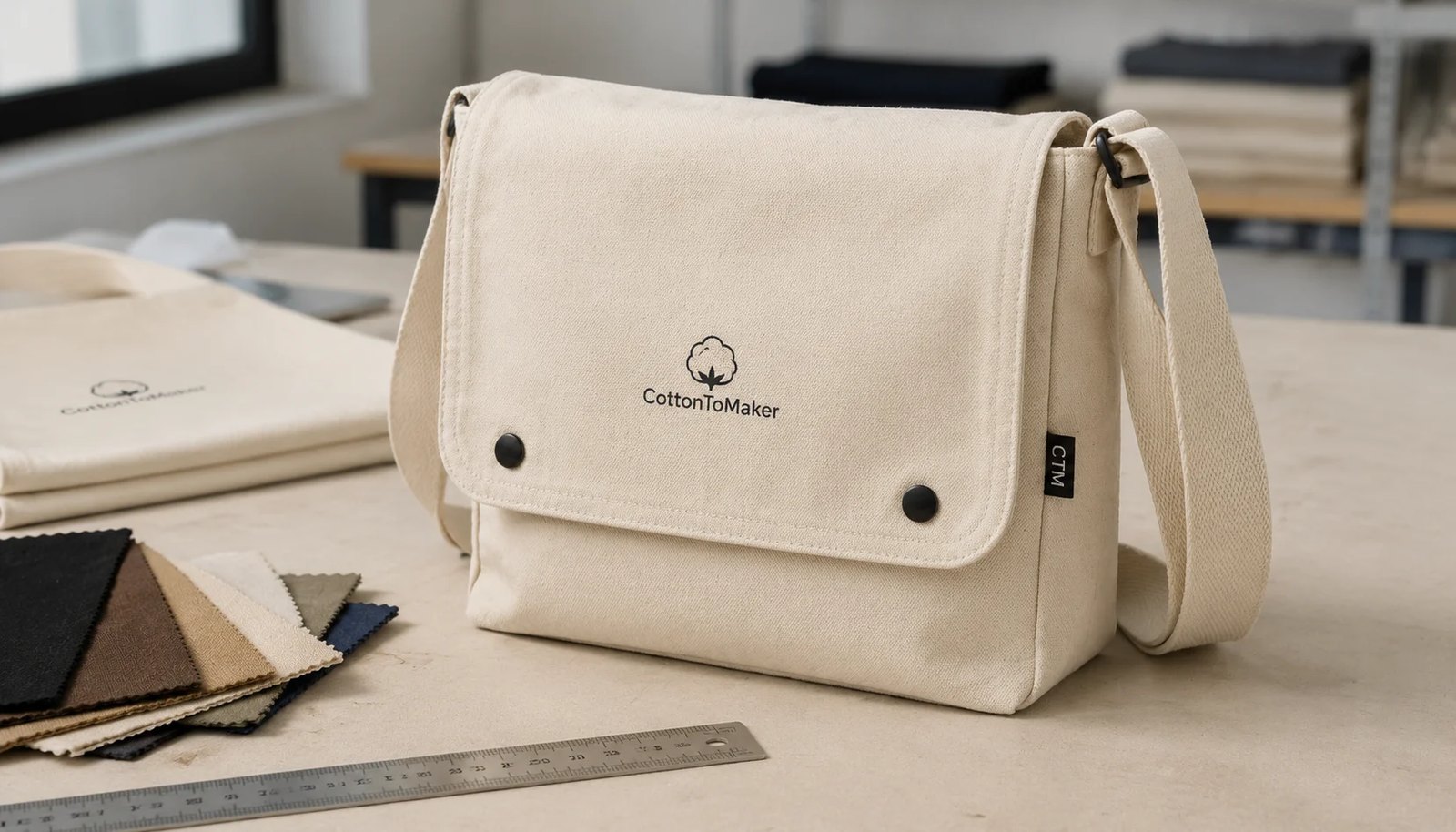
Understand What MOQ Really Means In Canvas Bag Sourcing
For liquor retailers, MOQ negotiation usually goes wrong when the discussion starts with one question: can you do fewer pieces? In practice, the factory minimum for custom canvas messenger bags is not just a sales number. It is the result of fabric availability, cutting efficiency, print setup, sewing line interruption, hardware sourcing, label setup, and carton planning. If those inputs stay vague, the supplier protects itself with a higher MOQ, a wider tolerance, or a construction that is cheaper than the buyer expects.
A more accurate approach is to treat MOQ as a technical sourcing outcome. For example, a stock 10 oz or 12 oz canvas body with one screen print and standard metal hardware is often negotiable because the supplier can use stocked materials and a familiar sewing route. A custom-dyed body, two logo versions, branded woven labels, custom hangtags, and retail-ready packing can shift the true minimum upward even when the bag shape looks simple. Procurement gets better leverage when each variable is visible.
This matters for liquor retail because programs are often fragmented. One team wants a tasting event giveaway, another wants a club pickup accessory, and another wants a low-volume resale item. If all three are merged into one RFQ, suppliers usually quote against the most complex scenario. The result is a minimum quantity that looks inflexible but is actually tied to specification complexity rather than to the messenger bag category itself.
- Treat MOQ as a combination of material minimums, setup charges, and line efficiency.
- Ask which exact specification element is creating the minimum: fabric, logo, hardware, label, or packing.
- Separate pilot-launch requirements from long-term repeat requirements.
- Do not assume a catalog MOQ applies to your custom version of the bag.
Define The Retail Use Case Before You Negotiate Price
A messenger bag for a liquor retailer can serve very different purposes, and each purpose changes the right specification. An event giveaway bag may only need to hold tasting cards, brochures, and a small accessory. A staff or distributor bag may need daily durability, comfortable strap width, and reliable closure. A retail resale item may need cleaner topstitching, tighter print control, hangtags, barcode labels, and more careful folding to look shelf-ready.
The practical way to define the use case is to list the actual contents, how long the bag will be used, and who sees it. If the contents are mainly paper and lightweight accessories, overbuilding with lining, foam, and multiple internal compartments may create needless cost and MOQ pressure. If the bag will be sold in-store, the visual standard and defect tolerance need to be closer to retail merchandise than to a one-day promotional freebie.
Load expectation should be stated in the RFQ, even if it is approximate. A bag designed for 1 to 2 kg of mixed paper goods and accessories may use different reinforcements than one expected to carry heavier boxed items. Factories do not always receive this information unless the buyer provides it, but it directly affects strap attachment, closure stress, and gusset shape once loaded.
- Name the use case in the purchase document, not just in email discussion.
- List the longest, widest, and thickest items the bag must hold.
- State whether the bag is for single-event distribution, moderate repeat use, or resale.
- Decide whether presentation or load durability matters more for the first order.
Set A Realistic Fabric Specification: Weight, Finish, And Stock Status
For most liquor retail messenger bag programs, 10 oz to 12 oz cotton canvas is a practical baseline. In metric terms, that is roughly around 340 to 410 GSM, though exact conversion varies by weave and finishing. This range usually gives enough body for a flap bag without creating excessive seam bulk, heavy carton weights, or avoidable sewing slowdown. It also tends to support cleaner screen printing than very lightweight canvas.
Buyers should ask for more than just canvas weight. The quote should state whether the fabric is stock or made to order, whether it is natural, dyed, washed, or otherwise finished, and whether the fabric weight is nominal finished weight or greige basis. These details matter because shrinkage, shade variation, and handfeel can all shift after dyeing or washing. A supplier may say 12 oz canvas, but one 12 oz fabric can feel notably softer or looser than another depending on weave density and finish.
Overbuilding is a common mistake in MOQ-sensitive projects. A 14 oz or 16 oz canvas body can sound premium, but it may also require slower sewing, larger needles, more reinforcement planning, and heavier cartons. If the mill does not stock it in the chosen color, the fabric minimum can become the real MOQ driver. For a first run, liquor retailers usually gain more by choosing a stock 10 oz or 12 oz canvas and improving reinforcement, print control, and packing discipline than by jumping directly to a very heavy body cloth.
- Request fabric weight in both oz and GSM.
- Confirm whether the fabric is stock, custom dyed, washed, or specially finished.
- Ask for the nearest stocked alternative if your first-choice canvas triggers a high minimum.
- Align supplier quotes only after weight, finish, and stock status are the same.
Control Dimensions, Gusset Depth, And Functional Fit
Finished dimensions affect cost more than many buyers expect. Width and height determine panel consumption; gusset depth changes both capacity and sewing complexity; flap depth affects appearance and closure alignment. A baseline size around 35 x 28 x 8 cm often works for liquor retail programs carrying A4 materials, event collateral, folded apparel, and small branded accessories. But the correct dimension should come from actual contents, not a default catalog pattern.
Gusset depth deserves special scrutiny. A bag with an undersized gusset may look neat when empty, then distort badly once loaded. The flap may stop closing cleanly, the snaps may pull out of line, and the printed logo can sit at an awkward angle when worn. On the other hand, an unnecessarily deep gusset raises fabric consumption, can make the bag bulky for giveaways, and may reduce packing efficiency in cartons.
The best sourcing habit is to test a sample under load before final approval. Put the planned contents inside, close the flap, adjust the strap, and observe the shape. Does the flap sit flat? Does the closure align? Does the strap attachment pull the body out of square? This basic load check catches more real-world errors than reviewing an empty sample on a table.
- State finished dimensions and tolerance in the purchase specification.
- Measure dimensions on a filled sample, not just an empty one.
- Check that the flap closes over the intended contents without strain.
- Update carton quantity and CBM after final size is confirmed.
Keep Construction Functional But MOQ-Friendly
The most negotiable construction for custom canvas messenger bags is usually a single-compartment body with front flap, adjustable cotton webbing strap, standard metal adjuster, and limited internal features. This gives liquor retailers a branded messenger silhouette without forcing the factory into a complex sewing route. It is often enough for event use, staff use, distributor kits, and many loyalty programs.
Feature creep is what usually turns a manageable MOQ into a difficult one. Each added detail changes labor content and control points: lining adds extra cutting and assembly; zipper pockets add component sourcing and alignment risk; padded panels add thickness and slow sewing; bottle dividers add pattern complexity; decorative binding or piping increases visible workmanship exposure. None of these features are wrong, but they should be justified by the use case and target quantity.
Where buyers should not compromise is reinforcement at stress points. Strap attachments, flap corners, snap positions, and gusset joins need clear construction direction. If the bag is intended for regular use, ask where bartacks, box stitches, or reinforcement patches will be applied. That type of specification improves durability without automatically forcing a premium MOQ the way custom linings or niche trims often do.
- Prioritize reinforcement before decorative complexity.
- Specify strap width, webbing material, and adjuster finish clearly.
- Use one main compartment unless organization features are truly necessary.
- Ask the supplier to identify which added feature changes the sewing route and MOQ.
Choose Branding Methods That Support Both Cost Control And Retail Presentation
Branding on canvas messenger bags should be chosen for manufacturability, not just appearance on a concept render. For most liquor retailers, screen printing is the most practical method when the logo uses one to three spot colors. It generally offers a matte look that suits cotton canvas, good cost control at volume, and straightforward repeatability. It also tends to support MOQ negotiation better than methods that require special materials or slower application.
However, even screen printing needs proper specification. Buyers should state artwork size, Pantone references, exact print position, and whether the print is applied on flat cut panels before sewing or on assembled bags after sewing. Panel printing can improve position consistency for some designs, but assembly can still shift the final visual center if seam allowance and flap shape are not controlled.
Alternative branding methods change risk. Embroidery can feel premium but may pucker canvas, especially on dense or small-detail artwork. Heat transfer can handle gradients and fine detail but may look glossier than expected and should be tested for adhesion on textured fabric. Woven labels work well for subtle repeat branding and are often useful when multiple store logos would make direct printing expensive, but labels carry their own setup and minimums. Patches add dimension, yet they also add another material stream to approve.
- Provide vector artwork and Pantone references with the RFQ.
- Keep logos away from seams, snaps, fold lines, and thick corner areas.
- Request a strike-off, printed fabric panel, or photo measurement for strict logo approval.
- For multiple banners, keep logo size and placement identical even if artwork changes.
Use MOQ Levers The Right Way In Negotiation
The best MOQ negotiation is not a generic push for lower quantity. It is a trade-off discussion built around operational simplicity. If a supplier says the minimum is too high, ask what would happen if you keep one stock body color, one hardware finish, one print position, and one standard export carton. Buyers are more likely to get movement when they remove changeovers than when they simply demand a lower opening quantity.
It is also essential to clarify the unit of MOQ. Some suppliers quote per style, some per color, some per artwork, and some effectively per production run. A quote that looks like 1000 pieces minimum may really mean 1000 pieces per body color with one logo version. If the buyer wants four regional logos at 250 pieces each, that needs a different discussion about screen cost, minimum per artwork, or use of a common woven label instead of four separate large prints.
A useful negotiation tool is to separate small-run surcharge from base unit price. Rather than insisting on one blended price for a low pilot quantity, ask the factory to show the surcharge explicitly. This lets procurement compare the economics of a 500-piece pilot versus a 1000- or 2000-piece repeat order without hiding setup cost in the unit price. It also makes future volume conversations cleaner.
- Clarify whether MOQ is per style, color, artwork, print position, or shipment.
- Offer simplification: stock fabric, one print position, one hardware finish, one carton spec.
- Request explicit small-run surcharge rather than a vague all-in low-volume price.
- Use realistic annual forecast data only if internal demand is credible.
Compare Quotes On Total Landed Cost, Not Just Unit Price
Canvas messenger bags are soft goods, but they still carry meaningful freight and handling implications. Heavier fabric, wider gussets, and inefficient packing all increase shipping cost. A quote that appears cheaper on unit price can become more expensive once carton size, gross weight, sample charges, label setup, or excluded packing labor are added. For liquor retailers operating on fixed event calendars or promotional launch windows, missing this detail can cause budget overrun or receiving issues later.
Each supplier quote should break out the same commercial inputs: unit price, sample fee, print setup, fabric basis, packaging assumptions, carton quantity, carton dimensions, gross weight, lead time, trade term, and payment terms. If one supplier includes polybagging, barcode labels, and carton marks while another excludes them, the two numbers are not comparable. Freight basis matters as well. EXW, FOB, CIF, and DDP shift responsibility and cost visibility in different ways.
Carton planning is especially important when bags must be allocated across stores, regions, or events. A practical supplier should be able to estimate pack count, carton size, and CBM before order confirmation. If the answer is vague, procurement should treat the quote as incomplete. In B2B sourcing, quote discipline is part of product quality discipline.
- Normalize all quotes to the same material, print, and packing assumptions.
- Collect carton quantity, carton dimensions, and gross weight from every supplier.
- Record what is excluded: sample courier, setup, labels, hangtags, polybags, inspections, inland delivery.
- Compare freight term and payment term alongside the visible unit price.
Approve Samples With Written Tolerances And Fixed Reference Points
A sample only helps procurement if it proves manufacturability under the intended production conditions. For custom canvas messenger bags, that means the sample should reflect actual or equivalent production fabric, approved hardware finish, final print method, strap specification, seam construction, and packing fold. A showroom sample made from similar materials can be useful for concept alignment, but it should not become the bulk standard by accident.
Written approval matters as much as the physical sample. Measure width, height, gusset depth, flap depth, strap width, adjustable strap range, and print placement from fixed reference points. Note whether dimensions are taken with the bag laid flat, lightly shaped, or filled. Define tolerance. For many sewn canvas bags, plus or minus 1 cm on finished dimensions is practical unless a tighter tolerance is specifically required. For simple logo placement, plus or minus 3 mm to 5 mm may be commercially workable depending on the printing stage and artwork size.
If the bag is being produced for resale or prominent brand presentation, also document softer acceptance points such as visible creasing, natural fabric specking, thread trimming, and whether slight print texture variation is acceptable. Many disputes happen because one side judges against a polished prototype photo while the other judges against typical softgoods practice.
- Use a pre-production sample as the formal bulk reference whenever timing allows.
- Measure from fixed points such as side seam, flap edge, and centerline.
- Record both hard specs and visual acceptance notes on one approval sheet.
- Keep matched approved references with buyer and supplier.
Set A Practical QC Plan Before Deposit And Before Bulk Cutting
Quality control for canvas messenger bags works best when it is set before production starts, not during final inspection under shipment pressure. The QC plan should identify what will be checked at incoming material stage, during early sewing, and at packed final stage. For liquor retailers, the priority checks usually include fabric weight and shade, print color and placement, closure alignment, reinforcement stitching, hardware finish, odor, and carton condition.
Tolerance language should be practical and written in plain terms. A buyer can ask for exactness that soft sewn goods cannot deliver economically. Instead, define acceptable ranges. Typical examples include finished dimensions within about plus or minus 1 cm, print placement within about plus or minus 3 mm to 5 mm for simple front graphics, and agreed commercial shade tolerance against the approved sample or lab dip. Natural canvas also needs a clear note on whether minor slubs or seed specks are acceptable.
It is wise to classify defects by severity. Critical defects may include sharp exposed hardware, broken strap attachment, missing closure parts, or contamination. Major defects may include wrong fabric weight, wrong color, severe crooked print, non-functioning closure, or heavy stains on visible panels. Minor defects may include small internal loose threads or slight visual variation within approved tolerance. This structure helps third-party inspection and internal receiving teams make consistent decisions.
- Approve QC points before deposit and before bulk cutting begins.
- Inspect early production for print position, flap alignment, and closure setting.
- Define tolerance ranges suitable for sewn canvas goods.
- Classify defects as critical, major, and minor for consistent inspection decisions.
Specification comparison for buyers
| Spec decision | Recommended option | When it fits | Buyer risk to check |
|---|---|---|---|
| Canvas body weight | 10 oz to 12 oz cotton canvas, approximately 340 to 410 GSM, with test method stated in writing | Most liquor retail programs: tasting events, wine club pickup, staff kits, loyalty gifts, light resale, and branded promotions carrying paper materials, flat accessories, corkscrews, bottle sleeves, or small boxed items | Below about 8 oz often lacks structure for flap bags and may show print distortion; above 14 oz can increase fabric cost, sewing time, seam bulk, needle wear, carton weight, and may trigger non-stock fabric minimums |
| Bag size | Approx. 35 x 28 x 8 cm as a baseline, adjusted from actual contents and target carry format | Suitable for A4 documents, tasting notes, club inserts, POS sheets, folded aprons, and small accessories without looking oversized | Oversized panels increase fabric consumption and CBM; undersized gusset depth can cause flap strain, snap misalignment, or an unusable carry profile once loaded |
| Flap and closure | Full front flap with 1 to 2 metal snaps or reinforced hidden magnets, backed with reinforcement patches | Best for repeated opening in store operations, event check-in, club pickup, or distributor visits where a cleaner retail look is preferred over an open tote | Snap placement drift, weak reinforcement, or uneven flap shape can cause poor closure alignment; magnets must be specified for pull strength and shielded from rust risk |
| Shoulder strap | 3.2 cm to 3.8 cm cotton webbing, adjustable length roughly 90 to 140 cm with metal slider | Comfortable for crossbody or shoulder wear during tasting events, retail floor use, or field visits | Narrow webbing twists under load; low-density webbing can feel soft and stretch; mixed hardware finishes make the bag look inconsistent across production lots |
| Print method | Screen print for 1 to 3 spot colors; heat transfer only when gradients or very fine detail are required | Screen print usually gives better cost control, matte appearance, and durability on cotton canvas for retail branding | Large ink coverage can crack or feel rubbery if over-inked; transfers may look glossy and need adhesion checks; embroidery can pucker lighter canvas if stitch density is too high |
| Logo position | Front flap center or lower body panel with print-safe margins from seams, snaps, and fold lines | Keeps branding visible when carried and reduces distortion risk from gusset curves or top edge seams | Art too close to hardware or folds can shift visually even when technically in tolerance; panel printing before sewing must match final seam allowance |
| Inner structure | Single main compartment plus optional flat slip pocket | Most suitable for promotions, staff issue, and event use where laptop-grade organization is unnecessary | Adding lining, zipper pockets, dividers, foam, or organizers raises labor content, sampling rounds, defect points, and often the MOQ |
| Color strategy | Use stock natural, black, or navy canvas first; request custom dye only when brand-color match is commercially necessary | Best for first orders, short lead time projects, or MOQ-sensitive launches | Custom dye often introduces fabric mill minimums, shade approval risk, longer lead time, and possible lot-to-lot variation that requires signed lab dip approval |
| Packing method | Flat packed, 25 to 50 pcs per export carton depending on size, canvas weight, and flap stiffness | Efficient for distribution centers, event staging, and store allocation | Over-compression can crease flap prints and distort shape; weak cartons may fail stacking tests or deform in long ocean transit |
Buyer checklist before sampling
- Define the business use clearly: event giveaway, loyalty member bag, staff issue, distributor sales kit, retail resale, club pickup accessory, or seasonal promotion.
- List the exact contents the bag must carry, including document size, approximate load weight, and whether the flap must close over boxed items, bottle sleeves, or folded apparel.
- Issue a measurable RFQ with finished size, gusset depth, flap depth, canvas weight in oz and GSM, strap width, strap length range, hardware finish, logo size, print colors, and packing requirement.
- State whether stock natural canvas, stock dyed canvas, or custom-dyed fabric is acceptable, and whether commercial color match is acceptable or Pantone match is required.
- Ask the factory to identify the MOQ driver separately for fabric, print setup, labels, hardware sourcing, and packing so you can negotiate the real constraint.
- Confirm whether MOQ is counted per style, per color, per artwork, per print position, per size, per hardware finish, or per shipment.
- Request pricing at several quantity breaks using the same exact specification, then ask what changes would reduce MOQ without changing the intended retail function.
- Require a pre-production sample made with production fabric, actual webbing, actual hardware, final print method, and intended folding or carton packing method.
- Set written acceptance criteria before deposit: size tolerance, print position tolerance, shade tolerance, stitch quality, hardware finish consistency, odor level, and carton condition.
- Ask for estimated unit weight, carton quantity, carton dimensions, gross weight, and CBM before selecting a supplier, because freight and warehousing can change the true landed cost.
Factory quote questions to send
- What is the MOQ for this custom canvas messenger bag by body color, artwork, print position, size, and hardware finish?
- Is the quoted fabric stock canvas or made-to-order canvas, and what is the nominal fabric weight in both oz per square yard and GSM?
- How do you measure fabric weight and what finished weight tolerance do you allow between approved sample and bulk fabric lot?
- What fabric composition is included in the quote: 100% cotton canvas, recycled cotton blend, or another construction, and is the canvas dyed, washed, or finished?
- What shrinkage should we expect after dyeing, washing, printing, or finishing, and how is final cutting allowance handled?
- Which print method is included in the unit price, how many colors and print positions are included, and is printing done on cut panels or on completed bags?
- What logo size is assumed in the quote, and what surcharge applies if the print area becomes larger or changes from one side to two sides?
- Are screen charges, sample fees, courier, woven label setup, carton printing, barcode labeling, polybags, and third-party inspection support included or separate?
- What is the unit price at 500, 1000, 2000, and 5000 pieces using the same body, same fabric, and same print specification?
- If we keep one stock body color, one hardware finish, and one print position, what is the lowest practical MOQ and what small-run surcharge applies?
Quality-control points to confirm
- Canvas body fabric verified against approved swatch before cutting, with nominal weight recorded in both oz and GSM. A practical bulk tolerance for woven cotton canvas may be agreed in advance, for example within about plus or minus 5% by fabric lot unless a tighter standard is specifically purchased.
- Fabric color checked against signed swatch, approved lab dip, or approved sample under consistent lighting such as D65 or equivalent daylight condition. For natural canvas, note that seed specks, slubs, and slight tone variation should be defined as acceptable or unacceptable before production.
- Finished bag width, height, gusset depth, flap depth, and pocket dimensions measured against the approved specification. Typical finished bag tolerance for soft sewn canvas goods is often about plus or minus 1 cm unless a tighter tolerance is agreed for specific dimensions.
- Strap width and adjustable strap length range measured against specification, with hardware installed in the approved direction and no strap twist. Stress-point stitching at strap attachments checked for reinforcement consistency and thread breakage.
- Print color compared to Pantone reference, approved ink drawdown, or signed sample rather than phone images. If exact Pantone match on absorbent natural canvas is not realistic, commercial tolerance must be documented before approval.
- Print placement measured from fixed reference points such as centerline, flap edge, or side seam. For a simple centered logo on a cut panel, a practical tolerance may be about plus or minus 3 mm to 5 mm depending on artwork size and bag construction.
- Print surface checked for pinholes, heavy over-ink, blurred edges, ghosting, offset marks, and poor cure. Adhesion or cure can be checked by dry rub and tape test where appropriate for the print system used.
- Flap shape and closure alignment checked with the bag both empty and loaded. Snaps or magnets should align without forcing, and reinforcement patches around closures should be present when specified.
- Snap and magnetic closure function checked through repeated open-close cycles on sampled units. QC should look for loose hardware, tearing at the canvas face, poor cap setting, and exposed sharp edges.
- Seam construction checked for skipped stitches, uneven stitch length, seam grin, raw-edge control where applicable, and secure back-tacking. Corners, gusset joins, and flap edges deserve special attention because bulk and shape change are common there.