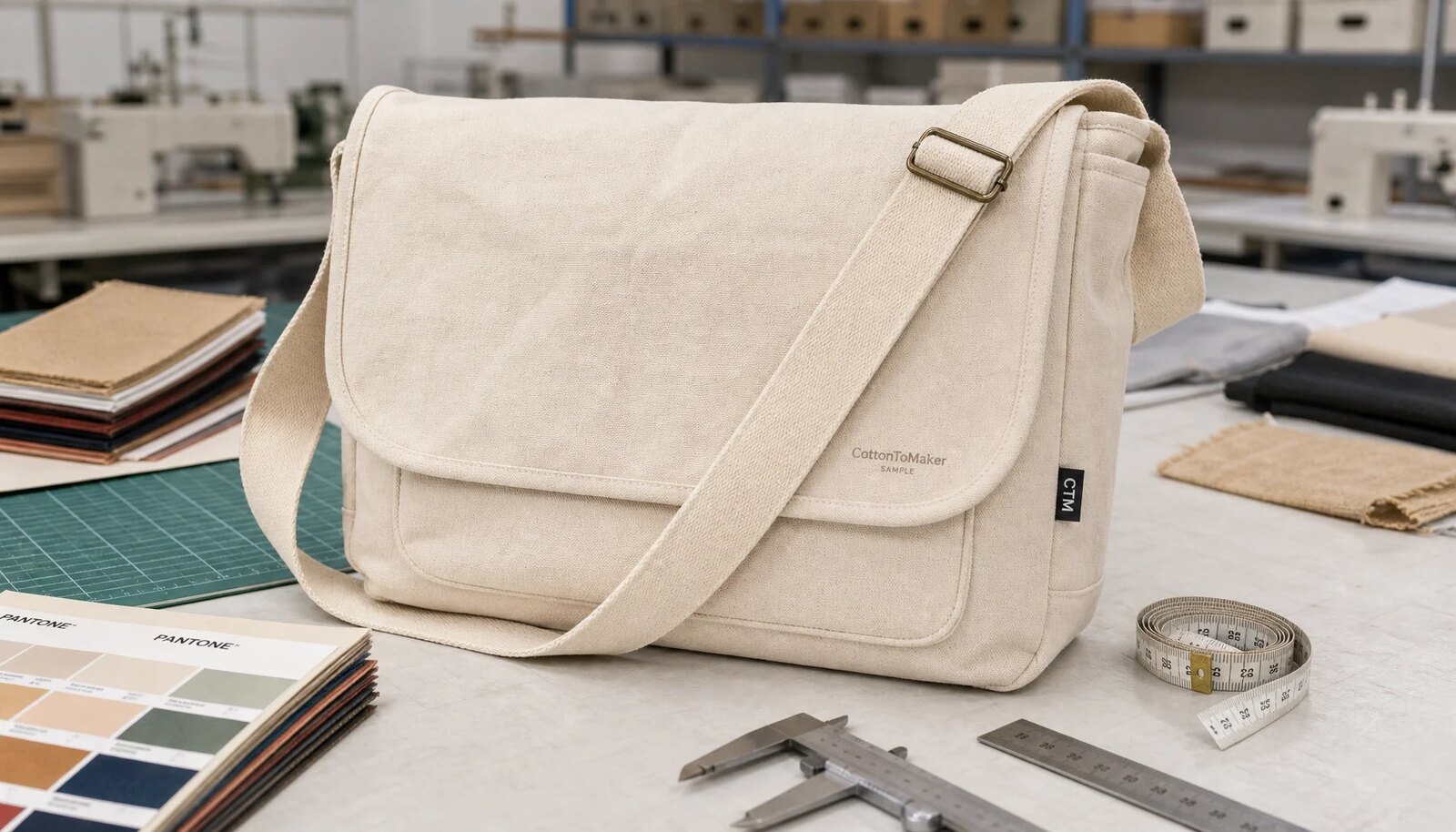
Start With the Product Spec, Not the MOQ
MOQ negotiation is easier when the supplier is pricing a defined bag, not guessing. “Canvas messenger bag with hotel logo, 500 pieces” leaves too many decisions open: fabric weight, gusset, flap coverage, strap type, closure, pocket layout, logo method, label, packing, and inspection standard. A cautious factory may quote a high MOQ to protect itself. A cheaper supplier may quote low, then add charges or weaken the build later.
For hotel retail, a practical first specification is usually a rectangular messenger body with a flap, one inner or front slip pocket, reinforced strap anchors, and an adjustable cotton webbing strap. It looks more substantial than a basic tote but avoids the cost and minimums of a padded laptop bag. Extra features should earn their place. A zipper pocket adds zipper sourcing and function checks. Padding adds foam, lining, bulk, and alignment risk. A custom buckle or badge can create a separate trim MOQ.
Write the retail purpose into the RFQ. A resort shop souvenir may need clean shelf appeal and a restrained logo. A city hotel travel accessory may need a secure closure and comfortable crossbody length. A multi-property program may need one shared bag body with property-specific branding. That purpose helps procurement simplify the right details without damaging sellability.
- Specify first: finished size, gusset, flap length, pocket layout, strap width, strap length range, closure, canvas weight, logo method, and packing.
- Lower-MOQ build: stock canvas, one flap, one slip pocket, standard cotton webbing, stock slider, simple closure, and one-color decoration.
- MOQ pressure points: custom dyeing, lining, padding, multiple compartments, metal logo trim, special buckles, embroidery, patch tooling, and split packing.
- Useful RFQ request: ask which specification changes would reduce MOQ without changing the retail purpose of the bag.
Choose Canvas Weight and Color Deliberately
Fabric is often the first MOQ bottleneck. Many buyers use 10oz to 12oz cotton canvas, roughly 340 to 407 GSM, as a planning range for opening hotel retail orders. That range can give enough structure for a messenger bag without making the item overly bulky to sew, fold, pack, or ship. A 14oz canvas can feel premium, but it may raise material cost, seam bulk, needle stress, carton volume, and cutting minimums. These are planning tradeoffs, not universal rules.
Ask for both ounce weight and GSM. “Heavy canvas” is not a purchase specification, and suppliers may describe fabric differently. The quote should also state composition, such as 100% cotton canvas or cotton-blend canvas, plus finish: natural, dyed, washed, unwashed, coated, or uncoated. If the bag must fit a shelf, fixture, or barcode pack, discuss shrinkage expectation before sample approval.
Color can push MOQ higher than construction. Natural canvas is often the easiest first-order route because many bag suppliers keep it available. Black, navy, and a few core shades may also work if the supplier stocks them regularly. A custom hotel brand color may require lab dips, dye-lot approval, minimum greige fabric commitment, and tighter shade control. For a first sell-through test, stock canvas plus a refined label, hangtag, or small logo is often the more flexible choice.
- 10oz canvas: lighter handfeel, easier folding, lower freight exposure, and suitable for value-oriented hotel retail bags.
- 12oz canvas: stronger shelf presence and a common middle ground for boutique hotel merchandise.
- 14oz canvas: heavier and more premium, but more likely to affect sewing, carton volume, and MOQ.
- Natural canvas: strong first-order choice for MOQ flexibility, fast sampling, and clean one-color print visibility.
- Custom dyed canvas: better for repeat programs or consolidated multi-property volume that can absorb dye-lot requirements.
Unbundle the Hidden MOQs
A finished-bag MOQ is rarely one simple number. Fabric may be bought by roll or dye lot. Webbing may require a minimum color run. Hardware may be purchased by carton or finish. Woven labels may have a higher minimum than the bag order. Printing can run at lower quantities, but screens and setup time still cost money. Packing teams may charge more when cartons are sorted by property, barcode, or destination.
Do not stop at “Can you make 500 pieces?” Ask which input prevents 500 pieces under the current specification. If custom dyed fabric is the blocker, switch to stock natural canvas. If woven-label MOQ is the issue, use print plus hangtag for the first run or buy extra labels for repeat orders. If cutting efficiency is the issue, use a common body size, fewer panels, or one shared pattern across properties.
Hotel groups may have useful leverage when they consolidate the base bag. Several properties can share the same fabric, strap, hardware, pocket layout, carton format, and inspection standard, then change only print, hangtag, barcode, or carton mark. That does not remove every setup charge, but it gives the factory more efficient material purchasing and production flow.
- Ask for MOQ by input: fabric, dyeing, webbing, hardware, label, print, patch, cutting, sewing, packing, and inspection.
- Consolidate where possible: same body, fabric, strap, and hardware across properties, with logo or hangtag changes only.
- Use visible surcharges: a clear low-MOQ surcharge is safer than hidden downgrades in fabric weight or reinforcement.
- Protect repeats: ask whether unused fabric, labels, approved screens, and trim references can support the next purchase order.
Select Decoration That Still Feels Retail
Decoration carries most of the hotel brand signal, but it also affects MOQ and inspection risk. A one-color screen print is often the simplest first-order option because setup is straightforward and production is efficient once artwork is approved. For hotel retail, restraint usually sells better than a large promotional mark. A small flap print, woven side label, tonal embroidery, or branded hangtag can make the bag feel like merchandise rather than a giveaway.
Each decoration has different minimums and failure modes. Screen printing needs screens, ink matching, placement control, and strike-off approval. Multicolor printing adds registration risk. Embroidery requires digitizing, thread matching, and checks for puckering on canvas. Woven labels may require a separate label MOQ. Leather, PU, rubber, or metal patches may need dies, molds, or special attachment methods. Heat transfer should be tested for adhesion on textured cotton canvas.
Send complete artwork before the supplier quotes. Include vector files, Pantone references where applicable, decoration size, placement from finished edges, color count, and acceptable placement tolerance. Natural canvas absorbs ink differently than paper or synthetic fabric, so approve a strike-off on actual or equivalent canvas before bulk printing.
- Best first order: one-color screen print, small woven side label, or print plus hangtag.
- Premium options: embroidery, leather patch, PU patch, rubber patch, or metal trim only when MOQ and sample approval justify them.
- Artwork package: vector logo, Pantone reference, decoration size, placement map, color count, and tolerance notes.
- QC risks: ink bleeding, ghosting, pinholes, cracking, placement variation, label orientation, embroidery puckering, and patch alignment.
Build a Quote Sheet That Shows Real Cost
The cheapest unit price can mislead hotel retail buyers. A messenger bag quote may look attractive until sample fees, screen charges, label setup, embroidery digitizing, patch tooling, hangtags, barcode stickers, carton sorting, inland freight, inspection, and rush shipment are added. Messenger bags also ship bulkier than flat totes because flaps, straps, pockets, and hardware create volume. Carton dimensions and gross weight belong in the first quote review.
Ask every supplier to quote the same specification at useful quantity breaks. Common tiers are 300, 500, 800, 1000, and 2000 pieces, but actual forecast levels are better. Each tier should show unit price, setup charges, decoration charges, packing charges, sample lead time, bulk lead time, pieces per carton, carton dimensions, gross weight, and CBM. If the order is split by hotel property, the quote should say whether property labels, carton marks, barcode stickers, and sorting are included.
Commercial terms need the same visibility. Clarify Incoterms, payment terms, deposit percentage, balance timing, sample charge, sample refund policy, tooling ownership, unused custom material charges, inspection timing, and shipment release conditions. This makes suppliers easier to compare and prevents a low unit-price offer from excluding the hotel retail requirements that matter.
- Unit-price fields: quantity break, fabric weight, dimensions, pockets, strap, closure, decoration, and packing assumptions.
- Setup fields: screens, embroidery digitizing, label setup, patch die, trim tooling, sample charges, and carton label setup.
- Packing fields: polybag or paper band, hangtag, barcode, inner carton, master carton, carton mark, SKU split, and property split.
- Freight fields: pieces per carton, carton dimensions, gross weight, CBM, and palletization if needed.
Negotiate MOQ With Defensible Tradeoffs
Factories can reduce MOQ when the cost pools become manageable. They cannot responsibly reduce it if every part of the bag still requires a separate minimum purchase. Procurement gains leverage by offering controlled alternatives: stock color instead of custom dye, 10oz instead of 12oz canvas if retail value still works, screen print instead of embroidery, stock slider instead of custom hardware, or a visible setup charge instead of a hidden downgrade.
Ask, “What can we change to reach the lower quantity without weakening retail quality?” That keeps the discussion practical. One supplier may require 1000 pieces for custom dyed 12oz canvas but accept 500 pieces in natural canvas. Another may keep a total MOQ of 1000 pieces but allow several property logos if the base bag is identical. Another may accept 300 pieces when setup fees are separated and standard trims are used.
Judge low-MOQ surcharges against inventory exposure. A 500-piece test order with a transparent surcharge may be better than holding 1000 pieces of unproven merchandise. Slow-moving stock ties up cash, uses storage, and may require markdowns. Still, the surcharge should have a reason: fabric waste, cutting setup, sewing-line inefficiency, print setup, label MOQ, packing labor, inspection time, or administration.
- Trade down carefully: simplify pockets, closures, decoration, and packing before reducing reinforcement or agreed fabric standard.
- Trade across properties: consolidate body fabric and construction, then vary only print, label, hangtag, barcode, or carton mark.
- Trade timing: accept a longer production window if it helps the factory combine material purchasing or schedule smaller runs efficiently.
- Reject concessions based on unapproved lighter canvas, weaker strap anchors, omitted QC steps, or vague substitute materials.
Approve Samples in the Right Sequence
A canvas messenger bag can photograph well and still disappoint in the hotel shop. The strap may be too short for crossbody use. The flap may not cover the opening. The pocket may be too shallow for a phone. The front panel may twist after folding. The barcode may be hard to scan once the hangtag is attached. Review a physical sample the way a guest and receiving team will use it.
Use staged sampling. First, approve a construction sample, even if it uses available fabric, to confirm size, gusset, flap, pocket, strap, stitching, and handfeel. Second, approve a logo strike-off or decorated panel to check ink, embroidery, label, patch, placement, and color. Third, approve a final pre-production sample with final fabric, trims, decoration, labels, hangtag, barcode, packing, and carton mark. Bulk cutting should not start until that sample is approved in writing.
Bring stakeholders in before release. Brand teams review logo scale and color. Retail teams judge shelf presence and guest appeal. Receiving or operations teams check barcode visibility, carton marks, and property splits. Procurement confirms the sample matches the quote, PO, and negotiated MOQ assumptions.
- Measure points: width, height, gusset, flap length, pocket depth, strap width, strap length range, logo distance, and label position.
- Load review: test with tablet, notebook, wallet, phone, water bottle, travel documents, and small retail purchases.
- Function review: adjust strap, open closure, access pocket, test hardware, inspect strap anchors, and check flap alignment.
- Approval record: keep photos of front, back, inside, side, strap, seams, logo, label, packed unit, carton mark, and measurement sheet.
Set QC Standards Before Bulk Cutting
Canvas has texture, so the QC standard must separate normal material character from retail defects. Minor slubs or small texture variation may be acceptable on natural cotton canvas. Oil stains, large dirt marks, holes, broken yarns, severe shade mismatch, crooked flaps, loose strap anchors, skipped stitches, open seams, and misaligned logos should not pass for hotel retail. Write this down before production starts.
Measurement tolerances should be realistic for a soft sewn product. About ±1 cm for body width and height is a common planning reference, but tolerances should be confirmed by measurement point. Strap length, flap length, pocket depth, logo position, and label placement may need separate controls because they affect usability and presentation. The PO should name the approved sample as the construction reference and the approved swatch or strike-off as the color and decoration reference.
Agree the inspection method early. Simple repeat orders may rely on factory final QC with photos, measurement records, and packing checks. Higher-value or more complex programs may justify third-party inspection using an agreed AQL level and defect classification. Either way, the checklist should cover fabric, shade, measurements, stitching, reinforcement, decoration, hardware, function, labels, packing, carton marks, and quantity.
- Measurement control: define body, gusset, flap, pocket, strap, logo, and label tolerances separately.
- Fabric rejects: oil stains, large dirt marks, holes, broken yarns, severe shade mismatch, unacceptable creases, and panel damage.
- Sewing rejects: open seams, skipped stitch runs, loose anchors, uneven visible topstitching, unsecured seam ends, and exposed raw edges.
- Decoration rejects: wrong color, wrong position, bleeding, ghosting, ink smear, pinholes, misregistration, cracking, and crooked labels.
Control Packing, Barcodes, and Property Splits
Packing can change MOQ and cost almost as much as decoration. A hotel shop may need each bag folded with a hangtag and barcode. A distributor may need cartons separated by SKU, property, PO, color, or destination. A resort group may want one base bag with property-specific tags or carton marks. These requirements are efficient when quoted early and expensive when added after sewing.
Let the sales channel decide the pack. Boutique retail needs protection, neat presentation, and a barcode that scans without opening every unit. In-room purchasable amenities may need compact folding and discreet labeling. Multi-property programs need carton marks that include property name, SKU, PO number, color, quantity, and carton sequence. Mixed cartons should be avoided unless the receiving team approves the layout and the packing list identifies contents clearly.
Reduced-plastic packing needs a practical check. Paper bands or bulk inner packing can reduce plastic use, but canvas can pick up dirt and moisture during handling and transit. If individual polybags are removed, confirm carton liners, folding method, handling rules, and receiving process. If polybags are used, destination-market warning language may be required depending on size and local rules.
- Retail pack: folded bag, controlled strap placement, hangtag attached, barcode visible, and carton sorted by SKU.
- Distributor pack: cartons separated by property, PO, SKU, or delivery destination with marks matching the final packing list.
- Reduced-plastic pack: paper band or bulk inner pack only after dirt protection, barcode handling, and receiving process are approved.
- Carton data: confirm pieces per carton, carton dimensions, gross weight, CBM, carton sequence, and mixed-carton rules.
- Barcode control: test scanability on the packed unit and confirm SKU, property, price file, and label placement before bulk packing.
Plan Lead Time Around Approval Gates
For standard custom canvas messenger bags using available materials, 7 to 14 days for sampling and 25 to 45 days for bulk after deposit and final approval can be useful planning ranges. They are not guarantees. Timing depends on fabric availability, trim sourcing, decoration method, order quantity, factory capacity, subcontracted processes, packing complexity, inspection booking, and holiday periods.
Hotel retail programs often have fixed dates tied to seasonal openings, renovations, conferences, events, or brand campaigns. Manage the order through approval gates instead of relying only on a promised ship date. The schedule should name the owner for artwork approval, construction sample approval, logo strike-off, pre-production sample approval, deposit payment, bulk cutting release, printing, sewing, packing, inspection, freight booking, and shipment release.
Lead time also affects freight cost. Canvas messenger bags are heavier and bulkier than many flat accessories, so urgent air freight can quickly hurt margin. This is especially true on low-MOQ orders, where setup costs are spread across fewer units. If the launch date is fixed, freeze the spec early, approve samples quickly, reserve standard materials, and consider partial air shipment only for the launch quantity if the landed cost still works.
- Fastest route: stock canvas, stock webbing, standard hardware, one-color print, simple packing, complete artwork, and quick sample feedback.
- Slower route: custom dye, embroidery, patch tooling, custom hardware, multiple property labels, split packing, and late barcode files.
- Approval gates: construction sample, strike-off, pre-production sample, packing mockup, bulk cutting release, final inspection, and shipment release.
- Freight rule: compare margin impact before choosing air shipment because canvas bags can have high weight and volume relative to selling price.
Specification comparison for buyers
| Decision area | Lower-MOQ option | Higher-MOQ or higher-risk option | Buyer verification |
|---|---|---|---|
| Canvas fabric | Stock natural, black, navy, or other supplier-held 10oz-12oz cotton canvas | Custom dyed canvas, washed finish, coated canvas, or 14oz+ fabric with heavier seam handling | Confirm ounce weight, GSM, composition, finish, shrinkage expectation, fabric lot, and no substitution without approval |
| Color strategy | One base fabric color across all hotel properties with logo or hangtag changes | Separate body colors for each property or exact brand-color dyeing for a first order | Ask whether MOQ is driven by fabric roll, dye lot, lab dips, cutting yield, or shade-control risk |
| Bag body | Standard rectangular messenger body, flap, one pocket, reinforced strap anchors, adjustable webbing strap | Padded laptop build, lining, multiple compartments, custom gussets, zipper systems, or shaped flap | Check finished dimensions, pocket depth, flap coverage, seam allowance, reinforcement method, and measurement tolerance |
| Closure and hardware | Stock snap, magnetic closure, hook-and-loop, or no closure if retail use allows | Custom buckles, plated hardware, metal logo plates, special sliders, or non-stock finishes | Verify hardware MOQ, finish consistency, sharp edges, corrosion risk, spare parts, and approved substitute procedure |
| Logo decoration | One-color screen print, small woven side label, or branded hangtag | Large multicolor print, embroidery, leather/PU/rubber patch, metal badge, or heat transfer on textured canvas | Separate setup charges, color tolerance, placement tolerance, strike-off approval, and rework responsibility |
| Label and barcode | Common woven label plus SKU barcode sticker or hangtag by property | Different woven labels, care labels, retail tags, price tickets, and carton marks for every property | Confirm label MOQ, barcode data, scan testing, SKU split, property split, and who supplies final files |
| Packing format | Folded unit with hangtag and barcode; cartons sorted by SKU or property only when needed | Complex mixed cartons, destination-specific inserts, gift boxes, or late-stage repacking | Request folded size, pieces per carton, carton dimensions, gross weight, CBM, carton marks, and mixed-carton rules |
| MOQ negotiation | Separate fabric, decoration, label, trim, packing, and finished-bag MOQ in the quote | Accept one blended MOQ with hidden setup cost or downgraded materials | Ask for quantity breaks with setup charges shown separately at actual forecast tiers |
| Sample path | Construction sample, logo strike-off, final pre-production sample with packing | Bulk approval from photos only or a sample missing final fabric, logo, labels, or carton marks | Physically test strap length, load comfort, pocket use, barcode scan, folding, carton data, and display appearance |
Buyer checklist before sampling
- Define finished width, height, gusset, flap length, pocket layout, strap width, usable strap length range, closure type, seam allowance expectation, and measurement tolerance before asking for MOQ.
- State fabric as cotton canvas or cotton-blend canvas with ounce weight and GSM, such as 10oz-12oz or approximately 340-407 GSM, instead of saying only “heavy canvas.”
- Ask the supplier to separate finished-bag MOQ from fabric MOQ, dye-lot MOQ, webbing MOQ, hardware MOQ, print MOQ, label MOQ, packing MOQ, and any low-quantity surcharge.
- Use stock natural canvas or one supplier-stock dyed color for the first order unless the hotel brand color is essential and the forecast supports a custom dye lot.
- Provide vector logo artwork, Pantone references where applicable, decoration size, placement from bag edges, decoration method preference, and acceptable placement tolerance.
- Request quote breaks at 300, 500, 800, 1000, and 2000 pieces, or at your actual forecast tiers, with unit price, setup charges, packing charges, and carton data shown separately.
- Ask whether multiple hotel property logos can share the same bag body, fabric color, strap, trims, and packing format to consolidate material volume.
- Ask the supplier to show setup charges separately for screens, embroidery digitizing, woven labels, patch dies, custom carton labels, barcode handling, and sample making.
- Approve a physical construction sample for strap comfort, flap coverage, pocket usability, seam strength, fabric handfeel, and retail shelf appearance.
- Confirm carton quantity, carton dimensions, gross weight, barcode placement, property split, carton marks, and inspection timing before releasing bulk production.
Factory quote questions to send
- What is your minimum finished quantity if we use your stock 10oz or 12oz cotton canvas in natural, black, navy, or another available color?
- Which part of the MOQ is driving your quote: fabric roll, dye lot, cutting efficiency, sewing-line setup, logo decoration, label purchase, trim purchase, packing labor, or administration?
- What fabric-lot MOQ applies for a custom dyed canvas color, how many lab dips are included, what shade tolerance do you use, and can unused fabric be reserved for repeat orders?
- Can you quote the same construction at 300, 500, 800, 1000, and 2000 pieces with unit price, setup charges, packing charges, estimated carton data, and lead time shown separately?
- Does your quoted MOQ include printed logo, woven label, hangtag, barcode sticker, individual packing, property-specific carton labels, and final inspection support, or are these separate minimums?
- What is the expected finished weight, carton quantity, carton dimensions, gross weight, and CBM difference between 10oz, 12oz, and 14oz canvas for the same bag?
- Which decoration method do you recommend for our logo size and color count, and what setup charge, minimum print quantity, strike-off process, and approval tolerance apply?
- Can you quote one-color screen print, woven side label only, print plus woven label, and small embroidery so we can compare retail presentation, MOQ impact, and QC risk?
- Which trims are already in stock, and which trims require separate MOQ, lead time, color approval, mold, die, plating, or substitute approval?
- What sample steps do you require before bulk production, and how many working days are needed for construction sample, logo strike-off, pre-production sample, and packing mockup?
Quality-control points to confirm
- Finished body dimensions should normally stay within about ±1 cm for soft cotton canvas unless the buyer and supplier agree to tighter or looser tolerances by measurement point.
- Critical measurement points should include body width, body height, gusset, flap length, strap width, usable strap length range, pocket depth, logo position, and label position.
- Fabric weight should match the approved specification within the supplier’s stated production tolerance and should not be substituted to a lighter canvas without written buyer approval.
- Bulk fabric shade should be checked against the approved swatch or sample under consistent light, especially for black, navy, dark green, and custom hotel brand colors.
- Natural canvas may show minor slubs or texture variation, but visible oil stains, large dirt marks, holes, broken yarns, severe creases, or strong panel shade mismatch should be rejected.
- Flap edge, front panel, gusset, pocket opening, and strap path should be visually straight enough for retail display, with no obvious twisting after folding or packing.
- Strap anchors should be reinforced with bartack, box stitch, or another approved reinforcement method, and inspection should include pull checks on both sides of the strap.
- Stitch density should be consistent on visible seams, with no skipped stitch runs, open seams, loose topstitching, unsecured seam ends, or exposed raw edges in visible areas.
- Pocket corners, flap corners, and stress points should be secured so the bag does not fail during normal guest use with light travel contents.
- Print position should match the approved strike-off within the agreed tolerance, with no bleeding, ghosting, heavy pinholes, ink smear, color shift, misregistration, or cracking under normal handling.