Why MOQ negotiation is different for craft fair messenger bags
Craft fair buyers do not usually source custom canvas messenger bags the same way a large retail chain does. The order is smaller, the delivery window is tighter, and the product often has to do three jobs at once: carry goods at the event, present the brand professionally on a booth table, and survive redistribution to customers, sponsors, or vendors after the fair. That combination creates a different kind of MOQ pressure. It is not only about how many bags the factory wants to produce; it is about how many variables the factory has to control within one run.
For a buyer, the challenge is that low quantity does not automatically mean simple production. A 400-piece order with one stock canvas body and one print can be easier to run than a 1,000-piece order with multiple colors, mixed closures, and three different logo placements. Factories make MOQ decisions based on material sourcing, cutting efficiency, sewing line setup, printing screens or transfers, and packing workflow. If buyers understand those cost buckets, they can negotiate intelligently instead of asking for a lower number in a way that weakens quality or delays the schedule.
The practical goal is to reduce customization where it creates real factory friction, while protecting the elements that matter to craft fair resale. That usually means keeping the body pattern, fabric weight, strap construction, and closure as standard as possible, then using branding details to make the bag feel custom. It also means being honest about the purpose: retail merchandise, sponsor giveaway, exhibitor kit, or distributor stock. Each use case changes the acceptable tradeoff between price, appearance, and durability.
- Easy to lower MOQ: stock fabric, standard size, one print location, existing strap width, simple carton packing.
- Hard to lower MOQ: custom dyed fabric, multiple body colors, new pattern development, custom hardware, many artwork versions.
- Most important buyer move: separate must-have brand details from nice-to-have construction changes before sending the RFQ.
- Craft fair buyers should treat MOQ as a production design problem, not just a pricing negotiation.
Start the RFQ with the bag function, not only the artwork
A strong RFQ begins with end use. A craft fair messenger bag can be a lightweight event carry bag, a retail product sold at a booth, a sponsor gift, or a maker kit bag for tools and samples. Those are not interchangeable specs. A giveaway bag can tolerate lighter construction and a simpler finish. A retail bag needs cleaner seams, a better flap silhouette, stronger reinforcement at the strap anchors, and packaging that supports shelf presentation or direct-to-customer handoff.
The most common RFQ mistake is to send logo artwork before defining what the bag must carry. If the user will place a tablet, catalog stack, small boxed product, or water bottle inside, the bag may need a specific body width, gusset depth, and flap length. If it only needs to hold a brochure set and a notebook, those dimensions can be smaller, which may help the factory lower material usage and reduce MOQ pressure. Start by stating the weight, volume, and shape of the intended contents, then ask the factory to propose the bag structure around that use case.
For procurement buyers, this also helps later in sample approval. If the bag is intended for resale, the final sample should feel like something a customer would buy, not just a proof that the logo exists. That means looking at silhouette, flap alignment, stitching neatness, strap comfort, and how the bag folds into cartons. Buyers who define function early are much better positioned to negotiate a lower MOQ without ending up with a bag that looks like a promotional item rather than a retail product.
- Basic fair giveaway: one main compartment, front flap, cotton strap, one logo print.
- Retail booth product: heavier canvas, cleaner flap finishing, inner pocket, woven label, better folding and packing.
- Exhibitor kit bag: reinforced seams, secure closure, document-friendly size, practical carton identification by event or sponsor.
- If the purpose is unclear, the factory may quote a generic sample bag that cannot support real buyer decisions.
Fabric weight choices that affect MOQ, appearance, and freight
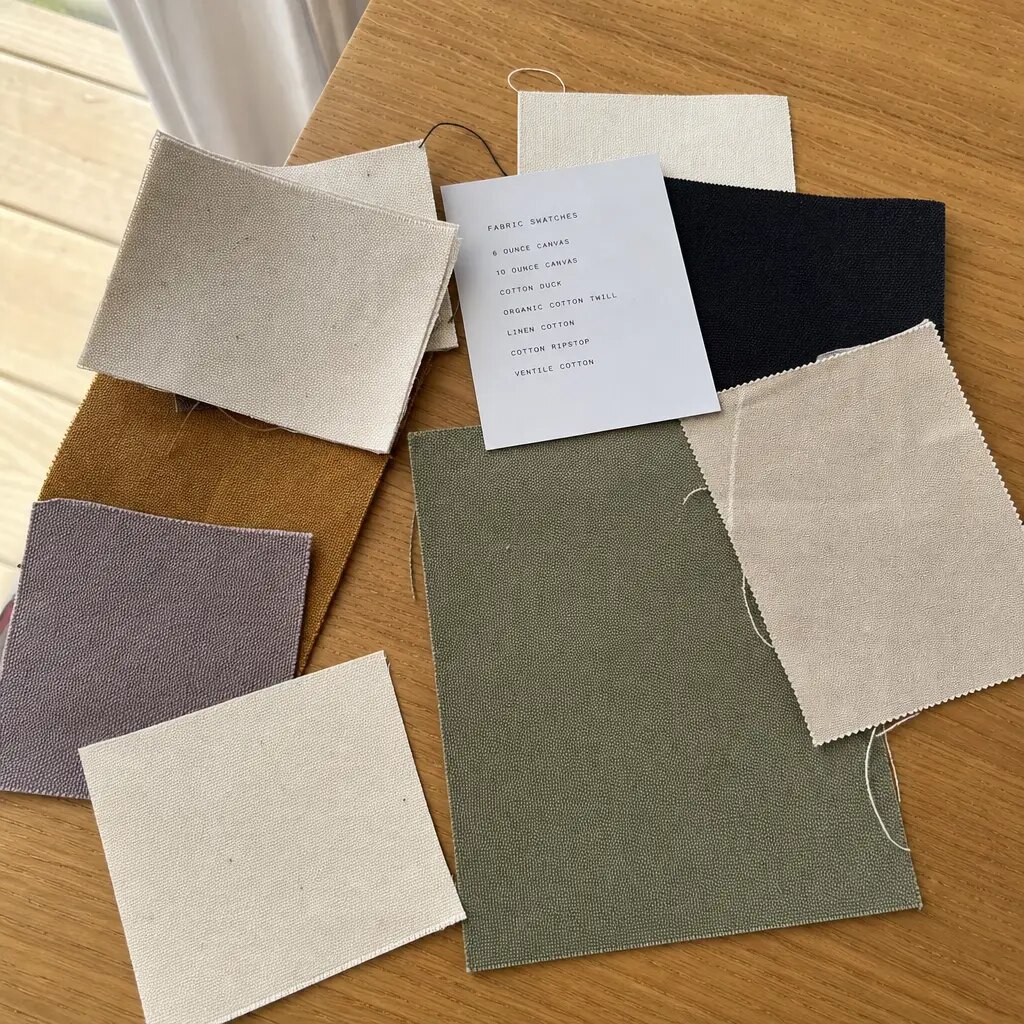
For custom canvas messenger bags used at craft fairs, 12oz canvas is often the most practical starting point. In real factory terms, that generally lands around 380 to 420 GSM depending on weave density and finishing. It gives the body enough structure to hold shape on a retail table, supports printing well, and still ships without turning the carton into a freight penalty. The canvas surface is also forgiving enough for screen printing, which matters when the bag flap carries the main brand mark.
Lighter canvas, usually around 8oz to 10oz, can reduce unit cost and may help if the bag is being treated as a lower-price giveaway. But the tradeoff is that the bag can collapse, wrinkle, and feel less substantial once it is on a customer’s shoulder. That can weaken the perceived value at a craft fair where the buyer is often comparing it to handmade goods and higher-touch retail presentation. If a factory uses “canvas” as a broad term without specifying weight, procurement teams should push for a written oz and GSM target before moving forward.
Heavier 14oz to 16oz canvas creates a more premium hand feel and a stronger bag body, but it also increases material cost, sewing resistance, and carton weight. A thicker bag can be attractive for premium branding, but it is not automatically the best choice for lower MOQ negotiation. If the pattern has several layers at the flap, gusset, and strap anchors, heavier fabric can slow output and make the factory more reluctant to accept a smaller batch. Buyers should ask whether the factory can build the same look in a standard 12oz body before choosing a heavier spec that raises the risk profile.
- 8oz to 10oz canvas: lower cost, easier giveaway positioning, weaker structure, more visible wrinkling.
- 12oz canvas: common balance for fair retail and sponsor merchandise, good print surface, manageable freight.
- 14oz to 16oz canvas: premium feel, stronger body, higher fabric cost, heavier cartons, more sewing attention needed.
- RFQ wording: state both oz and GSM target, then request the factory's available stock fabric details.
- Ask whether the quoted canvas is washed, dyed, enzyme treated, or raw natural, because finish changes the hand feel and color consistency.
How factories calculate MOQ on this product
MOQ is not a single fixed number. For custom canvas messenger bags, the minimum may be driven by fabric roll usage, cutting efficiency, print setup, trim sourcing, sewing line scheduling, or even the packing materials required to complete the order. A factory that already makes similar messenger bags may be willing to quote a lower MOQ because the pattern and sewing workflow are familiar. A factory faced with a new flap shape, unusual gusset depth, special lining, or custom color matching will often raise MOQ because the order becomes a development job instead of a repeat job.
That is why buyers should ask what exactly is causing the MOQ. Is it the fabric purchase minimum? Is it the print setup? Is it the special strap hardware? Is it the packaging requirement? If the buyer knows the real bottleneck, the negotiation can focus there. For example, if the factory’s issue is only the print screen setup, the buyer may be able to keep the same body and lower risk by restricting the artwork to one location and one or two colors. If the issue is fabric sourcing, the solution may be to use stock canvas instead of custom dyed material.
A good low-MOQ strategy is to preserve the bag body and customize the visible branding. That means using one size, one strap style, one closure type, and one pocket layout, while allowing different logo versions or sponsor names within a controlled print plan. It is also important to define whether MOQ applies per bag style, per color, or per artwork. Without that clarification, a seemingly small order can become several separate mini-orders in the factory system, each with its own minimum.
- Fabric MOQ: minimum yardage or roll quantity needed to cut the order.
- Print MOQ: setup time, screen cost, ink mixing, and curing line preparation.
- Trim MOQ: strap webbing, snaps, buckles, zipper, labels, and packaging purchases.
- Line MOQ: minimum quantity worth arranging cutting, sewing, finishing, and packing workflow.
- Admin MOQ: proofing, carton marks, inspection documents, and export handling for many small SKUs.
- Ask the factory to break down MOQ by component instead of quoting only one headline number.
Cost drivers to separate before comparing quotes
Two quotes for the same-looking bag can hide very different assumptions. One might include a heavier canvas, reinforced strap ends, one woven label, one screen print, individual polybag packing, and export cartons. Another might include a lighter fabric, no reinforcement callout, bulk packing, and no setup charge detail. The unit price on the second quote may look better, but if the factory silently expects a lower spec, the buyer may end up approving a weaker bag or facing unexpected extras later. Procurement buyers need quote transparency at component level, not just a low number on the last line.
Ask the supplier to separate the cost elements. The base bag price should reflect the final approved size and construction. Printing should show the method, setup charge, and how many colors are included. Sampling should show whether the sample charge is refundable against the order. Packing should identify whether each bag is individually protected, labeled, or bulk packed. Freight terms should be specified clearly, because EXW, FOB, CIF, and DDP quotes are not directly comparable without adjustment.
This level of separation also improves MOQ negotiation. If the factory tells you that a custom woven label is what pushes the minimum too high, you can ask whether a printed label or side seam label is a workable substitution. If the carton mark requirement is the issue, you can simplify packing codes. The buyer’s goal is not to strip away value, but to identify which custom detail creates real production cost and which detail is just habit or preference.
- Unit bag price: based on final approved size, fabric, construction, and order quantity.
- Print setup: screen charge, transfer setup, embroidery tape, or label tooling where applicable.
- Sample charge: prototype, pre-production sample, courier, and whether refundable after bulk order.
- Packing cost: individual polybag, paper band, hangtag, barcode sticker, inner carton, master carton.
- Freight basis: EXW, FOB, CIF, DDP, or buyer-nominated forwarder terms.
- Quote validity: important for cotton fabric and freight markets, especially before event seasons.
- Ask for a side-by-side quote sheet with the same specification repeated across suppliers.
Print method decisions for low to mid quantity orders
Screen printing is usually the best fit for a craft fair messenger bag when the artwork is a solid logo, event name, sponsor mark, or simple icon. It gives a natural fabric look and usually the best unit economics once setup is spread across the order. On canvas, though, texture matters. Very fine text, tight lines, or tiny reverse elements can fill in or lose clarity, especially if the bag flap bends in use. Buyers should simplify the artwork for the substrate instead of assuming a digital file will reproduce perfectly on woven cotton.
Heat transfer can be a useful option for full-color graphics, gradient artwork, or more detailed illustrations. It is especially relevant when the buyer wants a more photo-like design on a smaller batch. The tradeoff is hand feel and long-term wear on a flap that bends, folds, and rubs against the bag body. A large transfer can feel more like a film application than a textile print. For a craft fair brand that wants a handmade or artisanal look, that may not be the right visual language.
Embroidery can look premium, but it needs careful consideration on a messenger bag flap. Large stitching areas can pull the fabric, create bulk, or distort small lettering. It may also increase cost and setup time relative to the low-to-mid order quantity that many craft fair buyers need. Woven labels, side seam labels, or a small patch can be more stable and easier to scale when the buyer is balancing MOQ against presentation quality. The key point is to approve the decoration method based on sample performance, not only on mockup appearance.
- Screen print: best for solid logos, event names, simple icons, and medium MOQ.
- Heat transfer: useful for full color art, but test hand feel and edge durability.
- Embroidery: good for small premium marks, not ideal for large dense flap artwork.
- Woven label: stable branding method when several bag body colors or artwork versions are involved.
- Acceptance criterion: approve a physical print strike-off or pre-production sample before bulk printing.
- Ask whether the print is water-based, plastisol, or another system so you can compare feel, opacity, and curing behavior.
Sample approval should prove production, not just appearance
The sample stage is where a lot of avoidable problems are either caught early or allowed to become expensive. A photo can show layout, but it cannot prove the hand feel of the fabric, the stitch density at the strap anchor, the alignment of the flap, the placement accuracy of the logo, or how the bag looks when packed into cartons. A blank fit sample can prove the size, but not the decoration or curing performance. A print strike-off can prove the artwork, but not the overall construction. The safest approval route is a pre-production sample that uses the final fabric weight, final print method, final closure, final strap width, and final packing direction.
That sample should be treated as the production reference. Buyers should document the approved version with the PO number, approval date, fabric weight, strap width, print color references, and any agreed deviations. This is particularly important for custom canvas messenger bags intended for craft fairs, because small visual differences matter. The difference between a clean retail-ready bag and a merely acceptable sample can be visible in flap alignment, thread trimming, print centering, or how the strap sits against the body.
Before approving, buyers should test the sample like a real customer would. Load it with notebooks, a tablet, brochures, or the type of products the fair audience will carry. Check whether the flap sits flat, whether the closure aligns naturally, and whether the print shows stress after folding. Also inspect the sample under good light for stains, oil marks, and label placement. If the sample is going to anchor the bulk order, it needs to validate both appearance and production reality.
- Measure body size, gusset, flap length, strap width, and strap adjustment range.
- Bend the printed flap several times after curing to see whether ink cracks or flakes.
- Load the bag with realistic contents and inspect strap anchor stress points.
- Review closure alignment with the bag empty and lightly filled.
- Photograph approved details: print location, label position, stitching, hardware, packing fold.
- Approve one master sample and write down any permitted tolerance on the spec sheet.
Packing choices that protect margin and presentation
Packing is a quality decision, not just a shipping decision. Natural canvas shows stains, moisture marks, and dust more easily than many synthetic bags, so the packing method affects what the buyer receives and what the end customer sees after opening. Individual polybags are the safest and most common option for export because they protect against humidity, carton dust, and handling marks. For retail buyers who want less plastic, paper belly bands or tissue wrap can work, but only if the cartons are tightly controlled and the warehouse environment is clean.
Messenger bags are bulkier to pack than flat totes because the flap, strap, and closure create thickness. If cartons are overcompressed, the bag can develop sharp fold lines, the print can pick up pressure marks, and hardware can create imprints. If cartons are too loose, the bags shift and corners crush. Good packing design balances protection with freight efficiency. For procurement, that means asking the factory to quote carton quantity, carton dimensions, gross weight, and estimated CBM before the order is confirmed.
The buyer should also decide whether the bags need hangtags, barcode stickers, size stickers, or event-specific carton marks. Those details seem minor, but they affect packing labor and lead time. If the bags are distributed to multiple craft fair vendors or regional event booths, carton marks and artwork codes need to be clear. Otherwise, the receiving team may spend time sorting inventory manually, which adds hidden cost after the goods arrive.
- Bulk packing: lowest cost, higher risk of staining and mixed artwork confusion.
- Individual polybag: better export protection, easier counting, more plastic use.
- Paper belly band: retail-friendly presentation, needs tighter carton control.
- Hangtag or barcode: useful for distributors and retail buyers, but must be included in lead time.
- Carton marks: include PO, SKU, artwork code, quantity, destination, and carton number.
- Ask for packed bag photos or a packing sample to confirm fold direction and presentation.
Lead time risks when the event date cannot move
Craft fair orders are often tied to a fixed event date, and that makes lead time more dangerous than unit price. A bag that arrives a week late may miss the fair, miss the retail moment, or miss a sponsor deadline. Lead time should be counted from final sample approval and deposit, not from the first inquiry. If the artwork is still being revised, the Pantone is not approved, or the packing format is undecided, the production clock has not really started.
The lead time risk increases when MOQ is pushed lower while customization stays high. Small custom batches are often easier to schedule if the specification is simple, but they become slower when the factory must manage many SKUs, custom labels, or multiple artwork codes. A buyer should ask the factory which step is most likely to delay completion: fabric purchase, print proofing, sample correction, sewing capacity, inspection, or booking export space. The answer helps identify where to build time buffer.
For procurement teams, the safest schedule includes more than the nominal production time. Budget for artwork proofing, material preparation, sample making, sample transit, buyer review, any needed correction, bulk production, final inspection, packing, export booking, and domestic or international delivery. It is better to land the bags early and hold them than to chase a lower MOQ and lose the event window entirely.
- Typical schedule components: artwork proofing, material preparation, sample making, sample transit, buyer approval, bulk production, QC, packing, export.
- Common delay causes: late Pantone approval, unclear logo placement, unavailable strap color, new closure change, barcode file errors.
- Risk control: approve one master bag body first, then control logo versions through clear artwork codes.
- Event buffer: do not plan arrival on the week the craft fair opens; allow time for repacking, labeling, or redistribution.
- Ask the factory for a milestone schedule rather than a single broad lead-time estimate.
Negotiation moves that lower MOQ without weakening the bag
The best MOQ negotiations give the factory a simpler production path, not a riskier one. Start by keeping the bag body standard: one size, one fabric weight, one strap width, one closure type, and one pocket layout. Then customize the branding in the most controllable way possible. For many craft fair buyers, that means stock natural or dyed canvas, one print location, and an existing trim set. If the factory sees that the order can run like a controlled repeat style, it becomes much easier to quote a lower quantity.
Another effective move is to reduce the number of variables that trigger setup losses. For example, using two logo versions on one body style is often more manageable than asking for three body colors, two strap colors, and multiple pocket layouts. If the order must serve several sponsors or vendors, keep the differences in artwork only and preserve the same bag construction. The quote should clearly state whether each artwork is treated as a separate setup or as part of one combined batch.
Buyers can also negotiate on non-critical details. If the goal is a craft fair retail bag, do you really need custom dyed fabric, or is stock canvas acceptable? Do you need a custom metal buckle, or would a standard snap or simple hook-and-loop closure work? Is a woven side label enough, or is full embroidery essential? Replacing a custom structural change with a visible branding change is often the most effective way to lower MOQ while keeping the bag attractive enough for resale.
- Keep one body size and one construction across all versions.
- Use the same print location and similar print size for multiple logos.
- Choose stock fabric and strap colors instead of custom dyeing.
- Replace custom hardware with standard snaps, sliders, or buckles.
- Reduce pocket complexity before reducing fabric quality.
- Accept standard export packing if retail packing is not needed at the fair booth.
- Ask the factory which item in your spec creates the biggest MOQ jump, then negotiate there first.
Specification comparison for buyers
| Spec decision | Recommended option | When it fits | Buyer risk to check |
|---|---|---|---|
| Fabric weight for fair use | 12oz natural or dyed cotton canvas, typically about 380 to 420 GSM | Balanced choice for craft fair retail merchandise, sponsor gifts, maker kits, and booth products that need structure without becoming too heavy to ship | If a supplier calls 10oz or 280 to 320 GSM “equivalent,” the bag may collapse, wrinkle more, and look cheaper after flap printing |
| Low MOQ fabric strategy | Use stock canvas colors for the base bag and negotiate customization through print, label, strap color, or hardware | Best for 300 to 800 pieces when custom dyeing would trigger higher fabric MOQ, lab dips, and longer approval time | Stock dye lots can vary; require a shade reference, roll photo, and written color tolerance before sample cutting |
| Logo method on flap | Screen print for solid one- to three-color artwork; heat transfer only for full-color or gradient art | Screen print gives a clean craft-market look and usually better unit economics once screen setup is spread over the order | Heavy ink on a fold line can crack; keep artwork away from sharp crease points and ask for a bend test |
| Bag construction level | Single main compartment with inner slip pocket, cotton webbing strap, and reinforced flap corners | Works for fair shoppers carrying brochures, small products, tablets, or maker tools without turning the product into a complex laptop bag | Too many pockets, zippers, and metal fittings can turn a low MOQ order into a slower custom development job |
| Closure choice | Magnetic snap or hook-and-loop under the flap, selected based on retail positioning | Magnetic snap looks cleaner for retail; hook-and-loop is cheaper and more secure for giveaway use | Magnets need proper reinforcement and placement; hook-and-loop can catch fibers and may feel less premium |
| MOQ negotiation lever | Combine several logo versions on one common bag body if print color and placement stay controlled | Useful for distributors supplying multiple craft fair vendors, sponsors, or regional events from one production run | Multiple artworks increase proofing risk; define whether each artwork counts as a separate print setup and separate packing code |
| Packing format | One piece in recyclable polybag or paper belly band, then export carton with size and artwork code marked | Polybag protects natural canvas from humidity and carton dust; belly band suits retail buyers reducing plastic | Unprotected natural canvas can pick up stains; paper bands may shift unless carton packing is tight |
| Sample approval route | Pre-production sample in final fabric weight, final print method, final closure, and final strap width | Needed when the order is for resale, sponsor branding, or a fair program where color and presentation matter | A digital mockup or blank fit sample cannot validate print penetration, flap alignment, strap comfort, or carton packing |
Buyer checklist before sampling
- Define the selling or giveaway purpose: retail merchandise, sponsor gift, exhibitor kit, or distributor stock.
- Specify canvas weight in oz and GSM, not only the word canvas.
- Decide whether stock fabric color is acceptable before trying to negotiate below normal MOQ.
- Provide artwork size, Pantone references, print placement, and number of logo versions in the RFQ.
- State whether the bag needs a laptop function, inner pocket, zipper pocket, or only a simple daily-carry layout.
- Set acceptance limits for print position tolerance, shade variation, stitching defects, and carton damage.
- Request the sample to use the same fabric weight, print process, closure, strap, and label as mass production.
- Separate factory price, sample charge, print setup charge, carton packing, and freight terms in the quote comparison.
- Confirm how many pieces per carton, carton dimensions, gross weight, and whether each SKU or artwork gets separate carton marks.
- Build in time for sample correction, not only mass production lead time.
Factory quote questions to send
- What is your normal MOQ for this messenger bag construction, and what part of the MOQ is driven by fabric, cutting, printing, or packing?
- Can the order use your stock 12oz canvas roll, and what colors are currently available for sampling and production?
- If we order 500 pieces split across two logo versions, will you treat it as one bag MOQ or two separate artwork MOQs?
- What print method do you recommend for our artwork size and color count on 12oz canvas, and what setup charges apply?
- What fabric GSM, shrinkage allowance, and color tolerance will be written on the proforma invoice or specification sheet?
- Will the pre-production sample be made with final bulk fabric, final hardware, final print inks, and final packing?
- What is the estimated production lead time after sample approval, and which steps could extend the schedule?
- How many pieces are packed per export carton, and what are the estimated carton size, gross weight, and CBM?
- Can you provide inspection-ready AQL criteria for stitching, print, stains, measurement tolerance, and packing?
- What quote validity period applies if cotton fabric, hardware, or freight costs change before deposit?
Quality-control points to confirm
- Canvas weight checked against approved sample and fabric specification, with no substitution from 12oz to lighter 10oz material without written approval.
- Bag measurements within agreed tolerance, commonly plus or minus 1 cm for body dimensions and plus or minus 2 cm for adjustable strap length.
- Flap print centered within agreed tolerance, commonly plus or minus 3 mm for logo placement on the visible front panel.
- Print surface free from obvious pinholes, smears, ghosting, wrong Pantone direction, poor curing, or cracking after normal flap bending.
- Stress points reinforced at strap anchors, flap corners, pocket openings, and closure positions.
- Stitching neat, locked, and without skipped stitches, broken thread, open seams, or loose thread clusters on the front flap.
- Closure aligned so the flap sits flat when the bag is empty and when lightly filled.
- Natural canvas free from oil marks, dark stains, mildew odor, rust transfer from hardware, and carton dust contamination.
- Carton marks match SKU, artwork code, quantity, purchase order, and destination requirements.
- Packed bags are not over-compressed in cartons, especially when the flap has a fresh print or raised closure hardware.