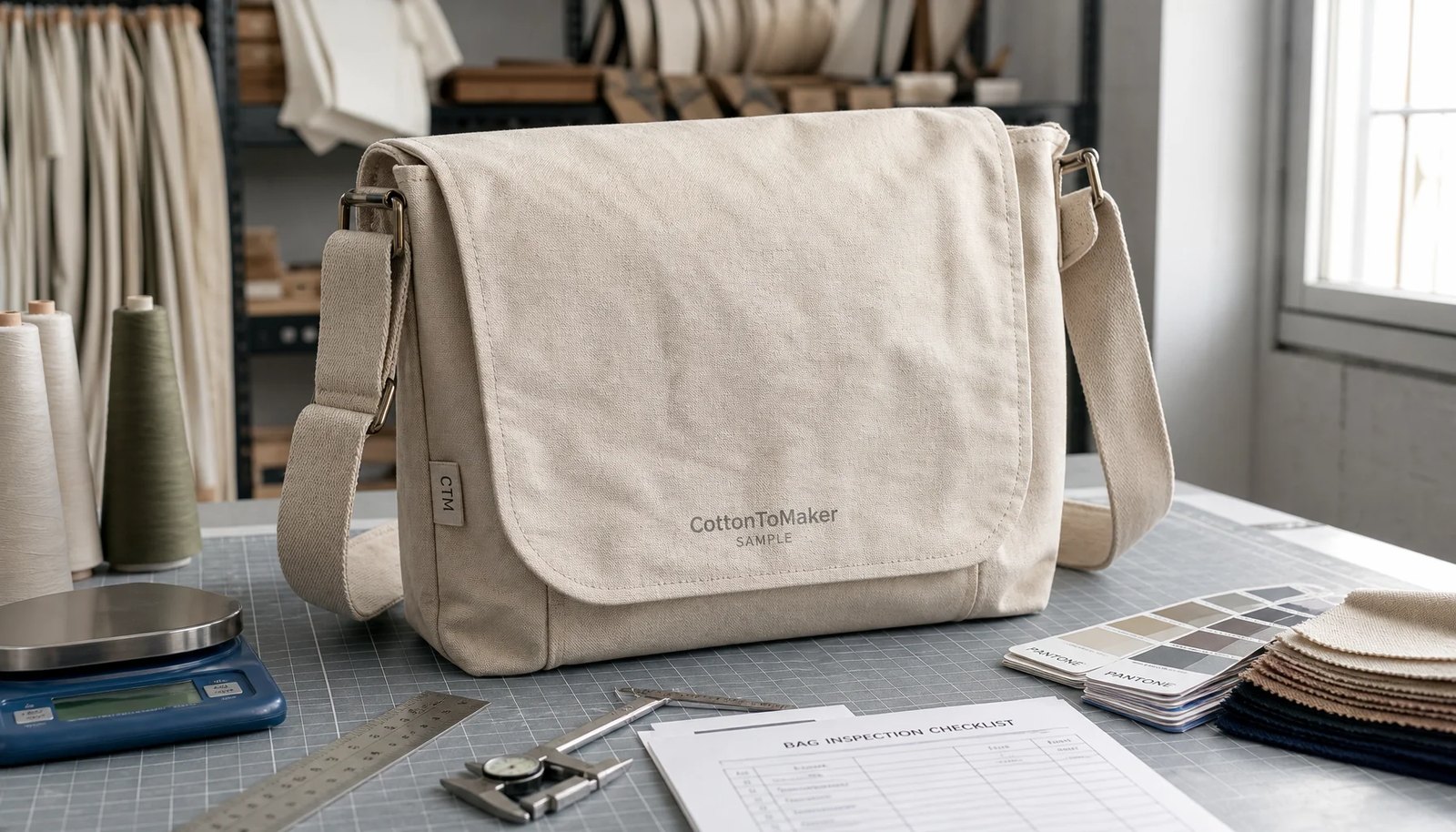
Start With The Show Load, Not The Product Name
A custom canvas messenger bag for trade show exhibitors has a job to do. It may be handed out at registration, issued to booth staff, packed with catalogs before shipment, used by sales teams during meetings, or offered as a reusable sponsor gift. Each use puts different pressure on the material and construction. A brochure bag and a staff tablet bag should not share the same specification just because both are called messenger bags.
Begin the RFQ with the expected contents and the handling environment. A bag carrying a notebook, badge, and flyer can use a lighter build. A bag carrying a tablet, charger, product samples, water bottle, and printed literature needs more structure: stronger canvas, wider webbing, reinforced attachment points, and a gusset that holds its shape when loaded. This is where procurement can prevent most quality problems before the first sample is made.
A picture-only quote creates avoidable confusion. One supplier may price 10 oz canvas with no lining, a narrow strap, and hook-and-loop closure. Another may assume 14 oz canvas, lining, a metal slider, and a magnetic snap. Both quotes may look competitive, yet they are not quoting the same bag. A simple load statement turns the conversation from style preference into production control.
- Visitor giveaway: light documents, simple pocketing, 10 oz to 12 oz canvas, and standard webbing may be sufficient.
- Exhibitor staff bag: 12 oz to 16 oz canvas, 38-50 mm strap, lining, internal zipper pocket, and reinforced strap points are usually more appropriate.
- VIP or distributor gift: consider washed or heavier canvas, cleaner lining, woven patch, embroidery, magnetic closure, and tighter packing control.
- Sample carrier: prioritize gusset depth, bottom seam strength, strap comfort, and carton efficiency over decorative extras.
- Write the expected load in kilograms or in contents, such as tablet plus charger plus two catalogs, so the factory can recommend construction instead of guessing.
Specify Canvas By Finished GSM, Weight, And Weave
Canvas weight is often discussed in ounces, but ounce weight alone is too loose for a procurement specification. Two fabrics described as 12 oz canvas can feel different because yarn count, weave density, finishing, washing, and coating all affect body and hand feel. For B2B buying, request both ounce weight and finished GSM, then approve the actual swatch by touch and measurement.
For trade show messenger bags, the practical main range is usually 12 oz to 16 oz cotton canvas, roughly 400-540 GSM depending on the mill and finish. This gives the flap enough body without making the bag bulky in cartons. A lighter 10 oz canvas can work for mass document programs, but it may collapse on a booth table and can make a premium brand feel underbuilt. An 18 oz canvas can look substantial, yet it also increases sewing difficulty, freight volume, needle marks, and cost.
Ask when the fabric weight is measured. Greige fabric weight, dyed fabric weight, washed fabric weight, and finished fabric weight are not always the same. If the bag uses washed canvas, approve the material after the same finishing process that will be used in production. A pre-wash swatch may look good and still behave differently after cutting, washing, pressing, and packing.
- 8 oz to 10 oz canvas: reserve for low-cost document carriers or simple tote-like builds, not structured messenger bags.
- 12 oz canvas: common starting point for event messenger bags carrying moderate contents.
- 14 oz to 16 oz canvas: stronger choice for staff bags, VIP gifts, and reusable merchandise programs.
- 18 oz and above: possible for heritage styling, but ask about seam bulk, needle marks, carton volume, and lead time.
- Request fabric width, finished GSM, ounce weight, weave description, color method, and stock status before comparing unit prices.
Choose Natural, Dyed, Or Washed Canvas With Eyes Open
Natural cotton canvas is popular because it looks approachable, feels material-led, and gives a clean background for one-color logos. It is often faster to sample than custom dyed fabric. The tradeoff is shade variation. Natural canvas can range from off-white to cream or beige depending on cotton lot and finishing, so buyers should approve a physical shade range instead of relying on a screen image.
Stock dyed canvas, such as black, navy, charcoal, olive, or khaki, gives stronger color direction without the MOQ and timing of custom dyeing. It is a practical route when the bag needs to coordinate with staff uniforms, booth colors, or a campaign palette. Custom dyed canvas can move closer to a brand color, but it usually adds lab dips, fabric MOQ, bulk shade approval, and extra calendar time.
Washed canvas changes the entire mood of the bag. It feels softer and more retail, but it can also introduce more variation in shade, shrinkage, wrinkles, and edge softness. That does not make it a bad choice. It does mean the approval process must be stricter. For a fixed event date, washed canvas should be sampled early and approved as a finished bag, not as a loose fabric idea.
- Use natural canvas for fast sampling, visible cotton character, and bold screen-printed logos.
- Use stock dyed canvas when color consistency matters but custom dye MOQ is not practical.
- Use custom dyed canvas only when quantity, budget, and timeline allow lab dip and bulk shade approval.
- Use washed canvas for a softer retail feel, while confirming shrinkage, shade range, hand feel, and packed appearance.
- Ask whether color approval will be based on lab dip, fabric swatch, pre-production sample, or bulk cutting lot.
Build The Interior Around Real Contents
The lining decision affects both cost and the way the bag feels in use. An unlined canvas messenger bag can be acceptable for economy programs, but the inside will show seam allowances, fabric fibers, and construction details. A lined bag looks cleaner, supports pockets, and protects contents better. It also adds more operations, which means more points to inspect.
For many exhibitor programs, 210D polyester lining is a practical middle ground: light, stable, and economical. A lighter 150D lining may be enough for simple pocketing. Cotton twill lining supports a more natural material story, but it can wrinkle and stain more easily. If a tablet sleeve is required, specify device size, opening direction, padding thickness, and whether the sleeve needs a closure. Avoid broad claims such as laptop bag unless the internal dimensions are written down.
Pocket layout should be quoted, not improvised after price approval. A front slip pocket, internal zipper pocket, pen loop, tablet sleeve, and key loop all change labor time and inspection scope. If the supplier priced a plain interior and the buyer later adds storage details, cost and lead time can move. A simple pocket map prevents that awkward middle-stage surprise.
- Document pocket: specify whether it must fit A4, US letter, catalogs, or folded brochures.
- Tablet sleeve: define maximum device dimensions, padding thickness, and closure type.
- Internal zipper pocket: useful for staff keys, badges, cards, and chargers, but zipper movement and stitching must be checked.
- Pen loops and small slip pockets: valuable for staff bags, less important for mass visitor giveaways.
- Unlined construction: approve interior seam finish, binding, and raw edge appearance before bulk production.
- Ask for a pocket map with dimensions and placement measurements as part of the quote package.
Control Reinforcement Instead Of Asking For Strong Stitching
Strong stitching sounds clear, but it is not a specification. Messenger bags usually fail at predictable points: strap attachments, flap corners, closure points, pocket openings, bottom corners, and side seams near the gusset. Heavier canvas does not solve weak construction. A 16 oz body with poorly attached straps can fail faster than a 12 oz body with backing patches and well-placed bar tacks.
Name the reinforcement method in the RFQ. Common options include bar tacks, box stitching, X-box stitching, binding, hidden backing patches, double-layer fabric panels, and rivets with washers. For a trade show bag expected to carry several kilograms of contents, strap ends should be sewn through reinforced layers, not only caught into a thin seam allowance.
Closures need the same attention. Magnetic snaps can pull through canvas if installed without backing patches, especially when users open the flap repeatedly. Buckles and rivets may look sturdy but can create point stress if poorly placed. Hook-and-loop is simple and economical, yet it should be stitched around the perimeter and aligned so the flap closes straight when the bag is full.
- Strap ends: specify bar tack, box stitch, or X-box stitch with reinforcement patch where needed.
- Magnetic snap: require backing reinforcement on both male and female parts.
- Bottom seam: add double stitching, binding, or reinforcement if product samples or catalogs will be carried.
- Pocket openings: use backstitching or bar tacks at stress points.
- Flap corners: inspect symmetry and edge flatness because the flap is the main branding surface.
- Rivets: confirm whether they are structural or decorative, and check for washers or backing where required.
Match Decoration To Canvas Texture And Event Visibility
Logo method should be chosen after the fabric is selected. Smooth unwashed canvas can support clean screen printing. Coarse or washed canvas may break fine lines and soften edges. A mark that looks sharp in vector artwork can lose clarity when printed across thick yarns, seams, or uneven texture. At a trade show, the bag is carried under bright lighting, photographed, stacked on counters, and seen at different distances. Legibility matters.
Screen printing is usually the most reliable option for bold one- or two-color logos on cotton canvas. It is cost-effective at volume and gives a clean brand surface when artwork is simplified. Heat transfer can handle more colors and detail, but adhesion must be tested on the exact canvas finish. Embroidery can feel premium, although it adds backing, stitch density, thread matching, and puckering concerns. Woven patches work well when the same brand mark will be used across multiple bag styles or fabric colors.
Do not approve decoration from a digital mockup only. Request a strike-off or decorated pre-production sample on the final fabric, especially when the artwork includes small text, thin lines, reversed-out areas, gradients, or tight registration. A slightly simplified logo often performs better than a detailed logo that becomes unreadable on a textured flap.
- Screen print: best for bold logos, solid colors, and simple event branding.
- Heat transfer: useful for fine detail or many colors, but test edge adhesion, cracking, and hand feel.
- Embroidery: premium, durable, and textured, but simplify small text and dense fills.
- Woven patch: consistent across bag colors and useful for repeat procurement programs.
- PU or leather patch: attractive for premium gifts, but check colorfastness, restricted substances, and attachment strength.
- Define logo size, placement tolerance, Pantone targets, minimum line thickness, and acceptable registration before bulk production.
Read MOQ And Cost Drivers Before Negotiating
MOQ is rarely just one number. It is tied to material availability, dyeing minimums, hardware sourcing, decoration setup, cutting efficiency, and production scheduling. A natural canvas bag with stock webbing, standard hardware, and one-color screen print can usually be quoted at a lower MOQ than a custom dyed, washed, lined bag with branded hardware and multiple pockets.
Separate the base bag MOQ from the MOQ of each custom component. The canvas may be available in stock while custom webbing color, printed lining, logo metal plates, special buckles, woven patches, or private labels each carry separate minimums. Without that breakdown, buyers may push for a lower order quantity without knowing which element is creating the constraint.
The best negotiation is often specification-based. If quantity is fixed, ask which features can be standardized without damaging the result. Stock canvas plus a well-positioned woven label may look more controlled than custom dyed canvas rushed through shade approval. A clean 12 oz or 14 oz build with reinforced strap points may outperform a heavier bag that was specified vaguely.
- Lower MOQ path: stock natural or stock dyed canvas, standard webbing, standard hardware, one-color screen print, simple pocketing.
- Mid MOQ path: lining, internal pockets, woven label, two-color print, embroidery, or stock washed canvas.
- Higher MOQ path: custom dyed canvas, custom lining print, branded metal hardware, private mold buckle, custom jacquard webbing.
- Ask for one-time setup charges separately from recurring unit price.
- Check whether splitting the order into several colorways changes fabric control, MOQ, or inspection complexity.
- When comparing quotes, confirm whether sample fee, setup fee, courier cost, packing upgrade, and inspection support are included.
Make The Pre-Production Sample The Production Standard
A photo approval is not enough for custom canvas messenger bags. The buyer needs to feel the fabric, test the strap, open and close the flap, inspect the interior, place real contents inside, and check how the logo behaves when the bag is filled. If the first prototype uses substitute fabric, treat it as construction direction only. Do not let it become approval for material, shade, or hand feel.
The pre-production sample should include final fabric, final lining, final webbing, final hardware, final closure, final decoration, final pocket layout, and final packing fold. If any component remains pending, list it clearly in the approval comments. This keeps the buyer and factory from assuming different things were approved.
Record measurements at sample approval. Measure width, height, gusset, flap drop, strap range, pocket size, and logo placement from stable reference points. Photos are useful for context, but measurement records are better for inspection. Keep one approved sample with the buyer and one with the factory so both sides have the same physical reference during bulk production.
- Load the sample with expected contents and inspect strap points, bottom seams, flap closure, and bag balance.
- Check whether the flap sits flat when the bag is empty and closes correctly when the bag is full.
- Rub the logo with a dry cloth and slightly damp cloth to screen for curing or adhesion issues.
- Measure all main dimensions and record tolerances before issuing the purchase order.
- Approve packed appearance, especially if the logo sits on the flap and may crease during carton packing.
- Keep approval comments factual: change strap to 50 mm, move logo 2 cm upward, reduce flap drop by 1 cm, or add reinforcement behind snap.
Write QC Standards Before Production Starts
Quality control should be agreed before cutting, not after defects appear. For canvas messenger bags, critical issues usually involve unsafe hardware, unusable closures, severe seam failure, incorrect logo, wrong material, or major contamination. Major defects include dimensions outside tolerance, broken stitches, poor print adhesion, visible stains, crooked flap, damaged hardware, and incorrect pocket construction. Minor defects might include small loose threads or slight cosmetic variation within the approved range.
Many buyers use AQL inspection for bulk orders, with inspection level and AQL values agreed before production. The exact plan depends on order size and buyer risk tolerance, but the important point is to define defect categories, sample size, measurement method, and acceptance criteria in advance. For event orders with fixed delivery dates, leave time for rework. A failed inspection one day before shipment is not just a quality problem; it is a schedule problem.
Load testing should be realistic. If the bag will carry 3 kg of event materials, test around that load and inspect the same areas users will stress: strap attachment, side seams, bottom seam, flap closure, and internal pockets. If the bag is intended for tablet carry, place a tablet-size object inside and confirm that the sleeve protects it without distorting the bag.
- Measurement checks: body size, gusset, flap drop, strap length, pocket placement, and logo position.
- Workmanship checks: skipped stitches, loose thread, broken thread, uneven tension, raw edges, puckering, and crooked binding.
- Material checks: shade, GSM confirmation if required, stains, odor, weaving defects, lint, and hand feel against approved sample.
- Decoration checks: color, registration, adhesion, cracking, pinholes, embroidery puckering, patch edge security, and placement.
- Function checks: closure alignment, strap adjustment, pocket usability, zipper movement, and loaded hang balance.
- Packing checks: fold line, logo protection, carton quantity, carton marks, gross weight, and carton strength.
Plan Packing And Delivery Backward From The Booth
A well-made canvas bag can still disappoint if it arrives with a hard crease through the logo, abrasion from hardware, or cartons that event staff cannot count quickly. Trade show teams often unpack at a warehouse, hotel, advance warehouse, or venue dock while working against a deadline. Packing should protect the visible flap, keep straps controlled, prevent metal parts from rubbing, and maintain consistent carton quantities.
Flat packing is usually efficient for messenger bags, but the fold line must be approved. Avoid folding through embroidery, patches, buckles, magnetic snaps, or large printed logos. If the bag has metal hardware or a printed flap, use tissue or a separator where surfaces rub. Individual polybags may be required by distributors or retailers, but they increase labor, plastic use, carton volume, and unpacking time.
Delivery planning should start with the required arrival date, not the opening day of the show. Advance warehouses may have receiving windows, carton label formats, appointment requirements, and fees for late or incorrect shipments. Ask for carton dimensions and gross weight early so freight estimates are based on real packed volume rather than optimistic assumptions.
- Approve a packing sample or packing photo before shipment.
- Use consistent pieces per carton so event teams can count quickly.
- Mark cartons with item code, color, quantity, gross weight, carton size, purchase order, and event reference if needed.
- Confirm whether cartons need palletizing, corner protection, or venue-specific labels.
- Protect logo surfaces from strap sliders, buckles, snaps, and carton abrasion.
- Reserve time for final inspection and rework before the shipping cutoff.
Specification comparison for buyers
| Spec decision | Recommended option | When it fits | Buyer risk to check |
|---|---|---|---|
| Main canvas weight | 12 oz to 16 oz cotton canvas, often about 400-540 GSM after finishing depending on yarn count, weave density, and mill standard | Most exhibitor messenger bags carrying brochures, tablets, chargers, light samples, staff documents, and giveaways | Do not compare ounce weight alone. Ask for finished GSM, weave description, fabric width, dye or wash state, and a swatch from the mill planned for bulk. |
| Economy fabric option | 10 oz to 12 oz canvas, approximately 340-400 GSM depending on construction and finishing | Document-focused visitor bags, registration kits, and large-volume giveaways where the expected load is light | A lighter body fabric can still work, but only if strap points, pocket openings, and side seams are reinforced correctly. |
| Premium fabric option | 14 oz to 18 oz canvas, approximately 470-610 GSM depending on finishing | Staff bags, distributor gifts, VIP programs, retail-style merchandise, or any program where reuse after the show matters | Heavy canvas adds sewing bulk, needle marks, carton volume, and freight weight. Request packed carton dimensions before approval. |
| Canvas finish | Unwashed canvas for cleaner dimensions and sharper print; enzyme or garment-washed canvas for softer hand feel | Unwashed canvas suits corporate logo clarity. Washed canvas fits casual, retail, or lifestyle positioning. | Washed canvas can shrink, wrinkle, soften, and shift shade. Approve the finish on a decorated pre-production sample, not only a lab dip. |
| Lining choice | 210D polyester for practical lining; 150D for lighter interiors; cotton twill for a natural-material story; unlined only for basic builds | Use lining when the bag includes internal pockets, a tablet sleeve, zipper storage, or a cleaner interior requirement | Unlined bags expose seam allowances and loose fibers. Lined bags need placement tolerances, seam allowance control, lining shade approval, and zipper checks. |
| Strap and webbing | 38-50 mm cotton or polyester webbing with adjustable slider and reinforced strap attachment | Full-day trade show use where attendees or staff carry catalogs, chargers, samples, bottles, and tablets | Thin 25-30 mm straps may reduce cost but can feel uncomfortable. Match slider inside width to webbing width and thickness. |
| Hardware and closure | Magnetic snap for clean corporate look; hook-and-loop for economy; metal buckle or side-release buckle for utility styling | Choose based on brand tone, speed of access, noise level, and expected reuse after the event | Magnetic snaps need backing patches. Hook-and-loop collects lint. Buckles add labor and can scratch fabric or decoration during packing. |
| Decoration method | Screen print for solid logos; embroidery for simplified premium marks; woven patch for repeat programs; heat transfer for high-color detail | Select after confirming fabric texture, logo size, color count, order quantity, and viewing distance at the booth | Canvas texture can break fine lines. Embroidery can pucker. Transfers need adhesion testing on the final fabric and finish. |
| Dimension tolerance | Main body +/- 1 cm, gusset +/- 0.5 cm, flap drop +/- 0.7 cm, pocket placement +/- 0.5 cm, strap length +/- 1.5 cm unless tighter tolerances are agreed | Practical for sewn canvas bags where fabric tension, cutting stack height, and finishing can affect measurements | Write tolerances into the purchase order and inspection plan. Photo approval alone will not control finished size. |
Buyer checklist before sampling
- Define the actual day-of-show load: brochure-only, tablet plus documents, staff kit, sample kit, or laptop-level carry. Use this to set canvas weight, gusset depth, strap width, and reinforcement.
- Specify the main fabric by finished GSM and ounce weight, weave type, fiber content, color, dye method, and whether the canvas is unwashed, washed, enzyme-washed, coated, or natural greige.
- State finished dimensions with tolerances: width, height, gusset, flap drop, handle or strap length range, strap width, pocket dimensions, and logo placement from fixed reference points.
- Confirm whether the quote includes lining, internal pocket map, zipper pocket, tablet sleeve padding, binding, closure reinforcement, bottom reinforcement, and any branded label.
- Send vector artwork with Pantone references, print size, logo placement, color count, minimum line thickness, and whether the logo must remain readable when the flap is curved or slightly wrinkled.
- Ask for a decorated pre-production sample using production fabric, final lining, final strap, final hardware, final closure, and the final decoration method. If substitutes are used, record which approvals are limited.
- Set measurable QC criteria for dimensions, seam strength, strap attachment, skipped stitches, loose threads, shade variation, odor, stains, print adhesion, print registration, hardware finish, and carton packing.
- Confirm compliance requirements early, including restricted substances, nickel concerns for metal hardware if relevant, packaging rules, labeling, country-of-origin marking, and any retailer or venue routing instructions.
- Clarify the delivery point: company warehouse, third-party logistics warehouse, hotel, trade show advance warehouse, direct-to-venue dock, local forwarder, or distributor consolidation center.
- Require carton marks, carton dimensions, gross weight, net weight, pieces per carton, pallet requirements if any, and photos of final packed cartons before shipment.
Factory quote questions to send
- What finished GSM, ounce weight, fiber content, weave type, and fabric finish are included in the price? Is the weight measured before or after washing or finishing?
- Is the quoted canvas a stock fabric, mill-dyed fabric, piece-dyed fabric, garment-washed fabric, or custom-dyed fabric? What MOQ and lead time apply to each option?
- What fabric color tolerance will be used for approval, and can you provide a lab dip, fabric strike-off, or bulk swatch before cutting?
- What lining material, lining weight, pocket layout, zipper type, tablet sleeve padding, strap width, webbing material, hardware finish, and closure are included?
- How are the strap attachment points constructed: bar tack, box stitch, X-box stitch, rivet, reinforcement patch, or a combination? Are rivets functional or decorative?
- Which decoration method is quoted, what is the maximum logo area, how many colors are included, and what setup charges apply for screen, embroidery digitizing, patch tooling, or transfer printing?
- What minimum line thickness and minimum text height do you recommend for this canvas texture and decoration method? Can you produce a decorated strike-off on the final fabric?
- What are the sample lead time, sample fee, courier fee, revision cost, and bulk lead time after final sample approval and deposit?
- What inspection standard will be used for critical, major, and minor defects? What AQL level do you recommend for this product and order quantity?
- What measurement tolerances are included for body size, gusset, flap, pocket placement, logo placement, and strap length?
Quality-control points to confirm
- Check finished bag width, height, gusset, flap drop, pocket dimensions, strap width, and strap adjustment range against the approved spec. Practical tolerances are often +/- 1 cm for main body, +/- 0.5 cm for gusset and pocket placement, and +/- 1.5 cm for strap length unless otherwise agreed.
- Inspect strap attachment points for bar tacks, box stitching, or X-box stitching through reinforcement layers. Reject skipped stitches, broken thread, loose tension, fabric tearing, and misaligned strap ends that affect hang balance.
- Perform a realistic load check using the expected event contents. For many exhibitor bags, this means testing with approximately 3-5 kg for a short handling test, then inspecting strap points, bottom seams, flap shape, and closure alignment.
- Compare canvas shade against the approved physical sample under consistent light. Natural canvas, black, navy, olive, and custom dyed colors should be checked carefully because shade differences are easy to notice across cartons.
- Review fabric surface for slubs, weaving defects, stains, oil marks, dye streaks, odor, mildew risk, and excessive lint. Natural cotton variation is acceptable only within the approved sample range.
- Check print position from fixed reference points, not by eye. Typical logo placement tolerance should be defined in advance, often around +/- 0.5 cm to +/- 1 cm depending on method and bag shape.
- Test decoration according to method: dry rub and damp rub for prints, tape pull where suitable for ink adhesion, embroidery backing and thread trimming for stitched logos, and edge security for woven or PU patches.
- Inspect flap edges, corners, bindings, and pocket openings for twisting, puckering, asymmetry, loose threads, and raw edges. The flap is usually the most visible surface at a booth, so cosmetic standards should be clear.
- Check closures after filling the bag. Magnetic snaps should align and be backed with reinforcement patches. Hook-and-loop should be straight and fully stitched. Buckles and sliders should move smoothly without sharp burrs.
- Inspect hardware for rust, plating scratches, burrs, color mismatch, weak rivets, and sharp edges. If metal touches fabric during packing, check for abrasion marks on the flap and logo area.