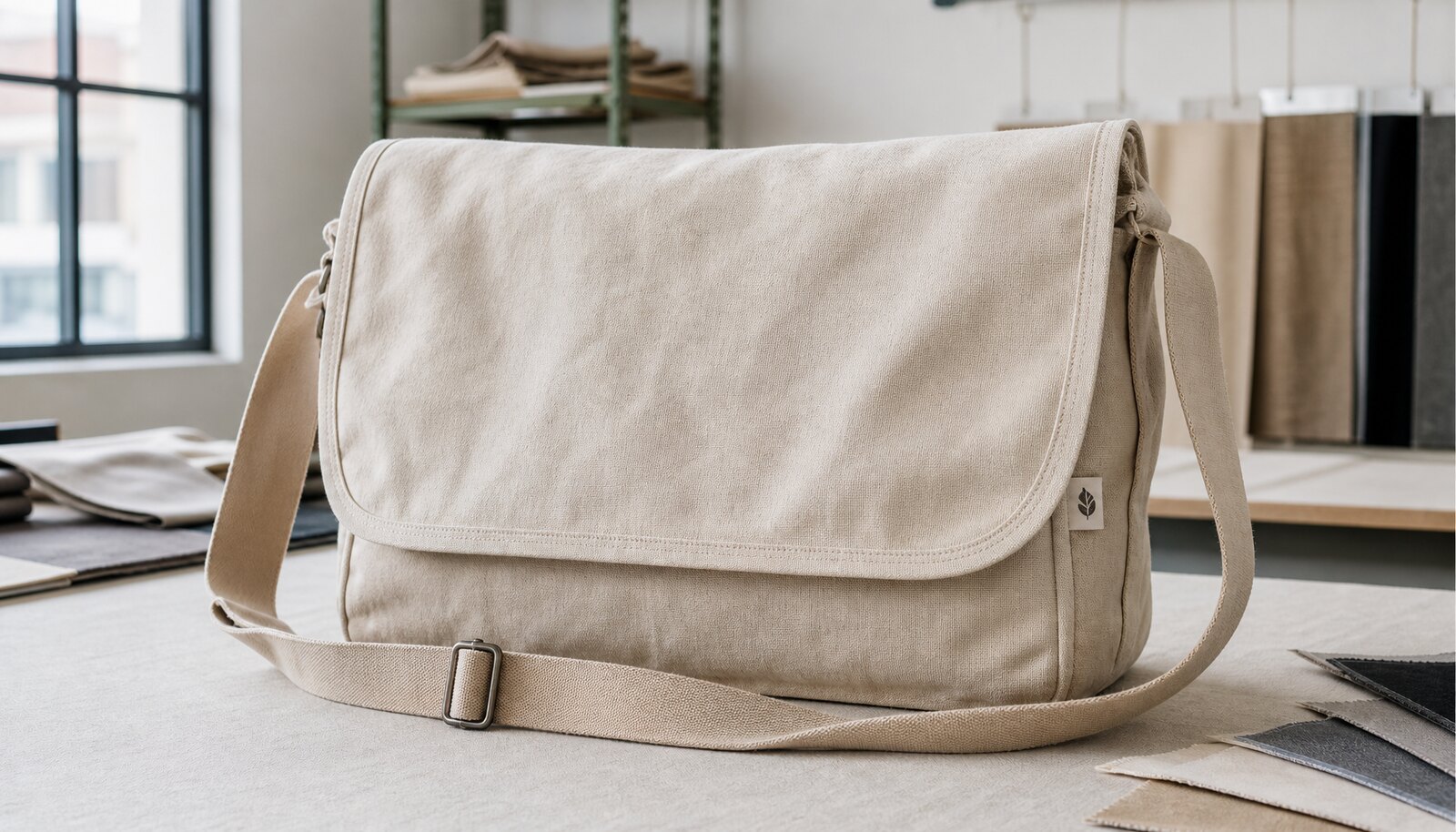
What gift-shop buyers are actually optimizing
A custom canvas messenger bag for a gift shop is not just a bag. It is a shelf item, a carry item, and a margin item at the same time. The wrong fabric choice can make the bag look limp in display, distort the logo, or create handling complaints after only a few uses. The right fabric choice supports the retail price, keeps the decoration clean, and gives the bag enough structure to survive shipping, unpacking, and customer handling.
For procurement teams, the key is to define the bag’s retail role before comparing suppliers. A souvenir-style messenger bag can be lighter, simpler, and more price sensitive. A premium gift item needs cleaner finishing, more consistent canvas, and a decoration method that feels deliberate rather than promotional. Once the use case is clear, the material spec becomes easier to control and easier to quote.
The practical goal is to avoid paying for structure you do not need and, just as importantly, to avoid buying a bargain fabric that creates markdowns later. In this category, material quality affects not only durability but also visual confidence. If the bag does not feel stable in hand, the consumer often assumes the store brand is also low confidence. That is why the most useful buying question is not “what looks nice?” but “what spec will survive retail handling, customer use, and repeat replenishment?”
- Start from shelf presentation, carried load, and target retail price.
- Treat canvas weight, weave, finish, and decoration as one system.
- Do not approve a softer sample if the final bag must carry books, bottles, or heavier souvenirs.
Start with a numeric canvas spec, not a generic fabric name
The word canvas is too broad to be useful on its own. Two suppliers can both quote “canvas” and still produce very different bags because weave density, yarn quality, finishing, and shrink control are not the same. For custom canvas messenger bags material selection, the buyer should ask for the actual fabric construction, not a marketing label. That means weight, weave type, density, finish, and tolerance.
A practical starting point for gift shops is usually 10–12 oz canvas for light souvenir programs, 12–14 oz for general retail messenger use, and 14 oz or higher if the bag must hold heavier contents or present a more structured premium look. Weight alone is not enough, though. A 12 oz loose weave can behave more weakly than an 11 oz tight weave. Ask for finished weight in oz/yd² or g/m² and ask how much the lot is allowed to vary. A realistic buyer tolerance is often ±5% on finished weight unless the program demands tighter control.
Weave density matters because it affects print quality, seam stability, and the visual feel of the bag. A tighter plain weave or duck-style construction usually gives a cleaner surface and reduces seam distortion. If the supplier cannot provide a pick count, warp/weft density, or a meaningful alternative description, the buyer should insist on a side-by-side swatch approval against the reference sample. A supplier who cannot define the fabric precisely is unlikely to control it consistently in bulk.
- Ask for finished weight in oz/yd² or g/m², not just “heavy canvas” or “premium canvas.”
- Request weave density or pick count when comparing suppliers.
- Use a ±5% finished weight tolerance as a practical starting point unless the program requires tighter control.
Compare canvas constructions by use case and reorder risk
Plain weave cotton canvas is the simplest path for clean decoration and predictable pricing. It is a good default for gift shop assortments because it works with a broad range of logo methods and does not usually fight the artwork. Duck canvas or other tighter constructions are better when the bag must keep shape, feel more substantial, or carry heavier contents. Recycled or blended canvas can support a sustainability story, but it needs tighter lot control because fiber variation can show up in shade, hand feel, and print results.
The question is not which canvas is “best.” The question is which construction creates the fewest downstream problems for this exact assortment. If the customer is mostly carrying postcards, paper goods, or lightweight souvenirs, a moderate canvas is enough. If the bag is positioned as an everyday messenger, the buyer should pay more attention to body stability, tear resistance, and reinforcement than to the lowest possible quote.
Gift shop programs also need to think about replenishment. If the first order succeeds, the reorder must look and feel the same. That is one reason to avoid overcomplicated fabric choices unless they are truly necessary. A simple, stable canvas with controlled finish usually reorders better than a fashionable but variable fabric blend. The fewer variables the buyer allows into the spec, the easier it is to hold the line on shade, texture, and logo position over time.
- Plain weave is usually the safest baseline for decoration and repeat buying.
- Tighter duck-style constructions usually offer better structure and seam performance.
- Blends and recycled options need tighter lot control because variation is more visible in retail use.
Choose finish for print clarity, hand feel, and dimensional stability
Finish changes how canvas behaves more than many buyers expect. A raw or minimally finished canvas can look authentic, but it may also shrink, skew, or distort after washing or after repeated customer handling. For gift shops that need stable sizing and repeat logo placement, pre-shrunk or controlled-wash canvas is usually safer. It lowers the risk that the second or third production run will look slightly different from the sample that won the order.
Natural canvas and lightly bleached canvas are the easiest backgrounds for clean print contrast. They typically help logos read clearly without pushing ink saturation too far. Dark dye, heavy wash effects, coatings, or wax finishes can create a more premium look, but they also introduce decoration compatibility issues. Buyers should ask whether the selected decoration process still bonds well after finishing and whether the fabric will fold cleanly enough to pack and ship without crease damage.
Softened or garment-washed canvas can fit lifestyle merchandising, but it should be evaluated against the shelf presentation requirement. A soft hand can make the bag feel pleasant, yet too much softness can reduce the crisp structure that gift displays often depend on. Ask the supplier whether the approved sample was washed, softened, or otherwise post-treated before approval. If the sample was cleaner or stiffer than the actual bulk fabric, the buyer is not comparing the right thing.
- Use pre-shrunk or controlled-wash fabric when repeat sizing matters.
- Use natural or lightly bleached canvas when print clarity is the priority.
- Treat coatings, waxes, and softening finishes as decoration-compatibility decisions, not cosmetic details.
Set hard limits on shrinkage, shade, and hand-feel variation
Buyers often discuss fabric quality in general terms, but procurement needs measurable control points. Shrinkage is one of the easiest places to create surprise cost because a bag that changes size after cutting can lead to placement errors, uneven strap drop, or inconsistent shelf appearance. For most retail programs, a max shrinkage of 3% in length and width after the agreed test method is a useful starting threshold, unless the customer or brand standards call for something stricter.
Shade variation should also be defined in buyer language. Natural canvas is not perfectly uniform, and buyers should expect some natural fiber variation. What matters is whether that variation stays within an approved shade band and whether carton-to-carton drift is small enough that the store floor does not look mismatched. If the supplier is using recycled fiber, blended fiber, or a special wash, ask how they control lot consistency and whether the material will be approved against a top, middle, and bottom sample of the lot.
Hand feel matters because it influences perceived value. A bag that feels thin or unstable may still meet a basic weight spec, while a slightly heavier but well-finished canvas can feel more premium and retail-ready. Ask for the exact finishing route, including whether the canvas is calendered, washed, brushed, or coated. Then compare the approved sample to the production lot under the same handling conditions. The goal is not a poetic fabric description; it is a repeatable result buyers can defend when they reorder.
- Set shrinkage tolerance at 3% or less unless a different threshold is justified.
- Approve shade against a real lot range, not against one perfect swatch.
- Document whether the sample was washed, softened, coated, or calendered before approval.
Match decoration method to artwork, durability, and order size
The decoration method should be chosen before the body spec is finalized because each process has different panel and surface needs. Screen print is usually the best default for simple logos, one- or two-color art, and repeat orders that need stable unit economics. It works well when the canvas surface is smooth enough to hold sharp edges and the art does not require gradients or photographic detail. Buyers should still ask for ink type, curing method, print thickness, and registration tolerance because a cheap print can look acceptable in a sample room and fail quickly in retail handling.
Embroidery adds texture and a premium cue, but it is only a good choice when the logo is small enough that stitch density will not distort the fabric. A larger embroidered panel can pull the canvas, create stiffness, and feel too heavy for a casual gift-shop bag. As a rule, the buyer should keep embroidered logos modest in size and ask for stitch count, backing method, and edge finish. If the bag has a coarse or soft body, check whether the embroidery puckers the panel after repeated flexing.
Heat transfer or direct-to-film methods can help with smaller runs or multi-color artwork, but they may introduce hand-feel issues, edge wear, and fold-line stress. That does not make them wrong; it means the supplier should prove durability and adhesion before bulk approval. A woven patch, label, or small sewn-on emblem can sometimes be smarter than a large full-panel graphic because it keeps the bag simpler, easier to replenish, and less sensitive to slight changes in canvas finish. For gift shop buyers, the best decoration is often the one that stays readable, durable, and easy to reorder.
- Screen print is usually the most practical choice for simple retail logos.
- Embroidery works best for small marks where stitch density stays under control.
- Do not approve artwork before checking whether the selected fabric can support the chosen decoration method.
Build the bag around strap, lining, and closure decisions
Messenger bags fail where load moves through the bag, not in the middle of the body panel. That means the strap and its anchor points deserve the same attention as the canvas itself. A webbing strap usually gives better load handling and easier reinforcement, while a self-fabric strap can look more integrated but may need extra control to avoid twisting or stretch. The buyer should specify strap width, strap length, strap drop, and the expected load so the factory knows what the bag must carry in real use.
Lining is not automatically required, but it changes the user perception and the internal quality of the bag. A simple 210D polyester lining can cover seam allowances, reduce friction on packed items, and make the inside feel finished instead of raw. If the bag is unlined, the spec should still call out how seams are finished so loose threads and rough edges do not become a visible complaint after the product reaches the shop floor. Buyers should also define whether an internal pocket is functional or decorative, because unnecessary pockets add cost, labor, and QC time.
Closures are a merchandising decision as much as a functional one. Open tops are cheaper and easier to produce, but they feel less secure and less giftable. Flaps, zippers, or magnetic closures add cost and require more QC, yet they can raise perceived value enough to justify the retail position. The right choice depends on what the store wants the bag to signal: convenience, security, or a more finished product story. If the closure is part of the retail pitch, the buyer should verify smooth operation, alignment, and repeated opening/closing before production starts.
- Use reinforced anchors and a defined load expectation for the strap.
- Add lining when the inside finish needs to look retail-ready or protect contents better.
- Choose the closure after you define the product role and the target shelf price.
Ask for procurement evidence, not just a quote and a photo
A strong supplier answer should include more than a single unit price. Buyers need a build breakdown so they can see where the cost is coming from. That means asking for the fabric construction, finished weight, weave type, lining, strap material, closure, label, decoration method, and packing method clearly. If the supplier cannot explain the build, they may also struggle to control substitutions later.
The documentation should support the spec, not replace it. For material-focused buys, ask for a fabric spec sheet that states fiber content, finished weight, width, finish, and the acceptable tolerance. If the supplier has lab data, ask for reports using common methods such as ISO 13934-1 for tensile strength, ISO 13937-2 for tear resistance, ISO 105-C06 for wash colorfastness, or rub tests where appropriate. You do not need every test on every order, but you do need enough evidence to know what the fabric does under use.
This is also where the buyer should clarify substitution control. The question is not whether the supplier can make the bag today; it is whether the same bag can be reproduced six months later without a quiet downgrade in canvas, zipper, strap material, or packing. Ask who owns the material purchase decision, who signs off on shade or weave changes, and whether any change requires written buyer approval before production continues. That question protects margin as much as it protects quality.
- Request a line-item or at least component-level explanation of the quoted price.
- Ask for fabric evidence: composition, width, finished weight, and available test reports.
- Require a written no-substitution rule for body fabric, decoration, and packing unless the buyer approves a change.
Use samples as a decision gate, not a courtesy step
The sample stage should prove that the selected material can support the full build, not just that the product looks attractive in a photo. Start by checking the canvas in hand. Then load the bag with the type of items your customers actually carry, and see how the body bends, whether the bottom panel collapses, and whether the strap anchors remain stable. If the bag feels correct empty but distorts when loaded, the fabric or reinforcement spec is not finished yet.
A sample should be evaluated against the same production route that will be used in bulk. That means the same canvas lot or a clearly approved equivalent, the same print or embroidery method, the same zipper or closure, and the same strap or lining material. The buyer should approve a sealed reference sample or golden sample and require the factory to hold that reference through production. If a supplier offers a nicer sample than the one described in the quote, that is a warning sign, not a bonus.
Use the sample approval process to confirm the points that are hardest to fix later: fabric behavior, color drift, logo placement, strap drop, and pack presentation. If anything looks off, stop and revise the spec before bulk sewing begins. A small correction at the sample stage is much cheaper than a carton of returned bags or markdown inventory.
- Load the sample with realistic contents before approval.
- Approve only the same fabric lot or a formally signed-off equivalent.
- Keep a sealed or golden sample as the reference for bulk inspection.
Write QC checkpoints that inspectors can actually verify
Quality control for this category needs concrete, inspectable rules. The most important checks are usually dimensional accuracy, print placement, stitching quality, reinforcement, and visual consistency. If the buyer says “good quality” without defining it, the factory will interpret that in the easiest possible way. A better spec says exactly where the logo sits, how much size variation is acceptable, and what visual defects are not acceptable at retail level.
For dimensions, the buyer should set a clear tolerance for body height, width, gusset depth, strap length, and strap drop. For print, the buyer should define the approved artwork reference, the placement window, and the acceptable registration tolerance. For stitching, the inspection should look for skipped stitches, seam waviness, loose thread ends, and poor backtacks at the stress points. The bag should also be checked for rough internal edges that could catch on merchandise or feel unfinished to the customer.
The bag should not just pass a visual scan in the warehouse. It should also be checked for the kind of wear that matters in real use. Zippers should run smoothly. Snaps should engage consistently. Anchor points should remain flat and secure. If the product includes a coating, the buyer should inspect for cracking at folds and the feel of the finish after handling. These are not cosmetic issues; they are the issues that become returns, complaints, and lost reorder confidence.
- Set measurable tolerances for size, logo placement, and strap drop.
- Inspect reinforcement at every load point, not just seam appearance.
- Reject lots with visible print cracking, shade mismatch, zipper snagging, or rough interior finishing.
Specification comparison for buyers
| Spec decision | Practical buyer target | Why it matters | Sourcing / QC threshold to request |
|---|---|---|---|
| Canvas weight | 10–12 oz for light souvenir carry; 12–14 oz for general retail messenger use; 14 oz+ for heavier or premium builds | Weight influences body, shelf structure, print opacity, and perceived value | Ask for finished weight in oz/yd² or g/m², plus ±5% lot tolerance; require the approved sample to match within that band |
| Weave density | Tighter weave for cleaner decoration and seam stability; avoid vague "canvas" claims | A denser weave reduces print bleed, seam distortion, and uneven surface texture | Request warp/weft count or pick count per inch; if unavailable, require a loom description and side-by-side swatch approval against the reference sample |
| Shrinkage control | Pre-shrunk or controlled-wash fabric when size consistency matters | Controls final dimensions and logo placement after production and during customer use | Set max shrinkage at ≤3% length/width after test wash; ask which standard was used and whether the sample was washed before approval |
| Reinforcement standard | Box-X or bartack reinforcement at every load point | Prevents strap pull-out and seam failure where the bag carries weight | Require at least 2 bartacks per anchor or a defined box-X pattern; ask for stitch count and thread spec for stress seams |
| Stitch density | Medium-density sewing for canvas bodies and high-density reinforcement at anchors | Too few stitches reduces durability; too many can puck or cut the fabric | Ask for stitch density in SPI or stitches per 3 cm: typical body seams 8–10 SPI, reinforcement 10–12 SPI, bartacks as specified by width |
| Decoration limit | 1–2 colors for screen print; small logo for embroidery; limited coverage on coated fabrics | Keeps cost and failure risk under control while preserving retail appeal | Set maximum print area, maximum ink colors, and minimum edge clearance from seams; require pre-approval for any artwork crossing folds or seams |
| Finish choice | Natural, lightly bleached, pre-washed, or coated depending on retail position | Finish changes hand feel, print adhesion, and folding behavior | Ask for rub, fold, and adhesion test results; require decoration compatibility confirmation for coatings and wax finishes |
| Sourcing documentation | Factory should quote the exact material system, not just a product photo | Prevents quiet substitutions in fabric, thread, strap, or packing | Require fabric spec sheet, component list, sample approval record, and no-substitution clause without written buyer sign-off |
Buyer checklist before sampling
- Define the retail role first: souvenir carrier, everyday messenger bag, or premium gift item. The fabric spec changes with load, shelf presentation, and price point.
- Set numeric targets for fabric weight, weave density, shrinkage tolerance, reinforcement method, and decoration limit before asking for a quote.
- Choose decoration method before artwork approval so the panel smoothness, print area, and color count match the production process.
- Lock strap width, strap drop, anchor reinforcement, and expected load so the bag is neither overspecified for souvenirs nor underbuilt for daily carry.
- Decide whether the bag needs lining, seam binding, an internal pocket, or a closure before the factory prices the build.
- Request a pre-production sample made from production-matched fabric, thread, strap material, and decoration method, not a showroom-only version.
- Ask for written evidence: fiber content, finished weight, weave description or density, shrinkage control, and any available test reports.
- Define packing early: fold method, insert, barcode, care label, bagging, carton count, and carton marks all affect shelf readiness and freight cost.
- State your inspection method before production starts, including AQL or equivalent acceptance criteria, rework responsibility, and who signs off on substitutions.
- Compare landed cost, not just unit price, because freight volume, packing, and decoration complexity can erase savings from a cheaper fabric.
Factory quote questions to send
- What is the exact canvas construction being quoted: plain weave, duck canvas, recycled blend, or another structure?
- What is the finished fabric weight, width, and tolerance, and can you show the lot data for the actual material you plan to use?
- What is the weave density or pick count, and what minimum density do you guarantee for this fabric lot?
- Is the canvas pre-shrunk, washed, coated, or dyed after weaving, and what does that do to print adhesion and sizing?
- Can you provide a fabric spec sheet and any available test reports for shrinkage, tensile strength, tear resistance, rub fastness, or colorfastness?
- What is the maximum allowed shrinkage after wash or humidity conditioning, and how do you verify it before cutting?
- What decoration method is included in the quote, how many colors or stitch operations are included, and what is the maximum print area?
- What are the decoration limits near seams, folds, zipper tape, or reinforcement points?
- What exactly is included in the unit price: body fabric, lining, zipper, strap, label, inner pocket, packing, barcode, and insert?
- What is the MOQ by color, by logo version, and by decoration method, and which components create separate minimums?
Quality-control points to confirm
- Fabric body matches the approved sample for weight, weave density, hand feel, and visible surface quality, with no holes, oil stains, thin streaks, or heavy slub concentration.
- Finished dimensions stay within the agreed tolerance, including body width, height, gusset depth, strap length, and strap drop.
- Canvas shrinkage remains within the specified tolerance, ideally no more than 3% after the agreed test method, unless the buyer approves otherwise.
- Decoration matches the approved artwork reference for placement, size, color, and registration, with no bleeding, cracking, lifting, or misaligned edges.
- Stitching is consistent and clean, with no skipped stitches, loose ends, broken thread, puckering, or seam waviness at the stress points.
- Strap anchors, zipper ends, flap corners, and other load points use the specified reinforcement method, such as box-X stitching or bartacks, with no loose reinforcement threads.
- Reinforcement stitch count matches the approved spec, including bartack width and density at anchor points and stress seams.
- Zippers, snaps, magnetic closures, buckles, and sliders operate smoothly and repeatedly without snagging, sharp edges, or visible deformation.
- Color is consistent across the lot and across panels, with no obvious carton-to-carton shade shift or front-to-back mismatch beyond the approved shade band.
- Inside finishing is clean, with no exposed raw edges, loose lining threads, or rough seam allowances that could snag contents or irritate the customer.