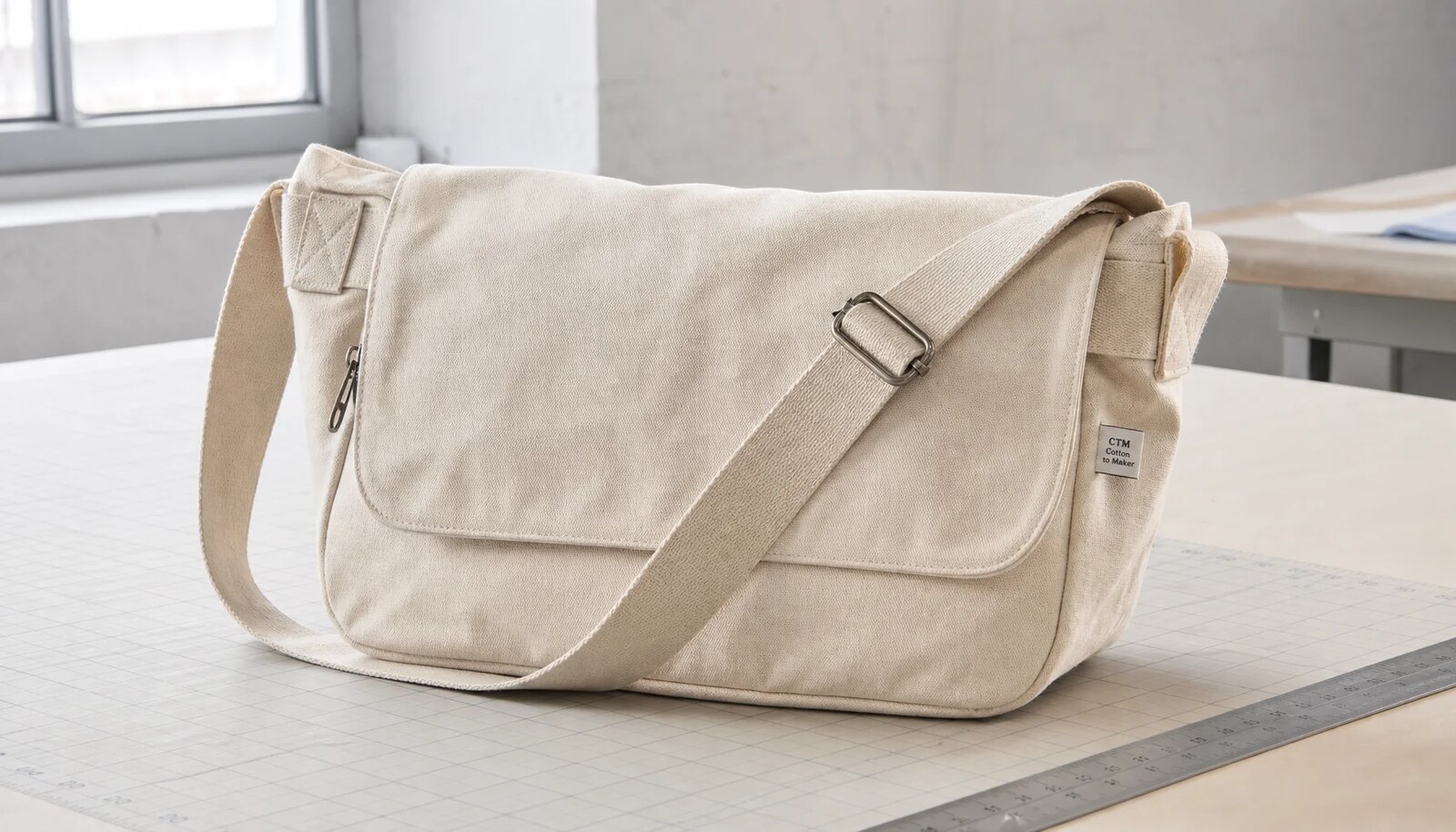
Start with the buying problem, not the bag name
A custom canvas messenger bag sounds straightforward until quotations start arriving. One factory may assume 10 oz natural cotton canvas, no lining, a one-color screen print, plastic adjusters, and bulk packing. Another may price 14 oz piece-dyed canvas, a lined interior, zipper closure, metal hardware, printed hangtags, individual bags, and a different carton count. The product name is the same. The product being quoted is not.
For B2B procurement, the job is to turn a design idea into a specification a supplier can price, sample, and repeat. This custom canvas messenger bags material selection guide for eco apparel brands focuses on the decisions that change cost and quality: finished fabric weight, fiber composition, weave, finish, lining, trims, logo method, reinforcement, tolerances, packing, MOQ, and approval flow.
Eco apparel buyers also need to separate appearance from claim. Cotton, organic cotton, recycled cotton, undyed canvas, natural canvas, rPET lining, plastic-free packing, and low-impact dye all sound aligned with an eco position, but they are not interchangeable. Some affect care labels, customs wording, documentation, marketing copy, and retailer compliance. A cleaner sourcing file keeps the design intent visible while tying every sustainability claim to the documents that support it.
The strongest RFQs read less like inspiration boards and more like controlled production briefs. They still leave room for factory input, but they do not let every supplier fill in the missing pieces differently.
- Use the product name as the starting point, then quote from the full material stack.
- Compare suppliers only after fabric, lining, trims, logo method, reinforcement, packing, and quantity assumptions match.
- Tie organic, recycled, undyed, rPET, or low-impact language to supplier documents before using it in product copy.
- Keep approved swatches, trim cards, strike-offs, and PP samples as the bulk production standard.
Map the use case before choosing canvas
Canvas weight should follow the job the bag needs to do. A conference bag may carry a catalog, T-shirt, bottle, and phone for a few days. A retail messenger bag may carry notebooks, apparel samples, a tablet, and daily essentials for months. A commuter or laptop-oriented version asks even more from the construction: stronger strap anchors, more secure closure, possible padding, and tighter internal dimensions.
Most custom canvas messenger bag programs sit between 10 oz and 16 oz shell fabric. As a working conversion range, 10 oz is often around 340 GSM, 12 oz around 400-410 GSM, 14 oz around 475 GSM, and 16 oz around 540 GSM. These are approximate figures. Yarn count, weave density, finishing, coating, washing, and moisture content can all move the final number, so procurement should ask for finished weight in both oz and GSM with a clear tolerance.
A 10-12 oz canvas can be right for lightweight branded carry, employee kits, events, and programs where carton efficiency matters. A 12-14 oz canvas is often the safer starting point for retail accessories because it gives enough body without making seams and flap folds too bulky. A 14-16 oz canvas feels more structured, but it should not be selected for weight alone. Heavier canvas may need stronger thread, larger needles, adjusted seam allowances, reinforced load points, and a packing plan that prevents permanent creasing.
Write the use case into the RFQ. Tell the supplier whether the priority is cost, daily durability, a softer natural hand, shelf presentation, freight efficiency, laptop compatibility, or documented material content. The more clearly the channel is described, the less guessing the factory has to do.
- Event or promotion: 10-12 oz canvas, simple flap, limited pockets, efficient carton count, and bulk or simplified packing.
- Retail accessory: 12-14 oz canvas, cleaner interior, better reinforcement, controlled logo finish, and hardware that matches the price point.
- Commuter or laptop style: 14-16 oz canvas only when paired with suitable lining, padding if needed, secure closure, and reinforced strap points.
- Wholesale add-on: prioritize repeatable materials, controlled colorways, carton data, and a construction that can be reordered without major changes.
Specify weight, weave, finish, and tolerance
A purchase order should not simply say canvas. It should state fiber composition, weave, finished weight in oz and GSM, color, finish, and acceptable tolerance. Finished weight is important because dyeing, washing, softening, coating, calendaring, and drying can change the fabric's mass and hand feel. If one supplier quotes greige weight and another quotes finished weight, the price comparison is already distorted.
For many bag programs, a finished weight tolerance around +/-5% is workable, although stricter retail programs may require a narrower range after factory confirmation. The tolerance needs to be realistic for the mill source and finish. If the approved sample uses 12 oz finished canvas at roughly 410 GSM, bulk production should not quietly shift to a lighter or heavier fabric because stock availability changed.
Weave matters as much as weight. Plain-weave cotton canvas with even warp and weft density gives a stable cutting surface, predictable flap shape, and a cleaner print area. Slub yarns can create a natural texture that fits eco apparel branding, but the approved slub level should be visual and specific. A few flecks or natural irregularities may be acceptable. Heavy slub clusters under a printed logo may not be.
Finish changes the look and the risk profile. Natural or scoured canvas can show cotton seed flecks and shade variation. Piece-dyed canvas needs shade control, and brand-critical colors may need lab dips. Pigment-dyed or enzyme-washed canvas can create a softer, worn-in surface, but variation must be approved before bulk production. Coated canvas may help with water resistance, but buyers should ask what coating is used, whether it affects material claims, and how it performs with the chosen logo method.
- State finished weight in both oz and GSM, including tolerance and measurement stage.
- Ask whether the swatch is greige, scoured, finished, dyed, washed, softened, waxed, or coated.
- Approve acceptable slub, speckling, shade range, surface texture, and odor with physical samples where possible.
- Use lot or mill references when repeat orders need the same hand feel, color, and print behavior.
- Require written approval before any change in fabric source, weight, composition, weave, or finish.
Build the material stack around the sales channel
The shell canvas gets most of the attention, but the full material stack determines how the bag feels, performs, and prices out. A complete specification includes shell fabric, lining, pocket fabric, reinforcement patches, webbing, zippers, sliders, snaps or magnets, D-rings, buckles, binding, labels, hangtags, and packing materials. When those details are missing, every supplier makes different assumptions.
Unlined construction can work well for simple messenger bags. It lowers cost, reduces sewing steps, folds flatter, and keeps the natural canvas look visible inside. The tradeoff is a less refined interior, visible seam allowance, and fewer pocket options. If the bag is unlined, specify how seams are finished: bound, overlocked, folded, or otherwise controlled.
Lining is useful when the product needs zipper pockets, a laptop sleeve, cleaner retail presentation, or protection from raw seam edges. Common options include 190T polyester, 210D polyester, rPET lining when documentation is available, cotton sheeting, or heavier cotton lining. Polyester usually slides more easily and keeps bulk down. Cotton lining may support a natural-material story, but it can add shrinkage risk, cost, and sewing bulk.
Webbing deserves close attention. Strap width, fiber, thickness, colorfastness, and hand feel affect comfort and perceived quality. A 25 mm strap may suit a small crossbody bag. A loaded messenger bag usually feels better with 38 mm or 50 mm webbing. Define the adjustment range, hardware type, and strap-end finishing. If the brand avoids animal materials, state that patches or pullers should be leather-free.
- Basic stack: canvas shell, simple flap, unlined interior, limited trims, and cost-efficient packing.
- Retail stack: midweight canvas, bound or lined interior, interior pocket, reinforced strap anchors, and a clean closure.
- Premium stack: heavier or more structured canvas, selected hardware finish, refined logo method, and tighter QC points.
- Eco-positioned stack: documented fiber content, necessary rather than excessive packaging, and claim language aligned with available paperwork.
Define trims, closures, and reinforcement before sampling
Messenger bags usually fail first at stress points, not in the middle of the canvas panel. Strap anchors, D-rings, zipper ends, pocket openings, flap corners, and side seams carry repeated load. These areas should be designed before the sample is approved, not patched after problems appear. Common reinforcement methods include bar tacks, box-X stitching, extra canvas patches, webbing that continues into the seam, or double-layer panels.
Closure choice should match the channel. A flap with snaps or magnets can be enough for casual retail, events, and branded merchandise. A zipper top adds security for commuting and travel, but it also adds cost, sewing complexity, and inspection work. Hook-and-loop can be economical, but the sound, lint pickup, and lower-end feel may not suit every brand. Magnets need correct strength and placement so the flap closes naturally after the bag is loaded.
Hardware specifications should be functional first. For metal parts, define finish such as nickel, antique brass, black zinc, or matte black, and ask the supplier to check plating consistency and sharp edges. For acetal or plastic parts, define color, size, and expected load. Thin D-rings, weak sliders, or poorly set snaps can make a strong canvas bag feel cheap quickly.
Zippers also need detail. The quote should state zipper type, tape width, tooth style, slider, puller, color, and whether the puller is generic or branded. For lined bags, check whether lining catches in the zipper. For top zipper openings, confirm the actual opening after sewing, not only the nominal zipper length.
- Reinforce strap anchors with bar tacks, box-X stitching, patches, or webbing extension into the seam.
- Specify D-ring, adjuster, snap, magnet, buckle, and zipper material, size, finish, and placement.
- Choose zipper closure only when the added security justifies added cost and QC effort.
- Check that hardware will not mark the canvas surface when the bag is folded in cartons.
- Ask for top-of-production photos of reinforcement areas when load points are critical.
Match the logo method to the artwork and fabric
Logo decisions should start with the artwork, then move to the fabric. Screen printing is usually the most practical option for one to three solid colors on flat canvas panels, especially for repeat orders. It can be efficient and durable when the weave is stable, the print area is not too close to folds, and the ink is properly cured.
Detailed artwork may require heat transfer, digital transfer, or a similar process. These methods can reproduce gradients and fine lines, but canvas texture adds risk. Transfers may look too glossy on natural canvas, crack when the flap bends, or lift at the edges. A strike-off on the approved canvas is essential. A simple flex check is useful: bend the printed panel several times and inspect for cracking, lifting, whitening, or edge separation.
Embroidery can work beautifully for small marks, monograms, or premium capsules. It becomes harder to control when the logo is dense or large. Needle penetration and thread tension can pucker the panel, especially near pockets or seams. Approve thread color, backing, stitch density, maximum artwork size, and placement before bulk production.
Eco apparel brands often do better with restraint. A woven label, cotton label, or small sewn patch can feel more aligned with natural canvas than a large print. Labels are also easier to repeat across body colors, but they still need a specification: material, fold type, dimensions, stitch line, placement tolerance, and whether they are included in the quoted MOQ.
- Screen print: best for bold, flat, repeatable artwork on stable canvas panels.
- Transfer: useful for complex artwork, but approve adhesion, gloss level, edge quality, and flex behavior.
- Embroidery: best for smaller marks; dense full-panel embroidery should be tested before commitment.
- Woven or cotton label: useful for understated branding and repeatable placement across colorways.
- Bulk inspection should compare goods to the approved physical strike-off or logo sample, not only the artwork file.
Write an RFQ that makes quotes comparable
A strong RFQ is a cost-control tool. It gives suppliers the same assumptions and asks them to state any exceptions. Include a sketch or reference, dimensions, finished canvas weight, composition, finish, lining, pocket layout, strap width, hardware, closure, logo method, artwork size, quantity, color split, packing method, inspection expectation, delivery term, and approval calendar.
Ask suppliers to separate the price lines that matter. Sample cost, logo setup, screen or plate charge, bulk unit price, packaging cost, hangtag or label cost, testing cost if required, and sample courier cost should not be hidden inside vague totals. A low unit price can become less attractive once setup charges, carton volume, or repacking labor are added.
MOQ should be tied to the variables that create it. Natural canvas may be available at a lower MOQ than custom dyed canvas. Custom lining, special webbing color, unusual hardware plating, or multiple artwork versions can each create separate minimums. An order of 1,000 pieces in one color is very different from 1,000 pieces split across five colors and three logo versions.
The RFQ should also invite practical factory comments. Ask whether the selected canvas is too heavy for the seam design, whether the print is too close to a flap fold, whether the lining may bunch near the zipper, or whether the packing method will crease the front panel. Early manufacturability feedback is often more useful than a cheaper quote that turns into three sample revisions.
- Send every supplier the same material, construction, logo, quantity, color split, and packing assumptions.
- Ask suppliers to list exclusions, substitutions, and unpriced items clearly.
- Request MOQ by body color, canvas quality, lining, logo version, trim color, and hardware finish.
- Require carton dimensions, gross weight, pieces per carton, and estimated CBM with the quote.
- Define lead time as days after final artwork, deposit, material confirmation, and PP sample approval.
Use sampling to prove the build, not just the shape
Sampling should prove the materials and construction, not only the outline of the bag. A first prototype may use available fabric to check size and sewing logic. That can be useful, as long as the limits are recorded. The pre-production sample should be much closer to bulk: approved canvas, lining, webbing, hardware, logo method, labels, and packing should all be represented as accurately as possible.
Inspect the sample the way the customer will use it. Load it with realistic contents. Adjust the strap to the shortest and longest usable lengths. Open and close zippers, snaps, and magnets. Check whether the flap lies straight, whether the bag tilts when worn, whether strap edges feel rough, whether hardware presses into the body, and whether the logo still looks clean after the panel bends.
Tolerances should be agreed during sampling. Canvas bags are soft goods, so small variation is normal. Undefined variation, though, creates disputes. Common tolerance points include body width, height, gusset depth, flap drop, strap range, pocket position, zipper opening, label placement, and logo placement. A practical starting point may be around +/-0.5 cm for smaller placements and +/-1.0 cm for larger body dimensions, subject to the design and factory confirmation.
Sampling should also test packing. Fold the bag as it will be shipped. Place hardware and straps where they will sit in the carton. Check whether pressure marks appear after compression. If the bag is sold at retail or shipped through e-commerce, packing is part of product quality.
- Approve fabric swatch, trim card, logo strike-off, PP sample, and packing method before bulk cutting.
- Record any substitute materials used in samples and confirm when they will be replaced by approved bulk materials.
- Load the sample with realistic weight and check strap comfort, anchor strength, flap alignment, and closure function.
- Set written tolerances for dimensions, logo placement, label placement, pocket position, and strap range.
- Keep one sealed approved sample or a controlled photo set for inspection reference.
Name QC points before production starts
Quality control begins when bulk materials arrive. Canvas should be checked for finished weight, shade, weave defects, stains, holes, oil marks, odor, skew, and heavy slub clusters. If natural canvas is used, define acceptable flecks and variation before production. If dyed canvas is used, separate shade lots or approve the acceptable shade range. If the fabric is washed, check shrinkage and distortion before cutting large batches.
Cutting and sewing inspection should focus on alignment and stress areas. Flap styles reveal skew quickly because the flap edge sits over the front panel. Pocket openings must be even. Strap anchors need the approved reinforcement, not just a line of stitching that looks neat from the outside. Stitch tension should be balanced, with no skipped stitches, loose loops, broken threads, needle cutting, or bulky seam allowance that interferes with zippers.
Logo QC must follow the application method. Screen prints need checks for registration, ink opacity, color density, edge sharpness, placement, curing, bleeding, and hand feel. Transfers need checks for edge lifting, cracking, bubbling, gloss mismatch, and adhesion after bending. Embroidery needs checks for puckering, thread breaks, missing stitches, backing visibility, and panel distortion. Sewn labels need checks for straight placement, fold accuracy, and clean stitching.
Final inspection should compare finished goods to the approved PP sample, written specification, tolerance sheet, and approved logo standard. It should include function checks for zippers, snaps, magnets, buckles, sliders, strap adjustment, and pocket access. It should also cover cleanliness, odor, thread trimming, carton count, carton marks, barcode placement, and packing condition.
- Incoming fabric: check weight, shade, defects, odor, slub level, skew, and roll consistency.
- Construction: inspect stitch density, reinforcement, panel alignment, pocket symmetry, seam finish, and thread trimming.
- Logo: inspect against the approved physical standard for the exact canvas and logo method.
- Hardware: check finish, sharp edges, setting strength, zipper movement, magnet strength, and adjuster function.
- Packing: verify folding method, piece count, carton data, barcode labels, surface protection, and carton marks.
Control packing, freight, and landed cost
Canvas messenger bags can become expensive to ship when fabric is heavy, hardware is bulky, or cartons are inefficient. A simple unlined 10 oz bag may fold flat and pack tightly. A lined 14 oz messenger bag with a zipper, metal hardware, padded sleeve, hangtag, and individual packing may need larger cartons and more careful folding. Procurement should review carton volume before awarding the order, not after production is finished.
Every quote should include pieces per carton, carton dimensions, gross weight, net weight if available, and estimated CBM. This gives the buyer a better view of freight impact and warehouse handling. A supplier with a slightly higher FOB unit price may still be stronger if the packing protects the bag and uses carton space efficiently. A cheaper quote can lose its advantage if it causes creased flaps, hardware marks, excess cartons, or relabeling work at the destination.
Individual polybags should be a channel decision, not a default. They may be needed for e-commerce, retailer routing guides, barcode scanning, or moisture and dirt protection. They may be unnecessary for some internal programs or bulk wholesale deliveries. For eco apparel brands, reduced plastic can be part of the brief, but the replacement still has to protect the product through export handling.
Write packing instructions before bulk production. Define whether straps are tucked inside, wrapped, or laid flat; whether flaps are closed; whether tissue is used; whether hangtags are attached or packed separately; where barcode labels go; and what carton marks are required. These small choices affect labor time, carton count, product condition, receiving accuracy, and landed cost.
- Request carton dimensions, gross weight, pieces per carton, and estimated CBM before supplier selection.
- Test whether folded hardware, buckles, or strap adjusters leave marks on the canvas surface.
- Choose polybags, paper bands, tissue, or bulk packing according to channel needs and buyer rules.
- Confirm hangtags, barcode labels, carton marks, silica gel, and suffocation warnings where applicable.
- Include packing condition in top-of-production or pre-shipment inspection.
Specification comparison for buyers
| Spec decision | Recommended option | When it fits | Buyer risk to check |
|---|---|---|---|
| Canvas weight | 10-12 oz, approximately 340-410 GSM, for lightweight programs; 12-14 oz, approximately 410-475 GSM, for daily retail use; 14-16 oz, approximately 475-540 GSM, for more structured or device-oriented bags | Use lighter canvas for events and simple branded carry; use midweight canvas for retail accessories; use heavier canvas only when the sewing construction, strap anchors, and packing plan can support the added bulk | Quotes may state greige weight instead of finished weight. Require finished oz/GSM, a tolerance such as +/-5%, and confirmation after dyeing, washing, or coating |
| Fabric structure | Plain-weave cotton canvas with controlled yarn count, even warp/weft density, and approved slub level | Best for eco apparel brands that need a natural surface, stable cutting, and a logo area that remains readable across repeat orders | Loose weave, heavy slub clusters, or uneven tension can cause print feathering, flap skew, pocket distortion, and roll-to-roll variation |
| Fiber composition | 100% conventional cotton, certified organic cotton, recycled cotton blend, or cotton/poly blend, selected by claim, durability, shrinkage, and price target | 100% cotton supports a simple natural material story; organic or recycled options fit documented sustainability programs; cotton/poly can improve dimensional stability and abrasion resistance | Do not use organic, recycled, or low-impact language unless the supplier provides supporting documents. Blends affect care labels, customs description, hand feel, dye uptake, and print adhesion |
| Fabric finish | Natural greige or scoured canvas, piece-dyed canvas, pigment-dyed canvas, enzyme-washed canvas, or coated canvas | Natural or undyed looks suit restrained eco apparel branding; dyed canvas supports merchandising palettes; washed canvas gives a softer hand; coated canvas may suit water-resistance requirements | Finishing changes weight, shade, shrinkage, odor, stiffness, and print performance. Ask whether the swatch is pre-finish or finished bulk quality |
| Lining and interior | Unlined for basic builds; 190T polyester, 210D polyester, rPET lining, cotton lining, or canvas binding for cleaner interiors | Use lining for zipper pockets, laptop sleeves, retail presentation, or when seam allowance should not be visible | Lining adds cutting and sewing tolerance issues. Confirm lining GSM/denier, colorfastness, pocket dimensions, seam binding, and whether recycled-content claims are documented |
| Reinforcement | Bar tacks, box-X stitching, patch reinforcement, double-layer canvas, or webbing continuation at load points | Required at strap anchors, flap corners, pocket openings, zipper ends, D-rings, and any laptop or catalog load area | A visually acceptable sample can still fail when loaded. Define stitch count, reinforcement location, and sample load test expectations |
| Logo method | Screen print for 1-3 solid colors; transfer or DTG-style digital print for detailed artwork; embroidery, woven label, or cotton label for subtle branding | Screen print works for bulk repeat orders; transfers suit complex artwork; labels and small embroidery work well for understated eco apparel branding | Require a strike-off on the approved canvas. Test print placement tolerance, rubbing, bending, wash or crocking risk where relevant, and edge adhesion for transfers |
| Closure and hardware | Flap with snap or magnet for casual retail; zipper top for secure carry; hook-and-loop only when sound and lint pickup are acceptable; metal or acetal adjusters based on positioning | Choose closures by channel: events can be simple, retail commuter bags need security, and premium capsules need better hardware finish | Cheap sliders, weak magnets, poor snap setting, thin D-rings, or rough plating can damage canvas and create returns |
| MOQ strategy | Keep first production to one construction, one canvas quality, one lining, and limited body colors; add variants after the build is proven | Useful for apparel brands testing a new accessory line, wholesale add-on, employee kit, or seasonal capsule | Too many colorways split dye lots, cutting batches, print setups, and QC sorting. Ask MOQ by fabric color, artwork, lining, and hardware finish |
Buyer checklist before sampling
- Define the use case: event giveaway, retail accessory, wholesale add-on, employee kit, laptop-style commute bag, or e-commerce bundle.
- Specify finished canvas weight in oz and GSM, with an acceptable tolerance such as +/-5% unless your inspection standard requires tighter control.
- State fiber composition, weave, finish, color standard, and whether sustainability documentation is required before any organic, recycled, undyed, or low-impact claim is used.
- Confirm whether weight is measured before or after dyeing, washing, coating, softening, or other finishing.
- Approve bag dimensions with tolerances: body width, height, gusset depth, flap length, strap width, adjustable strap range, pocket opening, and zipper length.
- Specify construction details: lined or unlined body, interior pockets, seam binding, laptop sleeve size, padding thickness if any, reinforcement patches, and bar-tack positions.
- Define trims: webbing fiber and width, zipper tape size, slider type, puller style, snap or magnet size, D-ring gauge, buckle finish, label type, and hangtag requirement.
- Lock logo method, artwork size, color references, placement distance from seams, artwork file format, and acceptable placement tolerance.
- Require a print strike-off, transfer test, embroidery sample, or label sample on the approved canvas before pre-production approval.
- Ask suppliers to quote the same material stack, sample cost, screen or tooling charges, packing method, carton data, lead time after approvals, and payment terms.
Factory quote questions to send
- What exact canvas composition, finished weight in oz/GSM, weave type, yarn style, and finish are included in this quote?
- Is the weight quoted as greige fabric weight or finished fabric weight, and what tolerance will you control in bulk production?
- Is the fabric natural, scoured, piece dyed, pigment dyed, yarn dyed, washed, softened, waxed, coated, or otherwise treated?
- Can you provide a fabric swatch from the intended bulk source and a mill or lot reference before sampling?
- What shade tolerance standard will be used for body fabric, lining, webbing, and binding, and how will roll-to-roll variation be separated or controlled?
- Is the quoted construction lined or unlined, and what lining denier/GSM, pocket layout, binding, zipper compartment, or laptop sleeve is included?
- What reinforcement is included at strap anchors, flap corners, zipper ends, D-rings, pocket openings, and side seams?
- What stitch density do you use for main seams and reinforcement areas, and what needle/thread type is planned for this canvas weight?
- Which print or logo method is assumed, how many colors are included, what artwork size is priced, and what setup charges apply?
- Can you produce a logo strike-off on the approved canvas before the PP sample, and how many days should be allowed for buyer comments and revision?
Quality-control points to confirm
- Incoming fabric weight should be checked against the approved finished oz/GSM range using cuttings from actual bulk rolls, not only the showroom swatch.
- Fabric inspection should note holes, broken yarns, oil marks, stains, shade bands, heavy slub clusters, skew, odor, and roll-to-roll color variation.
- For dyed or washed canvas, shrinkage and distortion should be evaluated before bulk cutting, especially when flap alignment and pocket placement are tight.
- Natural canvas variation should be defined in advance so acceptable speckling or slub is not confused with dirt, weak yarns, or weaving defects.
- Finished bag dimensions should be checked against written tolerances for width, height, gusset, flap drop, strap range, pocket placement, and zipper opening.
- Load-bearing areas should show consistent reinforcement at strap anchors, D-rings, side seams, flap corners, pocket openings, and zipper stops.
- Main seams should have consistent stitch density, balanced tension, secure back-tacking, trimmed threads, and no skipped stitches or needle cutting.
- Print inspection should compare registration, edge sharpness, ink opacity, color density, placement, curing, and hand feel against the approved strike-off.
- Transfers should be checked for edge lifting, cracking, gloss mismatch, bubbling, and adhesion after bending the canvas panel several times by hand.
- Embroidery should be checked for puckering, missing stitches, thread tension, backing visibility, and panel distortion.