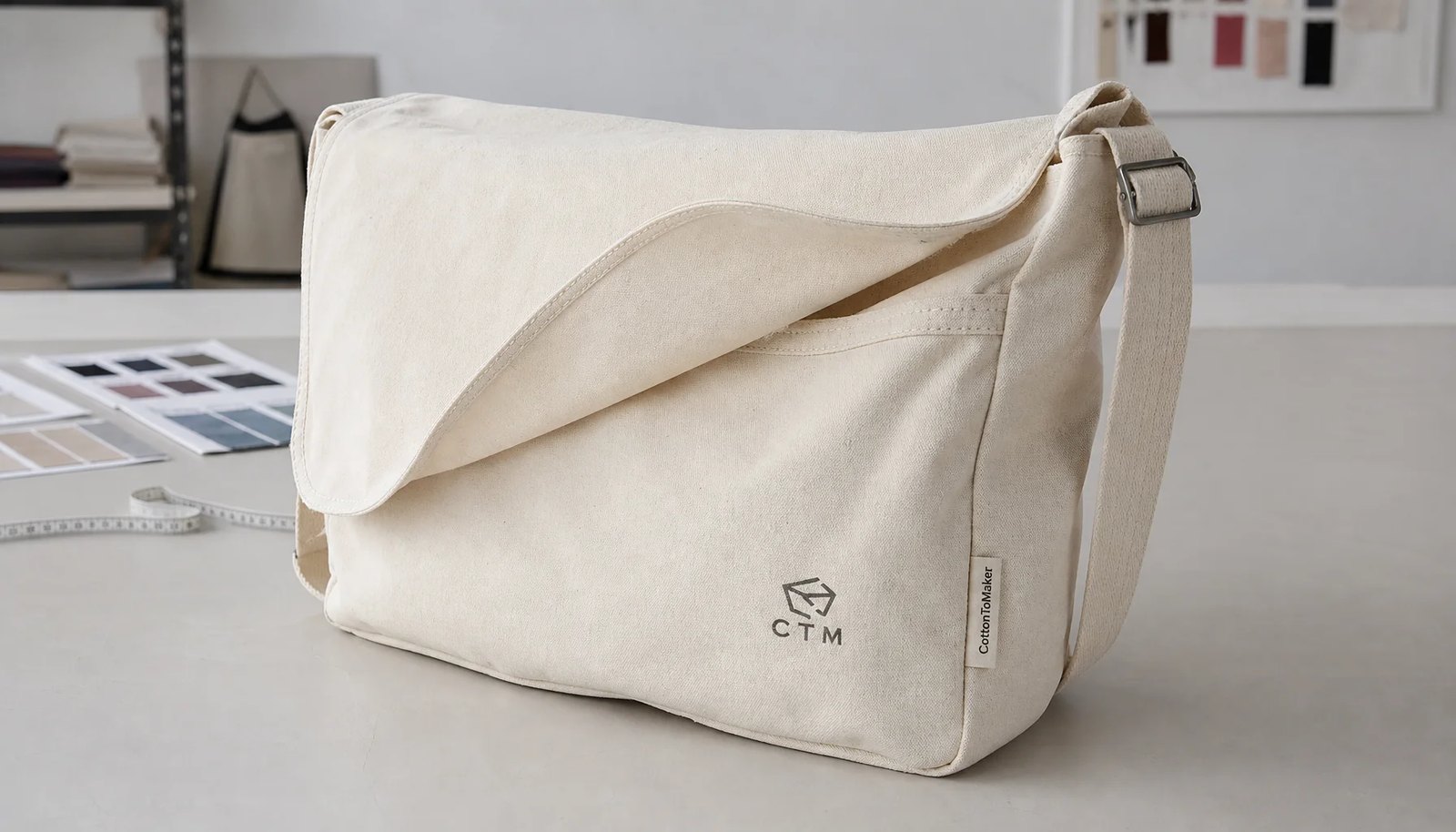
Start With the Bookstore Buying Scenario
A custom canvas messenger bag for a university bookstore has to work in three places at once: on the retail shelf, in the university licensing file, and in the warehouse receiving process. It may be sold to students for daily use, added to orientation kits, offered as an alumni gift, stocked for department resale, or shipped through an online campus store. Those are not the same brief. A daily student bag needs stronger fabric, comfortable webbing, dependable closures, and tested stress points. An orientation bag may need a clean one-color logo, lower unit cost, fast packing, and predictable delivery. A premium alumni item should feel more finished, with better lining, hardware, and handfeel to support the retail price.
Open the RFQ with the use case, target retail price, expected carry load, selling season, and required delivery date. That one step prevents a supplier from quoting the cheapest version that looks fine in a flat front-view image. Messenger bags rarely fail across the middle of the panel first. More often, problems appear at the strap anchor, bottom gusset, closure attachment, flap fold, zipper end, or side seam. An empty sample can look sturdy and still distort when loaded with two textbooks, a tablet, a water bottle, and a hoodie.
For many bookstore programs, a practical baseline is 12 oz cotton canvas, an adjustable 38 mm shoulder strap, reinforced anchors, a lined interior, one inner zipper pocket, one slip pocket, and screen-printed artwork on the flap. Buyers can move lighter or heavier from there, but every change should have a reason. Lighter fabric needs clearer load limits. Heavier fabric needs stronger sewing, compatible hardware, and packing that does not leave permanent flap creases.
- Daily student carry: specify 12 oz or heavier canvas, reinforced anchors, comfortable strap webbing, and a defined load test.
- Orientation bundle: use 10-12 oz canvas, simpler pockets, one-color branding, and compact carton packing.
- Alumni retail item: consider 14 oz canvas, lining, metal hardware, woven label, and cleaner interior finishing.
- Online bookstore item: confirm barcode, polybag, hangtag, repackability, and carton protection for fulfillment handling.
- Licensed merchandise: build artwork approvals, Pantone references, label placement, and defect limits into the sample process.
Select Canvas Weight by Load, Not Guesswork
Canvas weight is one of the easiest specs to misunderstand. Supplier words such as heavy, premium, thick, eco, or durable are not enough for procurement. Ask for ounces and approximate GSM, then add a tolerance. As a working reference, 10 oz canvas is often about 310-340 GSM, 12 oz about 390-420 GSM, 14 oz about 460-490 GSM, and 16 oz about 520-560 GSM. Actual values can shift with yarn count, weave density, finishing, moisture, and mill practice, so the purchase order should state an acceptable range rather than a single theoretical number.
For custom canvas messenger bags in university bookstores, 12 oz is usually the most balanced starting point. It gives the flap enough body, supports normal pocket construction, and can be sewn efficiently in bulk. Ten ounce canvas can work for light-use programs, but the buyer should accept a softer structure and require reinforcement at load points. Fourteen or sixteen ounce canvas creates a rugged retail impression, yet it also adds cost, bulk, sewing time, needle wear, carton weight, and possible crease issues during packing.
The best fabric is not always the heaviest one. A 16 oz body paired with thin webbing and weak sliders is not a premium build; it is an unbalanced spec. A 10 oz body with good anchor reinforcement may be perfectly acceptable for an orientation kit that carries papers and small merchandise. Match fabric weight to expected load, selling price, and product life. If students are expected to carry textbooks or electronics, write a load test into the PO instead of accepting a general statement that the bag is strong.
- Specify both oz and GSM, such as 12 oz, approximately 390-420 GSM, with plus or minus 5 percent tolerance if acceptable.
- Use 10 oz only for light carry, promotional programs, or price-sensitive events with reinforced anchors and modest load expectations.
- Use 12 oz as the default retail starting point for balanced structure, sewing efficiency, and perceived value.
- Use 14-16 oz for premium retail when webbing, hardware, needlework, and packing are upgraded accordingly.
- Approve bulk fabric before cutting when shade, handfeel, structure, or official campus color accuracy matters.
Compare Cotton, Cotton-Poly, and Recycled Canvas
Fabric composition changes more than cost. It affects handfeel, shrinkage, dimensional stability, labeling, artwork results, and the claims a bookstore can safely make. One hundred percent cotton canvas gives the familiar campus-store look: natural texture, classic handfeel, and strong compatibility with simple screen printing. It can also shrink, absorb moisture, crease, and vary from lot to lot. Natural cotton canvas may show seed flecks or slubs. Those can be part of the intended look, but they are different from oil stains, dirty handling marks, broken yarns, or weaving defects.
Cotton-poly canvas can be useful when dimensional stability matters or when the buyer needs a value-engineered bag with less shrinkage sensitivity. It may feel smoother and slightly less traditional than pure cotton, but it can still work well for bookstore retail. Recycled cotton or recycled polyester blends can support sustainability briefs, but only when the supplier can document the content. If recycled language will appear on a hangtag, product page, procurement record, or campus sustainability communication, ask for the recycled percentage and any available certification or transaction documentation.
Finish deserves the same attention as fiber. Natural canvas usually has simpler MOQ and faster sourcing. Custom dyed canvas needs lab dip approval and bulk shade control. Washed canvas creates a softer, vintage look, but it can distort dimensions and change print behavior if shrinkage is not controlled. Preshrunk or sanforized fabric may reduce movement, although availability depends on the mill and fabric type. For university colors, a Pantone reference helps, but physical approval matters more because canvas dye and ink will not match coated paper or a digital screen exactly.
- 100 percent cotton: best for classic campus retail, natural texture, and traditional canvas positioning.
- Cotton-poly: useful for dimensional stability, value engineering, and reduced shrinkage sensitivity.
- Recycled blend: use only with documented content if sustainability language will be customer-facing or procurement-facing.
- Natural canvas: lower shade risk, simpler MOQ, and faster sourcing than custom dyed or washed options.
- Dyed or washed canvas: require lab dip, shrinkage review, approved bulk shade range, and print testing before cutting.
Specify Lining, Padding, and Pockets Precisely
The inside of the bag is where a vague specification becomes visible to customers. An unlined messenger bag can fit a rustic natural canvas concept, but raw interiors may show lint, loose threads, and uneven seams. If unlined construction is chosen, seam finishing must be named: overlocked, bound, taped, or otherwise finished. For most university bookstore retail programs, 210D or 300D polyester lining gives a cleaner appearance, supports interior pockets, and improves perceived value without pushing the design into a high-cost category.
Lining is not padding. If the product is sold as tablet-friendly or laptop-friendly, specify the padded sleeve separately. Define the target device size, finished sleeve width and height, foam thickness, bottom protection, closure method, and whether the sleeve is suspended above the bottom seam. A lined compartment alone does not protect electronics from impact. Avoid broad claims such as laptop compartment unless the size, padding, and fit have been approved.
Pocket count should be useful, not crowded. A good baseline is one inner zipper pocket for valuables and one slip pocket for a phone, ID holder, charger, or receipts. Extra pen slots, card pockets, bottle pockets, and zip sections can add value, but each feature adds cutting, sewing, alignment, inspection time, and defect risk. Give finished dimensions, opening widths, zipper lengths, and reinforcement details. Ask the factory to test pockets with real items, not just pattern measurements.
- Unlined construction: specify overlocked or bound seams and reject loose threads, fraying, and dirty raw edges.
- Lined construction: define lining denier, color, attachment method, pocket layout, and whether seams are hidden or bound.
- Padded sleeve: specify device size, foam thickness, sleeve height, bottom clearance, and closure.
- Pocket dimensions: state finished size, not only pattern size, and confirm what item each pocket must fit.
- Zippers and openings: define zipper length, puller style, end reinforcement, and pocket corner stitching.
Match Decoration to University Artwork
University artwork can be demanding. It may include official colors, mascots, seals, crests, small serif text, fine outlines, and licensing rules. Canvas is textured, so artwork that looks crisp in a PDF may soften on fabric. Weave, slubs, natural flecks, wash finish, ink coverage, and the flap fold all affect decoration performance. Before choosing the method, classify the artwork: block school name, simple logo, detailed seal, department mark, mascot illustration, full-color graphic, or subtle retail label.
Screen printing is usually the most practical option for custom canvas messenger bags when the artwork uses one to three solid colors. It controls cost at bookstore volumes and works well on a large flap or front panel. Still, it needs testing. Fine text may fill in. Heavy ink coverage may feel stiff. A logo crossing the flap fold may crack if ink flexibility or curing is poor. Require a physical strike-off on the actual bulk-intended canvas, with approved logo size, placement, ink color, and curing standard.
Heat transfers can reproduce gradients and multicolor art, but they may sit visually on top of natural canvas and must be checked for edge lift after bending. Embroidery can look premium on small marks, yet dense fills can pucker canvas. Woven labels work well for subtle branding, department variations, or retail collections where a large printed mark is not desired. Whatever method is chosen, define placement from seams in millimeters, acceptable position tolerance, Pantone references, registration tolerance, and the approval route for licensed marks.
- Screen print: best for solid school names, block logos, mascots, and repeat one- to three-color programs.
- Heat transfer: useful for gradients and full-color artwork, but test flap bending, edge adhesion, and surface appearance.
- Embroidery: suitable for small premium marks; avoid large dense fills unless puckering is tested.
- Woven label: useful for subtle branding, multi-department programs, and lower risk on textured canvas.
- Strike-off: approve color, size, placement, edge clarity, adhesion, and fold performance before bulk decoration.
Engineer Strap, Hardware, and Closures
Many messenger bag failures start with the carrying system, not the main canvas panel. Students pull the strap unevenly, swing the bag over one shoulder, adjust it on the move, and load it with books or electronics. A narrow strap can dig into the shoulder. A weak slider can slip. A thin D-ring can deform. A poorly reinforced anchor can tear from the side seam. For many bookstore programs, a 38 mm webbing strap is a practical baseline because it balances comfort, availability, and cost.
Webbing should match the bag tier. Cotton webbing gives a natural feel, but cut ends can fray and dye can vary from the body fabric. Cotton-poly or polyester-blend webbing can offer better stability and cleaner edge finishing. Synthetic webbing ends should be heat sealed; cotton webbing ends should usually be folded and stitched or otherwise secured. If metal hardware is selected, specify nickel, antique brass, matte black, gunmetal, or another finish. Inspect for scratches, plating inconsistency, corrosion marks, and sharp edges. For plastic hardware, confirm thickness, color stability, and strength.
Closures affect both function and shelf presentation. Magnetic snaps are clean and convenient, but alignment must be controlled so the flap sits straight. Covered hook-and-loop is economical and quick to open, though exposed hook tape can collect lint and reduce perceived value. Buckles look premium but add labor and slow access. A zipper under the flap improves security but adds sewing complexity and another failure point. Test the closure after loading the bag because a flap that aligns when empty may skew when full.
- Strap width: use 38 mm as a practical baseline; consider wider straps only when the design and hardware support them.
- Anchor reinforcement: specify box stitch, bar tack, reinforcement patch, rivet, or combined method with clear placement.
- Slider performance: load the bag and confirm the strap does not slip through the adjuster.
- Hardware finish: define material, finish color, coating quality, and acceptable surface defects before sampling.
- Closure testing: cycle the closure, load the bag, then inspect flap alignment, fabric strain, and snap or buckle security.
Make Supplier Quotes Comparable
MOQ and price are shaped by more than the bag outline. Fabric availability, dyeing minimums, printing setup, hardware sourcing, webbing color, lining color, label tooling, pocket complexity, cutting efficiency, packing, and inspection level all affect the quote. A low MOQ may be realistic for natural canvas, stock lining, standard webbing, standard hardware, and one-color print. The same design may need a higher MOQ if the bookstore requests custom dyed canvas, custom webbing, custom lining, branded hardware, woven labels, or several department logo versions.
Two suppliers can quote the same drawing as a canvas messenger bag and still include very different products. One price may include 12 oz cotton canvas, polyester lining, 38 mm cotton webbing, metal hardware, reinforced anchors, individual polybags, barcode labels, and final inspection. Another may include lighter cotton-poly fabric, no lining, thin webbing, plastic hardware, no reinforcement patch, bulk packing, and unclear inspection terms. Photos will not expose all of those differences. Ask every supplier to quote from the same specification sheet and return a line-by-line confirmation.
When the target price is hard to reach, ask for costed alternatives rather than an undefined discount. Useful comparisons include 10 oz unlined versus 12 oz lined, screen print versus woven label, magnetic snap versus hook-and-loop, one zipper pocket versus no zipper pocket, metal hardware versus heavy plastic, and individual polybag versus bulk packing. This helps procurement see which changes reduce cost and which ones add risk. The cheapest unit price is not good value if bags arrive creased, fail under load, miss the selling season, or need repacking before display.
- Separate MOQs: ask for MOQ by base bag, fabric color, lining color, hardware finish, label, logo version, and packing version.
- Require line-item specs: canvas oz/GSM, composition, lining, webbing, hardware, decoration, pockets, reinforcement, and packing.
- Compare equal Incoterms: confirm whether pricing is EXW, FOB, CIF, DDP, or another term before comparing landed cost.
- Ask for costed options: tie price reductions to visible spec changes rather than accepting hidden material downgrades.
- Confirm quote inclusions: sample fees, tooling, screens, labels, barcodes, inspection, carton marks, and export documents.
Approve Samples With Measurable Tests
A development sample confirms the design direction, but it may not represent bulk production. If it uses substitute canvas, temporary hardware, different lining, or a non-final print method, record every deviation. The pre-production sample should use bulk-intended fabric, lining, webbing, hardware, closure, pocket layout, and decoration. It should be signed, photographed, measured, and stored as the production reference. For licensed campus merchandise, document both artwork approval and sample approval.
Test the sample the way a student and a receiving team would. Load it with expected items, adjust the strap, wear it cross-body or on one shoulder, open and close the flap, use the pockets, place it on a shelf, and repack it. Watch for strap twisting, slider slipping, anchor strain, flap skew, snap misalignment, pocket distortion, zipper roughness, print cracking, and gusset collapse. If the bag will be sold online, check whether it can be inspected and repacked neatly. If it will sit on a store display, check whether the front flap lies flat and the logo faces forward.
Sample comments should be measurable. Avoid notes such as make sewing better or improve logo. Write move logo 10 mm upward, reduce logo width to 180 mm, change thread to matching natural color, increase strap anchor box stitch to approved size, replace slider with heavier grade, widen phone pocket opening by 15 mm, or reduce carton compression. Confirm whether the supplier will provide a revised sample, production photos, or written confirmation only. For a high-visibility university bookstore item, a physical pre-production sample is usually worth the schedule time.
- Measure body width, height, gusset, flap length, pocket openings, strap width, and strap adjustment range against tolerance.
- Load test the sample using the agreed weight and duration, then inspect anchors, side seams, bottom gusset, and slider slip.
- Rub and bend the print, especially along the flap fold, to check adhesion, cracking, color transfer, and edge lift.
- Pack the sample for 24-48 hours, then inspect flap creases, body distortion, hardware marks, and logo appearance.
- Approve a signed pre-production sample and maintain a deviation list for bulk inspection reference.
Write QC Requirements Into the PO
Quality control belongs in the purchase order, not in a late email after defects appear. Canvas messenger bags have many visible and functional checkpoints: fabric weight, shade, stains, shrinkage, print placement, seam strength, hardware, strap performance, pocket function, symmetry, lining cleanliness, and packing. The PO should define the approved sample, inspection standard, defect classification, measurement tolerance, and required tests. If the buyer expects AQL inspection, state the inspection level and acceptable quality limits instead of assuming the supplier will choose an appropriate plan.
Measurement tolerances should be realistic and agreed before production. For many sewn bags, buyers may use tolerances such as plus or minus 5 mm for smaller dimensions and plus or minus 10 mm for larger body dimensions, although the right tolerance depends on design, fabric, and factory capability. Strap adjustment range, pocket openings, and logo placement may need tighter control because they affect function and appearance. Define how measurements are taken: flat, unstuffed, after resting from packing, and from which seam points.
Functional testing should include load, strap slip, closure cycle, seam review, and print adhesion. The load test should reflect expected bookstore use and include a safety margin. A quick hand pull is not enough. Print testing should include dry rub, wet rub, tape pull where appropriate, and bending at the normal flap fold. Visual inspection is just as important because canvas shows stains, crooked flaps, twisted straps, and uneven logos clearly. Natural slubs may be acceptable; oil stains, dirty marks, severe weaving defects, and sharp hardware should not be.
- Fabric checks: verify GSM range, shade standard, shrinkage risk, slub acceptance, stains, odor, and dirty handling marks.
- Measurement checks: define tolerance for body, gusset, flap, strap, pockets, logo placement, and lining fit.
- Functional checks: run load test, strap slip test, closure cycle check, pocket usability check, and print adhesion test.
- Appearance checks: inspect flap symmetry, logo clarity, thread trimming, skipped stitches, hardware finish, and lining cleanliness.
- Defect classification: define critical, major, and minor defects so inspection decisions are not subjective.
Plan Packing for Retail Receiving
Packing is not an afterthought for messenger bags. It affects freight cost, retail appearance, and campus receiving efficiency. Messenger bags are bulkier than flat totes, and the front flap is usually the main branded surface. If the flap is folded sharply, the logo may crease. If metal hardware presses against the print, it can leave pressure marks or scratches. If cartons are overfilled, bottom units can arrive compressed. If cartons are too large, the buyer pays for unnecessary CBM.
Individual polybags are common because they protect canvas from dust, moisture exposure during handling, and warehouse dirt. Depending on destination rules, polybags may need a suffocation warning. If the bookstore uses barcodes, confirm label size and placement before production so staff do not need to relabel units at receiving. Hangtags should attach consistently without puncturing the front flap or blocking the logo. Straps should be folded or secured to prevent twisting, tangling, or pressure marks.
Ask for carton data before confirming the order: pieces per carton, carton dimensions, gross weight, net weight, and total CBM. Cartons around 15-18 kg are often easier for warehouse and bookstore staff to handle, but buyer receiving rules should control the final limit. For premium bags, consider tissue, a facing sheet, or a folding guide to protect the front panel. Before shipment, inspect a packed carton, then unpack it and check whether the bag returns to the approved shape after resting.
- Quote carton data: request pieces per carton, carton dimensions, gross weight, net weight, and total CBM before landed-cost comparison.
- Protect logo area: prevent hardware pressure, ink transfer, sharp folds, strap marks, and over-compression.
- Confirm unit packing: specify polybag, suffocation warning if required, barcode, hangtag, silica gel if needed, and folding method.
- Control carton handling: keep weight aligned with bookstore, distributor, and warehouse receiving limits.
- Inspect packed recovery: unpack a sealed carton and check flap shape, logo surface, strap condition, and retail presentation.
Specification comparison for buyers
| Spec decision | Recommended option | When it fits | Buyer risk to check |
|---|---|---|---|
| Main canvas weight | 12 oz cotton canvas, commonly about 390-420 GSM, with a written tolerance such as plus or minus 5 percent before cutting | Core university bookstore retail programs where students carry tablets, notebooks, light textbooks, apparel, and daily items | A quote using 10 oz fabric may look similar in photos but lose structure at the flap, bottom gusset, and strap anchors under load |
| Budget fabric option | 10 oz canvas, commonly about 310-340 GSM, with bound or overlocked stress seams and reinforced anchors | Orientation kits, department giveaways, lower-ticket bundles, short-term events, or light-use retail | Do not assume textbook load capacity; require a defined load test and inspect for tearing around strap anchors |
| Premium fabric option | 14-16 oz canvas, commonly about 460-540 GSM, paired with stronger needlework, upgraded webbing, and appropriate hardware | Alumni shops, lifestyle campus collections, premium gifts, co-branded merchandise, and higher retail price points | Heavier fabric increases cutting difficulty, sewing time, needle marks, carton weight, CBM, and may require stronger machines or slower production |
| Fabric composition | 100 percent cotton for classic handfeel; cotton-poly for dimensional stability; recycled blend only with documented content | Cotton suits traditional bookstore retail; cotton-poly suits value durability; recycled blends suit sustainability briefs when evidence is available | Avoid unsupported terms such as eco canvas, sustainable style, or recycled look if claims appear on hangtags, websites, or procurement files |
| Canvas finish | Natural greige or natural cotton for lower MOQ; dyed canvas with lab dip approval; washed canvas only with shrinkage control | Natural canvas works for fast reorder programs; dyed canvas fits brand color stories; washed canvas fits vintage retail collections | Dyed and washed finishes can change shrinkage, shade, handfeel, print adhesion, and finished dimensions |
| Lining selection | 210D or 300D polyester lining; unlined only with clean seam finishing; padded sleeve only when specified by device size | Lined bags suit bookstore retail because customers inspect pockets, electronics storage, and interior cleanliness | Unlined raw seams can shed lint and expose threads; padding claims are risky unless foam thickness and sleeve dimensions are defined |
| Pocket plan | One inner zipper pocket plus one slip pocket as a practical baseline; add laptop sleeve only for a daily-carry program | Balanced retail function without excessive sewing complexity or inspection burden | Too many compartments increase misalignment, skipped stitches, zipper issues, and cost without always improving sell-through |
| Logo method | Screen print for one to three solid colors; woven label for subtle retail branding; heat transfer for gradients or small multicolor art | Screen print is usually cost-effective for flap logos, school names, mascots, and repeat bookstore orders | Fine seals, small serif type, trademark symbols, and heavy ink coverage require strike-off approval on the exact canvas |
| Closure type | Magnetic snap or covered hook-and-loop for mid-market bags; buckle or zipper-under-flap for premium or security-focused bags | Quick-access closures work well for student use and in-store handling | Magnets need alignment and pull-force checks; hook-and-loop collects lint; buckles add labor and can mark fabric in packing |
Buyer checklist before sampling
- Define the selling scenario first: daily student carry, alumni gift, orientation bundle, department resale, online bookstore item, or short-term promotion.
- State the target retail price, expected carry load, in-store date, reorder plan, and any university licensing or institutional procurement requirements.
- Specify canvas by oz and approximate GSM, plus tolerance, fiber composition, color, finish, shrinkage expectation, and whether the fabric is natural, dyed, washed, preshrunk, or sanforized.
- Provide finished dimensions for body width, body height, gusset depth, flap length, strap width, strap adjustment range, pocket openings, and acceptable measurement tolerance.
- Describe construction without shortcuts: lined, unlined, partially lined, padded, bound-seam, overlocked, zipper-top, flap-only, or flap plus internal closure.
- List every pocket with finished size, zipper length if applicable, opening direction, reinforcement method, and the real item it should fit, such as phone, ID, charger, tablet, or small notebook.
- Send artwork in vector format when possible, with Pantone references, logo size, placement from seams, color count, licensing notes, and minimum clear-space rules.
- Confirm whether seals, fine text, gradients, mascots, or detailed crest elements can reproduce on textured canvas before choosing screen print, transfer, embroidery, or woven label.
- Require reinforcement at strap anchors, flap corners, closure points, pocket openings, bottom gusset corners, side seams, and load-bearing tabs or D-rings.
- Ask for a physical strike-off on the actual bulk-intended canvas to check logo color, edge clarity, ink coverage, adhesion, and flap-fold performance.
Factory quote questions to send
- What exact canvas weight is quoted in oz and GSM, what tolerance applies before cutting, and will weight be verified from bulk fabric rather than only a swatch?
- Is the quoted body fabric 100 percent cotton, cotton-poly, recycled cotton blend, recycled polyester blend, or another composition, and what documentation is available if the buyer makes a claim?
- Is the canvas natural, greige, piece-dyed, yarn-dyed, pigment dyed, enzyme washed, garment washed, preshrunk, or sanforized, and how will shrinkage be controlled?
- For dyed fabric, is lab dip approval included, what bulk shade tolerance will be used, and will shade be checked under consistent lighting against the approved swatch?
- What lining material is included, including denier, approximate GSM if available, color, seam finish, pocket construction, and whether lining shifts or bags out after loading?
- What are the finished dimensions for body, gusset, flap, strap, and pockets, and what measurement tolerance will be used at final inspection?
- What strap webbing width, fiber content, thickness, end finishing, slider type, D-ring grade, and anchor reinforcement pattern are included in the price?
- Are strap anchors reinforced with box stitch, bar tack, patch, rivet, or a combination, and what load test can the factory perform on production samples?
- Which closure is quoted, what hardware finish is included, and how will alignment, pull force, sharp edges, corrosion marks, and secure attachment be inspected?
- Which logo method is quoted, how many colors are included, what is the maximum printable area, and is one physical strike-off on actual canvas included before the pre-production sample?
Quality-control points to confirm
- Canvas weight should be checked from bulk fabric before cutting using the agreed oz/GSM range, commonly with a tolerance such as plus or minus 5 percent unless a tighter standard is contracted.
- Fabric shade should be inspected against the approved lab dip, swatch, or signed sample under consistent lighting; natural canvas variation should be defined separately from stains or dirty marks.
- Shrinkage and dimensional stability should be reviewed for dyed, washed, or cotton-rich canvas because final bag size can change after finishing, pressing, and packing.
- Finished dimensions should be measured flat using an agreed method for body width, height, gusset, flap depth, strap width, strap range, and pocket openings.
- Strap anchors should be tested with a realistic static load based on expected use, with the load, duration, and pass/fail criteria written into the inspection checklist.
- Box stitches, bar tacks, reinforcement patches, rivets, and seam intersections should be checked for skipped stitches, broken thread, loose tension, stitch density, and placement accuracy.
- Print adhesion should be checked by dry rub, wet rub, tape pull where appropriate, and repeated bending along the flap fold line to identify cracking or edge lift.
- Logo color, placement, registration, edge clarity, and clear space should be checked against the approved strike-off and placement template, not only a digital mockup.
- Magnetic snaps, buckles, sliders, D-rings, rivets, zipper pulls, and hooks should be checked for alignment, secure attachment, sharp edges, corrosion, plating consistency, and finish scratches.
- Closure function should be checked through repeated open-close cycles and after loading the bag so misalignment, flap skew, and fabric strain are visible.