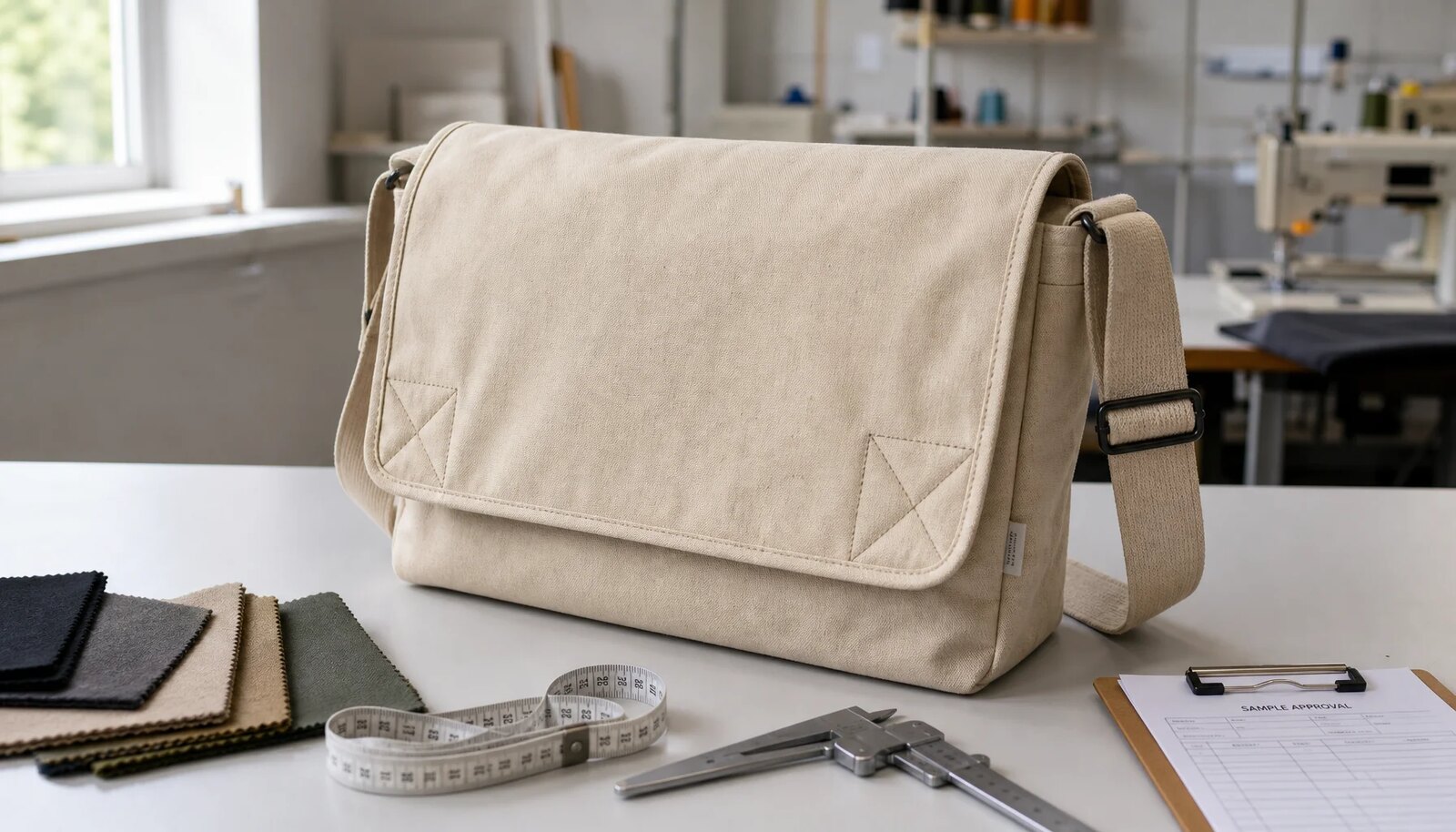
Start With The Event Load, Not The Logo
A strong sourcing brief for custom canvas messenger bags begins with the event operation. The logo matters, but the bag succeeds or fails based on what attendees need to carry, how the bag is distributed, and how long it is expected to last after the event. A one-day registration kit for printed agendas can use a simpler build than a reusable conference messenger bag that may travel between airports, hotels, meeting rooms, and sponsor booths.
Procurement should translate the event use case into measurable requirements before asking for prices. List the largest insert, typical contents, estimated loaded weight, and any rigid or bulky items such as catalogs, sample boxes, water bottles, power banks, tablets, badge holders, or product literature. A bag intended for brochures and a pen can use lighter canvas and fewer reinforcements. A bag that may carry electronics or dense printed catalogs needs stronger strap anchors, better seam finishing, and more conservative QC.
For B2B event planners, the practical question is not simply whether a messenger bag looks attractive in a mockup. The question is whether it works at registration, holds the agreed contents, survives venue handling, and arrives in cartons that the event team can actually process. Those outcomes depend on specifications that should be written into the RFQ, sample approval, purchase order, and inspection checklist.
- Define the event type, attendee profile, distribution method, and expected reuse life.
- List each intended content item with dimensions and estimated weight.
- Identify the largest rigid insert and the target loaded weight for testing.
- Confirm whether bags ship empty, pre-kitted, sorted by event site, or sorted by attendee group.
- Separate structural requirements from brand preferences before requesting supplier quotes.
Specify Canvas Weight, GSM, And Weave
Canvas weight is one of the most quoted specifications, but it is also one of the easiest to misunderstand. Ounces are commonly used in bag sourcing, while gsm gives a metric basis for comparison. A 12 oz canvas can suit light event handouts with paper collateral and small promotional items. A 14 oz canvas, often around 470-500 gsm depending on finish and construction, is a practical default for many custom canvas messenger bags used at conferences and trade shows. A 16 oz or heavier canvas can feel more substantial, but it adds material cost, sewing resistance, fold bulk, carton weight, and freight impact.
Buyers should ask whether the stated weight is measured before finishing, after dyeing, after washing, or on the finished fabric. The same nominal 14 oz label can cover fabrics that feel very different. A tight plain weave will usually print cleaner and support seam stress better than a looser construction at a similar quoted weight. Loose canvas can show needle holes more clearly, distort around strap anchors, and make ink edges look less sharp.
The best practice is to approve a physical swatch and record the written specification. If the supplier can provide yarn count, yarn size, or weave density, include it in the technical file. If not, require the approved swatch, gsm range, finish description, and hand-feel reference to control the bulk order. Natural canvas can include seed flecks and slight texture variation; that is different from stains, oil marks, severe slubs, inconsistent panels, or visibly open weave.
- Use 10-12 oz canvas only for budget bags with light, flat contents.
- Use 14 oz, roughly 470-500 gsm, as the default for many conference and trade show messenger bags.
- Use 16 oz or heavier canvas when premium structure or heavier reuse justifies cost and freight impact.
- Ask for oz, gsm, weave description, finishing method, and measurement point in the same quote.
- Approve a fabric swatch because weight numbers do not show stiffness, drape, surface texture, or print behavior.
Control Finish, Color, And Shrinkage
Finish changes the way canvas looks, prints, folds, smells, and behaves in cartons. Natural cotton canvas is often the lowest-risk choice for event programs because it is broadly available, has a familiar unbleached appearance, and usually avoids custom dye MOQ. Bleached canvas gives a cleaner base for bright graphics but can show dirt and handling marks more easily. Piece-dyed canvas can align with a brand palette, but it normally requires lab dip approval, dye-lot control, added lead time, and clear rules for shade tolerance.
Softening treatments should be specified carefully. Enzyme-softened or washed canvas can feel more retail-ready, but if it is too soft the bag may sag when filled and lose the structured messenger silhouette. Stiffer finishes can help shape and perceived durability, but may crease sharply when packed flat. Waxed or coated finishes may look premium, yet they can introduce odor, transfer, water-spot sensitivity, and print adhesion questions. Decoration should not be approved until the finish is known.
Shrinkage control is a sourcing accuracy issue, not a small detail. If fabric is washed before cutting, the supplier should quote finished-bag dimensions after that process. If panels are printed before sewing, shrinkage can shift logo placement or distort artwork. If finished bags are printed after sewing, seams and flaps can limit print area. Ask for expected shrinkage range and set tolerances against finished goods, not cut panels.
- Use natural canvas when availability, speed, and low color risk matter most.
- Use custom dyed canvas only when brand color control justifies MOQ, lab dips, and added lead time.
- Approve lab dips under consistent light and compare them to the intended webbing and trim colors.
- Confirm whether fabric is pre-shrunk, washed, enzyme-softened, coated, waxed, or finished after dyeing.
- Check odor, creasing, stiffness, crocking risk, and print adhesion before bulk approval.
Engineer Size, Gusset, Flap, And Pockets
A messenger bag is a pattern-engineered product. Finished width and height should be based on the largest insert plus practical loading clearance. If the bag must hold an A4 folder, letter-size folder, catalog, or tablet sleeve, specify the actual finished internal space rather than a rough outside size. A bag that barely fits the largest item during sample review may become frustrating when attendees try to load materials quickly at registration.
Gusset depth controls usable capacity and how the bag sits against the body. A narrow gusset packs flatter and keeps the silhouette slim. A deeper gusset holds thicker kits but increases fabric consumption, seam stress, and carton volume. Event teams should avoid adding capacity without checking carton quantity, gross weight, and closure function. A flap that closes neatly on an empty bag may pull open once the bag holds a notebook, sponsor gift, and water bottle.
Flap shape and pockets are also production decisions. A full flap gives coverage and a strong branding area, but it adds alignment points and requires closure placement control. Rounded flap corners can look softer but require more precise cutting and binding. Straight flaps are easier to inspect. Pockets, dividers, pen loops, and sleeves improve utility only when they match the event workflow; otherwise they add cost, sewing time, and defect opportunities.
- Set finished dimensions from the largest insert plus loading clearance.
- Confirm whether measurements are outside dimensions or usable internal dimensions.
- Choose gusset depth based on real contents, not only visual style.
- Limit pockets to functions attendees will use, such as agenda access, badge storage, or small device carry.
- Include tolerances for body size, gusset depth, flap length, pocket placement, and flap alignment.
Build Strap Strength Into The Spec
Strap construction deserves more attention than it usually receives in event bag briefs. Messenger bags are carried from one shoulder and concentrate load at two anchor points. For most event programs, 25-38 mm webbing is a practical range. Narrower straps can twist and dig into the shoulder. Wider straps may improve comfort but change the look, increase trim cost, and require matching hardware.
Adjustable straps need sliders that match the webbing width and do not slip under load. If the bag will carry heavier catalogs, samples, or a tablet-sized item, ask the supplier how the strap ends are reinforced. Box-x stitching, bar-tacks, folded webbing ends, and internal reinforcement patches are common ways to protect load points. The method should be visible in the sample or documented in the technical pack.
A meaningful load check does not require exaggerated claims. It should reflect the target use. If the buyer expects the bag to carry 3 kg of event contents, the inspection plan should test random bags at that weight and check for seam pulling, anchor distortion, slipped adjusters, closure failure, and fabric tearing. Testing with the intended contents is even better because rigid corners and uneven weight can reveal issues that loose weights do not.
- Specify strap width, finished length range, adjustment range, webbing material, and trim color.
- Confirm slider or buckle material, finish, and compatibility with webbing thickness.
- Use box-x stitching, bar-tacks, or reinforcement patches at strap anchors for reusable bags.
- Define the target load for inspection based on real event contents.
- Reject samples where strap anchors pucker, twist, tear, or pull away under realistic loading.
Choose Lining, Seams, And Closures
Lining changes both cost and perceived quality. Unlined custom canvas messenger bags can be economical, lighter, and faster to produce, which makes sense for large event giveaways. The interior still needs a specification. Raw seams can fray and leave threads on brochures, apparel, or electronics. Bound seams, overlocked seams, or clean trimming make an unlined bag feel controlled without the cost of full lining.
A lined bag gives a more finished interior and can hide reinforcement patches, seam allowances, and pocket construction. Polyester lining is smooth and common for utility interiors, while cotton lining may better support a natural-material positioning. Lining also adds fabric MOQ, cutting, sewing, turning, and inspection points. For premium delegate gifts, executive programs, or bags with interior pockets, lining can be worthwhile. For high-volume, budget-sensitive programs, a clean unlined or bound-seam build may be the better procurement choice.
Closures should match the event environment. Hook-and-loop is fast and economical but can snag fabric, collect lint, and sound less premium. Snaps are simple but need controlled placement. Magnets feel clean but require alignment and polarity checks. Buckles can look substantial but slow attendee access and add hardware inspection. The closure should be tested with the bag filled, not only empty.
- Choose unlined construction for simple high-volume bags when interior seams are still controlled.
- Choose bound or overlocked seams when avoiding loose threads matters but full lining is unnecessary.
- Choose lining for premium presentation, interior pockets, or hidden reinforcement.
- Specify closure type, placement, hardware finish, pull strength, and replacement rules.
- Check closure function after the bag is loaded to the target event weight.
Match Decoration To Canvas Reality
Decoration should be chosen after the material, finish, flap, and packing method are known. Screen printing is usually the best balance for one to three solid colors on canvas. It is repeatable, cost-effective at event volumes, and works well on natural canvas when ink coverage and curing are controlled. Dark canvas may require an underbase to keep colors from looking dull. More colors increase screens, setup cost, registration risk, and inspection time.
Embroidery can elevate small marks, sponsor names, or compact logos, but it is not ideal for large filled graphics on flexible canvas panels. Dense embroidery can pucker the fabric, stiffen the flap, and distort fine detail. Woven labels are useful for small brand marks that need crisp edges and repeatability. Heat transfer can reproduce gradients and complex art, but buyers should check edge durability, hand feel, fold marks, and abrasion resistance before approving it for packed event bags.
Logo placement needs physical review. A flat digital mockup does not show seam ridges, flap curvature, fold lines, or how the bag looks when filled. Keep artwork away from closure hardware, strap anchors, bulky seams, and deep fold areas unless the supplier confirms feasibility on an actual sample. Placement tolerance should be written into the PO; for many sewn canvas bags, a practical tolerance such as plus or minus 5 mm to 10 mm may be more realistic than a perfect digital location, depending on panel size and sewing method.
- Send vector artwork, Pantone targets, logo size, print area, and placement reference from fixed seams.
- Use screen print for solid-color event logos on most natural canvas bags.
- Use embroidery for small premium marks, not large filled areas on flexible panels.
- Request a strike-off or printed pre-production sample for new artwork, dark fabric, underbase, or tight color targets.
- Check print curing, opacity, registration, rub resistance, and fold impact before mass production.
Normalize Supplier Quotes And MOQ
Quote comparison only works when every supplier prices the same bag. A low quote for a generic canvas messenger bag is not comparable to a quote for 14 oz tight-weave canvas, lined interior, reinforced strap anchors, custom woven label, one-color screen print, and site-specific carton marks. Procurement teams should send one written RFQ package and require suppliers to list assumptions and exclusions.
MOQ is usually made of several smaller minimums. Canvas availability, dyeing, webbing color, zipper tape, hardware plating, label weaving, print setup, and sewing efficiency can each affect the final minimum quantity. A natural canvas bag with stock trims and a one-color logo may support a lower MOQ than a custom dyed bag with contrast lining, special metal hardware, and woven labels. Ask for MOQ by component so design decisions can be adjusted without guesswork.
Supplier route also matters. Direct factory sourcing provides better control when the bag is custom-built, the program repeats, or the buyer needs material and QC transparency. A trading company can be useful for consolidated mixed event merchandise, but the buyer should ask who controls fabric purchasing, printing, sewing, inspection, and corrective action. A domestic decorator may be useful for urgent stock bags, but it may not solve custom construction needs.
- Use the same RFQ, artwork, and technical details for every supplier.
- Request a line-item quote instead of a single blended price.
- Ask for MOQ by canvas, dyeing, webbing, hardware, lining, label, print setup, and finished assembly.
- Require suppliers to state what is included, excluded, substituted, or still assumed.
- Compare landed cost, sample quality, production control, and QC transparency, not unit price alone.
Use Samples As Approval Gates
Sampling should have clear purposes. A prototype sample confirms size, pattern, flap shape, pocket placement, strap function, and general construction. It may use substitute materials if the purpose is structure, but those substitutions should be listed. A revised prototype may be needed if the first sample reveals capacity, flap, pocket, or strap issues.
The pre-production sample should use actual bulk fabric, actual decoration, actual trims, closure hardware, label placement, and intended seam finishing. This is the sample procurement should treat as the material and construction reference. If decoration is complex, a separate print strike-off on the approved canvas may be useful before full pre-production sampling. The sealed golden sample should be kept at the factory for production and inspection, with a matching approved sample held by the buyer when possible.
Approval discipline protects the event date. Late changes to print size, flap length, closure type, or lining can restart sampling, require new screens, or force the factory to re-cut material. For fixed conferences, product launches, or sponsored events, build time for one revision into the schedule. That buffer is often less expensive than rushed production, air freight, or accepting defects because there is no time left.
- Use prototype samples to confirm pattern, size, function, and construction.
- Use pre-production samples to confirm bulk fabric, trims, print, closure, seam finishing, and packing.
- Seal a golden sample before mass production begins.
- Record all sample changes in writing, including dimensions, materials, and artwork revisions.
- Freeze artwork, fabric, trims, and construction before bulk cutting and printing.
Write QC, Packing, And Landed Cost Into The PO
Quality control works best when expectations are written before production starts. The purchase order or technical pack should define fabric weight range, finished dimensions, tolerances, stitch density, strap reinforcement, closure function, print placement, packing method, and carton marks. For sewn canvas bags, practical tolerances often need to allow small variation, but they should still be explicit. Body dimensions, gusset depth, flap length, strap length, and logo placement should not be left to verbal agreement.
Inspection should classify defects. Critical defects may include mold, sharp hardware, unsafe edges, severe odor, or strap failure. Major defects may include wrong fabric weight, incorrect dimensions outside tolerance, broken stitching, missing closures, severe print misregistration, nonfunctional zippers, crooked flaps, visible stains, or wrong packing. Minor defects may include small loose threads or slight shade variation within the approved range. Many B2B buyers use AQL inspection frameworks; the exact AQL level should be agreed with the supplier or inspection company rather than assumed.
Packing is part of the product for event orders. Bags may pass through factories, forwarders, warehouses, venue docks, and registration teams before attendees see them. Flat packing is efficient, but avoid folding through the main logo when possible. If bags are pre-kitted, provide a pack-out instruction showing item order, orientation, final bag weight, closure method, carton quantity, and site labels. Landed cost should include unit price, sampling, setup, labels, packing, inland freight, export charges, international freight, duty, brokerage, warehousing, kitting, and domestic delivery.
- Include written tolerances for dimensions, flap alignment, pocket placement, strap length, and logo position.
- Define critical, major, and minor defects with examples tied to the actual bag.
- Perform random load checks using the target event weight or actual contents.
- Inspect print after folding or packing simulation to catch rub, curing, and fold issues.
- Verify carton count, carton marks, gross weight, packing list, site labels, and delivery terms before shipment.
Specification comparison for buyers
| Spec decision | Recommended option | When it fits | Buyer risk to check |
|---|---|---|---|
| Event load target | Define largest insert size, expected contents, and loaded weight before quoting | Conference registration kits, sponsor bags, trade show handouts, VIP gifts, and multi-site event packs | Bag is priced around artwork only, then proves too small, weak, or costly once real contents are added |
| Canvas weight | 12 oz for light handouts; 14 oz around 470-500 gsm as the default; 16 oz+ for premium or heavier reuse | Most event messenger bags carrying notebooks, brochures, badges, chargers, light gifts, and small electronics | Supplier quotes ounces only, measures greige fabric instead of finished fabric, or uses a loose weave that feels thin |
| Weave and shrinkage | Tight plain weave, approved swatch, and finished-goods shrinkage stated before bulk cutting | Natural, dyed, washed, or enzyme-softened cotton canvas programs | Bulk dimensions drift because fabric shrinkage, washing, or finishing was not tied to final bag measurements |
| Finish and color | Natural canvas for lowest color risk; dyed canvas only with lab dip, dye-lot control, and MOQ confirmation | Natural event styling, brand-color programs, retail-style delegate gifts | Custom dyeing adds MOQ and lead time; coatings may affect odor, creasing, and print adhesion |
| Lining and seam finish | Unlined with bound or overlocked seams for budget; cotton or polyester lining for premium builds | High-volume giveaways, executive events, bags with pockets, zippers, or hidden reinforcement | Raw seams fray; lining adds labor, inspection points, and separate material MOQ |
| Strap and reinforcement | 25-38 mm webbing, adjustable slider when needed, box-x stitching or bar-tacks at load points | Shoulder carry, venue-to-hotel use, sponsor kits, catalogs, water bottles, or tablet-sized contents | Thin straps twist or dig into the shoulder; weak anchors fail during load checks |
| Closure system | Flap with hook-and-loop, snap, magnet, or buckle chosen by security, speed, and brand level | Registration bags, conference satchels, trade show kits, and reusable attendee bags | Hardware increases defect risk; magnets need alignment; hook-and-loop can snag or feel noisy |
| Decoration method | Screen print for 1-3 solid colors; woven label for small marks; embroidery for compact premium logos | Most natural canvas event bags where repeatability and controlled cost matter | Fine type, gradients, underbases, fold-line placement, and curing must be approved on actual canvas |
| Supplier route | Direct factory for custom construction; trading company for mixed merchandise consolidation | Repeat programs, custom sizes, controlled materials, or multi-category event sourcing | Actual fabric source, subcontracted sewing, trim substitutions, and QC ownership may be unclear |
Buyer checklist before sampling
- Confirm event type, distribution method, reuse expectation, ship-to locations, required delivery date, and whether bags are handed out empty or pre-kitted.
- List every intended content item with dimensions and estimated weight; note the largest rigid insert and target loaded bag weight for QC testing.
- Specify finished bag width, height, gusset depth, flap length, pocket dimensions, strap width, strap length range, and acceptable measurement tolerances.
- Choose canvas weight in both oz and gsm; ask whether weight is measured before washing, after finishing, or on finished fabric.
- Request yarn count or weave description, weave density if available, finishing method, shrinkage expectation, and a swatch from the intended fabric quality.
- Define color route: natural, bleached, piece-dyed, garment-washed, enzyme-softened, coated, waxed, or custom dyed with lab dip approval.
- Decide whether the bag is unlined, bound-seam, overlocked, or fully lined; specify pocket count, lining material, and interior seam cleanliness.
- Lock trims: webbing, thread, zipper tape, sliders, snaps, magnets, buckles, hook-and-loop, woven labels, care labels, hangtags, and carton labels.
- Specify decoration method, logo size, Pantone targets, underbase need, curing method, print placement tolerance, and artwork file format.
- Ask for MOQ by fabric, dyeing, lining, webbing, hardware, labels, print setup, and finished assembly instead of accepting one blended MOQ.
Factory quote questions to send
- What is the proposed canvas weight in oz and gsm, and is that value measured on greige fabric, finished fabric, washed fabric, or completed bags?
- What weave construction, yarn count or yarn size, and approximate weave density apply to the canvas, and can you provide a swatch from the intended fabric quality?
- What shrinkage range should we expect after washing or finishing, and are the quoted dimensions finished-bag dimensions after all processing?
- Is the canvas natural, bleached, piece-dyed, garment-washed, enzyme-softened, waxed, coated, or custom dyed, and what MOQ and lead time apply to each option?
- Are strap webbing, lining, zipper tape, labels, closures, sliders, snaps, magnets, buckles, and thread stock materials or custom-produced materials with separate MOQ?
- What finished measurement tolerances do you recommend for body width, height, gusset, flap length, strap length, pocket placement, and logo placement?
- What stitch density, seam allowance, reinforcement method, and load-point construction will be used at strap anchors and flap stress points?
- Which decoration method do you recommend for our artwork, and what are the limits for fine type, halftones, gradients, underbase, opacity, and registration on this canvas?
- Can you provide a prototype sample, pre-production sample using bulk materials, printed strike-off if needed, and sealed golden sample with timeline and fees shown separately?
- What inspection standard do you assume, what AQL level is included, and which defects will be classified as critical, major, and minor?
Quality-control points to confirm
- Canvas weight, gsm range, hand feel, shade, weave tightness, surface cleanliness, and finish match the approved swatch and written specification.
- Finished body width, height, gusset depth, flap length, pocket position, strap length, and logo placement stay within the agreed tolerance sheet.
- Stitch density is consistent, seam allowance is controlled, seams are straight, and load points have secure box-x stitching, bar-tacks, or reinforcement patches.
- Strap anchors show no puckering, twisting, loose stitching, fabric tearing, slipped webbing, or uneven left-right placement after random load checks.
- Flap alignment, closure position, magnet polarity, snap function, hook-and-loop contact, buckle movement, and pocket access work when the bag is filled.
- Print color, opacity, registration, curing, rub resistance, placement, and edge quality match the approved printed sample, especially near seams and fold lines.
- Embroidery, woven labels, zippers, pulls, snaps, magnets, buckles, sliders, and hook-and-loop are aligned, functional, clean, and free from sharp edges.
- Inside seams are bound, overlocked, lined, or trimmed according to spec, with no loose threads likely to catch on event contents.
- Bags are free from stains, oil marks, needle cuts, mildew, strong odor, shade panels, dirt, broken threads, and visible fabric flaws beyond approved natural variation.
- Carton count, polybag or bulk packing, carton marks, site labels, SKU labels, gross weight, and packing list match the purchase order.