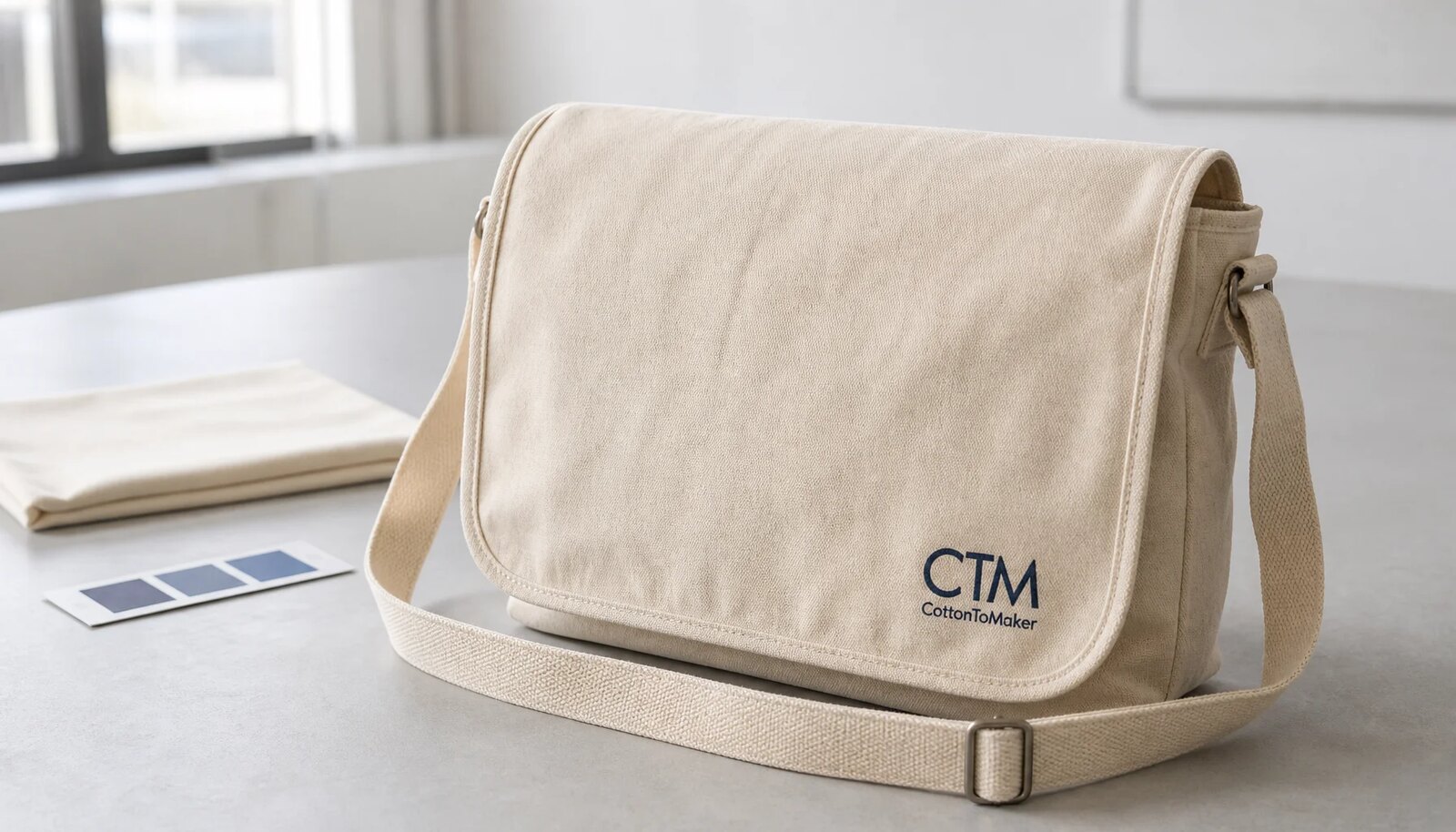
Start With the Craft Fair Selling Context
Logo placement should begin with the way the messenger bag will be used, not with the artwork file. At craft fairs, the same canvas bag may be retail merchandise, a booth staff bag, reusable customer packaging, a sponsor premium, or a private-label base for several vendors. Each role changes how large the logo should be, where it belongs, and how much production risk is worth accepting.
A resale bag needs to feel like a finished product. The logo should sit cleanly on the bag, hold up to repeated flap movement, and avoid the look of a temporary giveaway. A staff bag can carry a bolder mark because its job is visibility from the aisle. A customer packaging bag often works better with restrained branding; the buyer wants the end customer to keep using it after the event.
Display method matters just as much. On a wall grid, straps may cross the flap. On a table stack, the lower part of the flap can be covered by folded webbing, price cards, or hang tags. In a bin, shoppers may only see the top edge or side gusset. When staff wear the bag, the body can tilt once it is loaded, which makes a perfectly centered flat print look slightly off in real life.
The RFQ should include a short display note and, when possible, a photo of the booth setup. That one detail helps the supplier understand why the logo cannot sit near a fold, why a side label may be useful, and why packing must keep straps away from the printed face.
- Resale merchandise: use balanced front flap branding, controlled logo size, and retail-grade packing.
- Booth staff bag: prioritize readable placement from aisle distance and test the bag while worn with contents inside.
- Customer packaging: keep branding visible but modest so the bag feels reusable after the event.
- Multi-vendor program: standardize the bag and logo zone, then use hang tags, barcode labels, or inserts for vendor-level variation.
- Display brief: tell the supplier whether the bag will hang, stack, sit in a bin, ship to vendors, or be worn during the fair.
Freeze Construction Before Approving Artwork
Logo placement cannot be finalized while the bag construction is still moving. The usable print area depends on finished width, height, gusset depth, flap length, flap curve, binding, topstitching, pocket seams, closure type, and strap anchor position. A logo that looks perfect on a rectangular mockup can land too close to a snap, disappear under a fold, or run into a stitch line once the real pattern is used.
Most craft fair messenger bags fall into a few practical structures. A flat document-style bag gives a cleaner flap surface but less volume. A gusseted messenger carries more personal items and purchases, yet it bends more at the flap edge and creates more pressure during packing. A compact crossbody format is easy for staff to wear in a crowded booth, but it leaves less room for front branding.
Closure choice is one of the biggest placement constraints. Magnetic snaps create a pressure point and can leave a circular impression through the flap. Velcro creates an abrasion zone and can collect lint from natural cotton canvas. Buckles, buttons, leather tabs, and strap closures add character, but they interrupt the print surface. Even a small reinforcement patch can shift the best logo position by several millimeters.
Before final artwork approval, ask for a flat technical drawing. It should show the flap edge, seam allowance, top fold, binding, topstitching, closure center, pocket openings, strap anchors, reinforcement patches, and hardware. The logo should then be dimensioned from fixed physical points, not positioned by eye on a lifestyle mockup.
- Confirm body size: finished width, height, gusset, flap depth, flap curve, and dimensional tolerance.
- Confirm closure: magnetic snap, Velcro, buckle, button, zipper, tab, or open flap.
- Confirm strap: cotton webbing, canvas, adjustable webbing, shoulder pad, width, adjuster type, and anchor location.
- Confirm panels: front pocket, back pocket, lining, inner divider, reinforcement, binding, and seam allowance.
- Confirm process order: flat-panel printing before sewing or decoration after the bag is assembled.
Specify Canvas Like a Buyer, Not a Catalog
Canvas descriptions can sound reassuring while still being too vague to quote properly. Heavy duty, thick, and premium do not define fabric. For procurement, specify finished canvas weight in both ounces and GSM, then add color, finish, construction, hand feel, and substitution rules. Messenger bags are more sensitive than basic totes because the flap, gusset, strap, and closure all affect structure and print behavior.
For many custom canvas messenger bags used at craft fairs, 10 oz to 12 oz cotton canvas is a practical starting range. Depending on yarn, weave, and finishing, 10 oz may sit around 280-320 GSM and 12 oz may sit around 340-400 GSM. Treat those as comparison ranges, not universal conversions. Ask whether the quoted weight is greige fabric weight or finished fabric weight.
Finish changes the result quickly. Natural canvas may contain cotton specks, seed flecks, slubs, and uneven yarn texture. That can suit a handmade retail environment, but it can also break up small letters. Dyed canvas changes ink opacity requirements, especially on black, navy, olive, burgundy, and chocolate. Washed canvas may feel softer but print less evenly. Coated or water-repellent canvas needs adhesion checks before the decoration method is locked.
If the program uses multiple body colors, do not assume one logo setup will perform equally on every SKU. A navy print on natural canvas may be crisp at a modest size. A tonal logo on olive canvas may need more scale or a woven label. Dark body colors may need an underbase or a different branding method altogether.
- Basic event line: 8-10 oz canvas, simple flap, one-color print, limited pockets, and standard carton packing.
- Retail craft fair line: 10-12 oz canvas, reinforced flap, clean topstitching, controlled print position, and protected packing.
- Premium boutique line: 12-14 oz canvas, washed or structured finish, subtle label or patch, and stricter appearance inspection.
- Dark canvas: test ink opacity, curing, rub resistance, and edge clarity on the final fabric color.
- RFQ wording: state oz, GSM, finish, body color, swatch approval, shrinkage expectation, and substitution policy.
Build a Measurable Front Flap Logo Map
The closed front flap is usually the best logo position for a canvas messenger bag because it is the surface shoppers see first. It is also the surface that gets folded, touched, pressed, opened, packed, and rubbed. The aim is not the largest possible logo. The better goal is a mark that stays readable, straight, and intact after the bag is filled, worn, shipped, unpacked, and displayed.
A good starting rule is to keep the logo at least 20-30 mm away from binding, flap edges, topstitching, the bottom curve, the fold line, and hardware. Increase that margin for rounded flaps, thick binding, washed canvas, irregular natural slub, or artwork with small lettering. If the flap has a magnetic snap, avoid the pressure circle. If it has Velcro, avoid both the contact patch and the normal hand path used to pull the flap open.
For centered logos, define the vertical centerline of the flap and mark the logo center point. For lower-right logos, define the distance from the right or left flap edge and from the bottom flap edge. For asymmetric flaps, measure from a construction point that production and inspection can repeat. A phrase like lower right is not enough for a factory order.
Approve placement in physical conditions. Close the sample, open it, hang it, place it on a table, wear it, and fill it with a realistic load. A low logo on an empty sample may roll under the front edge when the gusset is full. A high logo can disappear into the fold when the flap bends forward.
- Recommended zone: lower-center or lower-right closed flap, outside hardware, folds, and seam pressure.
- Safe margin: start with 20-30 mm from flap edge, binding, topstitching, fold line, and closure components.
- Reference points: left edge, right edge, bottom edge, centerline, topstitch seam, closure center, and flap fold.
- No-print zones: snap pressure circle, Velcro patch, buckle straps, buttons, rivets, darts, heavy seams, and hand-grip areas.
- Approval evidence: require a marked technical drawing and physical sample photos with measurement reference.
Choose the Decoration Method Around the Artwork
Screen printing is often the first method to evaluate for custom canvas messenger bags. It works well for solid one-color or two-color logos, repeat production, and branding on flat cut panels. It can give natural canvas a clean craft-market look, but it still needs control: screen setup, ink opacity, curing, registration, and panel movement all affect the final bag.
Heat transfer can help when the artwork is full color, contains gradients, or has detail that is inefficient to screen print at the order quantity. The tradeoff is feel and flex. Transfers may lift, crack, or show a film edge if the flap bends repeatedly. A sharp digital proof does not answer those questions. The transfer has to be tested on the same canvas and then checked after folding, rubbing, and packing.
Embroidery can lift a small logo into a more premium position, especially on boutique merchandise. It is not automatically the best option. Dense embroidery on lighter canvas can pucker the flap, stiffen the panel, or show backing on the reverse side. If embroidery is selected, quote stitch count, digitizing, backing, thread color, maximum area, and whether the panel is embroidered before sewing.
Woven labels, cotton labels, and patches deserve serious consideration for craft fairs. A side label can make the bag feel like retail merchandise instead of a promotional item. A cotton label can support an artisan look. PU, rubber, or leather patches add presence, but they also add material approval, sewing tolerance, and compliance review for the destination market.
- Screen print: best for solid logos, repeat orders, flat panel decoration, and controlled color references.
- Heat transfer: useful for multi-color graphics but requires edge, flex, adhesion, and hand-feel testing.
- Embroidery: suitable for small premium marks but must control puckering, backing, density, and reverse appearance.
- Woven label: subtle, repeatable, and useful for boutique or private-label bags where a large print feels too promotional.
- Patch: adds structure and retail character but adds material sourcing, stitching tolerance, and compliance checks.
Control Logo Size, Detail, and Color Count
Logo size should be chosen for the bag, not copied from a tote program. For many canvas messenger bags, an 80-160 mm wide front flap logo is a useful starting range. Smaller marks can feel more retail, especially for boutique craft fair merchandise. Larger marks can help staff visibility, but they also increase ink coverage, alignment risk, scuffing exposure, and the chance of crossing a stress zone.
Canvas is less forgiving than paper, vinyl, or smooth polyester. Texture can close tiny gaps, soften sharp edges, and make small serif type hard to read. Natural cotton flecks may interrupt thin strokes. If the artwork includes fine lettering, a line illustration, a small tagline, or tight registration between colors, ask the supplier to state minimum line thickness and minimum letter height before making screens or digitizing embroidery.
Color count affects cost and stability. Each screen color adds setup cost, registration time, production handling, and inspection complexity. On natural canvas, single-color navy, black, rust, forest green, charcoal, or dark brown often reads clearly while still fitting a craft retail environment. On dark canvas, white or light ink may require an underbase or extra ink deposit, which can change hand feel and curing behavior.
For multi-vendor programs, standardization protects the schedule. Different artwork files are manageable. Different positions, decoration methods, body colors, label rules, and packing formats turn one order into a complicated customization project. Decide which variables are truly necessary before the RFQ goes out.
- Typical front logo width: 80-160 mm, adjusted after reviewing flap width, artwork detail, and retail display distance.
- Minimum detail: ask the factory for minimum line thickness and minimum letter height on the final 10-12 oz canvas.
- Color reference: specify Pantone, thread card, physical swatch, or approved strike-off rather than relying on screen color.
- Multi-color risk: budget for registration tolerance, underbase needs, extra setup, longer sampling, and more inspection points.
- Vendor programs: standardize logo zone and print method to reduce changeovers and mixed-SKU errors.
Quote MOQ by Real SKU Split
MOQ should be discussed by production reality, not by the total order number alone. A 2,000-piece run in one natural canvas body color with one navy front flap logo is straightforward. The same 2,000 pieces split across four body colors, six vendor logos, two label versions, individual polybags, and barcode stickers is a different project with different labor, sampling, and inspection needs.
Logo placement changes cost because different positions require different handling. Printing a flat front flap panel before sewing is usually more efficient than decorating a finished bag. Side labels, strap marks, patches, and multi-location branding add operations and QC points. Strap printing may need jigs and can still twist during actual use. Patches may require material MOQ, cutting, edge finishing, and separate color approval.
Ask suppliers to separate recurring unit cost from one-time and changeover costs. Screen fees, embroidery digitizing, woven label molds, patch molds, sample fees, lab dips, hang tags, barcode labels, and special packing should be visible in the quote. That structure makes reorders easier to plan and prevents a low unit price from hiding costs that return when a new vendor logo is added.
Compare landed cost with carton data in view. Messenger bags are bulkier than flat totes because of straps, gussets, closures, and heavier canvas. A lower unit price may lose its advantage if the fold method creates large cartons, low pieces per carton, or high pressure damage. Request carton dimensions, pieces per carton, gross weight, net weight, and packing photos before final comparison.
- Simple MOQ structure: one body color, one logo, one ink color, one position, standard fold, and master carton packing.
- Moderate SKU structure: two body colors using the same print size, same position, and consistent packing method.
- Complex SKU structure: multiple vendor logos, several positions, labels, patches, hang tags, barcodes, and individual retail packing.
- Quote comparison: align Incoterm, quantity, SKU split, canvas weight, print method, sample process, carton data, and delivery point.
- Hidden cost: post-approval logo movement can require new screens, new jigs, revised inspection criteria, and repeat sampling.
Use Samples to Prove the Whole Order
A strong sample process proves more than an attractive hand sample. It should confirm fabric, logo, construction, function, packing, and inspection criteria. A practical sequence is fabric swatch or lab dip, logo strike-off, pre-production sample, packed sample, then bulk approval. Skipping steps may look faster at the beginning and still cost time if bulk output fails inspection later.
The strike-off is the key step for logo work. It should be produced on the same canvas weight, color, and finish planned for bulk. A paper proof can confirm scale and layout, but it cannot prove opacity, edge clarity, rub resistance, or how small lettering behaves on textured cotton. For embroidery, the strike-off should show stitch density, backing, thread color, and puckering. For labels, it should show fold, cut edge, stitch position, and orientation.
The pre-production sample should become the master reference. Measure it, photograph it, and record the approved artwork version. Check the bag closed and open. Fill it with the expected carrying load, such as a notebook, small boxed goods, wallet, phone, or event materials. Hang it from a peg, wear it on a shoulder, and place it on a display table. The logo should still make sense in all of those states.
Packing approval should be separate. Ask for one sample packed exactly like bulk, including fold direction, strap position, tissue or release paper, polybag or paper sleeve, hang tag, barcode, carton orientation, and vendor-level labeling. If the strap crosses the logo or hardware presses into the printed flap, fix packing before production cartons are filled.
- Fabric approval: confirm color, hand feel, thickness, finish, shrinkage expectation, and substitution rules.
- Logo strike-off: confirm color, coverage, edge clarity, adhesion, line detail, and actual fabric behavior.
- Pre-production sample: confirm placement, construction, closure, strap path, filled-bag shape, and retail appearance.
- Packed sample: confirm fold method, logo protection, hang tag, barcode label, carton orientation, and pressure risk.
- Approval file: keep artwork version, measurements, photos, color references, tolerance notes, and packing instructions together.
Set QC Tolerances Inspectors Can Enforce
Quality control works best when the approved sample is translated into measurable rules. For front flap screen printing on canvas, ±5 mm from approved reference points is a common practical placement tolerance. Some suppliers may hold tighter placement, but that must be agreed before pricing and sampling because canvas panels can move during cutting, printing, curing, sewing, pressing, and packing.
Measurement instructions should be simple enough to repeat at carton inspection. For example, measure from the left flap edge to the left edge of the logo and from the bottom flap edge to the bottom edge of the logo. For centered artwork, compare the logo center to the flap centerline. For lower-right artwork, measure both horizontal and vertical offset. Visual judgment alone creates arguments, especially on curved flaps and textured canvas.
Define print defects before production starts. Common reject conditions include smears, tacky ink, double images, obvious skew, missing strokes, severe pinholes, wrong color, ink transfer, and misregistration that affects readability. Natural canvas flecks and minor texture show-through may be acceptable if the approved strike-off shows the same character. Write down where fabric character ends and printing defect begins.
QC should also test the logo against function. Open and close the flap several times. Check snap pressure, Velcro abrasion, buckle contact, hand-grip areas, and strap movement. Fill the bag and inspect whether side labels twist or disappear into the gusset. Review packed units for scuffing, offset, pressure shine, strap imprints, mixed SKUs, and incorrect carton marks.
- Position: measure X/Y placement from the same approved physical points on every inspected unit.
- Skew: compare artwork baseline to flap bottom edge, topstitch seam, or centerline, not only distance from edges.
- Color: compare to approved strike-off under consistent lighting and document acceptable shade range.
- Adhesion: perform dry rub and light wet rub after curing, then inspect for transfer, flaking, smearing, or tackiness.
- Function: open, close, fill, hang, and wear selected units to confirm the logo avoids stress and abrasion zones.
- Packing: inspect for strap marks, hardware dents, transfer, gloss change, carton compression, and mixed-logo cartons.
Write Packing Instructions Around the Logo
Packing is part of logo quality. Canvas messenger bags are often folded flat to reduce carton volume, but the fold can put pressure directly on the printed flap. Webbing straps, buckles, adjusters, snaps, and patches can press into ink or transfer film. A single sample may look fine on the factory table while carton pressure creates marks after storage or export handling.
The safest fold method depends on the decoration method. For heavier screen prints, tissue, release paper, or glassine over the print face may reduce scuffing and offset. For heat transfers, test whether the protection sheet prevents blocking or creates edge marks. For embroidery and patches, pressure dents and stitch abrasion may matter more than ink transfer.
Individual packaging should match the channel. Polybags can simplify shipment to individual vendors and protect against dust and handling, but some craft fair programs prefer reduced plastic or recycled materials. Paper sleeves, belly bands, glassine sheets, recycled polybags, or master-carton-only packing may all work if tested. Retail programs may also need hang tags, barcode labels, care cards, warning labels, or vendor-specific carton marks.
Carton planning affects both cost and appearance. Too many pieces per carton can crush flaps and mark logos. Too few pieces increase freight cost. Ask for carton dimensions, gross weight, net weight, pieces per carton, packing orientation, and photos of an open carton and sealed carton. For multi-vendor craft fair programs, carton labels should identify PO number, SKU, logo, body color, quantity, and destination.
- Protect the logo: use tissue, release paper, glassine, or sleeve when testing shows scuffing, offset, or gloss-change risk.
- Control straps: fold straps inside the bag or along the side, not tightly across the printed flap.
- Separate hardware: keep buckles, adjusters, snaps, and metal tabs from pressing directly into ink or transfer film.
- Match channel: specify polybag, recycled bag, paper sleeve, belly band, hang tag, barcode, or master carton only.
- Confirm carton data: require dimensions, pieces per carton, net weight, gross weight, CBM, carton marks, and packing photos.
Specification comparison for buyers
| Sourcing decision | Recommended specification | Why it matters for craft fairs | QC or quote risk to control |
|---|---|---|---|
| Main front flap logo | Place on the closed flap, usually lower-center or lower-right, with 20-30 mm minimum clearance from binding, topstitching, flap curve, closure hardware, and fold line | This is the face shoppers see when the bag hangs behind a booth, sits on a table stack, or is worn by staff in the aisle | If the logo crosses a snap, Velcro patch, buckle strap, heavy seam, or curved edge, it can look tilted, wear early, or crack under repeated opening |
| Logo measurement method | Define X/Y placement from fixed physical points such as left flap edge, bottom flap edge, vertical centerline, topstitch seam, closure center, or binding edge | Inspectors need a repeatable method that works across cartons, not a visual guess based on a digital mockup | Without fixed reference points, a supplier may center artwork on the cut panel while the sewn flap appears shifted after folding or binding |
| Canvas weight | Specify finished fabric in oz and GSM, such as 10 oz around 280-320 GSM or 12 oz around 340-400 GSM, subject to supplier standard and finishing | Messenger bags need more structure than flat totes because the flap, gusset, strap, and closure all affect retail appearance | Ounce weight alone is not enough; confirm whether the weight is greige or finished, and review thickness, hand feel, shrinkage, and finish |
| Canvas finish | Approve actual swatches for natural, dyed, washed, enzyme washed, brushed, coated, or water-repellent canvas before logo strike-off | Finish changes ink absorption, color appearance, stiffness, abrasion behavior, and how the bag marks in packing | A logo approved on smooth sample fabric may fail on washed, slubbed, dark dyed, or coated bulk canvas |
| Print method | Use screen print for solid 1-3 color logos on flat panels; evaluate heat transfer, embroidery, woven label, cotton label, or patch when artwork or brand positioning requires it | Craft fair programs often need a balance of visibility, retail feel, repeatability, and controlled unit cost | Fine lines can fill in, transfers can lift, embroidery can pucker, and patches add sewing tolerance; require method-specific samples |
| Logo size | Use 80-160 mm wide as a practical front flap range, then adjust to bag width, flap depth, artwork detail, and viewing distance | The mark should read at a booth without making the product feel like disposable promotional stock | Oversized artwork increases ink use, registration risk, scuffing, carton pressure marks, and the chance of crossing stress zones |
| Secondary branding | Use a woven side label, inner label, hang tag, cotton label, or small patch when subtle retail branding is more appropriate than a large print | Boutique craft fair, museum shop, maker market, and private-label programs often need quieter branding than event giveaways | Labels can twist, disappear into seam allowance, or face the wrong direction; approve fold, size, seam location, and orientation |
| MOQ planning | Quote by SKU split: body color, artwork, print color, logo position, packing method, label version, and barcode requirement | A 2,000-piece single-logo run is very different from 2,000 pieces split across many vendors, colors, and carton destinations | Hidden costs include extra screens, strike-offs, label MOQs, packing sortation, barcode setup, line changeover, and longer inspection time |
| Packing protection | Specify strap folding, logo-face protection, individual packaging, carton orientation, and maximum carton pressure before bulk packing | Messenger bag straps and hardware can mark the printed flap during storage, parcel handling, or ocean freight | Fresh ink, heavy transfers, buckles, and adjusters can leave offset, gloss change, abrasion, or pressure dents if packing is not tested |
Buyer checklist before sampling
- Define the sales role before design approval: resale merchandise, booth staff bag, customer packaging, event premium, subscription box item, or private-label retail line.
- Confirm finished bag dimensions, flap length, flap shape, gusset depth, strap width, closure type, inner pocket, back pocket, lining, reinforcement, and intended carrying load.
- State the finished canvas specification in both oz and GSM, and identify whether the quoted fabric weight is before or after dyeing, washing, coating, or other finishing.
- Request a physical fabric swatch or lab dip for each body color, including hand feel, thickness, shrinkage expectation, colorfastness expectation, and whether stock substitution is allowed.
- Provide vector artwork with final logo size, color reference, minimum line thickness, minimum letter height, clear space, orientation, and acceptable simplification rules for textured canvas.
- Mark logo placement on a flat technical drawing using fixed dimensions from flap edge, bottom edge, centerline, closure center, stitch line, binding, and strap anchor.
- Define no-print zones around magnetic snaps, Velcro patches, buckles, buttons, flap folds, pocket openings, bartacks, rivets, binding, and heavy seam allowances.
- Tell the supplier how the bag will be presented at craft fairs: wall rack, table stack, peg display, bin display, staff-worn, individual vendor shipment, or retail carton.
- Choose the branding hierarchy: main flap print, small side label, inner label, hang tag, barcode label, strap mark, patch, or no visible logo except packaging.
- Approve a logo strike-off on the same canvas color, weight, and finish planned for bulk; do not approve color, line detail, or opacity from a digital proof only.
Factory quote questions to send
- What finished canvas weight are you quoting in oz and GSM, and is that weight measured before or after dyeing, washing, coating, or other finishing?
- Is the quoted fabric greige, stock dyed, custom dyed, washed, enzyme washed, brushed, pigment dyed, waxed, water-repellent coated, or untreated natural cotton canvas?
- Can you provide a physical swatch or lab dip for each canvas color before full sample making, and can you state expected shrinkage after the selected finishing process?
- What is the maximum printable area on the closed flap after allowing for seam allowance, binding, flap curve, topstitching, fold line, closure hardware, pocket opening, and pattern movement?
- Will the front flap be printed as a flat cut panel before sewing, or will the finished bag be decorated after sewing? How does that change cost, tolerance, and maximum print size?
- Which decoration method do you recommend for this artwork on this canvas: screen print, heat transfer, embroidery, woven label, cotton label, rubber patch, PU patch, or leather patch?
- What minimum line thickness and minimum letter height do you recommend for clean results on the selected 10-12 oz canvas, including natural slub or dark dyed colors?
- What setup charges apply by screen color, transfer film, embroidery digitizing, woven label mold, patch mold, hang tag, barcode label, or special packing material?
- Can you produce a print strike-off on the final canvas before the pre-production sample, and can it include dry rub, light wet rub, tape pull, or other adhesion checks you normally perform?
- What logo placement tolerance in millimeters do you normally hold for flat-panel flap printing, finished-bag printing, side seam labels, patch stitching, and strap printing?
Quality-control points to confirm
- Measure logo placement from the same fixed points on every inspected bag, such as left flap edge, bottom flap edge, vertical centerline, closure center, binding edge, or topstitch seam.
- Set front flap print tolerance before production; ±5 mm is a common practical target for canvas flap printing, while tighter requirements should be priced and sampled specifically.
- Check logo skew by comparing the artwork baseline to the flap bottom edge, topstitch seam, or approved centerline; a logo can meet X/Y distance tolerance and still look slanted.
- Inspect ink coverage for pinholes, broken letter edges, uneven opacity, smears, double images, ghosting, contamination, tackiness, excessive ink buildup, and missing strokes.
- Compare bulk logo color to the approved strike-off under consistent neutral lighting, not only under warehouse light, phone photos, or digital artwork viewed on screen.
- Check ink adhesion after proper curing with dry rub and light wet rub on representative units; dark ink should not easily transfer to white tissue or packing paper.
- Open and close the flap repeatedly to confirm the logo does not sit under a magnetic snap pressure circle, Velcro abrasion zone, buckle movement, button contact, or hand-grip area.
- Verify topstitching, bartacks, rivets, patch stitching, label seams, and pocket seams do not cut through the artwork unless the approved sample intentionally shows that construction.
- Inspect side labels for correct fold, orientation, readability, stitch capture, seam allowance, and visibility when the bag is filled, worn, and placed on a display table.
- Check strap printing or strap labels for twist, off-center placement, rubbing under adjusters, hidden position under a shoulder pad, and inconsistent alignment between left and right sides.