1. Why eco apparel brands need lead-time planning before they request quotes
For eco apparel brands, custom canvas messenger bags are rarely just a bag order. They often sit inside a seasonal launch, a wholesale line review, or a branded retail drop where the bag must align with material claims, packaging standards, and margin targets. That means the timeline starts before the first supplier quote. If the brief changes after the factory has already booked canvas or trim, the order can lose both time and cost control.
The fastest way to get a misleading promise is to ask for a price before the product intent is stable. A simple messenger bag can become a longer project as soon as the team adds organic cotton canvas, recycled cotton content, custom dye, padded lining, or FSC-certified packaging. Buyers should treat lead-time planning as a commercial task, not just a production task: if the bag has to support a campaign date, wholesale delivery window, or sustainability claim, those requirements should be locked into the RFQ from day one.
- Define the launch window before supplier outreach, then work backward from ship date.
- Separate must-have sustainability claims from nice-to-have branding details.
- Treat packaging, labeling, and documentation as part of the product timeline, not as afterthoughts.
2. Lock the spec sheet and sustainability requirements first
A procurement team gets better speed and fewer revisions when it sends one version-controlled spec sheet instead of a loose description. For custom canvas messenger bags, the factory needs more than size and logo position. It needs the target use case, the bag silhouette, the strap construction, the closure type, the lining decision, the pocket layout, and the packaging format. For eco apparel brands, the brief should also say whether the bag must be made from organic cotton canvas, recycled cotton canvas, or a conventional canvas with verified low-impact materials.
The sustainability line should be written in operational language. If you need GOTS, OEKO-TEX, or GRS options, state which material or component the claim covers. If azo-free dyeing matters, say whether that applies to the fabric, lining, or print ink. If your retail team wants FSC hangtags, recycled-paper insert cards, or compostable or recyclable packaging, include those items in the spec rather than assuming the factory will add them. The more specific the brief, the easier it is to compare quotes and the harder it is for a supplier to hide exclusions.
- Freeze the spec version and put the date on every RFQ.
- List dimensions, fabric weight, closure, lining, strap drop, pocket count, and logo placement.
- State the sustainability claim for each component: fabric, trim, label, and packaging.
- Ask the factory to acknowledge every assumption in writing before sample work begins.
3. Material and finish choices that change speed, shade control, and documentation
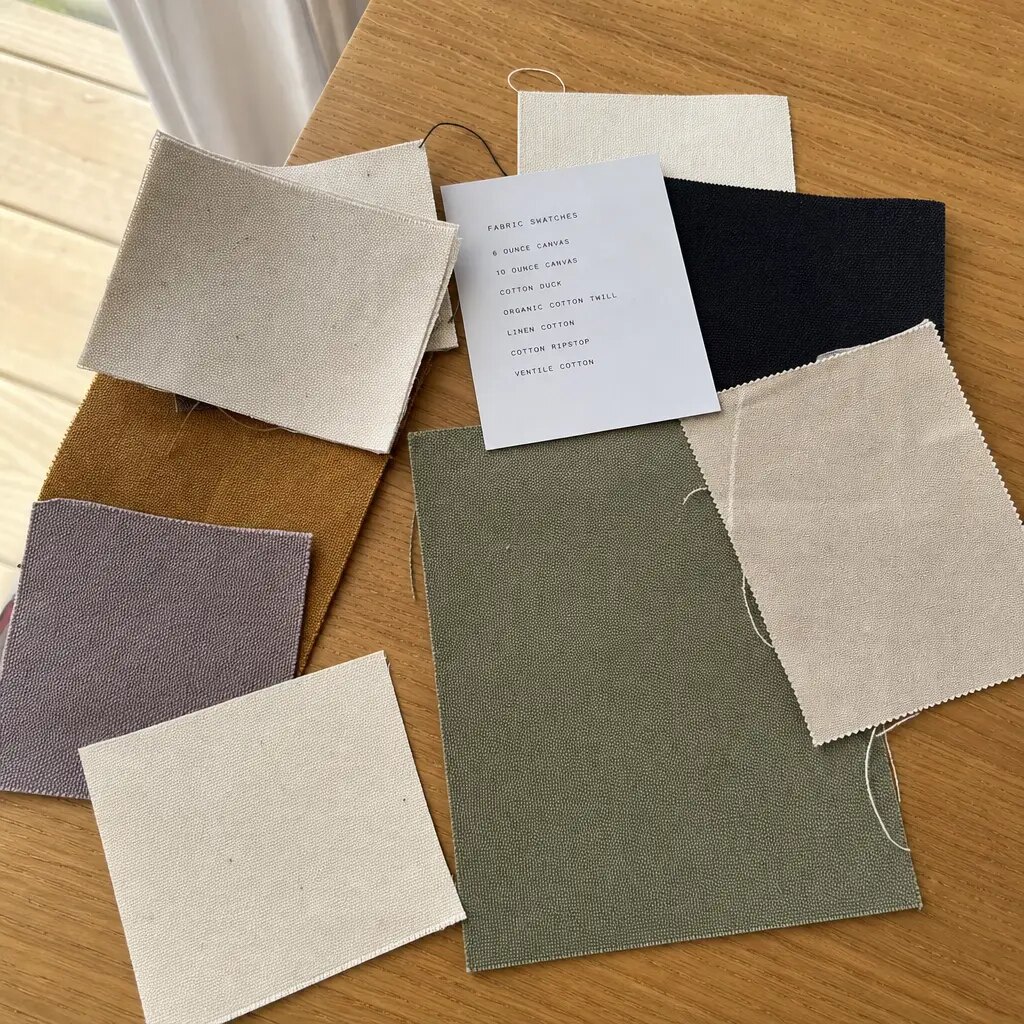
Material choice drives both lead time and risk. Organic cotton canvas can be a strong fit for eco apparel brands, but the factory still needs to confirm available weights, shrinkage behavior, and any certification scope tied to the yarn or fabric mill. Recycled cotton canvas can support a circular story, but the buyer should ask how the recycled content is traced and whether the supplier can provide the relevant certification or test documentation. If you are selling into a channel that checks claims closely, do not rely on a logo or verbal assurance alone.
Finishing choices are just as important. A raw-natural canvas may be the fastest route if it is in stock, while washed, garment-dyed, or enzyme-finished canvas often needs extra approval time and more attention to shade variation. Low-impact dyeing and azo-free colorants can support a cleaner brand story, but they still need sample approval and a clear agreement on acceptable shade band. For printed bags, water-based or low-impact print systems may reduce the environmental footprint, but the buyer should still test adhesion, hand feel, and rub resistance on the final fabric, not just on a swatch.
- Ask whether the canvas is stock, mill-order, custom-dyed, or finished after weaving.
- Confirm shrinkage, colorfastness, and shade tolerance before bulk booking.
- Request copies of certificates or test reports in scope, not just a supplier logo in an email signature.
- If you need a specific claim on hangtags or packaging, confirm what wording is permitted and who approves it.
4. A realistic lead-time calendar from artwork approval to freight booking
A useful lead-time plan breaks the job into stages instead of quoting one vague total. For a standard custom canvas messenger bag, the planning sequence usually begins with spec confirmation and artwork approval, then moves into material booking, sample making, bulk production, inspection, packing, and freight booking. If the bag uses stock canvas and a simple one-color logo, the process can move quickly. If it uses custom-dyed fabric, a new woven label, or special packaging, the approval gates expand the timeline.
A practical planning range for many small-to-medium orders looks like this: 1 to 3 days for final spec and RFQ alignment, 1 to 3 days for artwork proofing, 3 to 10 days for stock-material booking, 5 to 10 days if a lab dip or shade sample is needed, 7 to 14 days for a first sample, 5 to 10 days for a pre-production sample, 10 to 25 days for bulk sewing and finishing, 1 to 3 days for inspection, and 2 to 5 days for packing and dispatch preparation. Larger volumes, multi-color print, or custom finishing can extend the sewing phase. For seasonal launches, add a buffer of at least one approval cycle and one additional transit week so a late artwork change does not erase the ship window.
- Build the calendar backward from store launch or warehouse receipt date, not from factory start date.
- Treat artwork approval, shade approval, and sealed sample sign-off as schedule gates.
- Add extra time for custom dyeing, special hardware, and branded packaging.
- Do not book freight too early if product details are still moving.
5. Compare sourcing routes before you commit to a quote
The best supplier route depends on what you need to control. A direct factory is usually strongest when your spec is clear, your volume is repeatable, and you want one point of accountability for sewing, finishing, and final QC. A trading company can be useful when you need to benchmark options quickly, coordinate several factories, or trial a small run without building every supplier relationship yourself. Mixed sourcing works when the bag body, the labels, and the packaging are better handled by different specialists.
Procurement buyers should not compare routes only by unit price. A direct factory may quote a slightly higher bag price but lower total risk if it can hold the same fabric lot, maintain sewing consistency, and cut revisions quickly. A trading company may look flexible, but the buyer should understand where the actual production happens and who signs off on the final quality. Mixed sourcing can be efficient, but only if one party owns the final spec and release decision; otherwise the project becomes a handoff problem instead of a production plan.
- Use a direct factory when spec control and reorders matter most.
- Use a trading company when you need market speed or small test quantities.
- Use mixed sourcing when packaging, hangtags, or labels have separate sourcing advantages.
- Ask who owns final QC, not just who sends the quote.
6. Sampling gates that prevent costly bulk rework
Sampling is where many timelines are won or lost. A prototype sample should prove proportion, pocket depth, strap drop, and overall look. A pre-production sample should prove the final material, final branding, final label placement, and final packing method. If the bag uses dyed canvas, this is also where shade approval matters. Do not approve from photos alone when the color or hand feel is important; a real sample is the only practical way to judge how the fabric behaves under sewing tension and use.
The safest approval path is simple: prototype, then material or shade approval if needed, then pre-production sample, then sealed reference sample. Keep one sealed sample at your office and one with the factory. Mark the approved version number, date, and any agreed tolerances directly on the spec sheet. That gives your operations team a clear reference during mass inspection and prevents the classic dispute where the buyer remembers one version of the bag and the factory remembers another.
- Measure the sample, do not just eyeball it.
- Test the closure, strap length, pocket function, and balance when the bag is loaded.
- Approve shade under consistent light, not beside a window one day and under warm office lighting the next.
- Keep written sign-off for artwork, sample, and packing before bulk cutting starts.
7. Packing, labeling, and sustainability documentation should be part of the quote
Packing choices influence both damage risk and receiving speed. Canvas messenger bags fold, crease, and pick up dust if the pack format is too loose or too tight. The factory should confirm the fold direction, whether the logo panel stays visible, and whether insert paper, tissue, or stiffeners are needed. For eco apparel brands, packaging may also be part of the sustainability story, so it matters whether the hangtag is FSC-certified, whether the insert card is recycled paper, and whether the polybag is recyclable or compostable in the way your market requires.
Documentation is where sustainable sourcing becomes procurement-ready. If you need to support an organic cotton or recycled-content claim, ask for the right paperwork in advance and confirm that the documents match the exact component used in production. A certificate that is out of date, out of scope, or tied to a different mill is not enough. If the factory is also supplying packaging, ask for the packaging material spec and make sure the warehouse team can still scan, shelve, and unpack it efficiently. Sustainable packaging that slows fulfillment can create a different operational problem.
- Define the unit pack, master carton count, and carton mark before bulk starts.
- Request FSC hangtags or recycled-paper inserts only if they are actually part of your retail brief.
- Confirm whether the packaging claim applies to the bag, the label, the insert, or the carton.
- Ask for barcode format, carton dimensions, and outer label placement so your warehouse can receive the goods without relabeling.
8. Procurement-grade QC: measurements, seams, print, color, and cartons
A useful QC plan is specific enough that a third party could inspect the order without guessing. For custom canvas messenger bags, the inspection should cover dimensions, stitching, reinforcement, printing, hardware, and packing. Many buyers use AQL 2.5 for major defects and 4.0 for minor defects on wholesale programs, but your internal standard may be tighter for premium retail. The important point is to define it before production so the factory knows what is being measured and what counts as a failure.
Measurement tolerance should be written in numbers, not adjectives. A common buyer approach is to allow around ±0.5 cm on key body dimensions for standard bags and around ±1 cm on strap length unless your brand standard demands tighter control. Seam checks should include bartacks at stress points, no skipped stitches, no loose thread tails, and no seam slippage at corners. For print, check placement against centerline and edge distance, then do a dry rub and a slightly damp rub on a sample from the bulk lot. Hardware should open and close smoothly with no sharp edges, rust, or crooked setting. If the style is destined for a channel that requires needle detection, define the process in advance so metal hardware does not create false alarms. Before shipment, inspect random cartons for count accuracy, moisture, odors, carton crush, and correct SKU labels, then release the lot only after the inspection report is closed.
- Agree the AQL standard and defect definitions before bulk cutting.
- Test strap reinforcement under load, not only by visual inspection.
- Check print adhesion and rub resistance on bulk samples.
- Verify carton count, carton condition, and packing list accuracy before release.
9. How to write a quote request suppliers can price without hidden assumptions
A good RFQ saves more time than a rushed follow-up call. To make quotes comparable, every supplier needs the same version of the same bag. That means one spec sheet, one artwork file set, one packing standard, and one sustainability requirement list. Ask the supplier to show every assumption in the quote: whether it includes lining, whether the label is woven or printed, whether the hangtag and barcode are included, whether the canvas is stock or custom dyed, and when the lead time clock starts. If the supplier is vague, the quote will be vague too.
Procurement teams also need to think beyond the first order. If the style may be reordered, ask the supplier how they will keep consistency across dye lots, print registration, and hardware sourcing on the second run. If the bag is for a seasonal launch, ask whether the factory can reserve material and line time after sample approval. For eco apparel brands, this is also the moment to check document readiness: can the supplier provide the material paperwork, carton spec, and packing list format that your warehouse and compliance team expect? The right quote request is not longer; it is clearer.
- Use one RFQ template for every supplier so you can compare apples to apples.
- Separate bag-body cost, branding cost, packaging cost, and freight assumptions.
- Ask for lead time by stage, not only as a single total number.
- Request a written list of exclusions and change-order charges before you approve the order.
10. Launch buffers and reorder rules for seasonal eco collections
For seasonal launches, the biggest mistake is treating the factory promise as the whole schedule. Lead-time planning should include a buffer for artwork revision, sample correction, shade approval, inspection rework, and freight booking. A simple stock-material bag may only need a modest buffer, but once you add organic cotton sourcing, recycled-content verification, or custom packaging, the plan should carry a wider margin. In practice, that usually means one extra approval cycle and enough time to change freight mode if the launch date is suddenly at risk.
Reorder planning deserves the same discipline. If the first run succeeds, the second run should not depend on memory. Save the approved spec, artwork version, seal sample photo set, carton marks, and certificate copies in one folder. Ask the supplier which inputs are likely to change next time: fabric lot, shade, hardware availability, or packaging MOQ. For eco apparel brands, consistency matters because sustainable claims and customer expectations tend to be stricter over time. A strong reorder process protects the product story as much as it protects the margin.
- Add buffer for launch-critical orders instead of assuming the best-case schedule.
- Save every approved document from the first run so the reorder can match it.
- Review what changed between runs: fabric lot, dye lot, packaging, or hardware.
- If timing is tight, decide early whether to change freight mode or reduce scope.
Specification comparison for buyers
| Sourcing route / scenario | Control | Typical speed | MOQ / setup profile | Cost pattern |
|---|---|---|---|---|
| Direct factory / stock canvas and standard trims | High | Fastest if materials are already in stock | Usually lower setup burden; MOQ depends on existing fabric and hardware | Best unit cost when you keep one color and one logo method |
| Direct factory / custom-dyed or washed canvas | High | Slower because shade approval adds time | Higher MOQ risk due to dye lot and finishing minimums | Higher material cost and more approval steps |
| Direct factory / lined or padded messenger bag | High | Moderate to slow | More labor and component coordination | Higher sewing cost and longer inspection time |
| Trading company / test order with stock materials | Medium | Often faster for quoting and coordination | Low-to-medium MOQ depending on supplier network | Convenient for small tests, usually not the cheapest unit price |
| Trading company / multi-supplier benchmark round | Medium | Moderate | MOQ varies by factory behind the trader | Can look competitive upfront but add coordination fees |
| Trading company / urgent reorder management | Medium | Fast for communication, not always for production | Best when the prior factory relationship already exists | May carry service or handling premium |
| Mixed sourcing / bag body direct, labels and hangtags separate | High on body, medium on branding components | Moderate | Useful when branding items have different MOQs | Can reduce waste if packaging volumes are smaller |
| Mixed sourcing / bag body direct, packaging sourced locally | High on core bag, medium on packaging | Can shorten export packing if local vendor is close | Packaging MOQ may be separate from bag MOQ | May reduce freight if packaging is flat-packed locally |
| Mixed sourcing / sample development in one place, bulk in another | Medium to high if governance is strong | Can be fast for sampling but slower if bulk source changes | Sample-only MOQ is usually separate from bulk MOQ | Sample cost can be recovered by better bulk control |
Buyer checklist before sampling
- Freeze bag dimensions, strap drop, closure type, pocket count, and target load before asking for price.
- State the sustainability position clearly: organic cotton canvas, recycled cotton content, or conventional canvas with certified trims and packaging.
- Ask which certifications are actually in scope for the materials used, such as GOTS, OEKO-TEX, or GRS, and whether transaction certificates are available where needed.
- Send vector artwork, Pantone references, logo placement drawings, and the number of print locations or embroidery zones.
- Confirm whether the canvas will be stock dyed, custom dyed, garment washed, or raw-natural, because each choice changes lead time and shade control.
- Define packaging in the RFQ: compostable or recyclable polybag, FSC hangtag, recycled-paper insert card, barcode label, and master carton mark.
- Ask for a sample path with dates: prototype sample, material approval or lab dip, pre-production sample, and sealed reference sample.
- Set the launch date backward from shipping, then add a buffer for artwork revision, material booking, inspection, and freight booking.
- Request a written QC plan with AQL level, measurement tolerances, load-test expectations, and carton/moisture checks.
- Confirm Incoterms, factory ship readiness date, and who is responsible for booking freight, export paperwork, and destination documentation.
Factory quote questions to send
- What exact fabric composition, weight, weave, and finish are included in the quote, and is shrinkage already allowed for?
- Does your lead time start from deposit, artwork approval, material approval, or pre-production sample sign-off?
- Which materials are stock and which are custom-made, and what extra days are needed for custom dyeing, washing, or certification checks?
- Can you quote the same bag with and without lining, padding, and internal organizer pockets so we can see the cost impact?
- What MOQ applies per color, per print version, and per hardware option?
- Which certification documents can you provide for the claimed material: GOTS, OEKO-TEX, GRS, or supplier-specific test reports, and are they current and in scope?
- What is included in the packing quote: individual polybag, insert card, FSC hangtag, barcode sticker, carton mark, and master carton spec?
- What inspection standard do you follow, and what AQL level do you recommend for this style?
- What measurement tolerances do you accept for bag body, strap length, print placement, and pocket alignment?
- If we request a lab dip, custom woven label, or nonstandard hardware, how much extra time and cost should we budget?
Quality-control points to confirm
- Agree the inspection standard before production starts; for many wholesale programs, buyers use AQL 2.5 for major defects and 4.0 for minor defects, but the final standard should match your own risk policy.
- Measure body width, height, and gusset against the approved spec, typically with a tolerance of about ±0.5 cm for ordinary bag dimensions and ±1 cm for strap length unless your brand standard is tighter.
- Check strap bartacks, handle reinforcement, and stress points with a load expectation tied to use case; if the bag is laptop-ready, request a documented pull or load test against your internal standard.
- Inspect stitch quality for skipped stitches, loose thread ends, needle damage, puckering, and seam slippage, especially around pockets, flaps, and gussets.
- Confirm print placement and registration against a fixed reference point, and use the same lighting and approved artwork version for every inspection.
- Test print adhesion with a dry rub and a slightly damp rub on a sample from the bulk lot; reject obvious transfer, cracking, or premature peeling.
- Check shade band control for dyed or washed canvas so one carton does not contain visibly different tones without approval; if the program allows shade variation, define the acceptable band before sewing starts.
- Verify hardware function: zippers run smoothly, buckles close squarely, snaps seat fully, rivets are centered, and there are no sharp edges or rust marks.
- If your downstream channel requires needle detection, define the process before packing and clarify how metal hardware will be handled so the factory does not create false rejections.
- Use a pre-shipment inspection flow that includes carton count, carton condition, unit pack check, random measurement sampling, function testing, moisture or odor check, and photo evidence before release.