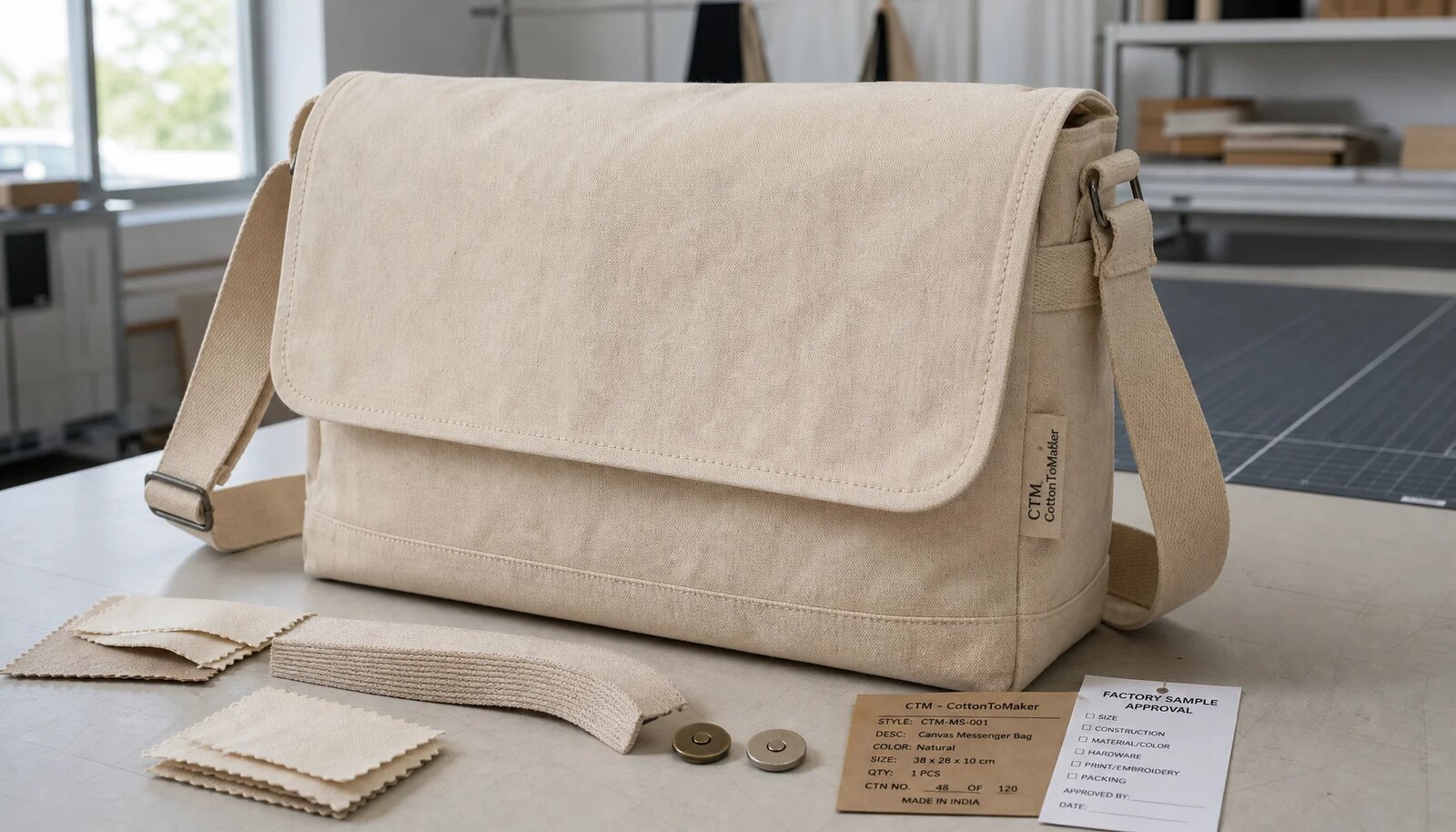
Start with the fair date, not the factory date
For custom canvas messenger bags used at craft fairs, the factory completion date is only one milestone. The real deadline is earlier: the day the bags must be ready for booth setup, event-kit assembly, distributor pick-and-pack, retail shelf loading, sponsor dispatch, or warehouse receiving. If the shipment arrives after the event window, a technically acceptable bag may still fail the program commercially.
That is why buyers should separate sourcing lead time from production lead time. A supplier may quote 30 or 45 days, but that figure may exclude quotation, artwork checking, fabric swatches, sample making, sample courier, internal approval, deposit processing, material booking, print strike-off, inspection, packing, inland transport, export clearance, freight, customs, and final receiving. Ask exactly what starts the production clock.
Build the calendar before negotiating the last few cents. Work backward from the event date. Subtract booth setup and receiving cutoffs, then freight and customs, final inspection, packing, bulk sewing, printing, material arrival, sample approval, and artwork confirmation. The result will show whether the order can move by ocean freight, whether part of it needs air freight, or whether the specification needs to be simplified.
On a fixed craft fair schedule, late design changes are more dangerous than many buyers expect. Changing canvas weight, flap depth, logo position, closure, label, strap, or packing after approval can reset pattern work, print layout, trim ordering, and QC criteria. Treat sample approval as a production freeze unless the calendar still allows another controlled sample round.
- For repeat designs with approved specifications, plan roughly 30-45 days for confirmation and bulk production before freight.
- For new structures with custom flap, pockets, lining, closure, strap, or trims, plan roughly 45-60 days before freight.
- Add 10-15 working days of buffer for artwork corrections, sample courier delays, fabric shade issues, inspection findings, or packing rework.
- For ocean freight, include booking, port handling, destination customs, inland trucking, and warehouse receiving, not only sailing time.
- For multi-location craft fair programs, add time for SKU sorting, carton labeling, destination allocation, pallet rules, and receiving appointments.
Turn the event use into a real specification
A canvas messenger bag can be paid merchandise, a sponsor gift, an exhibitor welcome item, an artist collaboration product, a staff bag, or a seasonal stock item for several fairs. Those use cases should not be sourced the same way. Retail merchandise needs a cleaner finish, stronger presentation, consistent logo placement, and better packing. A giveaway may prioritize speed, cost control, and a simpler logo method.
Load matters. A bag carrying a map and postcards does not need the same reinforcement as one expected to hold catalogs, notebooks, a tablet, water bottle, samples, and customer purchases. Messenger bags carry weight through side strap attachments and across the flap area, so strap angle, gusset depth, side-seam reinforcement, and closure placement carry more risk than they do on a flat tote.
A useful RFQ tells the factory who will use the bag, what it will carry, whether it is retail or promotional, what document size it must fit, and how it will be distributed. If the bag must hold A4 or US letter materials, say so. If it will be sold on a peg or shelf, include hang tag, barcode, and individual packing. If it will be packed into exhibitor kits, define carton quantities and destination labels.
Internal approval time also belongs in the sourcing plan. Procurement may compare quotes, but marketing often approves logo scale, merchandising approves retail presentation, logistics approves carton weight, compliance may review material declarations, and event teams approve destination packing. If those decision owners are not ready during sampling, factory waiting time can consume the buffer.
- Define whether the bag is retail merchandise, sponsor gifting, exhibitor kit, staff equipment, or low-cost promotional distribution.
- State expected carrying load, such as catalogs, notebooks, small purchases, samples, tablet, water bottle, or event guide.
- Confirm whether the finished bag must fit A4, US letter, a tablet sleeve, retail hang display, or pre-packed event kit.
- Choose a target positioning: natural artisan, dyed brand color, premium boutique, budget promotional, or reusable utility bag.
- List internal approvers for structure, artwork, trims, labels, packing, carton data, logistics, and final sample release.
Lock canvas weight and finish early
Canvas weight is one of the quickest ways for two quotes to drift apart. One supplier may price 8 oz canvas while another prices 12 oz, and both may call the item a custom canvas messenger bag. The name sounds the same, but the product, cost, sewing behavior, carton weight, and customer perception are different. Ask for both oz and GSM because regional fabric descriptions are not always consistent.
For many craft fair programs, 10-12 oz cotton canvas, roughly 280-340 GSM, is a practical middle range. It gives the flap enough body without making side seams and bottom corners overly bulky. A 14 oz canvas can suit a heavier retail line, but it adds cutting resistance, sewing time, needle wear, seam bulk, carton weight, and possible freight cost. Lighter 6-8 oz canvas can work for short-term promotional use, but it may feel too soft for a structured messenger shape.
Finish affects both appearance and schedule. Natural canvas supports an artisan look, but shade can range from off-white to beige. Bleached canvas gives a cleaner base and stronger contrast, though it can show dirt faster. Dyed or pigment-dyed canvas gives stronger brand color direction but needs swatch approval and dye-lot control. Washed canvas feels softer and more retail-ready, yet it can shrink or distort, so the pattern and tolerance must allow for it.
Request swatches before the full sample when shade, hand feel, print absorption, or material claims matter. A swatch is not a production approval, but it prevents wasted sample rounds on unsuitable fabric. If the bags will appear in presale images, sponsor catalogs, or online listings, approve the fabric shade before final photography.
- Specify canvas in oz and GSM, for example 10 oz / approximately 280 GSM or 12 oz / approximately 340 GSM.
- State whether fabric is natural, bleached, dyed, pigment-dyed, washed, unwashed, organic cotton, recycled blend, or pre-shrunk.
- Ask whether the quote uses stock fabric or a custom-dyed lot, because custom dyeing can change MOQ and approval time.
- Confirm shrinkage expectations if fabric is washed, steam finished, or stored in humid conditions before distribution.
- Approve swatches for shade, hand feel, density, and print absorption before finalizing the production sample.
Engineer the messenger bag before sampling
Messenger bags can look simple in product photos, but small construction choices change the production route. A basic unlined flap bag with one main compartment is quick to cut, print, sew, inspect, and pack. Add lining, zipper pockets, laptop sleeves, piping, binding, metal sliders, key loops, woven labels, or rivets, and the project gains more operations and more supplier dependencies.
Many sample delays begin with missing construction details. If the RFQ does not specify flap depth, gusset width, strap width, usable strap length, closure position, pocket layout, label placement, seam allowance, and reinforcement method, the factory has to assume. Those assumptions may be fine for a first sample photo, but not for the real selling environment. Correcting them later can change the pattern, print position, cutting yield, and sewing sequence.
Reinforcement should be designed before bulk cutting, not added after problems appear. Stress points include side strap attachments, bottom corners, magnetic snap areas, flap corners, pocket openings, and heavy seams. Depending on the style, reinforcement may include box stitching, bar tacks, backing patches, double-layer canvas, binding tape, or extra seam allowance. These details are more reliable when they are part of the pattern from the start.
The strap is one of the first quality points users notice. A 38-40 mm strap is a common comfortable range for adult messenger use, but final selection depends on bag size, load, and brand positioning. Adjustable straps add flexibility, especially for crossbody wear, but they require sliders, buckles, and extra inspection. Fixed straps are faster and simpler, yet the length must work over light clothing and jackets.
- Provide finished dimensions as width x height x gusset, and state whether measurements are taken flat, filled, or shaped.
- Define flap coverage, closure location, pocket layout, label location, and whether the bag is lined or unlined.
- Specify strap width, material, fixed or adjustable construction, hardware finish, and usable length range.
- Mark reinforcement at strap joints, bottom corners, flap corners, snap positions, pocket openings, and stress-bearing seams.
- Use box stitching, bar tacks, backing patches, or double layers where load and repeated opening are expected.
- Avoid changing pockets or flap depth after artwork approval because seams and folds affect logo placement.
Choose decoration by artwork, not habit
Screen printing is often the most predictable choice for craft fair canvas messenger bags when artwork uses one to three solid colors. It offers good cost control, reliable opacity when the ink is selected correctly, and efficient output after screens are prepared. The buyer should provide vector artwork, final print size, Pantone or color references, and exact placement measured from a seam, flap edge, or centerline.
A digital mockup can hide problems that appear on sewn canvas. The flap folds over the body, seams create uneven surfaces, and snaps or rivets reduce the printable area. Keep logos away from folds, snaps, binding, and heavy stitching. As a practical rule, 15-20 mm of clearance helps reduce distortion and registration issues, although the factory should confirm the workable area based on its equipment.
Heat transfer can reproduce gradients, fine text, photographs, and multi-color sponsor marks, but it changes hand feel and requires careful pressing. Check for edge lifting, scorching, gloss difference, cracking, and a plastic-like surface feel. Embroidery can look premium for small marks, but dense embroidery on coarse or lighter canvas may pucker the flap. Woven labels work well for subtle branding, but label MOQ and lead time must be quoted.
A print strike-off is a small step that prevents expensive surprises. It verifies ink color, opacity, registration, curing, edge sharpness, and absorption on the actual canvas. Natural canvas can make ink look warmer or duller than it appears on coated paper or a screen proof. If sponsor colors are strict, approve a physical strike-off and define the acceptable color range before bulk printing.
- Use screen print for one to three solid colors, clean logos, event names, and most craft fair brand marks.
- Use heat transfer for gradients, small text, photo-like graphics, or many colors at lower quantities.
- Use embroidery for small premium marks, initials, or patches rather than large filled artwork on bulky flap panels.
- Keep decoration at least 15-20 mm from seams, folds, snaps, rivets, binding, and heavy stitching unless approved by the factory.
- Approve a print strike-off for color, opacity, registration, curing, rub resistance, and placement before bulk panels are printed.
- Confirm whether printing happens before sewing or after sewing because placement tolerance and defect risk are different.
Read MOQ by component, not by total order
MOQ for custom canvas messenger bags is not just a factory preference. It is shaped by fabric purchasing, dye lots, cutting yield, print setup, trim sourcing, line changeover, packing separation, and inspection time. A 1,000-piece order may run efficiently as one style and one logo. Split it into five colors, ten sponsor logos, and several packing lists, and it becomes several smaller jobs.
Procurement teams should ask for MOQ per style, fabric color, print design, woven label, trim color, closure type, and packing method. A supplier may accept 500 pieces total but require 300 pieces per color, or charge a separate setup for every logo. Without this detail, buyers compare unit prices that are not based on the same production reality.
Split designs can still work when the bag platform is standardized. Keep the same canvas, strap, closure, dimensions, label position, and carton format, then vary only the print where possible. If sponsor identification does not need to be permanent, a hang tag, insert card, belly band, or carton allocation may be easier than many low-quantity printed versions.
Price negotiation should look at landed value, not only FOB unit cost. A lower unit price can disappear after screen charges, sample rounds, special packing, SKU sorting, extra freight volume, and warehouse rework. Ask for quantity breaks using the same specification, and request carton CBM at each break if freight will be quoted separately.
- Confirm MOQ per bag style, fabric color, print design, label, strap color, closure, and packing configuration.
- Ask whether multiple logos can share one cutting and sewing run while using separate print setups.
- Expect additional setup charges and longer handling time for many low-quantity sponsor or exhibitor logo versions.
- Reduce cost by standardizing fabric, strap, closure, dimensions, label location, packaging, and carton marks.
- For a trial order, one 500-piece colorway is usually easier to manage than five 100-piece color splits.
- Compare product cost, setup, sampling, packing, freight CBM, and warehouse labor before choosing the lowest unit price.
Use samples as buying controls
Samples are not presentation props. They are buying controls. A custom messenger bag sample proves fabric weight, pattern balance, flap alignment, strap comfort, closure strength, print absorption, pocket access, label placement, and packing appearance. A sample made from substitute fabric can show the general shape, but it should not release bulk production for a fixed craft fair deadline.
For a new structure, plan on a prototype and then a pre-production sample. The prototype checks the pattern, proportions, load path, and general construction. The pre-production sample should use final canvas, final webbing, final hardware, final decoration, final label, and final packing. This sample becomes the reference for bulk cutting, sewing, packing, and final inspection.
Sample comments should be measurable. Instead of saying the flap should look better, write increase flap depth by 20 mm. Instead of move the logo slightly, write move the logo centerline 10 mm higher from the bottom flap edge. Instead of make the strap stronger, specify 40 mm webbing, box stitch size, bar tack, backing patch, and required pull check. Clear feedback saves sample rounds.
Buyer review time needs its own calendar slot. If the factory makes a sample in five working days but the buyer takes ten working days to gather comments, the delay is internal. For event-based orders, assign decision owners and review windows before the first sample ships.
- Fabric swatch checks weight, shade, hand feel, weave density, shrinkage risk, and print absorption.
- Prototype sample checks size, structure, flap coverage, strap comfort, pocket layout, and general sewing method.
- Print strike-off checks color, opacity, edge sharpness, registration, curing, and placement on actual canvas.
- Pre-production sample checks final fabric, webbing, closure, trim, print, label, packing, and carton presentation.
- Seal sample should be signed or approved in writing, dated, photographed, and referenced in the purchase order.
- Do not release bulk cutting from a digital mockup when the construction, fabric, or decoration is new.
Write an RFQ factories can price without guessing
A strong RFQ protects the buyer and the factory. It gives the supplier enough detail to price the real bag, and it gives procurement a clean basis for comparing quotes. A product photo and quantity are not enough. If fabric weight, strap specification, closure, pocket layout, logo method, label, packing, carton data, and delivery terms are missing, the quote will be full of assumptions.
Ask suppliers to separate unit price, setup charges, sample cost, courier cost, decoration charges, trim charges, label cost, packing cost, carton data, payment terms, Incoterm, and lead time triggers. For importers and distributors, carton dimensions and gross weight are not minor details. They affect freight budget, container planning, courier feasibility, warehouse handling, and event routing.
Normalize specifications before comparing suppliers. A quote for 8 oz natural canvas with hook-and-loop closure and bulk packing should not be compared directly with a quote for 12 oz dyed canvas, magnetic snap, woven label, individual recycled polybag, and barcode sticker. The price difference may simply be a specification difference.
Good RFQ language also includes tolerances and approval gates. When the purchase order defines fabric weight, finished size, print location, construction details, carton marks, inspection standard, and production lead time trigger, accountability is clearer. If the order relies only on a photo or an old reference sample, disputes over shade, strap length, or logo placement become harder to resolve.
- Request price breaks at 500, 1,000, 2,500, and 5,000 pieces using identical specifications.
- List unit price separately from screen charges, digitizing, sample fees, courier, labels, tags, barcodes, and special packing.
- Ask for estimated carton size, pieces per carton, net weight, gross weight, and CBM before freight budgeting.
- Clarify Incoterms, loading port, quote validity, payment terms, approval process, and production lead time trigger.
- Require the supplier to confirm any assumptions about fabric, trim, printing, packing, or tolerances in writing.
- Compare suppliers only after matching fabric weight, dimensions, strap, closure, print area, label, packing, and carton data.
Plan packing for freight and event handling
Light canvas can show dust, carton rub, water marks, and handling dirt more easily than dark synthetic fabric. Craft fair messenger bags may pass through factory packing, inland trucking, export handling, ocean or air freight, customs, warehouse receiving, event staging, booth staff, and finally the customer. Packing has to protect the product without slowing receiving or adding unnecessary volume.
Individual polybags are the most practical protection against dust and moisture on longer routes. Recycled polybags can reduce virgin plastic use while keeping light canvas cleaner. Paper belly bands create a more retail-friendly low-plastic presentation, but they do not protect the bag from dust or humidity. Bulk packing may be acceptable for internal giveaways, but it increases the risk of creased flaps, tangled straps, dirty fabric, and mixed quantities.
Packing can add real lead time. Hang tags, barcode stickers, retail inner cartons, destination packing, mixed assortments, pallet labels, and allocation by venue all require files, approvals, labor, and inspection. Provide barcode data, label artwork, destination lists, and carton mark requirements before bulk goods reach the packing line.
Carton planning affects cost and delivery reliability. Canvas messenger bags are bulkier than flat totes and can become heavy when packed tightly. Overpacked cartons can crush flaps and exceed warehouse handling rules. Underpacked cartons increase CBM and freight cost. Define pieces per carton, maximum gross weight, carton strength, SKU separation, and whether cartons can be mixed.
- Use individual polybags when natural or light canvas must remain clean through freight and warehouse handling.
- Use recycled polybags if protection is required and the buyer wants reduced virgin plastic content.
- Use paper belly bands only when the route is controlled and lower dust or moisture protection is acceptable.
- Keep cartons separated by SKU, fabric color, logo, label, packing style, purchase order, and destination.
- Set gross weight limits, commonly around 12-18 kg depending on warehouse handling rules and local requirements.
- Confirm palletization, mixed carton rules, barcode files, carton marks, and destination allocation before final quote approval.
Set measurable QC before production starts
Quality control for canvas messenger bags should focus on defects customers and event teams notice fast: weak strap joints, crooked flaps, dirty fabric, loose threads, print misplacement, poor ink curing, snap tearing, uneven dimensions, odor, and carton mix errors. The best time to prevent these issues is before bulk sewing, not when cartons are sealed and the event date is close.
Inspection standards should be measurable. Finished dimensions within plus or minus 1 cm are usually realistic for sewn cotton canvas unless the bag must fit tight packaging or fixtures. Print placement within plus or minus 5 mm from the approved sample is a practical target when measured from a defined seam, flap edge, or centerline. Strap pull checks should reflect expected use; for craft fair bags carrying catalogs, notebooks, tablets, and small purchases, a common practical check is a 5-8 kg static load plus visual review for seam distortion.
Inline inspection matters because defects appear at different points. Fabric shade mixing and stains are caught during roll inspection and cutting. Print defects should be caught before sewing. Strap reinforcement, snap backing, seam puckering, and pocket stitching are controlled during sewing. Thread trimming, stains, odor, dimension checks, and packing accuracy are verified during finishing and final inspection.
Final QC must include carton review. A shipment can pass product inspection and still fail the program if cartons contain mixed logos, wrong barcodes, inaccurate quantities, missing destination marks, or excessive gross weight. For craft fair programs, carton errors create rework at exactly the moment event teams have the least time.
- Inspect fabric rolls and cut panels for weight, shade, stains, holes, skew, and wrong material before printing.
- Inspect printed panels before sewing for registration, opacity, curing, crooked placement, smears, and color variation.
- Check strap attachments, side seam reinforcement, snap backing, pocket openings, and flap corners during inline sewing.
- Review finished bags for dimension tolerance, flap symmetry, seam puckering, loose threads, stains, odor, and logo alignment.
- Verify cartons for SKU, quantity, barcode, destination mark, carton condition, gross weight, and packing method.
- Request inspection photos that compare bulk goods to the approved pre-production sample and show measured checkpoints.
Specification comparison for buyers
| Procurement decision | Recommended specification | Lead time impact | QC or quote risk to verify |
|---|---|---|---|
| Canvas body fabric | 10-12 oz cotton canvas, approximately 280-340 GSM, for most craft fair retail and event programs | Stock greige or natural fabric is usually faster; custom-dyed lots add swatch approval, dyeing, and shade control time | Confirm actual GSM, weave density, shrinkage if washed, and whether the quote is based on stock fabric or a custom dye lot |
| Premium fabric upgrade | 14 oz canvas, approximately 395-475 GSM, only when the bag is positioned as heavier retail merchandise | Heavier canvas slows cutting and sewing, increases seam bulk, adds carton weight, and may raise freight cost | Check sewing capacity, seam bulk at corners, strap attachment strength, needle marks, and whether cartons stay within weight limits |
| Fabric finish | Natural, bleached, dyed, pigment-dyed, washed, or unwashed canvas stated in the RFQ | Natural and stock colors are quicker; washed or custom-dyed canvas needs extra approval and shrinkage control | Natural shade can vary by lot; dyed canvas needs color tolerance; washed canvas needs dimension checks after finishing |
| Main structure | Messenger style with flap, gusset, side seam strap attachment, and optional internal pocket defined by technical drawing | Simple unlined structures move fastest; lining, zipper pockets, piping, and laptop sleeves add operations and trim purchasing | Unclear flap depth, gusset width, pocket placement, and strap length cause sample revisions and print-placement errors |
| Closure | Magnetic snap with backing patch for retail feel, or hook-and-loop tape for budget event distribution | Magnetic snaps require hardware stock and reinforcement; hook-and-loop is usually faster but less premium | Magnetic snap pull force, backing patch size, and alignment must be checked; hook-and-loop can collect lint and show wear |
| Strap | 38-40 mm cotton webbing or heavy cotton-poly webbing, fixed or adjustable, with box stitch and bar tack where appropriate | Adjustable straps with metal sliders and buckles add trim sourcing, sewing time, and inspection points | Confirm usable length range, webbing color tolerance, stitch density, hardware finish, and pull test load before bulk sewing |
| Decoration | Screen print for 1-3 solid colors; heat transfer for gradients or small text; embroidery or woven label for small premium marks | Screen printing needs film/screen setup and curing; heat transfer needs press control; embroidery adds machine time | Ask for print strike-off, Pantone or Lab target, placement tolerance, rub/tape/fold checks, and artwork limits near seams |
| MOQ structure | 500-1,000 pieces per style/color/logo as a practical planning range; confirm factory-specific minimums | Multiple colorways, logo versions, labels, or packing sets behave like separate mini-runs | Quote MOQ per fabric color, per print design, per label, per trim color, and per packing method, not only total order quantity |
| Sample gate | Prototype plus pre-production sample using final fabric, trim, decoration, label, and packing for fixed event dates | New structures often need two sample rounds; repeat approved designs may move directly to PP sample | Do not approve bulk cutting from a digital mockup or substitute-fabric sample when delivery date is fixed |
Buyer checklist before sampling
- Confirm the craft fair date, booth setup date, warehouse receiving deadline, and latest acceptable delivery date before requesting factory pricing.
- Build a reverse calendar that separates RFQ, artwork proof, fabric swatch, prototype, print strike-off, pre-production sample, bulk production, inspection, packing, export handling, freight, customs, and warehouse receiving.
- Specify canvas in oz and GSM, and state natural, bleached, dyed, washed, unwashed, pigment-dyed, organic, recycled blend, or pre-shrunk if relevant.
- Provide finished dimensions as width x height x gusset, plus flap depth, pocket layout, strap width, usable strap length range, closure type, stitch reinforcement, label placement, and packing format.
- Send vector artwork with Pantone or other color references, final print size, print location, print method preference, number of colors, and minimum distance from seams, folds, snaps, and flap edges.
- State whether the program includes one style only or split SKUs by logo, fabric color, trim color, label, hang tag, destination, carton mark, or packing method.
- Ask for MOQ and price breaks by style, fabric color, print design, label, closure, and packing set before comparing unit prices.
- Require a pre-production sample made with final fabric, final webbing, final closure, final print, final label, and final individual or bulk packing for fixed craft fair delivery dates.
- Set written tolerances for finished dimensions, flap symmetry, print placement, print adhesion, stitch density, strap pull strength, snap reinforcement, fabric shade, stains, odor, and carton labeling.
- Confirm carton dimensions, pieces per carton, estimated CBM, net weight, gross weight, carton mark format, pallet requirements, barcode files, and destination allocation before production finishes.
Factory quote questions to send
- What canvas weight are you quoting in both oz and GSM, and is the fabric stock natural, bleached, dyed, washed, unwashed, pigment-dyed, or custom produced?
- What fabric shrinkage tolerance should we expect after washing, steaming, or normal humid storage, and will the production pattern be adjusted for washed canvas?
- Is the quoted price based on our finished dimensions, flap depth, gusset width, strap width, usable strap length, pocket layout, closure, reinforcement, and packing method?
- What is the MOQ per style, fabric color, print design, woven label, trim color, closure type, and packing set?
- How many working days are needed for prototype sample, fabric swatch, print strike-off, pre-production sample, bulk production, final inspection, and packing after each approval?
- When does the production lead time start: after deposit, artwork approval, sample approval, material arrival, final packing file approval, or all of these gates?
- Which decoration method is included, how many colors are included, what ink or transfer type is used, and what is the maximum print area included in the unit price?
- Are screen charges, embroidery digitizing, mold charges, magnetic snap cost, zipper cost, woven label cost, hang tag cost, barcode sticker cost, recycled polybag cost, and sample courier cost included or separate?
- Can you quote 500, 1,000, 2,500, and 5,000 pieces using the same specification and show any changes in sample time, bulk lead time, carton data, or setup charges?
- What are the estimated carton dimensions, pieces per carton, net weight, gross weight, and CBM for the finished goods, and what maximum carton weight do you recommend?
Quality-control points to confirm
- Finished bag width and height should normally be controlled within plus or minus 1 cm for canvas bags; tighter tolerances may require buyer approval because cotton fabric and sewing bulk can vary.
- Gusset width and flap depth should be measured from defined seams or fold lines; specify whether the bag is measured flat, filled, or lightly shaped.
- Print placement on the flap or front panel should normally stay within plus or minus 5 mm from the approved sample when measured from a seam, flap edge, centerline, or printed reference point.
- Keep printed artwork at least 15-20 mm from seams, folds, snaps, rivets, binding, and heavy stitching unless the factory confirms the placement is technically workable.
- Strap attachments should be tested against the buyer's expected load; for craft fair messenger bags, a practical check is commonly 5-8 kg static load plus visual inspection for seam distortion.
- Side seam strap joints, bottom corners, pocket openings, flap corners, and closure points should use backstitching, box stitching, bar tacks, backing patches, or double-layer reinforcement as specified.
- Magnetic snaps should include backing reinforcement and should be opened and closed repeatedly during inspection to check tearing, fabric distortion, and alignment.
- Natural canvas shade should be reviewed against the approved swatch under consistent lighting because cream, beige, and off-white lots can vary and affect print appearance.
- Screen print should be checked for registration, opacity, curing, dry rub, light wet rub if relevant, tape adhesion, and cracking or ink break when folded.
- Heat transfer should be checked for edge lifting, cracking, gloss difference, hand feel, scorching, and resistance to gentle bending at the flap area.