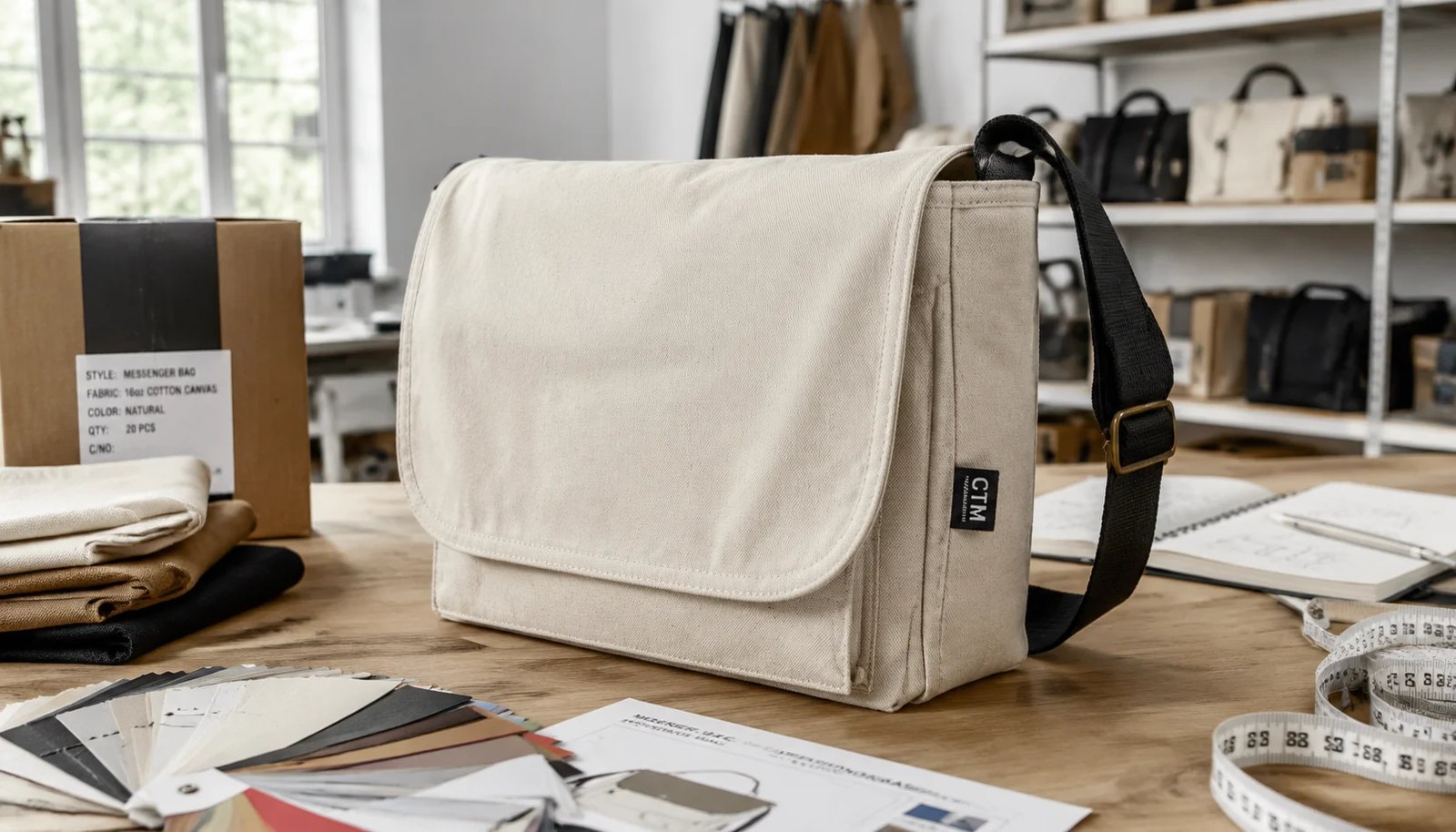
Why lead time planning is harder for liquor retail messenger bags
Custom canvas messenger bags for liquor retailers usually sit between a pure promotional tote and a structured retail accessory. That changes the schedule. A simple two-panel tote with one-color print can move quickly if stock fabric is available. A messenger bag with flap, webbing strap, hardware, inner pocket, and branded trims needs more approvals, more sewing operations, and more chances for a small delay to move the shipping date. Buyers often underestimate that difference when they request quotes using only size and logo artwork.
Liquor retail calendars also create a sharper deadline than general merchandise programs. These bags are often tied to holiday gift campaigns, wine club pickups, premium spirit launches, store anniversaries, or loyalty redemptions. Missing the in-store date can cut most of the commercial value even if the shipment is only one or two weeks late. Lead time planning therefore has to include not only factory production days, but also artwork approval lag, sample courier days, packing confirmation, freight booking, and internal warehouse receiving time.
- Typical delay sources: unclear bottle-fit requirement, late logo revision, hardware color change, custom dye approval, and carton packing changes after sample sign-off
- First orders usually need more buffer than repeat orders because pattern, print position, and packaging standards are not yet stabilized
- Retail promotions with fixed launch dates should be managed from warehouse-in date backward, not from order date forward
Start with the exact use case before you lock any bag spec
The best lead time plans begin with one practical question: what exactly will the bag carry in the real channel? For liquor retailers, the answer might be two wine bottles plus flyers, one premium bottle gift set, tasting event materials, or a general reusable branded bag sold near checkout. Each use case changes the right canvas weight, gusset width, bottom support, and pocket layout. Without that clarity, factories quote different constructions and buyers end up comparing prices that are not based on the same product.
A messenger bag used as a lifestyle resale item may prioritize flap shape, cleaner print, softer hand feel, and lighter weight to keep the retail price acceptable. A bag used for bottle transport needs better base support and stronger strap reinforcements. If you leave these details vague, the lowest quote often strips out hidden performance features: no bottom insert, narrower webbing, weaker reinforcement, or lighter fabric that cannot hold bottle weight well after repeated use.
- Useful RFQ detail: 'Bag must hold 2 x 750 ml bottles upright plus A5 flyer' or 'Bag is for general retail resale, no dedicated bottle divider required'
- Common size starting point: around 34 to 38 cm wide, 26 to 30 cm high, 10 to 14 cm gusset, depending on bottle carry need
- Strap width of 3.8 cm to 5 cm usually feels more stable than narrower webbing on bottle-carry bags
Fabric weight and construction choices that affect both performance and schedule
For most custom canvas messenger bags in liquor retail, 12 oz to 14 oz canvas, roughly 340 to 400 GSM, is the practical middle ground. It is heavy enough to carry bottle weight with a better premium feel than lightweight promo canvas, but still workable for efficient sewing and acceptable freight weight. At 10 oz or below, the bag can feel too soft unless the base is reinforced. At 16 oz or above, buyers often gain durability they do not really need while adding material cost, harder turning and sewing, and longer operator time.
Construction details matter as much as fabric weight. A double-layer base, internal bottom board sleeve, or stitched reinforcement panel adds more real use value than simply moving to an ultra-heavy canvas. For first orders, simple construction usually protects the schedule: one front body print, one woven side label, webbing strap, flap closure, and one interior pocket. Every extra panel, contrast binding, zipper compartment, rivet, and custom trim adds another operation and another chance to hold the line if one component arrives late.
- Common practical fabric range: 340 to 400 GSM for mainstream retail messenger bags
- Use a base reinforcement if bottles are part of intended use, instead of relying only on thicker canvas
- If sustainability messaging matters, specify exact content claim such as recycled cotton blend percentage and whether supporting test documents are required
- Natural cotton canvas can show shade variation more than dyed synthetic fabrics, so approve the acceptable look early
Print method and branding decisions that can save a week
The fastest branding route for most liquor retail messenger bags is usually a one- or two-color screen print on stock natural or stock dyed canvas. Screen print setup is straightforward, color is easier to control, and production speed is predictable once artwork is approved. Heat transfer is useful when you need photo elements, gradients, or many colors on a smaller run, but transfer films and adhesion performance need careful review on textured canvas. Embroidery adds premium appearance, yet it also adds machine time, stitch file approval, and possible puckering on lighter canvas.
A common planning mistake is treating logo placement as a simple artwork issue rather than a production issue. On messenger bags, logo position must relate to flap line, body seam, pocket placement, and fold line in packing. A front print that looks centered on a flat digital mockup can look off once the flap closes or once gussets are filled. This is why a printed pre-production sample is worth the time. It prevents bulk rework later, which is where real schedule damage happens.
- Best speed option: stock canvas plus 1 to 2 color screen print
- Use woven labels for subtle branding if the bag should work as a resale item beyond one campaign
- Approve print size, exact position from seam lines, ink color reference, and curing standard on the pre-production sample
- If using dark fabric, ask whether an underbase is needed because that affects print hand feel and cost
How MOQ logic changes the lead time, not just the price
MOQ is not only a budget issue. It changes sourcing route and therefore schedule. A low MOQ program often uses available stock fabric colors, standard webbing, and existing hardware finishes. That can reduce the time spent waiting for dyeing, webbing weaving, or trim customization. A larger forecast gives you more freedom to request custom pantone-matched fabric, embossed patches, custom zipper pullers, and printed linings, but each of these can add separate procurement days before sewing starts.
Buyers should also separate MOQ by component. A factory may accept a lower total bag quantity but still require minimum consumption for custom dyed fabric or custom woven labels. If you plan multiple regional logo versions for different store groups, the total order may look large enough, but each artwork split can create additional print setup time and inefficiency. It is better to quote two or three route options: stock-color quick program, semi-custom mid-range program, and full custom brand program.
- Lower MOQ route usually means: stock body fabric, stock webbing, screen print logo, standard hardware, and simpler packing
- Higher customization route usually means: dyed-to-match canvas, branded trims, more approvals, and longer pre-production phase
- Ask suppliers to quote MOQ by bag style, body color, print colorway, and any custom component separately
- If launch timing matters more than exact pantone match, stock color can be the better commercial choice
Build a realistic calendar from warehouse date backward
A useful buyer calendar starts from the date the bags must be available in your warehouse or distribution center, not the date the purchase order is issued. From that warehouse date, subtract customs and inland delivery time, ocean or air transit, booking cut-off, bulk production, raw material prep, and sample approval time. For messenger bags, the sample stage often takes longer than buyers expect because strap, flap, print placement, and inner pocket details need physical review. If the order is imported, this early stage is where most missed launch dates begin.
For a first custom order using stock canvas and simple screen print, a practical planning example might be: 5 to 7 days for quote alignment and artwork clarification, 7 to 10 days for sample making, 3 to 5 days for courier and internal approval, 25 to 35 days for bulk production, and then freight time according to route. A more customized version with dyed fabric, custom patch, and multiple logo versions can easily add 10 to 20 days before bulk sewing even starts. These are not promises; they are planning ranges that help procurement teams avoid unrealistic internal deadlines.
- Treat sample approval lag inside your own company as a real lead time component
- Add at least 1 to 2 weeks schedule buffer for first orders or holiday launches
- If the order is split across multiple SKUs or artwork versions, line scheduling may need extra production days
- Book space based on confirmed ex-factory window, not the earliest verbal estimate
Sample approval should test use conditions, not just appearance
Many pre-production samples get approved because they look acceptable on a desk. That is not enough for messenger bags intended for liquor retail. The sample should be loaded with the actual bottle count or equivalent weight, worn with the strap extended, opened and closed repeatedly, and packed the same way planned for shipment. This quickly reveals whether the flap twists, the strap anchor pulls the body out of shape, the base sags, or the print lands under a fold line that will mark during packing.
Buyers should also distinguish between a construction sample and a final approval sample. A quick first sample can validate size, bottle fit, pocket access, and shape. The approval sample should use the real canvas weight, real webbing, real print process, real label, and planned packing fold. Approving too early on substitute materials is a common reason bulk goods differ from expectation, especially with natural canvas texture and print hand feel.
- Load test with actual 750 ml bottles or equivalent weight before approving the sample
- Review topstitch alignment, bartacks at strap joints, flap drop, and closure alignment under real use
- Check whether print cracks, transfers, or scuffs after folding and unpacking
- Approve final sample photos inside export carton if packing presentation matters
Quote comparison: where cost differences usually come from
When supplier quotes vary widely for the same messenger bag brief, the difference is usually not factory margin alone. It often comes from hidden assumptions in fabric weight, print method, hardware count, reinforcement, and packing. One supplier may quote 340 GSM stock canvas with screen print and standard webbing. Another may build in 400 GSM, custom dyed webbing, bottom support, and individual polybags. Without line-by-line clarity, buyers can accidentally choose a low quote that later grows through revisions or a high quote that includes features they did not need.
For procurement teams, the most useful quote format breaks the product into visible cost drivers rather than one lump sum. Even if the supplier does not reveal their exact internal costing, they should be able to identify which elements add meaningful cost or time. This makes tradeoff decisions easier. If the launch date is tight, you may drop custom dyed lining and keep the heavier canvas. If the landed-cost target is tight, you may switch from individual polybag to bulk packed with interleaf paper.
- Major cost drivers: canvas GSM, size and gusset, print colors and coverage, webbing width and quality, hardware type, inner pockets, bottom reinforcement, and packing method
- Schedule-sensitive cost drivers: custom dye, custom trim tooling, patch development, and multi-SKU print setups
- Ask for separate line impact of: heavier fabric, woven label, magnetic snap, divider panel, and polybag packing
- Compare quoted carton quantity because freight cost per bag can shift noticeably with packing density
Packing rules can protect margin or quietly create freight waste
Packing is often treated as an afterthought, but for canvas messenger bags it directly affects freight cost, retail presentation, and damage risk. Messenger bags with flap panels, straps, pockets, and patches do not fold as efficiently as flat totes. If the packing method is not defined early, the factory may choose a fold that saves carton space but leaves a permanent flap crease or print mark. For liquor retail programs where the bags are sold as merchandise, this becomes a warehouse and store complaint rather than a simple cosmetic issue.
The most commercial packing choice depends on sales channel. For bulk promotional distribution, stacked packing without individual polybags may be the best route if cleanliness can be controlled and barcode handling is simple. For resale or premium gifting, a cleaner individual presentation may be justified. Buyers should also set carton gross weight limits according to warehouse handling standards. Overweight cartons create receiving problems and carton breakage even if the bags inside are fine.
- Define whether bags are flat packed, lightly stuffed, or folded at flap line
- Set barcode label position and whether each bag or only outer cartons need identification
- State carton gross weight limit, especially if heavier GSM canvas and hardware are used
- Request packing photos and carton dimensions before shipment booking to verify freight assumptions
QC thresholds that prevent the most common messenger bag complaints
Canvas messenger bag defects in liquor retail programs are usually very visible: crooked flap, off-center print, weak strap joins, mixed hardware finish, and dirty natural canvas. These are not abstract quality topics. They affect whether the bag looks shelf-ready and whether it survives normal use. QC criteria should therefore be product-specific. For example, a small print position shift may be acceptable on a casual tote, but not on a messenger bag where the logo must sit centered under a flap line. Likewise, seam reinforcement matters more when bottle weight is involved.
Good QC planning also reduces lead time surprises. If the factory knows before production that bartack reinforcement, flap symmetry, and print rub resistance are priority checks, they can control those points in-line instead of discovering issues at final inspection. That is especially important for natural canvas because stains, shade variation, and needle marks may not be fully visible until pieces are handled in bulk.
- Define acceptable print position tolerance in millimeters relative to seam or flap edge
- State that strap joints must include reinforcement suitable for expected load, not simple single-pass stitching
- Require clean fabric appearance standard for natural canvas, including oil mark and loose thread limits
- If hardware finish matters to brand image, require one approved finish standard sample for comparison
Specification comparison for buyers
| Spec decision | Recommended option | When it fits | Buyer risk to check |
|---|---|---|---|
| Canvas weight | 12 oz to 14 oz canvas, about 340 to 400 GSM | Best balance for liquor retail gift-with-purchase bags, staff-use promo bags, and reusable bottle-carry retail merchandise | Below 10 oz may feel too soft for bottle weight; above 16 oz adds cost, shipping weight, and slower sewing |
| Bag structure | Padded bottom insert or double-layer base panel | Useful when bags may carry 2 to 4 bottles, catalogs, POS kits, or mixed retail items | If omitted, base sag can trigger complaints even when fabric passes GSM target |
| Closure style | Flap with magnetic snap plus internal zip pocket | Fits retail lifestyle use and keeps branded bag more premium without heavy hardware count | Hidden magnet placement must be sample-approved; poor placement causes crooked flap and rework |
| Print method | Silk screen for solid logos; heat transfer only for photo graphics or small multicolor runs | Screen print is usually the most stable option for medium to large runs with simple liquor retail branding | Heat transfer can crack on heavy crease lines; puff or thick ink may mark in packed cartons |
| Logo application | Woven side label or small leather-look patch plus front print | Works when retailer wants subtle branding and better perceived value at shelf level | Patch sewing adds operation time; label color fastness and seam position should be locked at sample stage |
| MOQ route | Use stock fabric color with custom print for lower MOQ; use dyed-to-match fabric only for larger forecasts | Good for promo launches, regional campaigns, and buyers testing one SKU first | Custom dye can add 7 to 14 days and may require higher MOQ by fabric color lot |
| Inner organization | One zip pocket and one bottle divider panel if bottle-carry use is core | Fits wine club pickups, premium spirit gift sets, or staff messenger use around store events | Overbuilt interiors increase sewing time and defect points; divider dimensions must match bottle height |
| Packing format | Individual polybag only if channel requires cleanliness; otherwise stacked with interleaf and export carton | Best for reducing carton cube and freight cost on bulk retail orders | Tight folding can mark prints and bend patches; request packed-carton photos before shipment |
| Lead time buffer | Build 2 weeks buffer beyond stated production time for first order or holiday launch | Essential for imported orders tied to promotions, loyalty programs, or store opening dates | Factory lead time often excludes art approval lag, sample courier time, and booking delays |
Buyer checklist before sampling
- Define end use clearly: promotional giveaway, retail resale, staff bag, wine club pickup bag, or bottle gift bag with messenger styling
- Lock fabric weight in GSM or oz, not just 'canvas', and state whether recycled cotton content is required
- Specify finished size, gusset width, flap drop, strap length range, and whether bags must fit standard 750 ml bottles upright
- Choose print method by artwork type: screen print for solid logos, transfer for complex graphics, embroidery only if budget allows
- State if hardware must be nickel-free, matte black, antique brass, or other finish to avoid mixed quote assumptions
- Clarify MOQ by colorway and by artwork version so promotional regional variants do not trigger surprise setup charges
- Approve a pre-production sample that reflects actual fabric, actual print scale, actual label, and actual strap construction
- Set packing rules: flat packed or folded, polybag yes or no, barcode sticker placement, carton weight limit, and carton dimensions
- Include shipment target date by destination warehouse and ask supplier to work backward to ex-factory deadline
- Add AQL or defect tolerance expectations for stitching, print registration, measurement, and color consistency before production starts
Factory quote questions to send
- What canvas weight are you quoting in GSM and oz, and what is the tolerance per lot?
- Is the quoted fabric stock color or custom dyed, and how many days does dyeing add to the schedule?
- What is the MOQ per size, per color, and per logo version for this messenger bag construction?
- Which print method is included in the quote, how many colors, and what artwork size is priced?
- Does the quote include woven label, patch, inner pocket, bottle divider, magnetic snap, and bottom reinforcement, or are these optional adders?
- How many sample stages are needed: digital layout, blank construction sample, printed pre-production sample, and production approval sample?
- What are the normal lead times for sample making, lab dip or color swatch approval, bulk production, and export booking?
- What carton pack quantity and carton dimensions are planned, and what estimated gross weight per carton will result?
- How is strap webbing sourced and matched to body fabric, and what color variation tolerance is accepted?
- What in-line and final QC checks do you perform for print adhesion, seam strength, measurement, and metal accessory placement?
Quality-control points to confirm
- Fabric weight should match approved spec within stated tolerance; random roll checks should be recorded before cutting
- Finished measurements should be checked on width, height, gusset, flap length, and strap length adjustability against approved tolerance
- Screen print position must match approved artwork placement and stay level relative to flap edge or front panel seam
- Print adhesion and rub resistance should be checked after curing, especially on dark canvas or heavy ink coverage areas
- Stitch density should be consistent, with reinforced bartacks at strap joints and stress points carrying bottle weight
- Magnetic snap or closure alignment should be centered and functional without pulling flap off line
- Inner pockets and divider panels should be measured for usable opening size, not only seam-to-seam dimensions
- Metal hardware finish should be consistent across one order without mixing glossy and matte tones
- Needle damage, oil marks, and chalk marks on natural canvas should be controlled because they show easily at retail
- Packing fold method should avoid crushing prints, bending patches, or permanently creasing the flap