Start the timeline from the campus selling date, not the purchase order date
University bookstore orders often have a fixed selling window: freshman orientation, homecoming, graduation, bookstore anniversary events, alumni weekends, or department merchandising launches. A custom canvas messenger bag is not the same as a plain stock tote. The buyer has to allow time for logo approval, sample revision, material booking, printing, sewing, packing, inspection, freight, customs, and warehouse receiving. If the product arrives two weeks after orientation, the unit cost may look fine on paper but the commercial result is weak.
A practical calendar works backward from the date the bookstore needs units available on shelves or online. For import orders, build a buffer before that date rather than using the event date as the delivery target. Bookstore receiving teams may need time to create SKUs, apply price tickets, scan barcodes, allocate stock to multiple campus locations, and handle internal licensing checks. Those days are real lead time even though they are not factory production days.
- For a normal custom order, allow 7 to 14 days for sample development before final approval if artwork and specifications are ready.
- Allow 25 to 45 days for bulk production after approval when fabric and hardware are available.
- Add time for third-party inspection, booking, export documents, international freight, customs clearance, and local delivery.
- If the university brand office must approve the item, add an internal approval buffer before the supplier begins mass printing.
Choose a canvas specification that matches the way students will use the bag
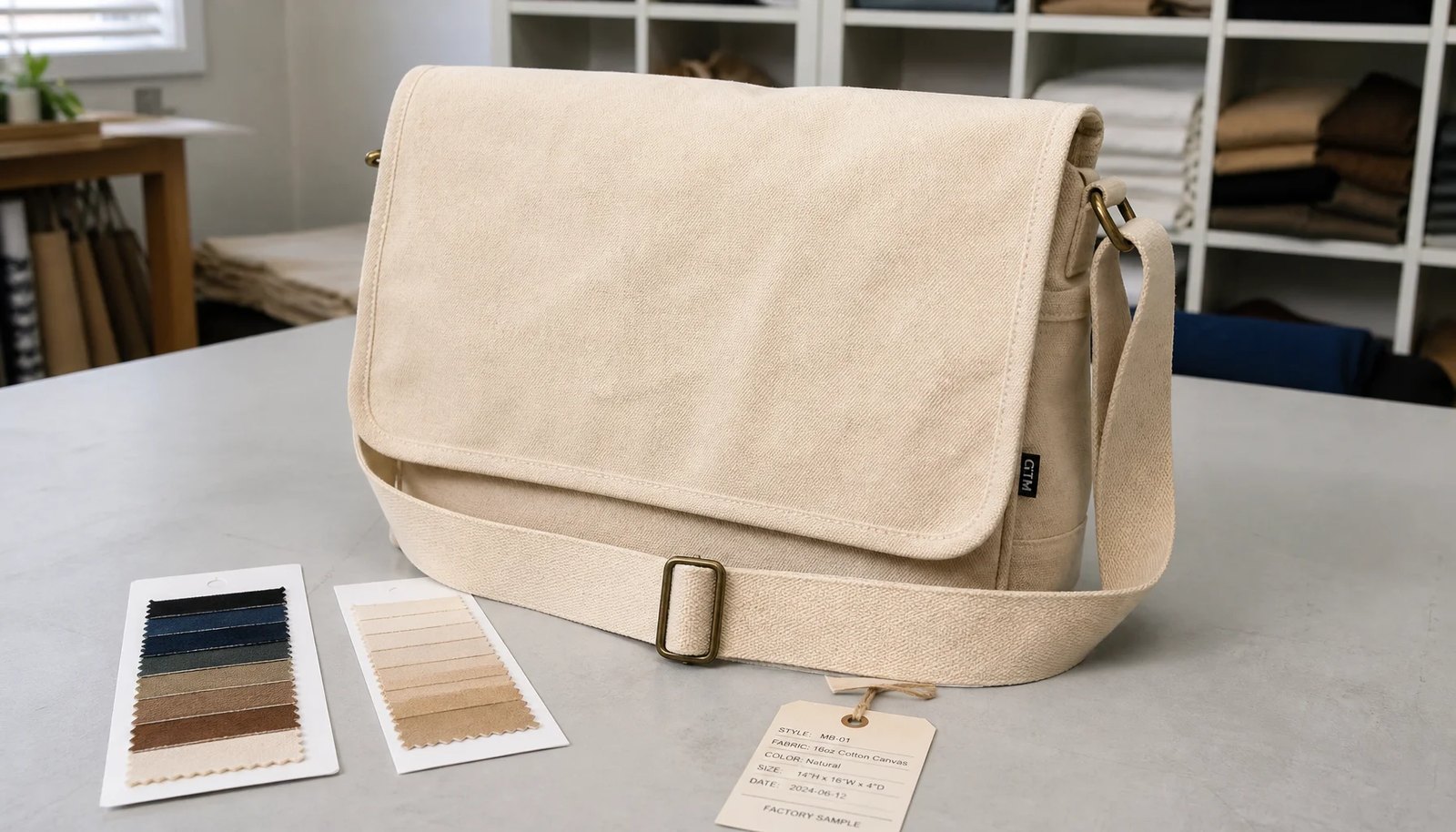
For bookstore retail, the canvas messenger bag needs enough body to hold a shape on display and enough strength for daily campus use. A common practical range is 14 oz to 16 oz cotton canvas, roughly 475 to 540 GSM depending on yarn and finishing. This range works for textbook carriers, laptop-friendly bags, and premium campus merchandise. A lighter 10 oz to 12 oz canvas can work for lower-cost orientation programs, but it will usually feel less structured and may show more creasing after carton packing.
Do not accept a quote that only says canvas. The difference between 10 oz, 12 oz, 14 oz, and 16 oz affects fabric cost, sewing speed, needle choice, print coverage, carton weight, and final retail perception. Natural cotton canvas often has visible seed flecks and slight shade variation; dyed canvas adds color control and dye lot risk. Washed canvas gives a softer hand but adds shrinkage and shade variation that must be approved before bulk.
- Typical retail messenger bag: 14 oz or 16 oz cotton canvas with reinforced stress points.
- Budget event bag: 10 oz or 12 oz canvas with a simpler structure and limited hardware.
- Premium department or alumni edition: heavier canvas, lining, embroidery, woven label, or upgraded metal hardware.
- RFQ wording: state GSM, color, finish, shrinkage tolerance, and whether the fabric must match a previous order.
Build the bag spec around stress points, not only flat dimensions
Many RFQs describe only width, height, and logo size. That is not enough for a messenger bag. The gusset depth affects how many books or kits the bag can hold. The flap drop affects both security and logo visibility. The strap width and adjustment range determine whether the bag feels comfortable across different users. The attachment points decide whether the bag survives real campus use.
A bookstore messenger bag usually performs better when the strap is 38 mm to 50 mm wide and stitched with a box stitch, bar tack, or reinforced patch. Metal sliders and D-rings feel more durable than plastic parts, but they increase cost and weight. Hidden magnetic snaps give a cleaner retail look, while buckles can look more rugged but slow down production and increase inspection points. If the bag may carry laptops, reinforcement around the base and side seams becomes more important than saving a few cents on stitching.
- Define finished size with width, height, gusset, flap drop, and acceptable tolerance.
- Specify strap width, total strap length, adjustable range, hardware material, and hardware finish.
- Add reinforcement instructions at strap anchors, flap corners, closure backing, and bottom gusset.
- Include stitch color, stitches per inch, seam type, and whether inside seams need binding.
Match print method to campus artwork before approving the production calendar
Screen printing is usually the most efficient option for bookstore messenger bags when the artwork uses one to three solid colors. It gives a clean result on cotton canvas and keeps the unit cost manageable for bulk orders. However, coarse canvas texture can break very small letters, fine mascot lines, and thin trademark symbols. A vector logo that prints well on paper may not reproduce cleanly on 14 oz natural canvas without adjustment.
Embroidery, woven labels, and applique can lift the perceived value, especially for alumni or department-branded merchandise. These methods also change the lead time. Embroidery requires digitizing and thread approval. Woven labels need label sampling and MOQ planning. Heat transfer can reproduce more detail, but the hand feel and edge durability must be reviewed on actual canvas. The safest schedule is built after the decoration method is confirmed, not before.
- Screen print: best for solid campus marks, larger logos, and repeat bookstore orders.
- Embroidery: premium feel, but check puckering on medium-weight canvas and confirm backing.
- Woven label: good for subtle branding, side labels, and licensed retail details.
- Heat transfer: useful for detailed graphics, but test adhesion and edge lifting on canvas texture.
- Approval item: printed strike-off or decorated panel on actual bulk fabric, not only a digital proof.
Understand MOQ logic before pushing for a smaller order
MOQ for custom canvas messenger bags is not only a factory preference. It comes from fabric availability, dyeing minimums, print setup, cutting efficiency, hardware purchasing, label production, and sewing line changeover. If the buyer selects natural, black, navy, or another available canvas color, a factory may be able to support a lower MOQ such as 300 to 500 pieces depending on size and construction. Custom dyed canvas, special lining, custom metal hardware, or woven labels can push the practical MOQ higher.
For university bookstores, the MOQ decision should be tied to SKU planning. One design at 500 pieces is usually easier to control than five department designs at 100 pieces each. If multiple campus departments need the same bag shape, combine the base material and change only the print or label where possible. This can protect price and shorten the lead time while still allowing separate bookstore SKUs.
- Lower MOQ is easier when using stocked canvas, standard strap webbing, common hardware, and one print location.
- MOQ increases when using custom dyed fabric, special lining color, custom zipper pulls, custom metal logo plates, or many artwork versions.
- Split shipment by department can be arranged, but the packing plan must be written into the PO.
- For quote comparison, request price breaks at several volumes instead of asking only for the minimum order quantity.
Use samples to prevent production mistakes, not just to see the logo
A pre-production sample should represent the exact production plan. For bookstore retail, it should use the approved canvas weight, strap, hardware, closure, stitch color, label, decoration method, and packing method where possible. If the supplier sends a sample made from substitute fabric or similar hardware, it may still be useful for shape review, but it should not release bulk production unless differences are documented.
Sample review should be structured. Measure the bag, load it with expected contents, check how the flap sits, test the strap adjustment, inspect logo position, and put the packed sample into a carton or shelf environment. A bag that looks acceptable flat on a desk may not hang well, may collapse on a retail display, or may crease badly under bulk packing. The sample stage is the cheapest time to fix these issues.
- Measure width, height, gusset, flap drop, strap width, and strap length against the spec sheet.
- Test likely contents such as two books, a tablet sleeve, or an orientation packet if that is the intended use.
- Review print color under normal store lighting, not only under factory light.
- Photograph the approved sample from front, back, inside, strap joint, closure, label, and packed condition.
- Seal one approved sample at the factory and one with the buyer for final inspection reference.
Separate quote data so suppliers can be compared fairly
A low unit price may hide missing items. One supplier may include individual polybags, barcode labels, reinforced strap stitching, and export cartons. Another may quote only the sewn bag with bulk packing. The comparison is not valid until the quote data is separated. For messenger bags, small specification differences can change labor time and material cost more than buyers expect.
For a clean RFQ, request a costed specification summary instead of only a price. The supplier may not disclose every internal cost, but they should state what is included. This is especially important for importers and distributors quoting to bookstore chains or campus retail groups, because any missing barcode, carton mark, or inspection requirement becomes a charge or delay later.
- Fabric: weight, GSM, color, finish, and whether it is stock or custom dyed.
- Decoration: print method, number of colors, print size, number of positions, setup or screen charge if applicable.
- Construction: flap, gusset, lining, inside pocket, closure, strap, reinforcement, and hardware.
- Branding: woven label, care label, hangtag, price ticket, barcode sticker, or licensed product label.
- Packing: individual packing, carton quantity, carton size, gross weight, master carton marks, and assortment.
- Commercial terms: sample cost, sample lead time, bulk lead time, payment terms, Incoterm, validity date, and freight basis.
Plan packing and carton marks for bookstore receiving
Packing is often treated as an afterthought, but it directly affects receiving speed and product condition. Canvas messenger bags with flaps can develop permanent creases if packed under pressure or folded inconsistently. Hardware can mark the fabric if there is no protection. Natural canvas can pick up dust from poor cartons. For retail bookstore orders, the packing plan should protect appearance and help warehouse teams receive accurately.
Individual polybags are common, but some universities prefer reduced plastic. Paper bands, tissue, or recyclable bags may be options depending on budget and product finish. Whatever the method, it must be tested with the sample. Carton labels should include PO number, SKU, item description, color, quantity, carton number, gross weight, net weight, and country of origin if required. If the bookstore uses barcodes, confirm whether barcode labels are applied to each unit, hangtag, polybag, or carton.
- Set carton weight limits so warehouse teams can handle cartons safely, often below 15 to 18 kg depending on buyer policy.
- Avoid over-compression that bends flaps, crushes gussets, or presses hardware into the canvas.
- Use color and design separation by carton when multiple department logos are ordered.
- Include moisture protection for ocean shipments, especially for natural cotton canvas.
- Approve final carton marks before packing starts, not after the goods are already sealed.
Control lead time risk during holidays, licensing delays, and freight changes
The factory lead time is only one part of the total calendar. Delays often come from artwork revision, school trademark approval, fabric dyeing, label proofing, inspection booking, vessel space, customs exams, and local delivery appointments. University bookstore orders are also seasonal, which means many buyers request similar products at the same time. If the supplier confirms a capacity window, the buyer should protect it with fast approvals and clear documents.
Holiday periods need special attention. Production schedules around Lunar New Year, Golden Week, Christmas, and local factory holidays can shift quickly. If the bookstore needs spring orientation goods, a purchase order placed just before a long holiday can lose several weeks. Air freight can rescue some late orders, but canvas messenger bags are bulky and heavy compared with small pouches, so emergency freight can damage margin.
- Treat artwork approval delay as buyer-side lead time and include it in the schedule.
- For custom dyed fabric, add lab dip approval and bulk fabric shade approval before cutting.
- Book inspection early if the shipment date falls before a campus event or holiday closure.
- Keep one approved decision maker for logo, sample, and packing approval to avoid circular revisions.
- Discuss partial shipment only if the supplier can pack and label early units correctly by SKU.
Set acceptance criteria before the factory starts cutting
Quality disputes are easier to prevent than solve. For canvas messenger bags, the most common disputes involve shade variation, loose threads, crooked flaps, weak straps, off-center logo placement, print cracking, dirty natural canvas, and mixed packing. These issues should be classified before production as critical, major, or minor defects. The purchase order should reference the approved sample, spec sheet, and inspection standard.
For bookstore retail, appearance matters because the product may sit on a shelf next to licensed apparel, notebooks, and higher-margin gift items. A bag can be structurally usable but still not retail acceptable if the logo is tilted or the flap is visibly uneven. The inspection plan should include measurement, function, appearance, packing, and carton count. AQL sampling can be used, but the defect definitions must be product-specific.
- Logo placement tolerance: define acceptable movement in millimeters from centerline or edge.
- Dimension tolerance: set realistic limits for fabric products, for example plus or minus 1 cm for main dimensions when appropriate.
- Stitching: reject broken stitches, skipped stitches at stress points, open seams, and unsecured thread ends in visible areas.
- Hardware: reject rust, sharp edges, poor plating, weak snaps, and misaligned magnetic closures.
- Cleanliness: reject oil marks, mildew odor, excessive dust, and stains on visible fabric panels.
- Packing: reject mixed SKUs, missing labels, wrong carton marks, or carton quantities that do not match the packing list.
Specification comparison for buyers
| Spec decision | Recommended option | When it fits | Buyer risk to check |
|---|---|---|---|
| Fabric weight for bookstore retail | 14 oz to 16 oz cotton canvas, about 475 to 540 GSM before washing or finishing | Good balance for textbooks, laptops, orientation kits, and retail shelf presentation without making the bag too stiff | Do not compare quotes only by ounce rating; request GSM, yarn construction, shrinkage range, and whether fabric is dyed, bleached, or natural |
| Economy campus giveaway version | 10 oz to 12 oz canvas with simplified flap and cotton webbing strap | Works for high-volume welcome events where price and delivery matter more than long retail life | Thin fabric can lose shape after packing; require a pre-production sample and packed carton photo before mass production |
| Decoration method for campus logo | Screen print for 1 to 3 solid colors; embroidery or woven label for premium department merchandise | Screen print is efficient for bookstore orders with clean school marks and repeated annual quantities | Small serif text, gradients, and mascot details may fail on coarse canvas; approve printed strike-off on actual fabric |
| Flap closure choice | Hidden magnetic snap or metal snap with reinforced backing patch | Best when the bag needs a cleaner bookstore look and faster user access than buckles | Magnets can shift if the flap pattern is not controlled; require alignment tolerance and pull test during QC |
| Strap construction | 38 mm to 50 mm cotton webbing with box-stitch reinforcement and optional length adjuster | Suitable for students carrying daily books, tablet sleeves, and campus merchandise bundles | Weak strap stitching is a common failure point; define stitch density, reinforcement area, and minimum load test |
| MOQ and color planning | Start with natural, black, navy, or school color fabric at 300 to 500 pcs when fabric is available; higher MOQ for custom dye | Useful for bookstores testing multiple departments, alumni editions, or seasonal campus designs | Custom dyed canvas usually adds fabric lead time and lab dip approval; split-color orders can increase unit cost and schedule risk |
| Packing for retail receiving | Individual polybag or paper band by unit, carton with SKU label, PO number, color, quantity, and barcode if required | Helps bookstore warehouses receive by department, campus location, or online store SKU | Bulk packing saves cost but causes flap creases and mixed receiving errors; include packing method in the quote, not after production |
| Lead time basis | Plan 7 to 14 days for sampling, 25 to 45 days for bulk after approval, plus inspection and freight | Realistic for standard canvas messenger bags with available fabric and normal print complexity | Supplier lead time often excludes artwork delay, lab dip, holidays, packaging approval, inspection booking, and vessel cut-off |
Buyer checklist before sampling
- Lock the campus selling date first, then work backward through artwork approval, sample approval, bulk production, inspection, freight, customs clearance, and bookstore receiving time.
- Define the bag size by use case: laptop sleeve, textbook carrier, orientation kit, or retail gift item. Do not use only a flat width and height without gusset and flap coverage.
- Specify fabric in both ounce and GSM, including natural, dyed, washed, or laminated finish if relevant.
- Provide logo files in vector format and note Pantone colors, print size, print position, and whether the school requires brand office approval.
- Decide whether a pre-production sample is mandatory before bulk cutting. For bookstore retail, it usually should be mandatory.
- Confirm strap width, strap length range, hardware color, closure type, reinforcement method, and stitch color before comparing prices.
- Include packing requirements in the RFQ: individual bagging, barcode sticker, carton label, carton size limits, carton weight limits, and assortment method.
- Ask the factory to quote lead time by stage, not as one total number. Sampling, material booking, printing, sewing, finishing, packing, and inspection should be separated.
- Reserve time for campus stakeholders. Bookstore buyers, licensing offices, athletic departments, and alumni teams often create approval delays outside the factory schedule.
- Set acceptance criteria for print color, logo placement, seam strength, fabric defects, metal hardware, odor, and packing before placing the purchase order.
Factory quote questions to send
- What fabric weight are you quoting in ounces and GSM, and is the fabric in stock or woven/dyed after order confirmation?
- What is the MOQ for the selected fabric color, and how does the price change at 300, 500, 1000, and 3000 pieces?
- How many days are required for artwork review, sample making, sample shipping, and buyer revision before bulk production starts?
- Will the pre-production sample use actual bulk fabric, actual hardware, actual print method, and final packing materials?
- Which print method are you quoting, and what are the limits for small text, Pantone matching, ink hand feel, and wash or rub resistance?
- What production lead time applies after written sample approval and deposit, excluding international freight?
- How many sewing lines can be allocated to this order during the requested production window, and what other capacity risks should be noted?
- What carton quantity, carton dimensions, gross weight, and packing method are included in the quote?
- Can you provide a quote sheet separating fabric, decoration, hardware, label, packing, sample, inland transport, and export charges?
- What inspection standard, AQL level, and critical defect list will you accept before shipment?
Quality-control points to confirm
- Fabric GSM should be within the approved tolerance and consistent with the sealed sample; visible slubs, stains, weaving bars, or color shading should be classified before inspection.
- Finished bag dimensions should be measured flat at width, height, gusset, flap drop, strap width, and adjustable strap length, with tolerance stated in the purchase order.
- Logo placement should stay within agreed tolerance from bag edges or flap centerline; tilted prints and off-center embroidery should not be accepted as normal handmade variation.
- Print should pass dry rub and light wet rub checks suitable for canvas texture; cracking, pinholes, and ink bleeding around small letters need clear defect limits.
- Strap joints should use reinforcement stitching such as box stitch or bar tack, with no skipped stitches, loose threads, or broken needle marks at stress points.
- Snap, buckle, slider, and magnetic closure should align correctly and function repeatedly without tearing the fabric or pulling out the backing patch.
- Inside seams and binding should be clean enough for retail sale; raw fraying edges inside the flap or gusset can create returns even if the outside looks acceptable.
- Packed cartons should match the approved SKU, quantity, color, barcode, and PO information. Mixed colors or unmarked cartons delay bookstore receiving and online fulfillment.