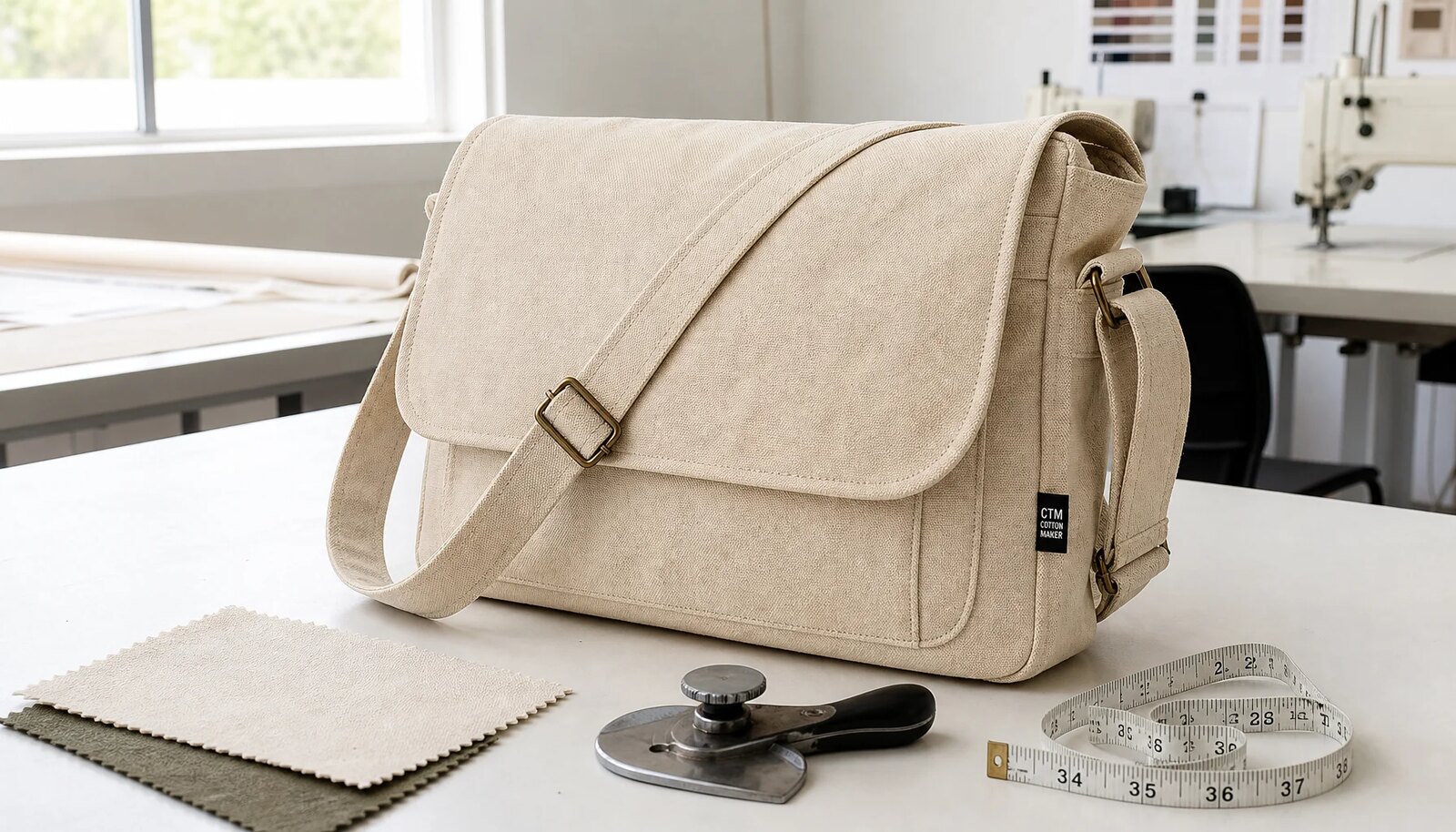
Define The Event Scenario Before You Ask For A Fabric Weight
Most sourcing mistakes happen before a factory ever quotes the bag. Procurement receives a request for a custom canvas messenger bag, asks for price by ounce weight, and only later learns the bag must carry a catalog, charger, stainless bottle, or tablet during a three-day event. That sequence produces weak comparisons because the same 12 oz claim can suit one program and fail another. In practice, event planners should begin with the user journey: who receives the bag, what goes inside, how long it will be carried, whether it needs to look premium on a registration table, and whether the business expects reuse after the event.
This is where a custom canvas messenger bags fabric weight guide for event planners becomes useful. Fabric weight is not a standalone quality badge. It affects drape, structure, print clarity, crease recovery, packing efficiency, and freight. A light bag can be completely appropriate for maps and brochures but look underbuilt if it is meant to support boxed sponsor gifts. A heavier bag can impress at first touch but create avoidable storage and shipping cost if the program is a one-day handout. The right starting brief is operational, not decorative: contents, load, presentation standard, delivery route, and target price band.
- Ask internal stakeholders what the bag must hold on event day, not what fabric number sounds premium.
- Separate one-time distribution bags from bags expected to be reused for commuting or travel.
- Record the intended pack-out method early because pre-loaded bags usually need more structure than empty handouts.
Translate Oz Claims Into Finished GSM Before Comparing Quotes
Suppliers often describe canvas in ounces because that is familiar in the bag trade, but procurement comparisons become clearer when you request finished GSM. Ounces usually refer to weight per square yard, while GSM refers to grams per square meter. The practical issue is not the math; it is the quoting basis. One supplier may quote greige fabric before finishing, while another quotes the finished cloth after washing, dyeing, coating, or printing. Those numbers are not directly comparable, and a bag that was sold as 12 oz can feel noticeably lighter or softer once finishing is complete.
Use rough conversion ranges only as a starting reference: 8 oz is about 271 GSM, 10 oz about 339 GSM, 12 oz about 407 GSM, 14 oz about 475 GSM, and 16 oz about 542 GSM. Then ask the supplier to confirm which stage that weight represents. If the order includes enzyme wash, pigment dye, water-resistant coating, or heavy print coverage, the hand feel may change again. For a serious RFQ, ask for finished GSM, acceptable tolerance, and whether the sample swatch came from the same finishing route as bulk. That simple step removes a large amount of ambiguity before pricing starts.
- Use both units in the spec sheet if helpful, but make finished GSM the controlling number.
- Request the allowed GSM tolerance in writing so the inspection standard is clear before production.
- Treat any ounce claim without finishing details as incomplete information.
How Common Canvas Weight Bands Behave In Event Use
For most event programs, 8 oz to 10 oz canvas sits in the lightweight category. It works for slim collateral, badges, maps, and simple sponsor giveaways where the bag does not need to stand upright or carry dense contents. This range usually folds easily and ships efficiently, but it can look soft on a larger messenger shape, especially if the flap is broad or the print area is large. If the bag will be photographed, pre-filled, or stacked visibly at check-in, lightweight canvas can read more promotional than premium unless the pattern is kept simple and the print execution is clean.
The 10 oz to 12 oz range is often the safest commercial choice because it balances structure, sewing ease, printability, and cost. Many conference and association programs land here. A midweight bag can usually carry a notebook, event guide, charger, slim bottle, or tablet without feeling flimsy, provided the strap and anchor construction are specified correctly. It also gives factories more room to achieve clean screen printing and stable seams than very light cloth. For procurement, this range is usually the baseline that other options should be compared against.
Once you move into 12 oz to 14 oz, the bag begins to feel more substantial in the hand and holds a cleaner silhouette on the table. That can be useful for VIP attendee kits, premium sponsor gifts, or bags expected to remain in use after the event. At 14 oz to 16 oz, the product shifts toward a retail-style build. That may be appropriate for resale merchandise or laptop-focused use, but event teams should make that choice deliberately. Heavyweight canvas increases bulk, can stiffen flap movement, and often raises freight and manual handling cost without improving results for a basic handout program.
- Choose 8-10 oz when the contents are light and cost control outweighs structure.
- Start with 10-12 oz for most attendee messenger bags unless the program clearly needs a premium build.
- Use 12-14 oz or above only when the heavier body changes the user experience in a meaningful way.
Fabric Weight Is Only One Cost Driver On The Quote
Buyers often overestimate how much of the unit price comes from the outer canvas alone. Fabric weight matters, but the quote also moves with panel size, cutting yield, gusset depth, flap construction, lining, inside pockets, zipper type, webbing width, metal hardware, labels, and finishing steps. A large messenger bag in 10 oz canvas may use more material and labor than a compact 12 oz bag. Likewise, a washed canvas bag with dyed webbing, inside organizer pockets, and individual polybag packing can cost more than a simpler heavier-weight version. Comparing weight numbers without comparing the whole pattern is not a reliable procurement method.
The practical fix is to require line-item visibility. Ask for separate pricing for body fabric, lining, strap webbing, hardware, decoration, label, packing, and any sample or setup charges. Then request the same pattern quoted in two or three GSM bands. That lets you see the real marginal cost of moving from, for example, 10 oz to 12 oz. In many programs the bigger commercial difference is not the cloth itself, but the added labor created by extra pockets, bound edges, zipper closures, or custom packaging. Procurement needs that breakdown to decide which features improve the attendee outcome and which merely complicate the order.
- Do not compare an unlined 10 oz bag to a lined 12 oz bag and assume the fabric is the only variable.
- Require the same dimensions, same trim, and same packing format when comparing weight options.
- Ask whether quoted freight assumptions change when the fabric weight changes.
Match Construction Details To The Real Load
A messenger bag fails more often at the construction points than in the middle of the canvas panel. That is why fabric weight must be linked to strap design, reinforcement, and seam engineering. If the bag will carry brochures only, a simple unlined body and standard webbing may be enough. If it must hold a tablet, charger, catalog, and bottle, the buyer should specify stronger strap anchors, cleaner bar-tacks, and a webbing width that spreads load comfortably across the shoulder. Many problems blamed on "thin canvas" are really the result of weak anchor stitching, short seam allowance, or an oversized bag body paired with light reinforcement.
Messenger bag usability also depends on structure choices that buyers sometimes leave vague. A zipper top under the flap improves content security but adds labor, hardware, and failure points. An inside slip pocket helps the user organize a phone or agenda but changes assembly time. A bottom reinforcement panel or lining can improve body and abrasion resistance without jumping to very heavy outer canvas. In other words, weight is only one way to create sturdiness. Procurement should ask which construction change solves the actual problem: more rigid presentation, more carrying comfort, better organization, or stronger stress performance.
For event programs, strap drop deserves special attention because it affects whether the bag feels usable or awkward. A bag that looks good in a sample room can become uncomfortable if the strap is too short over a blazer, too long for smaller users, or twisted because the anchor angle is off. Request a measured strap drop, webbing width, and anchor position in the spec sheet. Those details are inexpensive to define and expensive to correct after mass production.
- Link heavier loads to stronger anchors, appropriate webbing width, and clear seam reinforcement requirements.
- Use lining or base reinforcement when you need more body but do not want the bulk of a very heavy outer canvas.
- Write strap drop and strap width into the order instead of approving them by eye on one sample.
Choose Decoration That Works On The Chosen Weight
Canvas decoration performs differently across weight bands and finishes. Screen printing is still the most practical option for many event programs because it handles simple logos well and scales cleanly at volume, especially on stable midweight canvas. On lighter cloth, however, pressure and ink deposit can distort the panel or make the printed area feel stiff compared with the rest of the bag. On heavily textured or washed canvas, fine edges may look softer than expected. Embroidery can create a premium look on a flap or front panel, but it adds thread density and backing that can pucker a soft bag if the base cloth is not firm enough.
Transfers and digital methods are useful when the artwork changes frequently, when names or regional versions are needed, or when order volume does not justify screens. The tradeoff is durability risk. Event buyers should test fold-line cracking, edge lift, and adhesion on the actual fabric weight, particularly if the logo crosses a flap bend or front panel crease. Dark canvas may also require an underbase or different print recipe to preserve color accuracy. The safest approval path is a strike-off on the real cloth, in the real bag color, with the final artwork size and placement. Anything less leaves too much room for assumptions.
- Use screen print for stable artwork and midweight canvas when cost and repeatability matter most.
- Use embroidery, patches, or woven labels when the logo should read more premium than promotional.
- Keep large decoration away from fold lines, thick seam joins, and high-stress corners whenever possible.
- Approve print color and edge definition on the exact canvas color and finish planned for bulk.
Write RFQs And Sampling Stages So Suppliers Cannot Fill In The Gaps
A vague RFQ invites suppliers to make different assumptions, which makes the quote comparison look easier than it really is. A usable bag RFQ should include finished GSM target, dimensions, gusset depth, flap shape, strap width and drop, lining status, closure type, pocket count, webbing color, hardware finish, decoration method, artwork size, label requirement, packing format, incoterm, and delivery window. If the event has a hard in-warehouse date, state that clearly rather than only listing the event opening date. Procurement cannot evaluate lead time correctly if the receiving point and deadline are not defined.
MOQ should also be broken into meaningful categories. Ask whether minimums apply per bag color, per print version, per woven label, or per hardware finish. This matters because event teams often assume one order total can be divided freely across sponsor variants, only to discover later that each colorway or artwork change triggers separate setup or production constraints. The more custom elements you add, the more important it becomes to understand where the true factory minimum sits. That is especially relevant when mixing standard attendee bags with smaller VIP or staff versions in the same program.
Sampling should move in stages. A fabric swatch confirms color and hand feel. A proto sample checks shape and approximate construction. A print strike-off confirms decoration behavior on the chosen canvas. A pre-production sample should then mirror the final specification as closely as possible before bulk cutting begins. If any stage uses substitute cloth, alternate webbing, or temporary hardware, require the deviation in writing. That is how procurement prevents the common argument that a sales sample was "for reference only" after bulk goods arrive.
- Put every commercial assumption into the RFQ instead of leaving the factory to infer missing details.
- Ask MOQ by variable, not only total units, if the program includes multiple sponsors, colors, or trims.
- Treat the pre-production sample as the contract sample for quality, not just a presentation sample.
Set Acceptance Criteria And Inspection Points Before Bulk Starts
Approval based on a single attractive sample is not enough for procurement. Before bulk starts, convert subjective expectations into measurable acceptance criteria. Common buyer-set standards include a defined finished GSM tolerance, size tolerance by panel, strap drop tolerance, print position tolerance, and visual requirements for seam quality. The exact numbers should fit the program, but the main point is to choose them before production, not during a dispute. If the bag must feel structured, define what creates that structure: outer GSM, lining, base reinforcement, or all three. Otherwise the supplier may technically meet the weight claim while still delivering a softer bag than the team expected.
Inspection should compare bulk goods against an approved gold sample and written checklist, not against a generic factory standard. For messenger bags, concentrate on the predictable failure points: strap anchors, gusset joins, flap corners, zipper ends, and printed areas close to folds. If the design uses dark canvas, dyed webbing, or mixed materials, include a rub check to reduce the risk of color transfer onto inserts or lighter panels. If hardware is included, random pieces should be opened, closed, adjusted, and loaded by hand so hidden friction or weak attachment is caught before shipment.
Many procurement teams also benefit from agreeing the inspection stage in advance. A pre-production review catches pattern or artwork errors before cutting volume. An in-line inspection can identify seam, print, or shade issues before the entire run is finished. A final random inspection verifies count, workmanship, packing, and labeling. The earlier defects are found, the cheaper they are to correct. That matters more than winning an argument after the goods are already on the water.
- Use a sealed gold sample plus written tolerances as the reference for final approval.
- Inspect stress points, print areas, and closures first because those are the most common failure locations.
- Agree the inspection timing early so defects are found before shipment release, not after event receiving begins.
Plan Packing Around Venue Receiving And Kitting Workflow
Packing is not an afterthought on an event order because the bag often moves through a warehouse, kitting house, advanced receiving point, or hotel dock before it reaches attendees. Decide early whether each bag should be individually polybagged, bulk packed, flat folded, tissue protected, or pre-loaded with inserts. Individually bagged units stay cleaner and can reduce handling marks, but they add labor and waste. Bulk-packed bags can speed kitting if the team opens cartons and fills bags on site, but only if the canvas will not pick up dust, moisture, or scuffing in the process. The right choice depends on how the event operation actually works.
Carton planning should support receiving, not merely container optimization. If the order is split by venue, sponsor, date, or region, the carton marks need to reflect that logic so staff do not open every master carton to sort goods. Buyers should also define inner pack count, carton dimensions, and a practical carton gross weight for manual handling. Over-compressed packing can leave hard fold lines in heavier canvas or distort flap shapes in structured bags. If the shipment may face humid conditions, moisture protection and dry storage instructions matter because canvas can absorb odor and visible marks long before the event begins.
- Write the final delivery flow into the packing spec: warehouse, kitting house, venue dock, or direct room drop.
- Use carton marks that help event staff receive by destination or sponsor version without opening every carton.
- Avoid compression methods that create permanent creases in structured messenger bag bodies or flaps.
Build Timeline And Landed Cost Backward From The Event Date
The fixed event date should drive the sourcing calendar backward. Start with the in-warehouse deadline, then work back through venue receiving, customs clearance if applicable, transit, final inspection, production, sample approval, artwork approval, and internal sign-off. Canvas bags often look simple, but the schedule can stretch when artwork changes late, sponsor versions multiply, or the team waits too long to settle the construction. A buyer who asks for pricing before dimensions and packing are fixed is usually also at risk of approving samples too late. The safest approach is to identify the last date on which the specification can change without moving the delivery risk.
Landed cost deserves the same discipline. Unit price is only one line on the total event budget. Procurement should account for sample charges, screens or decoration setup, duty and tax where relevant, freight mode, warehousing, kitting labor, split deliveries, and the cost of rework if the spec was loose. Heavier canvas can affect more than material cost; it can reduce carton quantity, raise freight, and slow manual handling at the venue. A lower unit price on paper may still lose once the order requires rushed transit or extra labor to sort, repack, or protect the goods.
When timing is tight, contingency planning should be explicit. That may mean approving stock blank backups, reserving partial air freight for a small urgent quantity, or freezing artwork earlier than the creative team would prefer. The point is not to add cost reflexively. It is to understand which decisions preserve the event date and which decisions only create the appearance of flexibility while shifting risk downstream.
- Build the schedule from the receiving date backward, not from the factory ship date forward.
- Compare total delivered cost across GSM options using the same freight assumptions and packing format.
- Use contingency freight or backup blank stock only after the construction and artwork are truly locked.
Specification comparison for buyers
| Spec decision | Recommended option | When it fits | Buyer risk to check |
|---|---|---|---|
| 8-10 oz economy build | Best for lightweight handouts where freight and unit cost matter more than rigid structure | Event registration kits, brochures, badges, maps, and slim notebooks | Soft body can look underbuilt if the bag is large or packed with catalogs; confirm print distortion risk on light cloth |
| 10-12 oz standard build | Best balance of structure, printability, and cost for most custom event programs | Conference bags, sponsor giveaways, attendee packs, and moderate daily reuse | Verify finished GSM, strap reinforcement, and whether the bulk cloth matches the approved sample |
| 12-14 oz premium build | Best for a more substantial hand feel and stronger shape retention | VIP gifts, premium conferences, heavier inserts, and longer post-event reuse | Check carton count, sewing quality at thick seams, and whether added stiffness makes packing inefficient |
| 14-16 oz heavyweight build | Use only when a retail-style body or high load capacity is a real requirement | Resale merchandise, laptop-heavy programs, or branded keepsake bags | Freight, storage, and manual handling costs rise quickly; the bag can feel too stiff for simple handout use |
| Midweight fabric with lining or bottom reinforcement | Useful when you want better body without moving to very heavy outer canvas | Messenger bags carrying mixed inserts, tech accessories, or boxed sponsor items | A lined 10 oz bag can outperform an unlined 12 oz bag, but only if lining, base panel, and seams are specified clearly |
| Factory-direct custom production | Best control over fabric source, pattern, trim, and repeatability from sample to bulk | Programs with custom size, flap design, pockets, labels, or exact GSM requirements | Ask which sample stages use production materials and require a written note for any substituted fabric or trim |
| Stock blank plus local decoration | Fastest path for urgent programs with low customization needs | Late sponsor approvals, short regional runs, or simple one-color branding | Blank bag specs may be inconsistent; inspect actual GSM, strap drop, and pocket layout before decorating |
| Trader or consolidator route | Useful when procurement wants one vendor across bags and other event merchandise | Multi-item event buys, bundled sourcing, or teams that need one commercial contact | Demand the actual fabric specification, mill source if available, and a physical swatch from the production source |
| Digital or transfer decoration route | Best for short runs, variable names, or frequently changing artwork | Pilot programs, local sponsor versions, or last-minute graphic changes | Test adhesion, cracking, and edge lift on the chosen canvas weight before approving bulk |
Buyer checklist before sampling
- State the real event use case first: attendee handout, VIP gift, sponsor kit, resale item, or staff carry.
- Specify finished fabric weight in GSM and list the nominal oz only as a reference so suppliers quote the same basis.
- Tell the supplier whether the GSM target is for greige cloth or finished cloth after washing, coating, dyeing, or printing.
- Lock the bag dimensions, gusset depth, flap size, strap width, and strap drop before asking for price comparisons.
- List the expected contents and approximate load, such as brochures only, tablet plus charger, or catalog plus water bottle.
- Define whether the bag is unlined, lined, padded, washed, coated, garment-dyed, or reinforced at the base.
- Choose the decoration method early and specify artwork size, placement, Pantone references, and whether a strike-off is required.
- Ask for the same pattern quoted in at least two GSM bands if you need to compare cost against user experience.
- Request a line-item quote for fabric, lining, webbing, hardware, print, label, packing, and any setup charges.
- Confirm MOQ by bag color, print version, hardware finish, and any optional feature such as inside pocket or zipper top.
Factory quote questions to send
- What is the finished GSM of the bulk canvas, and is that measurement taken before or after washing, coating, dyeing, or printing?
- Can you quote the same bag pattern in 10 oz, 12 oz, and 14 oz canvas so we can compare actual cost and carton impact?
- What dimension tolerance and GSM tolerance do you normally hold on this construction, and can those tolerances be written into the order?
- What webbing width, seam allowance, and reinforcement do you recommend at the strap anchor for the stated load?
- Is the sample made from the same fabric source and finishing process as bulk production, or is it only a shape reference?
- What is the MOQ by bag color, artwork version, woven label, zipper option, and hardware finish?
- Which decoration method do you recommend for this canvas weight and artwork size, and what are the failure risks we should test?
- Can you break the quote into fabric, lining, webbing, hardware, print, label, packing, sample charge, and any tooling or screen fees?
- What are the standard inner pack quantity, master carton quantity, carton dimensions, and carton gross weight for this bag?
- What production step carries the highest schedule risk: fabric sourcing, printing, sewing, washing, inspection, or outbound booking?
Quality-control points to confirm
- Finished canvas GSM falls within the agreed tolerance and the inspection report states whether the measurement is on finished cloth.
- Bag width, height, gusset depth, flap size, and strap drop match the approved specification within the written tolerance.
- Strap anchors show clean bar-tacks or equivalent reinforcement with no skipped stitches, seam grin, or pulled corners.
- Seams at gussets, flap corners, zipper ends, and pocket openings are even, closed, and free from puckering or broken needle damage.
- Print color, coverage, registration, and logo position match the approved strike-off on the same canvas weight and color.
- Embroidery, patch, or transfer edges sit flat without distortion, bubbling, edge lift, or obvious backing show-through.
- Zippers, snaps, magnets, buckles, and hook-and-loop parts function smoothly across random samples without snagging the canvas.
- Dark fabric, dyed trims, and printed areas pass a basic rub check so color transfer does not stain lining, inserts, or nearby panels.
- Bags are free from mildew odor, excessive crease marks, oil stains, loose threads, and visible shade variation within the same carton.
- Inner pack count, master carton count, carton marks, destination labels, and packing list details match the purchase order exactly.