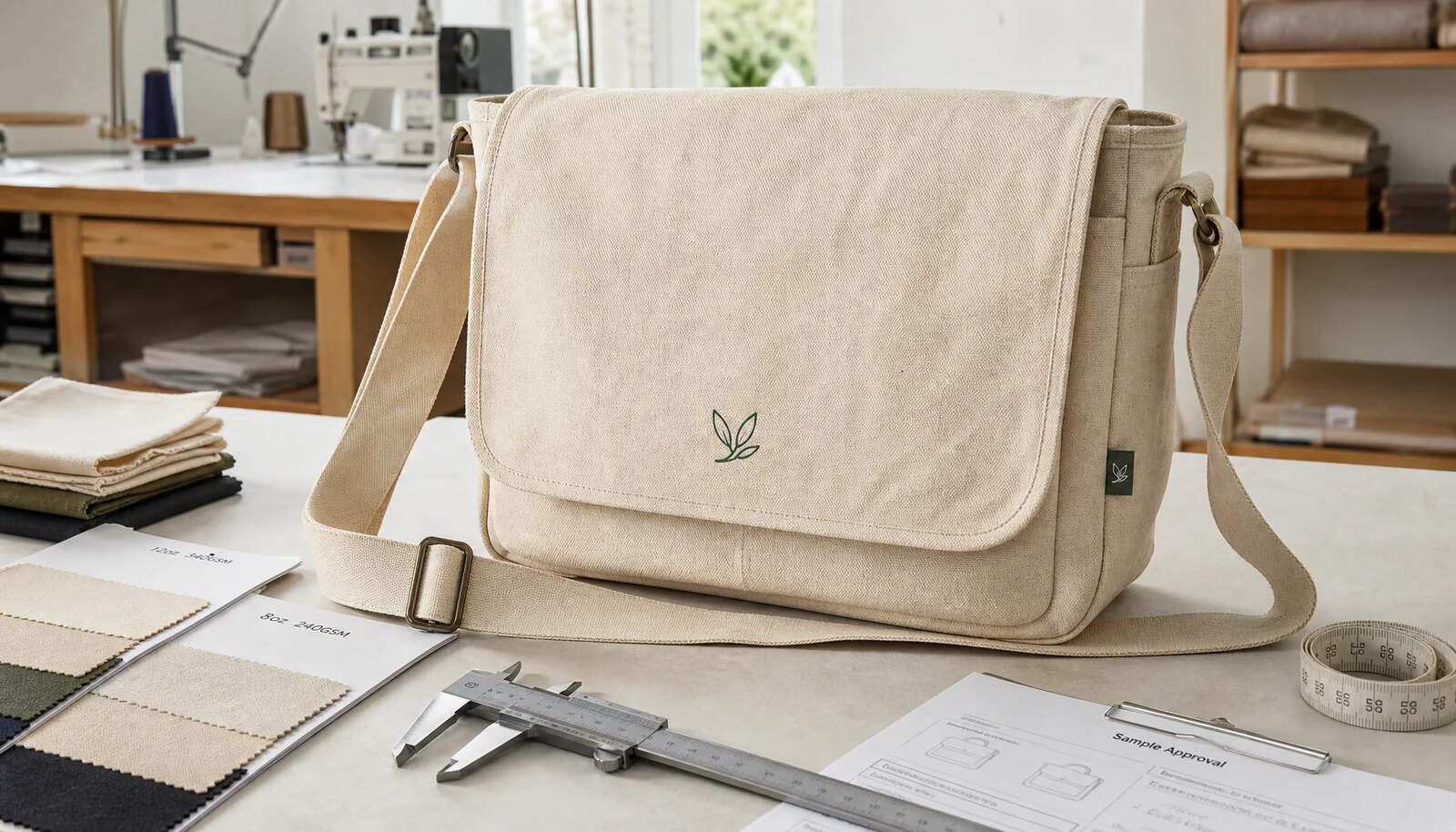
Start with the buying job, not the fabric number
A custom canvas messenger bag should begin with the job it has to do. Fabric weight matters, but it is not the whole brief. An event giveaway, a commuter accessory for an eco apparel brand, and a structured laptop messenger may all be called canvas messenger bags. They do not need the same carry strength, shelf shape, closure system, decoration method, or packing standard.
This is where many RFQs become hard to compare. If the brief says only canvas messenger bag, 12 oz, logo on flap, each supplier has room to make different assumptions. One may quote a lined bag with reinforced strap joins and a stable flap. Another may quote a softer unlined version with lighter actual fabric, basic webbing, and dense carton packing. The numbers may look close on a spreadsheet, but the products are not equivalent.
For procurement buyers, the first question is not what GSM is cheapest. It is what the customer will carry, how often they will use the bag, and what the brand promise requires. A notebook, hoodie, and water bottle call for different stress planning than a tablet or small laptop. A retail product needs better presentation and tighter consistency than an internal giveaway. Sustainability-led programs may also need recycled-content documentation, organic cotton confirmation, or plastic-reduced packaging. Those requirements belong in the sourcing brief before the supplier builds the quote.
A useful custom canvas messenger bags fabric weight guide for eco apparel brands connects GSM to the full build. GSM affects price, of course. It also affects print feel, flap symmetry, carton recovery, sewing difficulty, freight weight, and inspection tolerances. Heavier canvas can feel premium, but only when the factory can sew the thick points cleanly. Lighter canvas can work well, but it may need lining, interlining, or localized reinforcement to behave like a real messenger bag.
- Define the end user, carry load, target retail price, and sales channel before choosing GSM.
- Separate promotional bags from daily-use retail bags because the durability assumptions are different.
- Use finished GSM as the fabric control point, then align lining, strap, closure, reinforcement, and packing around it.
- Ask suppliers to price controlled alternatives so the construction assumptions stay visible.
Translate ounces into finished GSM you can buy against
Canvas is often sold in ounces, while many factories quote in GSM. Both can be useful, but finished GSM is usually the better procurement control point. Ounce language can drift. Some suppliers use nominal market terms. Some refer to greige fabric before dyeing. Others describe a familiar hand-feel rather than the exact finished fabric being cut for production. That is why one supplier's 12 oz canvas may not match another supplier's 12 oz canvas after washing, softening, coating, or mechanical finishing.
The safer RFQ format is to state the expected ounce range and the finished GSM range together. For example: 12 oz canvas, often about 340-400 GSM finished, plus or minus 5 percent unless another approved tolerance is agreed. The word finished is important. Fabric weight and hand-feel can change after dyeing, washing, softening, calendaring, water-repellent treatment, or shrinkage control. If the finished material is not controlled, sample and bulk can drift even when the supplier believes they followed the original instruction.
GSM also needs context. It is not a complete strength specification. Yarn count, weave density, finishing, fiber blend, and fiber quality all affect tear behavior and abrasion resistance. Recycled cotton, organic cotton, conventional cotton, and cotton-poly blends can behave differently at the same GSM. Recycled cotton content may have a different fiber-length profile, so buyers should test the actual fabric instead of assuming that weight alone equals performance.
For eco apparel brands, this is not an argument against recycled or organic options. It is an argument for clearer approval records. Keep the approved swatch. Label it with composition, finished GSM, color, finish, supplier, date, and any test notes. When bulk fabric arrives, QC has something practical to compare against instead of relying on memory from the sample room.
- Ask whether quoted GSM is greige, dyed, washed, coated, or fully finished.
- Use a written tolerance such as plus or minus 5 percent when the supplier can support it.
- Request composition by percentage, including recycled cotton, organic cotton, polyester, or blended yarns.
- Confirm whether GSM is checked on roll goods before cutting or on finished bulk fabric before sewing.
- Keep an approved swatch card with date, supplier, color, GSM, finish, and buyer signoff.
Choose the GSM band by use case
Most canvas messenger bag programs sit somewhere between about 230 and 540 GSM finished. Below that, the product may behave more like a light tote with a flap unless lining or interlining gives it help. Above that, the bag can become expensive to sew, bulky to pack, and heavier than the customer expects. The middle range is popular for a reason: for many eco apparel retail programs, about 340-410 GSM gives enough substance without making the bag feel overbuilt.
A 230-300 GSM canvas can work for event merchandise, bundled promotional items, and price-sensitive programs where the carry load is light. The buyer should expect a softer body, more sag when loaded, and less shelf structure. A 300-340 GSM canvas can fit entry retail styles, especially if the bag is compact, the flap is simple, and the hardware is not heavy.
The 340-410 GSM range is often the practical retail sweet spot. It supports cleaner flap presentation, better abrasion resistance, and more confident hand-feel while keeping sewing and decoration manageable. It is also easier to balance with lining, webbing, and closures without making the finished bag too heavy for daily carry.
Premium programs may move into 410-540 GSM, especially for laptop carry, zipper-under-flap designs, metal hardware, multiple pockets, or a workwear-inspired look. This can be a strong choice, but it needs tighter sampling. Thick seam crossings at flap edges, gusset corners, strap joins, zipper ends, and binding points can produce needle marks or uneven stitching if the factory is not prepared for the construction. Ask whether the pattern needs seam grading, binding changes, different needles, or adjusted stitch density when moving up a weight band.
- 230-300 GSM: promotional messenger bags, simple construction, light carry load, cost-sensitive programs.
- 300-340 GSM: entry retail styles, soft body, modest gusset, limited hardware, simple flap print.
- 340-410 GSM: common retail range for daily-use custom canvas messenger bags.
- 410-540 GSM: premium structured bags, laptop or tablet carry, heavier hardware, higher perceived value.
- Any GSM can fail if strap joins, flap corners, closure points, and pocket openings are not reinforced correctly.
Specify the bag by functional zone
A messenger bag is not one fabric decision. It is a set of functional zones. The body panel, flap, gusset, strap, pockets, lining, binding, and reinforcement all do different work. If an RFQ specifies one canvas weight for the whole product, the factory may overbuild low-stress areas and underbuild high-stress ones. The result can be expensive without being durable.
The body panel sets the main hand-feel and structure. The flap is the most visible face of the bag and often carries the logo, so it needs special attention. Even when the body fabric is substantial, a flap may still need lining or interlining to prevent wavy edges, twisting, or poor print presentation. The gusset controls capacity and shape. If it is too soft, the bag can collapse or twist when loaded. If it is too thick without pattern adjustment, corner sewing can become inconsistent.
The strap is where the user feels the product most directly. A strong body cannot compensate for a strap that rolls, stretches, cuts into the shoulder, or slips through the slider. For many messenger formats, cotton webbing or recycled blended webbing is more predictable than self-fabric straps. Common strap widths run from about 32 mm to 50 mm. A 38 mm strap may suit light daily use; a 50 mm strap often feels more comfortable for heavier carry.
Lining should also be a deliberate choice. A 210D-300D lining can improve usability, hide raw seams, support inner pockets, and give the product a more finished feel without forcing the outer canvas into a heavier weight. Interlining can be localized rather than used everywhere. Closure points, flap corners, zipper ends, strap joins, and pocket openings are usually better places to spend reinforcement budget than hidden low-stress panels.
- Body panel: define finished GSM, composition, color, finish, and shrinkage expectations.
- Flap: specify whether it is self-fabric only, lined, interlined, or reinforced at closure points.
- Gusset: confirm depth, seam construction, corner handling, and whether binding or lining support is needed.
- Strap: state material, width, thickness, adjuster type, hardware finish, stitch pattern, and reinforcement.
- Lining and pockets: define denier, color, pocket layout, seam finish, and whether raw edges are visible.
Match decoration to texture, bending, and scale
Decoration failures on canvas messenger bags often start with an approval shortcut. A logo may look perfect on a digital proof and rough on the finished flap. Canvas has texture, and that texture changes with yarn, weave, GSM, washing, and finish. Coarse natural canvas can break up fine lines. A large solid print can feel stiff. A heat transfer may look clean at first but struggle if it crosses a fold zone. Embroidery can add a premium touch, yet it can pucker lighter canvas if stitch density and backing are not controlled.
Screen print is still the common value choice for simple logos on custom canvas messenger bags. It works well for one-color or two-color artwork at medium to large scale, especially on natural, black, or dyed cotton canvas. Buyers should confirm ink type, print size, color matching method, location tolerance, and whether the surface requires pre-treatment. For a large flap graphic, do not approve from substitute cloth. Ask for a strike-off on the final fabric.
Heat transfer can be useful for detailed or multi-color artwork, but review the hand-feel carefully. Check edge adhesion and flex the area if the transfer is near a fold. Embroidery is usually better for smaller marks, monograms, or compact premium branding. It needs backing control, thread color approval, and stitch-density review. On lighter canvas, even a beautiful embroidery file can distort the panel if the stitch count is too high.
Woven labels, side labels, and patches are often lower-risk branding choices when the bag uses textured canvas or when the flap needs to stay flexible. They can also help eco apparel brands keep the main panel quieter while still making the product identifiable. The key is to test decoration on the exact construction, not on a flat idea of the bag.
- Request a print strike-off or embroidery swatch on the exact finished canvas before bulk approval.
- Check large flap prints after folding, packing, opening, and flexing the flap several times.
- Avoid oversized embroidery on light canvas unless backing and stitch density are proven.
- Use woven labels or small patches when natural canvas texture is part of the design language.
- Confirm print placement tolerance, especially when flap alignment affects how centered the logo appears.
Make supplier quotes genuinely comparable
A low quote is often low because the assumptions are different. One supplier may include lining, flap interlining, wider webbing, magnetic snap reinforcement, print strike-off, and retail carton labels. Another may quote an unlined bag with narrower webbing, lighter actual fabric, basic Velcro, and tighter carton compression. Both quotes may say 12 oz canvas messenger bag. Only one may match the product the brand expects to receive.
Treat each quote as a construction proposal, not just a price. The unit cost should connect to a bill of materials, sample standard, decoration method, packing method, and production schedule. If those items are vague, the price is not ready for a buying decision. Strong RFQs ask for a baseline and controlled alternatives. For example, request the same size, pattern, print, hardware, lining, and packing in 10 oz, 12 oz, and 14 oz canvas. That makes the cost movement easier to understand.
One-time charges also need daylight. Screen setup, embroidery digitizing, lab dips, sample freight, color matching, barcode labels, and inspection costs may sit outside the headline unit price. For B2B procurement, the decision should be based on landed and channel-ready cost, not only FOB unit price. A bag that arrives with permanent flap creases, weak strap stitching, incorrect labels, or shade issues can create claims and rework that erase a small unit-price advantage.
Ask suppliers to explain what changes when fabric weight changes. Sometimes the heavier option requires different needles, slower sewing, wider binding, extra reinforcement, or a higher raw material MOQ. Sometimes it does not. You want that discussion before sample approval, not after the purchase order is placed.
- Compare finished GSM, not only the ounce description in the quote.
- Check whether lining, interlining, binding, reinforcement, and hardware backing are included.
- Confirm strap width and material because small changes affect both cost and perceived quality.
- Separate sample, setup, color matching, and inspection charges from bulk unit price.
- Ask for carton dimensions and gross weight early so freight impact is visible before approval.
Control MOQ before colorways multiply
MOQ pressure usually appears when the range changes too many variables at once. A brand may ask for three body colors, two logo treatments, different linings, and a heavier premium version. On a line sheet, those changes can look modest. In production, they may require separate fabric buys, dye lots, print setups, hardware allocations, and packing runs.
Fabric weight is one of the biggest hidden MOQ drivers. A 10 oz, 12 oz, and 14 oz canvas may come from different greige stock or different finishing runs. Even if the pattern is similar, the raw material plan may be separate. That is why a good-better-best range should be treated as separate constructions, not simple colorways.
For eco apparel brands, MOQ planning should also reduce leftover material. The cleanest approach is to keep one shared construction across the launch: same finished GSM, lining, strap width, closure, hardware finish, and reinforcement map. Then vary body color, print color, woven label, or hangtag where supplier minimums allow. This gives the factory a cleaner production plan and reduces the chance of deadstock from over-specific components.
If a promotional 10 oz version and a premium 14 oz laptop version are both needed, keep the visual language aligned but quote them separately. Each should have its own cost sheet, sample, QC notes, and packing review. You can still control complexity by sharing outer dimensions, artwork placement, hardware finish, or label systems where practical.
- Keep GSM, lining, strap, closure, and hardware shared across colorways whenever possible.
- Treat different fabric weights as separate material programs, even when the pattern is similar.
- Ask for MOQ by body color, fabric weight, lining color, artwork, print color count, and hardware finish.
- Use labels, hangtags, or print color changes before changing the whole construction.
- Track expected leftover fabric and ask whether it can be used for approved future replenishment.
Approve samples with load, weight, and pack-out
A messenger bag sample can look excellent on a table and disappoint in use. Review it with realistic contents, final decoration, and the intended packing method. Load the sample with what the end customer is likely to carry: notebook, hoodie, tablet, small laptop, bottle, catalog set, or daily accessories. Then watch what happens. Does the body collapse? Does the strap dig in? Does the flap twist? Does the magnetic snap pull awkwardly? Does the gusset distort?
Weigh the sample. Finished bag weight in grams is a useful control point because it links fabric choice to freight, hand-feel, and sample-to-bulk consistency. If the approved sample weighs much less than the quoted construction suggests, substitute fabric may have been used. If it weighs much more, landed cost and customer comfort may become issues. Record the finished weight with the sample approval notes.
Measurements still matter. Check width, height, gusset depth, flap drop, pocket size, strap adjustment range, and print placement. Messenger bags also need symmetry checks. Hang the bag loaded and unloaded. Confirm the flap sits centered, the edge reveal is even, and the strap hardware does not pull the bag out of shape.
Natural canvas needs an extra approval conversation. Slubs, seed flecks, minor shade variation, and irregular texture may be part of the look. They can also become disputes if the merchandising team expected a cleaner surface. Define acceptable natural character with the approved sample, swatches, or photos. If the brand needs a smoother look, request a tighter fabric grade or different finish and expect possible cost or availability changes.
- Weigh the sample and record finished bag weight with the sample approval notes.
- Measure width, height, gusset, flap drop, strap range, pocket size, and print placement.
- Load the bag with realistic contents and check sagging, strap comfort, flap alignment, and closure strength.
- Fold and repack the sample to see whether the logo, flap edge, or corners develop permanent marks.
- Approve natural canvas character limits in writing so QC has a practical reference.
Set QC standards before bulk starts
Quality control should be measurable enough for the buyer, factory, and inspector to use the same standard. Good stitching and nice canvas are not inspection criteria. The approved sample is important, but it should be supported by tolerances for dimensions, finished GSM, print position, shade, stitch density, hardware function, seam finish, and packing. Retail and B2B distribution channels can be unforgiving when labels, cartons, or presentation are inconsistent.
Fabric inspection should confirm that bulk canvas matches approved color, composition, finish, and GSM tolerance. Natural canvas may include small irregularities, but oil marks, holes, dirty streaks, major shade panels, and weaving defects should be controlled. Cutting inspection should watch panel direction and shade grouping so one bag does not mix visibly different tones.
Sewing inspection should focus on the places that carry stress: strap joins, flap corners, pocket openings, gusset corners, zipper ends, and magnetic snap positions. Look for skipped stitches, broken thread, loose ends, needle damage, weak bartacks, and uneven box-x stitching. If the bag uses heavier canvas, inspectors should pay extra attention to thick crossings where machines are more likely to struggle.
Final inspection should combine function, appearance, and packing. Hardware should open and close smoothly. Magnetic snaps should align and stay firmly attached. Zippers should not wave, catch, or fail at the ends. Prints should be checked for placement, color, pinholes, smudging, cracking, and migration. Embroidery should lie flat without puckering or visible face-side backing. Cartons should match the purchase order, with correct counts, labels, shipping marks, barcode placement, and fold method. For larger or higher-risk orders, an inline inspection can catch construction drift before the full batch is packed.
- Set dimension tolerances before bulk, including width, height, gusset, flap drop, and strap range.
- Check finished GSM against the approved tolerance and keep the test record with inspection files.
- Inspect strap box stitches, cross stitches, bartacks, or reinforcement patches for consistency.
- Confirm hardware pull, zipper operation, snap alignment, and slider movement on finished bags.
- Inspect packed cartons for count, fold direction, barcode accuracy, hangtag placement, and shipping marks.
Plan packing around the flap
Packing is not a back-end detail for canvas messenger bags. The flap is usually the main branding surface, and it is also the part most likely to be damaged by poor folding. Heavy canvas can hold pressure marks. Printed areas can crack, polish, or show compression if they are pressed against hardware. Magnetic snaps, buckles, and strap adjusters can leave impressions on nearby panels when the pack method is inconsistent.
The right pack format depends on the channel. Wholesale and B2B distribution may accept flat packing with controlled fold lines and master carton labels. Retail-ready programs may need hangtags, barcode stickers, individual bags, tissue, or light stuffing to protect presentation. Sustainability policies may restrict individual polybags or require recycled-content packaging, paper bands, or other alternatives. These decisions affect labor, carton cube, moisture protection, and destination receiving compliance, so they belong in the RFQ.
Freight planning should use both gross weight and carton dimensions. Messenger bags can become cube-sensitive when they have structured flaps, padded compartments, metal hardware, or wide straps that prevent tight compression. More units per carton can reduce carton count, but it can also create permanent creases or hardware impressions. Ask for proposed carton dimensions during quotation. Review a packing sample or clear packing photos. If the order is high value, test whether the bag recovers after being packed for several days.
Fold direction should be approved just like print position. Keep folds away from the main logo line, flap edge, and closure hardware where possible. Confirm whether the strap is tucked, wrapped, or laid flat. Small packing choices can decide whether the bag arrives retail-ready or needs rework.
- Define flat pack, light stuffing, hanger pack, or retail-ready pack before quoting.
- Keep fold lines away from the main flap logo, closure hardware, and sharp panel edges.
- Confirm whether individual polybags are allowed, restricted, or replaced by paper bands or tissue.
- Request units per carton, carton size, net weight, gross weight, and carton compression assumptions.
- Include barcode, hangtag, warning label, assortment label, and shipping mark requirements in the packing spec.
Specification comparison for buyers
| Spec decision | Recommended option | When it fits | Buyer risk to check |
|---|---|---|---|
| Body fabric weight | 12 oz canvas, often about 340-400 GSM finished | Most daily retail messenger bags that need structure without becoming too stiff | Some suppliers quote nominal ounce weight before dyeing, washing, or finishing; confirm finished GSM, tolerance, and test basis |
| Lightweight promotional version | 8-10 oz canvas, often about 230-300 GSM finished | Giveaways, event merchandise, and light-carry use at lower price points | The bag may sag on shelf, large prints can distort, and corners can wear faster |
| Premium structured version | 14-16 oz canvas, often about 400-540 GSM finished | Laptop carry, higher AOV retail, and workwear-inspired collections | Higher fabric weight can raise freight cube, sewing difficulty, and minimum fabric order requirements |
| Flap and gusset reinforcement | Self-fabric plus interlining or 210D-300D lining, with localized reinforcement | Bags with large flap prints, magnetic snaps, wide gussets, or security zippers | Without reinforcement, flap edges can wave, snaps can pull through, and gusset seams can twist under load |
| Strap and load-bearing parts | Cotton webbing or recycled blended webbing, commonly 32-50 mm wide, with box-x or bartack reinforcement | Daily-use messenger bags where comfort and durability matter more than matching every panel fabric | Self-fabric straps can stretch, roll, or tear at adjustment points unless they are backed and stitched correctly |
| Print method on canvas | Screen print for simple logos, embroidery for smaller premium marks, woven label or patch for texture-heavy canvas | Chosen by artwork size, color count, canvas finish, and target margin | Large solid prints can crack or feel stiff; embroidery can pucker on lighter canvas without proper backing |
| Closure hardware | Velcro, magnetic snap, zipper under flap, or buckle depending on channel and security needs | Selected by price position, customer expectation, and use case | Magnets need pull-force consistency; metal hardware needs corrosion checks; zipper tape color must be approved |
| MOQ strategy | Keep one pattern and shared components across colorways | Best when launching several SKUs while controlling leftover stock | Changing GSM, lining, or hardware by colorway can create separate raw material buys |
| Packing format | Flat pack or light-stuffed pack, usually 10-20 pcs per carton, with folds kept away from logo lines | Wholesale, DTC replenishment, and retail prep where presentation and freight cost both matter | Poor fold direction can create permanent crease lines or hardware impressions |
Buyer checklist before sampling
- Define the real use case first: promotional carryall, commuter bag, tablet bag, laptop messenger, or premium retail accessory.
- State the target finished GSM range, not only the ounce label, and ask the supplier to confirm whether the weight is measured before or after finishing.
- List body fabric, flap fabric, gusset fabric, lining, interlining, strap webbing width, binding, and reinforcement separately.
- Specify shrinkage allowance, color tolerance, and whether the supplier is quoting greige, dyed, washed, coated, or fully finished canvas.
- Set a target finished bag weight in grams when freight, shelf feel, or DTC parcel weight matters.
- Match the decoration method to the final canvas texture and fold line; do not approve artwork from a flat digital proof alone.
- Request a print strike-off, embroidery swatch, or patch sample on the actual fabric before approving bulk artwork.
- Approve a pre-production sample with final fabric, final print scale, final hardware, final strap, and intended pack method.
- Confirm carton pack quantity, fold direction, barcode placement, hangtag requirements, and whether polybags are allowed.
- Request needle size, stitch density, seam type, and reinforcement details at strap joins, flap corners, zipper ends, and pocket openings.
Factory quote questions to send
- What is the exact finished fabric composition and GSM tolerance for the body, flap, gusset, lining, binding, and reinforcement parts?
- Is the quoted GSM measured before or after dyeing, washing, coating, and finishing, and what test method or internal standard is used?
- What finished bag weight in grams do you estimate for this size, fabric weight, lining, hardware, and packing method?
- Which print method is included in the quote, and what artwork limitations apply on this canvas texture and flap construction?
- Does the quote include pre-treatment, print strike-off, embroidery backing, screen setup, Pantone matching, lab dip, and sample revision costs?
- What reinforcement is included at strap box stitches, flap edge, pocket corners, zipper ends, magnetic snap positions, and other stress points?
- What strap material, width, thickness, slider hardware, and color tolerance are included in the quoted construction?
- What is the MOQ by bag color, fabric color, artwork, print color count, lining color, and hardware finish if we keep the same pattern?
- Can you quote 10 oz, 12 oz, and 14 oz canvas using the same pattern, print, hardware, and packing so the cost differences are clear?
- How many days are needed for lab dip, fabric sourcing, sample development, sample revision, print strike-off, bulk production, and final inspection?
Quality-control points to confirm
- Finished body fabric GSM should stay within the agreed tolerance, commonly plus or minus 5 percent unless another written standard is approved.
- Finished bag measurements should meet the approved tolerance, often plus or minus 1 cm on width and height and plus or minus 0.5 cm on gusset depth.
- Strap length should be checked across the full adjustment range, including the shortest and longest positions, not only the middle setting.
- Finished bag weight should be compared with the approved sample and quoted target when freight or hand-feel matters.
- Strap attachment seams should show clean box-x or bartack reinforcement with no skipped stitches, broken thread, loose ends, or needle damage.
- Flap alignment should sit centered on the body with symmetrical edge reveal and no twisting after hanging, loading, or repacking.
- Print placement should match the approved sample location and size, with no obvious pinholes, smudging, color migration, cracking, or poor edge definition.
- Embroidery should sit flat with controlled stitch density, no puckering, no thread breaks, and no visible backing from the face side.
- Magnetic snaps, buckles, sliders, and zippers should operate smoothly and remain firmly fixed after pull and open-close checks.
- Canvas surface should be free from major slubs, oil marks, shade panels, holes, stains, and weaving defects beyond the approved natural character.