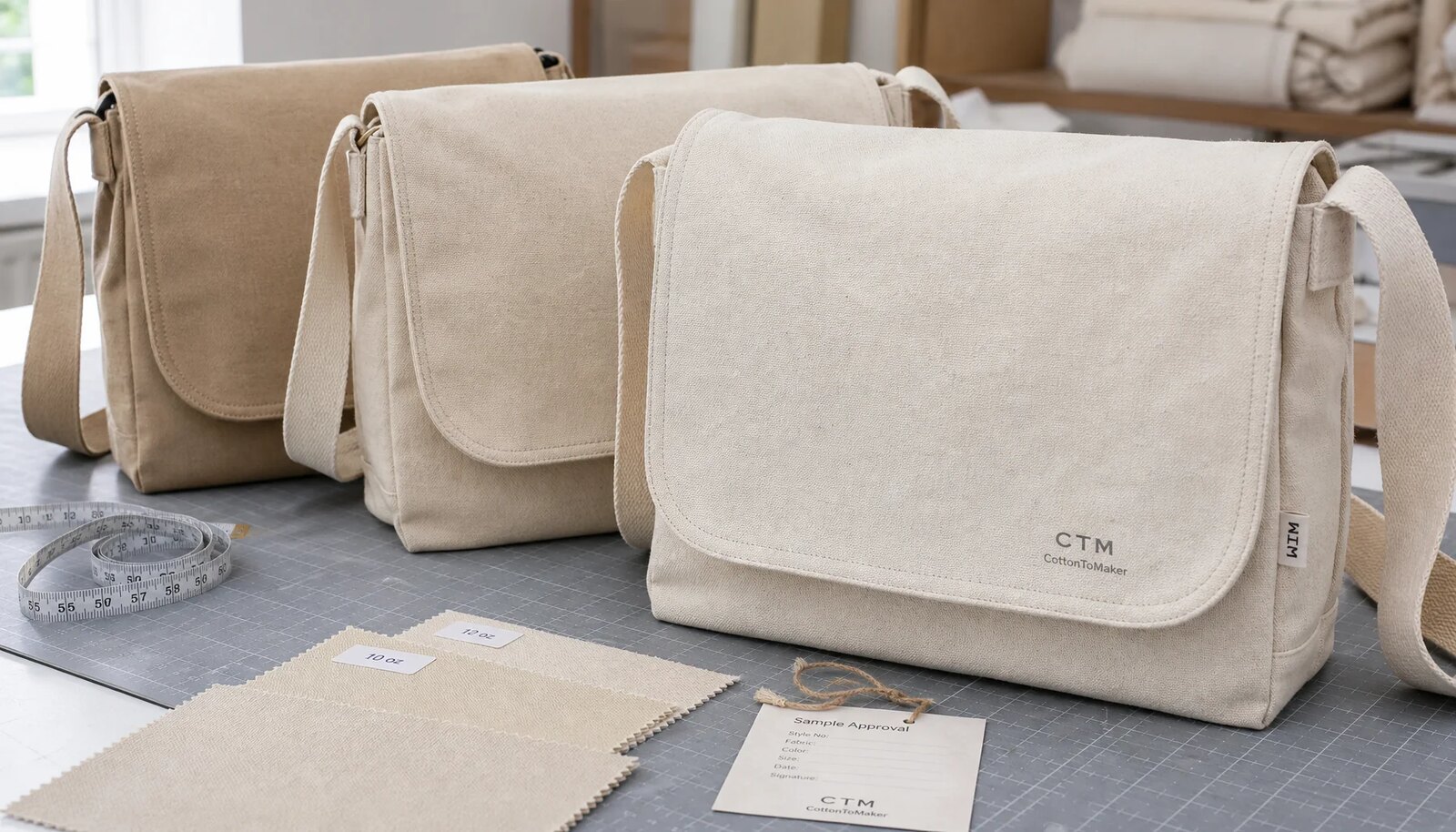
Start With the Bag’s Real Job
The first decision in custom canvas messenger bag sourcing is not whether the bag sounds heavy, premium, artisan, or eco-friendly. Those words help with merchandising, but they do not control production. One factory may call 10 oz finished cotton canvas heavy. Another may quote 14 oz greige canvas before finishing. A third may offer a cotton-poly blend with a stiff handle that feels heavier than it is. On a spreadsheet, the quotes may look close. In the booth, in the carton, and under load, they can behave very differently.
A better RFQ begins with the job the bag must do. Craft fair programs can mean sponsor giveaways, workshop kits, association merchandise, maker-market resale, or boutique-ready inventory. Each use has a different cost and quality balance. A giveaway bag needs clean branding, sensible strength, and a landed cost that can survive event budgets. A paid messenger bag needs more body, better strap comfort, neater stitching, and packing that keeps it clean until it reaches a market table or retail shelf.
Load should be written in kilograms and connected to likely contents. Light event bags may carry brochures, a small bottle, a wallet, event maps, and a few lightweight purchases. Craft fair resale bags may hold soap boxes, candles, notebooks, yarn, fabric bundles, catalogs, or small ceramics. Tablet-friendly positioning creates another level of expectation: lining, pocket structure, strap pull strength, flap alignment, and comfort all matter. A well-reinforced 10 oz canvas bag can be appropriate for light use. A 14 oz bag with poor strap joins can still fail.
- Light event use: plan around approximately 3-5 kg, 10 oz canvas, simple construction, and reinforced strap attachment points.
- General craft fair resale: plan around approximately 5-7 kg, 12 oz canvas, a stable flap, comfortable strap, and defined load testing.
- Premium utility use: consider 14-16 oz canvas or a structured 12 oz lined canvas, but approve seam samples before bulk cutting.
- Tablet or catalog use: add lining, pocket reinforcement, strap pull testing, and dimensions based on the intended device or catalog size.
- RFQ control: include expected contents, loaded weight, retail price band, display method, delivery market, and packing format.
Use Finished GSM, Not Guesswork
Canvas is often quoted in ounces and GSM. Ounces usually mean ounces per square yard. GSM means grams per square meter. Both are useful, but only if the supplier states what stage of fabric is being measured. A fabric weight taken before dyeing, washing, brushing, coating, or preshrinking is not the same as the finished fabric that will be cut into bags. This is where many procurement comparisons go wrong: one quote is based on greige fabric, another on finished fabric, and another on a nominal canvas name.
Fabric weight changes more than hand-feel. Higher GSM can give the bag better structure and perceived durability, but it also affects cutting yield, needle choice, thread tension, sewing speed, carton cube, freight weight, and the risk of bulky seams. Messenger bags have layered stress zones. The flap edge, strap joins, side seams, bottom gusset, pocket openings, and closure points may include two or three fabric layers plus lining, reinforcement, or webbing. These areas must be sewable, not just strong on paper.
Lower weight should not be dismissed automatically. A 10 oz finished canvas with bartacks, closure backing, and a sensible bottom construction can make a strong light-duty craft fair bag. A 16 oz canvas can look premium but create needle holes, uneven topstitching, and thick flap corners if the design is not adjusted. Procurement teams should compare the full build, sample feel, carton data, and load-test result rather than ranking suppliers by the biggest fabric number.
- 10 oz canvas: usually about 320-340 GSM finished, efficient for simple event bags but needing reinforcement at stress points.
- 12 oz canvas: usually about 380-410 GSM finished, the safest baseline for most craft fair messenger bag programs.
- 14 oz canvas: usually about 450-480 GSM finished, with stronger retail feel but more seam bulk, weight, and packing pressure.
- 16 oz canvas: usually about 500-540 GSM finished, best reserved for premium bags after seam, flap, and load testing.
- Purchase order wording: specify finished GSM with tolerance, such as approved 12 oz canvas around 380-410 GSM or approved swatch within plus or minus 5 percent.
Match Weight to the Sales Scenario
Craft fairs put bags through a specific kind of pressure. Shoppers carry uneven purchases, move between booths, set bags on tables, and judge the product by touch before they buy. A messenger bag can photograph beautifully and still disappoint if the flap collapses, the strap twists, the bottom sags, or the logo looks fuzzy on textured canvas. Fabric weight should match the bag’s selling role, not only the buyer’s instinct that heavier must be better.
For sponsor giveaways and lower-cost event merchandise, 10 oz natural canvas is often a practical choice when the construction stays honest. Keep the shape simple, avoid oversized pockets and heavy hardware, use a stable webbing strap, and place the print away from the harshest fold points where possible. For paid craft fair resale, 12 oz canvas usually gives a stronger booth presence. It has enough body to hang cleanly and feel substantial, while still being efficient to print, sew, fold, and ship.
Premium maker merchandise may justify 14 oz or 16 oz canvas, but the higher weight should support the price story and the use claim. Sometimes a lined 12 oz messenger bag with reinforced flap, clean hardware, and good stitching delivers better value than an unlined 16 oz bag that costs more to ship and is harder to pack without deep creasing. The best specification is the one that passes the load test, looks right on display, protects margin, and fits the channel.
- Sponsor giveaway: 10 oz natural canvas, one-color screen print, fixed webbing strap, simple flap, and bulk carton packing.
- Workshop or class kit: 10-12 oz canvas, inside pocket, stable logo placement, and enough body for handouts or small tools.
- General craft fair resale: 12 oz canvas, reinforced flap, optional lining, magnetic snap or button, and clean retail finishing.
- Premium maker merchandise: 14 oz canvas or structured 12 oz lined canvas, metal hardware, woven label, hangtag, and individual packing.
- Tablet-friendly accessory: 12-14 oz canvas with lining or padded sleeve option, strap testing, and dimensions matched to the target device.
Specify Canvas Type, Finish, and Color
Fabric weight is only one line in the canvas specification. Buyers also need to define fiber content, weave, finish, color, and acceptable natural variation. Natural cotton canvas may show slubs, seed flecks, small texture changes, and shade movement. For a craft fair look, those details can be part of the charm. For a retailer expecting a cleaner surface, they can become defects. The difference should be decided in the RFQ, not during final inspection.
Fiber content affects feel, labeling, claims, and sourcing risk. One hundred percent cotton canvas gives the familiar natural hand-feel many craft fair buyers expect. Cotton-poly canvas can improve consistency or help manage cost, but it may not support the same product story. Recycled cotton, organic cotton, and other material claims need documentation if they appear in marketing, hangtags, product listings, or retailer files. Do not approve claim language until the supplier confirms what evidence is available and which part of the supply chain it covers.
Color is its own control point. Stock natural canvas usually samples faster, carries lower MOQ pressure, and avoids some dye-lot complexity. Custom dyed canvas needs lab dips, bulk shade approval, rub fastness checks, and planning around fabric booking. Pigment dyed or washed canvas can give a softer vintage appearance, but it may also increase shade variation, shrinkage, and seam puckering. Any finish change can affect final GSM, print adhesion, and how cleanly the bag sews.
- Natural canvas: define acceptable seed flecks, slub level, shade range, odor limit, stains, and whether optical brighteners are allowed.
- Reactive dyed canvas: use for stronger brand color targets; require lab dips, bulk shade approval, and dry/wet rub checks.
- Pigment dyed or washed canvas: approve the worn-in appearance, shrinkage, seam puckering, color variation, and final GSM.
- Blended canvas: request composition, labeling impact, hand-feel sample, print test, and confirmation that product claims remain accurate.
- Certified material: request documentation early and confirm the certificate scope covers material, supplier, factory, and product claim.
Build the Construction Around the Weight
Messenger bag performance comes from the whole build, not the canvas roll alone. The same 12 oz fabric can feel durable or flimsy depending on pattern balance, flap size, gusset design, strap placement, seam allowance, reinforcement, and closure support. If the fabric is too light for the design, the flap may curl and the bottom may sag. If the fabric is too heavy for the design, folded seams may become bulky and the flap may not close smoothly.
Straps deserve close attention because craft fair users often carry bags for hours while browsing. A 30-40 mm cotton webbing strap is usually more repeatable in bulk production than a self-fabric strap. It also gives clearer strength control. Adjustable straps improve fit, but they add hardware, stitching, and inspection points. Self-fabric straps can look more boutique, especially on natural cotton programs, yet they should be tested for twisting, edge comfort, strap slippage, and seam strength under load.
Closures and pockets also change how fabric weight performs. Magnetic snaps should not be set through a single layer of light canvas without backing. Buttons need pull-force checks and secure stitching. Hook-and-loop is practical for utility kits, though it can collect lint from cotton surfaces. Inside pockets add value, but poor placement can distort the lining or pull the body panel out of shape. A strong tech pack should show reinforcement patches, stitch lines, bartack locations, seam allowances, and closure backing, not just a short written description.
- Flap structure: specify double-layer canvas, interfacing, or reinforcement patches if the flap must hold shape on a booth table.
- Bottom control: use a boxed gusset, bottom seam reinforcement, or lining support if the bag will carry dense purchases.
- Strap joins: require bartacks, X-box stitching, or reinforced seam construction and approve exact placement on the sample.
- Closure support: add backing patches behind magnetic snaps, buttons, rivets, and studs to reduce tearing under repeated use.
- Pocket control: define pocket dimensions, seam allowance, attachment points, and whether the pocket is sewn into the lining or body panel.
Choose Branding That Works on Canvas
Canvas is a textured print surface. Yarn size, weave density, slubs, seed flecks, fabric color, and finishing all influence logo clarity. Fine serif text, thin lines, distressed artwork, and pale ink on natural canvas may lose definition. For most custom canvas messenger bags for craft fairs, screen printing remains the safest route for solid one- to three-color artwork because it is efficient, familiar, and well suited to cotton canvas.
Artwork should be approved at actual size on the selected fabric. A digital proof confirms layout; it does not confirm ink behavior. A print strike-off on a smoother substitute fabric cannot approve bulk production because surface texture and fabric color drive edge sharpness and color appearance. This matters even more for dark canvas, white ink, metallic ink, heavy coverage, and flap prints that bend or rub during use.
Other branding methods can solve specific problems. Woven labels protect small details and keep the front panel clean. Embroidery adds texture, but it can pucker lighter canvas and should be tested with backing. Heat transfers can help with gradients or short runs, yet they may look glossy or synthetic on natural cotton. Leather, faux leather, or cotton patches can support premium positioning, but they add sourcing, MOQ, colorfastness, and attachment checks.
- Screen print: best for solid logos, medium to large orders, strong cost control, and repeat craft fair merchandise.
- Woven label: best for small text, multiple colors, clean retail branding, or artwork that would blur on coarse canvas.
- Embroidery: best for simple marks on stable panels; approve puckering, backing, thread color, and needle impact.
- Heat transfer: best for gradients or short runs; test adhesion, shine, edge lift, and compatibility with cotton texture.
- Patch branding: best for premium positioning; confirm patch material, stitch strength, colorfastness, placement tolerance, and MOQ.
Separate MOQ From the Unit Price
MOQ for canvas messenger bags is rarely a single number. A supplier may accept a lower sewing MOQ when using stock natural canvas, while custom dyed fabric requires a larger fabric booking. Screen printing, woven labels, embroidery, custom hardware, lining colors, strap colors, hangtags, barcode labels, and individual packing can each carry their own minimums or setup costs. If the RFQ asks only for one MOQ, the answer may hide the real purchasing constraints.
Craft fair programs often need several designs for different artists, sponsors, markets, dates, or regions. The cleanest approach is to keep the base bag consistent and vary only the logo, label, or hangtag. One body fabric, one strap, one lining, one closure, and one carton plan allow the factory to cut, sew, inspect, and pack more efficiently. Splitting fabric colors, lining colors, hardware finishes, or pocket details across small quantities increases shade risk, sorting work, and inspection complexity.
Price breaks should be quoted against the same specification. A lower unit price may come from better cutting yield, reduced setup allocation, or more efficient carton packing. It may also come from a hidden downgrade, such as lighter canvas, omitted reinforcement, cheaper hardware, fewer bartacks, or bulk packing instead of individual packing. Ask suppliers to flag any specification change clearly, line by line, so the landed cost comparison remains honest.
- Lowest MOQ route: stock natural canvas, standard strap, standard hardware, one-color screen print, and bulk packing.
- Moderate MOQ route: stock dyed canvas, custom logo, standard lining, standard closure, hangtag, and carton marks.
- Higher MOQ route: custom dyed canvas, custom lining, special hardware finish, woven label, barcode packing, and strict shade control.
- Split-order strategy: keep the base construction identical and split only artwork, label design, or hangtag where possible.
- Quote comparison rule: compare the same fabric, lining, reinforcement, hardware, logo method, packing, and inspection terms at every price break.
Treat Samples as Production Controls
Sample approval is where many bulk problems can be stopped early. A photo sample is not enough. Buyers need to handle the flap, wear the strap, fill the bag, open and close the closure, and inspect how the logo behaves on the selected canvas. A blank fit sample can approve silhouette and dimensions, but it cannot approve final hand-feel, print adhesion, hardware finish, load performance, or packing presentation.
A practical approval sequence includes fabric swatch, lab dip if dyed, blank construction sample, print strike-off, revised sample if needed, and pre-production sample. The pre-production sample should use the final fabric weight, final color, final thread, final strap, final hardware, final lining, final logo method, final reinforcement, final sewing method, and final packing. It should be signed, dated, labeled with a revision number, and retained so the buyer, factory, and inspector use the same reference.
Feedback should be measurable. Instead of saying the flap feels weak, state whether to add interfacing, use double-layer canvas, increase flap depth, or move the topstitching. Instead of saying the strap is too long, state the finished length and tolerance. Clear sample comments reduce revision loops and protect the production calendar because the supplier can make exact changes before cutting bulk fabric.
- Measure the sample: width, height, gusset, flap drop, flap width, pocket size, strap length, strap width, and logo placement.
- Weigh the sample: compare complete bag weight with quoted unit weight and carton gross weight assumptions.
- Load the sample: fill it with representative contents and check strap comfort, flap alignment, closure function, and bottom shape.
- Test branding: perform dry rub and light wet rub checks and review flaking, dye transfer, edge bleeding, and cracking at folds.
- Record approvals: photograph bartacks, stitch density, closure backing, lining attachment, logo position, folding method, and carton packing.
Write QC Tolerances Before Cutting
Quality control belongs in the purchase order before production starts. The approved sample is important, but it is not enough unless measurable tolerances are also defined. Messenger bags have many variables: body size, flap shape, gusset depth, strap length, logo position, closure alignment, stitch density, fabric shade, and carton quantity. Without written tolerances, inspection becomes subjective and disputes are harder to resolve.
For many canvas bag programs, buyers use general inspection levels with AQL targets such as 2.5 for major defects and 4.0 for minor defects, unless a retailer or internal standard requires a different approach. Critical defects should be zero tolerance. Major defects may include open seams, broken strap attachments, severe stains on the main face, wrong logo, wrong color, unsafe hardware, or a failed load test. Minor defects may include small thread tails, slight shade variation within the approved band, or small placement variation inside tolerance.
The load test should match the product claim. A light craft fair bag may be tested at 5 kg, while a general resale messenger bag may be tested at 7 kg. If the bag is promoted for tablets, books, catalogs, or heavier utility use, the buyer should define a higher or more specific test. After loading, check not only whether the bag breaks, but whether seams stretch, the flap distorts, the closure shifts, pockets tear, or the strap becomes uncomfortable.
- Dimension tolerance: define body width, height, gusset, flap depth, pocket size, strap length, and strap width before inspection.
- Logo tolerance: measure from fixed seams or panel edges, commonly plus or minus 3-5 mm for small marks and plus or minus 5-10 mm for larger flap prints.
- Fabric tolerance: control finished GSM, shade band, odor, stains, slub level, seed flecks, weaving defects, and shrinkage where relevant.
- Stitching tolerance: approve stitch density, bartack length, thread color, skipped-stitch limits, backtack security, and seam puckering standard.
- Load and function tests: check strap joins, closure alignment, pocket strength, bottom shape, flap tension, and hardware after filling the bag.
Plan Packing, Freight, and Timing Early
Messenger bags are more difficult to pack than flat totes. The flap can crease, the strap can tangle, and heavy canvas can hold deep fold lines when cartons are over-compressed. For craft fair retail, presentation matters because the bags may be unpacked quickly at a booth and placed on hooks, shelves, or tables. Packing should be part of the product specification, not a warehouse decision made after sewing is complete.
Flat packing can be efficient, but the buyer should define the fold line, strap position, tissue use, pieces per carton, and maximum carton gross weight. Individual polybags keep natural canvas clean, but they may conflict with sustainability goals. Paper bands, kraft sleeves, carton liners, or bulk packs can work if they protect the bag from dirt, moisture, and abrasion. If bags move through distributors or retail channels, barcode labels, carton marks, and carton strength need approval before production packing begins.
Lead time depends on approvals, not sewing time alone. Fabric booking, lab dips, artwork proofing, print strike-offs, sample revisions, hardware sourcing, packing-label approval, inspection, and shipment booking all affect the calendar. Changing fabric weight after sample approval is a major schedule risk because it can trigger new pattern checks, sewing tests, print approval, load testing, and carton recalculation. Lock fabric, construction, artwork, and packing before cutting authorization.
- Packing control: specify folding method, strap placement, tissue use, individual bagging or paper banding, pieces per carton, and carton gross weight.
- Moisture control: use clean storage, carton liners, and silica gel where appropriate for natural cotton canvas during humid storage or sea shipment.
- Freight control: compare CBM per 1,000 pieces, gross weight per carton, pallet fit, and whether heavier canvas reduces pieces per carton.
- Timeline control: separate dates for swatches, lab dips, samples, strike-offs, bulk production, inspection, packing, and shipment booking.
- Change control: require written approval before changing fabric weight, fabric color, strap type, hardware, logo method, reinforcement, or packing.
Specification comparison for buyers
| Spec decision | Recommended option | When it fits | Buyer risk to check |
|---|---|---|---|
| Light craft fair giveaway | 10 oz cotton canvas, typically about 320-340 GSM finished fabric | Sponsor bags, workshop handouts, event maps, brochures, wallets, small packaged crafts, or low-cost branded merchandise where folded packing and lower freight matter | The flap and bottom may feel soft; specify reinforcement patches, stitch density, bottom gusset construction, and a realistic static load test rather than relying on fabric weight alone |
| Balanced retail baseline | 12 oz cotton canvas, typically about 380-410 GSM finished fabric | Most custom canvas messenger bags for maker markets, craft fair resale, association merchandise, branded class kits, and distributor programs | Confirm finished GSM after dyeing or washing; suppliers may quote greige fabric weight, finished fabric weight, or nominal ounce weight, which are not always equivalent |
| Premium structured specification | 14-16 oz canvas, typically about 450-540 GSM finished fabric | Higher-price artisan merchandise, tablet-friendly bags, retail shelf display, premium sponsor kits, and programs where added weight supports the product story | Thick seam intersections can create needle damage, uneven topstitching, bulky flap edges, and slower production; require seam samples and load tests before bulk cutting |
| Natural canvas body | Unbleached or natural cotton canvas with approved shade, slub, seed-fleck, and odor limits | Craft fair aesthetics, handmade positioning, eco-forward visual style, simple one-color logos, and lower-complexity sampling | Natural cotton variation is normal unless restricted; define acceptable appearance, shade tolerance, contamination limits, and whether optical brighteners are allowed |
| Dyed canvas body | Reactive dyed canvas for stronger color targets or pigment dyed canvas for a washed casual look, subject to lab dip approval | Brand color programs, seasonal assortments, school or association colors, and retailer-specific merchandise collections | Custom dyeing may increase MOQ and lead time; approve lab dips, bulk shade bands, dry/wet rub fastness, shrinkage, and print compatibility on the final fabric |
| Lining and internal structure | 5-7 oz cotton lining, TC lining, or 190T polyester lining, with defined tack points and seam allowance | Cotton lining supports a natural product story; polyester lining improves consistency and may reduce lint; lining improves body for tablet, catalog, or gift-set use | Loose lining can twist, sag, or catch contents; specify pocket dimensions, tack points, lining attachment at side seams, and bottom corner control |
| Logo method | Screen print for solid artwork, woven label for small detail, embroidery for simple premium marks, transfer only after adhesion approval | Screen print is efficient for one- to three-color craft fair logos; labels preserve fine detail; embroidery or patches can support premium positioning | Canvas texture reduces print edge sharpness; approve a strike-off at actual size on the selected finished fabric color and weight, including rub and fold checks |
| Strap construction | 30-40 mm cotton webbing strap, adjustable webbing strap, or reinforced self-fabric strap | Webbing gives stable strength and repeatability; adjustable straps improve fit; self-fabric straps match boutique styling | Narrow or poorly reinforced straps fail comfort and strength expectations; specify strap width tolerance, bartack count, pull points, and loaded hang test method |
| Closure style | Magnetic snap, button, hook-and-loop, hidden snap, or no closure depending on price point and channel | Magnetic snaps look clean; buttons fit handmade styling; hook-and-loop is practical for utility kits; no closure can work for simple low-cost giveaways | Closures concentrate stress at the flap; require reinforcement patches, alignment tolerance, pull-force checks, and filled-bag closure testing |
Buyer checklist before sampling
- Define the intended carrying load in kilograms before choosing GSM: light event use around 3-5 kg, general craft fair resale around 5-7 kg, or heavier utility use only if the construction is reinforced and tested.
- State the target as finished fabric weight, not just nominal canvas weight; require the supplier to confirm whether the ounce/GSM value is measured before or after dyeing, washing, brushing, coating, or preshrinking.
- Specify fiber content and weave clearly: 100 percent cotton canvas, cotton-poly canvas, recycled cotton blend, organic cotton canvas, plain weave duck canvas, twill canvas, washed canvas, or pigment dyed canvas.
- Lock the complete construction in the RFQ: finished size, gusset, flap depth, lining, pockets, strap width, strap length, closure type, reinforcement patches, bartacks, labels, hangtags, packing, and carton marks.
- Approve logo placement and decoration on the same fabric weight, color, weave, and finish planned for bulk production; do not approve print performance from a smoother substitute fabric.
- Set measurable tolerances for finished dimensions, commonly plus or minus 5 mm for small panels and plus or minus 10 mm for larger body dimensions unless the pattern requires tighter control.
- Set fabric control limits in the purchase order, such as finished GSM within plus or minus 5 percent of the approved swatch, shade within the approved bulk shade band, and no visible stains on the main display face.
- Request a pre-production sample made with bulk fabric, bulk hardware, final thread color, final strap, final logo method, final reinforcement, final packing, and production sewing method before authorizing cutting.
- Compare landed cost per usable bag, including defect allowance, inspection cost, carton cube, gross weight, inland freight, sea or air freight, storage space, repacking risk, and retailer compliance work.
- Clarify MOQ separately for base bag sewing, stock fabric, custom dyed fabric, lining color, strap color, hardware finish, screen print color count, woven label, hangtag, barcode label, and packing format.
Factory quote questions to send
- What is the finished GSM and nominal oz per square yard of the canvas after dyeing, washing, brushing, preshrinking, or finishing, and what tolerance do you control in bulk production?
- Is the quoted fabric 100 percent cotton canvas, cotton-poly canvas, recycled cotton blend, organic cotton canvas, or another construction, and can you provide composition documentation if required?
- Is the canvas plain weave duck, twill canvas, washed canvas, pigment dyed canvas, reactive dyed canvas, or coated canvas, and how does that choice affect hand-feel, shrinkage, and print behavior?
- Can you provide swatches with fabric weight test data, shrinkage results, dry and wet rub fastness, fabric width, and estimated consumption per finished bag?
- What static load test do you recommend for this construction, how many hours will the bag be loaded, and which points are inspected after testing?
- Which logo method do you recommend for our artwork size, line thickness, Pantone or brand color target, ink coverage, fabric color, and fabric texture, and why?
- Does the unit price include flap reinforcement, bottom gusset reinforcement, bartacks, inside pocket, closure hardware, adjustable strap hardware, woven label, hangtag, barcode label, and final carton marks?
- What MOQ applies separately to the bag body, fabric color, lining color, strap type, hardware finish, woven label, screen print, embroidery, patch, and individual packing?
- What sample sequence is included: fabric swatch, lab dip, blank fit sample, printed strike-off, revised sample, pre-production sample, and retained factory sample?
- What are the lead time assumptions for fabric booking, lab dip approval, sample making, artwork proofing, print strike-off, cutting, printing, sewing, inspection, packing, and delivery to port?
Quality-control points to confirm
- Finished canvas weight should be checked against the approved swatch or purchase order target, commonly within plus or minus 5 percent unless the buyer requires a tighter tolerance.
- Fabric should be inspected before cutting for shade variation, slubs, seed flecks, stains, weaving defects, holes, oil marks, odor, excessive creasing, skewing, and contamination from storage or carton dust.
- Finished bag dimensions should be measured on a flat, relaxed bag after sewing and pressing, with written tolerance for width, height, gusset, flap depth, pocket size, strap length, and strap width.
- Logo placement should be measured from fixed seams or panel edges, with typical tolerance of plus or minus 3-5 mm for small logos and plus or minus 5-10 mm for larger flap prints depending on panel shape.
- Stitch density should be consistent with the approved sample, commonly around 7-9 stitches per inch for many canvas bag seams unless the construction or machine setup requires another value.
- Stress points should include bartacks, X-box stitching, or equivalent reinforcement at strap joins, side seams, flap corners, pocket openings, closure attachment areas, and bottom gusset corners.
- Load testing should reflect expected use, such as a 5 kg static hang test for light event bags, 7 kg for general craft fair resale, or a buyer-defined higher test for tablet, book, or catalog use.
- After load testing, inspectors should check strap slippage, seam opening, broken stitches, fabric tearing, closure distortion, flap alignment, pocket tearing, and bottom gusset deformation.
- Print adhesion and color should be checked on the actual production fabric color with dry rub, light wet rub, edge bleeding review, cracking check at folds, and comparison to the approved strike-off.
- Closure alignment should be checked with the bag filled to intended load because flap tension changes when the bottom gusset expands; empty flat inspection alone is not enough.