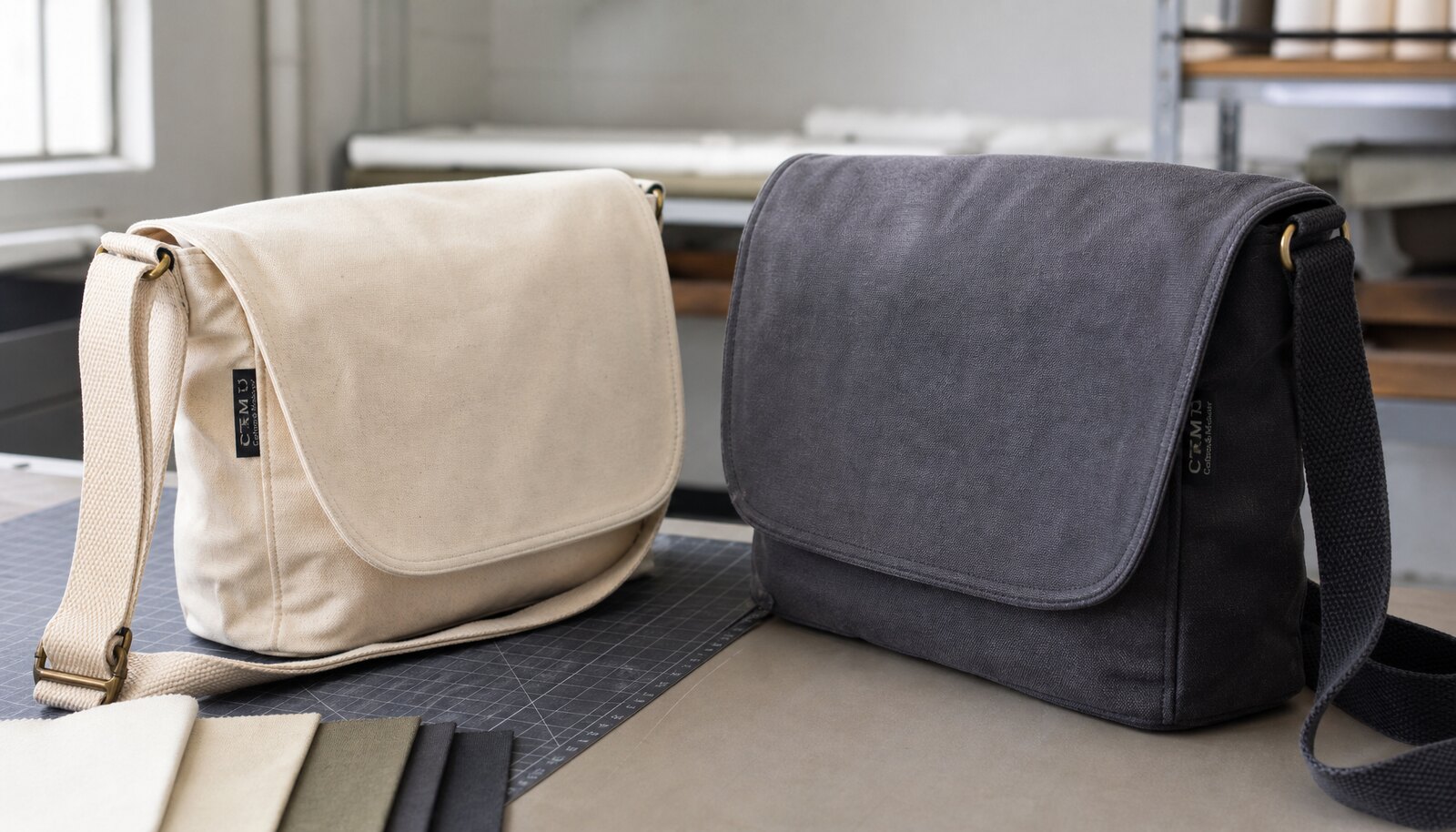
Start with the winery use case, not the logo
For boutique wineries, a canvas messenger bag is usually doing more than carrying paper. It may sit in a tasting room as a retail item, go out as a club gift, hold event collateral, or travel with a buyer sample set. Fabric weight should be chosen around that job, not around a vague idea of "premium." If the bag only needs to hold a notebook, brochure, and small accessory, a midweight canvas can look sharp without adding unnecessary cost. If it must carry heavier contents or survive repeated daily use, the structure needs to move up with the load.
The key mistake is approving a bag from a visual sample and leaving the spec loose. Once the body weight, lining, strap build, and closure are undefined, every supplier will interpret "custom" differently. The result is quote comparisons that do not match. Before RFQ, define the real use, the fill weight, whether the bag is sold empty or pre-packed, and whether it must fold flat for distribution or keep a more structured profile for display.
- Retail SKU: prioritize shelf appearance, logo clarity, and a clean fold.
- Club or event gift: prioritize structure, strap comfort, and protected corners.
- Staff carry bag: prioritize load-bearing seams and a closure that stays shut.
- Gift-with-purchase insert: prioritize low freight volume and fast turn production.
Use GSM as the buying language, then convert to ounces
For canvas messenger bags, GSM is the most useful way to compare suppliers because it removes the guesswork from vague terms like "light" or "heavy." As a practical starting point, 10-12 oz canvas is roughly 340-410 GSM, 14-16 oz is about 475-540 GSM, and 18 oz plus moves into a much stiffer, more workwear-like range. Those bands are not just about thickness. They also affect drape, edge bulk, sewing difficulty, and how well the bag holds its shape after packing.
Boutique wineries usually do better in the middle of the range. A 12 oz body gives a softer retail look and keeps cost reasonable if the bag is decorative or light-duty. A 14-16 oz body is a better match when the bag needs to feel substantial on the shelf and survive repeated handling. Move higher only when the design really needs structure, because overbuilt canvas can make the bag feel awkward, raise labor time, and push freight cost up without improving buyer value.
- 10-12 oz: best for softer retail carry, simpler shapes, and lower-cost programs.
- 14-16 oz: best for premium merchandising, stronger hand feel, and better shape retention.
- 18 oz+: best for rigid, utility-style bags, not for every winery brand story.
- If the fabric is washed or pre-shrunk, ask for finished size after processing, not only cut size.
Match the fabric weight to the load and the structure
A messenger bag fails when the fabric choice ignores the actual contents. If a winery bag may hold catalogs, a bottle, sample inserts, or a small boxed item, the stress lands at the strap anchors, side seams, and flap edge before it shows anywhere else. A lighter canvas can still work, but only if the pattern is reinforced with lining, a better strap spec, or a stiffer pocket panel. A heavier canvas can also fail if the sewing line is weak, so weight alone is not the answer.
Think in terms of structure packages. A 12 oz outer body with reinforcement tape and a partial lining can outperform a bare 16 oz shell that is poorly sewn. Likewise, a 14 oz body with a cotton webbing strap and box-X reinforcement may be the best commercial balance for a boutique winery that wants something presentable, not tactical. Buyers should treat the fabric choice as part of a full build system, not an isolated line item.
- Soft retail profile: 12 oz body, partial lining, and one internal pocket.
- Premium shelf presence: 14-16 oz body, full lining, and reinforced strap ends.
- Higher load or staff use: heavier canvas plus bartacks, edge binding, and stronger hardware.
- If the bag includes a flap or zipper, confirm that the chosen weight does not fight the closure.
Construction details matter as much as fabric weight
The same canvas weight can feel cheap or premium depending on the build. Strap width should be wide enough to spread load on the shoulder, and the strap anchor should be reinforced with a box-X or bartack, not just a straight stitch. Edge finishing also matters. A raw seam inside an unlined canvas bag may be acceptable in a low-cost program, but a winery retail bag usually benefits from clean binding or a lining so the inside does not shed threads or look unfinished when a customer opens it.
For boutique wineries, small construction decisions change how the product is perceived at the point of sale. A flat body with a single pocket works well for brochures or small retail items. If the bag is expected to be reused, consider a gusset that allows the bag to stand and a base reinforcement that helps it keep shape. The buyer should request a construction sketch or tech pack, because fabric weight alone does not show how the bag will perform once the seams are loaded.
- Use a strap width that matches the intended load, not just the visual design.
- Specify reinforcement at all stress points: strap ends, pocket corners, and flap joins.
- Choose lining when the inside view matters to the buyer or end customer.
- If the bag must stand on a counter, ask for base reinforcement or a bottom insert.
Decoration method should fit the canvas, not fight it
Canvas texture affects print quality. A simple one- or two-color screen print is usually the most stable choice for winery logos because it stays legible on textured cloth and does not rely on tiny detail. Embroidery can look strong on heavier canvas and adds perceived value, but it can pucker lighter bodies if the stitch density and backing are not balanced. Woven labels and sewn patches are useful when the brand mark is small, detailed, or meant to feel more premium without covering a large area of the panel.
For art with fine type, gradients, or thin lines, buyers should not assume that a fabric decoration method will reproduce it cleanly. The better route is often to simplify the mark for canvas and place the detailed version on a hangtag or insert. That lets the bag carry the brand without overloading the production line. Ask the factory to show the print tolerance, placement tolerance, and any minimum line thickness they require before they accept artwork.
- Screen print: best for clean logos, low setup risk, and repeat replenishment.
- Embroidery: best for premium perception, but verify puckering on lighter canvas.
- Woven label or patch: best for small marks and brand signatures that need crisp edges.
- Avoid tiny text and thin rules unless the supplier has already proven the result on canvas.
MOQ logic should follow material and decoration, not just unit price
MOQ usually moves with the most constrained component in the bag. If the factory is using stock natural canvas, a simple screen print, and standard hardware, the minimum can stay relatively manageable. Once the order adds custom-dyed fabric, custom lining, special pulls, or multiple decoration colors, the MOQ often climbs because every extra variable ties up material and labor. Buyers who only compare unit price miss the real cost of complexity.
A useful quote should break out the bag into parts: body fabric, lining, strap, closure, print, packaging, and sample cost. That tells you where the money is going and which specification is pushing the order into a higher MOQ bracket. It also makes supplier quotes comparable. If one supplier says the bag is cheap but hides the packing and decoration costs, the final landed price may be higher than a cleaner quote from a direct factory.
- Stock natural canvas usually supports lower MOQ than custom-dyed canvas.
- One-color screen print usually costs less to sample and repeat than multi-color decoration.
- Custom hardware, lining, or wash effects should be treated as MOQ drivers.
- Ask for separate sample fees so proto cost does not get buried in the unit price.
Sampling is where fabric-weight mistakes get exposed
A visual sample is not enough. Buyers should move through a simple sequence: proto sample, pre-production sample, then bulk approval. The proto proves size, silhouette, and construction. The pre-production sample proves the actual fabric lot, print method, and packing approach. If the winery bag is meant to feel soft and retail-friendly, the sample should also be compared under real lighting and handled by the people who will sell or pack it, because that is where bad weight choices show up first.
The sample review should focus on specific acceptance criteria, not taste. Check whether the fabric stands up or collapses as intended, whether the strap drop feels correct on the shoulder, whether the logo sits where the artwork calls for it, and whether the final package folds without hard permanent creases. If the sample is supposed to carry a realistic contents set, load it before approval. A canvas messenger bag that looks good empty but distorts under load is not a finished product.
- Approve size against the tech pack, not against the sample maker's memory.
- Test logo sharpness, placement, and color on the actual fabric lot.
- Load-test the bag with the real contents or an agreed equivalent weight.
- Review the folded packed sample so shipping damage does not become a warehouse issue.
Use inspection thresholds, not opinions
For bulk production, quality control should be written as measurable thresholds. A buyer can start with an AQL plan if the company already uses one, but the more important step is defining what counts as a defect on this product. On a canvas messenger bag, the common problems are not abstract. They are crooked logo placement, weak strap reinforcement, skipped stitches, inconsistent color, zipper snags, and panel distortion from bad cutting. Those are the items that damage a retail program.
A simple control sheet should define size tolerance, placement tolerance, stitch quality, and color consistency before the first bulk lot ships. If the bag is intended for boutique retail, even a small shift in logo position or panel size can make the product look off on shelf. This is why a clear golden sample matters. The factory needs a physical reference that shows what "approved" actually means, especially if the bag uses a heavier canvas where seams and edges can behave differently from the first proto.
- Size tolerance should be tight enough that pairs of bags look consistent in a display set.
- Logo placement should be measured from a fixed seam or edge, not from the edge of printed artwork alone.
- Stitching should show no skipped areas, loose ends, or missed reinforcement points.
- Color should match the approved sample under daylight and retail indoor lighting.
Packing and carton design affect the landed cost
Canvas bags are deceptively simple to pack, but the wrong method creates hidden cost. Heavy canvas can crease if it is folded too tightly, while lighter canvas can pick up dust or rub marks if it is packed loosely with no protection. For boutique winery orders, a flat fold with tissue, a paper insert, or a simple polybag usually works better than aggressive compression. The point is to protect the product without giving it a crumpled look when the carton is opened at warehouse receipt.
Carton planning matters because freight is paid on volume as well as weight. A bag with a stiff insert or bulky zipper can create more carton space than expected, and that changes the landed price. The supplier quote should include pieces per carton, carton dimensions, gross weight, and whether the carton is retail-ready or only export-ready. If the program will be replenished later, consistent carton counts and labels matter more than saving a small amount on each packed unit.
- Use a packing method that preserves the bag shape but does not over-compress the canvas.
- Request carton dimensions and gross weight before you approve the order.
- Keep SKU labels and carton counts aligned with your warehouse receiving process.
- If the product will sit in retail inventory, avoid packing that creates permanent fold lines.
Compare supplier routes by control, not by headline price
The cheapest quote often belongs to a supplier who is not controlling the whole process. A trading company can be useful if the buyer needs one contact for multiple item types or wants a simplified purchase order flow. A direct cut-and-sew factory is usually better when the bag needs custom construction, tighter spec control, or a repeatable re-order program. A local decorator may be fine for a short-run promotional bag, but the buyer should not expect deep control over fabric sourcing or sewing quality if the core work is being outsourced.
The real comparison is landed cost versus control. Include sampling, freight, duty, packaging, warehouse receiving, and reject risk in the math. A bag that looks cheap at the factory gate can become expensive once freight volume, rework, or delayed approval is added. Boutique wineries usually benefit from a stable spec and a supplier who can repeat that spec without quiet substitutions. If the quote does not tell you exactly what fabric, print method, and packing method are included, it is not a usable comparison.
- Direct factory: best for custom build control and repeat orders.
- Trading company: best when you want bundled sourcing and fewer vendor touchpoints.
- Local decorator: best for short runs and urgent programs, but weaker on fabric control.
- Always compare complete landed cost, not only ex-factory unit price.
Specification comparison for buyers
| Spec decision | Recommended option | When it fits | Buyer risk to check |
|---|---|---|---|
| Fabric weight for light retail use | 10-12 oz canvas, usually 340-410 GSM | Merch bags, tasting-room upsells, and low-load gift use where softness matters more than structure | Too thin if the bag must hold heavy catalogs, a bottle, or hardware without seam stretch |
| Fabric weight for premium retail use | 14-16 oz canvas, usually 475-540 GSM | Higher-ticket winery goods, club gifts, and bags that need a more substantial hand feel | Heavier fabric raises sewing difficulty and can make the bag stiff if the pattern is not adjusted |
| Sourcing route for custom control | Direct cut-and-sew factory | Custom size, custom pocket layout, and repeat orders where spec control matters | Higher MOQ and longer sample cycle than a decorator-only supplier |
| Sourcing route for low-friction buying | Trading company or bundled supplier | Buyer wants one contact for fabric, print, packing, and mixed accessory sourcing | Less visibility into the actual mill, sewing floor, and fabric lot consistency |
| Decoration method for most winery logos | 1-2 color screen print or woven side label | Simple marks, clean brand lockup, and medium-to-high quantity orders | Fine details, gradients, and tiny text can blur on rough canvas texture |
| Decoration method for premium feel | Tonal embroidery or sewn patch | Retail bags that need a more elevated look and stronger shelf presence | Embroidery can pucker lighter canvas and increase unit cost |
| Closure choice | Top zipper or magnetic flap | If the bag will be carried with inserts, documents, or retail goods that should stay protected | Hardware quality and pull strength must match the bag weight, or the closure becomes the failure point |
| Packing route | Flat-folded with tissue or insert, master carton with size labels | Export cartons, retail-ready inventory, and repeat replenishment programs | Over-compression causes permanent creases and can distort a structured canvas bag |
Buyer checklist before sampling
- State the finished size, target use, and real load the bag must carry.
- Specify canvas weight in GSM and ounces, not only "heavy" or "premium".
- Name the decoration method, print colors, artwork file type, and placement tolerance.
- Decide whether the bag is unlined, partially lined, or fully lined before quoting.
- Set strap width, strap length, and reinforcement standard at the quote stage.
- Request sample type, pre-production sample timing, and approval criteria in writing.
- Ask for packing details: folding method, polybag type, carton count, and master carton dimensions.
- Confirm lead time split between sample, material booking, production, and export loading.
Factory quote questions to send
- What GSM and finished fabric weight are you quoting, and is the canvas pre-shrunk or washed?
- How much fabric is used per bag, including lining, pocket material, strap, and reinforcement pieces?
- Which print method is included, how many colors are included, and what is the setup cost per color?
- What is the minimum order quantity per colorway, and does the MOQ change if I use custom dye or custom lining?
- Will you provide a proto sample, a pre-production sample, or both, and what is the sample lead time?
- What stitching standard do you use on strap anchors, zippers, and pocket edges?
- What is the packing method per piece, how many pieces per carton, and what are the carton dimensions and gross weight?
- What are the production lead time, shipping-ready date, and the main schedule risks if artwork or fabric approval changes?
Quality-control points to confirm
- Fabric weight should stay within a practical tolerance of the approved spec, with no obvious lot-to-lot hand-feel change.
- Logo placement should stay within the agreed tolerance on both front and back panels, with no skew from panel to panel.
- Stitching on strap anchors should be clean, dense, and reinforced with box-X or bartack construction, with no skipped stitches.
- Seams should sit flat without puckering, thread breakage, or seam opening under a real-use load test.
- Zippers should run smoothly from end to end, without snagging on lining, seam tape, or pocket edges.
- Canvas color should match the approved sample under daylight and indoor retail lighting, with no uneven dye streaking.
- Finished size should match the approved spec after packing and de-folding, especially for structured bags with lining or inserts.
- Packaging should protect the bag from abrasion and moisture without over-compressing the canvas into hard crease lines.
- Carton labels, SKU marks, and quantity counts should match the purchase order and packing list exactly.