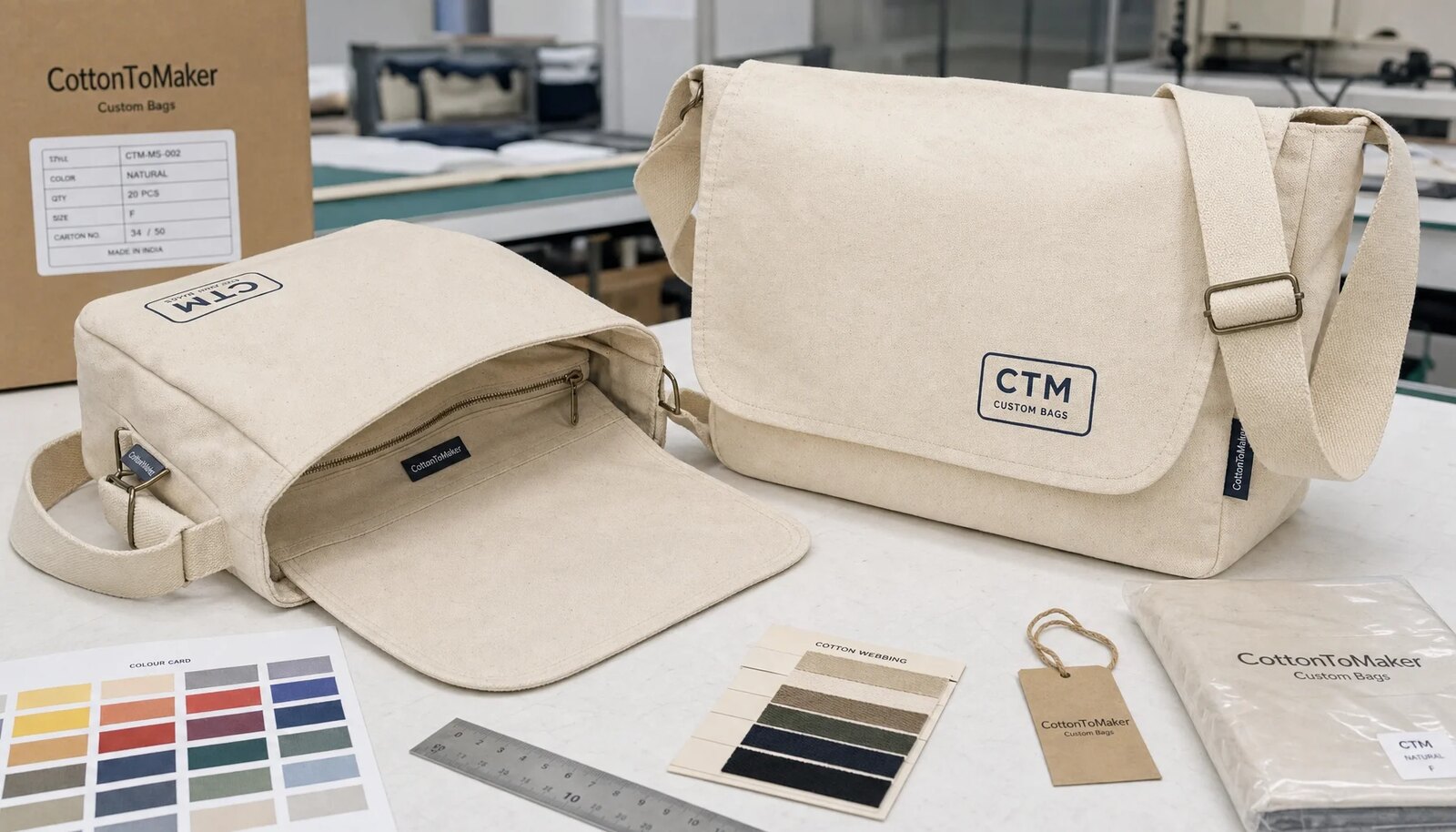
Start With the Craft Fair Use Case
A custom canvas messenger bag for craft fairs should be specified around how it will be used, not just how it looks in a mockup. The same pattern can become a retail product, a vendor staff bag, a sponsor giveaway, a buyer welcome kit, or a workshop supply bag. Each use changes the right fabric weight, strap strength, pocket layout, logo method, label plan, packing format, and defect tolerance.
Procurement should define the commercial role before asking for pricing. If the RFQ only says custom canvas messenger bag with logo, one supplier may quote a flat 10 oz satchel with a fixed shoulder strap. Another may quote a gusseted 14 oz crossbody bag with zipper pocket, adjustable webbing, metal hardware, hangtag, barcode label, and individual packing. Both may technically answer the request, but they are not comparable offers.
Craft fair timing adds pressure because the event date usually cannot move. A well-made bag that arrives after setup day is still a failed order. The sourcing brief should show the warehouse arrival date, event setup date, inspection deadline, latest ship date, and any kitting or booth distribution work needed before the fair. That lets the supplier judge whether material sourcing, sampling, printing, sewing, packing, inspection, and freight can realistically fit the calendar.
Display method matters too. Bags sold from booth hooks need better flap shape, cleaner front-panel stitching, and consistent strap folding. Bags handed out from cartons can tolerate simpler presentation if the logo and function are right. A welcome kit needs packing that protects inserts from dust, moisture, and hardware marks. A staff bag needs comfort and reliability over long shifts. Treating these scenarios as one generic promotional bag is how buyers end up with mismatched quotes.
- Retail resale: prioritize flap shape, clean stitching, durable branding, hangtag, barcode, fiber label, and clean carton presentation.
- Vendor staff use: prioritize strap strength, secure pockets, darker colors, zipper reliability, and comfort during long shifts.
- Shopper giveaway: prioritize visible logo, moderate canvas weight, low freight weight, simple construction, and fast packing.
- Sponsor merchandise: prioritize logo color accuracy, print placement tolerance, repeatability, and clear separation by sponsor version.
- Buyer welcome kit: prioritize protected contents, inner pocket function, insert fit, presentation packing, and accurate kitting quantity.
Convert Requirements Into a Technical Spec
A strong RFQ turns the idea into measurable instructions. Canvas messenger bags have more variables than flat totes: finished size, gusset depth, flap coverage, strap length, pocket opening, closure placement, seam finish, and reinforcement. If those details are missing, factories usually quote from an existing pattern. The lowest price may simply be the quote with the fewest included details.
Write finished dimensions as width x height x gusset, then define how each point is measured. Width can mean the top opening, the widest front panel, or the base width after sewing. Height may include or exclude the flap depending on the drawing. Mark flap length from the top seam to the lower edge, pocket opening length, zipper length, strap adjustable range, closure distance from the edge, and logo placement from a centerline or seam. A marked drawing with arrows prevents long email debates later.
State the load expectation in practical language. A staff bag carrying a tablet, cash pouch, receipt pad, pens, and small tools needs stronger strap reinforcement than a lightweight sponsor satchel holding flyers. Buyers do not need to over-engineer the product, but suppliers need enough information to choose reinforcement patches, bartacks, box stitching, seam allowance, thread size, and hardware. These construction choices can affect cost, logo area, packing bulk, and sewing speed.
Keep the final specification in one controlled document. Sample comments, marked photos, emails, and chat threads are helpful during development, but the production release should consolidate decisions into a tech pack or specification sheet. Include version date, approved artwork file, approved sample reference, allowed tolerances, trim references, packing method, and the person authorized to approve deviations.
- Minimum spec fields: dimensions, fabric, color, lining, strap, hardware, pockets, closure, decoration, labels, packing, tolerance, and inspection method.
- Measurement control: define where width, height, gusset, flap length, pocket length, and strap range are measured.
- Load control: state target contents or approximate carrying weight so strap and seam reinforcement are priced correctly.
- Revision control: date every version and mark whether it is for quotation, sampling, pre-production approval, or bulk release.
- Approval control: keep one signed approved sample with the supplier and one matching sample with the buyer.
Specify Canvas Fabric With Real Numbers
Canvas weight is one of the biggest cost, hand-feel, and durability variables in custom canvas messenger bags. Quote gaps often start here. One supplier may price 10 oz cotton canvas, while another prices 14 oz or 16 oz. For craft fair resale and branded merchandise, 12 oz to 16 oz cotton canvas is usually the practical range. A 10 oz canvas can work for giveaways, but it may collapse on display, wrinkle after tight packing, and feel less substantial when shoppers handle it.
Ask for both ounce and GSM because suppliers and mills may describe fabric differently. As a working reference, 10 oz canvas is often around 340 GSM, 12 oz around 400 GSM, 14 oz around 475 GSM, and 16 oz around 540 GSM. Weave, finishing, dyeing, and washing can shift the actual value, so the approved swatch and confirmed tolerance matter more than the conversion table. If weight affects quality or price, write the allowed tolerance into the PO, commonly plus or minus 5% when the mill can support that control.
Fabric finish changes both appearance and inspection. Natural canvas has a craft-market look but shows dirt, oil marks, water spots, and shade variation easily. Dyed canvas supports brand color but needs lab dip approval, bulk shade tolerance, and rubbing fastness checks. Washed canvas can feel softer and more premium, although it may bring more dimensional variation. Laminated or coated canvas can improve moisture resistance, but it may affect hand feel, decoration adhesion, and recycling claims.
Handle material claims carefully. If the bag will be promoted as organic cotton, recycled-content canvas, undyed cotton, azo-free dyed canvas, or low-impact material, request order-relevant evidence before marketing uses the claim. If no claim is needed, describe the material plainly as conventional cotton canvas or buyer-approved substitute. Accurate wording is safer than broad sustainability language that the order documents cannot support.
- 10 oz canvas: lower cost and lighter freight, suitable for simple giveaways or low-load promotional use.
- 12 oz canvas: balanced choice for moderate structure, manageable sewing cost, and craft fair merchandise.
- 14 oz canvas: stronger retail hand feel and better flap presentation, with higher material and freight cost.
- 16 oz canvas: premium structure, but thick seams require stronger needle, thread, and seam control.
- Dyed canvas: useful for brand colors, but requires lab dip approval, shade tolerance, and rubbing fastness review.
- Natural canvas: strong craft aesthetic, but inspect stains, shade variation, slubs, and packing dirt more strictly.
Lock Construction Before Decoration
Engineer the bag body before finalizing the logo. Messenger bags have moving parts: flap length, gusset, shoulder strap, closure, pockets, zipper, lining, side seams, and reinforcement. All of them affect where decoration can sit. If artwork is approved before construction is stable, the final logo may land across a seam, buckle line, flap curve, or stress point.
Choose the body type with the end use in mind. A flat messenger bag is cheaper and packs efficiently, but it carries less volume and may bend contents. A gusseted body holds catalogs, sample cards, tablets, and small purchases better, but it requires more fabric, more sewing operations, and tighter dimensional control. Flaps can be straight, rounded, angled, or full-cover. A full-cover flap looks substantial and protects contents, but it may hide pockets and reduce easy front-panel access.
Strap construction deserves close attention. Specify webbing material, width, thickness if relevant, adjustable range, buckle type, attachment location, and reinforcement. Cotton webbing looks natural but can vary in shade. Polyester webbing usually offers stronger color consistency and dependable strength. Self-fabric canvas straps can look premium, although they may wrinkle, stretch, or feel bulky. For many messenger bags, a 30 mm to 40 mm strap feels more comfortable than a narrow promotional strap, but the final choice should match the intended load and price point.
Pocket layout should solve a real use problem. A staff bag may need a zipper pocket for cash, a slip pocket for a phone, and pen slots. A resale bag may need a simpler interior to control cost and keep a clean silhouette. Define pocket opening length, pocket depth, zipper size, lining material, seam finish, and whether raw edges are acceptable. If there is no lining, specify whether inner seams are bound, overlocked, or left raw.
- Body: list width, height, gusset, finished tolerance, and whether A4 documents or a tablet must fit.
- Flap: define shape, length, edge finish, closure location, and whether the flap must cover the full front panel.
- Strap: specify material, width, adjustable length range, buckle type, attachment method, and reinforcement.
- Pockets: define zipper pocket, slip pocket, phone pocket, pen slot, divider, and each usable dimension.
- Reinforcement: require bartacks, box stitching, or reinforcement patches at strap, flap, pocket, and closure stress points.
- Interior finish: specify lining, binding, overlock, or raw-edge acceptability before sample making.
Match Decoration to Canvas Texture
Craft fair shoppers inspect products up close, so decoration quality affects sell-through and brand perception. Screen printing is often the most cost-effective method for solid one-color or two-color artwork on canvas. It gives a direct-to-fabric look and can cover a large flap area. The tradeoff is texture: rough canvas can break fine lines, and heavy ink coverage can feel stiff. Ask the supplier to test ink coverage, edge sharpness, curing, and color match on the actual bulk fabric.
Embroidery gives a premium handmade impression for small logos, monograms, patches, and side labels. It is less forgiving for large dense flap artwork unless the fabric, backing, and stitch density are controlled. Dense embroidery can pucker lighter canvas, distort flap shape, or leave rough reverse-side backing that catches contents. The embroidery proof should show thread colors, stitch count, backing type, trimming standard, and placement tolerance.
Heat transfer can reproduce multicolor logos, gradients, and fine detail more easily than screen print, but it may feel less natural on heavy or washed canvas. Inspect it after cooling and after light flexing. Look for edge lift, bubbling, scorch marks, color shift, poor bonding, and an unacceptable plastic hand feel. Digital print or direct-to-garment printing may be possible on selected canvas qualities, but buyers should verify repeatability before using them for fixed-date event orders.
Woven labels and patches are useful when the buyer wants the same branding element across several bag colors or when exact print color is difficult on textured fabric. They can make the bag feel more retail-ready, but placement still matters. A crooked woven label on a front flap is often more obvious than a small screen-print variation.
- Screen print: best for bold event logos, sponsor marks, and cost-controlled front flap branding.
- Embroidery: best for premium small logos, but inspect puckering, backing, thread trimming, and reverse side.
- Heat transfer: useful for multicolor artwork when bonding, edge lift, and hand feel are approved.
- Woven label: good for repeat programs, subtle branding, and multi-color body assortments.
- Patch branding: useful for a craft aesthetic, but check patch edge stitching, shrinkage, and colorfastness.
- Position tolerance: set a measurable limit, commonly within 3 mm to 5 mm for front flap artwork.
Read MOQ, Price, and Lead Time Together
A supplier's advertised MOQ rarely tells the whole story. Messenger bags include body fabric, lining, webbing, zipper, buckle, snap, label, thread, print screen, packing material, carton label, and sometimes hangtag or barcode label. Each component can carry its own minimum. A supplier may accept 500 pieces total only if the order uses one body color, one logo, one hardware finish, one label version, and one packing method.
Ask suppliers to break MOQ down by component and quote realistic quantity ladders. For procurement comparison, 500, 1,000, 2,500, and 5,000 pieces are often more useful than one unit price. A low price at 5,000 pieces does not help if the buyer needs 800 pieces for a fixed fair date. The quote should also list sample fees, print screen charges, embroidery digitizing, woven label setup, hangtag printing, barcode labels, inspection support, and any reorder fees.
Lead time depends on material readiness. Stock natural canvas with one-color screen print is usually faster than dyed canvas with custom webbing, custom zipper tape, woven labels, and branded hangtags. If the supplier must dye fabric, wait for lab dip approval, produce print screens, order hardware, or outsource embroidery, the schedule must show those steps. Late artwork approval can delay production because print screens, embroidery files, and label proofs cannot be finalized.
Compare price only after incoterm, packing, and QC support are clear. A FOB quote and a DDP quote are not directly comparable. Neither are a bulk-packed quote and an individually bagged, hangtagged, barcode-labeled quote. Ask each supplier to quote the same base specification and list optional upgrades separately. Cost reductions should be intentional, not hidden as material or packing downgrades.
- Separate MOQ by bag color, lining color, logo version, print color, webbing, zipper tape, label, and hardware finish.
- Request price ladders at 500, 1,000, 2,500, and 5,000 pieces, plus setup fees and reorder fees.
- Clarify whether dyed fabric, special webbing, custom labels, or extra trims create leftover material liability.
- Confirm whether sample materials are bulk materials or substitutes, and record any substitution in approval notes.
- Compare quotes only when incoterm, packing, payment terms, inspection support, and shipment readiness are visible.
- Protect the event date by working backward from warehouse arrival, not from factory ship date only.
Compare Suppliers With Evidence
Supplier compliance is not only a certificate file. For custom canvas messenger bags, practical evidence matters: recent product samples, trim cards, production photos, line capacity, print curing process, inspection records, packing examples, and clear ownership of sample comments. A supplier that cannot explain how it controls flap alignment, strap reinforcement, and print placement may be friendly and responsive, but the production risk is still there.
Direct factories are often strong when buyers need custom construction, repeat consistency, and fast technical feedback. They can usually answer questions about seam allowance, reinforcement, and production flow. Some factories, however, need closer guidance on export documentation, retail labeling, and polished communication. Trading companies can help coordinate small mixed orders or multiple product categories, but buyers should confirm whether the trader has authority to stop production, require rework, and approve replacement materials.
Specialized bag workshops are valuable when construction details matter. They understand gussets, flap shape, pocket openings, strap load paths, and hardware behavior better than many general promotional suppliers. The tradeoff is capacity. Craft fair seasons, holiday orders, and retail replenishment can compete for sewing lines. Ask for a production calendar, not only a broad lead-time promise.
Request evidence before bulk deposit. Ask for dated photos or videos of similar canvas messenger bags from the same workshop, not generic catalog images. Confirm whether printing, embroidery, washing, and packing are in-house or subcontracted. If decoration is subcontracted, clarify who checks color, curing, and placement before panels return to sewing. Also confirm who stores the approved sample and who signs the first finished production piece.
- Request dated photos or videos of similar messenger bags made in the same workshop.
- Confirm whether printing, embroidery, washing, and packing are in-house or subcontracted.
- Review trim cards for canvas, webbing, zipper, buckle, D-ring, label, thread, print swatch, and packing material.
- Identify who owns sample comments, bulk handoff, inline QC, final inspection, and rework decisions.
- Require first-piece photos before mass sewing continues and before packed cartons are sealed.
- Keep one approved sample at the supplier and one with the buyer for dispute control.
Approve Samples With Measurable Limits
A sample should not be approved only because it looks acceptable in a photo. For canvas messenger bags, sample approval should record dimensions, fabric hand feel, strap comfort, seam reinforcement, print color, logo location, pocket usability, closure function, label position, and packing method. The approved sample becomes the production standard. If approval is vague, the buyer may struggle to reject bulk goods that are technically close but commercially disappointing.
A practical sequence is a construction sample first, then a decorated pre-production sample. The construction sample confirms pattern, dimensions, gusset, pockets, strap, closure, and reinforcement. The decorated sample confirms artwork size, placement, color, print feel, embroidery quality, label position, and packing. If the schedule is tight, the buyer can combine these steps, but the correction risk is higher.
Write comments in factory-executable language. Instead of saying the flap looks uneven, measure the left and right flap edge difference and state the required tolerance. Instead of saying the logo is too low, measure the distance from the top seam, bottom edge, side edge, or centerline. Instead of saying the strap feels weak, request a reinforcement patch, bartack count, box-stitch size, or pull-test requirement. Photos should include rulers, seam close-ups, and a full-bag view under normal light.
Before bulk cutting begins, issue a pre-production approval note. It should state the approved sample date, required changes from sample to bulk, final artwork file name, approved fabric and trim references, packing method, inspection criteria, and the person authorized to approve deviations. Any substitution after approval should be documented and re-approved before production continues.
- Measure finished width, height, gusset, flap length, strap length range, pocket opening, and closure position.
- Photograph logo placement with a ruler from the flap edge, top seam, and centerline.
- Test zipper movement, snap alignment, magnetic closure, and flap closure with light contents inside.
- Wear the bag crossbody to judge strap comfort, adjuster location, buckle pressure, and twisting.
- Inspect embroidery reverse side, label stitching, seam finish, pocket usability, and loose thread trimming.
- Record approved changes in the tech pack or sample approval form, not only in chat messages.
Control Labels, Claims, and Documents
For craft fair programs, compliance can look simple because the product is a cotton canvas bag. In B2B procurement, it still needs control. Confirm material claims, labeling, country-of-origin marking, restricted-substance expectations, and document consistency. If the bag is sold at retail, labeling and barcode accuracy may matter far more than they would for internal staff use or free giveaways.
Material claims need order-specific support. If the bag is described as organic cotton, recycled canvas, undyed cotton, azo-free dyed fabric, or low-impact material, request documentation that connects to the actual fabric batch or supplier chain. If the buyer will not make a claim, the specification should avoid unsupported marketing language. Conventional cotton canvas can be perfectly acceptable when it is described accurately.
Label review should cover fiber content, country of origin, care instruction, brand label, hangtag, barcode, SKU, event name, and sponsor requirement where applicable. The position of each label should be included in sample approval. Country-of-origin marking should be durable and placed according to the buyer's receiving expectations. For retail-ready shipments, barcode data should be scanned before mass label application.
Documents should match the purchase order and shipment plan. Confirm commercial invoice description, packing list, carton count, gross and net weight, incoterm, consignee details, shipment marks, and HS code assumption before export. If third-party inspection or lab testing is required, schedule it before the goods are fully packed or before the vessel cutoff becomes urgent.
- Material evidence: request composition, fabric weight, dye information, and sustainability documents if claims are used.
- Label control: approve fiber content, country of origin, care label, brand label, hangtag, and barcode before bulk production.
- Restricted substances: ask about dye, print ink, adhesive, hardware finish, and destination-market requirements.
- Traceability: record fabric lot, color lot, production date range, inspector, and carton lot separation for repeat orders.
- Document control: confirm invoice, packing list, carton data, incoterm, shipment marks, and test documents before export.
- Claim discipline: do not use organic, recycled, eco, or azo-free claims unless evidence matches the order.
Set Bulk QC and Shipment Release Rules
Canvas bags can hide problems until the order is packed. Common defects include uneven flap shape, weak strap attachment, loose threads, dirty canvas, shade variation, skipped stitches, crooked labels, zipper catching, misaligned prints, odor, and carton quantity mismatch. These defects matter at craft fairs because bags are handled in person and often displayed under bright booth lighting. A stain or twisted flap that might pass on a low-cost giveaway can damage a retail presentation.
Classify defects before inspection starts. Critical defects include unsafe sharp hardware, broken straps under normal use, mold, wrong branding, wrong country-of-origin label, or anything creating safety or legal risk. Major defects include wrong fabric weight, visible stains, poor stitching at stress points, zipper failure, off-center flap, significant print color error, incorrect packing, or wrong SKU label. Minor defects may include removable thread ends, slight wrinkles, or shade variation within the approved tolerance.
Inline QC is worth the effort because many messenger bag defects are easier to fix before packing. Check cut panels for fabric shade, direction, stains, and size. Check first printed panels for artwork position, curing, and color before sewing. Check first finished pieces for flap alignment, strap attachment, zipper function, closure placement, and label accuracy. Once goods are packed, rework becomes slower and can threaten the fair delivery date.
The final inspection checklist should be specific enough for the supplier and any third-party inspector to follow. Include sample size or AQL plan if used, measurement points, pull-test method or practical load check, zipper function check, print rub check, barcode scan, carton marks, carton quantity, gross weight spot check, and packing list reconciliation. Require inspection photos of representative defects, passed samples, carton marks, and sealed cartons before shipment release.
- Strap attachment: verify agreed load or pull check without seam burst, fabric tearing, bartack failure, or webbing slippage.
- Print quality: check color, placement, curing, rub resistance, edge sharpness, and transfer onto packing material.
- Dimensions: measure body, gusset, flap, strap range, pocket opening, and closure position against approved tolerance.
- Natural canvas: grade oil marks, water spots, dirt, mold, odor, shade panels, and visible slubs strictly.
- Packing: confirm individual or bulk packing, hardware protection, carton quantity, assortment, barcode, and carton label accuracy.
- Release rule: do not authorize shipment until inspection result, packing list, carton marks, and shipment documents match the PO.
Specification comparison for buyers
| Supplier option | What to verify | Commercial advantage | Buyer risk to control |
|---|---|---|---|
| Direct sewing factory | hardware trim card, strap-load photo, lining close-up, approved flap sample, and first-piece production photos | Better sample-to-bulk control and faster production feedback | May be weaker on export paperwork or branded packing unless checked early |
| Trading company | Factory name, production photos, trim-source proof, and who owns QC decisions | Can coordinate small mixed orders and extra services | Markup can hide real factory capability and slow defect decisions |
| Specialized bag workshop | flap shape, strap webbing, buckle, D-ring, inner pocket, zipper pocket, seam allowance, and load path | More practical for detailed construction, trims, and repeat programs | Capacity may be limited during peak seasons |
| Low-price general supplier | 10-16 oz canvas, washed canvas, rPET canvas, lining fabric, interfacing, and hardware finish | Useful for simple promotional runs with loose specs | Material downgrades, weak packing, and vague inspection scope can erase savings |
| Retail-ready supplier | shape support, strap folding, hardware protection, individual bag, carton drop expectation, and retailer hangtag placement | Can handle labels, SKU separation, carton marks, and receiving rules | Higher unit cost must be compared against reduced warehouse work |
| Compliance-focused supplier | Fabric records, labeling review, test plan, and production traceability | Safer for retail programs and repeat brand orders | Documentation claims need evidence, not only sales language |
| Local sample room plus bulk factory | Signed sample, bulk factory handoff, first-piece photos, and deviation owner | Good for complex branding before large production | Sample room quality may not match bulk line unless handoff is controlled |
Buyer checklist before sampling
- Define the order purpose: retail resale, vendor staff bag, sponsor merchandise, buyer welcome kit, booth uniform accessory, workshop kit, or shopper giveaway.
- State the expected contents and load: A4 catalog, 13-inch tablet, receipt book, cash pouch, sample cards, small boxed goods, water bottle, tools, or lightweight promotional inserts.
- Specify finished dimensions as width x height x gusset, plus flap length, pocket dimensions, strap length range, closure position, and whether A4 or tablet fit is mandatory.
- Specify canvas by ounce and GSM, construction type, color, finishing process, shrinkage expectation, and acceptable weight tolerance, commonly within plus or minus 5% if the mill can support it.
- Confirm whether the material is conventional cotton, organic cotton, recycled-content canvas, undyed cotton, dyed cotton canvas, washed canvas, brushed canvas, laminated canvas, or buyer-approved substitute.
- Provide vector artwork, Pantone references, print size, print location from edges or centerline, artwork orientation, and acceptable placement tolerance, typically 3 mm to 5 mm for front flap decoration.
- List trims with measurable details: zipper type and length, zipper tape color, slider finish, buckle material, D-ring size, snap type, hook-and-loop width, webbing width, thread color, labels, hangtags, and packing materials.
- Request a physical trim card showing body canvas, lining, webbing, zipper tape, zipper puller, buckle, D-ring, thread, label, print swatch, hangtag, polybag or paper wrap, and carton label.
- Ask for one construction sample and one decorated pre-production sample unless the order is a simple repeat using the same approved pattern, fabric, trim, and artwork.
- Define inspection points for dimensions, flap symmetry, seam security, strap attachment, zipper function, canvas stains, print defects, label accuracy, carton labeling, barcode scan, and quantity reconciliation.
Factory quote questions to send
- What exact canvas are you quoting in oz and GSM, and what finished-fabric tolerance do you allow after dyeing, washing, printing, or finishing?
- Is the body fabric in stock, dyed from greige fabric, specially woven for this order, or substituted from an available canvas quality?
- Can you provide a fabric swatch, lab dip for dyed canvas, printed strike-off, and complete trim card before sample approval?
- What is the MOQ by body color, lining color, logo version, print color, embroidery thread color, woven label version, zipper tape color, webbing color, and hardware finish?
- Can you quote the same bag at 500, 1,000, 2,500, and 5,000 pieces with screen print, embroidery, heat transfer, and woven label branding separated as line items?
- What reinforcement is included at strap attachment points, flap corners, pocket openings, zipper ends, closure points, and side seams?
- What stitch density, thread type, seam allowance, bartack length, box-stitch size, and reinforcement patch size are included in the quoted construction?
- Will the pre-production sample use bulk canvas, final zipper, final webbing, final hardware, final labels, final packing, and the exact approved decoration process?
- What are the sample fee, sample lead time, sample courier method, bulk production lead time, inspection window, and ship-ready date after deposit and final approvals?
- What in-house or third-party tests can you coordinate for strap pull, seam strength, zipper cycling, print rub, color fastness to rubbing, dimensional stability, and metal hardware finish?
Quality-control points to confirm
- Fabric weight should match the approved swatch and PO tolerance, with no unacceptable slubs, shade panels, oil marks, water stains, mold, odor, holes, loose yarns, or finishing residue.
- Finished bag size should stay within the agreed tolerance; common working limits are plus or minus 5 mm for small pockets and panels and plus or minus 10 mm for larger body dimensions unless the tech pack states otherwise.
- Flap alignment should be centered when the bag is empty and lightly filled, with left-right edge difference controlled so the bag does not look twisted on booth displays or retail hooks.
- Strap attachment should pass the agreed pull or load check without seam burst, webbing slippage, reinforcement patch tearing, bartack failure, or visible distortion at the side seam.
- Zippers should open and close smoothly through repeated operation without tooth gaps, tape twisting, slider looseness, fabric catching, broken pullers, skipped stitching, or uneven zipper ends.
- Screen print should show clean edges, correct color, proper curing, even ink coverage on textured canvas, no pinholes beyond the approved standard, and no cracking after light flap bending.
- Embroidery should not pucker the flap, distort the logo, expose backing excessively, leave long thread tails, or create rough reverse-side finishing that can snag contents.
- Heat transfer should be centered, fully bonded, free from bubbles, scorch marks, color shift, edge lift, and unacceptable plastic hand feel on the selected canvas surface.
- Labels and hangtags should match approved position, spelling, fiber content statement, country-of-origin marking, barcode data, SKU separation, brand artwork, and care instruction where applicable.
- Packing should protect flap shape, keep hardware from scratching the canvas, reduce moisture and dust exposure, preserve carton quantity accuracy, and match the approved packing list and carton marks.