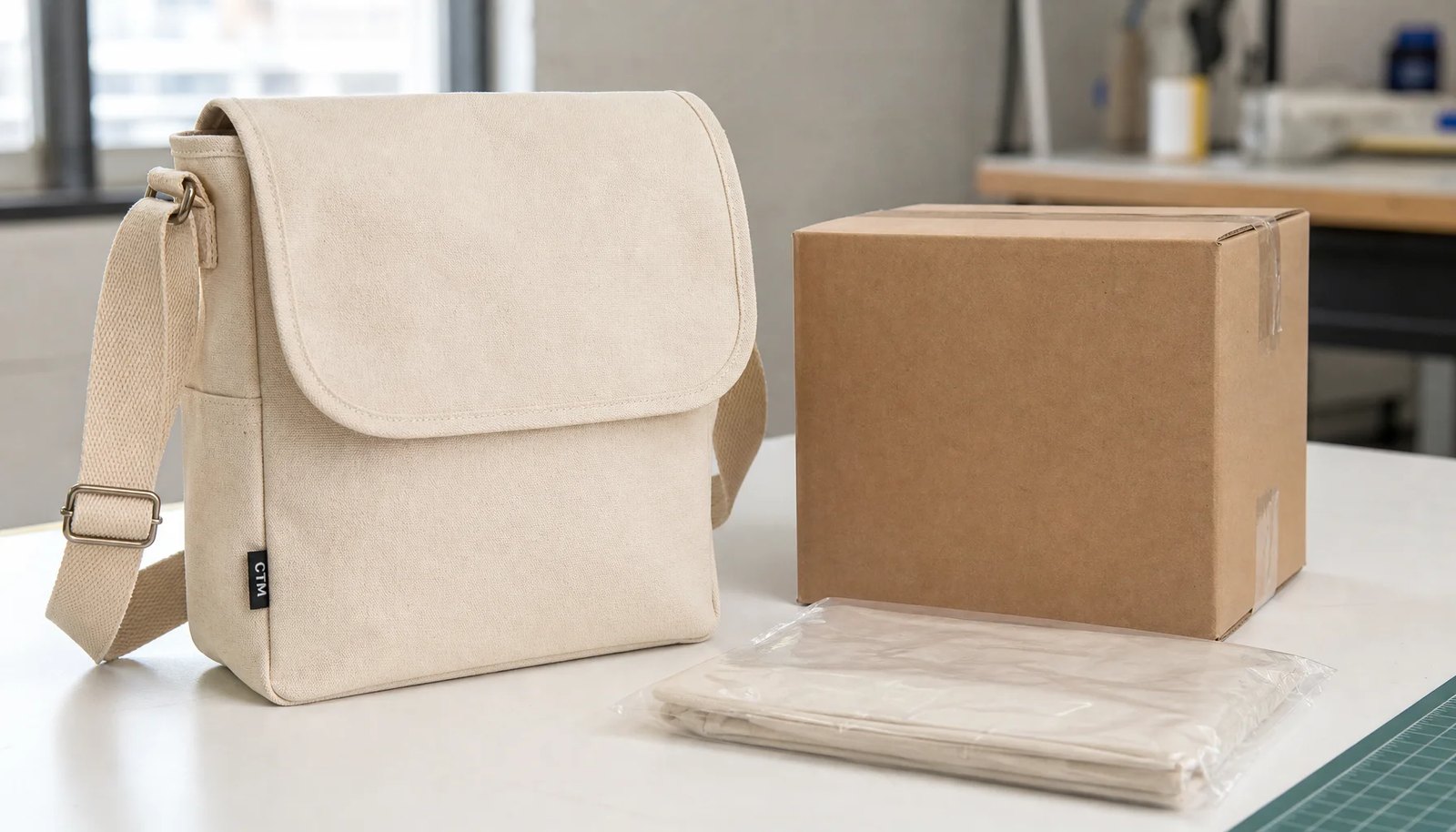
Start carton planning at RFQ stage
For custom canvas messenger bags shipping carton planning for university bookstores, the carton should be treated as part of the product spec. It is not a final shipping detail to settle after production. A messenger bag includes a flap, gusset, shoulder strap, webbing adjuster, hardware, seams, and often a decorated front panel. Those parts do not compress like a flat tote. When a supplier quotes an aggressive carton count to make freight look efficient, the order can arrive with creased flaps, rubbed ink, bent sliders, distorted gussets, and cartons that are no longer square.
A stronger RFQ connects construction, decoration, inner packing, carton dimensions, and receiving requirements at the same time. Ask for unit cost, decoration cost, MOQ basis, inner pack, pieces per carton, carton L x W x H, gross weight, net weight, carton quantity, and total CBM in the quote. This keeps supplier comparison honest. Two factories may appear to quote the same bag, but one may include barcode-ready individual packing and a stronger export carton while another assumes tight bulk packing in a lighter carton. The lower FOB price may not be the lower landed cost.
Campus receiving is part of the equation. During back-to-school, graduation, alumni weekend, and athletic event seasons, bookstore teams may receive many SKUs at once. A carton that opens cleanly, contains the expected count, and has clear SKU marks reduces sorting time. A carton with vague item names, mixed logo versions, or loose straps that must be untangled before scanning pushes hidden labor onto the bookstore.
- Treat carton size, units per carton, carton board, and gross weight as quote specifications, not freight paperwork.
- Compare suppliers using unit price plus total CBM, carton count, packing method, and receiving labor impact.
- Require packing photos or a short packing video when bags have flap decoration, hardware, padding, or multiple labels.
- Put bookstore receiving requirements in the RFQ and PO so the factory does not guess during final packing.
- Do not approve bulk production until the supplier states whether carton data is estimated or based on a trial pack.
Map the bookstore handling route
The best carton plan depends on the route the bags take after production. A campus bookstore receiving 300 pieces directly by courier may need smaller cartons, lower gross weight, individual packing, and simple marks that part-time receiving staff can read quickly. A distributor receiving 10,000 pieces for several campuses may prefer uniform carton dimensions, pallet-compatible stacking, carton barcodes, and strict SKU segregation. The bag itself may be identical. The carton plan should not be.
Freight mode changes the risk profile. Full-container ocean shipments can use larger master cartons when pallet patterns and container loading are planned. LCL shipments need stronger cartons because boxes are consolidated with unrelated cargo and handled several times. Courier shipments are sensitive to dimensional weight, maximum side length, and rough last-mile handling. Domestic warehouse transfers may need cartons that fit conveyor systems or comply with a distributor routing guide. Before asking a supplier to finalize packing, buyers should collect maximum carton weight, maximum side length, label placement, and pallet height rules from internal logistics or the distributor.
University bookstores also deal with tight backrooms. A carton that looks efficient for container loading may be awkward in a small receiving room behind a campus retail counter. In peak weeks, staff may need one-person-lift cartons that open without cutting the goods, count quickly, reseal neatly, and stage by SKU. That everyday handling reality should drive maximum gross weight and carton size.
- Direct-to-store shipment favors lighter cartons, clear SKU marks, and unit-level barcode packing.
- Distributor shipment favors consistent carton dimensions, carton numbering, pallet stability, and scan-ready labels.
- LCL freight needs stronger cartons because boxes may be stacked with unrelated hard goods.
- Courier delivery needs size discipline because dimensional weight can exceed actual fabric weight.
- Campus backroom storage favors cartons that staff can lift, count, reseal, and stage without repacking.
Lock bag specifications first
Carton count should not be finalized until the physical bag is defined. Key inputs include finished width and height, flap length, gusset depth, strap width, hardware type, lining, padding, pocket layout, and whether the bag has a structured bottom. A flat 12 oz canvas messenger bag with a simple flap may pack efficiently at 40-50 pieces per carton. A structured bag with a padded sleeve, magnetic snaps, metal sliders, wide webbing, and a reinforced bottom may need 20-30 pieces to avoid distortion.
Canvas weight affects both product feel and shipping behavior. For bookstore messenger bags, 12 oz cotton canvas, roughly 380-410 GSM depending on weave and finishing, is often a practical retail specification. It feels durable enough for daily campus use without pushing carton weight too high. Lighter 8-10 oz canvas can suit promotional or budget programs, but it may collapse in the carton and show more wrinkling. Heavier 14-16 oz canvas can support a premium product, yet it increases gross weight, sewing stress, carton pressure, and freight cost.
Specify fabric weight in both oz and approximate GSM. Suppliers may use different local standards, and finishing changes the result. Dyed canvas, washed canvas, natural canvas, and laminated canvas all pack differently. Washed canvas may be softer and bulkier. Stiff dyed canvas may hold shape but show pressure lines. If the bag must fit a laptop, textbook bundle, or retail fixture, test tolerance and post-packing recovery before confirming the carton count.
- Define finished bag dimensions, flap length, gusset depth, pocket layout, and strap length range before requesting final carton data.
- Set body size tolerance, commonly +/-1 cm, and logo/flap placement tolerance, commonly +/-3-5 mm where practical.
- Use 10 oz canvas when low cost and light carry matter more than structure and wrinkle control.
- Use 12 oz canvas for a balanced bookstore retail bag with manageable carton weight.
- Use 14-16 oz canvas only when premium feel justifies fewer pieces per carton and higher freight cost.
Protect licensed artwork in transit
University bookstore messenger bags often carry licensed school logos, department marks, alumni event graphics, athletic colors, or bookstore private-label branding. Decoration quality is therefore a procurement risk, not just a design issue. The packing method must protect the decorated panel from abrasion, pressure, color transfer, and hardware contact. A flap logo pressed against a metal slider can arrive with a visible dent. A large screen print packed before full curing can scuff or block. A heat transfer film pressed against rough canvas can develop shiny pressure marks.
Choose the decoration method together with the packing plan. Screen print is efficient for solid marks and repeat programs, but ink thickness, curing, and dry rub resistance must be controlled. Heat transfer can reproduce complex artwork and small details, but film edges, gloss, and pressure sensitivity need review. Embroidery and woven patches support a premium look, but raised areas change stacking thickness and may require fewer pieces per carton. If the logo sits on the flap, the supplier should show exactly how the flap is closed and how the strap is tucked before bulk packing.
Licensed artwork also needs version control. A university may approve different marks for the bookstore, alumni weekend, athletics, or a department event. Carton marks and packing lists should identify the logo version, not only the bag color. That detail helps receiving teams avoid mixing similar goods that belong to different promotions or approvals.
- Screen print: confirm ink type, curing method, dry rub result, color standard, and whether tissue separation is needed.
- Heat transfer: protect film from buckles, sliders, carton edges, and long pressure from folded flaps.
- Embroidery: allow extra carton volume because raised stitches affect stacking and can mark adjacent bags.
- Woven patch: check edge stitching, corner lifting, backing, and placement before full packing starts.
- Licensed programs: include logo version names in the PO, carton marks, packing list, and inspection checklist.
Set pieces per carton realistically
A common sourcing problem is approving price before understanding the pieces-per-carton assumption. For canvas messenger bags, a practical range is often 25-50 pieces per master carton, but it is not a fixed rule. The right count depends on bag dimensions, canvas weight, hardware, strap bulk, decoration, inner packing, and carton strength. Be cautious when a quote assumes very high carton counts for a bag with a flap, gusset, padding, and metal components.
The goal is a stable carton, not the highest number of bags that can be forced into a box. Overfilled cartons bulge, lose stacking strength, and may measure larger than the declared dimensions. That can increase freight charges and make pallets unstable. Over-compression can also create crease memory in cotton canvas, especially around the flap fold and bottom gusset. If the bookstore expects a shelf-ready presentation, a lower carton count may cost less than steaming, brushing, or repacking products after arrival.
Gross weight is a practical control point. Many manual-handling routes work better when master cartons stay under about 15-18 kg unless the buyer's warehouse approves more. For direct-to-campus shipments, lower weight can reduce handling damage and improve staff safety. For distributor shipments, heavier cartons may be acceptable if the cartons are palletized and moved by equipment. The PO should record agreed pieces per carton, carton dimensions, gross weight, net weight, and whether the data is final or estimated.
- Use 20-30 pcs for heavier canvas, padded bags, wide straps, metal hardware, or premium decorated styles.
- Use 40-50 pcs only when trial packing confirms the carton stays square and bags recover cleanly.
- Keep manual-handling cartons commonly under 15-18 kg gross weight unless receiving teams approve more.
- Do not force the same carton count across SKUs if color, finish, hardware, or decoration thickness differs.
- Record final carton L x W x H, gross weight, net weight, units per carton, carton count, and total CBM before booking freight.
Choose inner packing by selling method
Inner packing is easy to under-specify. Bulk packing may look attractive because it reduces material cost and plastic use, but it exposes canvas to dust, loose fibers, carton debris, and abrasion. It also transfers work to the bookstore or distributor because staff must count loose units, apply barcodes, and sort straps. For many university bookstore programs, one bag per recycled polybag or paper sleeve with an applied barcode is more efficient, even if the quoted unit cost is higher.
The best choice depends on how the bags will be sold. If they go directly to retail shelves, each unit may need a hangtag, care label, barcode, color sticker, and clean retail-ready inner pack. If the bags are for event giveaways, orientation and count may matter more than shelf presentation. If sustainability policies limit plastic, paper sleeves or bands can be used, but buyers should test scuff protection, moisture exposure, and barcode adhesion. Paper options are not automatically better if they tear, shed fibers, or fail in humid transit.
Avoid vague wording such as retail packed. The RFQ should define the exact inner pack material, thickness or paper type, label size, label content, label position, hangtag attachment, suffocation warning if required, and whether the barcode goes on the bag, hangtag, or outer sleeve. These details affect labor, MOQ, quote accuracy, inspection, and receiving speed.
- Individual recycled polybag: clean, scan-ready, and protective, but may need plastic-policy approval.
- Paper sleeve: better plastic reduction, but less moisture protection and possible tearing during handling.
- Paper band: lower material use, but limited scuff protection and less secure barcode placement.
- Bulk pack: lowest material cost, but higher receiving labor and higher scuff or miscount risk.
- Barcode label: define size, position, SKU text, human-readable content, and scan standard before production.
Use carton marks as receiving controls
Carton marks should be written for the people unloading and receiving the shipment. University bookstore programs often include similar SKUs: black with white logo, navy with white logo, natural canvas with green logo, event-version artwork, and department-specific marks. If carton labels show only an item number and quantity, similar cartons can be mixed before goods reach the sales floor. Clear marks reduce receiving time and help prevent the wrong product from being allocated to the wrong campus event.
A useful master carton mark includes PO number, buyer item number, supplier item number if needed, SKU, color name, logo version, quantity, carton number, gross weight, net weight, carton size, and country of origin. For distributor shipments, carton barcodes or SSCC labels may be required. For palletized shipments, marks should appear on at least two visible sides so staff do not need to rotate heavy cartons. If country-of-origin marking is required on the product or packaging, state the exact wording and placement early.
Carton numbering should be simple and consistent. A format such as 1 of 40, 2 of 40, and so on helps receiving teams identify missing cartons quickly. Multi-SKU orders should avoid mixed cartons unless the buyer explicitly approves assortment packing and provides an assortment map. If assortment cartons are needed for store allocation, the outside mark should state contents clearly and the packing list should match carton-level detail.
- Use PO number, SKU, color, logo version, quantity, and carton number as minimum receiving data.
- Show color names exactly as written on the PO, not informal descriptions such as dark blue or beige.
- Place marks on two carton sides when cartons are palletized, cross-docked, or stacked in a warehouse.
- Use carton barcodes if the distributor or university purchasing system requires scan receiving.
- Avoid mixed-SKU cartons unless an approved assortment plan and carton-level packing list are provided.
Control MOQ and cost drivers
MOQ for custom canvas messenger bags is not only a sewing quantity. It can be driven by fabric availability, dye lot minimums, print setup, webbing color, hardware finish, woven labels, hangtags, barcode labels, paper sleeves, and carton material. A natural canvas messenger bag with standard black webbing and one-color screen print may support a lower MOQ. A custom-dyed university color, branded lining, custom buckle, woven patch, and printed retail sleeve can push the true MOQ higher.
Procurement buyers should ask suppliers to separate MOQ drivers instead of accepting one blended number. The bag sewing MOQ may be lower than the dyed fabric MOQ. The woven label MOQ may be higher than the order quantity but usable for future reorders. A custom paper sleeve may have a separate printing minimum. If the bookstore is testing a new product, standard natural canvas, stock webbing, standard hardware, plain export cartons, and SKU stickers can reduce risk. If the program is a proven annual seller, custom materials may be justified.
Carton planning can also affect MOQ. Custom-sized export cartons are usually practical for bulk orders, but printed retail cartons, special carton labels, or pre-printed assortment marks may have separate minimums. For smaller bookstore replenishment orders, a plain five-layer export carton with printed or adhesive carton marks is often more flexible than a fully printed carton. Compare customization cost against sell-through expectations, storage space, and reorder flexibility.
- Separate MOQ by fabric, dyeing, sewing, decoration, hardware, labels, inner packing, and cartons.
- Use natural canvas and stock webbing when testing a new bookstore messenger bag program.
- Expect higher MOQ or longer lead time for custom university colors, special hardware finishes, and woven patches.
- Treat leftover labels or accessories as useful inventory only if the same logo version will be reused.
- Avoid printed master cartons for small runs unless receiving or brand requirements justify the cost.
Approve samples with packing included
A messenger bag sample should not be approved only while lying flat on a table. Review the product the way it will arrive: folded, packed, compressed, opened, and recovered. Canvas can crease, straps can leave pressure marks, hardware can dent decorated panels, and flaps can shift out of alignment. A pre-production sample should therefore include production-like fabric weight, webbing, hardware, label, print method, hangtag, barcode label, inner pack, and folding method.
For higher-volume orders, a packed carton trial is valuable. It does not always need to be a full production carton, but it should show realistic orientation, number of units, inner packing, carton fill level, strap placement, and decoration protection. Ask the supplier for packed carton photos from the top and side, plus a photo after opening the carton. From those images, buyers can judge whether the carton bulges, whether the print is protected, and whether staff can count units without disturbing every bag.
Approval should also include recovery time. A bag may look acceptable immediately after packing, then show strap pressure lines after 48 hours of compression. Conversely, some light wrinkles may relax after opening. For bookstore retail, the question is simple: will the product look sellable without steaming, brushing, or repacking? If shelf-ready appearance is expected, packed appearance must be part of sample approval.
- Approve a pre-production sample that includes actual fabric, decoration, webbing, hardware, labels, and inner pack.
- Ask for packed carton photos before bulk packing begins, especially for decorated flap bags.
- Open a packed sample after 24-48 hours of compression to check print marks, flap creases, and strap dents.
- Measure bag dimensions after unpacking recovery if fit matters for laptops, books, or display fixtures.
- Test barcode scanning on the actual label material and placement, not only from a digital proof.
Inspect packed cartons before shipment
Final inspection should cover both loose bag quality and packed carton quality. Many inspections focus on finished dimensions, stitching, and decoration, then overlook how goods are sealed for export. For university bookstore orders, that leaves too much risk. The inspector should open selected cartons, verify unit count, compare SKU and color against carton marks, check inner packing orientation, scan barcodes, and repack the carton to confirm the method is repeatable.
AQL inspection can be used for bag workmanship, but carton-level checks need their own line items. The checklist should include carton dimensions, gross weight, net weight, carton condition, tape application, carton seam strength, mark accuracy, country-of-origin marking, and consistency of units per carton. If the order has multiple SKUs, the inspection plan should sample each SKU and each logo version where practical. For licensed artwork, the wrong logo version is a major defect even when stitching quality is acceptable.
Reconcile carton data against the quote and shipping documents before freight is booked. If the factory changes carton size or pieces per carton during packing, total CBM and freight cost can change. A small increase in carton height multiplied across many cartons can matter more than a small unit-price difference. Require the supplier to update the packing list with final measured data and flag any deviation from the approved packing plan.
- Inspect loose bags for dimensions, stitching, fabric defects, decoration placement, hardware function, and thread trimming.
- Open packed cartons to verify unit count, SKU, color, logo version, barcode placement, and packing orientation.
- Check carton marks against the PO, packing list, and approved carton mark template.
- Measure actual carton L x W x H and gross weight, then compare with quoted CBM and freight booking data.
- Treat wrong logo version, mixed SKUs, unreadable barcodes, or incorrect carton quantity as shipment-risk defects.
Specification comparison for buyers
| Spec decision | Recommended option | When it fits | Buyer risk to check |
|---|---|---|---|
| Canvas weight | 12 oz cotton canvas, typically about 380-410 GSM depending on weave and finishing; request a measured GSM tolerance such as +/-5% from approved fabric | Core bookstore retail programs that need a durable hand feel without excessive carton weight | 8-10 oz can wrinkle and collapse; 14-16 oz improves body but reduces carton quantity and raises freight cost |
| Finished size tolerance | Bag width/height commonly +/-1 cm; flap, pocket, and logo placement commonly +/-3-5 mm where construction allows | Messenger bags that must fit books, tablets, laptops, hang fixtures, or planogram displays | Loose tolerances can create uneven cartons, poor flap alignment, and inconsistent retail appearance |
| Bag folding method | Flap closed squarely, strap tucked inside body, metal hardware isolated from print panels, no hard crease unless approved | Front-flap logo bags, licensed artwork, and shelf-ready programs | Loose sliders, buckles, and webbing ends can dent canvas, abrade ink, or create carton bulging |
| Inner packing | One bag per recycled polybag, paper sleeve, or approved paper band with barcode/hangtag applied before master carton packing | Bookstore receiving teams need count control, clean units, and scan-ready handling during peak terms | Bulk naked packing lowers material cost but increases dust, scuffing, miscounts, and store-level repacking labor |
| Master carton size | Five-layer export carton sized after trial pack; keep gross weight commonly under 15-18 kg for manual campus receiving unless approved | Direct-to-campus delivery, mixed-SKU bookstore shipments, LCL freight, or courier networks | Oversized cartons may cube out freight; overweight cartons may fail manual handling or arrive rounded and crushed |
| Units per carton | Usually 25-50 pcs, validated with production-like canvas, strap, hardware, decoration, and inner packing | Most bookstore replenishment and seasonal merchandise orders | Forcing 60-100 pcs can deform flaps, bend buckles, damage ink, split tape seams, and change booked CBM |
| Decoration method | Screen print for solid marks, heat transfer for detailed graphics, embroidery or woven patch for premium programs | Licensed university logos, department marks, alumni events, and private-label bookstore lines | Curing, dry rub, adhesion, patch stitching, and hardware contact must be checked before carton sealing |
| Carton board | Five-layer corrugated export carton with board strength matched to gross weight, stacking height, humidity exposure, and transit mode | Ocean freight, LCL consolidation, cross-dock handling, warehouse storage, and direct-to-store delivery | Weak cartons may pass factory loading but collapse after humidity, pallet stacking, or last-mile courier handling |
| Carton marking | PO, SKU, color, logo version, quantity, carton number, gross/net weight, carton size, and country of origin on two sides | Multiple bookstore SKUs, licensed artwork versions, distributor receiving, and campus event allocations | Unclear marks slow receiving and can mix similar navy, black, natural, and event-specific styles |
Buyer checklist before sampling
- Define finished width, height, gusset depth, flap length, strap width, strap length range, pocket layout, and tolerance before requesting carton data.
- Specify fabric weight in oz and approximate GSM, fabric composition, dyeing/finishing method, shrinkage expectation, and whether canvas is washed, laminated, or pre-shrunk.
- Confirm whether goods must arrive shelf-ready, barcode-ready, event-distribution-ready, distributor-ready, or only warehouse-ready.
- Decide if each bag needs a recycled polybag, paper sleeve, paper band, tissue sheet, hangtag, care label, suffocation warning, retail barcode, or country-of-origin label.
- Set a maximum gross weight per master carton based on campus receiving limits, distributor routing guide, carrier rules, and manual lifting requirements.
- Ask for pieces per carton, carton L x W x H, gross weight, net weight, total cartons, total CBM, and whether dimensions are estimated or trial-packed.
- Require a production-like packed carton photo before bulk packing, showing bag orientation, strap placement, hardware protection, inner pack, and carton fill level.
- Approve logo color, print placement tolerance, curing/adhesion method, and packing orientation from a pre-production sample before full production.
- Separate quote lines for base bag, decoration, inner packing, hangtag, barcode label, woven label, master carton, palletizing, carton marks, and testing.
- Confirm carton marking content, label placement on two sides, carton numbering format, mixed-SKU rules, and carton-level packing list before shipment.
Factory quote questions to send
- What canvas weight in oz and GSM is included, what GSM tolerance will you control, and is the fabric natural, dyed, washed, laminated, or pre-shrunk?
- What finished bag width, height, gusset depth, flap length, strap width, strap length range, pocket layout, and measurement tolerance are you quoting?
- What is the quoted dimensional tolerance for bag body, flap alignment, logo placement, pocket opening, and strap length?
- How many pieces per master carton are calculated, and what are the estimated carton L x W x H, gross weight, net weight, carton count, and total CBM?
- Are carton dimensions based on a real trial pack, a previous similar order, or an estimate from flat bag measurements?
- Will each bag be individually packed, bulk packed, paper sleeved, paper banded, or tissue separated, and what is the cost and CBM difference for each option?
- How will the strap, webbing ends, sliders, buckles, snaps, magnetic closures, zipper pulls, and D-rings be positioned to prevent pressure marks?
- Which decoration method is quoted, what ink/thread/patch specification is included, and what curing, dry rub, scratch, wash, or adhesion check will be completed?
- What is the MOQ by bag style, canvas color, decoration method, label type, hardware color, webbing color, inner packing, and carton requirement?
- What carton grade or board structure will be used, and can it be upgraded for courier shipment, LCL freight, humid storage, or pallet stacking?
Quality-control points to confirm
- Finished bag body size should normally be controlled within about +/-1 cm unless the bag is designed for a laptop, textbook bundle, or fixed display fixture requiring tighter control.
- Canvas GSM should be verified from approved fabric, cutting material, mill data, or a measured fabric sample; do not accept hand-feel confirmation only.
- Fabric color should be checked against an approved swatch or Pantone reference under agreed lighting, especially for black, navy, natural, cream, and university colors.
- Fabric defects should be inspected for slubs, stains, shade variation, weaving bars, oil marks, and panel-to-panel color mismatch before printing and sewing.
- Logo position should be measured from stable reference points such as flap edge, side seam, bottom seam, or pocket edge, with written tolerance commonly +/-3-5 mm for canvas bags.
- Screen print should pass curing, dry rub, light scratch, ink coverage, edge definition, and color consistency checks before packing.
- Heat transfer decoration should be checked for edge lifting, gloss consistency, cracking, scorching, adhesive residue, and pressure marks from hardware contact.
- Embroidery and woven patches should be checked for thread color, density, backing, stitch security, edge lifting, and distortion of the canvas panel.
- Stitching should be reinforced at strap anchors, flap stress points, side seams, bottom corners, buckle tabs, pocket openings, and any laptop-sleeve attachment areas.
- Metal sliders, buckles, snaps, D-rings, magnetic closures, zippers, and rivets should be counted, function tested, pull checked where applicable, and checked for sharp edges.