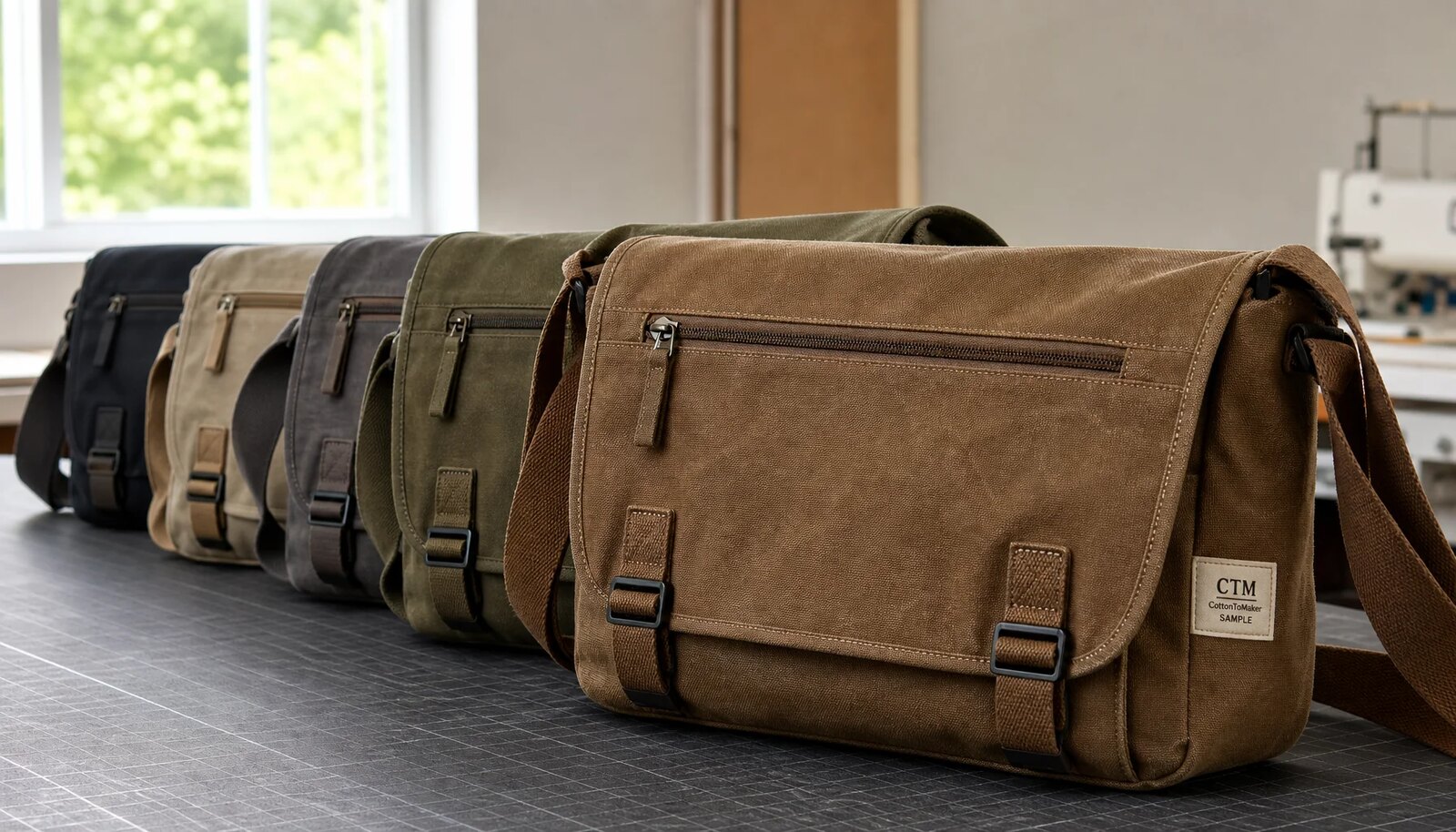
Why carton planning matters for this bag
Custom canvas messenger bags look straightforward until you ship them. The bag body, flap, strap hardware, and any print layer all affect how tightly the product folds, how much damage it can take in transit, and how many units fit into a useful carton. For farmers market vendors, the target is usually not luxury presentation; it is a bag that arrives clean, uncreased, and ready to move through a warehouse, a store back room, or a promotional distribution event without rework.
Carton planning is also where quote comparisons become real. Two suppliers can both say they are making a 12 oz canvas messenger bag, but one may be quoting loose packing in a heavier carton while another is quoting individual polybags, tissue wrap, and a smaller master carton. That difference changes freight cube, receiving labor, and damage risk. If you do not lock the pack-out early, the cheapest unit price can become the most expensive landed cost.
- A lighter carton may reduce freight, but only if the bag structure holds its shape after stacking.
- A well-planned pack-out lowers counting errors when cartons are received at a warehouse or retail DC.
- The packaging spec should be written into the PO, not left as a verbal note.
Start with the bag as a shipping object, not just a product
For messenger bags, buyers often focus first on size and print area. That is necessary, but shipping planning starts with the folded object. A common retail messenger bag might sit in the range of 10 to 14 oz canvas, while heavier daily-use versions may move toward 14 to 16 oz. Once you add a gusset, front pocket, flap, lining, and strap hardware, the folded thickness grows faster than many buyers expect. That extra thickness is what pushes carton volume and, eventually, freight cost.
Use the first sample to measure the bag in its shipping state, not only in its flat pattern state. Ask the factory to fold it the same way every time and report the packed dimensions, not just the sewn dimensions. If the vendor will carry produce samples, receipts, tablet accessories, or handout materials at a farmers market, the bag should stay structured enough to hold shape after folding. A soft bag that collapses too much can fit well in a carton but disappoint on the shelf.
- Set the approved fold method before production so carton counts do not drift.
- Measure body width, gusset depth, flap drop, and packed thickness from the sample bag.
- If the strap is detachable, confirm whether the strap ships inside the bag or separately.
Choose fabric weight and build details with the carton in mind
Fabric weight drives both product feel and packaging density. A 10 to 12 oz canvas can work for promotional or lightweight retail programs, but the bag may feel too soft if it carries heavier daily-use content. A 12 to 14 oz canvas is often the practical middle ground for a custom messenger bag because it gives better structure without making each unit unnecessarily bulky. If the buyer wants a more rigid retail feel, 14 to 16 oz canvas can be a safer choice, but the carton count will usually drop and shipping cube will rise.
The same logic applies to build details. A lined bag with an inner pocket, metal snaps, a padded flap, or a wide cotton webbing strap can create more volume than the artwork sheet suggests. Hardware matters too. A metal buckle or swivel clip can scratch adjacent bags if the inner packing is weak. For carton planning, the key question is not only whether the bag is strong enough. It is whether the bag can be stacked without deformation or scuffing across the full route from factory floor to customer receipt.
- Use 12 to 14 oz canvas as a working range for many buyer programs, then adjust by use case and freight target.
- Thicker canvas often improves shelf feel but may reduce the carton count enough to change the quote materially.
- Hardware-heavy designs need better separation inside the carton than a simple print-only bag.
Print method changes both cost and pack-out risk
Screen print is still the standard choice for many custom canvas messenger bag programs because it is stable, cost-effective, and clear on natural canvas. It works well when the design uses one to three colors and the buyer wants repeatable production. Heat transfer can handle more complex art or smaller runs, but the buyer should inspect edge quality and adhesion because a transfer that looks good in a photo can crack or lift after a rough shipment. Embroidery adds perceived value, but it increases thickness and can create pressure marks if the cartons are too tight.
The print method also affects where the bag should be folded. A front panel print can scuff if the same printed area contacts hardware or a rough seam. If the logo or illustration is large, the factory may need to place tissue or a soft divider to avoid transfer marks. For a farmers market vendor program, the goal is usually not premium gift-box presentation. It is a clean, repeatable surface that survives folding, carton compression, and repeated handling without warped graphics or ink rub.
- Ask for a dry rub and wet rub check on the approved sample before mass production.
- Confirm ink curing and the fold direction so the print does not crease on the same line every time.
- If the artwork is large, verify that the carton count still leaves enough air gap to avoid print-on-print scuffing.
Build the carton structure around handling, not only count
The best carton is the one that survives real handling with the least waste. In practice, that means balancing bag count, gross weight, and carton strength. A carton that is too full may push the master weight beyond a comfortable manual handling limit, while a carton that is too loose wastes cube and increases freight cost. For many textile programs, the buyer should start by targeting a gross carton weight that warehouse teams can still move without special handling, then adjust the count to fit that limit.
There is also a difference between a packing carton and a shipping carton. A simple polybagged bag may ride well in a standard master carton, but a structured messenger bag with a flap, pocket, or metal hardware may need a stronger carton, extra void-fill control, or corner protection. If you are shipping to a distributor, retail chain, or import warehouse, the carton label, outer mark, and SKU count should be readable without opening the box. That is a small detail that prevents a lot of receiving delay.
- Start with sample carton trials using the final fold method, not an imagined count.
- Keep the gross weight practical for warehouse handling, even if the carton could fit more units.
- Specify carton dimensions and carton grade in the RFQ so the factory cannot swap to a weaker box later.
MOQ logic is driven by print, packing, and carton artwork
MOQ is not just a sewing decision. It is affected by how many colors are printed, whether the carton has custom marks, whether the strap or lining is special, and whether the factory must reserve a dedicated packing line. A plain natural canvas messenger bag with a simple one-color logo and standard carton mark can usually support a lower MOQ than a bag with several print locations, custom zippers, and a printed retail carton. Buyers often miss that the carton itself can create a minimum. If the box needs custom print plates or a dedicated size run, the carton MOQ may be separate from the bag MOQ.
The cleanest way to compare quotes is to separate product cost, print setup, packaging cost, and carton cost. Ask the factory to identify where the MOQ changes if you switch from natural to dyed canvas, from screen print to embroidery, or from loose pack to polybag. That breakdown tells you whether the supplier understands production reality or is just quoting a vague unit price. For a buyers team, the best MOQ is the one that fits forecast risk, not the one that looks low on paper but forces a painful packaging compromise.
- Request MOQ by color, by decoration method, and by carton artwork version.
- If the quote bundles everything into one unit price, ask for a separate packing and carton line.
- A lower MOQ is only useful if the carton plan still works for freight and receiving.
Use sample approval to lock the carton plan before mass production
Sample approval should test more than aesthetics. A good pre-production sample for a custom canvas messenger bag must confirm sewn dimensions, print placement, fold direction, carton count, and how the product behaves after compression. Ask the factory to send both loose product photos and packed-carton photos. That second set matters because a bag that looks correct on a table can fail once five or ten units are stacked in a carton and the flap starts to imprint the next bag.
Build acceptance criteria that the factory can actually follow. For example, specify the exact measurement points, the approved color reference, the acceptable print shift, and the expected carton count by SKU. If the sample shows that a bag needs one extra tissue sheet or a different fold to stay clean, make that change before the PO. It is much cheaper to adjust a sample than to solve a full container of scuffed bags after shipping.
- Approve a pre-production sample and a packed-carton sample, not just a flat sample.
- Record measurement tolerances for body width, strap length, and packed thickness.
- If the carton count changes after the sample, require a revised photo set before mass production starts.
Use this buyer checklist before you approve the quote
A useful quote is one that can survive internal review without guesswork. The simplest way to keep procurement, merchandising, and logistics aligned is to turn the bag into a written pack specification. That means the supplier needs to know the fabric weight, the print method, the fold method, the inner pack method, the carton count, and the receiving destination. If any of those items are missing, the quote is not really complete. It may be a starting point, but it is not yet ready for approval.
This is especially important for farmers market vendor programs because the buyer often needs a product that looks retail-ready but ships like a wholesale textile item. A bag that sells well in a market stall may still be a poor shipping candidate if the strap buckles scratch the print or if the flap springs open inside the carton. The checklist below is the minimum set I would want in front of me before comparing two suppliers side by side.
- Final bag size, packed size, and fold method are confirmed.
- Fabric weight, weave style, and color standard are written into the spec.
- Print method, number of colors, and logo placement are approved.
- Inner pack method and master carton count are fixed.
- Carton dimensions, gross weight, and pallet plan are known.
- SKU labels, carton marks, and barcode placement are approved.
- Sample photos show both the bag and the packed carton.
- Lead time covers sampling, carton proof, production, and shipment booking.
Compare supplier quotes by landed cost, not unit price
The fastest way to misread a canvas messenger bag quote is to focus on the bag price and ignore the packaging math. If one supplier uses a smaller carton and another uses more protective but larger cartons, the freight cost may flip the result. The same is true if one quote includes inner polybags, carton labels, and a stronger board grade while the other leaves those items to the buyer. That is why landed cost matters more than the naked unit number.
A strong quote should let you compare like with like. Ask for the bag unit, setup charges, packing material cost, carton spec, carton printing, and the expected bags per carton. If the supplier can also give an estimated gross carton weight and carton cube, you can start comparing freight options before the order is released. For importers and distributors, this is the difference between a quote that supports a margin model and one that creates surprises after the booking is already made.
- Compare bag price, packing price, carton price, and freight cube together.
- Do not accept a unit price without carton dimensions and gross weight.
- If one supplier is cheaper only because they underpack the carton, that saving is not real.
Lead time risk starts with packaging decisions
Packaging choices affect schedule more than many buyers expect. A new print design, a new carton size, or a different inner pack method can add approval loops before production even starts. If the factory has to source stronger cartons or wait for printed carton art, the order can slip even when sewing capacity is available. For repeat programs, the most reliable lead times usually come from locking the exact carton spec and keeping the same fold method across reorders.
A practical schedule often includes sample approval, carton proof approval, production, packing, and booking. New custom programs usually need more calendar time than repeat runs because every packing detail has to be verified. In peak season, the risk is not only factory capacity. It is also carton supply, carton print queue, and warehouse space for finished goods. The buyer who treats packaging as part of the critical path is usually the one who avoids the last-minute rush.
- Ask whether carton procurement is already included in the lead time or added later.
- Confirm whether packing photos are required before shipment release.
- If you have a hard in-store date, build a buffer for sample and carton approval.
Specification comparison for buyers
| Spec decision | Recommended option | When it fits | Buyer risk to check |
|---|---|---|---|
| Direct factory with in-house packing | Use when the maker controls sewing, print, carton build, and final pack-out | Best for buyers who need one accountable source and stable carton dimensions | Confirm the carton spec is tied to the final sample, not only to a quote sheet |
| Trading company with bundled packing | Use only if they can name the actual factory and show pack photos from prior runs | Useful when you need mixed product programs or one commercial contact | Risk of markup and vague carton ownership if the quote does not break out packing details |
| Regional consolidation warehouse | Use for multi-SKU orders that need cross-docking or mixed pallets | Fits distributors and importers who ship to several DCs or retail partners | Check rework fees, relabeling fees, and whether carton counts change after consolidation |
| Single-SKU master cartons | Pack one color and one size per carton whenever possible | Best for clean warehouse receiving and lower pick error rates | Risk is slightly more carton count if you are forced to split by color or size |
| Mixed-color cartons with divider sheets | Use only when retail sets are small and internal sorting is controlled | Fits test orders, small replenishment lots, or promo assortments | Verify each color count is fixed in writing or carton audits become difficult |
| Individual polybag pack | Use for retail presentation, dust control, or if straps and buckles scuff during transit | Fits higher-value retail programs and long ocean shipments | Check the added cube, plastic cost, and whether trapped moisture needs a vent or desiccant |
| No polybag, tissue wrap only | Use when the bag is naturally stiff, the route is short, or plastic reduction is a priority | Fits low-cost wholesale programs and inner-pack controlled shipments | Risk of surface scuffing on printed canvas and strap abrasion inside the carton |
| Higher-burst carton with corner protection | Use for heavier canvas, metal hardware, or long transit lanes | Fits exports where cartons are stacked high or handled several times | Check that stronger cartons do not hide poor internal packing or increase freight cube too much |
Buyer checklist before sampling
- Final bag dimensions with body, gusset, strap length, and folded thickness
- Fabric weight in oz or GSM, plus weave density and color reference
- Print method, number of colors, and approved artwork placement
- Carton count, carton size, gross weight target, and pallet plan
- Inner pack method: polybag, tissue, belly band, or dust bag
- Labeling plan for SKU, barcode, carton mark, and country of origin
- Sample approval set with measurements, photos, and packing photos
- Shipment mode, target delivery window, and any humidity or crush concerns
Factory quote questions to send
- What exact folded bag dimensions, carton dimensions, and gross weight are you quoting?
- How many bags per master carton, and what is the empty carton weight?
- What are the print setup costs, color change costs, and any plate or screen charges?
- Do you quote the bag, packing, inner wrap, carton, and outer mark as separate line items?
- Can you provide two carton loading options so I can compare freight cube and handling weight?
- What is the MOQ by color, by print version, and by carton artwork version?
- Will you share pre-production sample photos, measurement data, and carton pack photos before mass production?
- What is your process if the sample passes on bag quality but fails on carton compression or transit scuffing?
Quality-control points to confirm
- Canvas weight matches the approved spec within the agreed tolerance and the hand feel is consistent across the lot
- Stitching is even, strap anchors are reinforced, and bartacks are present at all stress points
- Print registration is aligned, ink is fully cured, and rub resistance is acceptable after a simple friction test
- Bag measurements, fold size, and gusset depth stay within the allowed range so carton counts remain accurate
- Hardware, zipper function, and buckle action are smooth with no sharp edges or loose threads
- Cartons are intact, taped correctly, and able to withstand normal stacking without edge collapse
- Inner packs are clean, dry, and counted correctly so mixed lots do not create receiving errors
- Carton labels, barcodes, and SKU marks match the shipping documents and the approved packing list