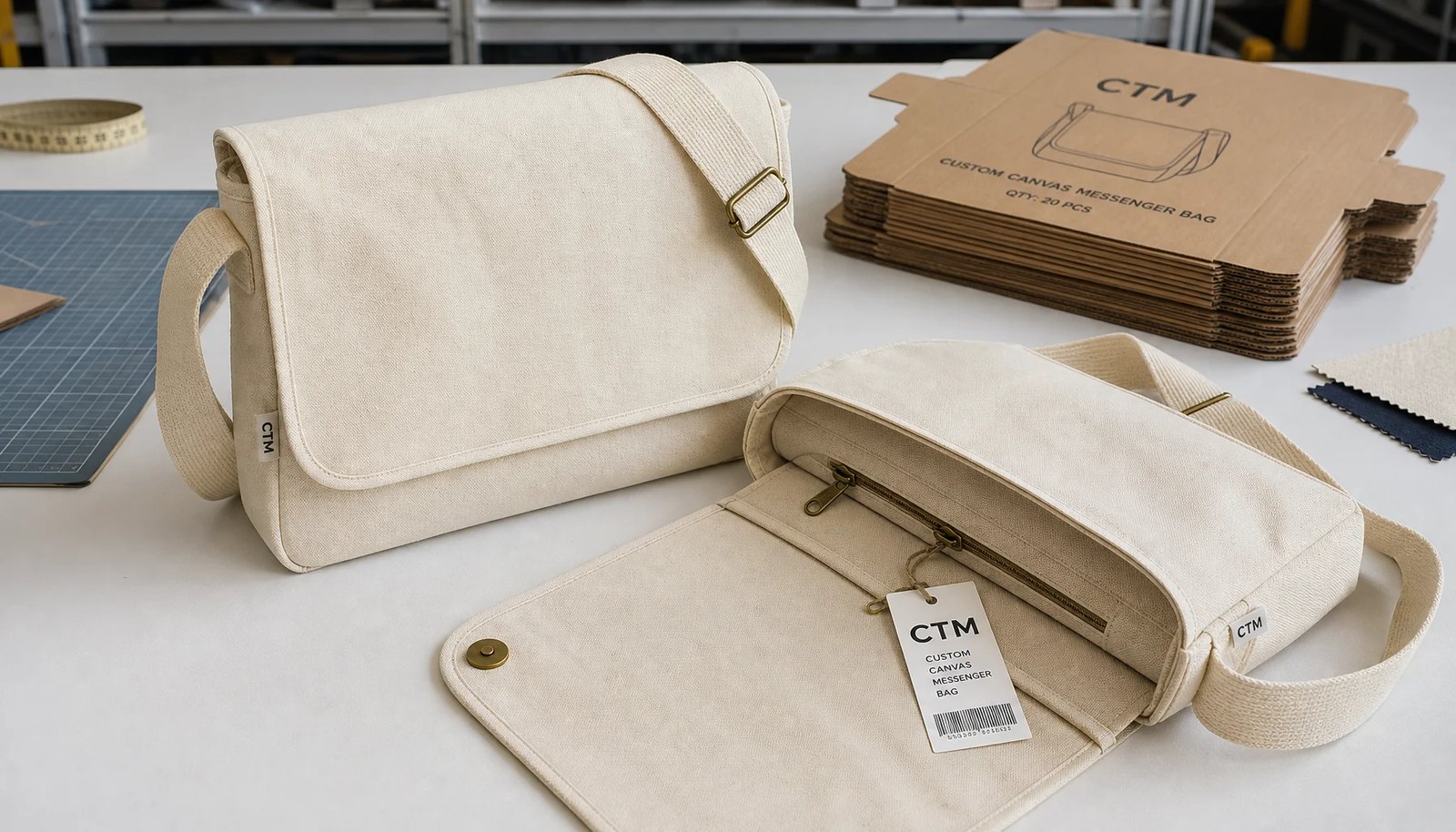
Why carton planning belongs in the RFQ
A custom canvas messenger bag for a university bookstore is rarely just a simple giveaway. It may carry licensed artwork, scan through a bookstore point-of-sale system, ship through a distributor, or arrive for a fixed campus date such as orientation, homecoming, graduation, or the start of term. If packing is handled only after production, the buyer can receive bags that look acceptable one by one but arrive creased, dusty, mislabeled, hard to count, or slow to release to the sales floor.
For procurement teams, the carton plan is both a quality specification and a landed-cost input. Two suppliers can quote the same finished bag size and the same nominal canvas weight while using different carton quantities, fold methods, unit packaging, carton board, and label formats. The cheaper unit price may not stay cheaper if it creates higher CBM, heavier manual handling, relabeling labor, more damages, or receiving delays.
Ask for carton data with the first serious quotation. At minimum, the supplier should estimate carton length, width, height, net weight, gross weight, CBM, pieces per carton, and total carton count by SKU. Those numbers will be revised after sample packing, but an early estimate exposes assumptions. It also lets freight, warehouse, and bookstore teams comment before the factory starts final packing.
- Put carton count, carton size, gross weight, net weight, and CBM in the quotation rather than waiting for shipment booking.
- Approve the fold method and strap placement before bulk sewing is complete.
- Require carton labels that match purchase order, SKU, logo version, color, quantity, carton number, and country of origin.
- Treat mixed-SKU cartons as an exception requiring written approval and a clear inner-pack map.
- Compare suppliers on sellable landed cost, not factory unit price alone.
Start with a complete bag specification
A stable carton packing plan starts with the product itself. Many retail canvas messenger bags sit in the 12 oz to 16 oz cotton canvas range, roughly 407 to 542 GSM. That range is useful for quoting, but it is not enough for production control. Ounce ratings shift with weave, yarn, dyeing, washing, and finishing, so the RFQ should ask how GSM is measured and whether the factory will record incoming fabric lot results.
Finished dimensions matter more than cutting dimensions. State the finished width, height, gusset depth, flap depth, strap width, strap length, shoulder drop, closure type, pocket size, lining, padding, and hardware. If the bag must hold textbooks, a tablet, a laptop sleeve, a bookstore kit, or a specific folded apparel item, specify usable internal space after seams and closure. If it will hang on a fixture, define hangtag location and display orientation.
Canvas is soft, so small variation is normal. Still, variation needs boundaries. For many messenger bags, plus or minus 0.5 cm for the main body, flap, and pocket, plus or minus 1 cm for strap length, is workable. Padded sleeves, curved flaps, washed canvas, heavy gussets, or very structured designs may need different tolerances. The key is to set them before cutting begins, not during final inspection.
- Record fabric weight in both oz and GSM, with the supplier's test point before or after finishing.
- Define finished dimensions, usable interior dimensions, and tolerances in centimeters.
- State whether natural cotton flecks, yarn slubs, and slight shade movement are acceptable.
- Specify thread color, stitch density, strap webbing, closure type, hardware finish, and reinforcement points.
- Include display needs such as hangtag position, barcode scan access, and shelf folding shape.
Map bookstore SKUs before quoting MOQ
MOQ for custom canvas messenger bags is not only the number of bags sewn. It can be driven by fabric color, dye lot, strap color, hardware finish, lining, woven label, care label, print setup, transfer sheets, embroidery digitizing, hangtag, barcode, carton label, and packing segregation. A 2,000-piece order with one natural canvas body and one screen print is very different from a 2,000-piece order split across eight department marks and four barcode versions.
Build a simple SKU matrix before asking factories to price. The matrix should show quantity by bag color, artwork code, print color, strap color, hardware finish, hangtag, barcode, and carton label. If all versions share body fabric and trims, the factory may manage several logos efficiently. If each version changes fabric and trims, separate material minimums and additional setup time are more likely.
Also separate product differences from packing differences. A department-specific barcode may not change the bag construction, but it changes label printing, inspection, carton segregation, and receiving. A bookstore may issue one purchase order while still requiring each SKU to arrive in separate cartons. If that rule is not written, the factory may mix versions to fill cartons, leaving the receiving team to sort and relabel.
- Provide quantity by SKU, artwork, body color, trim, barcode, and carton label at RFQ stage.
- Ask for setup charges for screens, transfers, embroidery digitizing, woven labels, hangtags, and barcode labels.
- Confirm whether small splits require separate cutting, printing, inspection, or packing handling.
- State whether mixed cartons are prohibited, allowed with inner packs, or allowed only for short balance quantities.
- Compare quotes only when every supplier used the same SKU split and packing assumptions.
Choose decoration with packing pressure in mind
University bookstore messenger bags often carry school names, licensed marks, mascots, department logos, alumni graphics, or event artwork. Screen printing usually suits solid-color campus marks and repeat orders because it can deliver consistent opacity once screens are approved. Heat transfer can help with small runs or multi-color graphics, but it needs testing on the actual canvas surface. Embroidery gives a premium feel on simpler artwork, though backing and stitch density can pucker a flexible flap if the design is too dense.
Decoration cannot be approved only on a flat table. A large ink area across a sharp flap fold may crack or hold a permanent crease after compression. A heat transfer may lift at the edge if the adhesive and textured canvas are not compatible. A slider, buckle, rivet, snap, or magnetic closure can dent a printed panel if the strap is folded against the logo in the bottom layers of a carton.
For campus color approval, digital proofs are not enough. PMS references help, but color shifts on natural, dyed, or pigment-washed canvas. Ask for a strike-off on the actual production canvas or approved bulk fabric. Review color, opacity, registration, handfeel, placement, and how the decoration behaves after folding.
- Measure logo placement from finished seams or finished edges, not raw cut-panel edges.
- Set print placement tolerance, commonly plus or minus 3 mm for critical front artwork where feasible.
- Identify whether artwork crosses a flap fold, closure point, strap contact area, or hardware pressure zone.
- Approve screen print curing, transfer adhesion, or embroidery backing on production fabric.
- Inspect decorated samples after folding because carton pressure can reveal problems missed on a flat sample.
Set carton count by weight, shape, and handling
The right carton quantity is not the largest number of bags that can be forced inside. A good carton count keeps the carton square, limits compression, protects decorated panels, prevents strap tangling, and stays within the buyer's handling rules. Depending on bag size and construction, carton quantities may range from 25 to 50 pieces. A flat 12 oz bag without bulky hardware may pack near the high end. A 16 oz gusseted bag with wide straps, sliders, buckles, and individual packaging may need a lower count.
State the maximum carton gross weight in the RFQ. Many buyers use a practical manual-handling range around 15 kg to 20 kg, but the correct limit should come from the bookstore, distributor, or campus warehouse. Heavy cartons are more likely to be dropped, dragged, or stacked roughly. Oversized cartons may reduce carton count but increase dimensional freight cost and make pallets inefficient.
Ask the supplier to quote carton dimensions in centimeters and calculate CBM. Then verify the estimate with a packed sample carton or early production carton. Any change in unit packaging, hangtag, strap fold, or carton board can change the final count and volume. Do not book freight against old packing data if the final retail pack has changed.
- Request carton length, width, height, gross weight, net weight, CBM, pieces per carton, and cartons per SKU.
- Use 5-ply export cartons for many standard routes and consider 7-ply for heavy bags, LCL handling, or long inland trucking.
- Avoid excess headspace because bags shift, rub, and lose their fold during transit.
- Avoid over-compression because flap creases and strap marks can remain visible at retail.
- Reconfirm carton count when packaging, hangtags, strap placement, or hardware protection changes.
Select unit packaging for the sales channel
Unit packaging should match how the bags will be received, stored, displayed, and sold. Individual polybags protect natural canvas from carton fibers, warehouse dust, dirty hands, abrasion, and moisture exposure. Paper sleeves or kraft belly bands reduce plastic and may work when the canvas surface is less vulnerable. Clean bulk packing can be acceptable for immediate orientation kits, but it is risky for long storage or retail shelves because unbleached canvas shows marks quickly.
Bookstore and distributor rules often decide the final packaging choice. Some teams need barcodes that scan without opening the unit. Others require hangtags in a fixed position, country-of-origin marking, polybag warning text, carton routing labels, or buyer-supplied labels. These details affect labor, packing sequence, carton dimensions, and inspection. They belong in the RFQ and sample approval, not in a late packing instruction.
Sustainability requests should be written in operational terms. Instead of asking for eco packaging, state whether the preference is recycled-content polybags, paper sleeves, plastic-free inner packs, FSC paper, or no individual pack. Also state what cannot be compromised: clean canvas, barcode access, dust protection, stable stacks, and readable carton labels.
- Use individual packaging for retail sale, long storage, distributor handling, or direct-to-store shipment.
- Use paper sleeves or kraft bands when plastic reduction matters and the product can tolerate lighter protection.
- Keep adhesive labels off natural canvas unless residue and discoloration have been tested.
- Place barcodes consistently on hangtag back, polybag exterior, or paper sleeve based on receiving rules.
- Confirm warning text, country-of-origin marking, recycled-content claims, and routing labels before production.
Control folding, straps, and hardware contact
Messenger bags are more difficult to pack consistently than flat totes. They have flaps, long straps, closures, sliders, buckles, and sometimes rivets or magnetic snaps. Without a folding instruction, each packer may choose a different strap position. The result is uneven carton height, tangled straps, dents on decorated panels, and extra reshaping work for the bookstore team.
The approved fold should present the bag in the same basic shape the customer will see. The flap can be closed, the strap placed inside the body, laid flat behind the back panel, or secured with a paper band. Metal parts should face away from printed or transferred artwork. When contact cannot be avoided, use tissue, kraft paper, or a non-printed fabric layer as a buffer.
Gusseted bags need special care. Forcing a gusset into a random sharp crease can make the bag look misshapen on the shelf. Alternating orientation inside the carton may solve uneven strap bulk. A few photos can prevent many arguments: open bag, closed bag, strap position, unit package, carton layer arrangement, and sealed carton label.
- Close the flap consistently before packing so retail shape stays uniform.
- Keep buckles, sliders, snaps, rivets, and adjusters away from logos and transfer films.
- Use alternating orientation when strap bulk makes one side of the carton higher.
- Avoid tight strap bends that create permanent creases or twisted display appearance.
- Attach folding photos to the approved sample record and final inspection checklist.
Approve samples with packing data, not just appearance
A table-top sample is not enough for a bookstore program. The pre-production sample should include the approved canvas, decoration, strap, hardware, label, hangtag, barcode, unit packaging, fold method, and carton label format. If mass production will ship in polybags, paper sleeves, or belly bands, the sample should show that packaging because it changes fold thickness and stack height.
Sample approval should include numbers. Record finished dimensions, print placement, strap length, pocket size, carton count, carton dimensions, net weight, gross weight, and CBM. If the supplier later finds the bag is bulkier than expected and wants to change the carton count, the buyer can decide before all cartons are packed.
For higher-risk artwork or hardware, run a simple packing check. Fold the decorated sample as mass production will be folded, place it under light stack pressure for 24 hours, and inspect for ink marking, transfer lifting, hardware dents, severe creasing, or strap impressions. This does not replace formal transit testing, but it catches avoidable issues before the order is fully printed and sewn.
- Approve one complete pre-production sample with retail packaging and barcode method.
- Request an artwork strike-off on actual production canvas before bulk decoration.
- Record carton count, carton dimensions, net weight, gross weight, and CBM after sample packing.
- Keep one signed or sealed approval sample with the factory and one with the buyer or inspector.
- Treat any change in fold method, unit packaging, or carton count as a packing revision needing approval.
Inspect product quality and packing together
Final inspection should cover the bag and the carton plan in the same visit. Product checks include fabric shade, GSM records, finished dimensions, sewing, bartacks, strap attachment, flap alignment, pocket construction, hardware, logo placement, decoration durability, odor, stains, and loose threads. Packing checks include unit packaging, barcode position, hangtag, carton count, carton label, SKU segregation, board strength, carton dimensions, gross weight, and carton condition.
Defect classification should reflect bookstore risk. A broken strap attachment, sharp hardware edge, wrong logo, wrong barcode, or mixed-SKU carton can be critical because it affects safety, licensing, or inventory control. A print that is 10 mm off-center may be a major retail defect even if the bag functions. A small cotton fleck may be acceptable on natural canvas if approved, while oil marks, mildew, weaving defects, or dirty-hand marks are not.
Inspectors should open cartons from different parts of the packed lot, not only the easiest cartons near the door. They should photograph the layer arrangement before removing units, then compare actual folding and strap placement against the approved method. If cartons are opened, resealing rules should be agreed so the shipment remains secure, countable, and acceptable to the receiving team.
- Use AQL or another written inspection plan with critical, major, and minor defects defined before production.
- Measure finished dimensions and logo placement against the approved sample and tolerance sheet.
- Check print curing, transfer adhesion, embroidery backing, strap bartacks, and hardware contact points.
- Verify carton labels against packing list, purchase order, SKU, barcode, quantity, and carton sequence.
- Record carton gross weight and dimensions before shipment release to confirm freight data.
Lock dates, routing, and receiving rules early
Canvas messenger bag production moves through several steps: material sourcing, fabric approval, artwork strike-off, sampling, cutting, printing or embroidery, curing, sewing, trimming, inspection, unit packing, master carton packing, and export booking. A quote that says production takes 30 days is incomplete unless it states when the clock starts and which approvals are required. Fabric dyeing, university licensing review, barcode approval, hangtag printing, or custom carton labels can all add time.
Bookstore deadlines are often immovable. Orientation week, graduation, homecoming, alumni events, and semester opening will not wait for late packing approval. Set both a latest ex-factory date and a latest required delivery date. If the shipment moves by LCL, allow time for consolidation, customs clearance, delivery appointment, and campus receiving. Rush air freight can wipe out sourcing savings, so carton dimensions and CBM need to be firm early enough for freight planning.
Routing rules should travel with the purchase order. If a distributor requires appointment delivery, pallet labels, carton sequence, specific carton label fields, no mixed SKUs, or maximum carton weight, the factory needs those rules before final packing. If the bookstore uses its own barcodes, provide data files and label proofs early enough to include them in sample approval.
- Define the production start point as approval of fabric, artwork strike-off, sample, packaging, and deposit or PO as applicable.
- Confirm when carton dimensions and CBM become firm for freight booking.
- Add time for licensing approval, barcode generation, hangtag proofing, and carton label review.
- Schedule final inspection after packing but before shipment release whenever possible.
- Give routing and receiving rules to the supplier before final packing begins.
Specification comparison for buyers
| Spec decision | Recommended option | When it fits | Buyer risk to check |
|---|---|---|---|
| Fabric weight | 12 oz to 16 oz cotton canvas, approximately 407 to 542 GSM before or after finishing as confirmed by supplier test method | Retail bookstore merchandise, orientation bags, alumni programs, department gifts, and daily student carry | Ounce ratings vary by weave and finishing; require actual GSM from bulk fabric lots instead of relying only on nominal fabric description |
| Finished dimensions | Specify finished width, height, gusset, flap depth, strap width, strap length, shoulder drop, and tolerance | Bags must fit books, tablets, laptops, bookstore fixtures, or orientation-kit contents | Cut-panel dimensions are not finished dimensions; shrinkage, seams, folds, lining, and padding can reduce usable space |
| Measurement tolerance | Main body plus or minus 0.5 cm; flap and pocket plus or minus 0.5 cm; strap length plus or minus 1 cm unless design requires otherwise | Standard soft canvas messenger bags where hand sewing and fabric relaxation create small variation | No tolerance invites disputes; too-tight tolerance may raise cost or rejection rate without improving retail function |
| Artwork method | Screen print for solid campus marks; heat transfer for multi-color small runs; embroidery for premium low-detail designs with backing approval | Licensed university logos, bookstore graphics, alumni marks, and department names | Ink on fold lines can crack; transfers can lift on textured canvas; embroidery can pucker thin flaps or distort small mascot details |
| Print placement tolerance | Measure from finished seam or finished edge; use plus or minus 3 mm for key logo placement when feasible | Retail-visible logo positions on flap or front panel | Measuring from cut fabric edges is unreliable because sewing and pressing alter final position |
| Unit packaging | Individual recycled polybag, paper sleeve, kraft belly band, tissue separator, or clean bulk packing based on channel | Retail shelf sale, distributor handling, direct-to-store shipment, or orientation kit packing | No unit protection reduces cost but increases dust, abrasion, moisture, dirty-hand marks, barcode handling issues, and retail claims |
| Master carton count | Set target pieces per carton plus maximum gross weight, commonly 15 kg to 20 kg depending on receiving rules | Manual bookstore receiving, distributor inbound, mixed-SKU shipments, pallet planning, and freight quoting | Too many pieces cause compression creases and heavy cartons; too few pieces increase CBM and freight cost |
| Carton strength | 5-ply export carton for most standard orders; reinforced 7-ply for heavy bags, LCL handling, long inland trucking, or high stacking risk | Sea freight, air freight, LCL consolidation, distributor transfers, and campus warehouse delivery | Weak cartons crush and lose count integrity; overbuilt cartons add cost, tare weight, and storage bulk |
| SKU segregation | Pack by SKU unless buyer approves mixed cartons with clear inner packs and carton marks | Multiple department logos, fabric colors, barcodes, hangtags, or purchase orders | Mixed cartons without a map create receiving errors, relabeling labor, inventory variance, and delays before retail release |
Buyer checklist before sampling
- Define finished bag dimensions in centimeters, including width, height, gusset, flap depth, strap width, strap length, shoulder drop, interior pocket, closure type, and measurement tolerance.
- Specify canvas by ounce and GSM, and state whether GSM is tested before washing, after dyeing, or after finishing; require incoming fabric lot records.
- Confirm fabric color standard using approved swatch or color reference, with shade tolerance for natural, bleached, dyed, or pigment-washed canvas.
- List fabric, strap, lining, thread, hardware, label, hangtag, barcode, carton label, and country-of-origin marking for every SKU version.
- Provide vector artwork, PMS references where applicable, print size, print location from finished edges, and whether artwork crosses a flap fold or pressure point.
- State the sales channel: bookstore shelf sale, e-commerce fulfillment, orientation kit, alumni merchandise, department giveaway, or licensed retail SKU.
- Choose unit packaging: individual polybag, recycled polybag, paper sleeve, kraft belly band, tissue separator, clean bulk pack, or buyer-supplied packaging.
- Set target pieces per master carton, maximum gross weight, desired carton board strength, and any pallet, routing, or distributor receiving rules.
- Ask the factory to quote estimated carton length, width, height, net weight, gross weight, CBM, pieces per carton, and total cartons by SKU.
- Require a pre-production sample packed as mass production, including fold method, strap placement, hangtag, barcode, polybag or sleeve, carton label, and carton arrangement photo.
Factory quote questions to send
- What is the actual GSM range of the quoted canvas, and will you verify GSM from incoming bulk fabric lots with a documented test?
- Is the canvas stock, greige fabric dyed to order, yarn-dyed, pigment dyed, washed, preshrunk, or finished after dyeing, and how does that affect MOQ and lead time?
- What shrinkage allowance are you using from fabric to finished bag, and what finished measurement tolerance will you commit to for body, flap, pocket, and strap?
- Which print method do you recommend for our artwork on this canvas texture, and what curing, adhesion, rub, and fold checks will you perform before packing?
- Can you provide a strike-off on the actual bulk canvas, not only a paper proof or digital mockup, for university color approval?
- How will straps, buckles, sliders, snaps, rivets, or adjusters be positioned inside the carton to avoid pressure marks on the logo?
- How many pieces will you pack per export carton, and what are the estimated carton dimensions, net weight, gross weight, CBM, and carton count per SKU?
- What is the heaviest carton in your proposed packing plan, and does it stay below our maximum gross weight limit?
- Which carton board will you use, such as 5-ply or 7-ply, and what edge crush, stacking, or route assumptions are behind that choice?
- What is the MOQ by fabric color, logo version, print color, label version, barcode version, hangtag, and carton label, not only the total order quantity?
Quality-control points to confirm
- Incoming canvas GSM should be checked by fabric lot and recorded; do not accept only the nominal ounce rating from the quotation.
- Finished main body dimensions should normally be controlled within plus or minus 0.5 cm, with strap length within plus or minus 1 cm unless the approved sample requires a different tolerance.
- Fabric shade should be checked against the approved swatch under consistent lighting, especially for navy, maroon, black, forest green, royal blue, and natural canvas lots.
- Natural canvas standards should distinguish acceptable cotton flecks and slubs from unacceptable stains, oil marks, weaving defects, mildew, or dirty handling marks.
- Print position should be measured from fixed finished edges or seam lines with a stated tolerance such as plus or minus 3 mm for key retail artwork.
- Screen print should be dry, cured, non-sticky, and resistant to reasonable rubbing, tape pull, or scratch checks appropriate to the ink system and fabric surface.
- Heat transfer should be checked for edge lifting, gloss variation, poor adhesion, cracking after folding, and visible film edges on textured canvas.
- Embroidery should be checked for puckering, skipped stitches, thread color accuracy, loose thread, backing show-through, and distortion of small text.
- Strap attachment should be reinforced with consistent bartacks or box stitching, with no skipped stitches, broken thread, weak seams, or uneven stress points.
- Hardware should be checked for rust, burrs, sharp edges, weak attachment, plating inconsistency, magnetic snap function, slider movement, and contact damage to decorated panels.