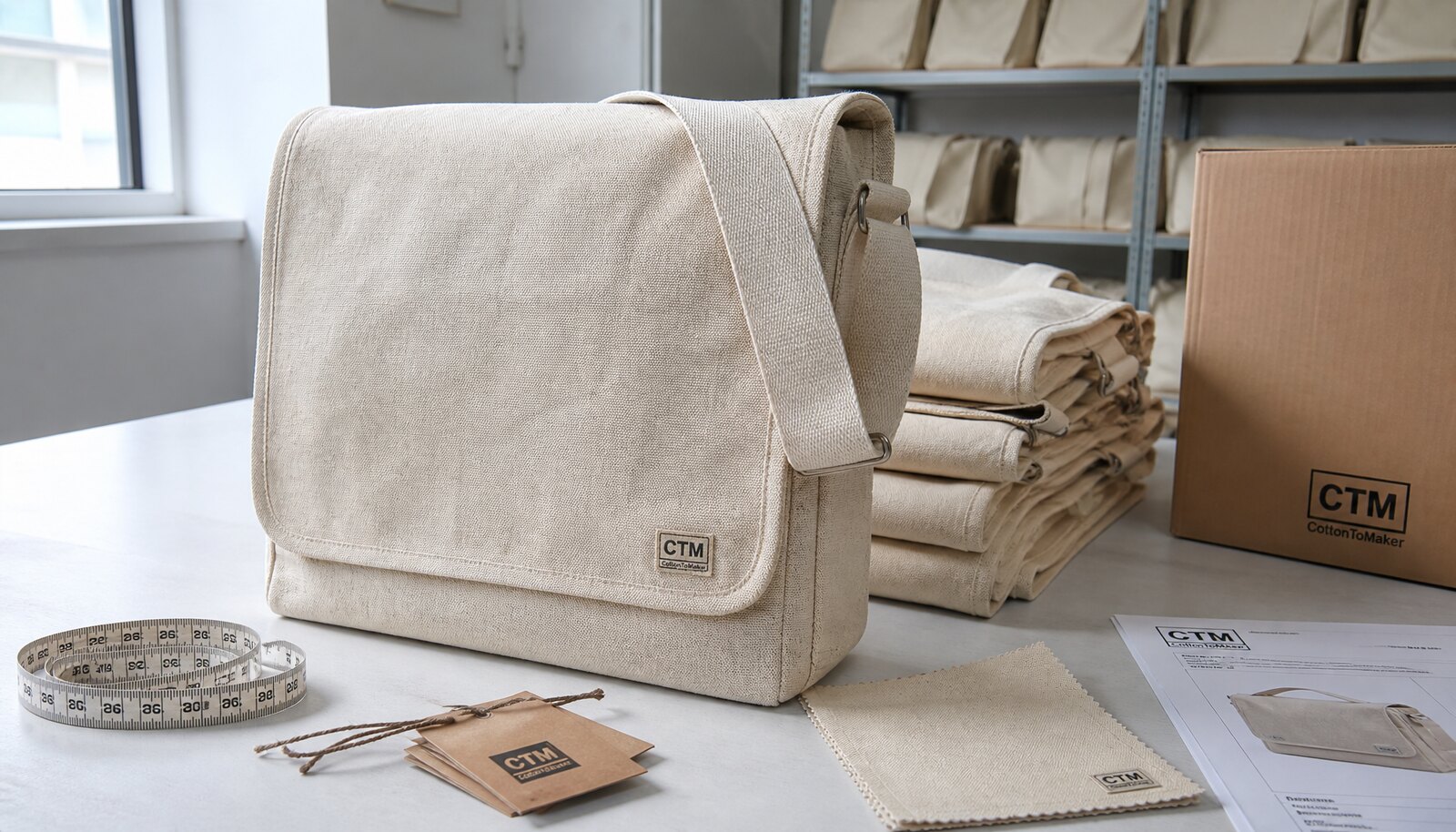
Why carton packing matters more than the bag spec on gift-shop orders
Gift shop buyers often spend more time on print art than on carton packing, but packing is where margin gets lost. Canvas messenger bags can look acceptable in production photos and still arrive with crushed panels, dirty folds, mismatched counts, or carton sizes that push freight costs higher than expected. If the bag is meant for retail display, the carton plan must protect the shape and keep the bags easy to receive, count, and replenish.
For custom canvas messenger bags carton packing plan for gift shops, the real objective is not just safe transport. The carton plan has to support the retail workflow: how the shop opens master cartons, how quickly staff can price and display the bags, whether they need inner bags for dust protection, and whether the bag survives repeated handling before it reaches the customer. That is why carton spec should be built into the RFQ instead of added after the quote comes back.
- A clean carton plan reduces rework at destination DC or store backroom.
- The wrong fold method can create permanent creases on light-colored canvas.
- Packing count affects both freight cube and retail replenishment speed.
Start with the right canvas weight, construction, and retail finish
For gift shops, 12oz canvas is usually the lower boundary for a bag that still feels like a real retail product. 14oz canvas is a better target if the bag needs a more structured body, especially when the print area is large or the bag will sit on a shelf. If the line is built for premium souvenir shops or museum stores, some buyers move to 16oz, but they should expect higher unit cost, higher carton weight, and more effort in folding and packing.
The construction should match the sales channel. An open-top messenger bag works for lower-priced impulse gifting, while a zipper top adds retail value and helps the bag hold smaller merchandise. Lining can improve appearance, but it also changes sewing cost and lead time. Do not compare supplier quotes unless they all use the same construction, because a lined zipper bag and an unlined open-top bag are not commercially equivalent.
- 12oz: better for price-sensitive gift shops and high-volume promotions.
- 14oz: better balance of structure, print clarity, and shelf presentation.
- 16oz: suitable when the bag must feel premium, but freight and packing become more expensive.
Print method and artwork control drive both MOQ and scrap rate
Canvas is a textured substrate, so print method selection affects both appearance and yield. For simple one-color or two-color logos, screen print usually gives the most durable result and the lowest cost at scale. If the artwork has gradients, many colors, or a short run, heat transfer can make more sense, but buyers should inspect edge sharpness and wash/rub resistance. Embroidery works well for small logos, yet it can distort thin canvas if the stitch density is too high.
The print size should be defined in millimeters, not in vague terms like 'large front logo.' A good RFQ gives print position, maximum print width, Pantone references if relevant, and whether the logo must sit centered relative to the front panel or shifted to avoid seams. The more exact the artwork placement, the less chance the factory will trim, rework, or charge a setup revision after sampling.
- Screen print is usually best when the design is simple and the order is repeatable.
- Heat transfer fits lower MOQ or complex art, but can show edge wear if quality is weak.
- Embroidery should be limited to areas that can hold the stitch density without puckering.
How MOQ really changes when you customize more than one detail
MOQ is not driven by the bag body alone. For canvas messenger bags, each customized element can add a separate minimum: fabric dye lot, print screen setup, woven label weaving, zipper color matching, or custom carton printing. A buyer who keeps the bag size and fabric standard but changes only the logo often gets a much better MOQ than a buyer who also wants custom lining, custom zipper pull, and custom hang tag.
This is why procurement teams should ask for MOQ by option, not as one flat number. A factory can often quote a lower MOQ for standard natural canvas with one print position, while a custom-dyed body or custom hardware package may require a much larger run. The supplier should state what part of the order is fixed cost and what part is variable cost, so the buyer can decide whether to simplify the spec or raise the volume.
- Keep one spec path for the first order if the goal is to test market demand.
- Use standard materials where possible: natural canvas, standard zipper tape, standard cotton webbing.
- Split the MOQ by accessory if the supplier offers optional upgrades.
Supplier comparison: factory-direct vs trading route for gift-shop packing
The sourcing route matters because carton packing is often handled at the last stage of production. A factory-direct supplier with in-house sewing, print, inspection, and packing can control folds, counts, carton marks, and carton strength more tightly than a trading company that outsources multiple steps. That does not mean trading routes are always wrong, but they need stronger documentation and a clearer packing approval process.
For retail buyers, the safest route is usually the one that can show a real carton pack sample before bulk shipment. If the supplier cannot produce a packed sample, the buyer is taking a packaging risk that is hard to correct after production starts. The table below compares practical sourcing options based on how they affect quote clarity, packing control, and order risk.
Comparison table for sourcing routes and packing control
The comparison below helps buyers separate low quote noise from actual landed-cost value. Two suppliers can offer similar FOB prices, but the one that packs tighter, labels correctly, and wastes less carton volume may land cheaper and create fewer store issues.
Define the measurable checks around strap pull, buckle function, flap alignment, pocket zipper cycle, lining seam check, hardware corrosion, and carton rub review. Add tolerance ranges only where the buyer truly cares, and ask for photos that show the measurement point, not just a finished product overview.
- Write decisions in measurable language, not only descriptive wording.
- Ask for sample photos plus one physical approval sample for important orders.
- Keep quotation, sample approval, and inspection notes tied to the same spec version.
Build the carton plan from retail handling, not just factory convenience
A good carton plan starts with how the bags will be opened and distributed after arrival. If the gift shop buys by the case and shelves the product directly, carton count should match the store’s replenishment rhythm. If the order goes to a central warehouse first, then carton marks, SKU coding, and stacking strength matter more than attractive retail presentation inside the master carton. Either way, the carton should protect the bag shape without making the pack count awkward.
For custom canvas messenger bags, common packing patterns include one polybag per bag, then 10 to 20 pieces per master carton depending on bag thickness and size. Heavier or lined bags often need fewer pieces per carton to stay within gross weight limits. The carton plan should include fold direction, strap tuck method, and whether the logo face should be protected by tissue or inner sheet paper to prevent abrasion.
- Use a consistent folding rule so the front logo appears the same way in every unit.
- Keep carton gross weight within the carrier and warehouse handling limit.
- Do not overload cartons just to reduce carton count; crushed canvas costs more than cardboard.
Quote breakdown: what should be priced separately
A useful quote separates the bag body, decoration, labels, packing, and freight assumptions. If the supplier gives only one total number, it becomes difficult to compare options or understand why the price changes after artwork approval. A professional quote should show the unit price for the base bag, the print setup or decoration charge, optional add-ons such as woven labels or zippers, and the packing method that was assumed for the quote.
Buyers should also ask for the carton dimension and estimated load efficiency. A slightly higher unit price can still win if the supplier packs efficiently and avoids oversize cartons. On the other hand, a cheaper bag price may become expensive when the cartons are too large for the shipping method or when the actual pack count has to be reduced to prevent deformation.
- Base bag price: fabric, cut, sew, and standard finishing.
- Decoration: screen print, embroidery, heat transfer, or label application.
- Packing: polybag, tissue, desiccant, carton marks, and carton reinforcement if needed.
Sample approval should include a packed sample, not only a sewn sample
The usual mistake in bag sourcing is approving a flat sewn sample and assuming bulk packing will look the same. Packing changes the product. Fold lines shift the logo view, straps can press into the canvas, and carton pressure can create permanent marks on light-colored fabric. For gift shops, the supplier should send at least one pre-production sample and one carton-packed reference sample when possible.
During sample approval, the buyer should evaluate three things: visual alignment, handling resistance, and packability. Visual alignment includes logo position, seam symmetry, and color consistency. Handling resistance means pulling the strap, checking stitch tension, and verifying that the bag keeps its shape after a few folds. Packability means the sample can be folded into the agreed carton count without forcing the bag into an awkward or crushed shape.
- Approve the exact fold method in writing.
- Check whether the sample can be repacked by warehouse staff without special training.
- Record the approved sample photos against the PO or technical sheet.
Lead time risks that usually get ignored until the order is late
Canvas messenger bag lead time is often presented as one number, but the real schedule has several risk points. Fabric availability, print plate or screen preparation, sample revision cycles, and final packing are separate steps. If the buyer delays artwork confirmation, the shipment date shifts even if the supplier is ready to cut fabric. Likewise, if carton marks are approved late, the goods may finish sewing but wait idle before packing and dispatch.
A realistic schedule should include sample time, production time, internal inspection time, and a buffer for rework. Orders with custom labels, zipper colors, or special carton marks need extra calendar space because each change increases coordination points. Procurement teams should not rely on a factory’s fastest possible lead time; they should use a schedule that reflects the actual approval path and the time needed to correct defects without pushing the shipment into air freight.
- Ask for a schedule broken into sampling, material booking, bulk production, packing, and inspection.
- Add time for artwork approval if the print is not a repeat order.
- Plan extra buffer when the order includes multiple SKUs or mixed carton configurations.
Specification comparison for buyers
| Spec decision | Recommended option | When it fits | Buyer risk to check |
|---|---|---|---|
| Fabric weight | 12oz–14oz canvas, pre-shrunk if possible | Gift shops want a structured hand feel and better shelf presentation | Too light looks weak; too heavy raises FOB and carton weight |
| Bag size | Medium format around 30 x 35 x 10 cm with an adjustable strap | Souvenir, museum, attraction, and bookstore assortments | Oversized bags can fail shelf fit and increase dimensional shipping cost |
| Print method | Screen print for simple art; heat transfer or embroidery for small runs and multi-color logos | When artwork is limited to 1–3 colors or small branding zones | Fine text may blur on textured canvas; embroidery can distort on thin fabric |
| Closure option | Open top or zipper top depending on retail price point | Open-top for impulse gift channels; zipper for higher perceived value | Zippers add cost, more inspection points, and more sewing risk |
| Lining | Unlined or light lining for gift-shop economy lines; lining for premium gift retail | When the bag carries light merchandise and needs a cleaner interior finish | Lining can hide sewing defects and increase lead time if not agreed in sample |
| Carton packing | Polybag plus inner bundle by count, then export carton with clear carton marks | For chain retail, DC delivery, and mixed-SKU gift shop distribution | Loose packing causes scuffing; overstuffed cartons deform bags and reduce cube efficiency |
| MOQ route | Standard fabric and standard size with one print position | When buyer wants lower MOQ and faster repeat business | Custom size, custom zipper color, and custom label can force a much higher MOQ |
| Supplier route | Factory with in-house cutting, printing, sewing, and final packing | When the buyer needs tighter control of packing and defect response | Trading-only quotes may hide carton cost, print loss, or labor add-ons |
| Approval method | Pre-production sample plus carton pack sample | When the order will ship to retail stores and repacking is expensive | A perfect PPS can still fail if carton layout, folding, or count is not approved |
Buyer checklist before sampling
- Confirm finished bag size, fabric weight in oz or GSM, and whether the canvas is pre-shrunk, bleached, or natural.
- Lock artwork size, print position, and color count before requesting quotes.
- State whether the bag needs lining, zipper closure, inside pocket, or reinforced bottom.
- Define carton pack count, polybag requirement, desiccant need, and retail barcode placement.
- Ask for a pre-production sample and a carton-packed sample, not only a flat sewn sample.
- Request the supplier’s sewing tolerance, print registration tolerance, and acceptable defect rate by AQL or internal standard.
- Verify carton strength, carton size, gross weight target, and whether master cartons are single-SKU or mixed-SKU.
- Get lead time split by sampling, material booking, production, inspection, and final packing.
Factory quote questions to send
- What exact canvas weight do you quote, and is it measured before or after finishing?
- Is the price based on open-top, zipper-top, or lined construction?
- What is included in the quote: print setup, label, polybag, carton, and outer mark?
- What MOQ applies if we keep the same bag size but change the print color or woven label?
- Can you provide a carton packing proposal with carton size, units per carton, and gross weight?
- What sample types can you supply: blank sample, printed sample, pre-production sample, and packed sample?
- What defect threshold do you inspect for sewing, print misalignment, stains, and carton damage?
- What lead time changes if we approve fabric color and artwork in the same week?
- Do you produce and pack in-house, or do you outsource print, packing, or final cartonization?
Quality-control points to confirm
- Canvas weight matches the approved spec within the supplier’s stated tolerance.
- Handle reinforcement, strap stitching, and stress points are secure with no loose threads at load-bearing seams.
- Print registration is aligned and legible, with no cracking, heavy ink bleed, or ghosting.
- Bag dimensions are within tolerance after sewing and finishing, especially width and gusset depth.
- Zipper runs smoothly if included, with no snagging at the ends or uneven top stitching.
- Carton pack count is exact, and packed bags are folded consistently to avoid crushing or wrinkling.
- Carton compression does not deform the bag body or transfer odor/stains to the canvas.
- Outer cartons show the correct SKU, color, quantity, and destination label format.