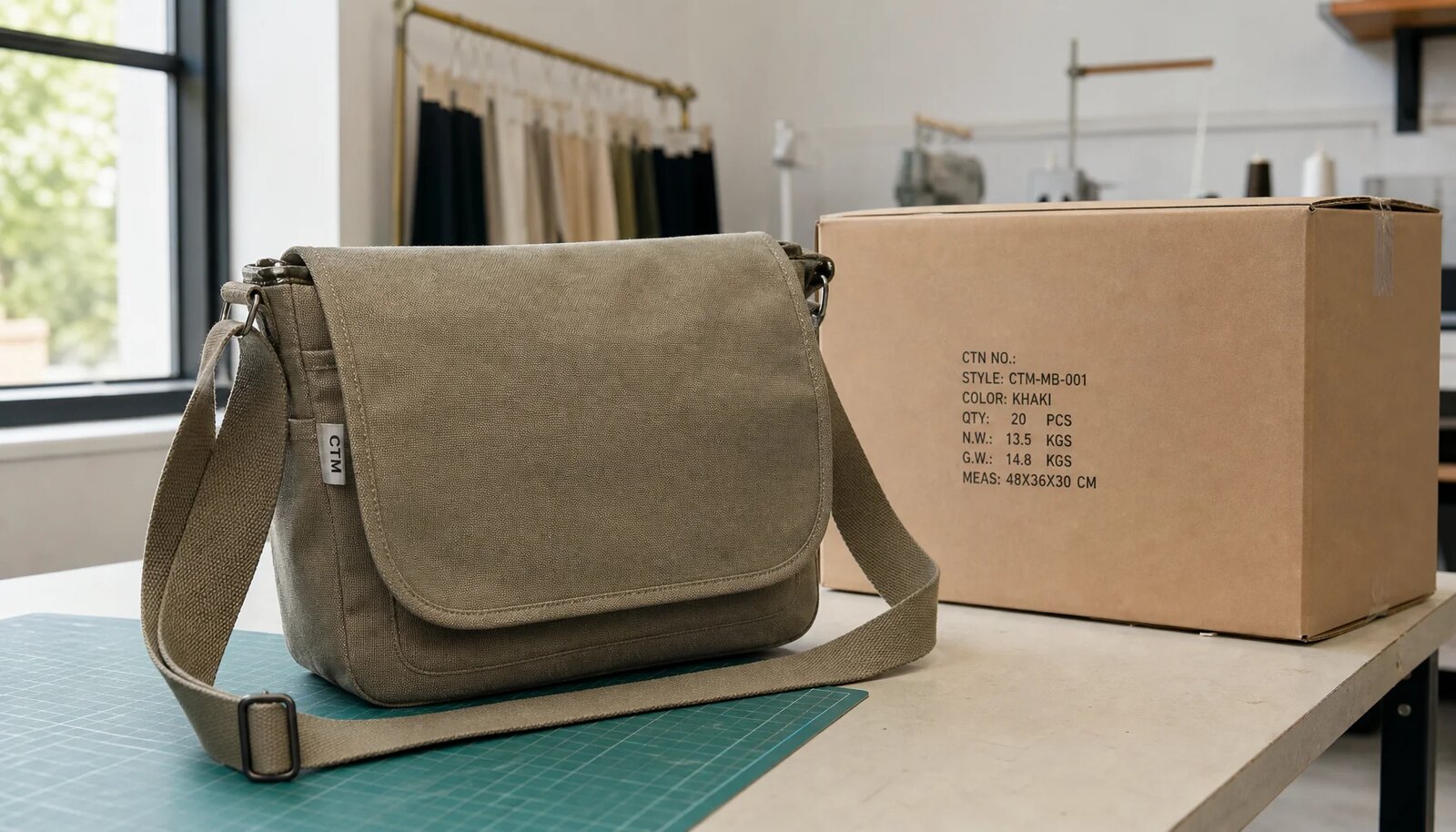
Map the Event Distribution Path Before You Specify the Bag
A custom canvas messenger bag order usually succeeds or fails before sewing starts. The deciding factor is often the distribution path, not the artwork. Event planners may ship to a convention center dock, a hotel back-of-house team, a sponsor fulfillment partner, a 3PL, or a warehouse that re-sorts by city and date. Each path changes the right carton count, label format, pallet split, and presentation standard. If the receiving team has to reopen every master carton to identify the correct venue allocation or logo version, the packing plan is already working against the event.
Write the bag's job in operational terms before discussing price. What will go inside the messenger bag, who fills it, who unloads it, how long will cartons sit in storage, and does the attendee see the bag sealed or loose? A bag that carries brochures and a badge is not packed the same way as a bag that must hold a water bottle, charger, notebook, and sponsor samples. Procurement should also ask about dock appointments, no-pallet venues, elevator limits, and manual unload requirements. Those details shape the carton plan more than a marginal unit-price difference.
- Define the handoff point: factory to 3PL, direct to venue, or warehouse to final event site.
- State whether bags arrive empty, prefilled, retail-ready, or ready for a fast giveaway line.
- Confirm who will count cartons on arrival and how quickly they must verify quantities.
- Capture venue handling limits such as no forklift access, manual carry only, or strict dock windows.
- Separate operational requirements from branding preferences before asking suppliers to quote.
Turn the Brand Brief Into a Production Spec
A useful RFQ for custom canvas messenger bags cannot stop at front logo and approximate size. Buyers need finished width, height, depth, flap or zipper closure, pocket layout, strap construction, hardware finish, lining, and target loaded weight. Canvas weight is a major cost and packing driver. For lighter conference materials, 280-320 gsm canvas may be sufficient. For catalogs, gift kits, or reusable programs where the bag must feel sturdier, buyers often move toward 340-420 gsm. Every added component such as full lining, foam, zipper tape, thick webbing, or metal adjusters increases folded thickness and carton cube.
The second part of the spec is substitution control. Decide what may vary and what may not. Some buyers allow a thread shade adjustment if the overall look remains clean. Most do not want silent changes to strap width, GSM, closure type, or hardware quality. Set measurable tolerances for body dimensions, strap drop, print placement, and acceptable shade variance. If the supplier is free to reinterpret those points, quotes become impossible to compare fairly. Clear specifications also make final inspection objective because the inspector can measure against a written standard rather than a vague expectation.
- List body dimensions and gusset depth in finished form, not only flat panel size.
- Specify strap width, strap material, adjuster type, and minimum reinforcement method.
- Call out whether lining, inside pockets, padding, or zipper closures are required or optional.
- State canvas range in GSM or ounce weight and name any non-negotiable trim quality points.
- Define dimensional and placement tolerances before sample approval starts.
Choose Decoration With Folding, Durability, and Sponsor Branding in Mind
Decoration changes both appearance and packing behavior. Screen print is usually the most practical choice for flat artwork on canvas because setup is predictable and the surface stays relatively flat in a master carton. Embroidery gives a more textured and premium result, but the stitched area creates bulk and can press against adjacent bags if pack density is too high. Heat transfer or digital transfer can reproduce fine detail and gradients, yet those methods are less forgiving if the bag is sharply folded or exposed to heat during transit. Woven labels and sewn patches are often useful where buyers want clean branding with lower ink-variation risk.
For event planner programs with multiple sponsors, the bigger risk is not just decoration cost but approval discipline. Artwork should be specified by distance from seams, pockets, flap edges, and top edge, not by a loose visual mockup alone. The factory needs placement coordinates, print size, and color references that survive the move from artwork file to sewn product. If logos sit across a flap fold, near a side seam, or on top of a pocket, request a sewn sample rather than approving artwork on a flat panel. That avoids late rework when the printed layout looks different once the bag is assembled.
- Use screen print for simple, flat graphics and stronger unit economics at scale.
- Use embroidery or sewn patches when brand texture matters more than carton efficiency.
- Use transfer methods only when image detail justifies tighter folding and heat-control requirements.
- Provide Pantone references and seam-based placement dimensions for every logo location.
- Decide early which marks belong on the body, side label, flap, or inside panel for sponsor-heavy programs.
Build the Carton Packing Plan From Real Measurements
Carton planning starts after the folded sample exists. The correct unit count depends on folded length, width, thickness, unit weight, and the bulk added by polybags, insert cards, labels, and tissue. Ask the supplier to measure the packed sample and show the carton math they used. Gross carton weight should include the bag, any inner packing, the master carton, and tape. Many buyers try to stay around 10-15 kg gross for cartons that will be handled manually at venues, although local safety policy and receiving practice should set the final limit. Counting in inner bundle increments such as 5 or 10 often makes arrival checks faster.
Board strength and carton cube deserve the same attention as units per carton. Terms such as export carton are too vague for procurement. Ask for the board grade or ECT or burst rating, wall construction, and whether the factory will use an inner liner bag or desiccant for humid or sea-freight routes. Single-SKU cartons are usually safer because they reduce recount time and labeling confusion. Mixed cartons only make sense when the event program truly needs pre-assorted allocations and the label system is reliable. If pallets are required, confirm pallet height, overhang, and carton orientation before bulk packing begins.
- Carton math inputs should include folded unit size, unit weight, protective materials, and target gross weight.
- Ask for the proposed carton dimensions and estimated freight cube before awarding the PO.
- Use bundle counts such as 5 or 10 when venue teams need rapid spot counts at receiving.
- Request board grade or ECT details rather than accepting a generic export-carton description.
- Confirm whether cartons must be palletized, floor-loaded, moisture-protected, or destination-sorted.
Plan Inner Packing, Inserts, and Carton Labels for Venue Receiving
Inner packing is often treated as minor, but it directly affects labor, cube, and presentation. Individual polybags protect against dust and surface rub, yet they add plastic, hand-pack time, and extra disposal work for venue teams. Tissue wrap, belly bands, or a simple interleaf sheet can sometimes protect printed panels with less bulk. If messenger bags are prefilled with brochures, notebooks, or sponsor gifts, confirm whether those components are factory-supplied or buyer-supplied, who counts them, and how shortages are documented. Even a thin insert card changes folded thickness and may reduce units per carton.
Carton labels should be designed for operations, not just freight forwarding. A shipping mark helps cargo move through transport systems, but the venue team also needs plain-language information they can read quickly on a loading dock. Standard fields usually include PO, style, color, quantity, carton number, destination, and gross weight. Event programs often add city code, event date, booth or room number, and a local contact. If a warehouse or 3PL scans inbound cartons, specify barcode symbology, label size, and placement in the RFQ. A perfect label format is useless if it is hidden by stretch-wrap or placed on the wrong panel.
- Approve the exact fold direction, strap tuck, zipper position, and polybag opening direction.
- Decide whether insert cards, desiccants, tissue, or belly bands are required or unnecessary cost.
- Keep freight marks separate from venue-facing labels if two audiences need different information.
- Include carton number sequencing such as 1 of 40 to speed shortage checks on arrival.
- Confirm label placement so warehouse scanners and venue staff can read cartons without re-handling them.
Approve Samples That Reflect Bulk Production, Not Just Appearance
Sample approval should happen in stages with different purposes. A prototype proves shape and layout. A pre-production sample proves the real materials, decoration, and construction. A packed sample proves that the approved bag still looks right after folding and being placed in the proposed inner pack. Procurement should reject approvals based only on a stock-fabric mockup or an unfinished printed panel, because those shortcuts hide the exact issues that later create bulk disputes. For messenger bags, it is also worth loading the sample with realistic event contents to check strap-anchor behavior, flap alignment, and overall shape when used.
Use measurements and recorded photos during review. Confirm body width, height, depth, strap drop, pocket depth, logo distance from seams, hardware finish, and trim orientation. Open the packed sample and repack it to see whether the logo creases, the strap twists, or the zipper teeth press into the face panel. If the bag uses a side label or woven brand mark, inspect its sewing just as carefully as the main artwork because trim errors often slip through when teams focus only on the large logo. Keep one signed golden sample and one packed golden sample for final inspection reference.
- Request at least one packed sample made with the actual bulk fold and inner packing method.
- Check the bag both empty and loaded with representative event contents.
- Photograph measurements and decoration placement instead of relying on email descriptions only.
- Approve side labels, woven labels, and inside labels as production details, not afterthoughts.
- Hold golden samples for inspection, claims review, and repeat-order consistency.
Set Quality Control Gates From Fabric Arrival to Final Carton
Effective QC for custom canvas messenger bags is staged across the order, not compressed into a final glance before shipment. Incoming material checks should confirm canvas weight, weave consistency, fabric shade, webbing width, hardware finish, zipper quality, and label copy before cutting begins. Inline inspection should focus on stitch density, seam quality, flap and pocket alignment, reinforcement placement, and logo position while the line can still correct problems quickly. Final random inspection then verifies both product quality and packing accuracy. Many buyer teams use AQL 2.5 for major and 4.0 for minor as a starting point, then adjust based on brand exposure and internal policy.
Defect definitions should reflect real event risk. A small thread tail may be minor if it trims cleanly, but a missing bar-tack, broken buckle, wrong venue label, or carton count shortage is operationally major because it can interrupt distribution or cause attendee-facing failure. Final inspection should include random carton opening, label verification, carton count checks, moisture and odor checks, and simple functional testing such as zipper operation and loaded strap handling against the agreed use case. If you hire an independent inspector, give them the approved spec, defect list, and packed golden sample. A vague workmanship brief is not enough.
- Incoming QC should confirm material identity before cutting to prevent hidden substitutions.
- Inline QC should focus on stress points and decoration placement while corrections are still low cost.
- Final QC should inspect both the bag and the carton, not product only.
- Treat wrong label versions, short counts, and packing-plan deviations as major defects.
- Use written defect definitions so the factory and third-party inspector are grading the same standard.
Compare Supplier Models by Ownership of Critical Steps
Supplier selection should be based on who controls the steps that matter to your program, not only on who can make a sample quickly. Buyers need to know who owns fabric booking, trim sourcing, printing, sewing, kitting, final packing, labeling, and export documentation. A direct factory with in-house final packing often offers the cleanest accountability because one team controls finished count accuracy and carton marks. A trading company can still be effective when the event program combines several products, but only if ownership is transparent and subcontractors are disclosed. Split processes create more approval loops and more places for specifications to drift.
Ask suppliers to demonstrate process capability with evidence rather than broad promises. Useful evidence includes sample packing lists, carton photos, production-line photos, examples of destination labels, and an explanation of how counts are verified before cartons are sealed. Ask whether kitting is internal, whether print is done on-site or outside, and how approved artwork flows to the production floor. For event planners, the supplier that can clearly describe how cartons move from sewing line to finished-goods area to dispatch is often the safer choice than a lower bidder whose process sounds vague.
- Map who owns fabric, print, sewing, kitting, packing, inspection, and shipping documents.
- Ask for proof of prior carton labeling and count-control methods, not only product photos.
- Require subcontract disclosure for print, embroidery, kitting, or final hand packing.
- Treat packing-line ownership as a commercial issue because it directly affects count accuracy and delivery readiness.
- Score suppliers on process clarity, not just on sample speed or email responsiveness.
Analyze Quotes on Landed Cost, Operational Labor, and Failure Risk
The lowest unit quote is often not the lowest total program cost. Ask suppliers to separate bag body, decoration setup, recurring print cost, labels, inserts, polybags, master cartons, palletization, inspection, and any venue sorting or kitting labor. Then normalize every offer to the same incoterm before comparing. EXW, FOB, DDP, and local-delivery offers are not interchangeable until inland freight, export handling, customs costs where applicable, and destination services are visible. A supplier that looks higher on the sewing price alone may become cheaper overall if the carton plan reduces freight cube, relabeling, recount labor, and damage exposure.
Buyers should also price the cost of failure, not only the expected spend. Oversized cartons increase freight and storage footprint. Mixed cartons may save a small amount of cube but add hours of sorting at venue receiving. Weak label control can force emergency relabeling. Thin board stock can lead to carton crush and replacement shipments. The practical way to compare offers is to use a shared landed-cost worksheet with product cost, freight cube, receiving labor, inspection cost, and rework contingency. That keeps the decision grounded in procurement economics instead of treating the order like a simple commodity item.
- Request separate line items for decoration, packing, labels, cartons, and sample work.
- Normalize all quotations to the same incoterm before ranking suppliers.
- Include freight cube, warehouse handling, and recount labor in your comparison model.
- Watch for cheap quotes built on oversized cartons, downgraded board stock, or silent trim substitutions.
- Evaluate the financial impact of a late or mislabeled shipment, not only the nominal bag price.
Freeze the RFQ, Timeline, and Change Control Early
A strong RFQ for a custom canvas messenger bags carton packing plan for event planners should read like a production brief, not a shopping request. Include a dimensioned drawing, fabric range, color references, decoration method, seam-based logo placement, expected contents, fold direction, inner packing method, carton target, label template, destination, incoterm, and requested delivery date. If you want alternatives such as a different GSM or a no-polybag option, ask suppliers to quote those as separate options. That forces every vendor to price the same baseline job and makes technical differences visible instead of hidden inside assumptions.
Build the schedule backward from the event door date rather than forward from factory production time. Allow time for artwork approval, pre-production sample, packed sample, material booking, bulk sewing, final inspection, freight, customs if applicable, receiving, relabeling, and final dispatch to venue or city. Then define change control. If artwork, trim, carton marks, or destination allocations change after approval, who must re-quote, who signs off the revised lead time, and who owns obsolete packaging cost? Those rules are essential protection when sponsor logos change late or venue allocations move near ship date.
- Attach a technical drawing or measured sample reference to the RFQ.
- State all non-negotiables such as strap width, GSM range, closure type, and label format.
- Ask suppliers to quote approved options separately instead of making silent substitutions.
- Plan backward from event delivery, including inspection, receiving, and rework buffer.
- Document how late artwork or label changes affect cost, lead time, and approval ownership.
Specification comparison for buyers
| Spec decision | Recommended option | When it fits | Buyer risk to check |
|---|---|---|---|
| Direct factory with in-house cutting, sewing, and final packing | Best control when one supplier owns fabric booking, sample making, sewing, inspection, and carton packing | Recurring event programs with fixed delivery windows, repeat artwork, and stable carton counts | Confirm which steps are truly in-house, especially printing and kitting, and require subcontract disclosure in writing |
| Factory with in-house kitting and labeling | Strong choice when bags need insert cards, barcode labels, city sorting, or venue-specific pack-outs | Conference welcome kits, sponsor packs, and multi-destination launches | Verify the factory can control insert counts, label versions, and carton sequencing without using an outside hand-pack team |
| Trading company or sourcing agent | Useful when the buyer needs one contact for mixed products, mixed materials, or several factories | Lean procurement teams managing a broader event merchandise program | Layered margin and blurred ownership can hide who is accountable for wrong labels, short cartons, or late approvals |
| Overseas factory plus third-party inspection agent | Adds independent quality and count verification when the buyer has no local team | Compliance-heavy procurement or first orders with a new supplier | Inspection only works if the approved spec, defect list, and carton plan are frozen before bulk completion |
| Bag factory plus specialist decorator | Suitable when the bag body is straightforward but decoration is complex, multi-location, or premium | Sponsor-heavy branding, embroidery, patch work, or unusual print placement | Split ownership between sewing and decoration can create delays if artwork, seam placement, and fold direction are not aligned early |
| Factory plus local 3PL redistribution | Good when import is centralized but final delivery must be split by venue, city, or event date | Roadshows, multi-city conference series, and staggered dispatch calendars | Every extra touchpoint increases the risk of relabeling errors, recount labor, and carton damage after factory pack-out |
| Consolidation warehouse near port | Works when several PO batches or mixed SKUs must ship together under one freight plan | Programs with staggered production timing or mixed sponsor collateral | Cross-dock handling can mix lot numbers, crush cartons, or break pallet integrity if carton marks are weak |
| Domestic rush finisher or local decorator | Practical for emergency replenishment, sample remakes, or low-volume domestic runs | Last-minute event changes where speed matters more than import economics | Base bag quality, fabric consistency, and export-grade carton standards may be weaker than a specialist bag factory |
Buyer checklist before sampling
- Define the receiving path first: venue dock, 3PL, sponsor kit assembler, retail warehouse, or direct mail.
- State the bag's job in operational terms: giveaway, VIP welcome kit, staff issue, literature bag, or resale item.
- Specify finished width, height, depth, strap drop, webbing width, pocket layout, closure type, and hardware finish.
- Call out canvas GSM or ounce range, color reference, lining requirement, and which substitutions are allowed or not allowed.
- Provide decoration details: method, artwork file format, Pantone references, placement dimensions from seams, and max print size.
- List expected contents and approximate loaded weight so strap reinforcement and fold method match real use.
- Set the inner packing method: individual polybag, tissue, belly band, insert card, desiccant, or no inner packing.
- Define carton targets: units per carton, bundle count, gross weight ceiling, board grade or ECT requirement, and single-SKU or mixed-SKU rule.
- Specify carton marks, barcode format, carton numbering, destination labels, and pallet labeling if required by the warehouse or venue.
- Require a pre-production sample, a packed sample, and bulk packing photos before shipment release.
Factory quote questions to send
- What exact canvas construction are you quoting: GSM, weave, cotton content or blend if any, dye method, and finish?
- Which steps are in-house and which are subcontracted: dyeing, printing, embroidery, sewing, kitting, labeling, and final packing?
- What is the MOQ by bag color, logo version, and carton mark variation?
- Which decoration method do you recommend for this artwork and fold direction, and why?
- What finished folded size and unit weight are you using to calculate the carton plan?
- How many units per carton do you recommend, what are the master carton dimensions, and what is the estimated gross weight?
- What board grade or ECT or burst specification will you use for the master carton, and can you add a liner bag or desiccant if requested?
- Can you pack single-SKU cartons, venue-sorted cartons, or mixed cartons, and what labor upcharge applies to each option?
- What sample stages are included in your quotation: prototype, pre-production sample, carton-packed sample, and approval photos?
- What inspection standard do you use before shipment, what AQL level is typical, and can you share your final inspection template?
Quality-control points to confirm
- Finished dimensions should stay within the agreed tolerance for width, height, depth, pocket opening, and strap drop.
- Canvas GSM, hand feel, and weave should match the approved sample with no undeclared substitution to a lighter cloth.
- Fabric shade should match the approved reference with no obvious panel-to-panel mismatch on the same bag.
- Stitch density should be consistent, with no skipped stitches, open seams, seam grin, or loose thread tails at visible edges.
- Bar-tacks or equivalent reinforcements should be present and secure at strap anchors, flap corners, and pocket stress points.
- Hardware, webbing, buckles, zippers, and snaps should function smoothly, sit straight, and show no rust, chips, or sharp edges.
- Logo placement should stay within the agreed tolerance from seams and edges, and multi-logo layouts should match the approved art map.
- Print should be clean and properly cured, with no bleed, ghosting, cracking, scorch marks, or obvious color inconsistency.
- Fold direction, strap tuck, polybag orientation, and insert placement should match the approved packed sample.
- Barcode labels, carton marks, inner inserts, and carton numbering should match the packing list and destination file exactly.