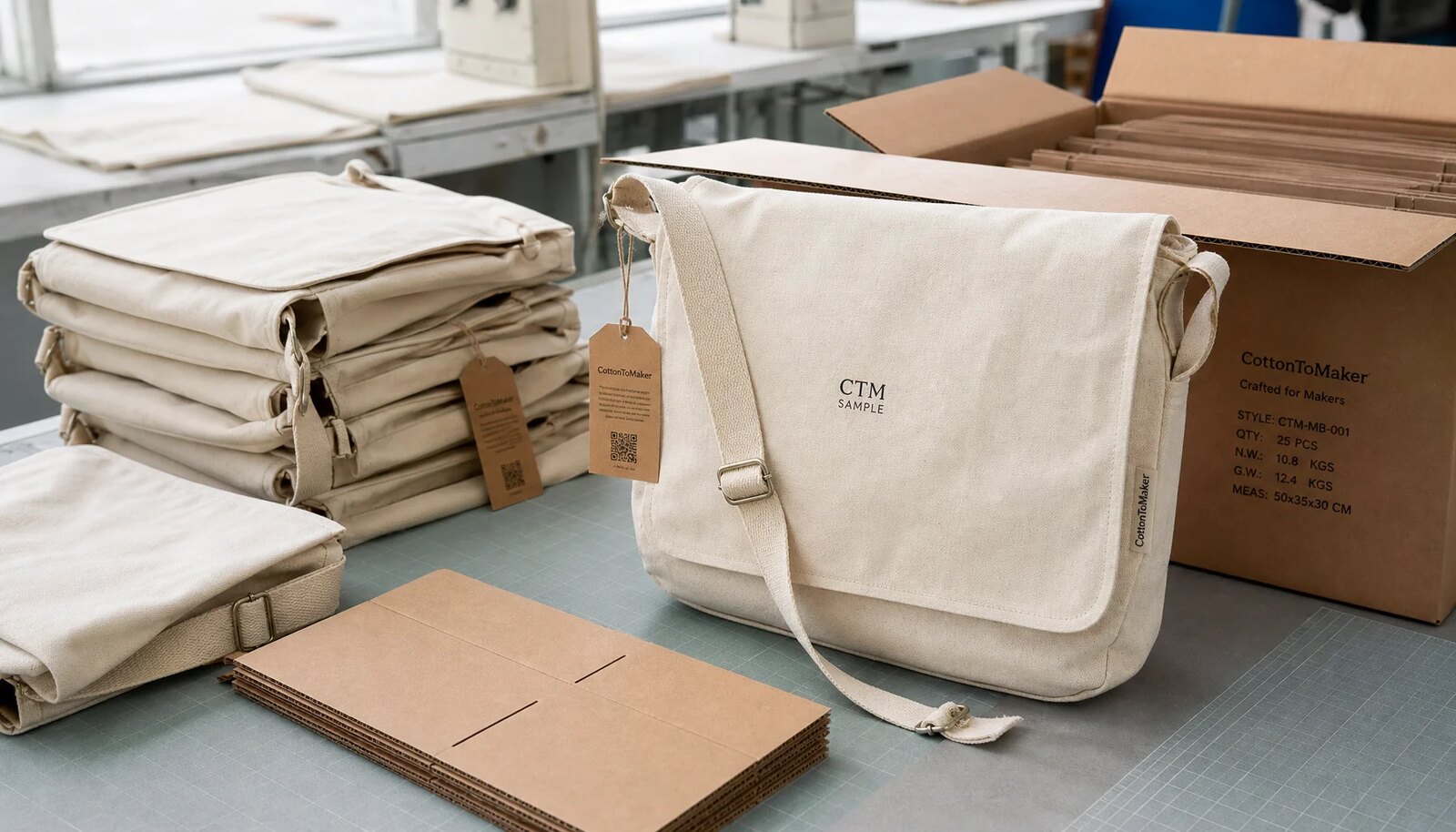
Start With the Carton, Not Just the Bag
For a custom canvas messenger bags carton packing plan for craft fairs, the carton is part of the product brief. Treat it that way from the first RFQ. A messenger bag is not a flat tote that can be stacked with little thought. It has a front flap, strap, gusset, closure, labels, and sometimes metal hardware. Each part can create pressure inside the carton. Fold the bag the wrong way and the logo may crease. Let the strap slider sit on the print and it may leave an embossed mark. Put a snap against the front flap and the damage may only appear when the event team opens the carton.
Carton planning also changes landed cost. One supplier may show the lowest unit price but use a bulky fold, weak carton, high inner-packing volume, or carton weights that are awkward for manual handling. Another quote may look slightly higher at the unit level yet save money through cleaner carton fill, fewer receiving errors, and less booth setup labor. For craft fair programs, saleable arrival condition matters. These bags may move from factory to forwarder, warehouse, van, venue corridor, temporary storage, and booth table before a customer ever sees them.
Ask for a bag-ready and carton-ready quote together. The quote should include pieces per carton, carton dimensions, gross weight, net weight, CBM, inner packing method, carton board type, carton mark format, sample method, and inspection checkpoints. If carton data is estimated, the supplier should label it as an estimate. Final approval should come after a packed sample, pilot carton, or at least open-carton packing photos that show the real fold and strap placement.
- Set maximum carton gross weight before quotation if cartons will be lifted by warehouse staff, courier drivers, or event teams.
- Require carton CBM per carton and carton CBM per 1000 pieces so freight comparison is not based on unit price alone.
- Ask for an open-carton layout photo, not only a sealed carton photo, to confirm strap placement and print protection.
- Review the printed flap after folding and compression, not only on a freshly pressed sample.
- Freeze folding method, inner packing, carton marks, and carton quantity before bulk packing materials are purchased.
Lock the Bag Specification Before Carton Math
Carton calculations are only reliable when the bag specification is stable. The RFQ should define finished width, height, bottom gusset, side gusset if any, flap length, flap overlap, strap width, adjustable strap range, closure position, label position, and print location. Words such as medium, standard, or craft fair shoulder bag leave too much room for interpretation. A 35 x 28 x 8 cm messenger bag with a 4 cm adjustable webbing strap packs very differently from a slim document satchel with no gusset.
State canvas weight in both oz and GSM. In many sourcing conversations, 10 oz cotton canvas is roughly 300-340 GSM, 12 oz is roughly 380-410 GSM, and 14 oz is roughly 430-470 GSM. The exact number still depends on mill, weave, finish, and moisture. Do not rely on marketing terms such as heavy canvas. Ask for a fabric test record or a weighed cut-panel check before cutting. If fabric is custom dyed, pigment washed, or pre-shrunk, confirm shade approval timing and shrinkage expectations before signing the production schedule.
Construction changes carton fill quickly. Reinforced strap joints improve durability but add thickness. Magnetic snaps can mark printed flaps if they sit under pressure. Padded straps, metal sliders, and wide cotton webbing all increase bulk. Even a small change to gusset depth can shift carton quantity. A clear technical drawing keeps suppliers quoting the same product and prevents last-minute packing surprises.
- Use a finished-size drawing with dimensions for body, flap, gusset, strap, closure, print, and labels.
- Set sewn product tolerances in the PO, commonly +/-0.5 cm for main body dimensions and +/-1 cm for strap or flap length unless sampling proves tighter control.
- Specify the intended carrying load, such as light event collateral, retail merchandise, or heavier seller kits.
- For dyed canvas, allow time for lab dip approval, bulk shade review, crocking checks, and shrinkage confirmation.
- Recalculate carton estimates if canvas weight, strap width, closure type, gusset depth, or flap length changes after sampling.
Protect the Front-Flap Print
The front flap usually carries the main branding for craft fair messenger bags. It faces outward when the bag is worn, hung, stacked, or displayed on a booth table. That makes print protection a carton issue, not only a decoration issue. Screen print is often practical for one-color and two-color logos on cotton canvas because setup and repeatability are manageable at B2B quantities. Heat transfer can handle more detailed artwork, but buyers should test handfeel, edge lift, cracking, and adhesion after folding. Digital print may support gradients or multicolor work, though it can change cost, texture, curing, and packing needs.
Write the print specification in measurable terms. Include vector artwork, print dimensions, distance from flap edges, Pantone references or approved color standards, number of colors, underbase requirement if any, and acceptable placement tolerance. For sewn canvas bags, +/-0.5 cm print placement tolerance is often more realistic than perfect alignment. Approve color on the actual canvas, not just on a digital proof. Natural, bleached, black dyed, and washed canvas all affect how ink appears.
Then test the fold. A large solid logo across the main fold line may show fold memory. Under-cured ink may transfer when printed panels touch under pressure. Hardware, tag eyelets, strap sliders, and barcode labels can scuff or dent the print. During sample approval, look at the flap after the planned fold and compression. Freshly pressed samples can hide problems that appear only after 24 hours in a packed stack.
- Keep large solid artwork away from the main fold line where the branding layout allows.
- Approve ink color and coverage on bulk-equivalent canvas, especially for natural or dark dyed fabrics.
- Require curing or heat-setting details and avoid packing printed panels before the ink is ready for compression.
- Use tissue, release paper, or alternate stacking when printed flaps face hardware, sliders, snaps, tags, or other printed panels.
- Check print after packed-condition simulation for transfer, scuffing, cracking, ghosting, pinholes, and pressure marks.
Build MOQ Around Components and Artwork
MOQ for custom canvas messenger bags is not only about sewing time. Fabric sourcing, cutting yield, printing screens, strap material, hardware finish, woven labels, hangtags, barcode stickers, carton marks, and packing labor all shape the real minimum. A stock natural canvas bag with one screen print color and bundled packing is much easier to batch than a program with custom dyed fabric, custom strap colors, metal hardware, woven labels, individual barcode polybags, and ten artwork versions.
Separate MOQ per fabric color from MOQ per artwork. A supplier may accept 1000 pieces total, but ten designs at 100 pieces each can create ten screens, ten print setups, ten allocation groups, more inspection records, and a higher mixed-carton risk. If craft fair teams need exact artwork quantities for specific destinations, share the allocation sheet before packing starts. Otherwise the factory may pack for production efficiency, not event receiving accuracy.
Use a quote matrix instead of one blended price. Ask for 500, 1000, 3000, and 5000 piece breaks using the same material, construction, print, and packing method. Request separate lines for screen charges, sample charges, label setup, hangtags, barcode labels, and special packing. This avoids a common mistake: comparing a simple bulk-packed quote with a retail-ready quote and assuming the unit prices mean the same thing.
- Ask for MOQ by fabric color, strap color, artwork, hardware finish, woven label, hangtag, and carton mark group.
- Separate one-time artwork and screen charges from repeat-order unit pricing.
- Confirm whether small artwork runs can be packed as one SKU per carton or must be mixed into master cartons.
- State acceptable overage or shortage tolerance when craft fair allocation quantities must be exact.
- Reduce artwork count or consolidate base colors if the order needs lower cost and cleaner carton control.
Set Carton Quantity by Weight and Route
For many 12 oz canvas messenger bags, 20-40 pieces per export carton is a sensible starting range. It is not a rule. Finished size, gusset depth, strap bulk, closure type, canvas weight, folding method, inner packing, and carton strength all influence the final count. A slim lightweight bag may fit more pieces. A 14 oz gusseted bag with metal hardware and a wide strap may need fewer pieces to prevent crushed flaps and distorted gussets.
Gross weight needs its own limit. Many buyers target about 15-18 kg for manually handled cartons, but the correct number should follow warehouse policy, courier rules, workplace safety requirements, and event setup conditions. Craft fair cartons may be lifted from pallets, carried through venue corridors, loaded into vans, stacked behind booths, and opened during a tight setup window. A carton that looks efficient for ocean freight may be poor for the people who must move it at the venue.
Specify carton construction rather than assuming the factory will choose the right box. Export cartons should resist corner crushing, tape failure, moisture exposure, and stacking pressure. Ask for carton dimensions, board type, tape method, and whether cartons will be palletized or shipped loose. If cartons travel by courier or pass through several handling points, stronger board and clearer marks may cost less than replacing damaged goods.
- Validate pieces per carton with a packed sample or pilot carton before approving bulk packing.
- Compare suppliers by carton CBM per 1000 pieces and gross weight per carton, not only by pieces per carton.
- Check open-carton layout for consistent folding, strap placement, void space, print protection, and carton fill height.
- Specify whether cartons will be palletized, courier shipped, loose loaded, cross-docked, or split by event destination.
- Reject carton plans that exceed handling limits or crush the flap, gusset, strap, closure, or printed branding area.
Choose Inner Packing for Receiving
Inner packing should match the way the bags move after production. Individual polybags protect each bag from dust, abrasion, and handling during split picking. They are useful for retail distribution, e-commerce replenishment, unit barcode scanning, and storage where cartons may be opened and reworked. The downside is clear: more material, more labor, more carton volume, and more waste at unpacking.
Bundled packing can work better for craft fair teams. Five-piece or ten-piece bundles with kraft bands, paper sleeves, or tissue between printed flaps can reduce plastic and speed counting. The trade-off is lower unit protection. If printed panels touch each other, or hardware sits against the logo, transfer and pressure marks become more likely. For ocean freight or humid storage, paper-only packing may also require carton lining, desiccant discussion, or other moisture-control steps.
Make inner packing a priced specification. Do not leave the factory to decide between polybags, bundles, tissue, or loose packing after the quote is approved. Each method affects unit price, carton CBM, carton quantity, inspection approach, receiving labor, sustainability claims, and disposal at the event.
- Use individual recycled polybags when bags need unit barcode scanning, split picking, retail storage, or longer open-carton handling.
- Use 5-piece or 10-piece bundles when full cartons go directly to craft fair booths or workshop teams.
- Specify polybag size and gauge, recycled content claim support, suffocation warning if needed, barcode label position, and sealing method.
- Specify tissue or release paper size when printed flaps face another bag, snap, slider, tag, or strap.
- Quote inner packing as a separate line item so cost, waste, and CBM trade-offs are visible.
Control Carton Marks and Allocation
Carton marks are an operational control. They are not decoration. Craft fair programs often include seasonal artwork, city-specific designs, retailer accounts, booth kits, or regional shipments. If cartons carry only a generic product name, receiving teams must open boxes to find the right design. That adds labor, creates repacking risk, and can send the wrong artwork to the wrong event.
A useful carton mark includes purchase order number, SKU, artwork code, bag color, size, quantity, carton number, total carton count, gross weight, net weight, carton dimensions, and destination or event code when cartons are pre-allocated. If country of origin, importer information, compliance markings, or barcode carton labels are required, provide the template before packing. Do not ask the factory to recreate carton marks from memory after cartons are sealed.
One SKU per carton is usually the cleanest structure for distributor receiving and event allocation. Mixed cartons can make sense for small order quantities, but only when the composition is controlled. If mixed cartons are approved, define the exact SKU count, inner bundle labels, and carton sequence before final packing starts.
- Provide a carton mark template before production, not after cartons are sealed.
- Use one SKU per carton when receiving accuracy is more important than maximum carton fill.
- If mixed cartons are unavoidable, require inner bundle labels and a packing list showing exact SKU quantities per carton.
- Verify carton marks against the PO, artwork allocation sheet, packing list, and inspection report.
- Freeze destination codes and carton sequences before packing to avoid relabeling, reopening cartons, or shipment delay.
Approve Samples With Packing Simulation
A pre-production sample should prove both the bag and the packing method. It should use bulk-equivalent canvas, the approved print method, final strap, final closure, final labels, final hangtags, and the proposed folding method. If the sample uses substitute fabric, temporary hardware, or a different strap, the carton quantity and pressure risks may not represent bulk production.
Review the sample twice: first when it is freshly opened, then after packed-condition simulation. The supplier can fold the bag according to the planned method, place it in the intended inner packing, compress it in a carton-like stack, and open it for review. Check flap crease, print transfer, strap marks, hardware dents, odor, loose threads, lint, ease of reshaping, and display appearance. This matters most for large flap logos, dark dyed canvas, metal closures, wide straps, and plastic-free bundled packing.
Keep the approval record practical. Include measurements, photos, and the folding sequence. Production sewing teams, packing workers, and inspectors need the same reference. If the buyer changes inner packing after sample approval, the supplier should recheck carton quantity, carton dimensions, gross weight, CBM, and cost before bulk packing begins.
- Measure the sample after sewing and again after unfolding from packed condition to evaluate fold recovery.
- Photograph the approved folding sequence, strap placement, tissue placement, label position, and carton layout.
- Keep one approved sample as the inspection standard and mark it clearly by date, PO, SKU, and revision.
- Require a revised carton plan when fabric weight, closure, strap, print size, hangtag, or packing method changes.
- Approve pilot carton photos before full packing on first orders or multi-artwork programs.
Use Messenger-Bag-Specific QC
Messenger bag inspection needs more detail than a tote bag checklist. A tote check may focus on body size, handle length, and print. A messenger bag also needs flap alignment, closure matching, strap adjustability, gusset shape, reinforced load points, and hardware pressure control. These features affect function and display quality at craft fairs.
Classify defects before production. Critical defects may include unsafe sharp hardware, mold, strong chemical odor, or an incorrect product that cannot be sold. Major defects may include wrong artwork, severe print shift, broken closure, weak strap joint, large stain, incorrect carton quantity, or carton mark mismatch. Minor defects may include small loose threads, light wrinkles, or slight shade variation within the approved range. Clear defect classes make inspection decisions less emotional and easier to resolve with the supplier.
Inspection should cover both product and carton. Product sampling should measure dimensions, print location, stitching, strap adjustment, closure function, cleanliness, odor, and match to the approved sample. Carton sampling should verify quantity, open-carton layout, inner packing, carton dimensions, gross weight, net weight, carton sequence, carton marks, and packing list accuracy. For first orders, request representative inspection photos for every artwork SKU.
- Check flap alignment with the bag closed, not only when the bag is laid flat.
- Check strap joints for approved bar tack, box stitch, or X-box reinforcement and no skipped stitches at stress points.
- Check closure alignment, pull function, edge safety, plating consistency, and pressure marks after packing.
- Check print after compression for transfer, smearing, scuffing, pinholes, cracking, and position shift beyond tolerance.
- Check carton marks and carton counts against the allocation sheet before goods leave the factory.
Compare Quotes by Landed Cost
A complete quote should make landed-cost comparison possible. Buyers need unit price, sample charge, screen or setup charge, MOQ, price breaks, packing method, pieces per carton, carton dimensions, gross weight, net weight, CBM, total carton count, lead time, trade term, payment term, and quote validity. Without carton dimensions and weight, freight estimates are incomplete. Without separated setup charges, repeat-order pricing is unclear.
Normalize trade terms before comparing suppliers. EXW, FOB, CIF, DDP, and delivered warehouse prices include different responsibilities and cost layers. A low EXW price may lose its advantage after local transport, export handling, customs clearance, freight, duties, and final delivery are added. Carton CBM per 1000 pieces is especially useful because messenger bags vary widely in folded volume depending on gusset, strap, hardware, and inner packing.
Break schedule risk into milestones. Useful checkpoints include artwork approval, lab dip or fabric approval, sample making, sample transit, sample approval, fabric purchase, cutting, printing, curing, sewing, trimming, packing, inspection, and export booking. Craft fair dates do not move easily. The production calendar should show when artwork, fabric color, carton marks, and packing method become frozen. Late barcode labels, changed destination codes, or revised inner packing can delay shipment just as much as a sewing issue.
- Ask for price breaks at identical specifications and identical packing methods so supplier comparison is fair.
- Compare carton CBM per 1000 pieces, carton gross weight, and total carton count by SKU.
- Separate first-order charges from repeat-order unit costs, including screens, labels, samples, and carton label setup.
- Schedule final inspection after packing is complete but before goods leave the factory.
- Request milestone photos for fabric, print strike-off, first sewn pieces, pilot carton, packed cartons, and inspection readiness.
Specification comparison for buyers
| Spec or packing decision | B2B recommendation | Useful tolerance or figure | Procurement risk to control |
|---|---|---|---|
| Canvas weight | Quote by both oz and GSM; common options are 10 oz about 300-340 GSM, 12 oz about 380-410 GSM, and 14 oz about 430-470 GSM. | Confirm by fabric test report or weighed cut panel before cutting; record shrinkage after washing or finishing if applicable. | Oz names vary by mill and finish. Low GSM can collapse after unpacking; heavy canvas adds freight weight, seam bulk, needle marks, and fold memory. |
| Finished bag size | Define width, height, bottom gusset, side gusset if any, flap length, flap overlap, strap width, and adjustable strap range. | Typical sewn textile tolerance: +/-0.5 cm for main body dimensions and +/-1 cm for flap or strap position, unless the PO sets tighter limits. | Suppliers may quote different capacities under one size name if the drawing does not show gusset, flap overlap, and strap path. |
| Strap and reinforcement | Use cotton webbing or canvas strap with bar tack, box stitch, or X-box reinforcement at load points. | Specify strap width, commonly 3-5 cm, and target functional load for inspection, such as 5 kg or 8 kg depending on intended use. | Weak strap joints create more complaints than minor fabric wrinkles. Overbuilt joints add bulk and can reduce carton quantity. |
| Print method | Use screen print for one- or two-color logos; assess heat transfer or digital print only when artwork complexity requires it. | Set print placement tolerance, often +/-0.5 cm on the flap; require cured ink before folding and packing. | Large solid prints, under-cured ink, and printed panels touching hardware can cause transfer, scuffing, or pressure marks. |
| Closure and hardware | Specify magnetic snap, metal snap, hook-and-loop, or no closure with finish, placement, pull strength expectation, and corrosion requirement. | Check alignment, edge safety, and function on every inspection sample; use protective placement or tissue where hardware touches print. | Unspecified hardware can vary in plating, pull force, rust resistance, thickness, and carton pressure marking. |
| Carton quantity | Start testing at 20-40 pcs per export carton for many 12 oz messenger bags, then validate by packed sample. | Keep carton gross weight within buyer handling rules; many teams target 15-18 kg for manual handling, but internal policy should decide. | Overpacking can crease flaps, deform gussets, emboss straps, burst cartons, or create cartons too heavy for event staff. |
| Inner packing | Choose individual recycled polybags, 5-piece bundles, 10-piece bundles, kraft bands, or tissue interleaving based on the receiving route. | Specify polybag gauge, barcode label position, tissue size, bundle count, and whether printed panels may touch. | Too little protection causes ink transfer and abrasion; too much retail packing increases cost, CBM, waste, and booth unpacking time. |
| Carton marks | Use a carton mark template with PO, SKU, artwork code, color, size, quantity, carton number, gross weight, net weight, dimensions, and destination code. | Match carton marks to the final packing list and inspection record; one SKU per carton is safest for allocation. | Generic marks slow receiving and can send the wrong artwork to the wrong craft fair booth, retailer, or distributor branch. |
| MOQ and artwork batching | Separate MOQ by base fabric color, strap color, hardware finish, artwork, label, and carton mark group. | Ask for price breaks at 500, 1000, 3000, and 5000 pcs using the same specification and packing plan. | Many small artwork runs create extra screens, sorting labor, carton labels, inspection steps, and mixed-carton risk. |
Buyer checklist before sampling
- Issue a technical drawing showing finished width, height, bottom gusset, flap length, flap overlap, strap width, strap length range, closure position, label position, and print position.
- State canvas weight in oz and GSM, fabric color, weave expectation, finish, shrinkage requirement, and whether the fabric is stock, custom dyed, washed, or pre-shrunk.
- Define buyer compliance requirements before quoting, including restricted substances, azo dye limits, formaldehyde limits, recycled content claims, organic cotton claims, or country-of-origin labeling.
- Attach artwork files with print size, print location, Pantone references, number of colors, underbase requirement if any, and placement tolerance for each artwork SKU.
- Set practical tolerances in the PO, such as +/-0.5 cm for main body dimensions, +/-1 cm for strap length, +/-0.5 cm for print position, and agreed color tolerance against approved standard.
- Confirm reinforcement method at strap joints, flap corners, gusset seams, closure points, and high-stress corners before sample approval.
- Choose individual packing, 5-piece bundles, 10-piece bundles, or no unit packaging, then specify tissue, release paper, kraft bands, barcode labels, hangtags, and plastic-reduction rules.
- Set maximum carton gross weight, maximum carton dimensions, carton board requirement, tape method, pallet requirements, and whether cartons will be courier shipped, palletized, or handled by craft fair staff.
- Request quote data for unit price, MOQ by color and artwork, setup charge, sample charge, pieces per carton, carton dimensions, CBM, gross weight, net weight, lead time, trade term, and payment terms.
- Provide carton mark artwork or a carton mark template before packing, including PO number, SKU, artwork code, bag color, quantity, carton sequence, destination, and any barcode carton label.
Factory quote questions to send
- Which canvas weight are you quoting in oz and GSM, and how will you verify it before cutting: mill record, internal test, or weighed panel sample?
- Is the quoted fabric stock, custom woven, custom dyed, pigment dyed, washed, or pre-shrunk, and what shrinkage tolerance applies before and after sewing?
- What finished size tolerance applies to body width, height, gusset depth, flap length, flap overlap, strap width, print position, and adjustable strap length?
- What reinforcement is included at strap joints, flap corners, gusset seams, and closure points, and can you provide close-up photos of the stitch type planned for this order?
- Which print method is included, how many colors are included, what ink system is used, how is curing controlled, and what screen or setup charge applies per artwork?
- What print placement tolerance and color tolerance will you accept against the approved sample or Pantone reference on actual bulk canvas?
- How many pieces fit in one export carton using the proposed folding method, and what are the carton dimensions, gross weight, net weight, and CBM per carton?
- Is the carton quantity based on a real packed sample, a previous similar order, or an estimate, and can you send open-carton photos before bulk packing?
- Does the quoted price include individual polybags, recycled polybags, kraft bands, tissue paper, hangtags, barcode labels, carton marks, desiccant if needed, and export cartons?
- What carton board type, bursting strength or edge crush specification if available, tape method, and moisture protection are included for export shipment?
Quality-control points to confirm
- Canvas weight should be verified from a fabric test record or cut-panel weight calculation, not only from a catalog label such as 10 oz, 12 oz, or heavy canvas.
- Fabric color should be checked against the approved swatch or lab dip under consistent lighting, especially for natural, bleached, black dyed, pigment dyed, and washed canvas.
- Finished dimensions should remain within the agreed PO tolerance, commonly +/-0.5 cm for main body dimensions and +/-1 cm for strap length or flap length unless tighter limits are approved in sampling.
- Flap alignment should be checked with the bag closed; skewed flaps, uneven overlap, and closure mismatch are major visual defects for messenger bags displayed at craft fairs.
- Front flap print should be centered within the agreed tolerance and free from major pinholes, smearing, ghosting, registration shift, uneven coverage, color mismatch, cracking, or ink transfer after packing simulation.
- Printed panels should be reviewed after folding and compression; reject packing methods that emboss the strap, snap, slider, hangtag, or seam allowance into the visible logo area.
- Stress points at strap joints, flap corners, closure positions, and gusset seams should use the approved bar tack, box stitch, X-box, or reinforced stitching and show no skipped stitches, loose threads, or seam slippage.
- Hardware should be aligned, securely fixed, free of rust, burrs, sharp edges, plating inconsistency, and excessive pressure marks after cartons are packed.
- Straps should adjust smoothly, lie flat without severe twisting, and be tucked or protected so webbing and sliders do not deform the printed flap or crease the gusset.
- Cleanliness should include checks for stains, oil marks, loose threads, lint, strong odor, mold risk, and visible chalk or marking residue on natural canvas.