Define the Bookstore Buying Case First
A university bookstore bag order usually has several decision makers. Procurement cares about unit price, payment terms, supplier reliability, and delivery risk. Store operations care about shelf presentation, barcode handling, carton labels, and receiving labor. Licensing or brand management may review logo color, trademark use, and department lockups. A useful bulk pricing plan starts by naming the program and the approval path before asking factories for prices.
The same canvas messenger bag can serve different campus needs, but each use case points to a different build. A paid retail SKU needs consistent stitching, clean shade, durable strap attachment, scannable labels, and tidy packing. An orientation giveaway may accept lighter canvas, simpler pockets, and bulk-friendly cartons. Alumni or donor gifts may justify heavier fabric, metal hardware, embroidery, or a woven label. If the RFQ only says custom messenger bag, suppliers will fill in the blanks and quotes will not compare cleanly.
Write a short buying brief before requesting tiers. Include target user, target retail price or landed-cost ceiling, required arrival date, artwork approval steps, receiving rules, and reorder expectations. Also state the expected load. A light event bag does not need the same strap width, gusset depth, or reinforcement as a bag intended for notebooks, a tablet, and daily campus use.
- For bookstore resale, prioritize retail finish, shade consistency, barcode accuracy, and shelf appearance.
- For orientation distribution, prioritize delivery reliability, low unit cost, and fast carton handling.
- For alumni or donor gifts, prioritize upgraded hand feel, subtle branding, stronger hardware, and sample control.
- For department merchandise, keep the base bag common and change only artwork, label, or print placement.
- For distributor stock, document repeat-order rules for pattern, fabric, hardware, decoration files, and packing.
Turn Retail Goals Into Specifications
Bulk pricing is useful only when every supplier quotes the same bag. A complete specification should cover finished dimensions, flap coverage, gusset depth, fabric weight, lining, strap construction, hardware, pockets, reinforcement, decoration, labels, packing, and tolerances. Without this detail, one quote may price a retail-ready bag while another prices a lighter promotional version.
Start with size and function. Larger dimensions increase fabric consumption, cutting time, sewing time, folding bulk, carton volume, and freight weight. A deeper gusset adds capacity but creates more seams and inspection points at the gusset turns. Flap depth also affects cost and quality: too shallow can look unfinished, while too long adds fabric and increases decoration flex.
The strap is a major perceived-value point. For light promotions, simple cotton webbing may be enough. For paid bookstore retail, specify strap width, adjustment range, attachment method, and reinforcement. A 3.8 cm or 5 cm cotton webbing strap typically feels more substantial than a narrow strap when carrying books. Adjustable straps require sliders, buckles, or D-rings, so ask for material and finish details such as antique brass, nickel, black painted, or matte hardware.
- Specify finished width, height, gusset, flap depth, strap width, strap length range, and pocket measurements.
- State whether the bag is unlined, self-lined, cotton-lined, or made with a separate inner fabric.
- Define the strap as fixed, adjustable, detachable, padded, or simple cotton webbing.
- Identify hardware material and finish for sliders, snaps, rivets, magnetic closures, buckles, or D-rings.
- Confirm reinforcement at strap anchors, flap corners, bottom corners, gusset seams, and pocket openings.
Choose Canvas Weight and Finish
Fabric is one of the largest visible cost drivers in a canvas messenger bag. Ask suppliers to state both ounce weight and GSM. As a planning reference, 10oz canvas is often around 340 GSM, 12oz around 407 GSM, and 14oz around 475 GSM. Exact values vary by yarn, weave, moisture, and finishing, so the quote should state tolerance and whether GSM is measured before or after washing, dyeing, or other finishing.
For many university bookstore programs, 12oz canvas is a strong starting point because it provides more structure than light promotional canvas without making the bag overly heavy. A 10oz version can work for orientation kits, club bundles, and budget promotions. A 14oz version fits premium retail or alumni gifting, but it usually increases material cost, sewing resistance at thick seam intersections, carton weight, and sometimes production time.
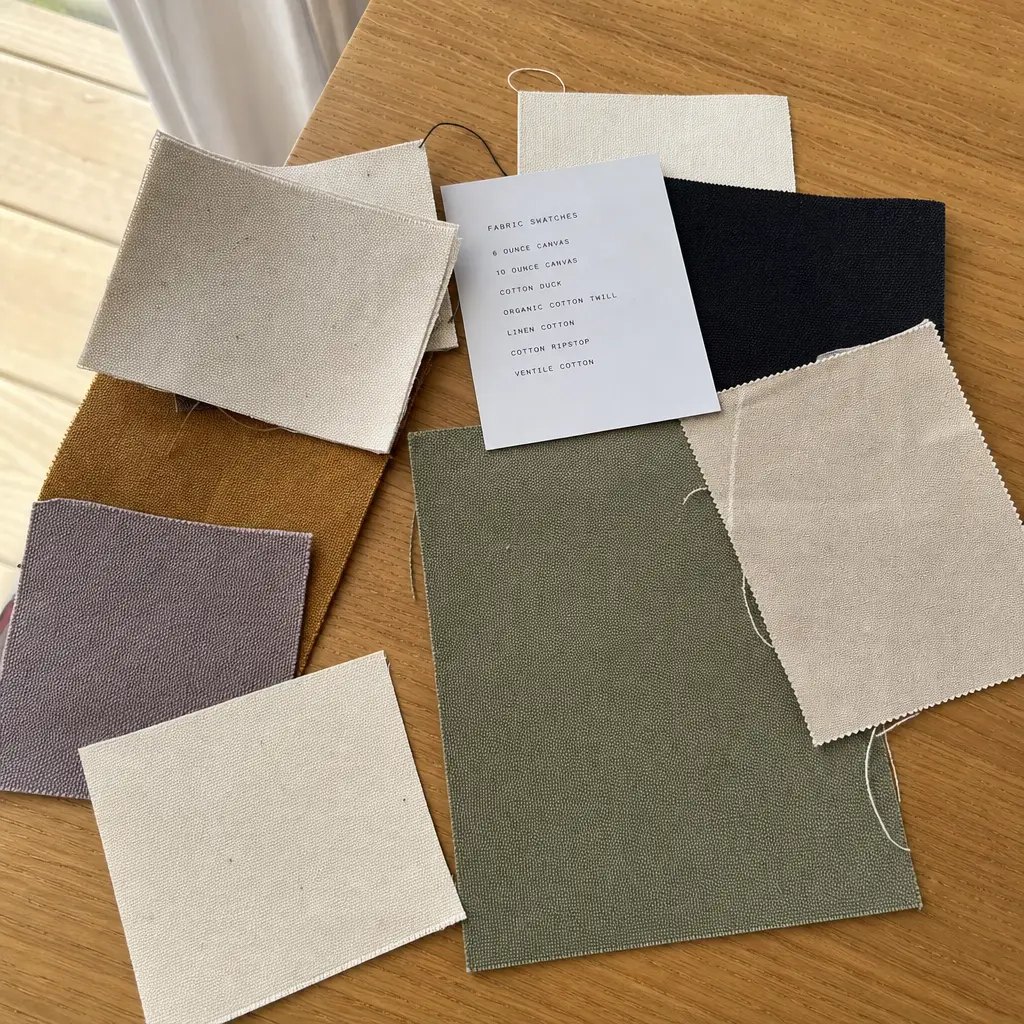
Finish changes both price and inspection. Natural canvas has a classic campus merchandise look and may show cotton flecks that are normal for the material. Dyed canvas adds shade control and colorfastness risk. Washed canvas feels softer but can affect finished measurements. Greige canvas, stock dyed canvas, custom Pantone dyed canvas, organic cotton, and recycled cotton blends should be quoted as separate material options, not treated as interchangeable names.
- Quote canvas by oz and GSM, not by the word canvas alone.
- State fabric finish: natural, greige, dyed, washed, stock color, custom dyed, organic cotton, or recycled blend.
- Agree a GSM tolerance before production, such as +/-5% when suitable for the fabric quality.
- Confirm that sample and bulk production will use the same fabric construction, color lot, and finish.
- Separate acceptable cotton flecks from stains, holes, mildew, oil marks, weaving defects, and dye patches.
Build a Real Pricing Plan
A strong pricing plan compares the same approved bag at 500, 1,000, 2,500, and 5,000 pcs, then lists all variables on separate lines. Unit price, setup charges, sample fees, decoration alternates, packing changes, inspection cost, freight data, and payment terms should not be blended into one vague number. This structure helps the bookstore decide whether to test demand, support one semester, or commit to an annual buy.
A 500 pc order can test sell-through or support one department, but setup and material loss are spread across fewer units. A 1,000 pc order often improves cost absorption for screen printing, barcode labels, and retail packing. A 2,500 pc order may support multiple departments using a shared base bag. A 5,000 pc order may offer better unit economics, but it increases storage needs, inventory risk, capital commitment, and exposure if the specification is wrong.
Keep alternates separate. Quote a base 12oz natural canvas bag first, then add optional lines for 10oz budget fabric, 14oz premium fabric, lining, embroidery, woven label, custom color, hangtag, or department sorting. If a supplier’s higher-tier price drops sharply, ask them to confirm that fabric GSM, strap width, hardware, reinforcement, logo size, packing, inspection, and Incoterm assumptions are unchanged.
- Request 500, 1,000, 2,500, and 5,000 pc tiers using one locked construction.
- List setup charges outside unit price, including screens, embroidery tape, labels, samples, hangtags, and barcode setup.
- Compare FOB or EXW price with carton CBM, gross weight, inspection cost, and receiving labor.
- Keep cheaper constructions as alternates, not replacements inside the main tier comparison.
- Ask for reorder pricing and file-retention terms before choosing the largest tier.
Verify Suppliers and Commercial Terms
Supplier verification should go beyond whether a factory can sew a sample. Ask which steps are in-house and which are subcontracted, especially dyeing, washing, printing, embroidery, woven labels, barcode labeling, and final inspection. If the supplier coordinates subcontractors, they should still own the production schedule, sample control, corrective action, and final shipment quality.
For university programs, documentation may matter. Request business license or export capability where appropriate, material declarations, fiber-claim support for organic or recycled cotton language, and confirmation that university artwork will be used only for the approved order. If licensing approval is required, define who submits the sample, who approves Pantone or trademark placement, and whether bulk production can begin before written approval.
Commercial terms affect the real cost of a bulk pricing plan. Confirm Incoterms, port, lead-time basis, payment schedule, deposit requirement, balance timing, and inspection release point. A common risk is paying the balance before inspection findings are resolved. For repeat bookstore programs, also ask how long patterns, print screens, embroidery files, woven-label artwork, hardware references, and fabric records will be retained.
- Confirm in-house versus subcontracted processes and who is responsible for defects.
- Request documentation for export capability, material claims, and artwork-use controls when relevant.
- Define licensing approval steps before strike-off, sample approval, and bulk production.
- Clarify Incoterms, payment terms, port, inspection release, and balance-payment timing.
- Document reorder controls for patterns, artwork files, screens, hardware, labels, and fabric records.
Select Decoration Without Brand Risk
Decoration is both a branding decision and a quality-control decision. The front flap is usually the most visible placement, but it bends, rubs, and gets handled often. A large one-color screen print can look strong on a shelf and remain efficient in bulk production, but it needs checks for placement, opacity, dry rub performance, tape-pull response, and cracking after flap flexing.
Screen printing is usually the first choice for bold artwork in one to three solid colors. Embroidery gives a more premium look for smaller marks, but cost depends on stitch count and puckering must be controlled with the right backing and tension. Woven labels are useful for repeat retail programs because they create a consistent brand element that can be sewn into a side seam, flap edge, or inner pocket.
Put brand compliance into the quote package. Provide vector files, Pantone references, approved logo variations, trademark symbol rules, minimum clear space, and restrictions on department lockups. If multiple departments use the same bag body with different marks, quote one base construction and each logo as a separate decoration run. Measure logo placement from fixed physical points such as flap edges, side seams, pocket edges, or label fold locations.
- Use screen print for large, bold, 1-3 color flap artwork.
- Use embroidery for smaller premium marks with controlled stitch count, backing, and puckering.
- Use woven labels for subtle branding, repeat retail identity, and consistent SKU presentation.
- Request strike-offs for strict university colors, dark canvas, large print areas, or new artwork.
- Approve trademark use and logo placement before bulk printing, embroidery, or label production.
Approve Samples as Production Controls
A sample should not be treated as a photo prop. It is the physical control reference for bulk production. The pre-production sample should use production canvas, final hardware, final decoration, correct labels, approved dimensions, reinforcement points, and intended packing. If any element is temporary, record the difference and require a corrected approval reference before bulk cutting or printing.
Inspect the sample like a receiving team and a student customer. Measure width, height, gusset, flap depth, strap width, full strap length range, pocket dimensions, logo placement, and label placement. Load the bag with realistic items such as notebooks, one or two books, and a tablet to check strap comfort, seam stress, and flap function. Fold it, hang it, and stack it according to the planned bookstore display method.
After approval, keep one controlled sample or photo record with measurements and revision date. Share the same reference with the supplier, inspector, importer, distributor, and bookstore buyer. Retire earlier versions so there is only one approved standard. Many disputes happen because fabric, artwork, and packing were approved separately, but the finished packed product was never approved as a complete SKU.
- Approve a complete pre-production sample before bulk cutting or printing.
- Measure the sample and record tolerances instead of relying on visual approval.
- Test loaded use for strap comfort, seam stress, flap function, and hardware operation.
- Photograph stress points, inside seams, hardware, print, labels, barcode placement, and packing.
- Keep one final approval reference for production, inspection, and receiving teams.
Set Inspection and AQL Expectations
Quality control should be written before production starts. Define critical, major, and minor defects. Critical defects may include safety hazards such as sharp hardware or exposed metal burrs. Major defects may include broken seams, missing parts, wrong logo, severe stains, incorrect size, barcode failure, hardware malfunction, or visible print defects. Minor defects may include small thread ends or natural slubs that match the approved standard.
For larger orders, buyers often use AQL or another written acceptance plan. The exact AQL level, inspection stage, sample size, and accept/reject limits should be agreed with the supplier or third-party inspector before production. If no third-party inspection is used, still define the factory’s internal sampling method and require inspection photos, measurements, and packed-carton checks before shipment.
Inspection should cover loose product and packed product. A bag can pass sewing inspection but fail bookstore receiving if barcodes do not scan, carton marks are wrong, quantities are inconsistent, cartons are crushed, or department sorting is incorrect. Include corrective-action language in the purchase order so rework, replacement, discount, or shipment hold procedures are clear before a problem appears.
- Define critical, major, and minor defects before production begins.
- Agree AQL level or sampling method, inspection timing, and accept/reject rules in writing.
- Set measured tolerances for body, flap, gusset, strap, pockets, logo placement, and label placement.
- Inspect packed goods for barcode accuracy, carton marks, carton condition, quantity, and SKU sorting.
- Clarify corrective action if bulk goods do not match the approved sample or inspection standard.
Plan Packing, Barcodes, and Reorders
Packing affects unit cost, freight volume, receiving labor, and shelf readiness. A factory may quote simple bulk packing by default, while a university bookstore may need individual barcodes, hangtags, purchase order references, department sorting, campus destination labels, or carton marks that match a receiving system. These requirements take labor and materials, so include them in the first RFQ.
The best format depends on the program. Individual recycled polybags help keep bags clean and make retail handling easier, but they add material, labor, and freight volume. Paper bands reduce plastic and can give a cleaner shelf presentation, although they protect less during long transit. Bulk packing lowers unit cost and may suit event distribution, but it can create scuffing, wrinkling, counting work, and sorting labor.
Carton data belongs in the price comparison. Ask for pieces per carton, carton dimensions, net weight, gross weight, total CBM, and carton strength. A planning range of 25-40 pcs per export carton may be realistic depending on bag size, fabric weight, folding method, and hardware. Before shipment, request packing photos, carton marks, and barcode scan confirmation.
Reorder controls protect the bookstore after the first buy. Confirm whether the supplier can repeat the same pattern, fabric, shade range, strap, hardware, print file, embroidery file, woven label, hangtag, barcode format, and carton marks. For annual programs, the lowest first-run price is less valuable if the second run cannot match the approved SKU.
- Choose polybag, paper band, hangtag, barcode sticker, or bulk pack based on receiving needs.
- Specify barcode type, label size, SKU data, placement, and scan-check expectations.
- Request carton dimensions, pieces per carton, net weight, gross weight, and total CBM before approving price.
- Include PO numbers, department labels, campus codes, style names, color IDs, and destination marks where required.
- Ask for reorder pricing, material availability, file retention, and component repeatability in the first quote.
Specification comparison for buyers
| Pricing tier | Best use case | Typical cost-impact levers to confirm | Procurement risk to control |
|---|---|---|---|
| 500 pcs | Pilot SKU, department program, bookstore demand test, or event-limited run | Setup charges have the largest effect per unit; confirm screen fees, sample fees, label setup, barcode labor, and minimum component charges separately from unit price | Do not over-customize before demand is proven; require a clear reorder quote using the same approved construction |
| 1,000 pcs | Semester launch, orientation retail item, or shared campus program with moderate confidence | Better absorption of artwork setup, cutting setup, packing setup, and inspection cost; small upgrades such as barcode labels or one inner pocket may become easier to justify | Check that the price drop is from scale, not reduced canvas GSM, narrower strap, smaller logo, or simplified reinforcement |
| 2,500 pcs | Multi-department bookstore program, alumni/event overlap, or wider campus distribution | Fabric purchasing, cutting efficiency, label runs, and carton planning usually matter more; request FOB unit price plus carton CBM and gross weight | Inventory commitment rises; confirm storage plan, SKU sorting, inspection sampling, and whether partial shipment is allowed |
| 5,000 pcs | Annual bookstore buy, repeat retail SKU, distributor stock, or proven high-volume campus program | Best tier for amortizing screens, embroidery files, woven label setup, hangtags, and custom packing; freight and warehouse costs can offset unit savings | Only choose this tier when brand approval, pre-production sample, payment terms, inspection plan, and reorder controls are locked |
| Construction alternate | Compare 10oz budget, 12oz standard, and 14oz premium builds as separate quote lines | 10oz may reduce material and freight; 14oz may raise fabric cost, sewing time, carton weight, and inspection complexity | Never let suppliers mix fabric weights or pocket layouts inside the same MOQ tier comparison |
| Decoration alternate | Compare one-color screen print, multi-color print, embroidery, and woven label separately | Cost moves with print size, color count, screen count, stitch count, label MOQ, and strike-off requirements | University licensing can reject incorrect color, trademark use, or placement; require brand approval before bulk production |
| Packing alternate | Compare bulk pack, individual recycled polybag, paper band, hangtag, barcode label, and department sorting | Retail-ready packing adds labor and material but can reduce campus receiving, relabeling, and dust-control work | Low-cost packing can create higher downstream labor if barcodes, PO labels, carton marks, or SKU sorting are missing |
| Landed-cost review | Use when comparing factory-direct, distributor, or importer-managed quotes | Request Incoterm, port, carton dimensions, pieces per carton, total CBM, gross weight, inspection cost, and payment terms | A low unit price may not be lowest landed cost if cartons are bulky, barcodes fail, or receiving labels are excluded |
Buyer checklist before sampling
- Define the program type: bookstore resale, orientation giveaway, alumni gift, department merchandise, donor package, athletics-adjacent retail, or distributor stock.
- Set the target retail price, target landed cost, or budget ceiling before choosing fabric weight, lining, pockets, hardware, decoration, and packing.
- Specify finished width, height, gusset, flap depth, strap width, strap length range, pocket dimensions, and measurement tolerance.
- List canvas weight in both oz and GSM, plus finish: natural, greige, dyed, washed, stock color, custom dyed, organic cotton, or recycled cotton blend.
- Attach vector artwork with Pantone references, print size, placement measurements, trademark rules, clear-space requirements, and university licensing approval steps.
- Ask for 500, 1,000, 2,500, and 5,000 pc tiers using identical construction, decoration, packing, inspection, and Incoterm assumptions.
- Separate unit price from screen charges, embroidery tape, woven label setup, sample charges, barcode setup, hangtag printing, inspection, and special carton labeling.
- Require a pre-production sample using production canvas, final hardware, final decoration, approved labels, reinforcement points, and intended packing.
- Confirm supplier documentation: business license, export capability, material declarations if needed, fiber claim support, brand-use confidentiality, and subcontracted process list.
- Define QC before production: AQL or sampling plan, defect classes, GSM tolerance, shade range, stitch quality, reinforcement, dimensions, print tests, barcode scan, carton condition, and corrective-action rules.
Factory quote questions to send
- What exact canvas weight in oz and GSM is quoted, what tolerance applies, and is GSM measured before or after dyeing, washing, or finishing?
- Is the fabric natural, greige, dyed, washed, stock color, custom dyed, organic cotton, recycled cotton blend, or another blend, and can the same quality be repeated for reorders?
- What MOQ applies to this exact messenger bag construction, and which cost items change at 500, 1,000, 2,500, and 5,000 pcs?
- Does the unit price include fabric loss, cutting, sewing, thread trimming, reinforcement stitching, hardware, logo application, labels, individual packing, carton packing, and export carton marks?
- Which processes are in-house and which are subcontracted, including dyeing, washing, printing, embroidery, woven labels, barcode labeling, packing, and final inspection?
- What setup charges apply per screen color, embroidery tape, woven label design, Pantone dye lot, hangtag design, barcode format, special carton mark, or sample revision?
- Which Incoterms can you quote, what port is used, and can you provide carton dimensions, pieces per carton, net weight, gross weight, and total CBM before order confirmation?
- What payment terms are available, and are deposits, balance payments, inspection release, or payment before shipment negotiable for repeat bookstore programs?
- What finished dimensions, flap depth, gusset width, strap width, strap length range, pocket measurements, hardware material, and reinforcement points are included in the sample?
- What inspection standard do you support, including AQL level or sampling method, critical/major/minor defect definitions, and corrective action if goods fail pre-shipment inspection?
Quality-control points to confirm
- Canvas GSM tolerance should be agreed before cutting, expressed as a percentage or agreed range, and verified through fabric records or measured swatches rather than hand feel alone.
- Fabric shade should be checked under consistent light against the approved swatch or sample; natural cotton flecks should be separated from stains, oil marks, mildew, holes, dye patches, and weaving breaks.
- Finished dimensions should be measured flat at agreed points, including width, height, gusset, flap depth, pocket size, strap width, and full strap length range.
- Main body dimension tolerance should be written into the specification; for many soft canvas bags, +/-1 cm may be practical, while logo placement and label placement often need separate limits.
- Seams at strap attachment, flap corners, gusset turns, pocket openings, and bottom corners should match the agreed reinforcement method with no skipped stitches, open seams, or weak backtacks.
- Bartacks, box stitches, cross stitches, rivets, or reinforced seams should be visually inspected and lightly pull-checked at stress points before packed-goods inspection.
- Screen print should be checked for registration, edge sharpness, opacity, Pantone match, placement, dry rub performance, tape-pull response, and cracking after repeated flap flexing.
- Embroidery should be checked for stitch density, backing residue, loose threads, puckering, thread color, registration, and placement consistency on the canvas panel.
- Woven labels should be checked for correct artwork, straight sewing, fraying, color accuracy, orientation, and placement from the side seam, flap edge, or pocket edge.
- Hardware should be free from sharp edges, burrs, coating flaking, weak snap action, loose rivets, mismatched finish, corrosion marks, or sliders that slip under normal strap tension.