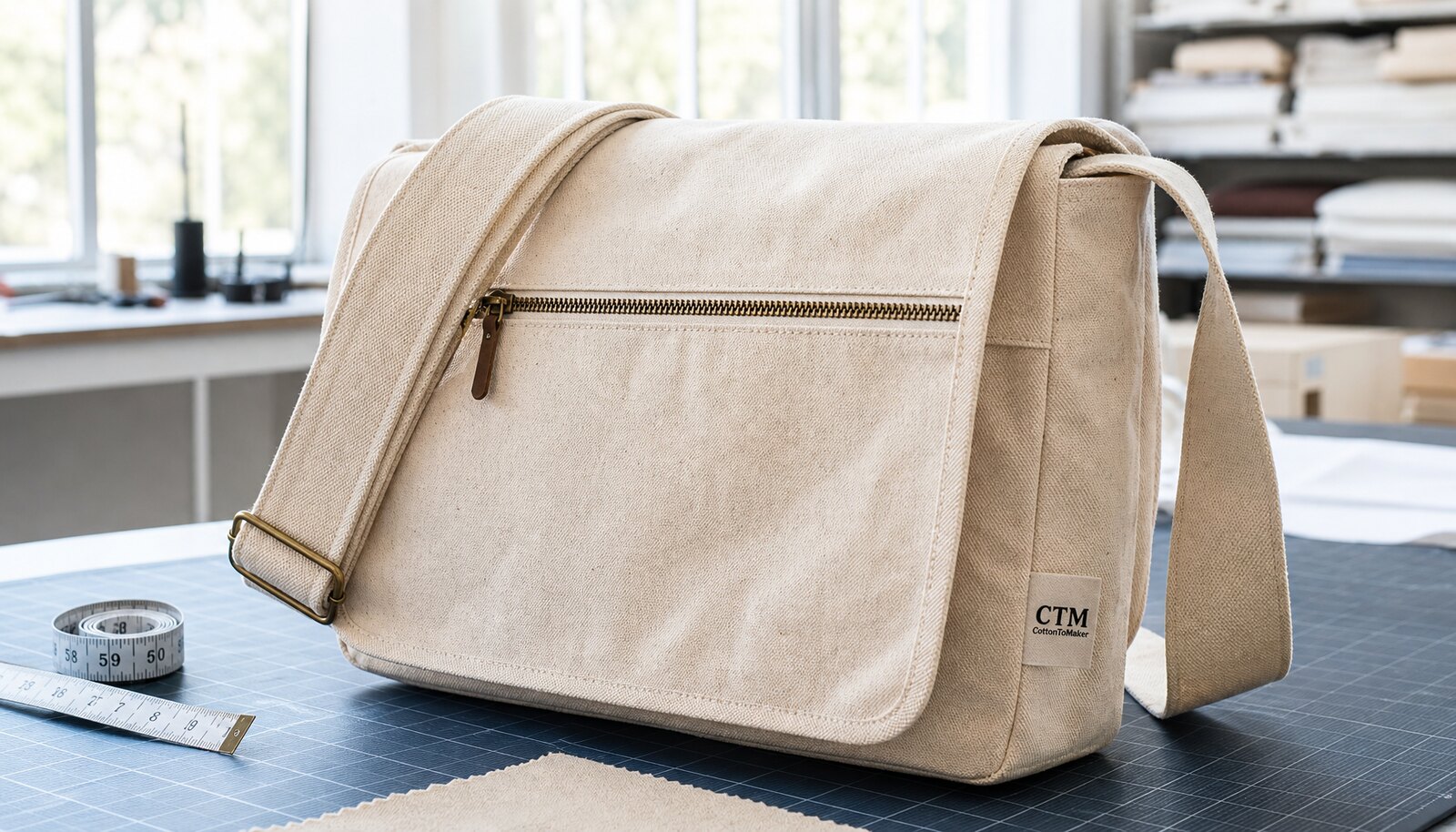
1. Start With Shelf Math, Not Factory Price
Gift-shop buyers should price the program from the shelf backward. A canvas messenger bag sold in a museum shop, tourist store, or bookstore rack has a different economics model than a bag sold through a pure wholesale channel. Before you ask for supplier quotes, define the target retail ticket, acceptable markdown room, and the gross margin the store needs after freight, receiving, label application, and any staff repacking time. If the bag must retail at $24.99, the landed-cost ceiling is not the same as it would be for a $39.99 premium item.
The procurement brief should describe the bag’s job in the assortment. A souvenir shop may want fast visual appeal and low receiving effort. A bookstore may prefer a flatter bag that stacks efficiently and does not snag on shelves. A museum shop may want a cleaner finish, better tactile feel, and packaging that looks giftable right out of the carton. Those choices change the quote before decoration is even discussed.
Buyers get better pricing when the supplier understands the final use case. A factory quote that ignores display format can look attractive but still miss the commercial target: the bag may be too soft to stand up, too bulky to ship, or too plain to support the intended retail ticket. Treat the quote as a response to a retail plan, not just a product description.
- Set the target retail price and minimum gross margin before sending the RFQ.
- Define whether the bag is a souvenir, carry bag, gift item, or premium branded item.
- Decide if the bag must stand upright on shelf or only function as a carry item.
- Tell the supplier whether this is a test launch, seasonal buy, or replenishment program.
2. Build a Spec That Fits the Store, Not a Generic Catalog
Canvas messenger bags usually move within a few useful spec bands. For many gift-shop programs, 8 oz canvas is the entry point, 10 oz is the balanced default, and 12 oz is the heavier premium step. The important difference is not the label alone but how the fabric changes structure, handfeel, freight weight, and shelf impression. A soft 8 oz body may be fine for a lower-ticket souvenir, but it can look underbuilt beside premium stationery or leather goods. A 10 oz body often gives the best balance between structure and price. A 12 oz body adds more substance and usually improves shelf presence, but it also raises fabric cost and can increase freight if carton weight climbs.
Construction choices can move the quote just as much as fabric weight. A flat messenger body with one exterior pocket is usually less expensive than a gusseted bag with lining, zipper top, internal divider, and reinforced base. That does not mean the simpler bag is always the right answer. It means each added component should earn its place in the retail story. If the item sits near checkout and must look giftable, a gusset and lining may justify the extra cost. If it is a straightforward souvenir, a flatter build may protect margin better.
Use the spec to control cost, not to load the product with unnecessary features. Every added panel or trim item should answer a retail question: does it improve shelf appeal, reduce returns, support a higher price, or improve durability in a way shoppers will notice? If not, leave it out and spend the budget where the buyer sees it, such as cleaner print placement or better finishing.
- 8 oz canvas: good for lighter souvenir positioning and lower ticket pricing.
- 10 oz canvas: strong default for most gift-shop messenger bags.
- 12 oz canvas: better for premium presentation or heavier daily use.
- Add lining, gusset, and zipper only if the shelf price can absorb the extra cost.
3. Use a Tiered Pricing Plan the Supplier Can Actually Answer
A procurement buyer needs a pricing ladder, not a single number. Ask for quotes at several volumes so you can see where the breakpoints really sit. For custom canvas messenger bags, the first meaningful price step is often around 500 or 1,000 pieces, but the real threshold depends on decoration, packing, and whether the supplier must buy custom components. A useful quote shows what happens at each tier and why. If the factory gives one figure and calls it 'competitive,' you cannot tell whether the price is built on low fabric weight, weaker stitching, lighter packing, or a genuinely efficient process.
Illustrative pricing bands help buyers sanity-check the market. For example, a 10 oz natural canvas messenger bag with one-color screen print and simple polybag packing might sit in a higher cost band at 300 pcs, ease down at 500 pcs, become more workable at 1,000 pcs, and improve again at 3,000 pcs if the spec stays unchanged. Add embroidery, a woven patch, a lined interior, or a shelf-ready insert card and hangtag, and the unit price usually rises enough that the retail ticket must rise as well. The exact numbers vary by sourcing region and freight mode, so buyers should treat published ranges as examples, not promises.
The real test is whether the supplier can explain the ladder. If the price barely changes between 500 and 1,000 pcs, ask what is holding the cost up. It may be a high setup burden, a one-off trim order, or a labor-heavy packing step. If the price drops sharply at 1,000 pcs, check whether that price assumes stock components or a specific shipment window. Good pricing plans are transparent enough that a buying team can see which tier supports a test launch and which tier supports a core SKU.
- Request prices at 300, 500, 1,000, and 3,000 pcs.
- Ask for the reorder price separately if the exact same spec is repeated later.
- Confirm whether the quote covers one artwork or multiple artworks.
- Compare blank-body savings against decoration and packing cost, not just the final unit price.
4. Split the Quote Into Buyer-Controlled Cost Drivers
There are only a few drivers that normally move a canvas messenger bag quote in a meaningful way: fabric weight, sewing complexity, decoration method, trim or hardware, and pack-out. The useful quote is the one that shows those drivers separately instead of folding everything into one number. A buyer who sees only an all-in price cannot tell whether a lower quote is the result of thinner fabric, fewer reinforcement stitches, simpler packing, or a cheaper closure.
Fabric and labor usually take the largest share of the cost. More panels mean more cutting time and more stitch operations. More pockets mean more alignment work and more defects to monitor. More complex closures — zipper, flap, magnetic snap, internal zip pocket — add both material and labor risk. Hardware can look minor, but metal zippers, D-rings, and specialty pulls often require more sourcing time and tighter inspection. In a gift-shop program, those touches can support a better shelf impression, but only if the margin can carry them.
The buyer should ask for body cost, decoration cost, trim cost, packing cost, and freight assumptions separately. If the supplier resists that breakdown, treat the quote carefully. Transparent line items make it easier to compare options, negotiate tradeoffs, and decide whether to keep the zipper pocket or remove it, or keep the logo size and reduce the pack-out. That is the kind of commercial choice a pricing plan should support.
- Ask for a line-item cost split instead of a single rolled-up unit price.
- Price the same bag with and without lining or zipper top.
- Treat hardware and trim as schedule risk as well as cost.
- If the supplier will not separate body, print, and packing, compare the offer cautiously.
5. Set MOQ Expectations by Artwork, Color, and Packing
MOQ for canvas messenger bags is rarely one clean number. It changes by body, color, decoration method, and packing requirement. A factory may be willing to produce 300 or 500 units, but if you want two body colors, two print colors, a woven label, a hangtag, and shelf-ready packing, the effective MOQ for each variant can rise fast. That is why artwork planning matters as much as quantity planning.
As a working market benchmark, one-color screen print usually supports lower MOQs than embroidery or woven patch builds. Screen print is generally easier to absorb at smaller quantities, especially on natural canvas. Embroidery often needs more setup discipline and can be less efficient at very low quantities if the design is large or dense. Woven patches, custom labels, and bespoke hangtags can still be manageable, but they create extra MOQ pressure because each component may have its own minimum order.
The easiest way to keep MOQ workable is to consolidate the program. Keep one bag body across multiple gift-shop SKUs where possible. Use the same base color and vary only the artwork or insert card if the assortment needs variety. If the supplier offers mixed-SKU pricing, ask how they allocate sewing, decoration, and packing across the assortment. Otherwise, a low overall price can hide a very expensive per-design cost.
- One-color screen print usually supports lower MOQ than embroidery or woven patch builds.
- Ask for MOQ by body, colorway, artwork, and packing style separately.
- Use one base body across multiple store SKUs when you need better cost efficiency.
- If you want multiple designs, ask for a blended price and the exact split by variant.
6. Compare Example Price Bands and Landed Cost by Volume
The cleanest way to evaluate a supplier offer is to convert it into landed cost per sellable unit and compare that number with the target retail price. The numbers below are illustrative, not universal, because region, labor market, trim choice, freight mode, and artwork complexity will all move the result. Still, they give buyers a useful frame for deciding whether a quote is in the right zone.
Illustrative price bands for a 10 oz natural canvas messenger bag with one-color screen print, standard strap, basic closure, and retail-ready but simple packing often behave like this: 300 pcs sits in the highest cost band because setup is spread thin; 500 pcs usually improves enough to make a test drop more feasible; 1,000 pcs often becomes the point where the unit cost feels materially better; and 3,000 pcs may improve again if the spec stays stable and pack-out is controlled. If you add embroidery, a lined interior, or a premium insert card and hangtag, expect landed cost to rise enough that the shelf price should move too.
For gift-shop buying, landed cost matters more than ex-factory price. A bag that costs less at the factory can still be the more expensive option once freight, duty, carton volume, receiving labor, and relabeling are included. If a bag lands at $6.50 and the retailer needs a 55% gross margin, the shelf price must still support overhead and markdown room. If the same bag lands at $8.40 because of heavier fabric, more elaborate packing, or slower freight, it may need to move into a different assortment tier entirely.
Ask for a cost model that includes body cost, decoration, packing, inland freight, international freight, duty or tax assumptions, and receiving labor if your team handles those costs. That is the difference between a product that looks competitive on a quote sheet and a product that actually earns shelf space.
- Convert every quote to landed cost per sellable unit.
- Test margin against the actual shelf price target, not only the factory price.
- Ask for a cost model that includes freight, duty assumptions, and packing.
- Use 300/500/1,000/3,000 as planning tiers, then verify the real breakpoints with the supplier.
7. Match the Branding Method to Shelf Value and Reorder Risk
Decoration should support the retail story. For most bulk orders, one-color screen print remains the best-value option because it gives a clear logo, low setup burden, and predictable repeatability. On natural canvas, it usually looks clean and commercial without pushing the item into a premium build. If the shop wants the bag to feel more elevated, embroidery or a woven patch can lift perceived value, but those methods should be selected because the shelf price can support them, not because they sound better in a meeting.
There is also a practical difference in how each method ages. Screen print can be durable when cured correctly, but the buyer should still ask for rub and fold checks because gift-shop bags are handled repeatedly before sale. Embroidery is visually strong, but a large stitched field can stiffen the front panel and add cost. Woven patches usually give a tidy brand presentation and can be easier to control than dense embroidery, though they add trim sourcing and attachment steps. Heat transfer can work for short-run graphics or multicolor art, but it needs extra checking for abrasion and long-term appearance.
For reorder planning, the best decoration method is the one the factory can repeat consistently. A sample that looks excellent in the room but is hard to repeat at scale creates rejects and delays. Ask how the factory stores art files, screen data, thread references, patch specifications, and packaging artwork so the second order matches the first. Reorder stability is part of the cost even if it does not show on the quote.
- Use one-color screen print when you need the best balance of cost and repeatability.
- Use embroidery or woven patch only when the shelf price can support a premium finish.
- Ask how the decoration will hold up to folding, handling, and light abrasion.
- Confirm the supplier’s file retention process for reorders and color matching.
8. Treat Packing as a Buying Decision, Not a Final Detail
Gift-shop buyers often lose margin in packing. A messenger bag that arrives loose in bulk may look inexpensive, but if the store must spend labor folding, labeling, and display-ready sorting it, the savings can disappear. Packing should therefore be quoted as part of the product. The factory should state whether each unit is folded or stuffed, whether it uses a polybag or tissue wrap, and whether it includes a hangtag, barcode, style label, or insert card.
Packing also affects freight. More air in the pack means a larger carton, and a larger carton can raise freight costs even when the bag itself is light. When comparing suppliers, ask for unit pack dimensions and master carton dimensions. A small change in folding method can create a real freight difference on larger orders. This matters especially for gift-shop assortments that ship in mixed cases or need shelf-ready packing at the receiving dock.
The best packing plan is the one that matches how the item is sold. If the bag hangs on a peg, the hangtag and fold should support that format. If it sits on a shelf in a museum store, the front panel and logo placement need to stay visible after packing. If barcode compliance is required, get barcode size, placement, and print quality approved before bulk starts. Small packing details often determine whether the receiving team can process the shipment quickly or has to relabel it by hand.
- Quote unit packing and master carton packing separately.
- Ask for the exact fold method because it changes carton size and shelf appearance.
- Confirm barcode size, label position, and carton labeling rules in writing.
- If the store handles receiving labor, include that cost in the margin model.
9. Build a QC Plan With Measurable Acceptance Criteria
Procurement value rises sharply when quality control is specific. For custom canvas messenger bags, generic 'we inspect before shipping' language is not enough. The bag should be checked against measurable targets for seam allowance, stitch density, dimensions, print placement, color consistency, packing count, and carton marking accuracy. If the supplier cannot describe the control points, the buyer is taking a blind risk.
Start with construction. Ask the factory to hold a specified seam allowance at key edges so the panel dimensions stay stable after sewing and turning. Confirm stitch density on main seams, strap anchors, pocket mouths, and zipper attachments. Loose thread tails should be trimmed. Bartacks should be complete and consistent. There should be no open seams, skipped stitches, broken needle points, or exposed raw edges where they were not approved.
Then move to appearance and performance. If the canvas is dyed, ask for rub and scuff checks on the body and corners. If the bag is printed, test whether the image cracks, smears, or shifts after flexing. If a label or patch is used, inspect centering and edge finish. If the bag includes a zipper, confirm smooth travel and no fabric catch. For retail programs, carton drop checks are useful because the bag may pass unit inspection but still arrive damaged in packed transit. The buyer should know who performs each check, how many units are sampled, and what defect level triggers hold or rework.
- Write seam allowance expectations into the tech pack or PO notes.
- Set a minimum stitch density or stitches-per-inch target for load-bearing seams.
- Test rub, scuff, and fold behavior on printed or dyed areas.
- Use carton drop checks when shelf-ready packaging matters.
- Tie inspection to a named sample size, defect category, and release authority.
10. Verify the Vendor Before You Treat the Quote as Real
A low price is not useful if the supplier cannot actually ship the product on time or prove that the factory can make it consistently. Vendor verification should be part of the buying plan, especially when the order includes custom print, custom packing, or a tight delivery window. Ask for the legal business name, manufacturing site address, export experience, and a contact who can answer production questions directly. If the seller is only a trading company, clarify who is making the bag and who owns the quality records.
Factory signals matter. A real manufacturing partner should be able to show production photos, recent QC reports, material traceability notes, and the packing method used on the same or similar item. If the supplier cannot explain where the canvas is sourced, where the print is done, or how the final carton count is verified, that is a risk signal. Buyers should also ask which compliance documents are available for the fabric, print chemicals, hardware, and packaging materials if the target market requires them. The point is not to collect paperwork for its own sake; it is to reduce the chance of a blocked shipment or a rejected receiving inspection.
If the order is meaningful, consider a factory audit or at least a structured remote review. Good audit signals include a clear production flow, identified QC checkpoints, controlled material storage, labeled work-in-process, and evidence that approved samples are kept and referenced on the line. Weak signals include vague answers, no sample retention system, no production records, and no clear ownership of final inspection. Those are practical procurement questions, not administrative extras.
- Verify the legal business name, manufacturing site, and export contact.
- Ask who actually makes the bag if the seller is a trading company.
- Request production photos, QC records, and recent packing examples.
- Ask which compliance documents are available for fabric, print chemicals, hardware, and cartons.
- Use audit signals such as material traceability, sample retention, and final inspection ownership.
Specification comparison for buyers
| Cost driver | Typical spec options | Illustrative unit-price impact | Buyer check before quoting |
|---|---|---|---|
| Canvas weight | 8 oz / 10 oz / 12 oz | 8 oz is usually the lowest-cost option; 10 oz is the common middle; 12 oz typically raises fabric cost and freight weight | Ask for actual GSM, weave, finish, and whether the number refers to raw fabric or finished bag body |
| Decoration method | Blank, one-color screen print, multi-color screen print, embroidery, woven patch, heat transfer | Blank is lowest; one-color screen print is usually the best value; embroidery and woven patch usually add clear premium | Separate setup fee, per-color fee, and any artwork repeat charge |
| Bag construction | Flat body, one pocket, gusset, lining, zipper top, internal divider, reinforced base | Each added panel, pocket, or closure usually increases sewing time and defect risk | Require a construction sketch or tech pack with seam count and reinforcement points |
| Hardware | No hardware, basic zipper, metal zipper, magnetic snap, D-ring, slider puller | Metal hardware and specialty closures usually raise cost and lead time | Specify finish, corrosion resistance, and approved equivalents |
| Packing level | Bulk pack, polybag, tissue wrap, insert card, barcode label, hangtag, shelf-ready carton | Retail-ready packing adds material, labor, carton volume, and receiving effort | Ask for pack-out cost per unit plus carton dimensions before comparing quotes |
| Order quantity | 300 / 500 / 1,000 / 3,000 pcs | Unit price often drops in tiers; the first meaningful break is often at 500 or 1,000 pcs, depending on decoration and packing | Request exact price at each quantity break and the MOQ by artwork, color, and pack style |
| Shipping term | EXW, FOB, CIF, DDP | EXW can look cheapest on paper; DDP can simplify buying but still needs a line-by-line freight view | Compare the same Incoterm and request the freight assumption sheet |
| Retail presentation | Plain utility bag, souvenir bag, giftable accessory, premium branded item | Better shelf presentation can justify higher cost if it supports a higher ticket | Define shelf role before approving the spec so the bag fits the store margin |
Buyer checklist before sampling
- Set the target retail price and minimum gross margin before requesting quotes.
- Define the bag’s retail role: souvenir, museum-shop accessory, bookstore carry bag, or gift-set component.
- Lock the finished size, gusset depth, strap length, pocket count, and closure style.
- Choose the canvas weight in GSM and ask the factory to state the actual fabric spec, not only 'heavy' or 'standard'.
- Separate blank bag cost, decoration cost, packing cost, and freight cost in the RFQ.
- Ask for tiered pricing at 300, 500, 1,000, and 3,000 pcs, plus a reorder price if the spec stays unchanged.
- Request sample fee, sample shipping fee, and whether the fee is deductible from the bulk order.
- Specify artwork format, print size, placement tolerance, and one approved color reference for each logo color.
- Confirm whether the quote includes polybag, tissue, hangtag, barcode, carton label, and master carton packing.
- Approve a pre-production sample against retail presentation, seam quality, print placement, and pack-out.
Factory quote questions to send
- What is the exact canvas GSM, weave type, and finish on the quoted bag body?
- What is the unit price at 300, 500, 1,000, and 3,000 pieces, and what changes at each tier?
- What is the MOQ by artwork, colorway, and packing style?
- Which decoration method is included in the base quote, and what are the setup fees for each print color or embroidery file?
- What are the sample fee, sample lead time, and whether the sample fee is refundable or deductible?
- Can you provide a line-by-line cost split for body, decoration, trim, packing, and carton?
- What Incoterm is quoted, and what freight assumptions are built into the price?
- Who performs final QC, and can you share the inspection standard and report template?
- What is the expected overrun or underrun range on bulk production?
- What is the reorder lead time if the bag body, artwork, and packing remain unchanged?
Quality-control points to confirm
- Verify canvas weight against the agreed spec; many buyers use roughly +/- 5 to 8 percent as a practical control band, but the actual tolerance should be written into the PO.
- Measure finished bag dimensions, gusset depth, and strap length on sampled units; set a dimensional tolerance such as +/- 0.5 in / 1 cm for key measurements unless the design requires tighter control.
- Inspect seam allowance consistency at major seams and pockets; ask the factory to hold a defined seam allowance so the bag does not shrink below spec after turning and topstitching.
- Check stitch density on load-bearing seams and strap anchors; request a defined stitch-per-inch range and inspect for skipped stitches, loose thread tails, and uneven bartacks.
- Examine bartacks or reinforcement stitching at strap joins, zipper ends, pocket corners, and flap stress points; these are common failure points on messenger bags.
- Confirm colorfastness for dyed canvas, prints, labels, and lining: request rub, wet-rub, and wash or spot-clean checks appropriate to the bag’s intended use.
- Review print registration, opacity, and edge sharpness; check for ghosting, pinholes, cracking, and any color shift against the approved sample.
- Perform a light abrasion or scuff check on high-contact areas such as corners, base edges, flap edges, and strap faces to spot weak finishing or poor coating.
- Inspect zipper travel, puller alignment, teeth engagement, and fabric catch points; zippers should run smoothly without waviness or dead spots.
- Check hardware finish for scratches, plating defects, corrosion risk, and sharp edges that could damage packaging or consumer hands.