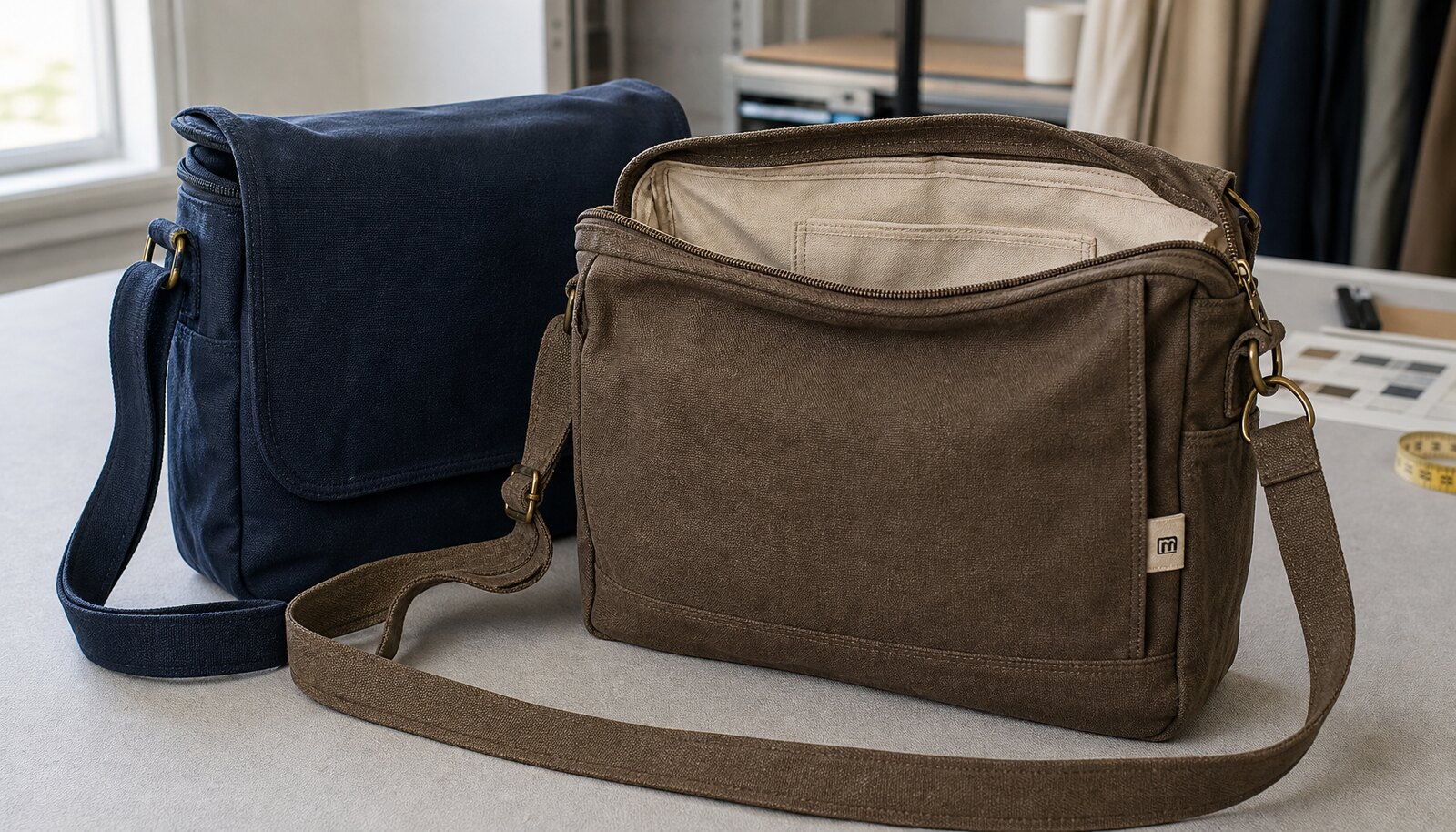
Why boutique winery buyers price canvas messenger bags differently
A canvas messenger bag for a boutique winery should not be priced like a generic promotional tote. Buyers are usually balancing three commercial jobs at once: retail presentation, practical carry capacity, and brand consistency across a small but visible merchandise program. That means a serious quote has to reflect the build of the bag, not just the surface area of canvas and logo print. The same artwork can sit on very different constructions, and the price gap often comes from sewing time, hardware, lining, and packing standard rather than the fabric alone.
For winery buyers, the first commercial question is how the bag will be used in the sales channel. If it is a tasting-room gift, a member-club add-on, or a light retail accessory for brochures, small merchandise, or event materials, the design can stay simple and still feel premium enough. If it will be sold as a retail item on shelves, bundled with wine accessories, or used repeatedly by visitors, then structure matters more. Buyers should not let a supplier frame the order as “just a canvas bag.” The correct spec depends on the retail context, not only on the decoration method.
A second reason winery pricing differs is brand sensitivity. Winery buyers usually want a calmer, more natural look than a loud promo bag. Natural canvas, muted black, navy, olive, or undyed finishes often make more commercial sense than bright fashion colors because they pair better with bottle packaging, tasting notes, and gift sets. But those choices also affect dye-lot management, color approval, and reorder consistency. A color that looks appealing in a single photo can become a procurement problem if the supplier cannot keep the same shade across repeat runs.
This is why procurement teams should avoid asking for “best price” before the bag’s job is defined. A fair comparison only starts once the dimensions, fabric weight, decoration area, closure type, and packaging format are fixed. Otherwise, suppliers may quote different assumptions and call them equivalent. The result is not a procurement negotiation; it is a confusion exercise.
For boutique wineries, the most useful frame is lifecycle value rather than first-order unit price. A bag that looks clean on a tasting-room counter, survives repeated use, and reorders without color drift will usually out-perform a cheaper bag that needs repacking, creates quality disputes, or looks off-brand on the next vintage. That is the commercial standard that should guide the quote request.
- Retail use usually needs cleaner finishing than event giveaway bags.
- Heavier fabric does not automatically mean a better buying decision if freight, folding, and sewing time become worse.
- Functional details like pockets, zippers, lining, and labels can move the cost more than the logo print.
The spec choices that move bulk pricing the most
For custom canvas messenger bags bulk pricing plan for boutique wineries, the biggest price drivers are fabric weight, panel count, closure type, lining, and decoration method. A simple open-top bag in 12 oz canvas with one-color screen print can sit near the lower end of the price range. Add a zipper, inside pocket, cotton or poly/cotton lining, and woven label, and the unit cost rises in layers that are easy to underestimate. Buyers should treat each added feature as a line-item cost or a measurable value decision, not as a vague upgrade bundled into one number.
Canvas quality should be discussed in GSM or ounce weight plus weave density. In practice, many buyers use 12 oz, 14 oz, or 16 oz canvas as a starting point. Twelve-ounce canvas usually works for merchandising and light retail carry. Fourteen-ounce canvas gives a better hand feel and less collapse on a shelf. Sixteen-ounce canvas can be appropriate for a premium reusable bag, but it may create higher sewing resistance, heavier cartons, and higher freight. That means the real cost impact is not linear. A heavier bag can move your landed cost more than the factory quote suggests because shipping density falls and carton weights increase.
The closure choice is also more commercial than cosmetic. An open-top bag is the lowest-cost structure and usually the easiest to sew. A zipper adds hardware cost, extra sewing operations, and one more point of failure. A magnetic snap sits between the two, but the actual cost depends on whether the supplier already runs that hardware regularly or needs to source it specifically for your order. For a winery merchant program, closure choice should track what the buyer wants the bag to carry. If the bag is meant to protect printed tasting materials or small premium items, a zipper can justify its cost. If it is mainly a branded carry bag, an open top may be enough.
Decoration can also distort the price if the artwork is not designed for the bag structure. Screen print is usually the most cost-effective method for one or two spot colors and is a strong fit for simple winery logos, repeated reorders, and clear bulk pricing. Embroidery has a premium, stitched feel, but it costs more and becomes difficult when the logo has small text or thin lines. Heat transfer can be practical for short runs or multi-color graphics, but it should be tested for folding, abrasion, and crack resistance. Buyers should ask where the artwork sits relative to seams, zipper ends, and handle stitches. A low-cost print becomes expensive when a poor placement forces rework or leads to a rejected sample.
A buyer also needs to think about panel count and reinforcement. A bag with extra gusset structure, double stitching, or reinforced base corners will cost more, but those features affect how the product sits on a shelf and how well it keeps shape when filled. For winery programs, that can matter as much as logo size because the bag is often sold or given in a premium environment. Build quality is part of the merchandising story.
- Use 12 oz if the bag is mostly a branded gift or light retail accessory.
- Use 14 oz if shape retention matters and the bag must feel more premium on shelf.
- Use 16 oz only when structure is part of the product value and freight can absorb the extra weight.
- Keep artwork away from stress points, especially where seams or zipper ends can distort the print.
Use a comparison matrix before you ask for quotes
A clean buying plan starts with a spec matrix, not a free-form email. If the supplier does not receive the same bag size, fabric weight, decoration size, packing method, and destination notes, then the quotations will not be comparable. For boutique wineries, that mismatch is common because one team member may care about retail presentation while another focuses on cost only. A good matrix turns those priorities into one controlled request so the supplier can quote the same item to every buyer.
The table below is the practical version. It is not only about what the supplier should make; it also shows what the quote should reveal about tradeoffs. The useful benchmark is not a single price but the commercial consequence of each choice. For example, a zipper can be worth the uplift if the bag is being sold with accessories or small gifts. But if the bag is only a tasting-room handout, that same zipper may be pure cost. The point is to buy only the features the channel will pay back.
The second reason for a comparison matrix is reorder discipline. Boutique winery programs are often seasonal, so the first order may be a test run, but the second order is the real margin check. If the spec is not fixed now, the next supplier may substitute a different canvas hand or a slightly different hardware finish, and the line will still look “close enough” on paper. That is where the comparison matrix protects the buyer: it makes a quiet substitution visible before it becomes a receiving problem.
Supplier scenarios also help in benchmarking. A direct factory quote might come in lower on unit cost but require higher internal effort on packaging and follow-up. A trading partner might quote a little higher but include more complete packing and communication. A value-focused factory may be fine for a giveaway program, while a retail-grade bag line needs a supplier with better sewing discipline. Buyers should use the matrix to decide which route matches the campaign, not just the lowest number.
- Do not compare quotes unless the spec sheet is identical.
- Use supplier scenarios to judge tradeoffs, not only price.
- Treat reorder stability as part of the decision, not an afterthought.
A practical sourcing route comparison for winery programs
Not every supplier route gives the same pricing logic. A direct factory quote can be best when you already know the spec and want repeatability, but some trading companies are better at handling mixed programs, smaller MOQ flexibility, or combined packaging requirements. The right route depends on how stable your artwork, colors, and reorder plan are. If your winery merchandise changes seasonally, a flexible sourcing partner can reduce internal coordination time even if the unit price is slightly higher. That can be a valid commercial tradeoff if the buyer values speed and simplicity over absolute factory-level pricing.
The key is understanding what kind of quote you are comparing. A factory that owns the sewing line and controls packing can usually give a cleaner breakdown of fabric, print, labor, and carton cost. A sourcing intermediary may bundle those items into one delivered number, which looks simpler but hides where margin sits and which parts are fixed versus variable. For procurement teams, the useful question is not only who is cheapest, but who can hold the same bag spec on reorders without quietly changing canvas hand, zipper grade, thread quality, or stitch density. Repeatability matters more than a small first-order discount when the bags are tied to a branded retail program.
Country and region matter too. If you source from a region with strong canvas bag specialization and access to stable hardware supply, you often get better consistency on sewing and finishing. If you source from a region where bags are only one small category in a larger product mix, you may see more variation in zipper quality, cutting accuracy, and packing discipline. Lower labor cost does not always mean lower risk. For a boutique winery, the hidden cost of a poorly managed bag line can be rework, late arrival, or inconsistent reorders. Those issues are costly because the order size is often modest and the launch window matters.
Procurement should also consider practical compliance and documentation. Depending on the destination market, ask whether the supplier can provide material declarations, country of origin marking, and any test reports needed for your internal file. If the bag is sold in retail channels, packaging and labeling should be discussed early: barcode sticker placement, inner polybag language if required by the market, hang tag attachment method, and carton marks. If you import through a distributor or warehouse, make sure the factory understands the label format your receiving team expects. Small documentation mistakes cause receiving delays even when the product itself is acceptable.
Before you approve a supplier route, ask for evidence you can verify: factory photos of the sewing line that are time-stamped or current, a stitched sample with the same hardware family, and carton photos showing packing ratio and label format. If the seller cannot show those items quickly, the quote may be competitive on paper but weak in execution. Procurement value is not built on promises; it is built on checkable evidence.
- Direct factory: best for repeat orders and spec control.
- Trading route: useful when you need multi-item consolidation or small-production flexibility.
- Mixed sourcing is workable only if the spec sheet is fixed before sampling.
- Ask suppliers what documentation they can provide for origin, materials, and packaging marks before you issue the PO.
What a clean quote should show line by line
A useful factory quote separates material, printing, sewing, hardware, and packing. If you get one flat unit price, you cannot tell whether the supplier is using thicker canvas, cheaper thread, a lower-grade zipper, or reduced QC labor to hit the number. For a boutique winery project, that makes reorder risk very real because the first shipment may pass visually while the second shipment quietly changes. Buyers should insist on enough detail to compare suppliers at the component level and to confirm that every quote is based on the same assumptions.
A practical quote should also show the number of colors, size of artwork, and the setup cost for each decoration method. Screen printing may require a plate or screen setup charge, and embroidery may require digitizing. Those costs matter more on smaller bulk runs because they dilute differently by volume. For example, a 1,000-piece order with one-color print can look inexpensive until the setup fee is added; a 5,000-piece order may absorb that fee much more efficiently. The buyer should therefore request a price ladder, not a single number. Ask for 1,000 / 3,000 / 5,000 pcs if that fits your buying pattern, and ask whether the setup charge is one-time or repeatable on reorders.
A clean quote also clarifies what is included in packing. Does the factory quote include a polybag, tissue, silica gel, barcode sticker, carton label, or export master carton? If the quote omits those items, the apparent savings can disappear once you add the packaging your warehouse actually needs. In winery retail, the bag often ships together with fragile or premium merchandise, so packaging quality matters more than many generic promo programs. A low quote that forces your team to repack at destination is rarely a real saving.
The most procurement-useful tactic is to compare three layers together: unit ex-factory price, packaging and packing format, and the defect/rework risk. A slightly higher quote that includes better carton protection, tighter measurement control, and a proper pre-production sample can win because it reduces failure points. In small to mid-size programs, one bad batch often wipes out the savings from a cheaper supplier.
Use one more check before you shortlist suppliers: ask them to restate the spec back to you in their own words. Good factories summarize dimensions, fabric, print, carton pack, and tolerance limits correctly. Weak sellers often miss a detail or generalize the order. That simple back-check reveals whether they understood the bag or just copied your email.
- Ask for unit price at 1,000, 3,000, and 5,000 pcs.
- Request separate pricing for print setup, tooling, and packaging inserts.
- Confirm whether the quote includes carton labeling, barcode stickers, and moisture protection.
- Verify whether sample costs are refundable or deducted from bulk order value.
MOQ logic: where the real minimum is hiding
The published MOQ is often not the full story. In canvas messenger bag production, the true minimum can be set by fabric dye lot, print setup, carton packing efficiency, or the supplier’s internal sewing batch. For example, a factory may accept 500 pcs on paper but charge so much for setup that the effective unit price is no longer competitive. Another supplier may set 1,000 pcs per color because they need a full fabric cut batch to avoid waste and shade variation. That is normal in custom production, not a hidden trick, but it must be accounted for before procurement signs off on the quote.
For boutique wineries, the safest MOQ planning approach is to think in style-color combinations rather than total quantity only. A 3,000-piece order split across three colors can be more expensive than a single-color 3,000-piece run because each color adds fabric management, print alignment, carton sorting, and extra approval work. If the bag is for seasonal retail and reorders are likely, one core color plus one limited run is often more efficient than a wide palette on the first order. In procurement terms, that means you are buying price stability and repeatability, not just unit count.
It helps to ask the supplier what part of the MOQ is driven by raw materials and what part is driven by machine setup. If the minimum is actually a fabric order size, the supplier may be flexible on color but not on weight or weave. If the minimum is set by print screens or embroidery digitizing, the buyer may have room to change body color while holding the decoration constant. This distinction matters because it affects whether you can later reorder a new color without changing the underlying bag construction.
A practical buying rule is simple: keep the first order as focused as possible. One size, one core color, one print position, one hardware set. That keeps the MOQ manageable and reduces the number of variables you need to approve. Once the bag sells, you can expand colorways or add features with better demand evidence.
If a supplier says the MOQ is flexible, ask for the cost curve, not just the minimum number. A useful quote should show where the unit price starts to improve and where setup costs drop away. That tells you whether the supplier is truly efficient or just willing to quote a smaller first run at a premium.
- Ask whether MOQ is set per color, per artwork, or per size.
- If the seller quotes a low MOQ, verify whether setup charges are front-loaded.
- One color, one size, one print position usually gives the cleanest bulk price.
- Ask whether reorders can use the same tooling without paying setup again.
Fabric, print, and hardware choices that suit winery retail
For winery merchandising, natural canvas remains the safest commercial choice because it feels authentic and shows a logo clearly. Black and navy can look more premium, but they are less forgiving in print registration and dust visibility. If the bag is meant to sit near bottles, tasting notes, or gift sets, a medium-weight canvas in a stable neutral shade will usually photograph and merchandise better than a very soft or very bright fabric. Buyers should avoid over-specifying exotic finishes unless they have a clear shelf display plan or a premium club program that justifies the added complexity.
Print method should be matched to brand use, not just to artwork file type. Screen print is usually the most cost-effective for simple logos, one or two colors, and repeat orders. It tends to work well on the rougher texture of canvas when the factory controls ink density and curing. Embroidery gives a stitched premium look and can be a good fit for badge-style logos, but it adds thread count, machine time, and inspection points. Heat transfer may be acceptable when the artwork is complex or the order is short, but it needs practical testing. Fold the sample, rub it, and check whether the edges lift or crack. That is more useful than judging it by a flat sample photo.
Hardware should support the merchandising role of the bag. A zipper gives better containment for small items, but it increases component count and creates a second quality checkpoint. Pull tabs, slider quality, and zipper tape alignment all matter. If the bag includes a shoulder strap or adjustable buckle, ask whether those parts are standard stock components or customized. Standard hardware is usually safer for pricing and replenishment. Custom hardware can be attractive, but it increases lead time and raises the chance of color variation or finish mismatch.
Inside pockets are another place where procurement teams can overspend without noticing. One small internal pocket can be useful for a tasting note card, key, or receipt, but a more elaborate pocket build slows sewing and creates a higher chance of uneven stitching. The commercial question is whether the pocket improves shelf value enough to justify the extra labor. If the bag is sold as a premium retail item, it may. If it is a giveaway or event bag, the extra cost may not return in customer value.
A related detail that matters to wineries is odor and finish. Bags that sit close to food or beverage merchandise should arrive with low odor, clean trim, and no sticky residue from labels or finishing agents. Ask for a sample that has been fully packed and unpacked once, because that is closer to what the bag will feel like on receipt. A neat-looking flat sample is not enough if the retail piece must open cleanly and smell neutral on the shelf.
- Choose screen print for simple logos and durable bulk pricing.
- Use embroidery only when the brand wants a stitched premium look and the logo is not too detailed.
- Avoid putting detailed artwork too close to seam folds or zipper edges.
- Use standard hardware when possible to reduce reorder risk and color mismatch.
Sample approval: the step that prevents most bulk mistakes
A pre-production sample is not just a formality. It is the only reliable way to verify the exact canvas hand, stitch behavior, zipper finish, lining quality, and logo placement before mass production starts. A good sample should match the intended production setup, not a showroom version built from better materials. If the factory sends a sample made from a different canvas weight or a different print process, the approval has limited value. The sample should be measured, photographed, and signed off against a spec sheet with tolerances so there is no debate later about what was approved.
The approval process should be practical and measurable. Compare bag width, height, handle drop, gusset depth, and internal pocket position against the approved dimensions. Check stitch density where handles join the body and where the zipper ends are anchored. Open and close the zipper multiple times to see whether the tape tracks cleanly. Fold the bag in the same way it will be packed for export and make sure the logo does not crack or transfer. If your winery uses a specific brand color, approve the sample under neutral light, not just by phone camera or a screen share.
For a procurement file, it helps to include a tolerance sheet. Typical buyer-side tolerances often sit around a few millimeters on bag dimensions and handle placement, but the exact range should be written into the order file rather than assumed. Also define acceptable variation for canvas shade, print registration, and label position. These standards do not need to be overly rigid, but they need to be written down. Otherwise, a production team in one country may consider a shift acceptable that your warehouse team will later reject.
A final sample discipline that saves time is reference retention. Keep one approved sample in procurement, one with QC, and one with the receiving team if the program is ongoing. That gives everyone the same physical standard. For repeat orders, this is often more useful than a long email chain.
If the supplier offers a photo approval instead of a shipped sample, use that only for non-critical decisions. A photo can confirm layout, not hand feel, seam finish, or zipper behavior. For any order that matters to retail presentation, insist on a physical sample before bulk production begins.
- Approve the sample only after measurement and functional testing.
- Confirm the sample uses the same fabric and hardware as the bulk order.
- Keep a signed reference sample for the production and shipment inspection team.
- Write tolerance limits into the PO or spec sheet before deposit.
Packing, carton counts, and warehouse handling
Packing is one of the easiest ways to destroy margin after production. A well-made messenger bag can still arrive with deep fold lines, crushed corners, or adhesive label damage if the packing method was not specified. For bulk shipments, carton count should be chosen based on bag thickness after folding, not just on what looks convenient to the factory. If the bags are retail-ready, the carton must also protect the surface finish from dust, zipper abrasion, and moisture. This matters even more for boutique winery buyers because the bag is often displayed next to premium packaging and is expected to look clean at first touch.
A clear packing plan starts with the receiving side. If your warehouse wants a standard master carton ratio, barcode sticker placement, or pallet pattern, the supplier should know that before production starts. Mixed cartons can create count discrepancies when several colors are on the same PO, so color segregation should be confirmed in writing. If the order is for a retail chain or distributor, ask whether outer carton marks need SKU, color, size, PO number, and country-of-origin marking. The clearer the carton labeling, the less labor your team spends on inbound verification.
Moisture control is also worth specifying. Canvas can absorb odor and humidity during transit, especially in long ocean shipments. In many cases, a clean polybag plus corrugated carton is enough. But if the bags are premium or the route is humid, consider a moisture barrier detail such as silica gel, inner poly packaging, or a carton liner. Don’t overpay for packaging that your channel doesn’t need, but don’t under-spec it and then spend money on repacking.
For buyers who sell through tasting rooms or gift shops, package appearance matters on opening. Flat, tidy folds usually look better than loose stuffing, but the fold method should still protect the shape. Ask for carton dimensions early if you plan to palletize or compare container loading. The most useful number is not just how many bags fit in a carton, but how much gross weight and cubic volume each carton creates.
If the winery team will be storing the bags before launch, ask whether the packing format can support stackability without compression damage. Some buyers need shelf-ready cartons; others need high-density export cartons. That is a different commercial requirement, and the supplier should quote against the real storage plan.
- State whether the bags should be folded, stuffed, or flat-packed.
- Confirm master carton quantity and whether colors can mix inside one carton.
- Ask for carton dimensions early if you are planning pallet or container loading.
- Confirm label content for warehouse receiving before the first shipment.
Lead time planning and schedule risk for boutique winery launches
A realistic schedule needs separate time blocks for sample approval, material booking, production, and export packing. If artwork is not final, or if the logo uses multiple colors, the print setup alone can add days before sewing even starts. Buyers often lose time by approving a sample late, then expecting the bulk order to hold the original delivery target without any buffer. For seasonal winery retail, that mistake can push the bags past the launch window and weaken the commercial return.
Lead time risk usually comes from three places: fabric availability, print approval, and packing changes. If your bag uses a special color or a heavier canvas grade, the mill may need extra time to source or weave the material. If your logo has fine type, a metallic effect, or strict brand color requirements, the supplier may need one more proof cycle. Packing changes matter because retail-ready bags take longer to assemble than bulk-folded export units. Buyers should treat final packaging signoff as part of the production critical path, not as an afterthought.
Seasonality is especially important for wineries because product launches often align with holidays, tasting events, harvest promotions, and club renewals. If the bag is tied to a campaign date, build in a cushion for freight, customs, or receiving delays. A small, well-planned buffer is often cheaper than a rushed air shipment or a missed retail window. From a procurement standpoint, the correct lead time is the one that allows sample approval, one correction cycle if needed, and on-time receiving without expediting fees.
When comparing suppliers, ask them to separate sample time from bulk production time and to tell you what tasks can run in parallel. For example, artwork approval, carton label creation, and packaging confirmation may all move independently if the supplier is organized. That kind of schedule clarity is often a better sign of a capable factory than a single optimistic delivery promise.
If the supplier gives only one total lead time, ask for a milestone plan. A factory that can name the sample date, production start trigger, and packing completion window is easier to manage. A seller who cannot break down the schedule usually cannot manage exceptions well either.
- Separate sample time from bulk production time in the purchase plan.
- Build a buffer if the order depends on custom color matching.
- Treat packaging approvals as part of production, not as an afterthought.
- Ask suppliers which steps can run in parallel to compress the schedule safely.
Specification comparison for buyers
| Spec decision | Recommended option | Typical cost impact | When it fits | Buyer risk to check |
|---|---|---|---|---|
| Fabric weight | 12 oz to 14 oz washed or plain canvas | 12 oz is the baseline; 14 oz often adds about 5% to 12% to material and sewing cost versus 12 oz, before freight | Boutique winery merch bags that need structure, gift appeal, and repeat use | Too-light fabric looks soft and creases; too-heavy fabric raises freight and unit cost without improving sell-through |
| Print method | Screen print for 1 to 2 spot colors; embroidery for premium badge-style branding; heat transfer only for short runs | Screen print is usually the lowest cost; embroidery can add roughly 15% to 40% depending on stitch count; heat transfer can be economical for very small runs but less durable | Simple winery logos, tasting-room retail, or event giveaways | Fine lines can fill in on screen print; embroidery can distort small text; heat transfer can crack if the bag is folded tightly during packing |
| Closure and hardware | Top zipper plus internal pocket, or open top with magnetic snap for lower cost | Zipper hardware and added labor often increase unit cost by about 8% to 18% versus an open-top bag | Retail bags that carry bottle-related accessories, maps, or tasting-room merchandise | Zippers add QC points; weak pulls or poor stitching fail in daily use |
| Supplier route | Direct factory with a confirmed canvas bag line and packing control | Direct sourcing can reduce middleman margin; trading routes may cost more but can lower internal coordination cost | Buyers who need tighter cost control and repeatable color matching | Factories that mainly do fashion bags may miss functional packaging needs for winery programs |
| MOQ structure | 1,000 to 3,000 pcs per color/style for custom production | Lower MOQ usually increases per-unit setup cost; smaller runs can be 10% to 30% higher than mid-volume pricing | Most winery merchandise programs and seasonal launches | Low-MOQ quotes often hide higher setup charges, fewer size options, or off-spec materials |
| Lining and pocket spec | Unlined for lowest price, or light poly/cotton lining with one inside pocket for premium use | Lining typically adds sewing time and material; expect a modest but noticeable increase, especially on small runs | When the bag is sold at retail and must hold its shape | Unlined bags can pill inside, look less finished, and print may show through on light colors |
| Packing route | Bulk packed in export cartons with a defined carton ratio and moisture protection; retail fold with barcode sticker if needed | Retail-ready packing can add labor and materials; bulk export packing lowers cost but may shift work to your warehouse | Importers, distributors, and retail buyers managing warehouse receiving | Loose folding causes creasing; overpacking increases carton damage and container inefficiency |
| Color strategy | Natural, black, navy, or one custom-dyed shade per program | One custom color often adds dye-lot risk and longer lead time; multiple custom colors can materially increase minimums and approvals | Boutique wineries with a tight brand palette and stable reorder plan | Multiple custom colors increase shade variation, approval lead time, and minimums |
| Supplier evidence | Pre-production sample, seam photo set, carton spec, and a measured spec sheet before deposit | Good evidence reduces rework and complaint handling cost; lack of evidence raises rejection risk | Any first order or switch to a new factory | Without evidence, quotes may look similar but arrive with different seam density, zipper grade, or fabric shrinkage |
Buyer checklist before sampling
- Define the end use: retail resale, tasting-room gift, event handout, or member club merchandise, because the price target changes by use case.
- Lock the canvas weight target, ideally with a tolerance range, before requesting quotes.
- Specify bag size, handle drop, pocket count, and closure type on the RFQ sheet.
- State print method, print location, artwork size, and acceptable color tolerance.
- Ask for a unit price at 1,000 / 3,000 / 5,000 pcs so you can see setup cost dilution.
- Request a pre-production sample or photo-approved prototype before mass production.
- Confirm carton packing, carton quantity, master carton dimensions, and moisture protection.
- Request a lead-time split: sample time, production time, and estimated booking window for shipping.
- Ask for a carton loading estimate and gross weight so you can compare freight efficiency.
- Require a written tolerance sheet for dimensions, stitch count, and logo placement before deposit.
Factory quote questions to send
- What canvas GSM and weave count are you quoting, and what is the fabric tolerance if the mill substitutes a nearby grade?
- How much of the unit price is printing, sewing, zipper/hardware, and packing separately?
- What is your MOQ by color, by print method, and by carton packing style?
- Can you supply a pre-production sample with the exact fabric, thread, zipper, and label construction?
- What QC points do you inspect before shipment, and can you share the measurement tolerances you use for bags?
- What is the lead time for sample approval, bulk production, and export packing after artwork is finalized?
- What is included in the quoted price: hang tags, barcode stickers, polybags, silica gel, or retail inserts?
- If there is a fabric substitution, do you require buyer re-approval before production starts?
- Can you share carton dimensions, gross weight, and packing ratio by color?
Quality-control points to confirm
- Fabric weight matches the agreed GSM or oz range, with no weak weave lines or thin spots in high-stress panels.
- Seam stitching is straight, secure, and dense enough at handle anchor points and zipper ends.
- Logo placement matches the approved artwork position and scale; print edges remain clean with no major misregistration.
- Zipper operation is smooth on repeated open-close testing, with no broken teeth or weak pulls.
- Handle length and drop are consistent across the lot, and both sides are balanced after loading.
- Cartons are closed, labeled, and packed to the agreed quantity per carton with moisture protection if required.
- Color variance stays within the approved sample window, especially for natural canvas and dyed navy/black shades.
- Measurement tolerances are documented on the sample approval sheet and checked on random cartons before shipment.
- Labeling, barcode placement, and carton marks match the purchase order and warehouse receiving instructions.