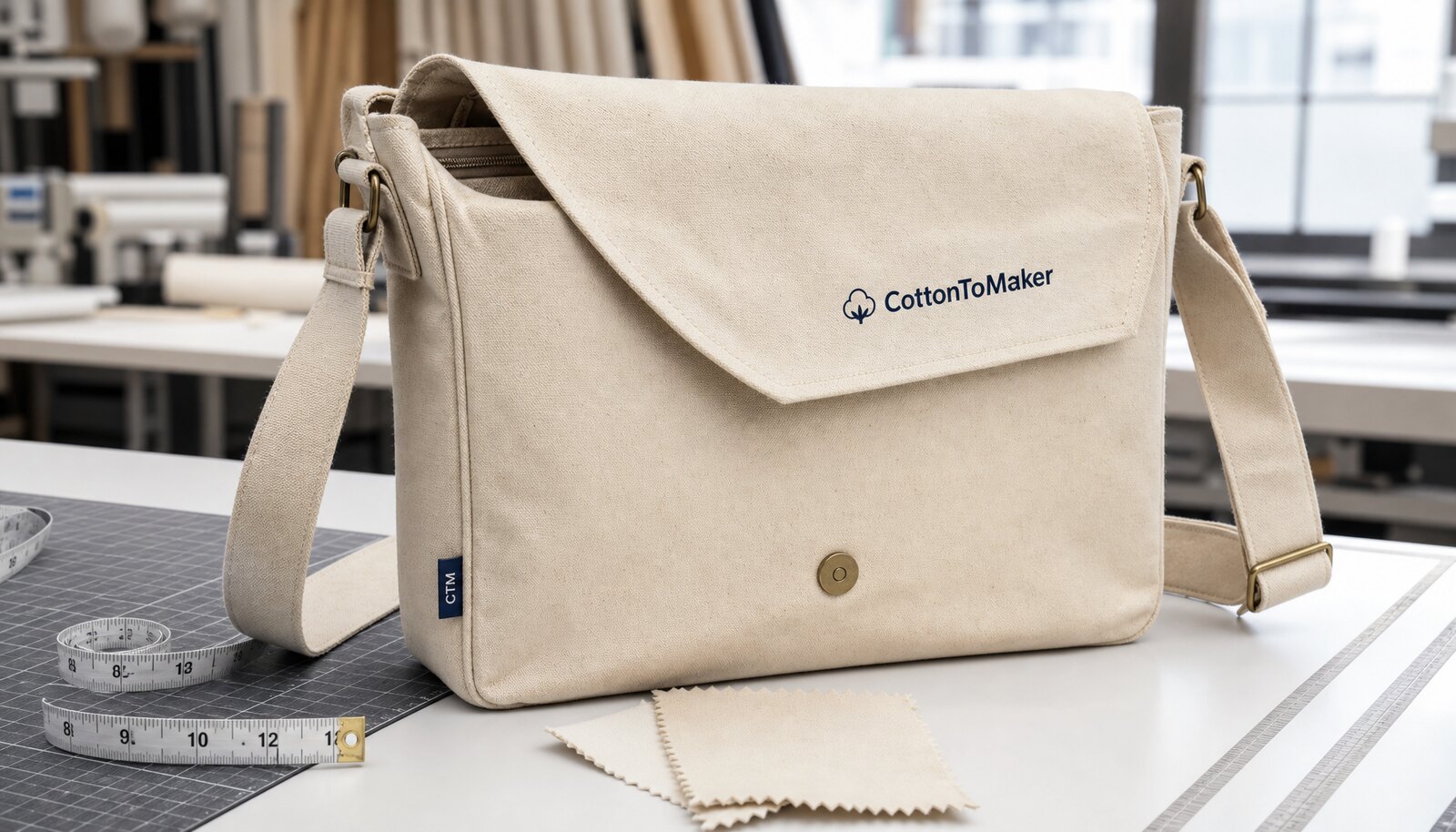
Start the RFQ With the Carrying Purpose
A custom canvas messenger bag wholesale quote can look cheap or expensive depending on what the factory assumes the bag must carry. A conference document bag, a casual retail shoulder bag, and a light laptop messenger bag are not the same product, even if the outside size is similar.
Before asking for price, define the real use case. If the bag must carry a laptop or heavy catalogues, the factory needs to quote stronger canvas, wider strap webbing, reinforced stress points, and possibly padding. If it is a promotional event bag for paper materials, a simpler construction may be enough.
- For documents and brochures, specify internal paper size and required gusset depth.
- For tablet or laptop use, provide device size, target load weight, and whether padding is required.
- For retail sale, confirm desired structure, lining, hardware finish, hangtag, barcode, and shelf presentation.
- For corporate gifting, define logo visibility, gift packing, and whether the bag must look premium at first touch.
Choose Canvas Weight by Structure, Not by Guess
Canvas weight is one of the largest cost and quality drivers. Buyers often request 12oz, 14oz, or 16oz canvas without connecting the weight to finished structure. In factory terms, heavier canvas gives better body but also increases sewing resistance, carton weight, freight cost, and sometimes the chance of needle marks or bulky corners.
For most custom canvas messenger bag wholesale orders, 12oz to 16oz cotton canvas is a practical range. A small flat messenger bag can use 12oz or 14oz. A larger commuter-style bag usually needs 16oz canvas or reinforcement panels. If the bag is washed after sewing, shrinkage and color shade variation must be discussed before sampling.
- 10oz canvas: cost-sensitive promotional use, lighter hand feel, less structure.
- 12oz canvas: common for simple messenger bags, conference bags, and light retail programs.
- 14oz canvas: stronger touch, better flap shape, good balance for brand merchandise.
- 16oz canvas: more durable and structured, suitable for heavier shoulder bags but higher freight impact.
- Washed canvas: softer and vintage-looking, but logo print and size tolerance need tighter control.
Specify the Bag Size as Finished Dimensions
A common sourcing mistake is sending only a rough size like 38 x 30 cm. The factory needs to know whether that is the finished outside size, front panel size, or usable inside capacity. Messenger bags lose capacity through seam allowance, flap overlap, lining, padding, and bottom gusset construction.
If your buyer team compares quotes from different factories, inconsistent size interpretation can create false savings. One supplier may quote a flat bag with no real depth while another quotes a gusseted bag with reinforced sides. The unit price difference may be construction, not margin.
- State finished width, height, and depth in centimeters or inches.
- Confirm flap length and whether it covers the full front panel or only the top section.
- Specify strap length range, webbing width, and whether the strap is fixed or adjustable.
- Define pocket layout, including front pocket, inner pocket, zipper pocket, pen slot, or laptop sleeve.
- Ask the factory to confirm cutting dimensions if capacity is critical.
Match Print Method to Fabric and Logo Position
Logo quality depends on fabric surface, logo detail, print area, curing, and placement. Canvas is not a smooth plastic sheet. Coarse yarns, seams, flap folds, washed texture, and dark colors all affect the final result. For B2B buyers, the safest artwork is not always the most colorful artwork.
Screen printing is the usual choice for bold one-color or few-color logos on canvas messenger bags. Heat transfer can reproduce detailed designs but may feel less natural on cotton canvas and needs testing for edge lifting. Embroidery works for small logos but can pucker lighter canvas if backing and stitch density are not controlled. Woven labels are useful when the brand wants a cleaner retail look with less print risk.
- Use screen print for solid logos, slogans, and simple brand graphics.
- Use embroidery for small premium marks, not huge filled artwork on thin canvas.
- Use woven labels or sewn patches when the logo must survive repeated abrasion.
- Avoid placing large prints across flap folds, darts, bulky seams, or snap reinforcement.
- Provide Pantone references, artwork file format, print size, and exact position from bag edges.
Understand MOQ Logic Before Comparing Quotes
MOQ is not only a sales rule. For custom canvas messenger bag wholesale production, MOQ is affected by fabric dyeing, canvas stock color, hardware plating, webbing color, logo method, label production, and carton packing. A natural canvas bag with one-color screen print usually has a lower entry MOQ than a custom-dyed washed canvas bag with branded metal hardware.
When suppliers quote different MOQs, ask what the MOQ is tied to. Some factories can produce a lower quantity if you use stock canvas and stock hardware. Others need a higher quantity because the fabric mill, dye house, or label supplier has its own minimum.
- Stock natural canvas usually supports lower MOQ than custom dyed colors.
- Custom webbing color may create a separate material MOQ.
- Metal hardware with custom plating can raise MOQ and lead time.
- Woven labels, rubber patches, or leather patches may have independent label MOQs.
- Split shipment or mixed colors can increase handling cost even when total quantity is high.
Check Construction Details That Affect Bulk Durability
Canvas messenger bags fail first at stress points: strap joints, side seams, flap corners, snap closures, zipper ends, and bottom gussets. These areas should be discussed in the RFQ, not discovered during inspection. A good factory quote should tell you how the bag is reinforced.
For wholesale buyers, the cheapest construction may pass a photo review but fail during use. Ask for close-up sample photos of stitching, inside seams, and reinforcement before approving bulk production. If the bag will carry a laptop or heavy materials, request a simple load test with the expected weight.
- Use bartack or box stitching at shoulder strap attachment points.
- Add reinforcement fabric behind magnetic snaps or metal buckles.
- Bind inside seams if the bag is unlined to reduce fraying.
- Use suitable zipper gauge if the design includes a top zipper or inner pocket.
- Check hardware edge smoothness to avoid cutting cotton webbing during use.
Approve Samples With Bulk Materials, Not Approximate Substitutes
A sample is useful only if it represents bulk production. Many pre-quote samples are made with available fabric, available webbing, or substitute hardware to save time. That can be acceptable for shape review, but it is not enough for final approval.
For a custom canvas messenger bag wholesale order, request a pre-production sample using bulk canvas weight, final color, final logo method, final hardware, final lining, and final packing method. If any material is still substituted, mark the approval as conditional and keep a written change list.
- Measure the sample size, strap length, flap alignment, and pocket placement.
- Check logo position against the approved artwork sheet.
- Rub the print surface with dry and slightly damp cloth after curing.
- Load the bag with realistic weight and inspect strap joint distortion.
- Photograph the approved sample from front, back, inside, side, and close-up stitching views.
- Keep one sealed approval sample for production comparison.
Define Packing and Carton Data Early
Packing affects freight cost, retail appearance, and defect rate. Canvas messenger bags are often flat packed to reduce carton volume, but heavy compression can create flap creases, print marks, and hardware pressure dents. If the print is on the flap, packing method should be tested before bulk export packing.
For distributors and retail buyers, carton data is also needed for warehouse planning. Ask for estimated carton quantity, carton size, gross weight, net weight, and carton mark format at quotation stage. If you need individual barcode stickers, hangtags, paper belly bands, or plastic-free packing, include them in the RFQ because they affect labor and material cost.
- Flat packing is efficient but needs protection for printed flaps and metal hardware.
- Individual polybags reduce dirt risk but may conflict with plastic-reduction policies.
- Paper belly bands can work for retail presentation if moisture control is handled.
- Desiccant may be needed for long sea shipments or humid seasons.
- Carton strength should match bag weight and stacking conditions.
Specification comparison for buyers
| Spec decision | Recommended option | When it fits | Buyer risk to check |
|---|---|---|---|
| Main canvas weight | 12oz to 16oz cotton canvas | Retail, corporate gifting, campus, light laptop carry | Too light may collapse; too heavy increases freight and sewing difficulty |
| Lining choice | 210D polyester or unlined bound seams | Lined for cleaner retail finish; unlined for lower cost and washable look | Dark lining can hide stains but may bleed if dye control is weak |
| Branding method | Screen print for flat logos; woven label for premium subtle branding | Screen print suits MOQ orders and bold artwork; labels suit long-term retail programs | Large prints over flap seams may crack or distort after folding |
| Closure system | Magnetic snap plus flap or metal buckle with hidden snap | Magnetic snap is faster for promotional use; buckle styling suits fashion or lifestyle retail | Weak magnets and thin reinforcement can tear canvas around closure points |
| Strap construction | 38mm to 50mm cotton webbing with slider adjuster | Better for commuter, conference, and school use | Narrow strap can feel cheap and cut into the shoulder when loaded |
| Packing method | Flat packed in export carton, optional individual polybag or paper belly band | Flat packing reduces carton volume and keeps flap shape | Over-compression can crease printed areas and deform padded panels |
Buyer checklist before sampling
- Confirm finished bag size in W x H x D, not only panel size before sewing.
- State canvas GSM or ounce weight, color, shrinkage tolerance, and whether fabric must be pre-shrunk or enzyme washed.
- Define carrying purpose: documents, tablet, laptop, retail fashion, conference gift, or promotional giveaway.
- Lock branding size, position, Pantone color, and print method before sample quotation.
- Ask whether stress points use bartack, box stitch, or extra reinforcement fabric.
- Confirm hardware material, color finish, buckle type, magnet strength, zipper gauge if used, and strap width.
- Request one pre-production sample using bulk fabric, bulk hardware, and final logo artwork.
- Specify packing: flat or folded, individual polybag or plastic-free pack, carton quantity, carton marks, and desiccant requirement.
- Ask for quote validity, MOQ by fabric color, sample lead time, bulk lead time, and what changes trigger requotation.
Factory quote questions to send
- What canvas weight do you recommend for this bag size and target retail price point, and what weight have you quoted?
- Is the fabric yarn-dyed, piece-dyed, natural cotton, washed canvas, or coated canvas?
- Does your quoted MOQ depend on fabric color, hardware color, label type, or print method?
- Can the logo be printed before sewing, or must it be printed after the bag is assembled?
- What reinforcement is included at strap joints, flap corners, closure points, and side seams?
- Will the sample use available substitute materials or exact bulk materials?
- What are the tolerances for bag size, strap length, logo position, and color difference?
- How many pieces per export carton, what is the estimated carton size, and can you quote gross weight?
- What inspection standard do you use for print defects, skipped stitches, stains, hardware scratches, and shape distortion?
- What information is missing from our RFQ that could change the final unit cost?
Quality-control points to confirm
- Check fabric GSM or ounce weight against the approved sample, not only the supplier's invoice description.
- Measure finished size after sewing and pressing because flap depth, seam allowance, and bottom gusset affect usable capacity.
- Rub test printed logos after curing, especially on washed canvas or dark dyed fabric.
- Load test the strap and closure points with realistic weight for the intended use.
- Inspect bartacks, box stitches, skipped stitches, loose threads, and seam slippage at stress points.
- Check flap alignment, buckle symmetry, magnetic snap placement, and zipper smoothness if the design includes a zipper.
- Review packing compression marks, moisture protection, carton strength, and barcode or carton mark accuracy.