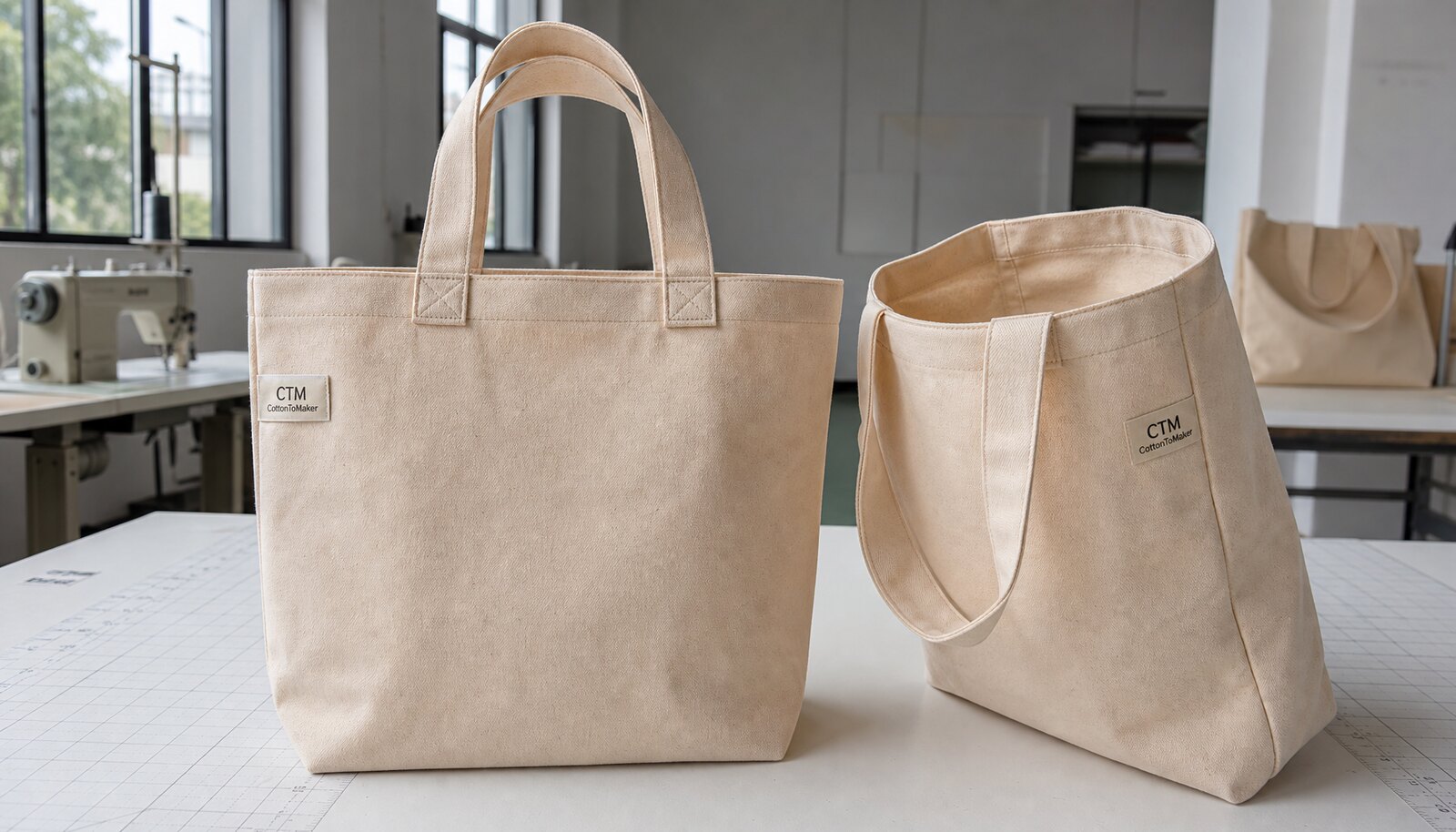
1) Define the tote's real job
Start with what the tote has to carry and how it will reach the recipient. A canvas grocery tote for an employee kit, client holiday gift, conference giveaway, loyalty reward, or retail add-on may look similar in a product photo, but each program has different risk. A brochure bag can be lighter. A tote carrying bottles, boxed food, notebooks, apparel, or a premium gift set needs a working gusset, stronger handle attachment, cleaner folding, and a base that does not collapse during kitting.
Put the use case directly into the RFQ. State whether the bag must stand open on a packing table, fit inside a gift box, fold into a mailer, carry comfortably on the shoulder, or arrive ready for event distribution. When suppliers receive only a logo and rough dimensions, one may quote a flat 10oz tote while another quotes a 14oz gusseted bag with reinforced handles. Both prices may be honest, but they are not comparable.
For corporate gifting, the tote is both packaging and a reusable product. Recipients notice handle comfort, stitching, logo position, and fabric hand after the gift contents are removed. Procurement also has to manage freight, carton count, storage, receiving, and inspection. The best tote is the one that fits the contents and brand standard without creating avoidable production or fulfillment cost.
- Employee kits: confirm apparel, bottle, notebook, card, and tech items fit without distortion.
- Client gifts: prioritize neat seams, consistent logo placement, and controlled folding.
- Grocery reuse: require gusset, reinforced handles, and a realistic load check.
- Events: check carton count, carton weight, SKU separation, and distribution speed.
- Retail resale: add barcode, hangtag, country-of-origin label, and stricter cosmetic inspection.
2) Specify canvas in measurable terms
Fabric is where many wholesale quotes drift. Words such as heavy, premium, durable, or thick do not tell a buyer whether the canvas is 10oz, 12oz, 14oz, or another construction. For many corporate gifting grocery totes, 12oz cotton canvas is a practical starting point because it gives body without becoming too bulky. A 14oz canvas can feel more substantial for premium gifts or heavier reuse. A 10oz fabric may work for budget programs if the sample still meets the use case.
Ask suppliers to state weight in both ounces and GSM where possible, and ask what the number describes. Is it greige fabric before finishing, finished fabric after dyeing or washing, or a supplier estimate from a stock fabric? Bleaching, dyeing, washing, and shrinkage can change hand feel, shade, and finished dimensions. Two quotes that both say 12oz may not produce the same bag.
Composition should also be written into the quote. The fabric may be 100% cotton, recycled cotton blend, organic cotton, cotton-poly blend, or another material. If your company needs organic, recycled, or restricted-substance documentation, name the required document before the supplier prices the order. Natural canvas may show seed flecks, slubs, and shade variation; bleached or dyed canvas may need tighter color approval.
- 10oz: suitable for lighter promotional use when the approved sample is acceptable.
- 12oz: balanced option for many branded grocery totes and corporate gift programs.
- 14oz: stronger structure and premium hand, with higher material cost and carton volume.
- Natural canvas: expect texture and shade variation unless tighter standards are approved.
- Dyed canvas: request lab dip or bulk swatch approval when color matters.
- Certified fabric: confirm available documents for the actual lot before making claims.
3) Build size and handles around the contents
Common finished sizes such as 14 x 14 x 6 in. or 16 x 15 x 6 in. can be useful starting points, but the bag should be sized around the actual contents. A square tote may suit boxed kits. A taller tote may suit bottles, folders, or apparel. A wider gusset helps packaged goods sit better, but it also uses more fabric, increases carton volume, and can affect how flat the print area looks when the bag is filled.
State finished dimensions after sewing: width, height, gusset, top opening, and usable interior space. Clarify whether width is measured across the front panel only or includes side gussets. If a gift box must fit, provide the box size and insertion direction. A box that technically fits may still slow the packing line if the opening is tight or the handles fall inward.
Handle details need equal precision. Specify material, width, finished length, handle drop, insertion depth, reinforcement, and intended carry style. Shoulder-carry totes need more drop than hand-carry totes, but long handles can complicate folding and carton packing. Self-fabric handles look cohesive; cotton webbing can provide a firmer grip and more consistent width. Either construction should have reinforcement that inspection can verify.
- Finished size: write width, height, gusset, top opening, and tolerance after sewing.
- Interior fit: test the largest item for easy insertion and removal.
- Handle drop: define hand carry, shoulder carry, or dual-purpose carry before sampling.
- Handle width: 1 to 1.5 in. is a useful range for many reusable totes.
- Reinforcement: require bartack, box-x, or approved equivalent at stress points.
- Base style: choose gusseted or boxed bottom for grocery function and boxed gifts.
4) Select logo method by artwork risk
Decoration should be chosen by artwork, fabric, color count, order quantity, and durability expectation. Screen printing is often the workhorse for canvas grocery totes because it handles solid marks efficiently and suits one to three spot colors. It is usually a strong fit for corporate logos, event marks, and repeat programs where the buyer wants a durable print and a canvas hand feel.
Detailed artwork needs more caution. Thin lines, small legal text, gradients, photographs, and many-color illustrations may need heat transfer, digital print, or another method. Transfers can have an edge feel and should be checked for adhesion and cracking when folded. Digital print can shift on natural canvas and may need pretreatment. Embroidery can look premium on some bags, but it can pucker lighter fabric and may not suit large filled logos.
Pantone references help, but canvas is not coated paper. Natural cotton can warm light colors, dull bright tones, and soften edges. For brand-sensitive orders, approve a strike-off on the actual fabric or a full pre-production sample before bulk printing. A digital proof cannot show ink opacity, print texture, real color on woven fabric, or how the mark behaves across seams and folds.
- Screen print: best for solid logos, spot colors, repeat orders, and larger runs.
- Heat transfer: useful for detailed art; sample for hand feel, edge quality, and flex.
- Digital print: useful for complex art; check color accuracy and opacity on canvas.
- Embroidery: consider only when fabric weight and logo size support it without puckering.
- Artwork file: provide vector art, Pantone references, print size, side, and placement.
- Small type: avoid fine copy on coarse canvas unless a strike-off proves readability.
5) Control MOQ by controlling variants
MOQ is shaped by fabric sourcing, dyeing, cutting, printing, sewing, packing, and inspection. The cleanest MOQ path is one size, one fabric color, one logo, one print position, and one packing method. Every additional version creates handling. A second fabric color may require another fabric lot. A second logo may need another screen or transfer setup. A zipper, lining, pocket, woven label, or special fold can move the tote into a different workflow.
Corporate gifting orders often become complicated late: department logos, office versions, separate insert cards, and multiple destination cartons. Those choices may be valid, but they should be priced deliberately. Ask for MOQ and unit cost by SKU, not only by total order quantity. A 3,000-piece order split across six artwork versions is not the same as one 3,000-piece run.
Version control also affects receiving. Mixed logos in one carton may save origin packing time but create sorting work at a fulfillment center. Separate cartons by SKU make counting easier, though carton count may rise. For first orders, keep the tote itself stable and personalize with inserts, belly bands, hangtags, gift contents, or outer packaging when possible.
- Lowest MOQ path: one size, one fabric color, one logo, one position, one pack format.
- Variant triggers: fabric color, artwork, print color count, pocket, zipper, lining, and label.
- Quote requirement: request MOQ, unit price, setup cost, and lead time by SKU.
- Receiving check: decide whether SKUs must be separated by carton, pallet, or destination.
- First-order tactic: standardize the tote and personalize around it.
6) Send a quote-ready RFQ
A useful RFQ turns a creative brief into a measurable product. Include finished tote size, gusset, fabric weight, composition, finish, handle material, handle drop, reinforcement, print method, logo size, print colors, quantity, delivery location, packing format, carton marks, and target schedule. Attach vector artwork and brand references. If the tote must hold gift contents, list item dimensions and approximate weights.
Ask for a structured price breakdown instead of only a unit price. Request line items for the base bag, printing, setup, sample, sample freight, packing, labels, inserts, carton marks, testing, inspection, and freight assumptions. This helps compare a direct factory, trading company, domestic decorator, or distributor. It also reveals whether a low price excludes sample revisions, special packing, or carton labeling.
Be precise about timing. Production lead time should start after written approval of the pre-production sample, artwork, and final PO details. Fabric dyeing, custom labels, testing, inspection, and peak-season capacity can change the calendar. Ask suppliers to identify deviations clearly. If they propose 10oz instead of 12oz or transfer print instead of screen print, it may be acceptable, but it must be visible.
- Attach final vector artwork and state exact print dimensions.
- State whether sampling, setup, packing, labels, inserts, and carton marks are included.
- Ask for production lead time after written sample and artwork approval.
- Request estimated carton size, carton quantity, gross weight, and volume.
- Require written confirmation of deviations from fabric, size, print, packing, or schedule.
- Ask for Incoterms or delivery terms so landed-cost comparison is possible.
7) Approve samples that match production
A catalog sample can help with direction, but it should not be the only approval for a branded wholesale order. The pre-production sample should use the actual canvas weight, fabric color, handle material, thread, print method, logo size, label, and proposed fold. If bulk fabric is not available yet, document that limitation and require a later fabric swatch or print strike-off before full cutting.
Evaluate the sample like a buyer and an inspector. Measure width, height, gusset, top opening, handle length, and handle drop. Check whether the tote stands open, folds neatly, and accepts the intended contents. Review top hem alignment, side seams, bottom corners, handle reinforcement, print opacity, print edges, fabric cleanliness, and odor. Load it with a realistic program weight and lift it repeatedly to watch for handle twisting, seam strain, or distortion around the print.
Record approvals in writing. Photograph the approved sample, note measurements, and mark logo position from fixed reference points. Keep one control sample with procurement or QC and one with the supplier. If a third-party inspector will be used, share the same measurement points and defect definitions.
- Approve the sewn tote, not only swatches or artwork proofs.
- Use final artwork, final print size, and final placement whenever possible.
- Measure and record the sample before authorizing bulk production.
- Test with realistic contents and approximate program weight.
- Approve the packing fold for gift boxes, mailers, or fulfillment cartons.
- Keep control samples for production, inspection, and dispute resolution.
8) Set QC rules before cutting
Quality control works best when acceptance criteria are agreed before production. For canvas grocery totes, inspection should cover fabric consistency, finished measurements, handles, seams, print, odor, cleanliness, packing, and carton count. Avoid subjective phrases such as good quality unless they are supported by measurable requirements. The supplier, inspector, and buyer should know what will be checked and what counts as a defect.
Dimension tolerances must be realistic for sewn cotton canvas. A body tolerance around +/- 0.5 in. may be practical for many orders, while logo placement or handle drop may need tighter control, such as +/- 0.25 to 0.5 in., depending on construction. These are examples to agree in advance, not universal factory standards. If a tote must fit a specific gift box, state that requirement before pricing and confirm it during sampling.
Classify defects so inspection decisions are not improvised. Critical defects affect safety, usability, or brand identity: broken handles, open seams, wrong logo, severe stains, mold odor, wet cartons, or unusable construction. Major defects hurt presentation or normal use: off-center print beyond tolerance, weak-looking reinforcement, wrong fold, mixed SKUs, or carton-count mismatch. Minor defects may include loose thread ends, light wrinkles, or natural cotton variation within the approved range.
- Inspection scope: fabric, dimensions, handles, seams, print, odor, cleanliness, packing, and marks.
- Measurement points: define top edge, side seam, gusset, handle drop, and logo centerline.
- Critical defects: broken handles, open seams, wrong logo, severe stain, mold odor, or wet carton.
- Major defects: visible print error, weak reinforcement, wrong packing, mixed SKU, or count mismatch.
- Minor defects: loose threads, light wrinkles, and approved natural cotton variation.
- Load check: define test weight, lift method, hold time, sample size, and failure criteria.
9) Treat packing as part of the spec
Packing affects cost, freight, warehouse receiving, fulfillment speed, and presentation. A well-made tote can still create problems if it arrives folded inconsistently, mixed with other logo versions, or packed in cartons too heavy for easy handling. For many corporate gifting orders, bulk flat packing by a consistent count is the simplest choice because it supports kitting and carton counting.
Individual polybags protect against dirt and moisture but add cost, labor, and plastic. Some buyers avoid them for sustainability reasons; others require them for retail control, warehouse scanning, or multi-location distribution. Paper belly bands, hangtags, tissue, barcode stickers, and insert cards can improve presentation, but each item needs approval and QC.
Fold size matters when totes go into gift boxes, mailers, or fulfillment bins. A 14oz gusseted tote with long handles may fold thicker than expected. Approve the fold during sampling and ask for folded dimensions. Carton labels should match the PO and receiving process, including item name, SKU, logo version, quantity, carton number, gross weight, net weight, and destination where needed.
- Bulk flat pack: efficient for kitting, lower material use, and easier counting.
- Individual polybag: better unit protection, with added cost and plastic use.
- Bundle pack: useful for office distribution, event kits, or fixed-quantity shipments.
- Retail-ready pack: requires barcode, hangtag, insert, sticker, and presentation approval.
- Carton control: separate SKUs clearly unless the PO requires mixed cartons.
- Freight planning: request carton dimensions, pack count, weight, and cubic volume.
10) Award on landed cost and supplier fit
The lowest ex-factory price is not automatically the best purchasing result. A cheaper quote may use lighter canvas, smaller finished dimensions, narrower handles, weaker reinforcement, fewer print colors, basic packing, or no allowance for sample revisions. Compare suppliers on landed cost per usable branded tote at the receiving location. Include base unit price, setup, sample fees, sample freight, packing, labels, inspection, freight assumptions, duties if applicable, and defect handling.
Supplier type matters. A direct factory may give stronger control over fabric, sewing, and repeat production, but it usually requires clearer specifications and more active review. A trading company may simplify communication or combine several gift items, but the buyer should clarify who owns QC responsibility. A domestic decorator may move faster for urgent programs, though base tote options can be narrower. The right route depends on order complexity, timeline, repeat potential, documentation needs, and control level.
Before issuing the PO, align the final specification, approved sample path, artwork proof, tolerances, packing method, carton marks, inspection plan, lead time, payment terms, and remedy for failed inspection. Confirm whether production starts only after written sample approval. Confirm who pays for rework, replacement, sorting, or expedited freight if the supplier ships outside the approved specification. A strong custom canvas grocery tote checklist turns a broad gifting idea into a controlled wholesale purchase.
- Compare fabric weight, finished size, handles, gusset, print method, and packing like for like.
- Calculate landed cost, not only unit price or ex-factory price.
- Check whether setup, samples, revisions, labels, carton marks, testing, and inspection are included.
- Review carton volume because bulky totes can change freight cost.
- Choose supplier fit based on control, speed, communication, documentation, and repeat reliability.
- Release the PO only after spec, sample path, QC rules, packing, and remedies are written.
Specification comparison for buyers
| Spec decision | Recommended option | When it fits | Buyer risk to check |
|---|---|---|---|
| Canvas weight | State both oz and GSM, with the basis identified as greige, finished, or supplier estimate | Corporate gifts, grocery reuse, employee kits, client welcome packs, and premium event bags | Heavy, premium, and thick are not purchasing specs. Two 12oz quotes may feel different if one is based on greige fabric and the other on finished fabric. |
| Fabric composition | Name 100% cotton, recycled cotton blend, organic cotton, cotton-poly blend, or other fabric on the quote | Buyers comparing cost, durability, sustainability requirements, and documentation needs | Do not treat eco wording as proof. Ask which documents can be supplied for the actual lot before making claims. |
| Finished bag size | Write width, height, gusset, top opening, and tolerance after sewing | Grocery function, boxed gift sets, apparel kits, bottles, notebooks, and multi-item corporate gifts | Catalog sizes may be approximate or measured flat. Clarify whether width includes side gussets and whether the bag must fit a box. |
| Dimension tolerance | Use realistic sewn-goods tolerances, such as body dimensions around +/- 0.5 in. when suitable | Most canvas tote orders where fabric relaxation and sewing variation are expected | Tighter tolerances can raise cost or rework risk. Loose tolerances can cause gift-box fit issues or uneven presentation. |
| Gusset and base | Side-and-bottom gusset or boxed bottom approved on sample | Grocery use, kitting lines, boxed gifts, and heavier contents | Flat totes may cost less but do not behave like grocery bags. Bottom corners need inspection on load-bearing orders. |
| Handle construction | Cotton webbing or self-fabric handles, defined width, drop, insertion depth, and reinforcement | Repeat use, shoulder carry, employee kits, and heavier grocery loads | Narrow handles, shallow insertion, missed bartacks, or uneven stitching can lead to field failures. |
| Logo method | Screen print for solid spot-color logos; transfer or digital print for detailed or many-color artwork | Corporate logos, campaign marks, and brand-controlled gifting programs | Fine type can fill on textured canvas. Transfers and digital prints should be sampled for hand feel, opacity, color, and flex behavior. |
| Logo placement | Artwork proof with print size, top-edge distance, centerline, side reference, and placement tolerance | Orders with brand review, multiple carton lots, multiple destinations, or repeat production | Visual centering by eye can create inconsistent logo height or prints too close to seams and folds. |
| Packing format | Bulk flat pack, individual polybag, bundle pack, or retail-ready pack stated before quoting | Kitting, warehouse receiving, event distribution, retail resale, and multi-location programs | Packing changes affect labor, carton volume, waste, scanability, and landed cost. |
Buyer checklist before sampling
- Define the business use: grocery reuse, employee welcome kit, client gift hamper, event distribution, retail resale, internal merchandise, or fulfillment-center kitting.
- List real contents with dimensions and approximate weights, including bottles, notebooks, apparel, food packs, tech items, inserts, or boxed gifts.
- Specify finished width, height, gusset depth, top opening, usable interior space, and whether dimensions are measured flat or standing open.
- State canvas weight in oz and GSM, fabric composition, color, finish, shrinkage expectation, and whether certification is required or optional.
- Choose construction details: open top, snap, zipper, lining, pocket, boxed bottom, side-and-bottom gusset, bound seams, woven label, or hangtag.
- Set handle material, width, finished length, handle drop, insertion depth, reinforcement method, stitch color, and intended carry style.
- Choose logo method after reviewing artwork complexity, Pantone requirements, fabric color, print size, hand feel, durability, and order quantity.
- Provide final vector artwork, Pantone or brand references, print dimensions, placement measurements, orientation, and approved proof requirements.
- Ask for MOQ and pricing by SKU, including each fabric color, logo version, print color count, bag size, special feature, and packing method.
- Request quote lines for base bag, printing, screens or setup, sample, sample freight, packing, labels, inserts, cartons, testing, inspection, and freight terms.
Factory quote questions to send
- What exact canvas weight will be used in oz and GSM, and does that weight describe greige fabric, finished fabric, or a supplier estimate?
- What is the fabric composition, and what documentation can be supplied if certification, recycled content, organic cotton, or restricted-substance records are required?
- Is the quoted color natural, bleached, dyed, pigment-dyed, washed, or yarn-dyed, and can you provide lab dip, bulk swatch, or lot approval before cutting?
- Are the quoted dimensions finished dimensions after sewing, and what tolerance do you hold for width, height, gusset, top opening, and handle drop?
- What handle material, width, length, drop, insertion depth, and reinforcement method are included in the unit price?
- What load expectation do you recommend for this construction, and how do you check handle attachment and seam strength during production?
- Which print method is included, how many colors are covered, what is the maximum print area, and what setup, screen, plate, or artwork charges apply?
- Can you match Pantone references on the actual canvas, and will you provide a strike-off or printed pre-production sample before bulk printing?
- What is the MOQ by fabric color, logo version, bag size, print position, print color count, and added feature such as zipper, pocket, lining, or label?
- Will the pre-production sample use actual bulk fabric, final print method, final handles, final thread, final label, and the proposed packing fold?
Quality-control points to confirm
- Canvas weight is checked against the approved specification in oz and GSM using the agreed basis; vague terms such as heavy, premium, or thick are not accepted as QC criteria.
- Fabric composition, color, weave character, slub level, odor, and hand feel match the approved swatch or pre-production sample within agreed natural variation.
- Finished width, height, gusset depth, top opening, handle drop, and folded packing size are measured from written reference points against the approved tolerance.
- A practical body-dimension tolerance for sewn canvas may be around +/- 0.5 in. when suitable, but the buyer and supplier should agree the number before quoting.
- Handles are aligned, symmetrical, evenly inserted, and reinforced with the approved bartack, box-x, or equivalent stitching pattern at each stress point.
- Handle stitching has no skipped stitches, loose ends, broken threads, needle cuts, open reinforcement, or obvious tension problems that could weaken attachment.
- Top hem, side seams, bottom seams, gusset corners, and pocket or zipper seams are closed, even, and free from open seams, excessive fraying, or raw-edge exposure beyond the approved style.
- Logo size, color, placement, orientation, and side are checked against the approved proof from fixed reference points rather than by eye only.
- Logo placement tolerance may be around +/- 0.25 to 0.5 in. depending on print size and construction; stricter requirements should be stated before production.
- Packing count, fold style, SKU separation, carton marks, carton condition, odor, moisture, and barcode or label accuracy are checked before shipment release.