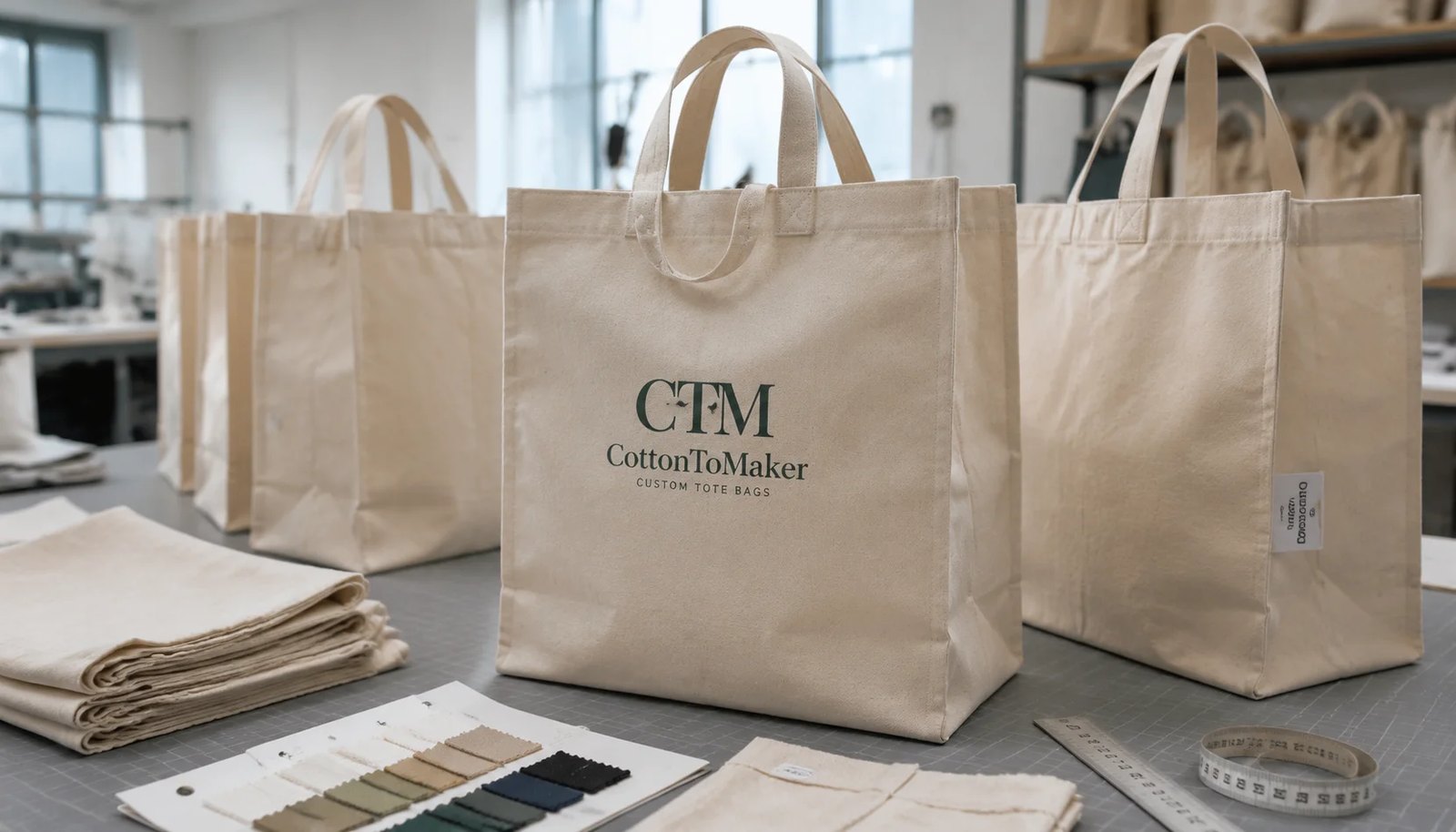
Start With the Real Carrying Use
A custom canvas grocery tote for natural grocers is not the same buying problem as a light cotton event tote. Shoppers may load apples, glass jars, milk cartons, bulk dry goods, and chilled items into the same bag. The specification should begin with carrying behavior, not only the logo size or target unit price.
For most grocery retail programs, the buyer needs a tote that feels natural and brand-appropriate but still carries weight without handle failure. A thin promotional tote may look acceptable in a sample photo and still fail at checkout when loaded with bottles. Define the expected load and the store use case before collecting quotes, because that decision affects fabric weight, handle reinforcement, bottom construction, carton size, and freight cost.
- Use a flat light tote only for coupons, dry packaged goods, or low-cost giveaways.
- Use a boxed-bottom grocery tote when the bag must stand open at checkout or carry bulky goods.
- Use wider handles when shoppers will carry the bag on the shoulder for more than a few minutes.
- Use a darker dyed canvas or heavier natural canvas when visible staining is a concern.
- Separate resale merchandise totes from free promotional totes; they normally need tighter finishing and packaging.
Choose Fabric Weight by Function
Fabric weight is one of the biggest quote differences in wholesale canvas grocery totes. Many buyers compare 8 oz, 10 oz, and 12 oz prices without confirming whether the supplier means greige weight, finished weight, or a local equivalent converted from GSM. That creates false savings. A tote quoted as 10 oz from one factory may feel close to another factory's 9 oz if the yarn, weave density, and finishing are different.
For natural grocers, 10 oz to 12 oz cotton canvas is usually the practical range for reusable grocery totes. Around 8 oz can work for light promotional bags, but it may collapse under heavier grocery use and show more distortion around the handle stitch. Above 12 oz can feel premium, but cost, sewing difficulty, carton weight, and freight all rise. If the tote is sold as a retail item, the heavier handfeel may be worth it. If it is a checkout campaign bag, the middle range is often more efficient.
- 8 oz canvas, roughly 270 GSM, fits low-cost light duty but needs conservative load expectations.
- 10 oz canvas, roughly 340 GSM, is a common starting point for reusable grocery totes.
- 12 oz canvas, roughly 400 GSM, gives stronger structure and better perceived value for resale or loyalty programs.
- 14 oz canvas and above should be treated as a premium bag with higher sewing, freight, and folding impact.
- Always approve a physical fabric swatch and finished sample; GSM alone does not show handfeel, shrinkage, or stiffness.
Lock the Bag Shape Before Price Comparison
The cheapest quote is often based on a flat tote with simple side seams and no gusset. That may not match a grocery buyer's expectation. A grocery tote usually needs a gusseted side or boxed bottom so the bag accepts cartons, produce clamshells, and bottles without forcing the shopper to stack goods awkwardly. The difference is visible in use and measurable in labor.
Finished size should be written as a complete dimensional spec, not only width by height. Include gusset depth, handle drop, handle width, seam type, and bottom shape. If the bag is expected to stand on a checkout counter, request a sample packed with typical grocery items and judge stability. A tote that looks clean when empty may fall over repeatedly when loaded.
- Common grocery size range: about 35-42 cm wide, 35-40 cm high, with 10-15 cm gusset.
- Shoulder handle drop: commonly 25-30 cm, depending on market preference and winter clothing needs.
- Handle width: 2.5-4 cm for comfort; narrow handles cut into the shoulder when loaded.
- Seam binding improves appearance and helps control fraying inside the bag.
- Cross-stitch, box stitch, or bartack reinforcement should be included at handle attachment points.
Match Printing to Artwork and Wear
Most natural grocer tote programs use simple brand artwork: one-color store logos, earthy spot colors, product campaign graphics, or short slogans. Screen printing is normally the most efficient method for solid artwork on canvas because setup is stable and ink coverage is predictable. The buyer should still control ink thickness, print placement, and print durability, especially on natural canvas where surface texture affects edge sharpness.
Heat transfer can reproduce complex graphics, small gradients, and multi-color illustrations, but it changes the surface feel and may not suit every brand. Embroidery can look premium on small marks, yet it is usually inefficient for large front panels and can pucker lighter canvas. Woven labels are useful when the tote design should stay clean and retail-like, but label placement and stitch color must be specified.
- Use screen print for one to three spot colors and larger logo panels.
- Use water-based or discharge-style effects only after approving handfeel and color strength on actual fabric.
- Use heat transfer for complex artwork only when flexibility, edge finish, and wash behavior are acceptable.
- Use embroidery for small premium logos, not large grocery messages.
- Include Pantone references, artwork size, distance from top edge, and acceptable print registration tolerance in the RFQ.
Understand MOQ Logic
MOQ for custom canvas grocery totes is not only a total piece number. It is shaped by fabric purchase, dyeing, print setup, label setup, cutting efficiency, packing versions, and factory line scheduling. A buyer asking for 1,000 pieces across five designs may receive a quote that looks accepted at first, then expands through setup charges and longer sampling time.
Natural grocers often need store-specific logos, regional campaigns, bilingual artwork, or seasonal colorways. Each variation should be counted before the RFQ goes out. The cleanest quote table separates total quantity from quantity per design and quantity per fabric color. This prevents the supplier from averaging costs in a way that hides the real expense of small runs.
- MOQ per natural canvas body is usually easier than MOQ per custom dyed fabric.
- Each print design may require separate screen setup and color matching.
- Each woven label version may require its own label MOQ even if the bag MOQ is lower.
- Small split shipments to many stores may increase packing labor and carton marking work.
- A slightly higher order quantity can reduce unit price if it improves fabric yield or carton efficiency.
Build an RFQ That Suppliers Can Price Cleanly
A useful RFQ should remove interpretation. If the supplier has to guess fabric, handle length, seam type, print size, packing, and label requirements, the first quote will be too vague to compare. Worse, the lowest supplier may simply assume the lightest construction. A clean RFQ does not need to be long, but it must include the details that change cost.
Procurement teams should request the quote in a consistent format: unit price, sample cost, tooling or screen charges, label charges, export carton data, lead time, payment terms, and validity period. This lets the buyer compare landed cost, not only ex-factory price. A tote that is 3 percent cheaper at unit level can become more expensive if carton volume is poor or packing creates store handling work.
- Product name: custom canvas grocery tote with boxed bottom and shoulder handles.
- Material: cotton canvas, target oz and GSM, natural or dyed, with any sustainability document requirement.
- Size: width, height, gusset, handle length, handle width, and finished tolerance.
- Printing: method, number of colors, Pantone codes, artwork size, and position.
- Packing: pieces per inner pack if needed, pieces per carton, carton marks, barcode rules, and pallet preference.
- Commercial data: MOQ, price breaks, sample timing, production lead time, carton dimensions, gross weight, and quote validity.
Use Samples to Prevent Production Drift
A sample is not only a sales sample. It is the physical contract for fabric handfeel, sewing method, print result, handle comfort, and packing fold. For wholesale grocery totes, one attractive photo is not enough. The buyer should approve a pre-production sample made with the same material route and print method planned for bulk production.
Sample comments should be written like production instructions. Instead of saying the logo should be bigger, state the new print width and placement from the top edge. Instead of saying the handle feels weak, specify wider handle webbing, extra stitching, or heavier canvas. Every change after the sample stage can affect price and lead time, so changes should be closed before bulk fabric is cut.
- Compare the sample fabric against the approved swatch in weight, color, stiffness, and surface texture.
- Measure finished width, height, gusset, handle drop, and handle width with the bag laid flat.
- Load the tote with a realistic grocery weight and inspect handle stress after carrying.
- Rub the print with a clean white cloth to see whether ink transfers after curing.
- Review folding and carton packing, because fold lines across the logo can become permanent on heavier canvas.
Set Practical QC Acceptance Criteria
Quality control should be specific enough for factory inspectors and third-party inspectors to apply consistently. For canvas grocery totes, the main risks are fabric inconsistency, weak handle attachment, print defects, stains, odor, incorrect dimensions, and rough inside finishing. A small cosmetic defect may be acceptable for a giveaway bag but not for a retail merchandise tote sold near the checkout counter.
Procurement teams should define critical, major, and minor defects before inspection. Critical defects include unsafe contamination, sharp objects, mildew odor, or handle failure under the agreed load. Major defects include wrong material weight, wrong logo color, open seams, severe stains, or incorrect size outside tolerance. Minor defects may include a short loose thread or slight natural cotton speckling if the approved sample shows similar character.
- Dimension tolerance: commonly plus or minus 1 cm for width and height, with gusset tolerance agreed separately.
- Fabric tolerance: commonly plus or minus 5 percent GSM unless the program requires tighter control.
- Handle strength: sample test should match the buyer's target load, such as a defined static hanging weight for a set time.
- Print tolerance: no obvious smearing, peeling, cracking, major color deviation, or off-center placement beyond approved tolerance.
- Odor control: no mildew, chemical odor, or damp carton smell at final inspection.
- Needle and trimming control: no broken needle fragments, sharp plastic tags, or hard thread knots in the bag body.
Plan Packing for Store Receiving
Packing is often treated as an afterthought, but it affects landed cost and store labor. Natural grocer buyers may need totes shipped to a central warehouse, allocated by store, or packed for retail sale. Each route has different requirements. A bulk carton for distribution is efficient, while a retail-ready bag may need hangtags, barcode labels, or individual folding bands.
Canvas totes are bulky compared with thin nonwoven bags, and heavier fabric increases carton weight quickly. Overpacking a carton can crush handles and create hard fold marks across the print. Underpacking wastes freight volume. A good factory quote includes pieces per carton, carton dimensions, net weight, gross weight, and suggested loading quantity so the importer can calculate sea freight, air freight exceptions, and warehouse handling.
- Flat pack reduces wrinkles but increases carton footprint.
- Half-fold packing can save volume but should avoid folding directly through the printed logo.
- Individual polybags may not fit a natural grocer's sustainability position; paper bands or bulk packing may be better.
- Store allocation requires carton marks that identify design, quantity, store code, and purchase order.
- Moisture protection should be planned for cotton canvas, especially during long ocean transit or humid storage.
Protect the Schedule
Lead time should be counted from final artwork and sample approval, not from the first inquiry. A realistic schedule includes fabric sourcing or weaving, dyeing if needed, sample making, sample shipping, buyer review, bulk cutting, printing, curing, sewing, trimming, inspection, packing, and export booking. Any delay in artwork approval or label confirmation moves the whole timeline.
The highest schedule risk usually appears when the buyer changes artwork after screens are made, adds a new store version late, requests certified material documents after production has started, or discovers packing requirements only at the warehouse stage. A sourcing calendar should name the decision owner for each approval. That prevents the factory from waiting several days for small confirmations that later become urgent.
- Reserve time for physical sample shipping, not only sample production.
- Approve Pantone colors on actual canvas where possible, because natural fabric changes color perception.
- Freeze artwork before screen making or transfer film production.
- Book extra time for custom dyed canvas, organic cotton documentation, or woven labels.
- Schedule final inspection before the cargo-ready date, leaving room for sorting or rework if defects are found.
Specification comparison for buyers
| Spec decision | Recommended option | When it fits | Buyer risk to check |
|---|---|---|---|
| Fabric weight for grocery use | 10 oz to 12 oz cotton canvas, about 340-400 GSM before finishing | Reusable grocery programs where buyers carry produce, jars, bottles, and packaged goods | Do not compare only by ounce rating; mills may quote finished GSM differently, so require actual GSM tolerance and sample swatch |
| Bag construction | Open-top tote with boxed bottom, inside seam binding, and reinforced handle cross-stitch | Retail checkout bags, loyalty gifts, and private-label grocery merchandise | Flat totes look cheaper in quotes but carry groceries poorly; boxed bottoms and seam binding add cost but reduce failures |
| Handle length | 55-65 cm shoulder handles using same canvas or heavier webbing | Most grocery buyers need shoulder carry plus hand carry comfort | Short handles reduce fabric cost but cause customer complaints when the bag is loaded or worn over winter coats |
| Print method | Screen print for solid logos; heat transfer only for complex multi-color artwork; embroidery for small premium marks | Natural grocer branding normally uses one to three spot colors on natural or dyed canvas | Heavy ink coverage can stiffen the panel and crack on folds; require print size, ink type, and wash/rub test standard |
| Material positioning | Conventional cotton canvas, recycled cotton blend, or organic cotton only when documentation supports the claim | Conventional canvas for cost-sensitive campaigns; certified organic only for retail claims or brand standards | Sustainability claims create compliance risk; specify certificate scope and transaction documents instead of accepting verbal claims |
| MOQ planning | MOQ by fabric color, print setup, and carton efficiency, not only total order quantity | Multi-store grocery rollouts with several logo versions or regional artwork | A supplier may accept a low total MOQ but charge hidden setup fees for each colorway, logo, or packing version |
| Packing format | Flat packed or half-folded by 50-100 pcs per export carton with moisture protection | Wholesale distribution, store allocation, and backroom receiving | Over-compressed cartons create permanent creases and distorted print panels; require carton size, gross weight, and fold method |
| Supplier route | Direct factory for repeat wholesale programs; trading company only when consolidating mixed bag categories | Direct factory fits stable canvas tote specs and repeat replenishment; traders fit small mixed SKUs | A cheaper route is not always lower landed cost; compare sample accuracy, defect handling, packing discipline, and communication speed |
Buyer checklist before sampling
- Define the intended load: light produce, weekly grocery shopping, bottled goods, or retail merchandise resale.
- Specify finished bag size, gusset depth, handle length, handle width, and whether the tote must stand when partially filled.
- State fabric type and target weight in both ounces and GSM, with an allowed tolerance range.
- Clarify natural, bleached, dyed, recycled, or organic cotton requirements and what documents are needed to support claims.
- Provide artwork as vector files with Pantone references, print size, print position, and acceptable color tolerance.
- Choose the print method before comparing quotes, because screen print, transfer, embroidery, and woven labels use different setup logic.
- List construction details: boxed bottom, side gusset, seam binding, bartack or cross-stitch reinforcement, and inside label requirements.
- Request a pre-production sample made in correct fabric, correct handle, correct print method, and correct packing fold.
- Set QC thresholds for fabric defects, seam strength, print registration, color variance, odor, stains, and carton condition.
- Require carton dimensions, pieces per carton, gross weight, net weight, and pallet loading suggestion for landed-cost review.
Factory quote questions to send
- What finished GSM and ounce weight are you quoting, and what is the normal production tolerance?
- Is the quoted canvas greige, washed, bleached, dyed, recycled blend, or certified organic cotton?
- What bag size, gusset, handle length, handle width, and seam construction are included in the unit price?
- Which print method is quoted, how many colors are included, and what is the maximum print area before extra charges apply?
- What MOQ applies per fabric color, per print design, per label version, and per packing method?
- Can the pre-production sample be made with bulk fabric and actual production ink or only available sample-room material?
- What tests or in-line checks do you perform for handle pull strength, seam slippage, print rub resistance, and color matching?
- How many pieces per export carton, what carton dimensions, and what gross weight are expected for the quoted specification?
- Are woven labels, care labels, hangtags, barcodes, recycled content documents, or organic cotton documents included or charged separately?
- What is the realistic lead time after sample approval, and what part of the schedule depends on fabric availability?
Quality-control points to confirm
- Fabric weight should match the approved sample within the agreed GSM tolerance, commonly plus or minus 5 percent unless otherwise stated.
- Finished bag dimensions should stay within the approved tolerance after sewing, usually plus or minus 1 cm for width and height on grocery totes.
- Handle attachment must be reinforced with clean cross-stitching, bartack, or equivalent stitching, with no skipped stitches at the load-bearing points.
- A loaded sample should hold the agreed test weight without handle tearing, seam opening, or visible fabric distortion beyond normal stretching.
- Print color should match the approved Pantone or lab dip reference under consistent lighting, with no obvious registration shift on multi-color prints.
- Print surface should pass a reasonable dry rub and light scratch check without flaking, heavy dusting, or ink transfer to adjacent bags.
- Inside seams should be secure and not expose raw edges that shed threads into grocery packaging.
- Bags should be free from oil stains, mildew odor, heavy lint contamination, broken needles, loose threads, and sharp trim residue.
- Cartons should be export-grade, dry, correctly marked, and packed to avoid permanent creasing across the printed logo panel.
- Random inspection should include product measurement, fabric handfeel comparison, stitching review, print review, odor check, and carton count verification.