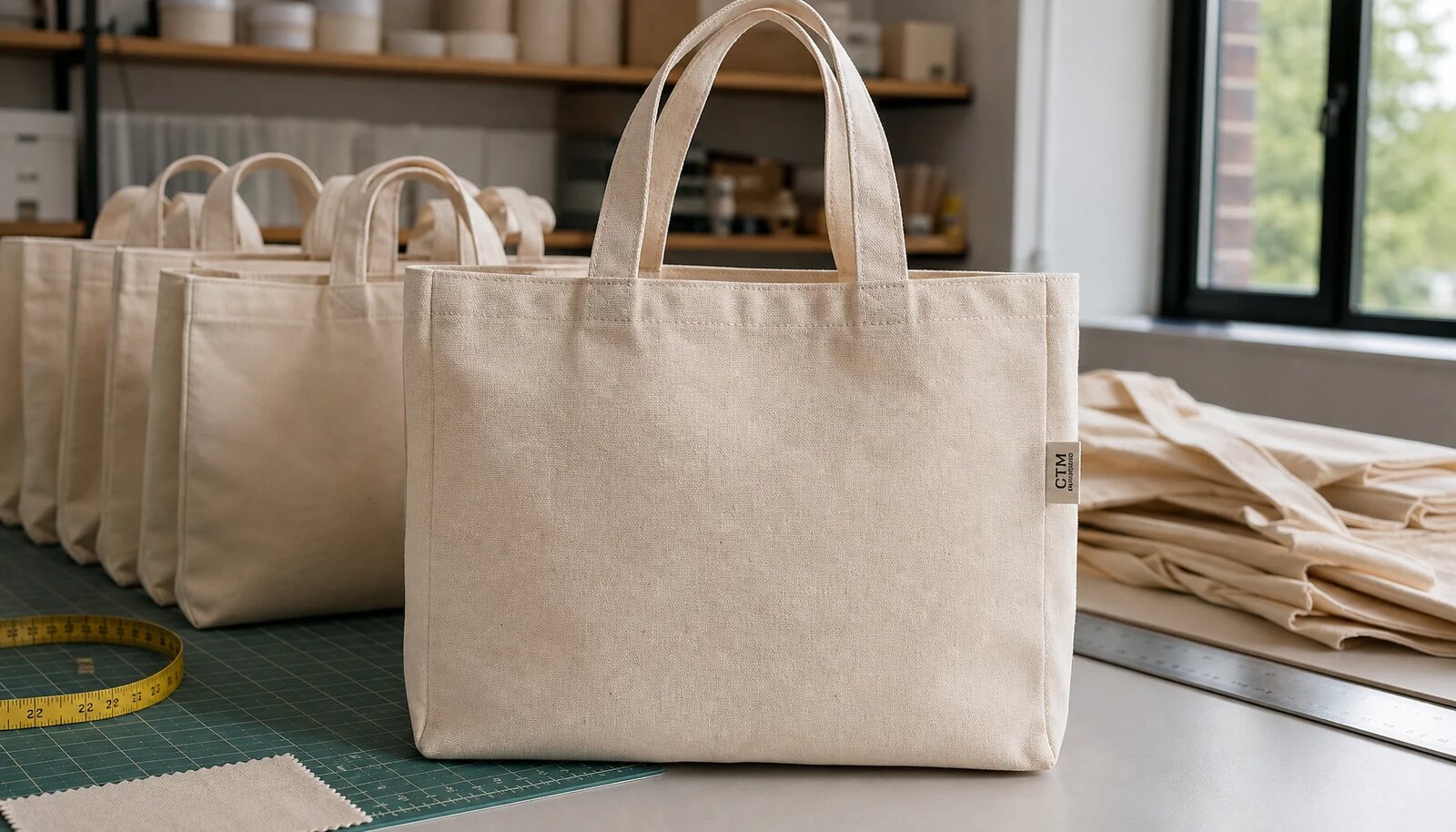
Start with the procurement brief
A custom canvas grocery tote looks simple until the order hits sourcing, quoting, and production. Fabric weight, seam construction, print method, packing, and inspection standards all change the final result. Eco apparel brands usually use these totes as retail resale items, customer gifts, store shopping bags, order inserts, or corporate merchandise, and each use case pushes the spec in a different direction.
Before you request pricing, write a short procurement brief that says who will use the tote, what it needs to carry, how often it should be reused, where it will be distributed, and how visible the brand mark should be. A tote for resale in an apparel store may need cleaner finishing, better print consistency, and barcode-ready retail handling. A giveaway bag may need a lower unit price and faster delivery. A grocery bag expected to hold heavier items needs a gusset, reinforced handles, and a sample tested with realistic load.
This brief also forces internal alignment. Marketing may want a softer natural canvas and a larger print area. Logistics may care more about carton count and fold size. Finance may focus on landed cost and reorder risk. Procurement sits in the middle and has to translate preferences into measurable requirements, because factories cannot quote accurately from mood boards or front-view renderings alone.
- Define the buying objective in one sentence, such as reusable grocery tote for retail resale or fold-flat tote for apparel order inserts.
- List the intended contents: light garments, produce, boxed goods, books, or repeated grocery loads.
- Rank the priorities: lowest unit cost, stronger construction, better print clarity, faster delivery, retail presentation, or lower packing waste.
- Confirm the distribution route: store replenishment, wholesale cartons, e-commerce fulfillment, pallet shipment, or event handout.
- Use a reference sample for visual direction, then convert it into dimensions, fabric, construction, and packing requirements.
Specify canvas in terms mills can build and factories can inspect
Fabric weight drives cost, hand feel, structure, print result, and freight volume. For many custom canvas grocery totes wholesale programs, 10 oz to 12 oz cotton canvas is a practical starting range. In metric terms, that is roughly 340 to 407 GSM, although conversion depends on how the supplier measures and finishes the fabric. Ten-ounce canvas can be enough for lighter retail or promotional use. Twelve-ounce canvas usually feels more substantial, holds its shape better, and gives buyers more confidence for reusable grocery carry. Heavier canvas can be appropriate for premium or higher-load programs, but it increases material cost, sewing bulk, carton size, and shipping weight.
The number on the quote is not enough. Some suppliers quote greige fabric weight before dyeing, washing, or softening. Others quote finished weight, and some use a nominal mill category that does not map cleanly to a finished bag. A washed 12 oz canvas can feel different from an unwashed 12 oz canvas. An open weave can feel less dense than expected even when the weight looks right. Buyers should approve a physical swatch or finished sample and record whether that sample is the production standard.
Finish matters as much as weight. Natural or unbleached canvas is popular with eco apparel brands because it pairs cleanly with organic cotton apparel, recycled packaging, and simple brand graphics. It can also show seed flecks, slubs, and shade variation. Those are not always defects, but the acceptable level should be defined before inspection. Dyed canvas needs shade approval. Washed or softened canvas needs finished-dimension confirmation because treatment can change shrinkage and hand feel.
- Request fabric weight in oz and GSM, plus the supplier's stated tolerance, such as +/-5% if that is their working standard.
- Ask whether the quoted weight is greige, finished, or nominal, and keep that wording in the approved spec sheet.
- Approve the actual fabric swatch or sample bag under neutral lighting, not only a photo.
- For natural canvas, define acceptable flecks, slubs, shade variation, and small yarn irregularities.
- For dyed canvas, request lab dip approval and note whether colorfastness or color transfer checks are needed for your channel.
- For washed canvas, measure the post-finish sample and confirm the quoted dimensions are finished dimensions.
Engineer the body for grocery carry, not just for shelf appeal
The tote body determines whether the bag works in real use. A flat cotton tote may be fine for an apparel insert, but groceries need volume, bottom support, and stress control. A gusseted construction gives the bag more usable space and helps it accept bulky items. A boxed bottom can make the tote sit better when filled, but it adds sewing complexity and creates corner points that need inspection. If the program is meant to feel durable, the body construction has to support that promise.
Specify the finished size the customer will receive. Include width, height, gusset depth, and bottom style. For grocery use, the gusset is not cosmetic; it changes capacity and stability. A deep gusset without good corner sewing can distort. A shallow gusset may save cost, but it can frustrate users who expect a real shopping tote. Finished bag measurements should be taken after sewing, pressing, washing, or any final treatment, because cut-panel dimensions are not the same as delivered dimensions.
Inside finishing deserves attention too. Raw inside seams may be acceptable for low-cost promotional programs, but visible fraying can undermine a premium apparel brand. Overlocked seams, folded seams, binding, or cleaner seam allowances increase cost, but they improve appearance and durability. The right choice depends on the product tier, and it should be selected deliberately in the RFQ rather than left to the factory's default.
- State finished width, height, gusset depth, bottom style, and whether the bag must fold flat or stand when filled.
- Ask the supplier to identify panel construction: separate panels, folded body, tubular canvas, boxed bottom, or side-bottom gusset.
- Set realistic dimension tolerances, often around +/-1 cm for many sewn tote dimensions unless the factory proposes a different standard.
- Define inside seam finish, seam allowance, and whether loose fraying is acceptable.
- Check bottom corners and gusset turns during sample review because that is where weak sewing often appears.
- Make sure the print area is not distorted by folds, gusset seams, or handle placement.
Treat handles as a load-bearing component
Handle failure is usually a spec problem, not a random defect. Handles carry the load, affect comfort, and shape the user's sense of quality. A short handle may work for hand carry, while a longer drop allows shoulder carry. Wider handles usually feel better under load, but they also change the visual balance and add sewing bulk at the attachment point. If the tote is supposed to survive repeated grocery trips, the handle spec deserves the same attention as the canvas.
Buyers should specify handle material, width, length, drop, placement, and attachment. Self-fabric handles look consistent with the body and can feel natural, but they may be bulkier where they join the bag. Cotton webbing handles can be stable and efficient, but the webbing shade, texture, and weight should match the intended look. Whatever the material, the reinforcement method must be explicit. Box-X stitching, bartacks, double rows, or multiple stitch passes can all work, but the approved method should be visible in sample photos and inspection criteria.
A useful RFQ asks for handle attachment dimensions and stitch details. The buyer does not need to over-engineer a simple tote, but should avoid vague wording like reinforced handles unless the factory defines what reinforcement means. During sample review, load the bag with a realistic weight and observe handle twist, fabric strain, and comfort. For repeated-use grocery programs, that is more useful than reviewing only a front-view photo.
- Specify handle material: self-fabric canvas, cotton webbing, or another tape.
- Confirm handle width, full handle length, usable handle drop, and placement from side seams or bag centerline.
- Ask whether reinforcement is box-X, bartack, double row, cross stitch, or another approved method.
- Inspect both outside and inside handle attachment areas for skipped stitches, puckering, tearing, or uneven placement.
- Check whether the handle color and texture match the canvas or intentionally contrast with it.
- Include a simple loaded-sample check before bulk approval for repeated-use grocery totes.
Choose decoration for repeatability on real canvas
Decoration is where a nice mockup turns into a production issue. Canvas has texture, absorbency, and surface irregularity, so fine artwork rarely prints exactly as it looks on screen. Screen printing is often the best starting point for simple logos, clean typography, and one to three spot colors. It is widely available, cost-effective at wholesale volume, and repeatable when the canvas and ink system stay consistent.
Other methods can work, but they need testing. Heat transfer can reproduce multi-color artwork or gradients, but edge feel, adhesion, folding performance, and cracking risk should be reviewed on the exact canvas. DTG may suit short runs or detailed graphics, but coarse canvas can reduce sharpness and color density. Embroidery can look premium for small logos or patches, but dense stitching may pucker lighter canvas and add backing that changes hand feel. Large ink coverage can make the panel stiff and may crease if the tote ships folded through the printed area.
The decoration spec should include method, print side, print size, placement, color target, number of colors, artwork file version, and tolerance. Placement should be measured from stable references such as the top edge, side seam, or bag centerline. If the print goes near seams, over gussets, or close to handles, agree on acceptable distortion before approval. For meaningful orders, approve a strike-off or pre-production sample on the final canvas, not just a digital mockup.
- Use screen print for simple spot-color logos, slogans, and repeat wholesale programs.
- Request a print strike-off for fine lines, small text, gradients, large solid fills, or distressed artwork.
- Confirm whether setup fees include screens, films, plates, artwork adjustment, color matching, and strike-off sampling.
- Set print placement tolerance, such as +/-0.5 cm or another factory-agreed standard, before production.
- Fold the printed sample the same way it will be packed and check for creasing, cracking, tackiness, or transfer.
- Keep approved artwork, print placement drawing, color reference, and sample photos tied to the same revision number.
Build an RFQ that produces comparable quotes
Many tote quotes are not comparable because suppliers are not quoting the same product. One supplier may include 10 oz natural canvas, a flat bottom, straight handles, and bulk packing. Another may quote 12 oz canvas, a gusseted body, box-X handle stitching, print strike-off, and individual packing. The first number looks lower, but it is not the same bag.
A strong RFQ for custom canvas grocery totes wholesale should force the same assumptions. Include the use case, finished size, canvas specification, construction, handle details, decoration, order quantity, artwork versions, packing, inspection standard, sample requirements, and delivery term. If the buyer is still deciding between structures, ask each supplier to quote two named options with the same format: for example, Option A 10 oz flat-bottom tote and Option B 12 oz gusseted grocery tote.
Ask suppliers to separate cost lines. Unit price alone can hide setup charges, sample fees, carton upgrades, retail packing labor, label costs, and freight assumptions. A clean quote should state MOQ, price breaks, setup fees, sample fees, lead time, payment terms, quote validity, delivery term, packing method, carton details, and any allowed overage or shortage. That makes negotiation cleaner and prevents surprise charges after the deposit.
- Attach a one-page spec sheet instead of relying on photos or general descriptions.
- Ask suppliers to quote exactly the same fabric weight, dimensions, handle type, reinforcement, print method, and packing.
- Separate unit price, setup charges, sample fees, label cost, hangtag cost, packing cost, and freight assumptions.
- Request MOQ by base bag, fabric color, artwork, label, and packing method.
- Ask for price breaks at practical quantities, such as pilot order, reorder quantity, and annual program quantity.
- Require the quote to list lead-time trigger, quote validity, payment terms, delivery term, and allowed quantity variance.
Use MOQ strategy to keep the program manageable
MOQ is not an arbitrary number. It reflects fabric purchasing, cutting efficiency, dye lot control, print setup, sewing line planning, label ordering, packing materials, and carton management. A low MOQ can help a brand test demand, but it often comes with higher unit cost, fewer fabric options, limited color control, or less efficient packing. A high MOQ may lower unit cost, but it can create inventory risk if the line is still being tested.
One practical approach is to standardize the base tote and vary only the artwork. A brand might approve one 12 oz natural canvas grocery tote with the same dimensions, gusset, handles, and carton packing, then run several print designs for retail stores, wholesale customers, or seasonal campaigns. That reduces fabric and sewing complexity while still allowing brand variation. Buyers should ask whether the factory can produce the blank base bags together and split printing by artwork, and what minimum applies to each artwork.
Color and trim can quietly multiply MOQs. Natural canvas is usually simpler to manage than several dyed shades because it avoids separate lab dips, dye lots, and color minimums. Custom woven labels, care labels, paper bands, hangtags, barcode stickers, and special cartons may also carry their own minimums. Procurement should map those drivers before approving a product plan that looks simple but creates too many small SKUs.
- List every MOQ driver: fabric color, size, print design, label, hangtag, barcode sticker, packing method, and carton mark.
- Use one base construction for the first order when demand by artwork is uncertain.
- Confirm whether different prints can share fabric purchasing, cutting, sewing, or blank inventory.
- Avoid too many dyed fabric colors in launch orders unless demand is already proven.
- Ask whether overage or shortage is allowed, and how it affects invoicing and receiving.
- Review inventory risk by SKU and artwork, not only by total order quantity.
Approve samples with a measurable standard
Sample approval should create a production reference, not just confirm that the tote looks acceptable in a photo. Depending on risk, buyers may request a fabric swatch, blank construction sample, print strike-off, or full pre-production sample. For a repeat wholesale grocery tote or retail resale item, the pre-production sample should reflect final canvas, finished dimensions, handle construction, decoration, label placement, fold method, and packing as closely as possible.
Measure the sample by hand. Record width, height, gusset, handle drop, handle width, and print placement. Photograph the ruler on the bag, plus close-ups of handle reinforcement, inside seams, bottom corners, labels, and print edges. Review the canvas under neutral lighting and compare it to the approved swatch. If natural canvas includes flecks or slubs, decide whether they are within the accepted standard. If print color matters, compare it against a Pantone reference, previous approved sample, or brand standard rather than judging from a phone photo.
A sample should also be handled like the finished product. Load it with the intended contents or a practical equivalent. Fold it using the proposed packing method. Check whether the print creases, the handles twist, the bottom seam strains, or the bag becomes difficult to pack. Any required change should be written as a revision list and confirmed by the supplier before bulk production starts. The approved sample, spec sheet, and artwork file should all match the same revision.
- Measure the finished sample after all washing, pressing, printing, and finishing steps are complete.
- Confirm whether the sample uses actual bulk fabric or sample-room substitute fabric.
- Review handle strength, bottom corners, gusset shape, seam finishing, and print placement in close-up photos.
- Check the tote with a realistic carry load before approving repeated-use grocery programs.
- Approve print color and placement against a documented reference, not only a mockup.
- Record sample revisions with dates, responsible approver, and final approved version.
Control packing, cartons, and landed cost
Canvas grocery totes are bulkier than many apparel accessories, especially when the fabric is heavy, handles are thick, or the gusset is deep. Packing decisions affect freight cost, warehouse receiving, product cleanliness, and print condition. A low ex-works unit price can become less attractive if cartons are inefficient, pieces are folded poorly, or natural canvas arrives marked by dust and pressure.
Approve the fold method before production if the tote has a large print, stiff ink, deep gusset, or retail presentation requirement. Folding through a heavy printed area can crease ink. Packing natural canvas too tightly can create pressure marks or attract carton dust. Individual polybags can keep products cleaner for retail handling, but they add material, labor, and plastic. Bulk packing, paper banding, or grouped packing may fit eco-oriented brand policy better, but carton count accuracy and moisture protection still matter.
Carton details should be included in the quote and packing list. Ask for pieces per carton, carton dimensions, gross weight, net weight, carton marks, and whether SKUs are mixed or separated. Carton marks should match the PO, item code, artwork, color, quantity, carton number, and destination requirements. Logistics teams need this data to estimate freight, pallet loading, storage space, and receiving labor.
- Approve the fold pattern and confirm whether the printed area is folded, rolled, or protected.
- Choose bulk packing, paper banding, grouped packing, or individual packing based on channel and brand policy.
- Request pieces per carton, carton size, gross weight, net weight, and carton material strength before PO release.
- Require carton marks that identify PO, SKU, artwork, color, quantity, carton number, and destination if needed.
- Keep different artwork versions and SKUs separated unless mixed cartons are explicitly approved.
- Compare landed cost per sellable tote, including carton volume, freight, inspection, and expected rejects.
Set QC and lead time before deposit
Quality control works best when the pass/fail standard is agreed before production. For custom canvas grocery totes, inspection should compare bulk goods against the approved sample, written spec sheet, artwork placement file, and packing instructions. The QC plan should cover fabric, dimensions, sewing, handles, decoration, cleanliness, labels, packing, carton marks, and count accuracy. Without this standard, inspection may catch obvious defects but miss measurable drift in size, print placement, or reinforcement.
Use tolerances where possible. Many sewn tote dimensions may need a tolerance such as +/-1 cm, while print placement may need a tighter or separate tolerance depending on artwork and factory capability. Fabric weight may be controlled by an agreed percentage tolerance. The exact numbers should be confirmed with the supplier and inspection partner because they depend on construction, order size, and factory process. The important point is to make tolerances explicit before the PO, not after a dispute.
Lead time should also be broken into stages. Fabric booking, lab dip approval, sample making, artwork correction, print screen preparation, cutting, printing, curing, sewing, trimming, inspection, packing, and export handover can each affect the schedule. Define the lead-time trigger: deposit received, artwork approved, fabric confirmed, or pre-production sample approved. For new eco apparel brand programs, sample approval plus production-ready files is usually the cleanest trigger because it prevents production from starting against unfinished specifications.
- Use the approved sample, spec sheet, artwork file, and packing list as inspection references.
- Set tolerances for fabric weight, finished dimensions, handle placement, print placement, and carton quantity.
- Inspect high-risk points: handle reinforcement, bottom corners, print curing, stains on natural canvas, loose threads, and mixed SKUs.
- Request in-line photos or inspection updates for new suppliers or complex first orders.
- Define the production lead-time trigger in writing and update the schedule if artwork, sample, or packing approvals change.
- Build buffer for sample revisions, material lead time, holidays, third-party inspection booking, and freight handover.
Specification comparison for buyers
| Spec decision | Recommended option | When it fits | Buyer risk to check |
|---|---|---|---|
| Fabric weight | 10 oz to 12 oz cotton canvas, or roughly 340 to 407 GSM, with the supplier stating whether the number refers to greige weight, finished weight, or a nominal mill category | Most reusable grocery, apparel retail, and brand merchandise programs | A quoted weight can look strong on paper but feel lighter after finishing, washing, or softening |
| Fabric tolerance | A written tolerance such as +/-5% for fabric weight and +/-1 cm for key finished dimensions, adjusted to the order and factory standard | Any program that needs repeatability across suppliers or reorders | Without written tolerances, small variations become subjective disputes after inspection |
| Material finish | Natural, unbleached, dyed, washed, or softened canvas approved by swatch and sample bag | Eco apparel brands that care about natural shade, hand feel, or retail presentation | Natural canvas can show flecks and slubs; dyed canvas needs shade control and possible colorfastness review |
| Bag structure | Gusseted or boxed-bottom tote with reinforced handle attachment and secure inside seams | Reusable grocery carry, retail resale, customer loyalty, and in-store shopping programs | Flat bags may quote cheaper but carry poorly; weak corners and unreinforced handles are common failure points |
| Handle specification | Cotton webbing or self-fabric handles with stated width, drop length, attachment dimensions, and reinforcement type | Repeated carry where comfort, strength, and visual consistency matter | Handle drop, stitch density, placement, and reinforcement all affect usability and load performance |
| Decoration method | Screen print for simple spot-color artwork; transfer, DTG, or embroidery only after testing on the exact fabric | Logos, clean typography, campaign marks, and limited-color brand graphics | Fine lines can fill in on coarse canvas; transfers may feel stiff; embroidery can pucker lighter canvas |
| RFQ structure | Quote one base spec with optional alternates, separating unit price, setup, sampling, packing, and freight assumptions | Procurement teams trying to compare suppliers like for like | Vague RFQs hide differences in fabric weight, sewing complexity, or packing method |
| MOQ strategy | Standardize one base tote and split by artwork only where the factory can manage print runs cleanly | Brands needing multiple store, campaign, or corporate versions | Each fabric color, label, hangtag, and packing style can trigger its own minimum or setup charge |
| Packing method | Approved fold pattern, SKU-separated cartons, clear carton marks, and confirmed pieces per carton, gross weight, and carton size | Wholesale receiving, retail distribution, e-commerce inserts, and pallet shipments | Poor folding can crease ink, dirty natural canvas, inflate freight, or create receiving errors |
Buyer checklist before sampling
- Write the tote use case before asking for a quote: reusable grocery carry, retail resale item, apparel order insert, employee kit, event giveaway, or wholesale store bag. The use case drives fabric weight, gusset depth, handle strength, decoration, and packing.
- State the practical load expectation instead of using only the phrase heavy-duty. Ask the supplier to sample against repeated grocery carry, light retail merchandise, or occasional promotional use, depending on the channel.
- Lock finished dimensions in the RFQ: width, height, gusset depth, handle length, handle drop, handle width, handle placement from the side seam, and the allowed tolerance. Ask for finished sewn-bag measurements, not just cut-panel sizes.
- Specify canvas weight in oz and GSM where possible, plus composition, finish, color, and whether the quoted weight is greige fabric weight, finished fabric weight, or a nominal category.
- Define construction details clearly: panel layout, side seams, bottom seam, boxed bottom or gusset shape, seam allowance, inside finishing, thread type where relevant, handle material, and handle reinforcement method.
- Provide production-ready artwork before final pricing: print method preference, number of colors, Pantone or brand color target, print size, placement, one-side or two-side printing, and whether the print can cross seams or folds.
- Ask whether multiple artwork versions can share one base-bag production run. Confirm separate MOQs and setup fees for each print design, fabric color, label, hangtag, and packing method.
- Require sample-stage evidence: fabric swatch, blank construction sample, print strike-off, or pre-production sample depending on order risk. For important orders, approve a physical sample before bulk production.
- Set inspection standards before production: fabric defects, finished dimension tolerance, print placement tolerance, handle reinforcement, loose threads, stains, carton counts, mixed SKU control, and packaging cleanliness.
- Request a written packing plan with fold method, individual or bulk packing, pieces per inner pack if used, pieces per carton, carton dimensions, gross/net weight, carton marks, barcode labels, and pallet requirements if applicable.
Factory quote questions to send
- What exact canvas weight is included in this quote, in oz and GSM, and is it greige weight, finished fabric weight, or nominal product weight? What fabric-weight tolerance do you apply?
- What is the canvas composition, weave, yarn or construction description if available, finish, color standard, and expected dimensional change after dyeing, washing, or softening?
- Can you quote the finished tote measurements for width, height, gusset depth, handle length, handle drop, handle width, and handle placement from each side seam, with inspection tolerances?
- Is the bag made from separate front/back panels, a single folded body panel, tubular canvas, or another construction method? How are the side and bottom seams finished inside?
- What handle material is used: self-fabric canvas, cotton webbing, or another tape? What is the handle width, finished thickness, and reinforcement method?
- How are handle stress points secured: box-X, bartack, double stitch, multiple stitch rows, or another construction? Can you share close-up photos from a similar recent tote?
- What stitch type, stitch density or stitches per inch, seam allowance, and thread type are normally used for this tote construction?
- Which decoration method do you recommend for our artwork on this exact canvas, and what risks do you see for fine lines, small text, gradients, large ink coverage, or print near seams?
- How many print colors are included in the quoted unit price, what is the maximum print area, and are screen, film, plate, strike-off, or color-matching charges listed separately?
- What is the MOQ by fabric color, bag size, print design, woven label, hangtag, barcode label, and packing style? Can artwork versions share one base-bag production run?
Quality-control points to confirm
- Fabric weight is checked against the approved specification and tolerance, with shade, hand feel, weave density, and finish compared to the approved swatch or pre-production sample.
- Finished dimensions are measured after sewing and finishing, including width, height, gusset depth, handle length, handle drop, handle width, and handle placement from side seams.
- Natural canvas is inspected for stains, oil marks, rust marks, dirty fingerprints, holes, needle damage, broken yarns, severe slubs, and panel shade mismatch beyond the approved standard.
- Dyed canvas is checked for shade consistency against the approved lab dip or sample, and for obvious color transfer risk where the tote may contact light apparel or packaging.
- Handle attachment is centered, symmetrical, and reinforced as approved, with no skipped stitches, broken thread, loose bartacks, torn fabric, or distorted handle bases.
- Main seams are straight, secure, and properly locked, especially at side seams, bottom seam, gusset turns, boxed bottom corners, and high-stress seam intersections.
- Stitching density, seam allowance, thread color, and inside finishing match the approved sample closely enough for both strength and appearance requirements.
- Print placement is measured from agreed reference points, with registration, edge clarity, color, opacity, show-through, and print hand compared to the approved strike-off or sample.
- Printed areas are reviewed after curing or setting for rubbing, folding, light abrasion, tackiness, cracking, peeling, and unwanted ink transfer appropriate to the selected method.
- Labels, hangtags, care notes, barcode stickers, inserts, and retail presentation elements match approved wording, placement, SKU assignment, and attachment method.