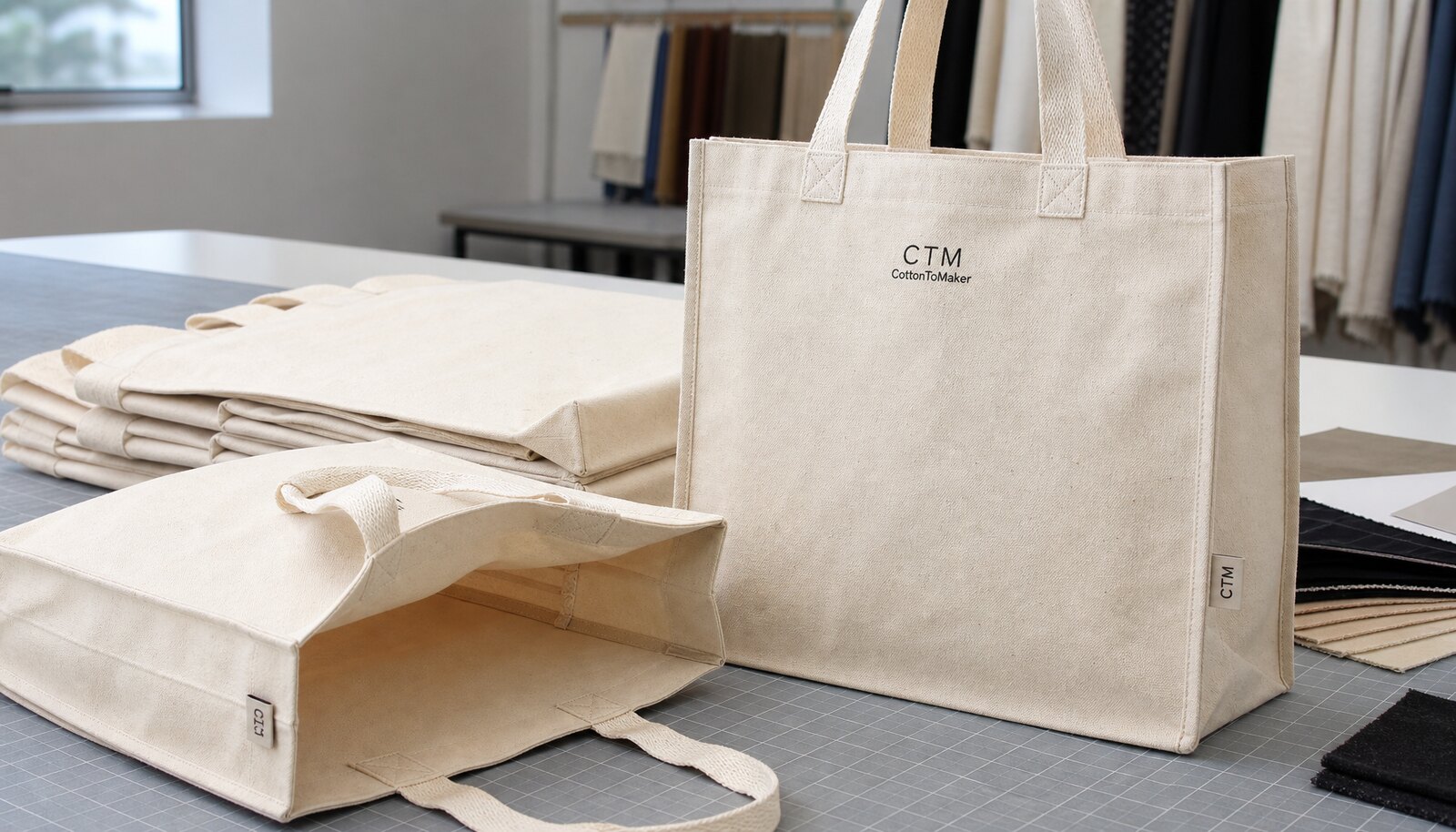
Start with the buying job, not the mockup
Custom canvas grocery totes look simple on a sourcing sheet, which is why weak specifications create so many preventable problems. Two suppliers can quote the same logo tote while using different fabric weights, handle constructions, print methods, packing formats, and document assumptions. A clean mockup does not prove the bag will carry the intended contents, arrive in usable condition, or satisfy a brand's procurement file.
For corporate gifting, the sourcing record should connect the brief, RFQ, approved sample, purchase order, inspection plan, packing instruction, and compliance documents. The point is not to make every tote premium. A trade show giveaway, employee welcome kit, retail gift-with-purchase, and client grocery gift each need different cost and quality decisions.
A useful checklist tells the supplier what is fixed, what may vary within tolerance, who approves changes, and what evidence is required before shipment release. It also gives procurement a fair way to compare quotes without relying on vague phrases such as export quality, heavy canvas, or eco-friendly tote.
- Use one written specification for quoting, sampling, production, inspection, and packing.
- Separate appearance requirements from functional requirements so defects can be classified clearly.
- State which changes require buyer approval: fabric, dye lot, print method, handle webbing, label, packing, or subcontractor.
- Keep approved sample photos, documents, artwork, PO, and packing rules in one procurement record.
Map the distribution use case
The best specification starts with how the tote will be used and handled. An event giveaway may prioritize a sharp front logo, efficient bulk cartons, and a unit price that fits a large audience. An employee welcome kit may need tidy folding, clean presentation, and carton labels that help a fulfillment center sort by location. A grocery-themed client gift may need a deeper gusset, stronger handles, and a load check based on the actual gift contents.
Write the expected contents into the RFQ. A flat tote for a brochure and pen can use lighter construction than a bag carrying bottles, notebooks, packaged food, or boxed merchandise. If the bag must stand upright for kitting or photography, specify gusset depth and fabric body. If it will be folded into a gift box, approve the fold direction before bulk production so the logo is not creased across the center.
Receiving requirements matter as much as construction. Ask whether goods ship to one warehouse, several offices, event sites, or a third-party fulfillment center. The answer affects carton count, gross weight, SKU separation, destination labels, barcodes, and whether simple bulk packing is enough.
- Event giveaway: control logo clarity, basic stitch quality, carton efficiency, and deadline risk.
- Employee kit: control fold presentation, destination labels, clean handling, and accurate counts.
- Client gift: control hand feel, print alignment, gusset shape, and individual protection.
- Grocery or bottle carrier: control reinforcement, seam strength, handle comfort, and practical load testing.
- Retail program: control hangtags, barcodes, SKU separation, carton marks, and receiving rules.
Specify canvas without measurement traps
Canvas is not a complete material specification. It can mean cotton canvas, duck canvas, recycled cotton blend, cotton-poly blend, or a lighter fabric with a canvas-like hand. A strong RFQ states finished fabric weight, fiber content, fabric finish, color standard, appearance tolerance, and whether the material is stocked or made to order.
Be careful when comparing ounces and GSM. Canvas ounce ratings and GSM figures are not always presented on the same measurement basis, and finishing can change the final result. Do not treat an 8-12 oz canvas reference as directly comparable to a lightweight 120-220 gsm cotton fabric without clarification. Ask the supplier to quote the finished fabric weight in the unit they use operationally, state the tolerance, and provide a swatch for approval.
For many corporate gifting programs, 10 oz canvas can work for lighter presentation totes, 12 oz is a common starting point for standard gifting, and 14 oz may be appropriate for heavier contents or a more substantial hand feel. The final choice should reflect contents, budget, decoration method, and desired presentation rather than a generic premium label.
- Request a fabric swatch before sampling when hand feel, shade, or recycled texture matters.
- Define fiber content and evidence for claims such as recycled, organic, or cotton-rich blend.
- State whether natural flecks, slubs, knots, shade bands, and yarn variation are acceptable.
- Confirm whether the fabric is natural, bleached, piece-dyed, yarn-dyed, washed, coated, or unfinished.
- Compare supplier quotes only after fabric weight, composition, finish, and tolerance are aligned.
Control construction details
Construction determines whether the tote hangs neatly, carries weight comfortably, and looks professional when handed to a recipient. Buyers should specify finished width, height, gusset depth, handle drop, handle webbing width, top hem depth, seam allowance, reinforcement method, and stitch quality. These details also make inspection objective.
Handle construction is one of the easiest places for hidden downgrades. A narrow handle may feel uncomfortable when loaded. A shallow handle drop may prevent shoulder carry. A simple straight stitch may be acceptable for a light giveaway, while heavier gift sets often need box stitching, box-and-cross stitching, bar tacks, an internal patch, or webbing captured under the top hem. Ask for close-up photos of the approved method.
Gusset style should be locked before pricing. A flat tote folds small and costs less, but it will not hold boxed items neatly. A bottom gusset adds capacity with moderate complexity. Full side and bottom gussets create a grocery-style shape and may stand better when filled, but they increase sewing time, fabric consumption, and carton volume.
- Define measurement points for dimensions, gusset depth, handle drop, and print placement.
- Specify handle material and width instead of accepting generic cotton handle wording.
- Set top hem depth and whether handles sit under the hem or are attached externally.
- Require no open seams, skipped stitches, loose thread nests, messy backstitching, or twisted panels.
- For heavy kits, approve a practical load check using the expected contents or an agreed test weight.
Approve artwork as production work
A digital mockup is not production approval. Canvas texture, absorbency, shade, and surface irregularity can change how artwork prints. Screen printing is often efficient for one-color or two-color logos at volume. Heat transfer can handle more detail but may leave a different hand feel or visible film edge. Digital printing can support complex art, but it should be tested on the chosen fabric. Embroidery can look premium, but puckering, stitch density, and back-side finish need review.
The RFQ should define logo size, placement, color reference, and tolerance. Placement should be measured from fixed points such as the top edge and side seam or centerline. If the bag has a gusset, confirm the visible front panel size before approving art. If the bag will be folded, keep critical text away from the fold line. For QR codes, sponsor logos, fine lines, or small legal text, require a strike-off that proves readability.
Clarify what the quoted decoration price includes. Screen charges, color matching, artwork cleanup, transfer setup, strike-offs, courier fees, and repeat setup costs may be separate. For multi-version programs, ask whether each logo, department, destination, colorway, or packing version creates a separate MOQ or setup charge.
- Provide vector artwork, target colors, print size, and placement from fixed edges.
- Set tolerances for centering, skew, registration, and color variation on textured canvas.
- Avoid tiny reversed text or thin lines unless a strike-off proves they remain readable.
- Confirm ink or transfer durability, curing requirements, and expected hand feel.
- For double-sided printing, check show-through, drying time, side matching, and packing protection.
Request compliance evidence with scope
Compliance requirements depend on buyer policy, destination market, distribution channel, and brand risk level. A tote used as a corporate gift may not be heavily regulated in every market, but procurement still needs a traceable file. At minimum, request a material specification, fiber-content statement, print material declaration, packing specification, country-of-origin information, and supplier declaration identifying the production route.
Document scope is the detail that matters. A certificate in a sales deck may apply to a different fabric, older production, a different ink system, or a broad product family. Ask what was tested, when it was tested, who issued the document, and whether it covers the exact fabric, handle webbing, label, print material, and packaging being used for the order.
Name market triggers in the RFQ. Depending on destination and use, buyers may need fiber content labeling, country-of-origin marking, restricted-substance declarations, Prop 65 review for California distribution, REACH-related information for EU programs, CPSIA review if the item is child-directed, packaging material rules, recycling marks, polybag warnings, or retailer-specific labeling. Sustainability claims such as recycled, organic, biodegradable, non-toxic, or eco-friendly should be supported by an appropriate declaration, certification, or test record.
- Request dated documents and check whether they apply to the exact item, material, lot, or product family.
- Confirm coverage for fabric, print materials, handle webbing, labels, hangtags, and packaging.
- Ask the supplier to disclose dyeing, washing, printing, embroidery, sewing, finishing, and packing subcontractors.
- Approve fiber-content, care, country-of-origin, hangtag, and carton wording before bulk production.
- Update the compliance file if the supplier changes fabric, ink, label, packaging, or production route.
Turn sample approval into a manufacturing record
A sample prevents disputes only when it becomes a recorded standard. Before bulk starts, measure the approved sample and record width, height, gusset depth, handle drop, handle width, top hem, print size, print location, label position, and fold method. Photograph the front, back, sides, bottom, inside seams, handle reinforcement, print close-up, and packed presentation.
Sample review should include practical use. Load the tote with the expected contents. Check handle comfort, top-edge smoothness, whether the bag twists, and whether the gusset behaves as intended. If the tote must fit into a gift box or fulfillment kit, test it with the actual box. If the program uses muted ink, white ink, metallic ink, or natural canvas, approve contrast under realistic lighting.
For larger, repeat, or brand-sensitive orders, request a pre-production sample made from bulk-booked fabric using the final decoration method. A sales sample may come from available fabric or a sample room. A pre-production sample should represent the production route, and both buyer and supplier should retain signed references.
- Record final sample measurements rather than relying only on the original drawing.
- Approve print contrast, registration, and placement on the actual canvas shade.
- Check inside cleanliness, loose threads, corner finish, and label placement.
- Test the fold and packing method if presentation matters on arrival.
- Release mass production only after dated approval tied to the PO and artwork version.
Normalize quotes before choosing
Unit price is meaningful only after the quotes describe the same product and service level. Confirm fabric weight, fiber content, finish, dimensions, gusset, handle construction, decoration method, color count, setup scope, packing style, inspection access, trade term, and delivery assumption. A quote with individual packing and FOB terms should not be compared directly with an EXW quote that excludes setup, testing, or carton requirements.
Separate one-time charges from recurring cost. Screens, plates, transfers, artwork cleanup, color matching, strike-offs, samples, courier, testing, labels, hangtags, carton marks, inspection, and document preparation should be visible. For repeat programs, ask which costs return on reorders and whether screens, patterns, or production files are retained.
Freight and fulfillment can change the best option. Ask for carton quantity, carton dimensions, gross weight, and estimated volume during quotation. A lower unit price can lose its advantage if bulky cartons increase freight, exceed warehouse handling limits, or require relabeling and sorting at the destination.
- Compare quotes on the same trade term and delivery point.
- Review MOQ by fabric color, print version, destination split, and packing version.
- Confirm lead time after artwork approval, sample approval, material booking, and deposit.
- Ask how long the quote is valid and whether cotton cost or exchange rates may affect it.
- Include inspection, testing, repacking, relabeling, kitting labor, and delay risk in total cost.
Set packing controls early
Packing protects both the tote and the launch schedule. A well-made bag can still arrive with hard creases through the logo, crushed handles, dirt marks, moisture damage, or wrong carton labels if packing is vague. The RFQ should state whether bags are bulk packed, bundled, paper banded, individually polybagged, paper sleeved, or packed for direct kitting.
The distribution model should decide the packing style. Bulk bundles may work for event distribution. Client gifts may need cleaner individual protection or a fold that presents well inside a box. Retail or employee-store programs may require barcode labels, SKU separation, hangtags, and carton numbering. Humid routes or long storage may require moisture controls and stronger cartons.
Ask for a packing pilot before full carton sealing. Photos should show the folded unit, inner bundle, carton layout, carton mark, carton dimensions, and gross weight. This gives procurement time to correct bundle counts, label wording, fold direction, or destination separation while goods are still at origin.
- Define units per inner bundle, bundles per master carton, and total pieces per carton.
- Set carton dimensions, gross weight limits, and any manual handling limits for offices or event teams.
- Specify fold direction, handle position, print-face protection, and plastic-free or polybag requirements.
- Require carton marks with item code, PO number, quantity, carton number, destination, and barcode if needed.
- Approve one carton label proof and packing photos before the supplier completes packing.
Use defect classes for inspection decisions
Inspection should be planned before cartons are sealed. For canvas grocery totes, the checklist should cover fabric, dimensions, gusset, handle reinforcement, stitch quality, decoration, labels, finishing, packing, carton marks, and counts. The buyer can use an internal checklist or third-party AQL inspection, but the acceptance criteria should appear in the PO or quality agreement.
Defect classification makes decisions more practical. Critical defects may include unsafe contamination, mold, sharp foreign objects, wrong artwork, wrong material, or severe structural failure. Major defects may include open seams, weak handle attachment, print placement outside tolerance, unreadable logo, severe shade mismatch, incorrect labels, wrong carton marks, or incorrect packing. Minor defects may include small thread ends, slight removable marks, or natural canvas variation within the approved range.
Higher-risk programs benefit from first-piece approval, in-line checks, and final carton verification. First-piece photos catch artwork, placement, and construction issues before volume production. In-line checks catch sewing or printing drift. Final inspection confirms finished goods, carton counts, destination separation, packing list alignment, and rework evidence before shipment release.
- Use fixed measurement points so factory, buyer, and inspector measure the same way.
- Set tolerances for dimensions, print placement, skew, shade range, and defect limits before production.
- Separate critical, major, and minor defects in the PO or inspection checklist.
- Require first-piece photos for fabric, print, handle reinforcement, gusset, labels, and packing.
- Verify carton counts, destination labels, packing list details, and rework photos before shipment release.
Specification comparison for buyers
| Supplier option | What to verify | Commercial advantage | Buyer risk to control |
|---|---|---|---|
| Direct sewing factory | fabric swatch, approved sample, seam close-ups, logo test photos, packing pilot, and final inspection evidence | Better sample-to-bulk control and faster production feedback | May be weaker on export paperwork or branded packing unless checked early |
| Trading company | Factory name, production photos, trim-source proof, and who owns QC decisions | Can coordinate small mixed orders and extra services | Markup can hide real factory capability and slow defect decisions |
| Specialized bag workshop | bag size, gusset, handle drop, seam allowance, stitch density, reinforcement patch, and loading expectation | More practical for detailed construction, trims, and repeat programs | Capacity may be limited during peak seasons |
| Low-price general supplier | 8-12 oz cotton canvas, 120-220 gsm cotton, recycled cotton, or blended fabric selected by use case and target price | Useful for simple promotional runs with loose specs | Material downgrades, weak packing, and vague inspection scope can erase savings |
| Retail-ready supplier | fold method, inner bundle, carton count, carton mark, moisture protection, SKU separation, and warehouse receiving needs | Can handle labels, SKU separation, carton marks, and receiving rules | Higher unit cost must be compared against reduced warehouse work |
| Compliance-focused supplier | Fabric records, labeling review, test plan, and production traceability | Safer for retail programs and repeat brand orders | Documentation claims need evidence, not only sales language |
| Local sample room plus bulk factory | Signed sample, bulk factory handoff, first-piece photos, and deviation owner | Good for complex branding before large production | Sample room quality may not match bulk line unless handoff is controlled |
Buyer checklist before sampling
- Define the tote use case: event giveaway, employee welcome kit, client gift, grocery carrier, bottle carrier, retail gift-with-purchase, conference kit, or boxed insert.
- State expected contents and approximate carry weight so the supplier can quote suitable fabric, gusset depth, handle width, and reinforcement.
- Specify finished fabric weight, composition, finish, and color standard. Avoid comparing oz and GSM casually; ask the supplier to confirm the measurement basis and tolerance.
- Confirm fiber content: 100% cotton, recycled cotton blend, cotton-poly blend, organic cotton, or another material, with support for any sustainability claim.
- Define acceptable fabric appearance: natural flecks, slubs, shade variation, washed effect, recycled texture, dye-lot movement, or clean bleached finish.
- Lock finished width, height, gusset depth, handle drop, handle webbing width, top hem depth, seam allowance, stitch density, and reinforcement method.
- Set tolerances before sampling: dimensions, print placement, print skew, color variation, shade range, and minor finishing variation.
- Provide vector artwork, color references, print size, placement from fixed edges, and legibility requirements for small text, QR codes, or sponsor logos.
- Ask the supplier to name the print method, ink or transfer type, included color count, setup charge, strike-off cost, curing requirement, and expected hand feel.
- Request dated compliance evidence covering material specification, fiber content, print materials, country of origin, labeling, restricted substances, packaging, and destination-market triggers.
Factory quote questions to send
- What finished fabric weight are you quoting, in the unit you control, and what tolerance applies from roll to roll and sample to bulk?
- What is the fiber content, and can you provide a dated composition statement for the quoted fabric?
- Is the canvas natural, bleached, dyed, washed, coated, recycled-look, or otherwise finished, and what visible variation should we expect?
- What finished bag dimensions, gusset depth, handle drop, handle width, top hem depth, seam allowance, and stitch density are included?
- Which handle reinforcement will be used: box stitch, box-and-cross, bar tack, internal patch, folded webbing under the hem, or another method?
- What practical load check do you recommend for the intended contents, and can you document the result on the pre-production sample?
- Which decoration method are you quoting, how many colors are included, and what setup charge applies per screen, plate, transfer, or artwork version?
- Can you make a strike-off or pre-production sample using the actual bulk canvas, final print method, final print size, and final placement?
- What tolerances apply to print placement, skew, registration, color variation, and small-text readability on textured canvas?
- Which documents can you provide for fabric, print materials, handle webbing, labels, packaging, country of origin, and restricted substances where applicable?
Quality-control points to confirm
- Finished fabric weight, composition, shade, and hand feel match the approved swatch or signed sample within agreed tolerance.
- Canvas surface is free from oil marks, holes, mildew odor, severe crease marks, weak slubs, obvious weave gaps, and contamination.
- Bag width, height, gusset depth, handle drop, handle width, top hem depth, and print position are measured from fixed reference points.
- Print is checked for placement, skew, registration, color match, ink coverage, edge sharpness, bleeding, ghosting, scorching, cracking, and small-text legibility.
- Handle reinforcement is secure and symmetrical, with no skipped stitches, broken thread, loose thread nests, needle cuts, or puckering at the top edge.
- Side seams, bottom seams, gusset corners, and top hem show even seam allowance, clean backstitching, no open seams, and no twisted panels.
- Labels, hangtags, care or fiber-content wording, and country-of-origin marking match the approved artwork and destination requirements.
- Thread trimming, inside cleanliness, fold direction, and presentation are checked because small finishing issues are visible in corporate gifting.
- Finished bags pass the agreed practical load check based on intended contents, especially for bottles, books, boxed gifts, food items, or grocery use.
- Carton counts, inner bundles, outer marks, carton dimensions, gross weight, SKU separation, destination labels, and packing list details match the packing specification.