Start carton planning while the tote is still being specified
For custom canvas grocery totes used at craft fairs, the shipping carton is part of the product specification, not a warehouse afterthought. Fold method, pcs/carton, carton strength, carton marks, and pallet plan influence freight cost, storage space, venue handling, and the condition of the bags when staff open boxes before the event.
A tote can pass a flat photo approval and still fail commercially. The logo may have a hard fold line through it. Cartons may arrive too heavy for easy booth distribution. Sponsor versions may be mixed without clear marks. These issues usually begin when buyers request unit price first and ask about packing data after production has already started.
Start with use case and work backward. A paid retail tote needs cleaner presentation than a free sponsor bag. A vendor shopping bag for jars or ceramics needs stronger handle stitching than a welcome-kit tote for flyers. Once the role is clear, fabric weight, gusset depth, print method, fold pattern, carton quantity, and inspection points become easier to lock down.
- For retail display: use cleaner folding, moderate compression, optional individual packing or paper belly bands, and accurate carton marks.
- For sponsor giveaways: use 25 or 50 pc inner bundles and carton marks by artwork code for fast counting.
- For vendor shopping bags: prioritize handle reinforcement, fast unpacking, and cartons that survive repeated movement.
- For heavy craft goods: specify realistic load testing and conservative carton gross weights.
- For multi-location fairs: pack by destination, sponsor, booth, or artwork instead of shipping mixed cartons that need venue sorting.
Define load profile, tote function, and receiving rules
Canvas grocery totes are not one standard item. A bag carrying handmade soap, candles, ceramics, jam jars, books, or framed prints faces different stress from a lightweight flyer bag. Before requesting quotes, describe the intended contents, approximate carrying weight, whether the bag is sold or given away, and whether the shopper is expected to reuse it after the event.
This prevents both overbuying and underbuying. If the tote is a low-cost giveaway, lighter construction may be acceptable if the use limit is understood. If it will be sold as event merchandise, flimsy canvas, twisting handles, uneven stitching, or visible print creases will damage perceived value. For grocery-style use, a gusseted construction usually performs better for bulky purchases than a flat tote, although the gusset adds folded thickness and carton cube.
Receiving rules belong in the same brief. Some buyers want plastic-free packing. Others need barcode labels, carton numbering, pallet labels, or cartons pre-sorted by sponsor artwork and fair location. If recycled, organic, or plastic-free claims appear in marketing copy, request supporting documents before approving the claim.
- Classify the tote as merchandise, packaging, giveaway, welcome-kit container, or operational supply.
- List contents and target carrying weight, such as 3 kg for light retail items or 5 to 8 kg for mixed craft purchases, subject to supplier validation.
- Confirm whether the bag must stand upright, fit books or prints, hold boxy items, or fold compactly for booth storage.
- State documentation requirements for recycled-content, organic cotton, or plastic-free claims.
- Define receiving needs: barcodes, carton marks, inner bundles, destination sorting, pallet labels, and maximum carton weight.
Choose canvas weight by GSM, feel, printability, and freight impact
Many craft fair grocery totes sit in the 10 oz to 12 oz cotton canvas range, roughly 340 to 410 GSM depending on yarn, weave, finishing, and measurement method. This range often balances reusable feel, durability, printability, and manageable carton packing. Lighter 7 oz to 8 oz canvas can suit budget giveaways or light goods, but it may sag with jars, candles, books, or ceramics. Heavier 14 oz to 16 oz canvas can feel premium, but it raises material cost, sewing difficulty, folded thickness, carton gross weight, and shipping cost.
Ask for both oz and GSM. Suppliers may use different conversion assumptions, and finishing can change final handfeel. Natural, bleached, dyed, washed, recycled cotton blend, organic cotton, and cotton-poly canvas can behave differently at similar GSM. Washed canvas may feel softer but can introduce shrinkage and shade variation. Dyed canvas needs shade-lot and colorfastness control.
Heavier fabric is not automatically better. A well-made 12 oz tote with suitable gusseting, reinforced handles, and controlled stitching may be more practical than a bulky 16 oz version. Before upgrading fabric weight, ask for estimated carton dimensions, gross weight, and CBM per 1,000 pieces for each option.
- Budget range: 7 oz to 8 oz canvas for light carrying and lower unit-price targets.
- Standard grocery tote range: 10 oz to 12 oz canvas for durability, printability, handfeel, and freight balance.
- Premium heavy range: 14 oz and above for heavier handfeel, with higher cost and thicker folds.
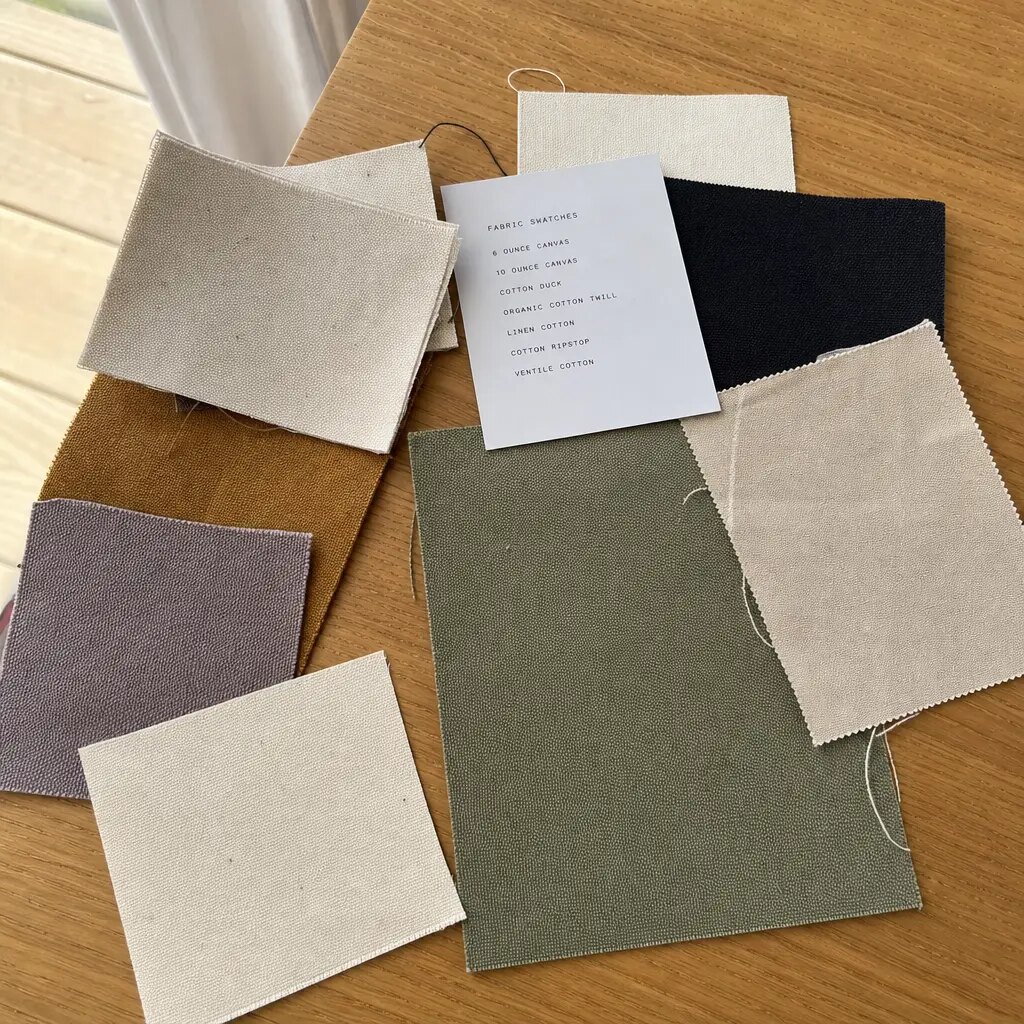
- Natural canvas note: seed flecks and minor slubs may be normal; define acceptable appearance with photos or approved samples.
- RFQ requirement: state target oz, GSM, fabric color, finish, tolerance, and whether the fabric is stock or custom sourced.
Specify construction so the tote carries well and packs evenly
A grocery-style tote is different from a flat promotional shopper. A practical craft fair tote usually needs a bottom gusset, side gusset, boxed bottom, or separate bottom panel so bulky purchases sit securely. A common finished size is about 38 x 40 x 12 cm, but the right size depends on merchandise. Candle and packaged food vendors may prefer a wider base. Artists selling prints may need a taller shape. Textile sellers may need more volume with a softer folded profile.
Write dimensions precisely. The RFQ should state finished body width and height after sewing, gusset depth, bottom style, seam type, handle width, handle length, handle drop, reinforcement method, thread color, and stitch density where relevant. For shoulder carry, handle drop is measured from the top edge of the bag to the highest inside point of the handle loop. Around 25 to 30 cm is common for shoulder use; about 18 to 22 cm is more hand-carry oriented.
Construction also affects cartons. Deeper gussets improve capacity but add folded bulk. Wide self-fabric handles can look durable and feel comfortable, but they add thickness and create uneven stacks if the fold is inconsistent. The target is not simply the cheapest sewing method; it is a construction that meets load needs and still packs without distortion.
- Specify finished width, height, gusset depth, and bottom style rather than relying on a reference photo.
- Define whether the bottom is boxed, folded, flat with side gussets, or made with a separate panel.
- State handle length, handle drop, handle width, handle material, thread color, and reinforcement method.
- Require box stitch, box-X stitch, bartack, reinforced patch, or another approved method at each handle attachment point.
- Ask how gussets and handles will be folded so stacks remain even inside cartons.
Match print method to artwork, canvas shade, and fold lines
Screen printing is usually the commercial choice for one to three solid spot colors on canvas grocery totes. It works well for event logos, sponsor graphics, simple market artwork, and bulk quantities. It still needs control: provide vector artwork, define print area, give Pantone references or approved ink targets, set placement tolerance, and confirm the ink is fully cured before folding.
Heat transfer, digital print, and embroidery can work when the artwork requires them. Heat transfer can reproduce gradients and fine lines, but buyers should check edge feel, adhesion, flexibility, and heat-press marks. Digital printing can handle complex art, yet color control on natural cotton varies with fabric shade and absorption. Embroidery can look premium for a small logo, but it can pucker lighter canvas and is usually inefficient for large front-panel graphics.
Approve print placement together with the fold method. A centered logo can land on a hard fold if the factory folds the tote across the print panel. Over-compressed cartons can press that fold into the ink. The proof should show seams, gussets, handle stitch zones, proposed fold lines, and safe zones for QR codes, sponsor names, and fine text.
- Screen print: best for solid spot colors, event names, sponsor logos, and controlled bulk cost.
- Heat transfer: useful for gradients and detail; inspect adhesion, flexibility, rub response, and edge feel.
- Digital print: useful for complex images; test color and clarity on the actual canvas shade.
- Embroidery: premium for small marks; check puckering, back-side threads, and added thickness.
- Suggested placement tolerance: agree a realistic range, often +/-0.5 to 1 cm depending on method.
- Approval requirement: inspect print after curing, folding, pressure, and reopening.
Control MOQ before splitting sponsors, colors, and versions
MOQ is shaped by fabric purchasing, dyeing, cutting efficiency, print setup, sewing line arrangement, labels, packing materials, carton marks, and inspection. A supplier may support a lower MOQ for one natural canvas tote with one-color screen print. Dyed fabric, multiple body colors, several sponsor logos, woven labels, hangtags, individual packing, or destination sorting can raise the practical minimum or unit cost.
Craft fair buyers often add avoidable cost by dividing a modest order into too many variations. A cleaner approach is to consolidate the base tote: one canvas weight, one finished size, one handle construction, one print area, and one packing method. Then vary artwork only where required. If sponsor versions are necessary, using the same ink color and print area can reduce setup changes.
MOQ should also match carton planning. If each artwork is packed in full cartons, order quantities should align with pcs/carton where possible. If the order is split across several sponsor versions, the packing plan must say whether partial cartons are allowed, whether mixed cartons are permitted, and how every carton will be marked.
- Lowest complexity: one natural canvas color, one artwork, one print color, one carton mark, and bulk bundles.
- Moderate complexity: one tote body with several artwork versions, same print size, and separate carton marks.
- Higher complexity: dyed bodies, multiple print methods, retail hangtags, barcodes, polybags, and destination sorting.
- RFQ tip: request price breaks at 500, 1,000, 2,500, and 5,000 pcs using the same spec and packing method.
- Artwork tip: assign every version a short code and use it on proofs, packing lists, cartons, labels, and inspection reports.
Plan carton quantity around cube, weight, protection, and venue workflow
Carton planning is a trade-off between freight efficiency and damage prevention. A 10 oz canvas grocery tote may pack around 100 to 150 pieces per export carton depending on finished size, gusset, fold, and packing style. A 12 oz gusseted tote may be better around 80 to 120 pieces per carton. Heavier canvas, individual polybags, hangtags, barcode labels, belly bands, or retail sleeves reduce the practical count. These are planning ranges only; the supplier should validate the count with the actual tote and packing method.
Gross carton weight matters for freight and handling. Very heavy cartons reduce carton count but increase the risk of split seams, crushed edges, difficult manual handling, and repacking. Oversized cartons may trigger dimensional weight charges for air, courier, or domestic parcel delivery. For ocean freight and LTL trucking, cartons should stack squarely on pallets without bulging or collapsing.
Venue workflow is often overlooked. Craft fair teams may have narrow receiving windows, temporary storage, and many booths to support. A carton with 100 pieces in two 50 pc bundles is easier to verify than a loose overstuffed carton with an odd count. If several artwork versions are involved, avoid mixed cartons unless requested. Clear marks can save hours of sorting.
- For bulk distribution: 100 pcs/carton is often simple for counting, allocation, and event staffing.
- For heavier canvas or retail packing: reduce pcs/carton to limit compression, print creasing, and distorted gussets.
- For LTL and pallet shipping: use cartons that stack squarely without bulging sides or crushed edges.
- For parcel reshipment: avoid cartons that exceed carrier size or weight thresholds and create surcharges.
- Carton marks should include PO number, artwork code, bag color, quantity, carton number, gross weight, and destination if relevant.
- Quote data required: carton L x W x H, pcs/carton, net weight, gross weight, carton ply, sealing method, and palletization plan.
Use CBM and gross weight to compare landed cost
Two suppliers can quote similar unit prices and still create different landed costs. One may pack more pieces into a weak carton to make packaging look cheaper. Another may use stronger cartons, cleaner folding, lower compression, and better marks. The first quote may look better until freight is calculated, cartons arrive crushed, or warehouse staff must sort mixed artwork versions. Compare cost per usable delivered tote, not unit price alone.
Calculate CBM per 1,000 pieces. Convert carton length, width, and height to meters, multiply to get carton CBM, divide by pieces per carton, then multiply by 1,000. Example: a 60 x 40 x 35 cm carton equals 0.084 CBM. If it holds 100 totes, the ratio is 0.84 CBM per 1,000 pieces. A 65 x 45 x 40 cm carton is 0.117 CBM; at 100 pieces, it equals 1.17 CBM per 1,000 pieces. That difference affects freight and warehouse space.
Review gross weight per 1,000 pieces beside CBM. It influences air freight, courier, warehouse handling, and pallet planning. For a fixed craft fair date, compare realistic in-hand cost and schedule risk, not only EXW or FOB unit price.
- Require unit price and packing data in the same quote sheet so suppliers are compared equally.
- Calculate CBM per 1,000 pcs before choosing FOB, CIF, DDP, air, courier, LTL, or warehouse delivery.
- Review gross weight per 1,000 pcs for air freight, parcel handling, venue unloading, and pallet loading.
- Ask whether carton data is estimated or based on a packing trial with actual fabric weight, tote size, fold, and packing.
- Treat weak cartons, unclear marks, dirty bags, mixed assortments, and creased logos as landed-cost risks.
Approve samples that prove fabric, sewing, print, and packing
A photo sample is not enough for a craft fair tote order. Buyers need a physical or documented pre-production sample made from production-equivalent canvas, with final stitching, final print method, and intended fold method. A blank sample can confirm size and handle comfort, but it cannot prove print curing. A print strike-off can confirm ink color, but it cannot confirm bag construction. The pre-production sample should bring fabric, sewing, printing, and packing together before mass production.
Sample review should be practical. Load the tote with realistic weight and carry it. Check whether handles twist, whether reinforcement holds, whether the gusset opens cleanly, and whether the bottom supports bulky goods. Measure finished width, height, gusset, handle width, handle length, and handle drop. Inspect seams for skipped stitches, loose threads, uneven sewing, and weak stress points.
Test packing performance before bulk cartons are sealed. Fold the sample exactly as proposed, place it under light pressure or in a small packing trial, then inspect it after reopening. Look for print cracking, gloss change, ink transfer, hard crease lines, fabric abrasion, or handle impressions on the print panel. Keep one approved sample with the factory and one with the buyer or inspector.
- Approve fabric handfeel, shade, weave appearance, thickness, and odor under neutral light.
- Measure finished dimensions against the specification sheet.
- Review print size, placement, color, registration, opacity, edge sharpness, curing, and rub resistance.
- Carry a realistic load and inspect handle attachment, seam stress, bottom shape, and fabric distortion.
- Fold the sample with the proposed carton method and reopen it to inspect the logo area and QR code if present.
- Label approved samples with date, artwork version, fabric weight, print method, packing method, and PO reference.
Set QC thresholds for the failures buyers actually see
Quality control for canvas grocery totes should focus on failures that affect event use: weak handles, crooked printing, dirty canvas, size variation, open seams, broken stitches, poor trimming, wrong artwork, mixed cartons, and damaged packaging. Natural canvas may include small cotton specks and minor slubs, so define acceptable fabric appearance instead of expecting a perfectly uniform surface. Large stains, oil marks, holes, strong odor, dampness, severe shade mismatch, and contamination should be rejectable.
Do not wait until every tote is folded and sealed. Inline checks after fabric receipt, cutting, printing, sewing, and trimming catch problems before they multiply. Print should be checked after curing and before packing. Handle reinforcement should be checked during sewing because stress-point failures are more serious than minor cosmetic variation. For larger orders, final inspection can follow an agreed AQL or buyer-defined sampling plan, with checklist items customized to the tote’s load profile and packing method.
Receiving accuracy is part of QC. If the order has multiple sponsor logos or destination allocations, final inspection should open cartons and verify assortment count, artwork codes, carton marks, hangtags, barcodes, gross weight, and packing list alignment. A well-sewn tote is still a procurement problem if the wrong artwork reaches the wrong booth.
- Fabric: reject large stains, oil marks, holes, serious weaving defects, unacceptable odor, dampness, mildew risk, or severe shade mismatch.
- Printing: reject major misregistration, missing ink, smearing, excessive pinholes, cracking, wrong placement, ink transfer, or unacceptable color deviation.
- Sewing: reject open seams, skipped stitches at handle points, broken threads, twisting handles, sharp thread tails, and uneven handle placement.
- Dimensions: apply agreed sewn tolerance, commonly around +/-1 cm for body dimensions unless tighter control is specified.
- Load performance: test handles and seams with a realistic load above expected use, then inspect for tearing or stitch opening.
- Packing: verify carton count, inner bundle count, artwork code, barcode label, carton marks, and packing list quantities.
- Cartons: inspect cleanliness, dryness, square shape, sealing, carton ply, crushed corners, and suitability for export plus local handling.
Specification comparison for buyers
| Spec decision | Recommended option | When it fits | Buyer risk to check |
|---|---|---|---|
| Canvas weight | 10 oz to 12 oz cotton canvas, roughly 340 to 410 GSM, with written bulk tolerance such as +/-5% unless otherwise agreed | Reusable craft fair grocery totes for candles, jars, ceramics, books, textiles, packaged foods, or mixed purchases | Below about 280 GSM can feel like a light giveaway; above about 450 GSM increases folded bulk, gross weight, sewing difficulty, and freight exposure |
| Bag size | Approx. 38 x 40 x 12 cm finished size with bottom gusset, adjusted to merchandise mix and print area | General craft fair shopping use where the tote should accept bulky purchases and present neatly on a booth table | Flat totes pack tighter but carry bulky goods poorly; deep gussets improve capacity but raise carton cube and may create uneven folded stacks |
| Handle construction | Self-fabric or cotton webbing handles, 2.5 to 3.5 cm wide, with box-X stitch, bartack, or approved reinforcement at four attachment points | Retail-grade grocery totes expected to carry moderate loads for short periods | Weak handle stitching often fails before the canvas body; narrow handles feel uncomfortable when loaded |
| Finished tolerances | Common sewn canvas tolerance: +/-1 cm on body width/height, +/-0.5 to 1 cm on gusset, +/-1 to 1.5 cm on handle drop | Programs where capacity, print placement, and carton count need predictable control | Unstated tolerances create disputes because shrinkage, seam allowance, folding, and manual sewing affect final dimensions |
| Print method | Screen print for 1 to 3 solid spot colors; heat transfer or digital only when gradients, photo art, or very fine detail require it | Event logos, sponsor marks, simple market graphics, and QR codes with adequate quiet zone | Poor curing causes ink transfer, odor, cracking, or rub failure; large ink blocks can show hard carton creases |
| Packing style | Fold once or twice, count into 25 or 50 pc bundles, then pack about 80 to 150 pcs/carton depending on GSM, size, gusset, and retail packing | Balanced handling, easier counting, stable pallet loading, and organized distribution by booth, sponsor, artwork, or destination | Over-compression can crease print, distort gussets, soil natural canvas, crush corners, and slow unpacking |
| Carton strength | 5-ply export carton for most import programs, with suitable crush resistance, moisture-resistant sealing tape, and clear marks | Ocean freight, LTL, warehouse stacking, parcel reshipment, and venue handling | Thin cartons save little if they split, collapse, lose count integrity, or require repacking before the fair |
| MOQ logic | 500 to 1,000 pcs per artwork/colorway is a common planning range for standard natural canvas; consolidate body specs when using several artworks | Small to mid-size craft fair programs with sponsor or seasonal prints on one common tote body | Too many colorways split MOQ and increase screen setup, dye lot control, carton marking, and inspection complexity |
| Sample approval | Approve a pre-production sample using production-equivalent canvas, final print, final handle stitching, and proposed fold method; request a small carton trial when timing is tight | Orders where presentation, carton cube, event date, and distribution accuracy affect the result | A flat photo sample misses fold marks, fabric shade, print rub resistance, carton fit, and realistic pcs/carton |
Buyer checklist before sampling
- Define the tote role: paid merchandise, sponsor giveaway, vendor shopping bag, welcome-kit container, reusable grocery bag, or booth replenishment supply.
- List expected contents and target carrying weight in kg, such as candles, ceramics, jars, books, prints, apparel, textiles, or packaged foods.
- Choose canvas weight by load, handfeel, print method, and freight impact; 10 oz to 12 oz, about 340 to 410 GSM, is a practical retail-grade range for many craft fair grocery totes.
- Specify fabric type: natural, bleached, dyed, washed, recycled cotton blend, organic cotton, conventional cotton, or cotton-poly blend; request documents for any claim used in marketing copy.
- State finished width, height, gusset depth, bottom construction, handle length, handle drop, handle width, seam type, stitch density, thread color, and reinforcement method.
- Provide vector artwork with Pantone references or target ink standard, print size, placement from top and side edges, color count, and color-match expectation.
- Ask the supplier to show seams, gussets, handle stitch zones, and likely fold lines on the artwork proof so QR codes and sponsor names do not sit on a hard crease.
- Select packing before quoting freight: bulk packed, 25/50 pc bundles, individual polybags, paper belly bands, hangtags, barcodes, or cartons packed by booth, sponsor, artwork, or destination.
- Require carton L x W x H, gross weight, net weight, pcs/carton, carton ply, sealing method, carton mark layout, and palletization suggestion in every quote.
- Calculate CBM and gross weight per 1,000 pieces before comparing suppliers, shipping mode, and landed cost.
Factory quote questions to send
- What canvas weight in oz and GSM are you quoting, and what bulk fabric tolerance will you guarantee?
- Is the canvas greige, natural, bleached, dyed, washed, recycled, organic, conventional cotton, or blended, and what documentation can support any material claim?
- Is the quoted fabric in stock, or does it require weaving, dyeing, washing, finishing, certification verification, or special purchasing?
- What shrinkage or finishing variation should we expect for washed, dyed, or printed canvas, and how does it affect finished size tolerance?
- What finished width, height, gusset depth, bottom construction, handle length, handle drop, handle width, thread type, stitch density, and seam type are included?
- What handle reinforcement is included: box stitch, box-X stitch, bartack, rivet, added patch, or another construction, and what load test can you perform?
- Which print method is included, how many colors, what maximum print area, what ink or transfer type, and what curing or fixation process will be used before folding?
- Can you provide a print placement proof showing artwork distance from top edge, side seams, bottom seam, gusset folds, handle attachment points, and proposed carton fold lines?
- What color tolerance will you use for print approval: Pantone target, approved physical swatch, or close commercial match on natural cotton?
- What is the MOQ per bag color, fabric lot, artwork, and print method, and can several artworks share the same fabric lot, cutting plan, and carton plan?
Quality-control points to confirm
- Fabric GSM tolerance should be agreed in writing, commonly +/-5% for bulk canvas unless tighter control is justified, with roll weights or fabric inspection records available when requested.
- Check fabric for large stains, oil marks, holes, weaving defects, excessive slubs, strong odor, dampness, severe shade variation, mildew risk, or contamination.
- Natural canvas may show seed flecks and minor slubs; define acceptable and rejectable marks with reference photos before bulk cutting.
- Finished size tolerance should be practical for sewn canvas, commonly about +/-1 cm on body dimensions, +/-0.5 to 1 cm on gusset depth, and +/-1 to 1.5 cm on handle drop unless otherwise approved.
- Measure gusset depth and bottom construction because small changes affect usable capacity, folded thickness, carton count, and how well the bag stands with purchases.
- Handle attachment must match the approved reinforcement method and should be tested against the intended load profile rather than judged by appearance only.
- A practical load check should place realistic weight in the tote for a defined time, then inspect handle stitches, seam opening, fabric tearing, and distortion after carrying.
- Print registration, placement, color, opacity, curing, rub resistance, and edge sharpness should be checked before mass packing begins.
- For screen printing, inspect pinholes, ink bleeding, uneven coverage, smearing, poor curing, color drift, ink transfer, odor, and cracking after folding.
- For heat transfer or digital print, inspect adhesion, edge lifting, handfeel, color accuracy, scorch marks, press marks, rub response if required, and flexibility after folding.