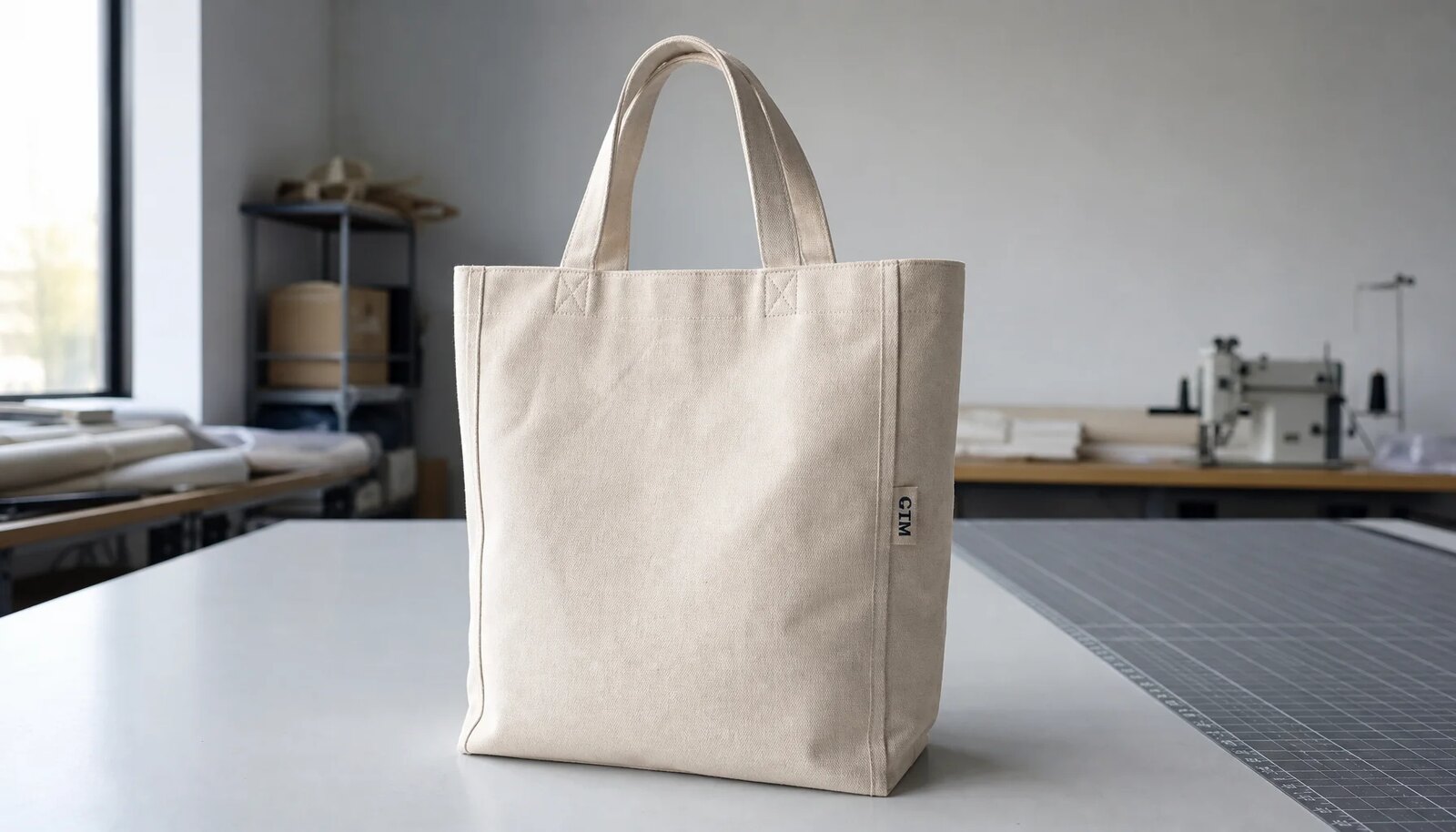
Start With the Event Job, Then Name the Tote
A strong RFQ for custom canvas grocery totes begins with the event operation. The product name alone does not tell a supplier enough. A registration tote for printed agendas carries different risk than a grocery-style tote filled with food samples, drinkware, sponsor kits, boxed merchandise, or retail goods. Event planners should open the RFQ with the basics that shape production: event type, city, delivery destination, in-hands date, target quantity, expected contents, and whether the tote will be distributed empty or packed before arrival.
This early context changes the quote. A low-cost handout may call for stock natural canvas, simple screen print, bulk cartons, and broad commercial tolerances. A donor gift, VIP welcome kit, sponsor grocery program, or resale item may justify heavier canvas, cleaner sewing, tighter shade control, individual folding, labels, barcode support, and a more careful inspection plan. Both approaches can be valid. The issue is making sure the supplier prices the one you actually need.
Operational details also matter after production. Venue receiving windows, carton weight limits, pallet requirements, labor rules, carton marks, and multi-city routing can all affect the order. A supplier who knows the totes must be counted quickly by temporary staff may recommend bundle packing. A supplier who knows the goods are going to hotel room drops may quote cleaner folding or individual packing. Put the event facts in the RFQ so the supplier can quote the tote, the packing, and the delivery reality together.
- Open with event type, city or destination, in-hands date, target order quantity, and number of artwork versions.
- Describe contents and working load, such as 2 kg of brochures, 5 kg of grocery samples, boxed kits, or sponsor inserts.
- State whether totes will be handed out empty, prefilled, sold, placed in rooms, or packed into attendee kits.
- List venue requirements that affect carton size, pallet format, delivery appointments, carton labels, or waste restrictions.
- Tell suppliers whether the program is one-time, seasonal, annual, or likely to reorder against the same approved sample.
Define Construction So Quotes Can Be Compared
Canvas tote pricing becomes hard to compare when construction is described loosely. A grocery-style tote is not the same as a flat promotional bag, and a boxed-bottom tote is not the same as a side-gusset tote that collapses differently. The RFQ should state finished width, finished height, gusset depth, top hem depth, handle length, finished handle drop, handle width, side seam construction, bottom construction, and reinforcement method.
Use finished dimensions rather than pattern dimensions. A clear line item might read: finished size 38 cm W x 40 cm H x 12 cm gusset, open top, 3 cm top hem, 60 cm handle length, 28 cm finished handle drop, 3 cm handle width, box-with-cross handle reinforcement, overlocked interior seams. If the tote is measured flat, say so. If the gusset is measured when opened, say so. If an existing tote is the reference, send it or approve a physical sample and make that the measurement standard.
Handle drop is easy to overlook until the tote is in someone's hand. A drop around 18-22 cm is usually hand-carry focused. A drop around 25-30 cm is more shoulder friendly, depending on tote height, garment bulk, and fill weight. For grocery contents, handle comfort and anchor strength matter as much as the body size. Ask how the supplier reinforces the handles and how they check that the attachment is consistent across bulk production.
- Specify body size as finished width x finished height x gusset depth, not only a general size label.
- Define handle length, handle drop, handle width, and whether the handle is self-fabric, cotton webbing, or another material.
- State bottom format: flat tote, side gusset, bottom gusset, boxed bottom, or reinforced bottom panel.
- Name reinforcement method: bar tack, box stitch, box-with-cross stitch, or another approved construction.
- Require suppliers to disclose any substituted stock size, stock blank, or construction change in the quote.
Specify Canvas Weight, Finish, and Evidence
Canvas weight drives both performance and cost. Ask suppliers for oz and GSM, and clarify whether the number refers to finished fabric weight after dyeing, washing, coating, or other finishing. As a practical range, 8 oz canvas can work for light brochures and short-use giveaways. A 10 oz canvas is often a better starting point for reusable event grocery totes. A 12 oz or heavier canvas may fit premium programs or heavier fills, though it will usually raise unit cost and freight weight.
Finish changes the product as much as weight. Natural canvas has a familiar cotton look, but seed flecks, slubs, and shade variation need an approved range. Bleached canvas can look cleaner but may show dirt more readily during handling. Dyed canvas needs lab dip approval and shade control. Washed canvas feels softer, but it may bring more finished-size variation. Coated canvas can add structure or water resistance, yet it can change hand feel, print behavior, recyclability, and compliance questions.
Be precise with sustainability and compliance language. If recycled cotton, organic cotton, unbleached cotton, or a restricted-substance requirement matters, name the documentation you need. Ask whether the claim applies to the fiber, fabric, factory, or finished tote. Broad wording such as eco-friendly canvas is not enough for procurement review. Specific evidence lets buyers compare suppliers without leaning on marketing language.
- Ask for fabric weight in oz and GSM, composition, weave or finish, color, and whether weight is measured before or after finishing.
- For natural canvas, approve a physical shade and fabric-character range before bulk cutting.
- For dyed canvas, request lab dip approval and define shade tolerance before fabric production.
- For washed canvas, ask how shrinkage and finished-size variation are controlled.
- For recycled, organic, or other material claims, request specific certificates or transaction documents instead of general wording.
Make Artwork and Print Limits Visible
Decoration is where many tote RFQs start to drift. Artwork that looks simple on a screen may behave differently on canvas because woven texture affects sharp edges, fine type, ink coverage, and color consistency. The RFQ should include artwork files, print side, print size, placement from the top hem and side seam, Pantone targets, number of colors, and whether the print crosses folds, gussets, or seam areas.
Screen printing is often efficient for one-color or two-color logos and larger runs. It can be durable on canvas, but screens, setup charges, second-side printing, and color changes should be quoted separately. Heat transfer can suit detailed graphics and lower quantities, though buyers should check edge feel, cracking risk, and how the transfer behaves after folding and carton pressure. Digital printing can handle complex art, but canvas texture may soften detail. Embroidery can look premium for a small logo, but it adds backing, stitch-count cost, and possible puckering on lighter fabric.
Event programs often carry version complexity: sponsors, cities, languages, dates, attendee tiers, or departments. Put every version in a matrix with SKU code, artwork file name, quantity, print colors, print side, destination, carton mark, and packing requirement. Ask whether setup charges repeat by version and whether cartons will remain segregated. Version control is not admin cleanup. It is a core event-day risk.
- Provide vector artwork where possible and identify Pantone references for spot colors.
- Specify print dimensions and placement, such as 24 cm wide, centered, 9 cm below the top hem.
- Ask the supplier to confirm minimum line weight and minimum readable text size for the chosen print method.
- Request a physical strike-off for tight color, fine type, large ink coverage, gradients, or sponsor logos.
- Use a version matrix for every artwork, language, city, date, sponsor, or attendee-tier variation.
Ask for Quote Tables, Not One Unit Price
A procurement-ready RFQ asks suppliers to complete a price table. Quantity tiers should match real buying decisions, such as 500, 1,000, 3,000, 5,000, and 10,000 units. Each tier should use the same tote construction, canvas weight, print method, packing format, and Incoterms. If the supplier changes an assumption at a certain tier, that change should be called out in the quote.
Fixed charges should sit outside the unit price. Setup fees, screens, plates, sampling, color changes, labels, hang tags, individual bags, carton upgrades, inspection fees, and domestic delivery can materially change the program cost. Multi-version sponsor programs may look inexpensive per tote but carry repeated screens, setup time, sorting labor, and packing-control costs. A clean quote table makes those costs visible before the purchase order is placed.
MOQ also needs to be broken apart. Ask whether minimums apply per total order, fabric color, size, artwork version, print color count, packing format, or shipment destination. Stock natural canvas and stock blank totes may support lower MOQ. Dyed custom fabric or a fully custom cut-and-sew tote may require higher minimums because fabric purchasing, cutting yield, and line setup become less flexible. The RFQ should make the cost of flexibility visible.
- Request tiered pricing with unit cost, setup cost, sample cost, packing cost, QC cost, Incoterms, and lead time shown separately.
- Ask suppliers to identify stock fabric, stock handles, stock blank totes, or any substituted standard size.
- Require a quote validity date because cotton, labor, freight, and production capacity assumptions can change.
- Compare total program cost at the likely order quantity, not only the lowest price tier.
- Ask for the price impact if artwork count, print color count, packing format, or delivery destination changes.
Use Samples as the Working Contract
A sample should do more than show that a supplier can make something similar. For custom canvas grocery totes, a physical sample confirms fabric hand feel, stiffness, shade, finished size, gusset behavior, handle comfort, stitch quality, print method, print placement, and folded appearance. Photos are helpful for quick review, but they cannot fully show canvas texture, handle balance, ink adhesion, or shade.
A practical approval path may include four stages. A blank reference sample confirms fabric and construction. A print strike-off confirms color, edge quality, registration, adhesion, and artwork scale. A pre-production sample confirms the exact tote before bulk production. A retained production reference sample is pulled from bulk goods and kept for future reorders or dispute resolution. A simple repeat order may not need every stage, but new fabric, new size, dyed canvas, tight color, retail packing, or many artwork versions usually deserve the fuller path.
Write approvals with detail. Record approved body size, gusset, handle drop, handle width, fabric shade, canvas character, print size, print location, stitch method, seam finish, and packing method. If the sample is approved with changes, list each change and require supplier confirmation before production starts. The sample record becomes the clearest reference when event timing leaves little room for rework.
- Request physical samples for custom size, custom fabric, custom print, dyed fabric, or retail-ready packing.
- Measure samples with a ruler and photograph front, back, gusset, inside seams, handle anchors, print placement, and folded packing.
- Classify approval as approved, approved with listed changes, or rejected with required corrections.
- Ask which sample fees are refundable after bulk order placement and which are not.
- Require the factory to keep a matching production reference sample until final shipment is accepted.
Write QC Standards Before Bulk Production
Quality control belongs in the RFQ because it affects cost, timing, and accountability. Common tote problems include wrong dimensions, short or uneven handles, weak reinforcement, skipped stitches, fabric stains, shade variation, print drift, poor ink adhesion, mixed artwork, wrong carton counts, and strong odor. If these issues are defined only after goods are finished, the buyer has fewer practical options.
Use measurable tolerances wherever possible. For standard event totes, body dimensions are often controlled around +/- 1 cm. Handle drop may use a similar tolerance, while print placement often needs +/- 0.5 cm to +/- 1 cm depending on artwork size and method. Fabric shade should be judged against a lab dip, strike-off, or signed sample under agreed lighting. Natural canvas should have an approved range for seed flecks and slubs. Oil marks, rust stains, holes, mold odor, severe shade bands, open seams, wrong artwork, and broken handles should be treated as serious defects.
Inspection planning should match risk. A small local activation may rely on supplier final inspection with photos, measurements, and carton count records. A fixed-date multi-city event, sponsor-heavy program, retail-ready order, or high-value shipment may justify third-party inspection with an agreed sampling plan. If AQL is used, state the inspection level and defect classification. If AQL is not used, still define how many pieces or cartons are checked and what evidence the supplier must send.
- Define critical defects such as wrong artwork, broken handle, unsafe contamination, severe stain, open seam, wrong size, or short quantity.
- Define major defects such as visible print drift, weak reinforcement, shade mismatch, puckering, heavy slub, or mixed carton.
- Define minor defects such as small thread tails, removable lint, or natural canvas flecks within the approved range.
- Set written tolerances for body size, handle drop, print placement, shade, print color, stitch quality, carton count, and gross weight.
- State corrective action options: sorting, rework, replacement, discount, air freight support, production hold, or shipment rejection.
Pack for Counting, Routing, and Venue Handling
Packing can decide whether the tote program feels orderly or frantic on site. Event teams need cartons that are easy to count, easy to route, and not too heavy for receiving staff. The RFQ should ask for folded tote size, bundle count, carton quantity, carton dimensions, gross weight, net weight, carton mark format, and pallet plan where relevant. These details belong in the first quote because they affect freight, labor, storage, and event setup.
The right packing format depends on use. Bulk giveaways may be packed loose or in counted bundles to reduce waste and speed distribution. VIP kits, hotel-room drops, retail tables, and donor gifts may need cleaner folding, individual packing, barcode labels, hang tags, paper bands, or insert cards. If the event has packaging rules, say whether individual polybags are prohibited, paper bands are preferred, or recycled-content packaging is required. Every packing upgrade should be a separate quote line because it changes labor, material cost, carton volume, and waste handling.
Version segregation needs special attention. Multiple sponsor logos, languages, cities, or attendee tiers should not be mixed unless the buyer approves a written mix plan. Carton marks should show item code, artwork version, quantity, carton number, destination, purchase order number, and event name when useful. For multi-destination programs, ask whether the supplier can palletize or carton-sort by event date or location.
- Request folded size, pieces per bundle, pieces per carton, carton dimensions, gross weight, and net weight.
- Set a maximum carton weight that the venue, warehouse, or receiving team can handle comfortably.
- Use carton marks with item code, artwork version, quantity, carton number, destination, PO number, and event name if needed.
- Prohibit mixed artwork cartons unless a written kit-packing plan requires them.
- Quote hang tags, barcode labels, paper bands, individual bags, insert cards, and retail folding as separate line items.
Build the Timeline Around Approvals
Lead time should be written as a calendar, not a single optimistic number. A supplier may quote 25 production days, but that clock may start only after deposit, artwork approval, fabric confirmation, lab dip approval, and signed pre-production sample approval. Event planners need the in-hands date protected, so the RFQ should ask exactly what starts the clock and where the schedule risk sits.
A useful timeline includes artwork confirmation, blank sample dispatch, strike-off approval, pre-production sample dispatch, material purchase, fabric dyeing if applicable, cutting, printing, sewing, trimming, final inspection, packing, ex-factory date, carrier handoff, customs clearance, domestic delivery, and venue receiving. Buyer review time should be included instead of assumed to be instant. If a sample correction is likely, build in a second sample window. If air freight is the fallback, ask when that decision must be made to protect the event date.
Capacity assumptions should be visible. Printing may become the bottleneck when many versions are involved. Dyeing may drive the schedule for colored canvas. Sewing capacity can tighten during peak promotional seasons. Retail folding and individual packing can slow the final week. Ask the supplier to name the bottleneck and the assumptions behind the quoted lead time.
- State required in-hands date, target ship date, latest acceptable ex-factory date, and venue receiving window.
- Ask whether lead time starts after deposit, artwork approval, fabric arrival, lab dip approval, or pre-production sample approval.
- Require milestone dates for sample, material, cutting, print, sewing, inspection, packing, and shipment handoff.
- Build buffer for sample corrections, customs clearance, domestic delivery, venue receiving delays, and carton sorting.
- Ask the supplier to identify the schedule bottleneck: fabric, dyeing, printing, sewing, packing, inspection, or freight booking.
Compare Landed Cost and Accountability
The lowest unit price is not always the lowest event cost. Procurement buyers should compare landed cost per usable tote. That includes product price, setup charges, sampling, packing upgrades, quality inspection, inland transport, export charges, freight, duty, customs brokerage, domestic delivery, warehousing, and any labor needed to sort, relabel, or repack cartons. A cheap quote can become expensive if cartons are bulky, counts are wrong, artwork is mixed, or defects require emergency sorting.
Incoterms must be stated clearly. EXW, FOB, CIF, DDP, and delivered-to-venue quotes include different responsibilities. Comparing an EXW factory quote with a delivered domestic quote can make the wrong supplier look cheaper. For apples-to-apples comparison, ask all suppliers to quote the same Incoterms or use a landed-cost worksheet that adds missing costs. Request carton dimensions and gross weight early because freight cost depends on physical weight and volume.
Supplier accountability should be part of the scorecard. A direct factory may control cutting, sewing, and printing closely. A trading company may help consolidate several event merchandise categories. A domestic decorator may move quickly but relies on blank tote stock quality. Ask who owns each process and who pays for rework, replacement, shortage, sorting, or air freight if goods ship outside the approved specification. Score suppliers on quote completeness, sample accuracy, QC transparency, timeline realism, documentation, and corrective-action terms, not only price.
- Compare landed cost per usable tote, not only FOB, EXW, or unit price.
- Include setup, samples, screens, labels, packing, QC, freight, duty, brokerage, warehousing, and expected sorting risk.
- Request carton dimensions and gross weight before estimating freight.
- Ask who pays for rework, replacement, shortage, sorting, or air freight if the supplier misses the approved specification.
- Use a supplier scorecard that weighs price, spec match, sample quality, documentation, lead-time realism, and communication speed.
Specification comparison for buyers
| RFQ decision | Procurement-ready specification | Useful buying range | Quote or QC detail to verify |
|---|---|---|---|
| Finished tote size | State finished width x height x gusset depth, plus whether dimensions are measured flat, opened, or against an approved physical sample | Common grocery and event sizes often sit around 35-42 cm width, 35-45 cm height, and 8-15 cm gusset | Require written tolerance, for example +/- 1 cm for standard body measurements unless the approved sample sets a tighter limit |
| Canvas weight | Ask for oz and GSM, fiber composition, weave or finish, color process, and whether the quoted weight is finished fabric weight | 8 oz for light handouts, 10 oz for reusable event grocery totes, 12 oz or heavier for premium or heavier fill | Confirm actual GSM range, roll inspection method, shade control, and whether the supplier may substitute fabric without approval |
| Handle design | Specify handle length, finished handle drop, handle width, handle material, and reinforcement method | Hand-carry drops often sit around 18-22 cm; shoulder-friendly drops often sit around 25-30 cm | Check handle symmetry, twist, anchor stitching, and load expectation before bulk production |
| Gusset and bottom construction | Define side gusset, bottom gusset, boxed bottom, flat bottom, or reinforced base panel | 8-12 cm gusset works for brochures and light kits; 12-15 cm better supports grocery-style contents | Confirm how print placement behaves when the bag is opened and how the tote is folded for packing |
| Print method | Match decoration to artwork: screen print, digital print, heat transfer, embroidery, woven label, or mixed method | Screen print for spot-color logos; digital or transfer for gradients and detail; embroidery for small premium logos | Request strike-off, Pantone target, placement tolerance, adhesion checks, wash or rub expectations, and color-change charges |
| Supplier model | Identify direct cut-and-sew factory, integrated factory with printing, trading company, domestic decorator, or stock blank supplier | Factory direct suits repeat custom programs; domestic decoration suits urgent local orders; stock blanks suit low MOQ | Ask which processes are in-house, which are subcontracted, and who owns corrective action if defects occur |
| MOQ rule | Break MOQ down by total order, fabric color, size, artwork version, print color count, packing format, and destination | Stock natural canvas may support lower MOQ; dyed fabric or full custom construction may require higher minimums | Require a written version matrix so sponsor, city, language, date, or attendee-tier variants are not averaged incorrectly |
| Samples and approvals | Use blank sample, print strike-off, pre-production sample, and retained production reference sample as needed | Simple repeat orders may need fewer approvals; new fabric, new size, dyed canvas, or retail packing should use the full path | Record approval status, measurements, print position, shade reference, defect limits, and approved changes in writing |
| Packing and carton control | Specify fold method, bundle count, individual packing, carton quantity, carton dimensions, gross weight, and carton marks | Bulk event distribution may use loose or bundled packing; VIP or retail use may need individual packing, paper bands, hang tags, or labels | Avoid mixed artwork cartons unless approved; require carton numbering, version code, PO number, destination, and event name if needed |
Buyer checklist before sampling
- Define the event type, city or destination, in-hands date, order quantity, number of artwork versions, and whether the tote is a giveaway, kit component, resale item, donor gift, or reusable grocery bag.
- Describe the expected contents and approximate working load, such as 2 kg of brochures, 5 kg of mixed samples, boxed kits, drinkware, grocery items, or sponsor inserts.
- Specify finished body size as width x height x gusset depth, and state whether the tote is measured flat, expanded, or against an approved physical sample.
- State canvas weight in oz and GSM, fabric composition, finish, color, and any documentation required for recycled, organic, unbleached, or other material claims.
- Define handle length, finished handle drop, handle width, handle fabric or webbing, and reinforcement method such as bar tack, box stitch, or box-with-cross stitch.
- Describe closure, internal pocket, label, hang tag, barcode, care label, insert card, or other trims only if they are required; otherwise state that no extra trims are included.
- Provide artwork files, print side, print area, artwork size, placement from top hem and side seam, Pantone targets, and whether exact color matching is required.
- Ask suppliers to recommend the print method and explain cost, setup, color accuracy, minimum detail size, adhesion risk, hand feel, and suitability for canvas texture.
- Request price tiers at realistic quantities, with unit price, setup charge, screen or plate charge, sample fee, label cost, packing upgrade, inspection cost, freight assumption, and Incoterms separated.
- Clarify MOQ by total order, fabric color, artwork version, print color count, tote size, packing format, and destination so multi-version event programs are quoted correctly.
Factory quote questions to send
- What finished tote dimensions are you quoting, including body width, height, gusset depth, handle length, finished handle drop, handle width, and top hem depth?
- Are dimensions measured flat, opened, or against a physical reference sample, and what production tolerance do you apply to each measurement?
- What is the exact fabric weight in oz and GSM, and is the weight quoted as finished canvas weight after dyeing, washing, coating, or other finishing?
- What is the fabric composition, yarn type if known, weave, finish, color process, and shade-control method for natural, bleached, or dyed canvas?
- Is cutting, sewing, printing, trimming, inspection, and packing completed in-house? If any process is subcontracted, which one and who controls QC?
- What MOQ applies per fabric color, per size, per artwork version, per print color count, per packing format, and per shipment destination?
- Please quote unit price at 500, 1,000, 3,000, 5,000, and 10,000 units, with setup charge, screen charge, plate charge, sampling fee, label fee, packing upgrade, QC fee, freight assumption, and Incoterms separated.
- Which print method are you recommending for this artwork, and what are the limitations for canvas texture, small text, line weight, Pantone accuracy, edge sharpness, fold marks, and durability?
- Can you provide a blank sample, printed strike-off, pre-production sample, and retained production reference sample? Please quote timing, cost, and refund terms for each.
- What stitch type, stitch count per inch or centimeter, seam allowance, top hem construction, and handle reinforcement method are used?
Quality-control points to confirm
- Finished body width, height, and gusset depth should match the approved specification within the written tolerance, commonly +/- 1 cm for standard event totes unless a tighter tolerance is agreed.
- Handle drop should match the approved sample within the written tolerance, commonly +/- 1 cm, because a short handle can change the tote from shoulder carry to hand carry.
- Left and right handles should be symmetrical, untwisted, and evenly attached, with no obvious difference in drop, angle, or tension.
- Handle anchors should use the approved reinforcement, such as bar tack, box stitch, or box-with-cross stitch, with no skipped stitches, broken thread, loose thread nests, or needle damage.
- Side seams, bottom seams, gussets, and top hem should lie flat without open seams, seam slippage, severe puckering, roping, uneven seam allowance, or exposed raw edges beyond the approved construction.
- Canvas should be inspected for holes, oil marks, rust marks, water stains, mold odor, heavy yarn defects, broken yarns, shade bands, dirt, and slubs outside the approved fabric character.
- Natural canvas should be judged against an approved shade and character range, allowing normal seed flecks only if they were accepted on the signed sample.
- Dyed canvas should be checked for shade consistency between panels and rolls, and for crocking risk where the tote may contact light apparel, printed inserts, furniture, or event materials.
- Print placement should remain within the approved tolerance from the top hem and side seam, commonly +/- 0.5 cm to +/- 1 cm depending on artwork size and production method.
- Print color should be checked against the approved Pantone target, strike-off, lab dip, or signed production sample under agreed lighting rather than judged from a screen image.